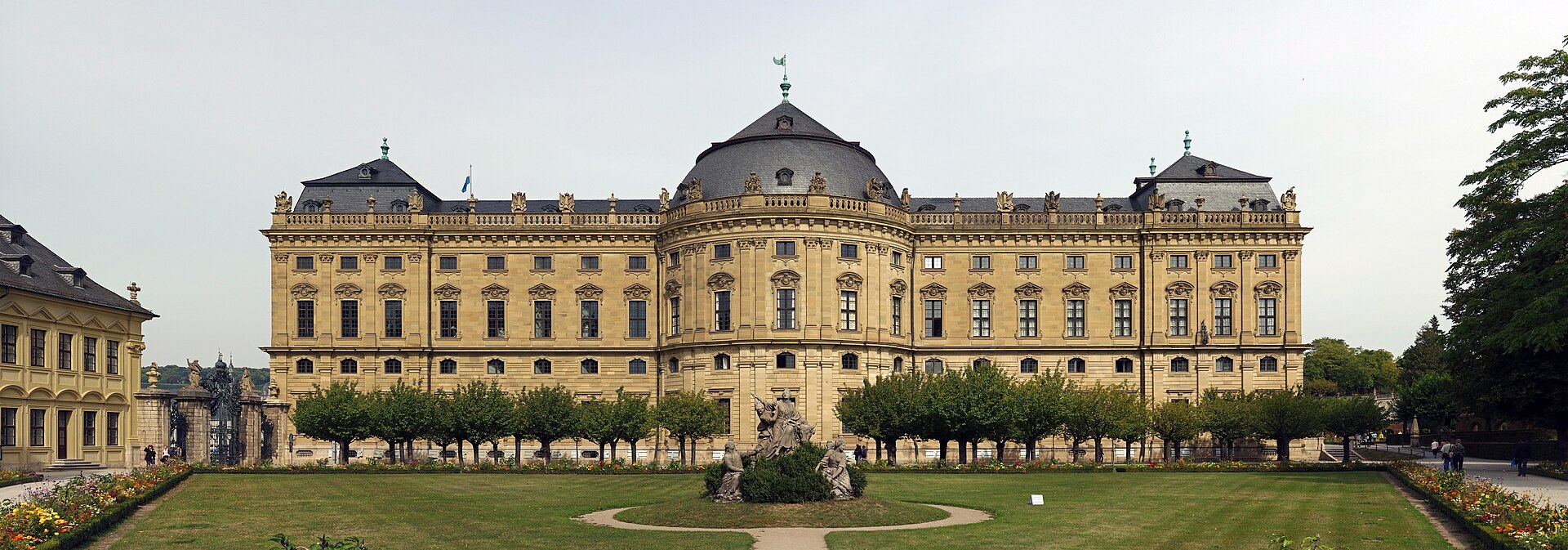
In the Franconian city of Würzburg, on the northern edge of Bavaria, stands a palace that many consider the single most perfect expression of the Baroque age in Germany. The Würzburg Residence was built not for a king or an emperor but for the prince-bishops who ruled the city, and yet it rivals and in some ways surpasses the grandest royal palaces of Europe. Behind its long, restrained facade lies an interior of such brilliance that Napoleon is said to have called it the finest parsonage in Europe.
The Residence is the joint masterpiece of some of the greatest talents of the eighteenth century. Its architecture is the crowning achievement of Balthasar Neumann, the supreme German Baroque builder, whose daring vaulted staircase is one of the wonders of European architecture. Its ceiling bears the largest fresco in the world, painted by the Venetian genius Giovanni Battista Tiepolo, and its state rooms glitter with stucco and gilding of unmatched refinement. Rarely have so many masters combined on a single building.
What makes the Residence all the more astonishing is that it very nearly ceased to exist. In the closing months of the Second World War, a devastating air raid gutted the palace and left much of it a burnt-out shell. That its greatest spaces survived at all is due partly to the extraordinary strength of Neumann’s vaults and partly to the efforts of those who fought to save it in the ruinous aftermath, and its restoration has been one of the triumphs of postwar conservation.
To walk through the Residence today is to experience the Baroque at the very height of its ambition, a total work of art in which architecture, painting, sculpture, and decoration fuse into a single overwhelming whole. From the moment you climb the great staircase and watch Tiepolo’s painted heavens open above you, you understand why this palace was recognized as a monument to all humanity. This is the story of how a line of prince-bishops built one of the most beautiful buildings on earth.
In This Article
- A Palace Fit for a King, Built for a Bishop
- The Schönborn Ambition
- Balthasar Neumann, Master of the Baroque
- The Greatest Staircase in Europe
- Tiepolo and the Largest Fresco in the World
- The White Hall: Stucco as Pure Poetry
- The Imperial Hall, Where History Meets Heaven
- The Court Church: A Jewel of Sacred Baroque
- State Rooms and the Vanished Mirror Cabinet
- The Court Garden Behind the Palace
- A Monument for All Humanity
- Destruction, Rescue, and Rebirth
- Visiting the Würzburg Residence Today
A Palace Fit for a King, Built for a Bishop
To modern eyes it can seem strange that one of the grandest palaces in Europe was built for a bishop, but in the Holy Roman Empire the prince-bishops of Würzburg were rulers in every worldly sense. They governed a substantial territory, commanded armies, levied taxes, and answered to no one but the emperor, combining spiritual authority with the full trappings of secular princely power. Their new Residence was designed to proclaim exactly that dual majesty.

The palace they built abandoned the old fortified hilltop castle above the city, the Marienberg, in favor of a modern town palace in the latest style, set within Würzburg itself. This move mirrored a wider European trend away from defensive castles toward open, magnificent palaces of display, and it announced that the prince-bishops had joined the ranks of Europe’s most fashionable and cultured rulers.
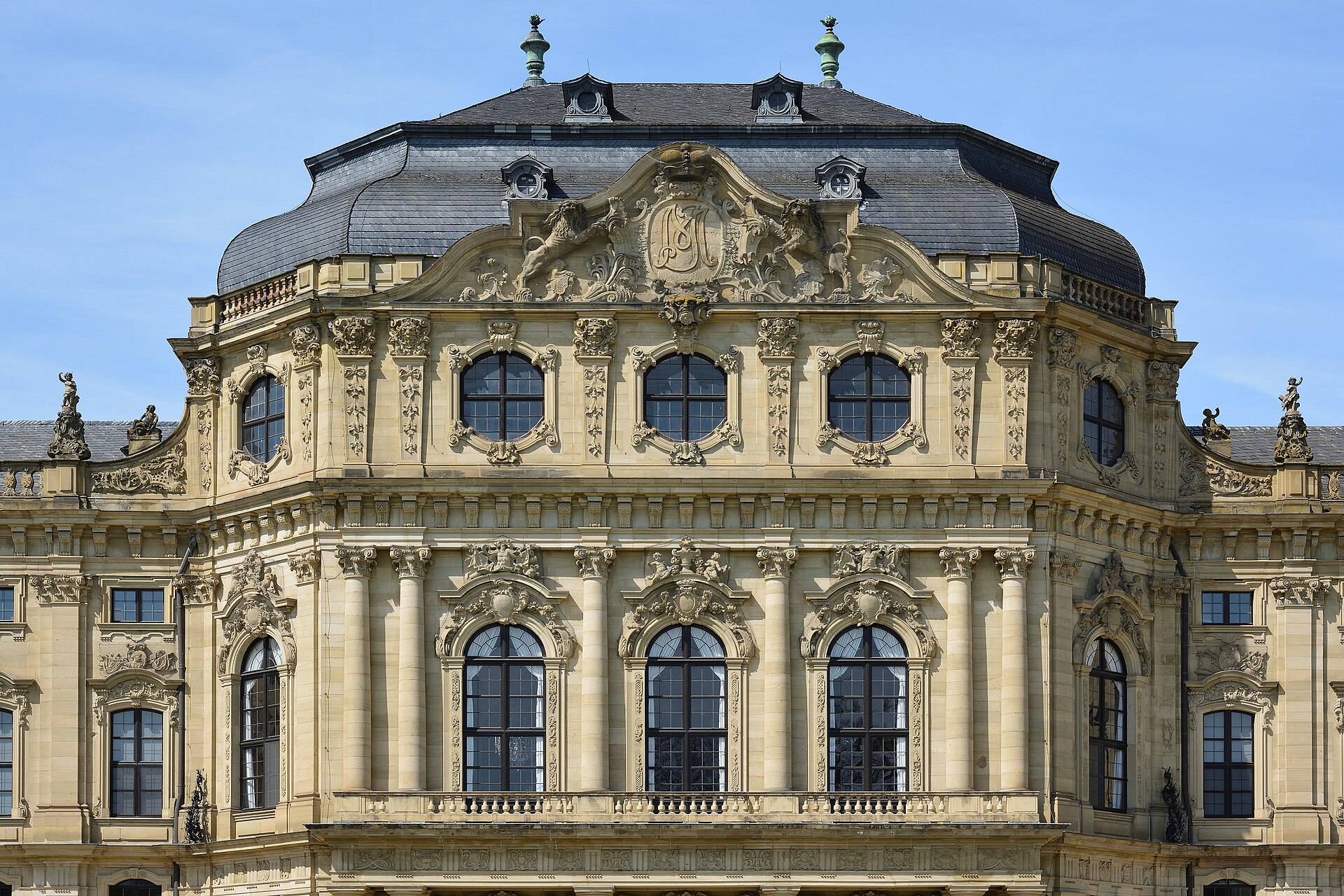
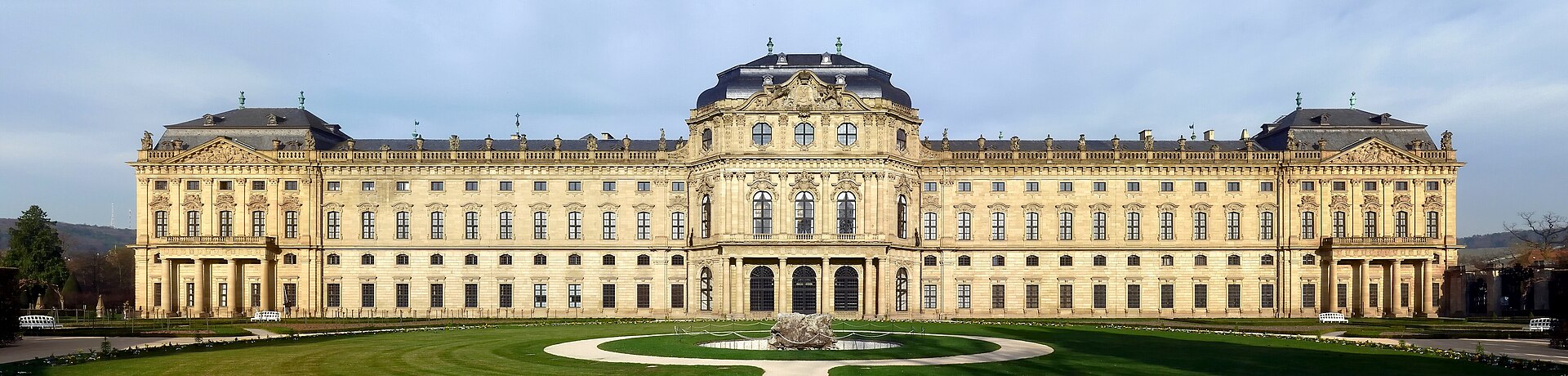
The Residence takes the form of a vast horseshoe, its long main range fronted by wings that embrace a great court of honor, with further courtyards to either side. The exterior, though enormous, is relatively restrained, its dignity residing in proportion and rhythm rather than ostentation. Nothing about the calm facade quite prepares the visitor for the explosion of artistry waiting within.
That contrast between exterior reticence and interior splendor is central to the experience of the Residence. It is a building that keeps its greatest treasures hidden until you cross the threshold, whereupon the full genius of the Baroque is unleashed. To understand how such a marvel came to be built in a provincial bishopric, we must turn to the ambitious dynasty of churchmen who commissioned it.
The whole complex is enormous, containing hundreds of rooms arranged around its courtyards, and in its day it functioned as a small city of government, worship, and courtly life. Yet for all its scale it was conceived as a single artistic idea, and it is this coherence, rare in so vast a building, that gives the Residence its special power and has earned it a place among the acknowledged wonders of European architecture.
The Schönborn Ambition
The driving force behind the Residence was the Schönborn family, a dynasty that supplied a remarkable number of prince-bishops and archbishops across the German lands and that possessed an almost insatiable passion for building. It was Prince-Bishop Johann Philipp Franz von Schönborn who, soon after his election, resolved to raise a palace worthy of his rank and set the great project in motion in 1720.

He was fortunate in his resources. A windfall of funds gave him the means to begin on a lavish scale, and he threw himself into the enterprise with characteristic Schönborn energy. Though he did not live to see much of it completed, the momentum he created carried the project forward, and his successors, above all his uncle Friedrich Karl von Schönborn, continued the work with equal devotion over the following decades.
The Schönborns were not passive patrons. They took an intense personal interest in every aspect of the design, corresponding about plans, summoning experts, and drawing on a family network of architectural knowledge that spanned the empire. This was a clan that regarded great building as both a duty and a delight, and the Residence became the supreme monument to their collective ambition.
Their vision extended beyond mere grandeur to a coherent artistic program celebrating the prince-bishopric itself, its history, and its place in the imperial order. Everything from the architecture to the frescoes was conceived to glorify the office and the dynasty, turning the palace into a vast statement of legitimacy and magnificence. To realize it, the Schönborns gathered an extraordinary team of artists, chief among them the architect who would make the building immortal.
The scale of the undertaking is easier to grasp when one remembers that it consumed the resources of the prince-bishopric for decades and drew craftsmen and artists from across Europe to Würzburg. Whole workshops of stuccatores, painters, gilders, cabinetmakers, and sculptors labored on the building over two generations, turning the city into a center of artistic activity and leaving behind a concentration of talent whose like was rarely seen.
Balthasar Neumann, Master of the Baroque
The genius who gave the Residence its architectural form was Balthasar Neumann, widely regarded as the greatest German architect of the Baroque. Trained originally as a military engineer and a maker of cannon, Neumann brought to architecture a profound understanding of structure and a boldness in vaulting that allowed him to attempt things others dared not. The Residence became the central work of his career and the fullest expression of his powers.
Neumann did not work in isolation. The Schönborns, wishing to draw on the best expertise in Europe, arranged for him to consult with leading architects in Vienna and Paris, including the celebrated designers of the French royal buildings. Neumann traveled, absorbed their ideas, and then synthesized them, balancing French planning, Viennese grandeur, and his own structural daring into a design that was greater than the sum of its influences.
His mastery is most evident in the way he handled space and structure. Neumann conceived interiors of soaring ambition and then engineered them to stand, above all in the great staircase, where he roofed an enormous hall with a single unsupported vault. His contemporaries doubted it could hold; Neumann was so confident that he reportedly offered to fire artillery beneath it to prove its strength. Time, and even the bombs of the twentieth century, would vindicate his confidence.
For Neumann the Residence was a labor of decades, and he poured into it a lifetime of accumulated skill. He designed not only the building’s structure but the disposition of its great rooms and the framework within which the painters and stuccoists would work. The result is an architecture of breathtaking coherence, in which every space flows into the next toward a series of climaxes. It stands as the enduring monument to the finest architectural mind of its age.
Neumann’s reputation rests not on the Residence alone but on a series of masterpieces across southern Germany, including celebrated pilgrimage churches whose flowing, light-filled interiors redefined what architecture could achieve. Yet even among these triumphs the Residence stands apart as his most complete statement, the place where his structural courage and his sense of spatial drama found their grandest scope. His portrait would later appear on German currency, a fitting tribute to a national genius.
The Greatest Staircase in Europe
The heart of the Residence, and the space that has awed visitors for more than two and a half centuries, is the grand staircase. Neumann conceived it as a piece of theater in stone: a single flight rises from the entrance hall, then divides and returns in two arms to the main floor, so that anyone ascending is drawn upward through a great open volume of light and air toward the painted vault above. It is architecture as choreography, a processional route designed to overwhelm.
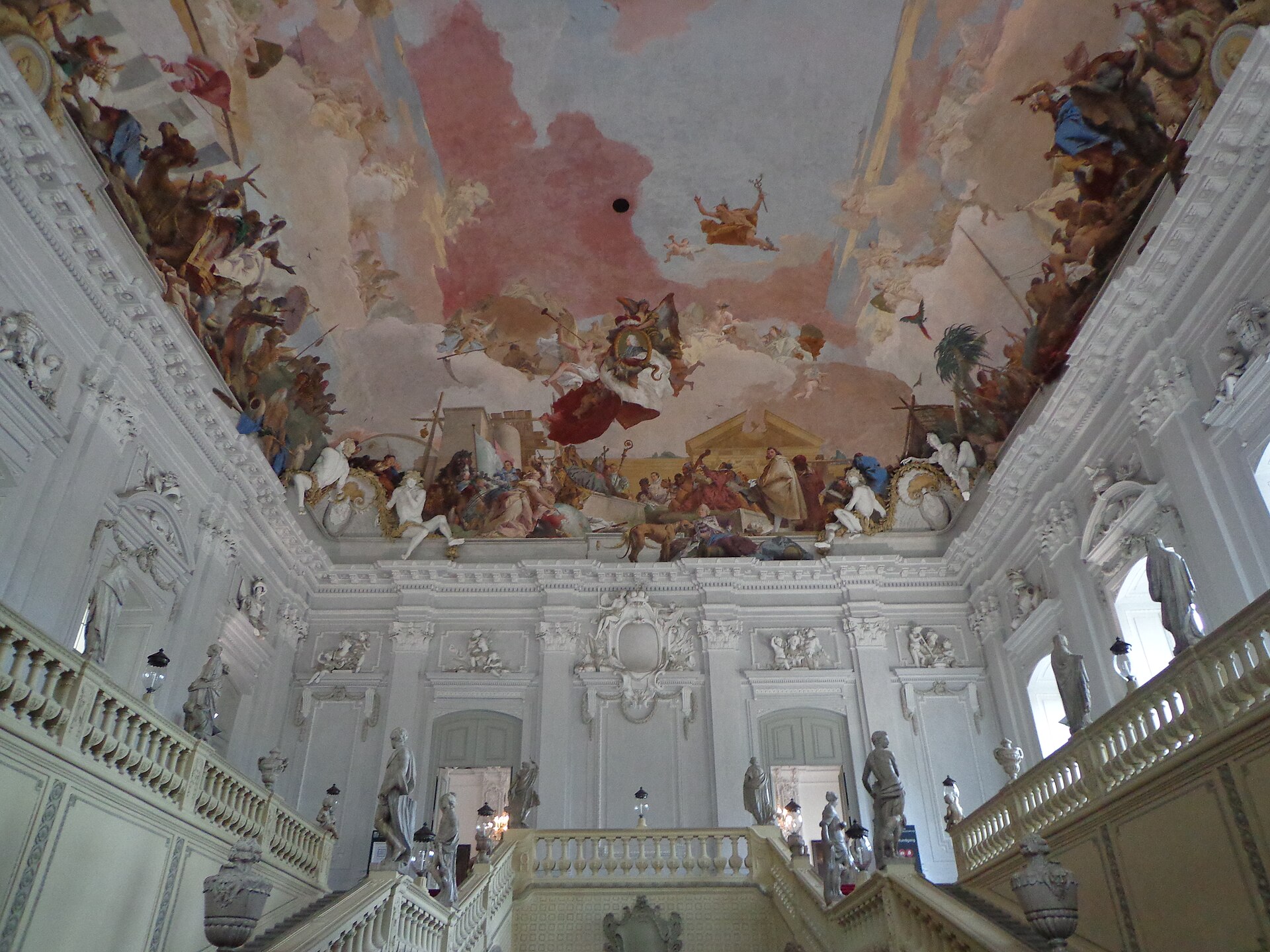
The engineering feat is as remarkable as the drama. Neumann covered this vast hall with a single great vault, unsupported by any central column, spanning the entire space in one sweep. It was an audacious solution that his critics believed impossible, and the confidence with which he built it speaks of a structural genius far ahead of his time. The vault became the essential precondition for what would crown it: the largest fresco ever painted.
As you climb, the experience unfolds in stages. From the lower flight the ceiling is only partly visible; as you turn and ascend the returning arms, the painted heavens gradually reveal themselves in their full extent, until at the top you stand beneath a boundless sky teeming with figures. Neumann designed the movement of the visitor and the unveiling of the fresco as a single unified experience, an idea of extraordinary sophistication.
No description quite captures the effect of standing in this space for the first time. The sense of light, height, and grandeur, the slow revelation of the painting overhead, and the sheer confidence of the whole conception combine into something that visitors have struggled to describe since the eighteenth century. It is, by common consent, one of the supreme interior spaces of European architecture, and the beating heart of the Residence.
Tiepolo and the Largest Fresco in the World
To crown his staircase, the prince-bishop summoned the greatest decorative painter alive: Giovanni Battista Tiepolo, the Venetian master whose luminous frescoes were sought by patrons across Europe. Tiepolo came to Würzburg in the early 1750s, bringing his son to assist him, and over the vault of the staircase he created what remains the largest fresco in the world, an immense painted heaven covering the entire ceiling.

The subject is a glorification of the prince-bishop and his realm through the allegory of the four continents. Around the edges of the vast composition, the four known parts of the world, Europe, Asia, Africa, and America, are personified in richly imagined scenes full of exotic peoples, animals, and marvels, while above them the god Apollo ascends through a radiant sky. At the center of the European section, Tiepolo placed a portrait of his patron, borne aloft amid the splendors of art and culture.
The painting is a tour de force of illusion and imagination. Tiepolo’s mastery of light, color, and airy space makes the solid ceiling seem to dissolve into infinite sky, and his teeming cast of figures rewards endless looking. Details of costume, fauna, and fantasy abound, a whole world compressed into a single overwhelming vision, executed with a lightness of touch that belies its colossal scale.
That Tiepolo painted it directly onto fresh plaster, working at speed and without possibility of major correction, only deepens the wonder. The fresco is inseparable from Neumann’s architecture, the two conceived as a single unity of structure and image, and together they form the greatest collaboration of architect and painter in the history of the Baroque. It is the reason many travelers come to Würzburg at all.
The commission drew Tiepolo away from Venice at the height of his fame, a measure of the prestige and wealth the prince-bishops commanded. He and his workshop completed the enormous ceiling in a remarkably short span, a feat of stamina as much as artistry, given that fresco demands the painter keep pace with the drying plaster. The Würzburg frescoes are widely counted among the greatest works he ever produced, the summit of an already extraordinary career.
The White Hall: Stucco as Pure Poetry
Between the grand staircase and the Imperial Hall lies a room that provides one of the most brilliant transitions in all of architecture: the White Hall. After the overwhelming color of Tiepolo’s fresco, the visitor passes into a space almost entirely white and grey, its walls and ceiling covered in an astonishing filigree of stucco ornament. The effect is like a sudden intake of breath, a palate-cleansing moment of cool restraint between two explosions of color.

The stucco work is the masterpiece of Antonio Bossi, a stuccatore of exceptional gifts who covered the room in a delicate, endlessly inventive tracery of Rococo ornament. Military trophies, foliage, figures, and abstract flourishes flow across every surface in shades of white and pale grey, catching the light and creating an impression of extraordinary refinement. It is decoration reduced to its purest and most virtuosic form.
The choice of near-monochrome was deliberate and inspired. By draining the room of color, the designers threw all emphasis onto the play of light and shadow across the sculpted surfaces, allowing the sheer artistry of the modeling to shine. The White Hall demonstrates that the Rococo could achieve sublime effects through restraint as well as through gilded exuberance.
Positioned as it is between the staircase and the Imperial Hall, the White Hall also plays a crucial role in the choreography of the visit. It prepares the eye for the renewed splendor to come, heightening by contrast the impact of the gilded and frescoed rooms on either side. It is a perfect illustration of how the Residence was conceived not as a series of separate rooms but as a single unfolding experience of carefully calculated effects.
The Imperial Hall, Where History Meets Heaven
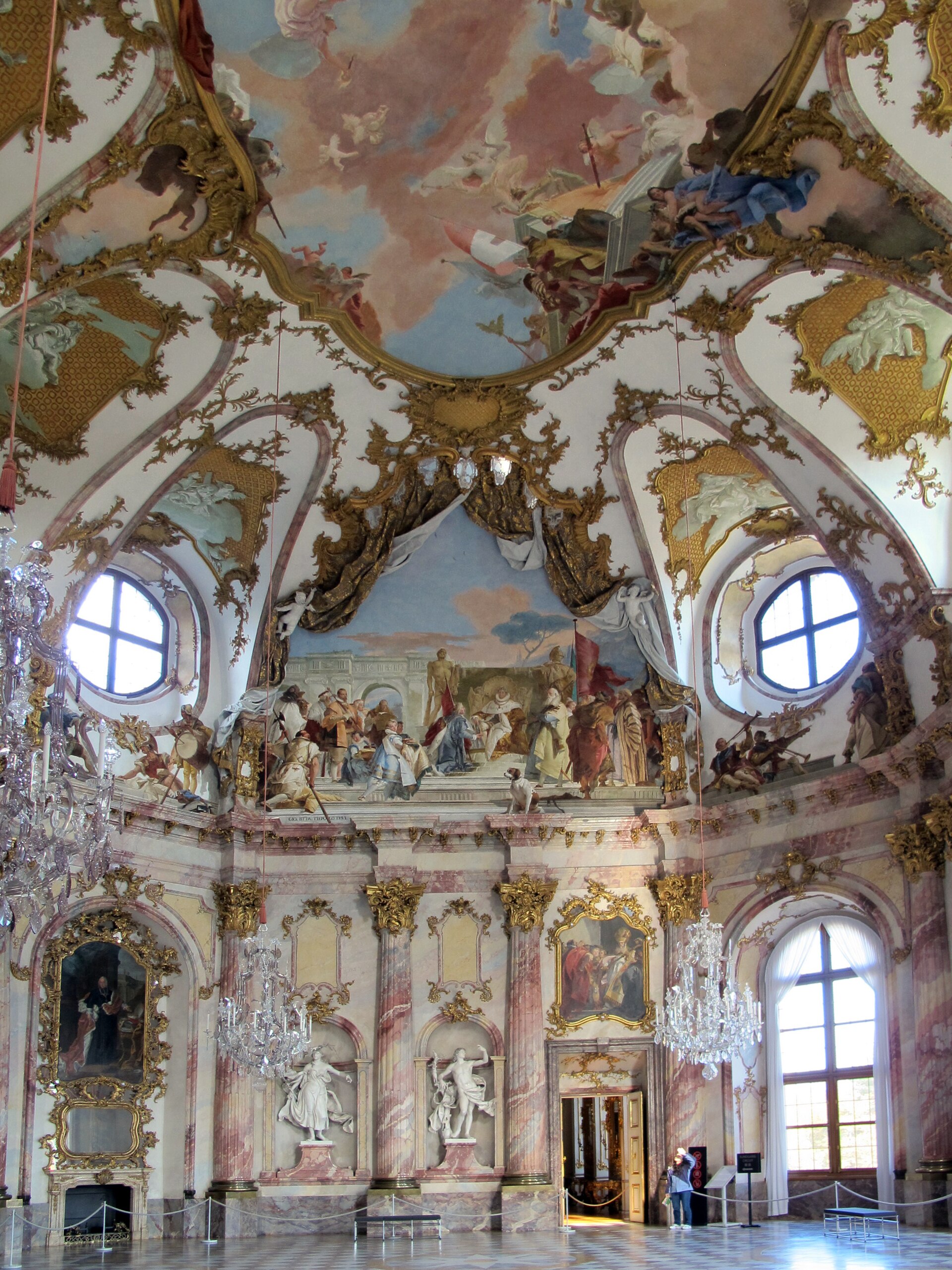
Beyond the White Hall lies the ceremonial climax of the Residence: the Imperial Hall, or Kaisersaal. This grand oval room, rich with marble, gilding, and colored stucco, was the setting for the most solemn occasions of the prince-bishopric, and it represents the fusion of all the arts at their highest pitch. Once again the ceiling and upper walls were entrusted to Tiepolo, who filled them with frescoes of dazzling brilliance.

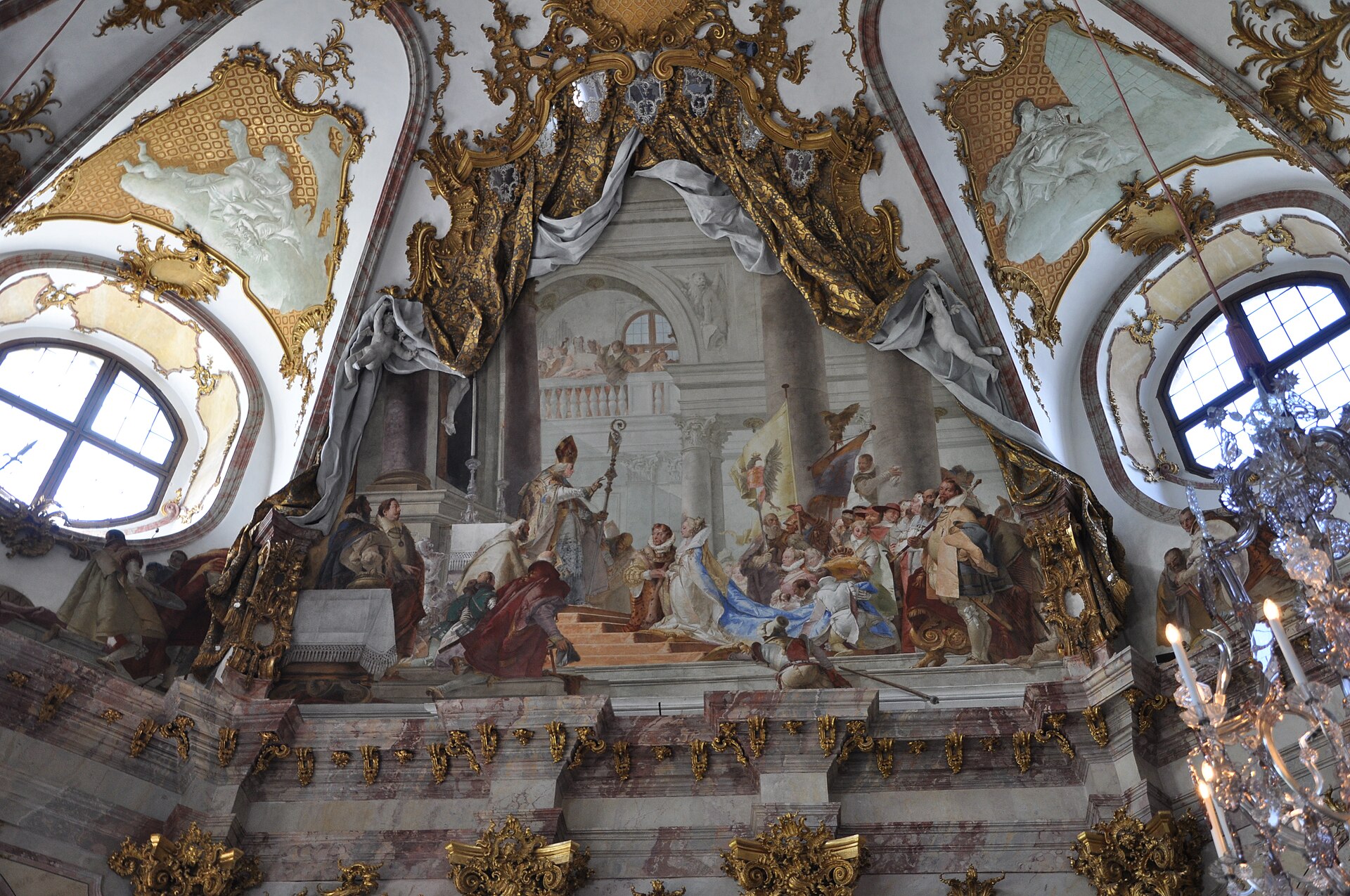
The paintings celebrate the historic ties between the prince-bishops of Würzburg and the Holy Roman Empire. In luminous scenes, Tiepolo depicted episodes such as the marriage of the Emperor Frederick Barbarossa, celebrated at Würzburg in the twelfth century, and the granting of the duchy to the bishop, moments that anchored the prince-bishopric’s claims to sovereignty in the deep past. History and allegory intertwine beneath a painted sky.
What distinguishes the Imperial Hall is the seamless integration of architecture, sculpture, and painting. Tiepolo’s frescoes spill from the ceiling onto the walls, where painted figures seem to step into the real space of the room, blurring the boundary between illusion and reality. Gilded stucco frames and enriches the compositions, and the whole ensemble glows with color and light. It is the Baroque dream of a total work of art fully realized.
Standing in the Imperial Hall, one grasps the full ambition of the Residence. Every element, the marble columns, the sculpted ornament, the historical frescoes, works together to glorify the office of the prince-bishop and its place in the imperial order. It is a room designed to persuade as much as to delight, and it remains one of the most magnificent interiors of the eighteenth century anywhere in Europe.
The room’s oval form, ringed with columns of reddish stucco marble, gives it a sense of gathered grandeur, drawing every eye upward and around toward the painted scenes. It was here that the most important guests were received and the most solemn ceremonies enacted, the architecture and painting together lending an air of timeless legitimacy to the prince-bishop’s authority. Few rooms so completely fuse political purpose with artistic splendor.
The Court Church: A Jewel of Sacred Baroque
Tucked into one corner of the Residence, and easy to overlook amid the secular splendor, is the Court Church, or Hofkirche, one of the finest Baroque church interiors in Germany. Here Neumann faced a difficult challenge: to fit a richly conceived church into a confined and awkward space within the palace block. His solution, a sophisticated arrangement of intersecting ovals and curving vaults, turned the constraint into a triumph.
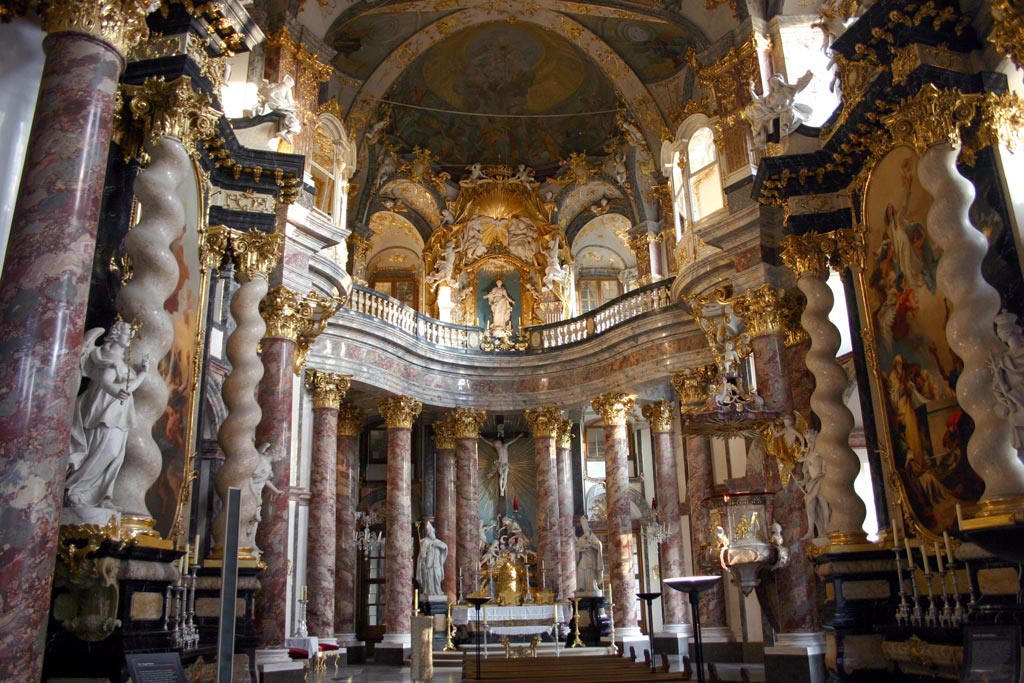
The interior is a riot of color and light. Marble columns of deep hues, lavish gilding, and swirling stucco create an atmosphere of intense devotional richness, while cleverly placed windows fill the space with a golden glow. Neumann’s manipulation of the vaults gives the small church a sense of soaring, complex space far greater than its actual dimensions, a hallmark of his genius for sacred architecture.
The decoration draws once again on the finest talent. Tiepolo himself contributed altarpieces to the church, and the sculptural and painted ornament throughout is of the highest quality. The Court Church shows that the same artistic ambition lavished on the state rooms was applied with equal intensity to the palace’s sacred heart, as befitted the residence of a prince who was also a bishop.
For many visitors the Hofkirche is a revelation, a compact masterpiece that distills the whole spirit of the Residence into a single glowing space. It reminds us that the prince-bishops were, after all, churchmen, and that the glorification of their rule was inseparable from the glorification of their faith. In this jewel-like church, the sacred and the magnificent become one.
State Rooms and the Vanished Mirror Cabinet
Beyond the great ceremonial spaces, the Residence contains a long sequence of state apartments, richly decorated rooms through which visitors of appropriate rank would be led toward the presence of the prince-bishop. These apartments, hung with tapestries and paintings and fitted with fine furniture, mirrors, and clocks, display the full luxury of an eighteenth-century court and the international reach of its taste.
Each room was designed to a distinct character, with color schemes, textiles, and ornament carefully coordinated. Together they form an enfilade of mounting splendor, a processional route in which the visitor’s growing sense of the prince-bishop’s magnificence was itself part of the message. The craftsmanship throughout, from the parquet floors to the carved and gilded paneling, is of the highest order.
The most celebrated of these rooms was the Mirror Cabinet, a small chamber whose walls were covered in painted glass and mirrors in a dazzling display of Rococo fantasy. It was widely regarded as one of the most beautiful rooms of its kind in Europe, a space of glittering, jewel-box intensity. Tragically, it was among the interiors utterly destroyed in the war, its unique decoration reduced to ashes.
Its recreation is one of the marvels of the Residence’s restoration. Working from old photographs and surviving fragments, craftsmen painstakingly recreated the lost Mirror Cabinet over many years, reviving techniques that had nearly been forgotten. That the room can once again be admired is a testament to the extraordinary dedication that has gone into bringing the whole palace back from the brink of oblivion.
The Court Garden Behind the Palace
No Baroque residence would be complete without its gardens, and the Würzburg Residence is embraced on two sides by the Court Garden, or Hofgarten, a delightful example of the late Baroque and Rococo garden art. Laid out in the second half of the eighteenth century, partly upon the old town fortifications, the garden makes ingenious use of the sloping, irregular terrain that the ramparts left behind.
The designers turned the constraints of the site to advantage, creating terraces, ramps, and stairways that rise against the old bastions, adorned with clipped hedges, ornamental parterres, fruit trees, and a wealth of Rococo statuary. Cherubs and mythological figures peer out from among the greenery, and the whole garden has an intimate, playful character that complements the grandeur of the palace behind it.
Different areas of the garden offer different moods, from the formal beds near the palace to the more relaxed orchard-like plantings beyond. The interplay of geometry and greenery, of sculpture and sky, makes the Hofgarten a place of endless small pleasures, and it provides the ideal setting from which to admire the garden facade of the Residence rising above the trees.
Free to enter and much loved by the people of Würzburg, the Court Garden remains an integral part of the experience of the Residence. It extends the artistry of the palace out into the open air, wrapping the great building in a landscape as carefully composed as any of its interiors. To stroll here on a summer evening is to feel the full harmony of architecture and nature that the Baroque aspired to achieve.
The garden also served as a stage for the social life of the court, a place for promenades, receptions, and quiet retreat alike. Its careful blend of the formal and the intimate reflects the same sensibility that shaped the palace interiors, where grandeur and delight were always held in balance. Restored along with the palace, it remains one of the most charming Baroque gardens in Germany.
A Monument for All Humanity
The supreme quality of the Würzburg Residence has long been recognized. In 1981 it was inscribed on the UNESCO World Heritage List, honored as one of the most homogeneous and extraordinary of Baroque palaces, a synthesis of the European Baroque brought to a single, unrepeatable perfection. The citation praised the unique way in which the building unites the talents of architects, painters, and decorators from across the continent into a coherent whole.
That international character is central to the Residence’s importance. Here the structural daring of a German architect, the painterly genius of a Venetian, the stucco artistry of an Italian, and the planning traditions of France came together under the patronage of German prince-bishops. The palace is, in a sense, a summation of the whole European Baroque, drawing its many national threads into one dazzling fabric.
It is also a supreme example of the Baroque ideal of the total work of art, in which no single element can be separated from the others. Neumann’s spaces were designed for Tiepolo’s frescoes; Tiepolo’s frescoes complete Neumann’s spaces; Bossi’s stucco mediates between them. The Residence is not a collection of masterpieces but a single, unified masterpiece, and that unity is precisely what makes it so rare.
For these reasons the palace occupies a special place in the story of European art. It represents a moment when the ambitions of the Baroque reached their fullest realization, before the age of revolutions swept such courtly grandeur away. To stand within it is to encounter that vanished world at its most confident and most beautiful, preserved and honored as a treasure belonging not just to Würzburg but to all humanity.
Destruction, Rescue, and Rebirth
The story of the Residence has a dark and dramatic chapter. On the night of the sixteenth of March 1945, in the final weeks of the Second World War, a devastating air raid struck Würzburg, and within a matter of minutes much of the historic city, and the Residence with it, was engulfed in flames. The roof of the palace burned and collapsed, and many of its interiors were destroyed, leaving the great building a gutted and smoking ruin.

And yet the most important spaces survived. Neumann’s mighty vaults over the staircase, the White Hall, and the Imperial Hall held firm even as fire raged around them, protecting Tiepolo’s frescoes above. The architect’s structural genius, proven two centuries earlier, had now saved his masterpiece from destruction. But with the roof gone, the frescoes and the surviving fabric were terribly exposed to the weather, and the palace’s fate hung in the balance.
Into this crisis stepped a number of individuals whose efforts proved decisive, among them an American art protection officer who arranged for a temporary roof to be thrown over the vulnerable structure in the chaotic months after the war. This emergency shelter kept the rain off the frescoes and bought the time needed for proper restoration to begin. It was a small act with enormous consequences, and it helped save one of the world’s great buildings.
The full restoration stretched across decades, a painstaking labor of rebuilding vaults, recreating lost rooms, and conserving what had survived. Room by room, the Residence was brought back to life, its ruined interiors recreated with meticulous care. That the palace stands today in something close to its original glory is one of the great achievements of postwar cultural recovery, a story of destruction answered by extraordinary devotion.
The loss of old Würzburg that night was one of the great cultural tragedies of the war in Germany, and the survival of the Residence’s core became, in the years that followed, a powerful symbol of endurance and hope. Rebuilding it was not merely a technical task but an act of faith in the value of beauty itself, undertaken by a society emerging from catastrophe and determined to reclaim what it had nearly lost forever.
Visiting the Würzburg Residence Today
Today the Würzburg Residence is one of the most rewarding destinations in southern Germany, cared for by the Bavarian Palace Administration and open to visitors throughout the year. The grand staircase beneath Tiepolo’s fresco, the White Hall, the Imperial Hall, the Court Church, and the recreated state apartments including the Mirror Cabinet can all be seen, offering an unforgettable immersion in the Baroque at its height.

View the exact location on Google Maps
A visit rewards a little time and attention. The great set-piece rooms are the obvious highlights, but the smaller apartments, the Court Church, and the changing collections repay unhurried looking, and the Court Garden should not be missed, especially in the warmer months. Guided tours help visitors appreciate the artistry and history of the interiors, and the sheer scale of Tiepolo’s achievement becomes clearer the longer one lingers beneath it.
The Residence sits in the center of Würzburg, a handsome city on the river Main at the heart of the Franconian wine country, easily reached by rail and well worth combining with the surrounding region. The palace’s central position makes it the natural focus of any visit to the city, and its calm forecourt gives little hint of the wonders waiting within.
Nearly three centuries after the Schönborn prince-bishops set out to build a palace worthy of their ambition, the Residence still astonishes everyone who enters it. Conceived by a line of churchmen, realized by a company of geniuses, ravaged by war, and lovingly restored, it stands as one of the supreme achievements of European art. To visit it is to witness the Baroque dream of total beauty made real, and to understand why the world has chosen to treasure it.
Palaces Nearby
If the Baroque splendor of the Residence has captivated you, these fellow masterpieces of German palace-building are well worth seeking out:
You May Like
Nymphenburg: The Summer Palace Bavaria Built to Celebrate a Birth