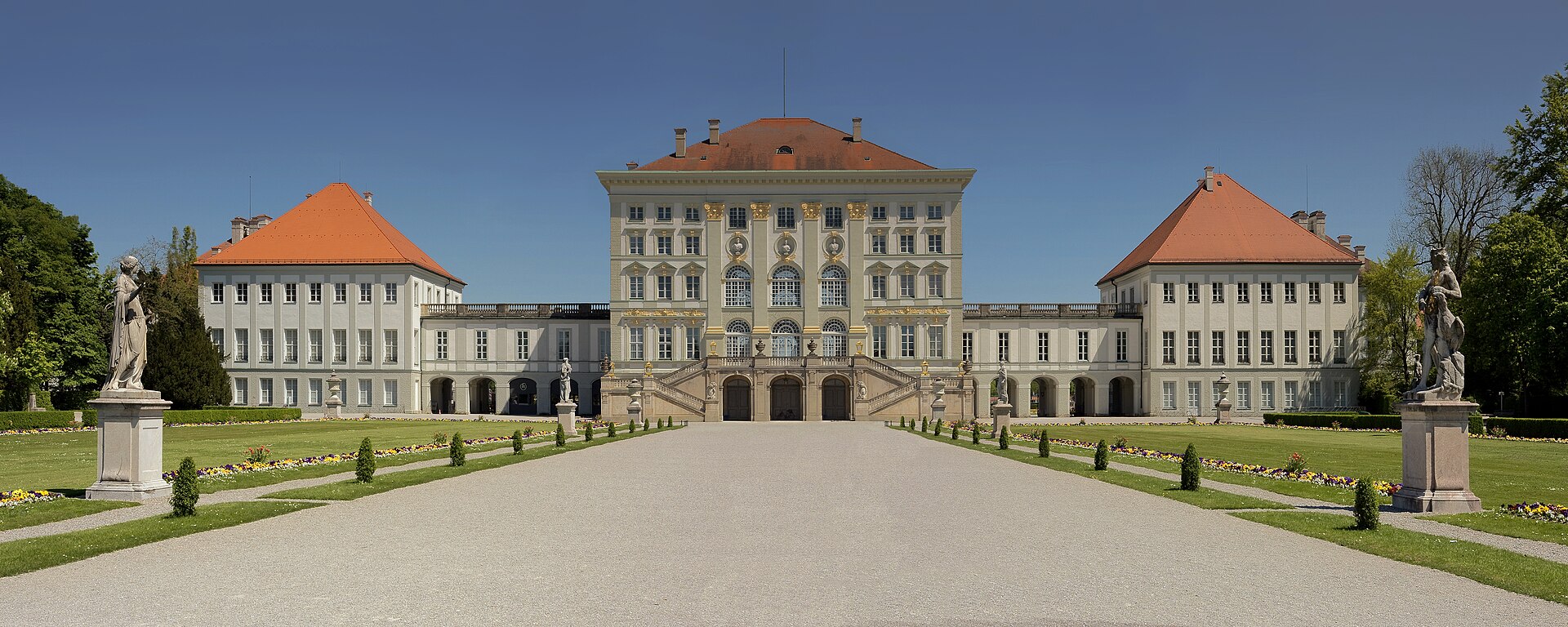
On the western edge of Munich, a palace stretches its pale wings so far across the landscape that you cannot take it in with a single glance. Nymphenburg, the “Nymph’s Castle,” was the summer residence of the Wittelsbach rulers of Bavaria, and it grew over more than a century from a modest Italian villa into one of the broadest palace facades in Europe, its central pavilion flanked by galleries and lesser pavilions that march outward on either side above a long formal canal.
The palace was born, fittingly, out of joy. It was begun in the 1660s to celebrate the birth of a long-awaited heir, a gift from a grateful ruler to his Italian wife, and that association with new life and pleasure never left it. Successive electors and kings added to it, each generation reaching for a little more grandeur, until the summer villa had become a vast complex of state rooms, galleries, garden pavilions, and one of the great landscape parks of Germany.
Inside, Nymphenburg is a treasury of the Bavarian court’s tastes and obsessions. Its soaring central hall is a masterpiece of the Rococo, painted with frescoes that dissolve the ceiling into open sky. Its walls hold a famous gallery of beautiful women, gathered by an art-loving king. In one quiet room a future fairy-tale king was born. And out in the park, hidden among the trees, stand jewel-like pavilions that count among the most exquisite small buildings of the eighteenth century.
To wander Nymphenburg is to trace the whole arc of the Bavarian monarchy, from Baroque triumph through Rococo delight to the romantic twilight of its last dreamer kings. It is a palace of celebration and spectacle, of hunting parties and masked balls and gilded carriages, and yet it wears its grandeur with a certain Bavarian ease. This is the story of how a birth gift became the summer heart of a kingdom.
In This Article
- A Palace as Wide as a Small Town
- A Gift to Celebrate a Long-Awaited Heir
- Max Emanuel and the Great Expansion
- The Stone Hall at the Heart of the Palace
- Cuvilliés, Zimmermann, and the Genius of the Bavarian Rococo
- The Gallery of Beauties
- Lola Montez and the King Who Lost His Throne
- The Birthplace of a Fairy-Tale King
- The Park: From Formal Baroque to English Landscape
- The Amalienburg: A Jewel of European Rococo
- Bathhouses, Pagodas, and a Hermitage in the Woods
- Golden Carriages and the Magic of Nymphenburg Porcelain
- Nymphenburg Today: Munich’s Summer Palace
A Palace as Wide as a Small Town
The first thing that strikes you about Nymphenburg is its sheer breadth. Where most palaces rise upward, Nymphenburg spreads sideways, its central block extended by arcaded galleries to flanking pavilions, which are in turn joined to further wings, so that the whole facade unfolds across an enormous span facing a broad formal canal. Approaching along the water, you feel less as though you are nearing a single building than an entire architectural landscape.
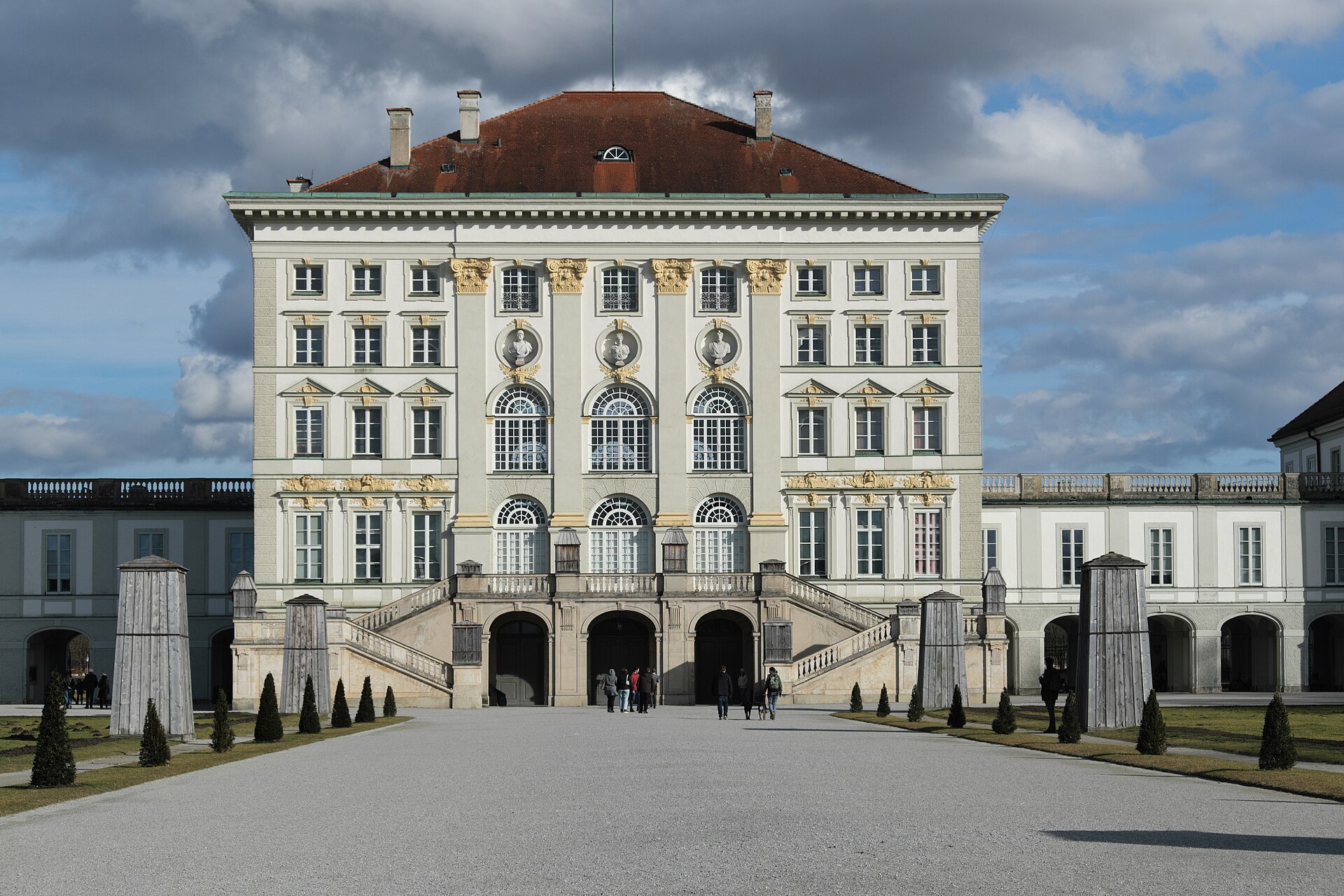
That horizontal grandeur is the product of accumulation rather than a single grand plan. The palace began small and grew outward in stages over more than a hundred years, as one ruler after another added a wing, a gallery, or a pavilion. The result has an unusual rhythm, a long procession of blocks and connecting galleries that gives Nymphenburg its distinctive, almost townlike scale, complete with service courts, stables, and a church folded into the ensemble.
For all its size, the palace never feels forbidding. The warm tones of its plastered facades, the greenery of the surrounding park, and the presence of the canal and its swans lend the whole place a lightness that suits its origin as a summer retreat. This was never a fortress or a seat of grim state business but a house of leisure, and the architecture wears that purpose openly.
Set within the district that now bears its name in western Munich, Nymphenburg today sits within the city rather than beyond it, yet it preserves the atmosphere of a country residence. The vast park behind it, the pavilions scattered among the trees, and the long central hall at its heart all speak of a court that came here to escape, to hunt, to celebrate, and to play. Understanding that spirit of pleasure is the key to understanding everything that follows.
A Gift to Celebrate a Long-Awaited Heir
The story of Nymphenburg begins with a birth that changed the fortunes of a dynasty. The Elector Ferdinand Maria of Bavaria and his Italian wife, Henriette Adelaide of Savoy, had waited anxiously for a male heir, and when their son, the future Elector Max Emanuel, was born in 1662, the relief and joy at court were immense. In gratitude, the elector presented his wife with an estate west of Munich on which to build a summer residence of her own.

Henriette Adelaide, who had grown up amid the sophisticated culture of Turin, brought Italian taste to the project. The palace begun in the 1660s took the form of a tall, cubic Italian villa, designed by the architect Agostino Barelli, who also worked on Munich’s great Theatine Church. This central pavilion, refined and elegant, is the seed from which the whole enormous complex would later grow, and its Italian character still shows through the later additions.
The choice of an Italian Baroque villa was itself a statement. It announced that the Bavarian court, like the great courts of Italy and France, aspired to culture and magnificence, and it reflected the electress’s own background and connections. The palace was named for the nymphs, mythological spirits of nature and water, a fittingly playful and pastoral choice for a summer house set among gardens and streams.
For its first decades Nymphenburg remained essentially this single elegant villa, a private retreat for the electoral family. But the son whose birth it celebrated would grow up to become one of the most ambitious builders in Bavarian history, and it was under his direction that the modest villa began its transformation into the sprawling palace we know. The birth gift, in other words, contained the seed of its own vast expansion.
Max Emanuel and the Great Expansion
When Max Emanuel came to power, he set about turning his birthplace into a residence worthy of his soaring ambitions. A restless and cosmopolitan ruler who spent years in exile and admired the splendor of the French court at Versailles, he wanted Nymphenburg to reflect the grandeur he had seen abroad. Over the early decades of the eighteenth century, the compact Italian villa was progressively engulfed by new construction.

Architects including Enrico Zuccalli and, above all, Joseph Effner directed the work. Pavilions were added to either side of the original villa and linked to it by galleries, extending the facade dramatically outward. Effner refined the exterior into a more unified whole and gave the palace much of its present appearance, blending Italian, French, and German influences into a distinctive Bavarian Baroque. The broad canal in front of the palace was developed as a grand approach, mirroring the architecture in its still water.
The expansion did not stop at the palace itself. A whole planned settlement, a Rondell of buildings arranged in a semicircle, was laid out before the palace to house court officials and services, giving Nymphenburg the character of a small princely town. Stables, workshops, and dwellings clustered around the approach, all subordinate to the great facade rising beyond the canal.
By the time Max Emanuel’s building campaigns wound down, Nymphenburg had been transformed almost beyond recognition. What had begun as a single villa was now a vast horizontal palace with wings stretching in both directions, set within an ambitious formal landscape. The elector had given Bavaria a summer residence that could stand comparison with the great palaces of Europe, and later generations would embellish rather than fundamentally alter his grand conception.
It is worth pausing on the ambition behind all this. Max Emanuel dreamed of a grand European role for Bavaria and even of a royal crown, and his building projects at Nymphenburg and elsewhere were part of a deliberate campaign to project the magnificence of his court. Though his political gambles often ended in costly failure and exile, the palace remains as the enduring monument to his vision, a place where his outsized aspirations were translated into stone, water, and gilded stucco.
The Stone Hall at the Heart of the Palace
At the center of Nymphenburg, occupying the full height of the original villa, lies its most magnificent interior: the Steinerner Saal, or Stone Hall. This soaring three-story room is the ceremonial heart of the palace, a vast festive space rising through the central pavilion and opening on both sides to the canal in front and the park behind. It was here that the court gathered for its grandest receptions, concerts, and celebrations.

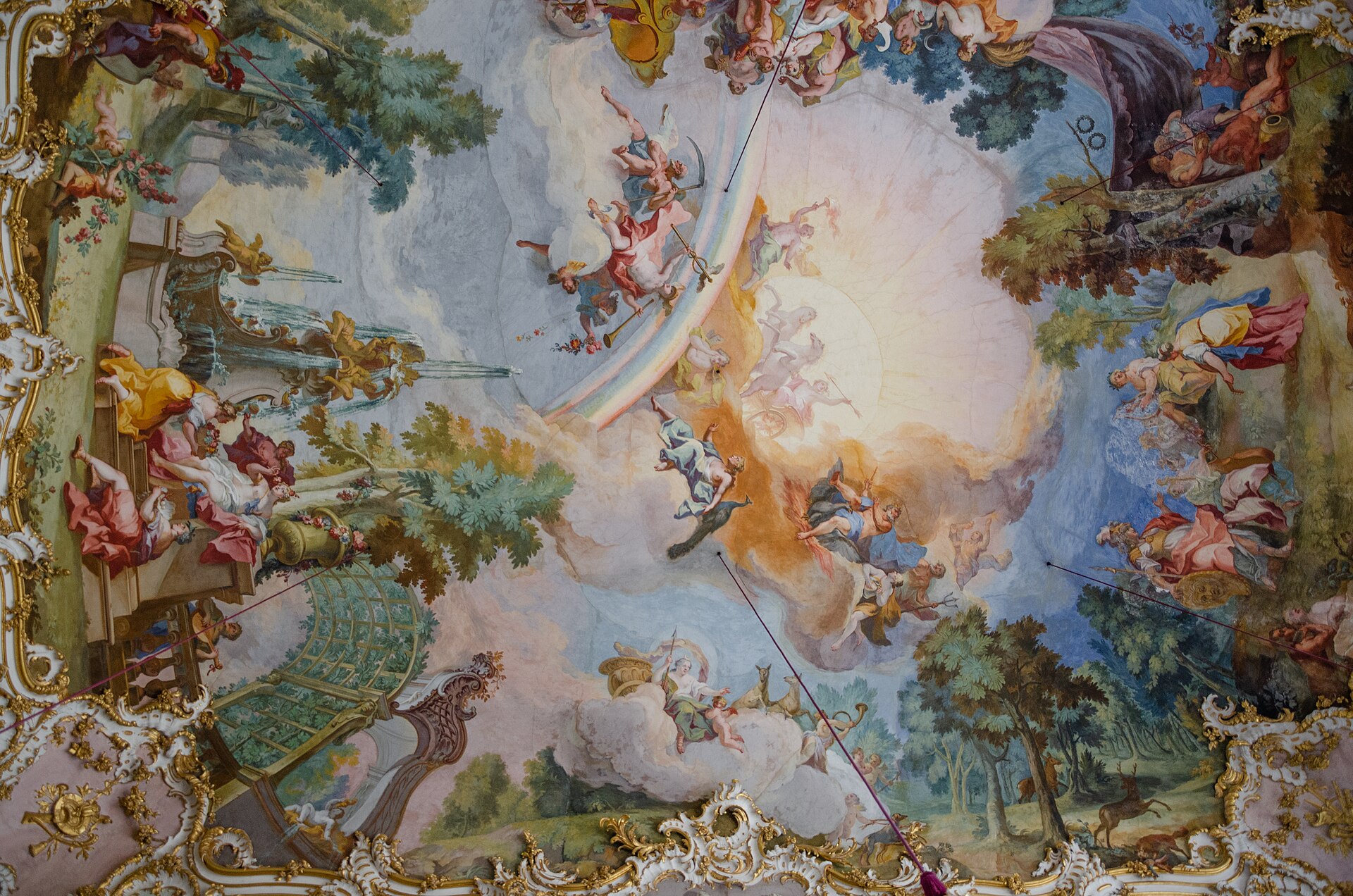
The hall takes its name from its stonelike decoration, but there is nothing cold about it. Its walls and ceiling are alive with the lightest, most exuberant Rococo ornament, gilded stucco flowing across every surface in a froth of shells, foliage, and figures. Tall windows flood the room with light from two sides, and the effect on a bright day, with the reflections of the canal playing across the white and gold interior, is dazzling.
The room was designed to impress and to delight in equal measure. As the setting for masked balls and musical evenings, it needed both grandeur and gaiety, and its decoration achieves precisely that balance. Standing in the center of the hall, with the park visible through one wall of windows and the canal through the other, you understand how the space was meant to dissolve the boundary between the palace and its gardens.
The Stone Hall is the culmination of everything the palace is about, the place where architecture, decoration, and landscape come together in a single overwhelming statement of courtly pleasure. It remains in use for concerts to this day, and to hear music fill the room beneath its painted sky is to experience Nymphenburg exactly as its builders intended. It is, without question, one of the great festival halls of southern Germany.
Concerts held here today continue a tradition that stretches back to the palace’s earliest days, when music was central to the life of the court. The acoustics of the great room, the play of light from its two facing walls of windows, and the sense of the park pressing in on either side combine to make any performance feel like an event. Few concert settings anywhere can rival the experience of hearing an orchestra beneath Zimmermann’s painted heaven.
Cuvilliés, Zimmermann, and the Genius of the Bavarian Rococo
The dazzling decoration of the Stone Hall was the work of two of the greatest talents of the German Rococo, and their names recur throughout Nymphenburg and its pavilions. The painter Johann Baptist Zimmermann covered the ceiling of the hall with a vast fresco in which the solid architecture seems to open onto a luminous heaven peopled by gods and nymphs, a virtuoso illusion that draws the eye endlessly upward.
The overall decorative scheme was shaped by François de Cuvilliés, a designer of extraordinary refinement who had risen from humble origins to become the leading exponent of the Rococo at the Bavarian court. Cuvilliés brought a lightness and inventiveness to ornament that few could match, and his hand can be felt in the delicate, playful character of the palace’s finest interiors. Together, painter and designer created a decorative world of astonishing sophistication.
What distinguishes the Bavarian Rococo, as practiced here, is its sheer joyfulness. Where French decoration could be cool and correct, the work at Nymphenburg bubbles with energy and wit, its scrolls and shells seeming almost to move. This was an art dedicated wholly to pleasure and celebration, perfectly suited to a summer palace built for festivity, and it reached heights that would rarely be equaled anywhere in Europe.
The collaboration of Cuvilliés and Zimmermann would find its most perfect expression not in the great hall but in a small building hidden in the park, to which we will come. But it is in the Stone Hall that most visitors first encounter their genius, and it sets the tone for everything else. The Rococo at Nymphenburg is not mere decoration; it is the very spirit of the place made visible in gold and color.
The Gallery of Beauties
Among the palace’s most famous and most curious attractions is the Gallery of Beauties, a room hung with dozens of portraits of beautiful women, all gazing out at the visitor from gilded frames. The gallery was the creation of King Ludwig I of Bavaria, an ardent lover of art and of beauty in all its forms, who over some two decades in the nineteenth century commissioned portraits of the women he considered the most beautiful of his day.
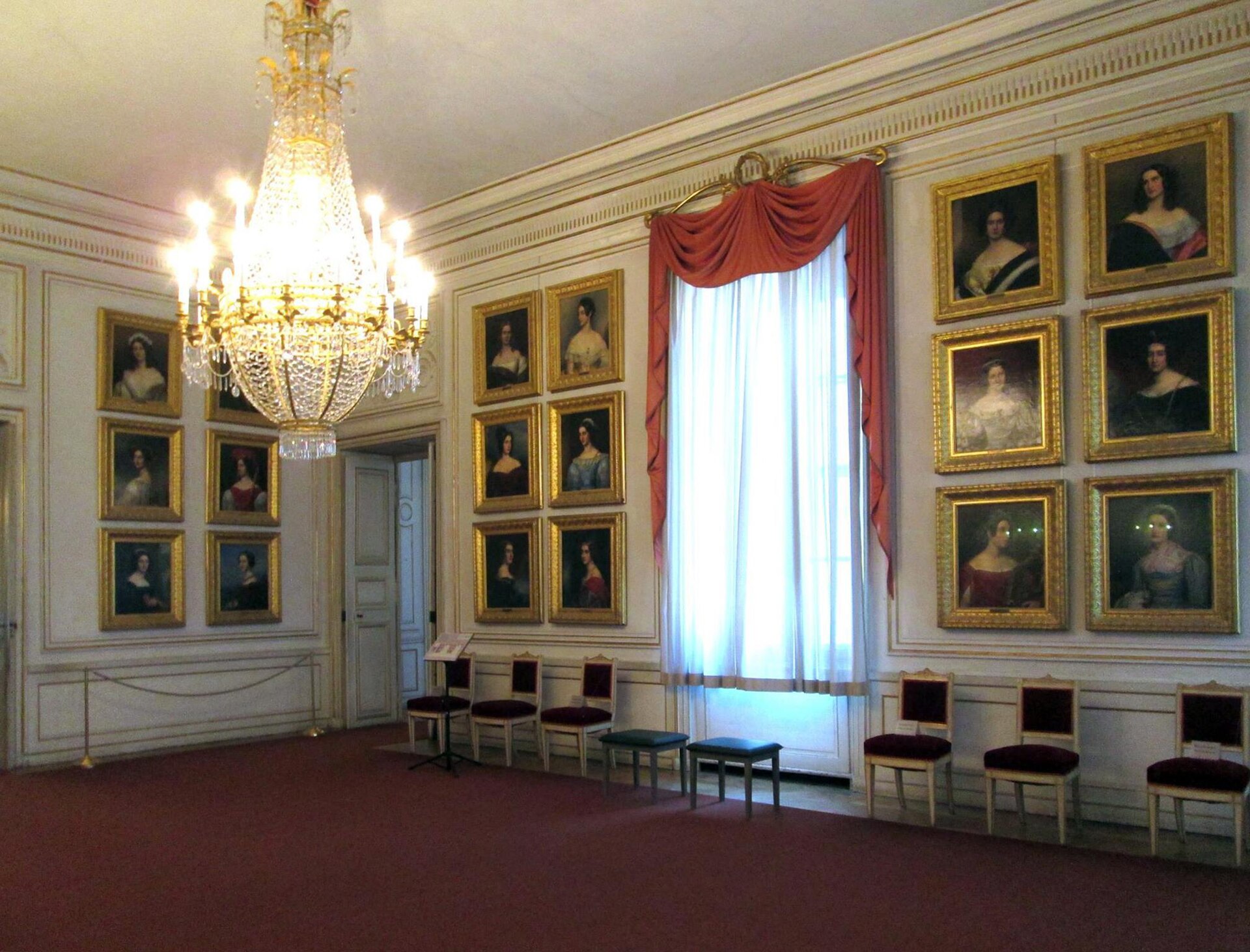
The paintings, most of them the work of the court painter Joseph Karl Stieler, are remarkable for their democratic range. The king chose his subjects not only from the aristocracy but from every level of society, so that duchesses and princesses hang beside the daughters of shoemakers and the wives of soldiers. What united them in the king’s eyes was simply their beauty, and the resulting collection offers a fascinating cross-section of nineteenth-century faces.
There is something both charming and faintly scandalous about the enterprise. A reigning monarch devoting a room of his palace to portraits of beautiful women, drawn from across the social spectrum, raised eyebrows even in its own time, and the gallery reflected the king’s romantic and aesthetic obsessions in a very public way. Yet the portraits themselves are accomplished and sympathetic, capturing personality as well as loveliness.
Today the Gallery of Beauties is one of Nymphenburg’s most visited rooms, a window into the tastes and passions of a king who could not resist beauty. Each face has its own story, and several of the women became famous, or notorious, in their own right. The gallery humanizes the grand palace, filling one of its rooms with individual lives and reminding us that behind the dynastic history ran a current of very personal desire.
The gallery also tells us a great deal about King Ludwig I himself, a ruler torn between his duties and his passions, a serious patron of the arts who filled Munich with neoclassical buildings and museums even as his private life courted scandal. In assembling this room he left behind a deeply personal monument, a record of what he found beautiful, and in doing so he unwittingly created one of the most human and approachable spaces in the entire palace.
Lola Montez and the King Who Lost His Throne
No portrait in the Gallery of Beauties carries a heavier history than that of Lola Montez, the dancer and adventuress whose affair with King Ludwig I would help bring down his reign. Presenting herself as a Spanish dancer, though she was in fact Irish-born, she arrived in Munich in the 1840s and swiftly captivated the aging king, who became infatuated with her and showered her with favors, titles, and influence.

The relationship scandalized Bavaria. Lola’s growing power over the king, her interference in politics, and her arrogance toward the establishment provoked fierce opposition from the court, the church, and the public. As the revolutionary year of 1848 swept across Europe, the resentment she inspired became entangled with wider demands for reform, and Munich seethed with unrest directed as much at the king’s mistress as at his government.
In the end the affair cost Ludwig his crown. Amid the upheavals of 1848, with protests mounting and his position untenable, the king was forced to abdicate in favor of his son. Lola fled Bavaria and went on to a restless, colorful life abroad, but the damage was done. Her portrait, hanging serenely among the other beauties, gives no hint of the political storm she unleashed, which makes its presence all the more remarkable.
The story is a reminder that the Gallery of Beauties was never merely decorative. These were real women who moved through the life of the court, and at least one of them changed the course of Bavarian history. Standing before Lola’s calm painted face, it is worth remembering that beauty at Nymphenburg was entangled with power, scandal, and even the fall of a king, giving the elegant gallery an undercurrent of real drama.
The Birthplace of a Fairy-Tale King
Nymphenburg holds a special place in Bavarian affection as the birthplace of its most beloved and most tragic monarch. In 1845, in a modest room of the palace, the future King Ludwig II of Bavaria was born, the dreamer king who would one day build the fantastical castles of Neuschwanstein, Linderhof, and Herrenchiemsee and pour the wealth of the state into his romantic visions.

The room where he came into the world is preserved and shown to visitors, a comparatively simple space that stands in poignant contrast to the extravagant fantasies its occupant would later create. From these ordinary beginnings emerged a king whose imagination knew no bounds and whose obsession with an idealized medieval and Baroque past would make him a legend and, ultimately, lead to his downfall.
Ludwig II’s connection to Nymphenburg links the palace to one of the most haunting stories in German royal history. Declared unfit to rule and deposed, the king died in mysterious circumstances in a lake in 1886, a death that has never been fully explained and that sealed his transformation into a figure of romance and tragedy. His fairy-tale castles now draw millions of visitors, but his life began here, in this summer palace of his ancestors.
To stand in the birth room is to feel the whole sweep of the Wittelsbach story compressed into a single point. The dynasty that built Nymphenburg as a Baroque celebration of new life produced, in this very room, the last great romantic of European kingship. There is a fitting symmetry in it, for the palace born to mark one princely birth also witnessed the beginning of Bavaria’s most unforgettable king.
The Park: From Formal Baroque to English Landscape
Behind the palace stretches one of the finest parks in Germany, and like the building it evolved through changing fashions. It began as a strict formal garden in the French and Dutch Baroque manner, with geometric parterres, straight avenues, clipped hedges, and a long central canal running away from the palace toward a great cascade. Everything was ordered and symmetrical, a landscape shaped to human design.
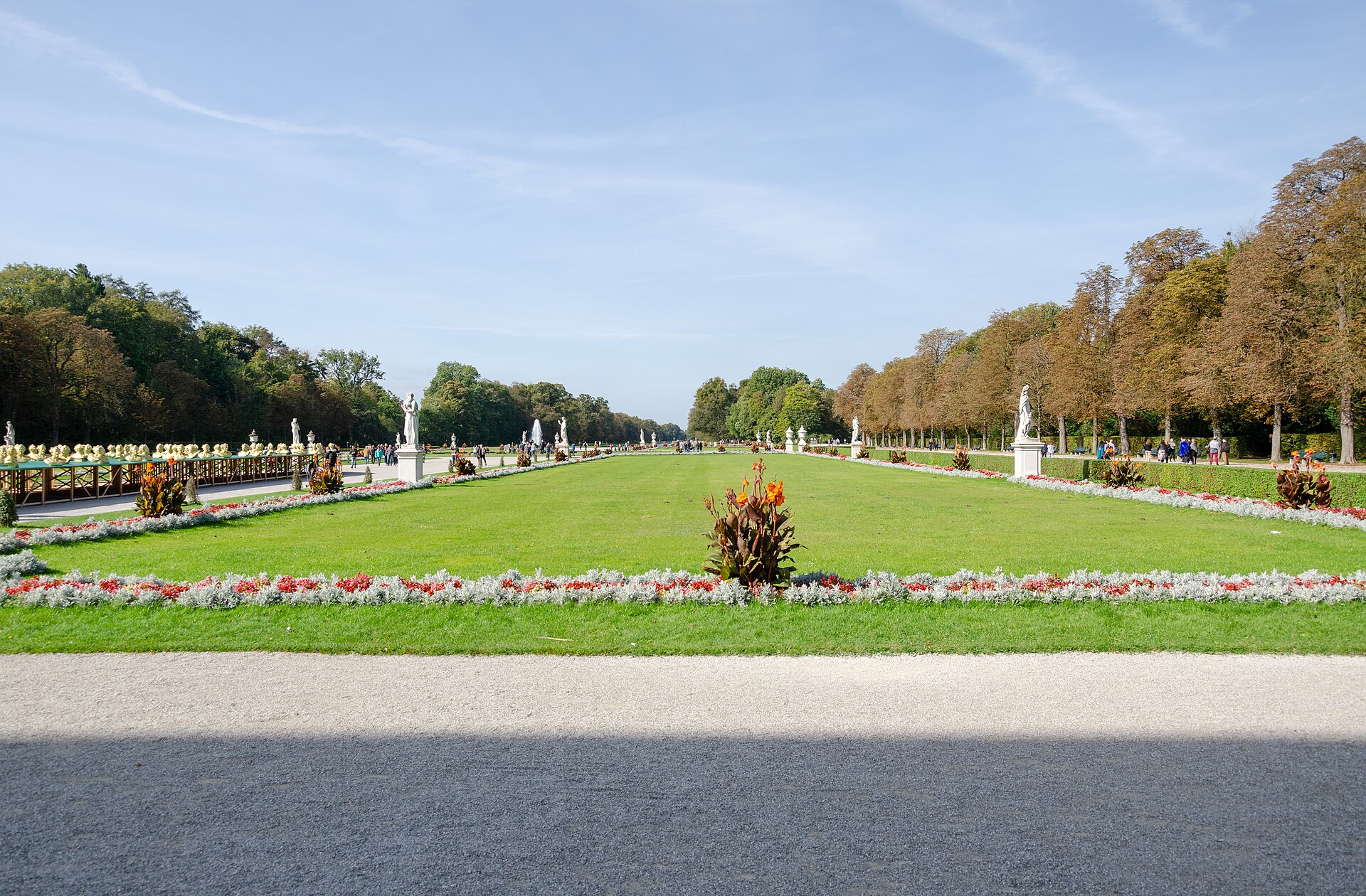
In the early nineteenth century, taste turned toward the naturalism of the English landscape garden, and the celebrated garden designer Friedrich Ludwig von Sckell was entrusted with transforming much of the park. He softened the rigid geometry into gently curving paths, rolling lawns, irregular groups of trees, and serpentine bodies of water, creating the illusion of an idealized natural landscape while cleverly preserving the great central axis and canal.
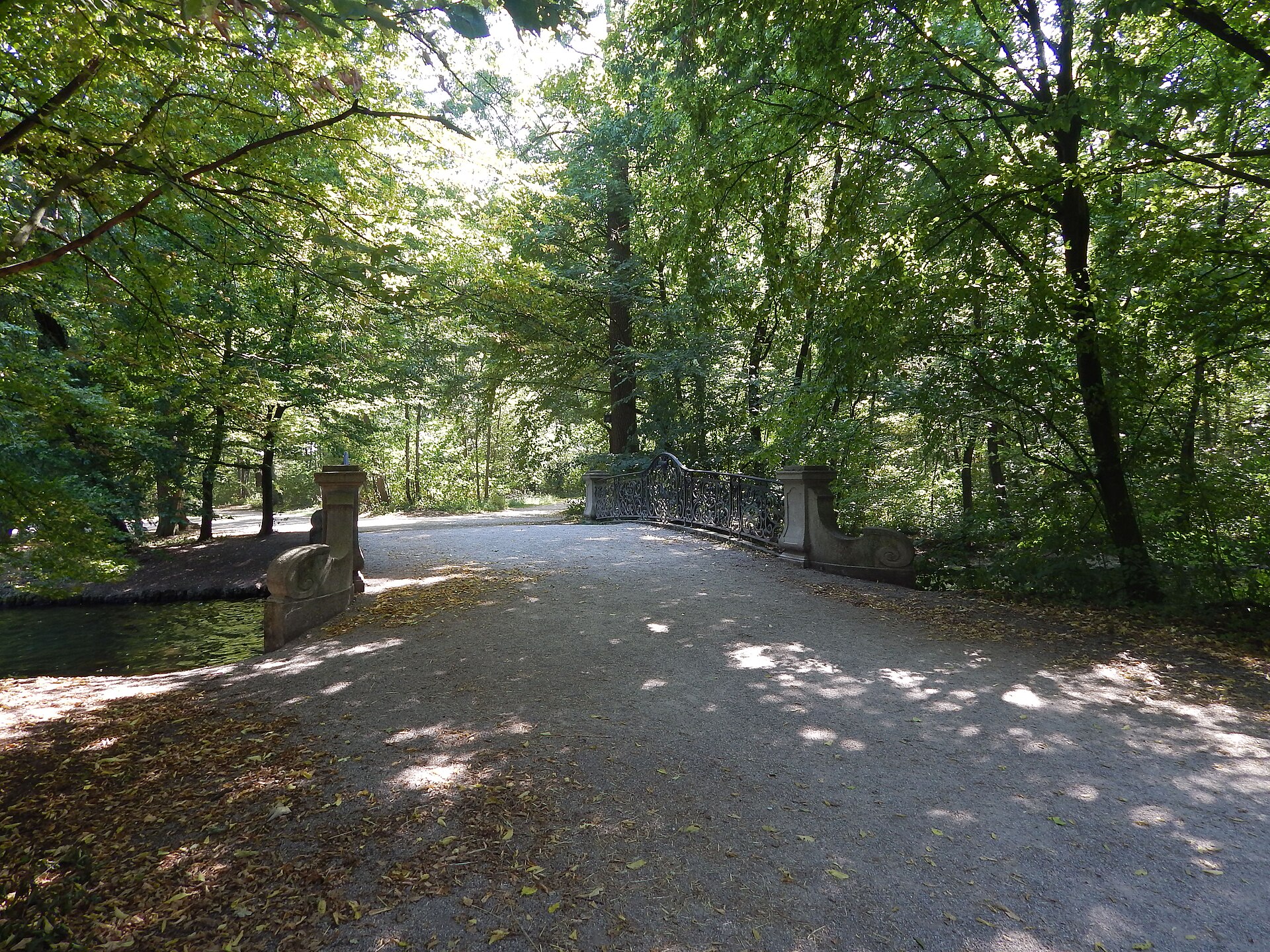
The result is a park of two characters that coexist in remarkable harmony. Near the palace and along the central canal, the old formal bones remain, while the wider grounds unfold as a romantic landscape park full of surprises. Swans glide on the canal, hidden pavilions appear among the trees, and the cascade still tumbles at the far end of the main axis, a survival from the Baroque design.
For the people of Munich, the park is a beloved green refuge, free to enter and endlessly rewarding to explore. Its combination of grand formal vistas and intimate wooded paths makes it one of the great pleasures of a visit, and it forms the essential setting for the jewel-like garden pavilions that are among Nymphenburg’s greatest treasures. To understand the palace, you must walk its park, where the whole history of European garden design plays out in a single landscape.
The park also served practical and ceremonial purposes beyond mere pleasure. Its long avenues were designed for the hunt, that great obsession of the aristocracy, and its vistas were carefully composed to be admired from the windows of the state apartments. Every element, from the placement of a pavilion to the line of a canal, was part of a total composition in which architecture and nature were meant to be experienced as a single unified work of art.
The Amalienburg: A Jewel of European Rococo
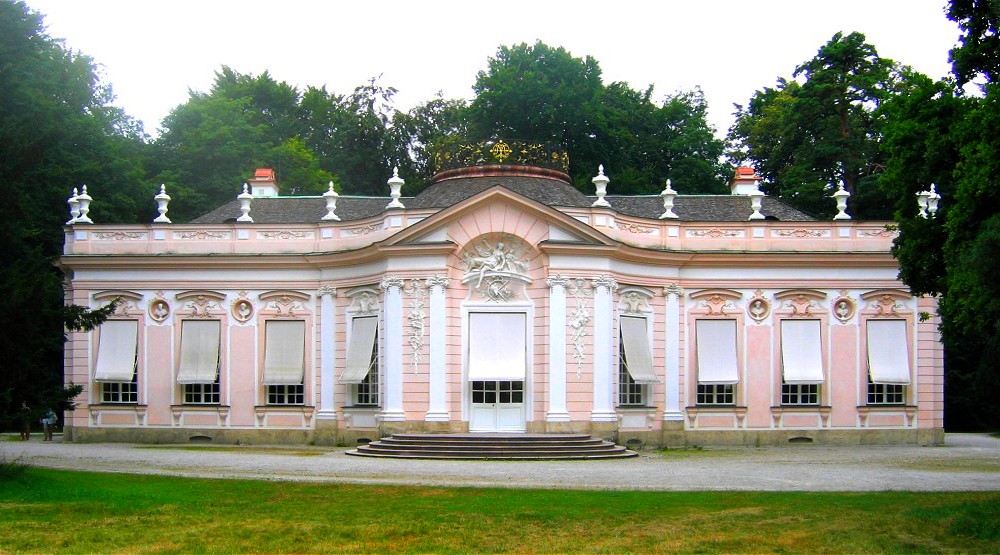
Hidden among the trees of the park stands the small building that many consider the single greatest treasure of Nymphenburg, and one of the supreme achievements of the European Rococo. The Amalienburg is a hunting lodge built in the 1730s for the Electress Maria Amalia, designed by François de Cuvilliés with decoration by Johann Baptist Zimmermann, the same pair responsible for the palace’s Stone Hall. In this modest pavilion their genius reached its absolute peak.
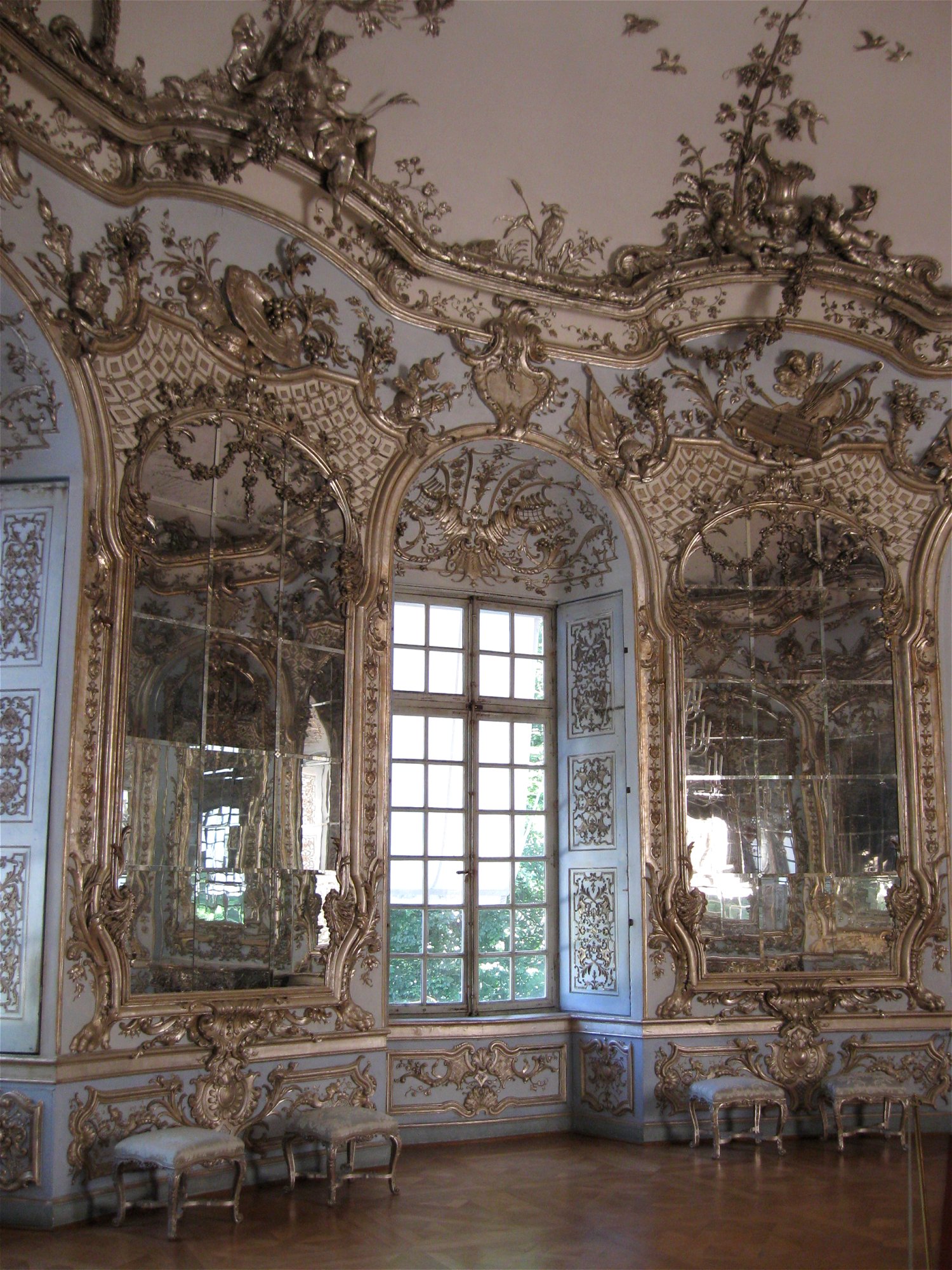
From the outside the Amalienburg is elegant but restrained, a single-story building of gentle curves. Nothing prepares you for the interior. At its center lies the Hall of Mirrors, a circular room of almost unimaginable delicacy, its walls a shimmer of silver-blue and gilded silver ornament in which mirrors, windows, and carved decoration dissolve into one another. Silvered stucco flows across the surfaces in a fantasy of foliage, musical instruments, birds, and figures, catching and multiplying the light.
The room is a triumph of pure decorative art, an interior conceived as a single, integrated work in which every element contributes to an overwhelming effect of lightness and grace. There is no grandeur here in the Baroque sense of weight and power; instead there is enchantment, an interior that seems almost to float. It represents the Rococo not as mere ornament but as a complete transformation of space into something magical.
That such perfection was lavished on a garden hunting lodge, rather than a great state room, tells us much about the values of the court that created it. The Amalienburg was built for pleasure and delight, a private fantasy set among the trees, and it remains one of the most exquisite rooms anywhere in the world. For many visitors, the walk out to this small pavilion is the true climax of a day at Nymphenburg.
Around the central Hall of Mirrors are grouped smaller rooms, including a kennel room for the hunting dogs and a kitchen lined with Dutch and Chinese tiles, each decorated with the same exquisite care. The building was conceived as a complete environment, and even its most functional spaces were treated as opportunities for beauty. This attention to every detail, from the grandest wall to the humblest tile, is what lifts the Amalienburg into the realm of the truly sublime.
Bathhouses, Pagodas, and a Hermitage in the Woods
The Amalienburg is the most famous of the park’s pavilions, but it is not alone. Scattered through the grounds are several other small buildings, each conceived for a particular pleasure or mood, and together they turn the park into a landscape of delightful surprises. Coming upon them one by one among the trees is one of the great joys of exploring Nymphenburg.
The Badenburg is a bathing pavilion, and a remarkably luxurious one, built to house a large heated bathing pool of a sophistication rare for its time. It allowed the court to indulge in the pleasures of bathing in surroundings of great elegance, and its very existence speaks of a refined and hedonistic court culture. Nearby, the Pagodenburg is a small pavilion reflecting the age’s fascination with East Asia, its interior decorated with Chinese and Dutch motifs as a place to take tea and rest after a game on the adjacent lawn.
Most unexpected of all is the Magdalenenklause, a hermitage built deliberately to look like a crumbling ruin. This artificial retreat, with its cracked walls and grotto-like chapel, was designed as a place for quiet religious contemplation, a fashionable expression of the era’s taste for melancholy and reflection amid all the surrounding gaiety. It offered the prince a place to withdraw and meditate on mortality within his pleasure garden.
Together these pavilions reveal the full range of the court’s imagination, from sensual luxury to exotic fantasy to pious retreat. Each is a small world of its own, and each rewards the visitor who takes the time to seek it out. They are proof that at Nymphenburg the art of building for pleasure was carried to a pitch of refinement and variety that few other courts ever achieved.
Golden Carriages and the Magic of Nymphenburg Porcelain
Within the palace complex, in the former court stables, lies one of Nymphenburg’s most dazzling collections: the Marstallmuseum, or Museum of Royal Carriages. Here are gathered the state coaches, sleighs, and riding equipment of the Bavarian court, culminating in the astonishing carriages and sleighs of King Ludwig II. Gilded, carved, and painted with fairy-tale extravagance, these vehicles are the rolling equivalents of his famous castles.
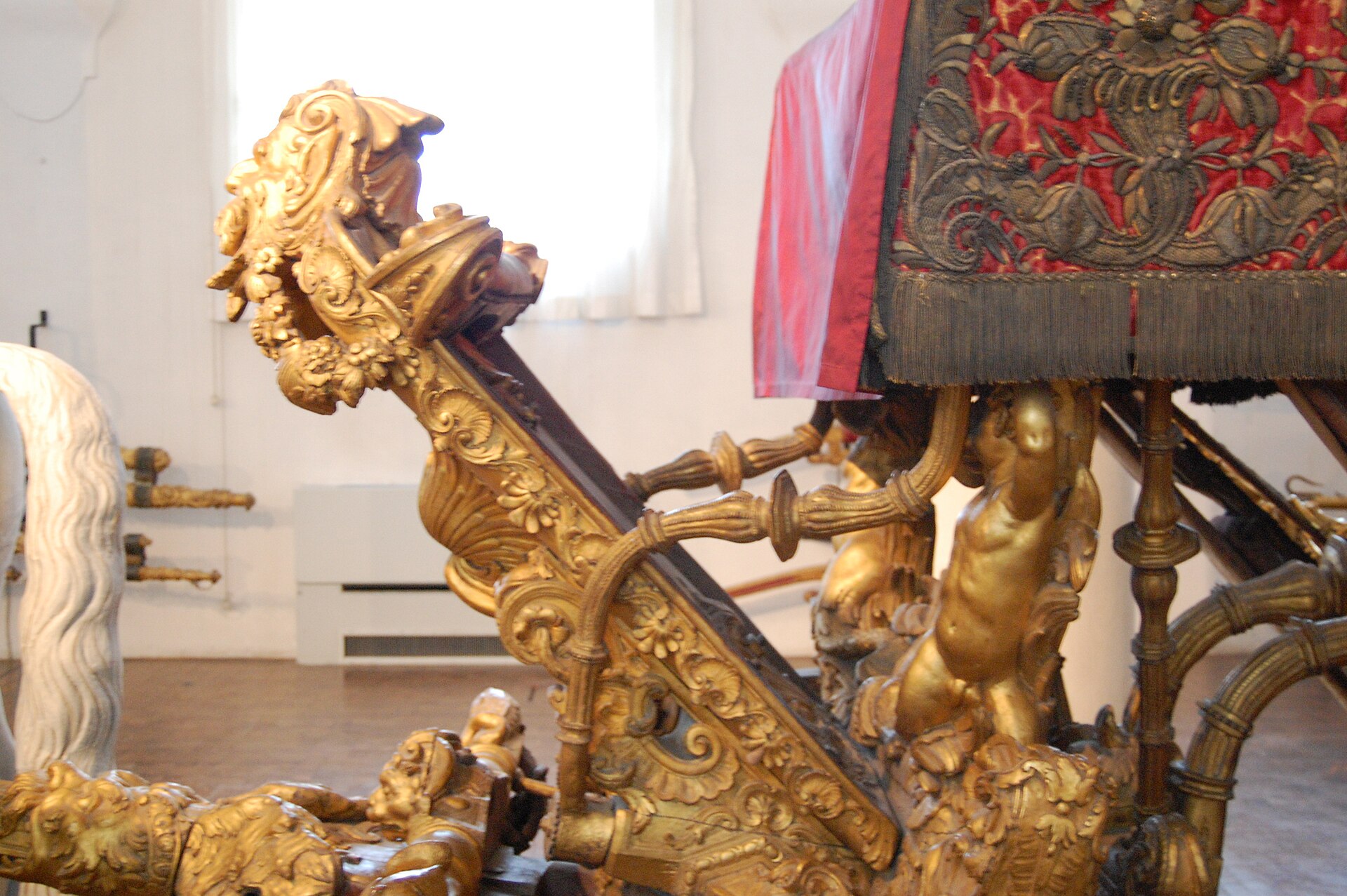
Ludwig’s coaches and sleighs, in which he traveled the mountains by night lit by torchlight, are objects of pure fantasy, encrusted with gilded cherubs, crowns, and ornament. They embody the same romantic imagination that drove his building projects, and seeing them gathered together is to glimpse the private dream world of Bavaria’s most eccentric king. The museum preserves them as some of the most extraordinary examples of the coachmaker’s art ever created.
Housed alongside the carriages is a superb collection of Nymphenburg porcelain, produced by the famous manufactory that has been associated with the palace since the eighteenth century. The Nymphenburg Porcelain Manufactory, still in operation, is renowned for the quality of its wares and above all for a celebrated series of Rococo figures, whose lively modeling ranks among the finest porcelain sculpture ever made.
Together the carriages and the porcelain display two very different faces of Bavarian courtly art, the grand theater of royal processions and the intimate perfection of the decorative arts. Both are expressions of the same impulse toward beauty and display that animates the whole palace. For many visitors, the Marstallmuseum is an unexpected highlight, a glittering coda to a day spent among the splendors of Nymphenburg.
The survival of these fragile objects, the carriages with their delicate gilding and the porcelain with its slender forms, is itself something of a wonder given the upheavals through which Bavaria passed. That so much has been preserved and is now displayed together allows the visitor to appreciate the extraordinary craftsmanship the court commanded, and to see how the same love of beauty ran through everything from the grandest hall to the smallest porcelain figure.
Nymphenburg Today: Munich’s Summer Palace
Today Nymphenburg is one of Munich’s great attractions and remains in the care of the Bavarian Palace Administration, which maintains the palace, its pavilions, and the vast park. The state rooms, the Gallery of Beauties, the birth room of Ludwig II, the Marstallmuseum, and the porcelain collection are open to visitors, and the park with its pavilions is free to wander, making the whole complex an inexhaustible destination.
View the exact location on Google Maps
A visit rewards a full day. The main palace and the Stone Hall can be seen fairly quickly, but the park is large, and reaching the Amalienburg, Badenburg, Pagodenburg, and Magdalenenklause on foot takes time and repays every step. Combining the interiors with a leisurely walk through the grounds, past the canal and the cascade, gives the fullest sense of what this summer residence was for.
The palace sits in the Nymphenburg district in the west of Munich, easily reached by tram and public transport from the city center, yet once inside the gates the noise of the modern city falls away. The long facade above its canal, the swans on the water, and the great park behind conspire to carry you back to the leisured world of the Bavarian court at its height.
More than three and a half centuries after it was begun to celebrate a princely birth, Nymphenburg still fulfills its original purpose as a place of pleasure and escape. Layered by generations of Wittelsbach rulers, adorned by the finest artists of the Rococo, and haunted by the memory of its dreamer king, it remains the summer heart of Bavaria. To visit it is to step into a world built for delight, and to feel, even now, the lightness and joy that its makers intended.
Palaces Nearby
If you are exploring the great royal palaces of Germany, these companions elsewhere in the country are well worth discovering:
You May Like


One thought on “Nymphenburg: The Summer Palace Bavaria Built to Celebrate a Birth”