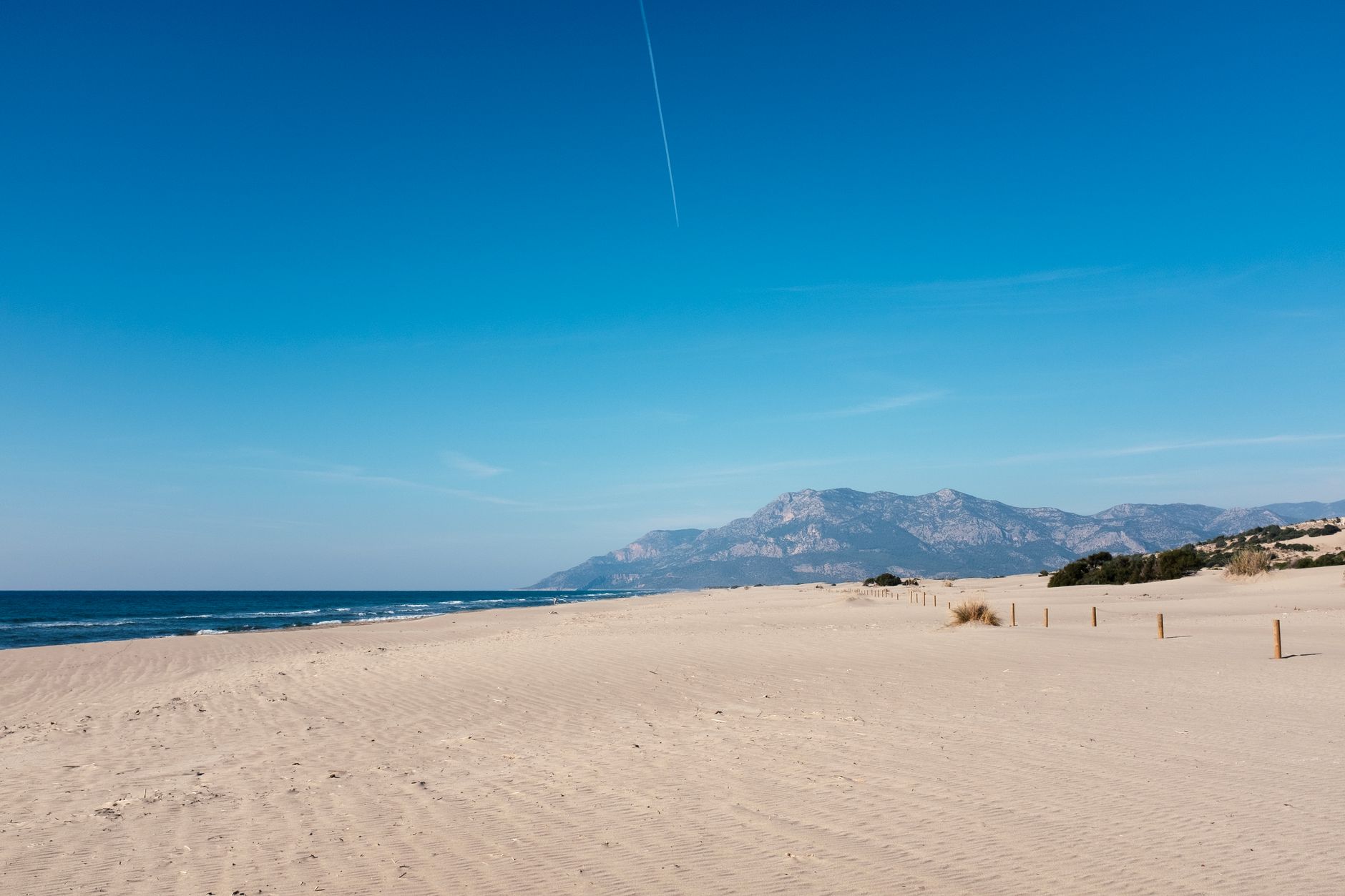
Patara Beach is located near the ancient city of Patara and is one of the largest and most beautiful beaches in this region.
Write your free format text here. The ancient city near Kalkan town of Kaş district, Antalya provincial borders.
Patara is a Lycian city and was the capital of the Lycian Union. It is one of the six cities of the Lycian Union with three voting rights, and perhaps the most important. Lycian union meetings were held in the union’s council building in the city.
The city, known as Patar in Hittite and Pttara in Lycian, dates back to B.C. Its existence in the 8th century has been confirmed by concrete data obtained as a result of excavations, and it is known that it was among the cities besieged by Alexander. Patara was a very important city during the Roman period and was the capital of the Lycia-Pamphilia provinces.
Patara port was important in terms of grain storage and shipment, therefore one of the 3 grain warehouses (Granarium) in the eastern Mediterranean is located in Patara. The city, which continued its development during the Byzantine period, was also considered important by Christians. It is said that Saint Nicholas, also known as Santa Claus, is from Patara.
The port of Patara, which is 400 meters wide and 1600 meters deep, began to fill with sand and boats had difficulty docking, causing Patara to gradually lose its importance. Wind-blown sands fill the harbor over time and cover the city to a large extent. It will be noteworthy that some of the ruins that can be seen in the city today are under the sand.
However, with the archaeological excavations carried out in recent years, the city has begun to be cleared of the sand covering it.
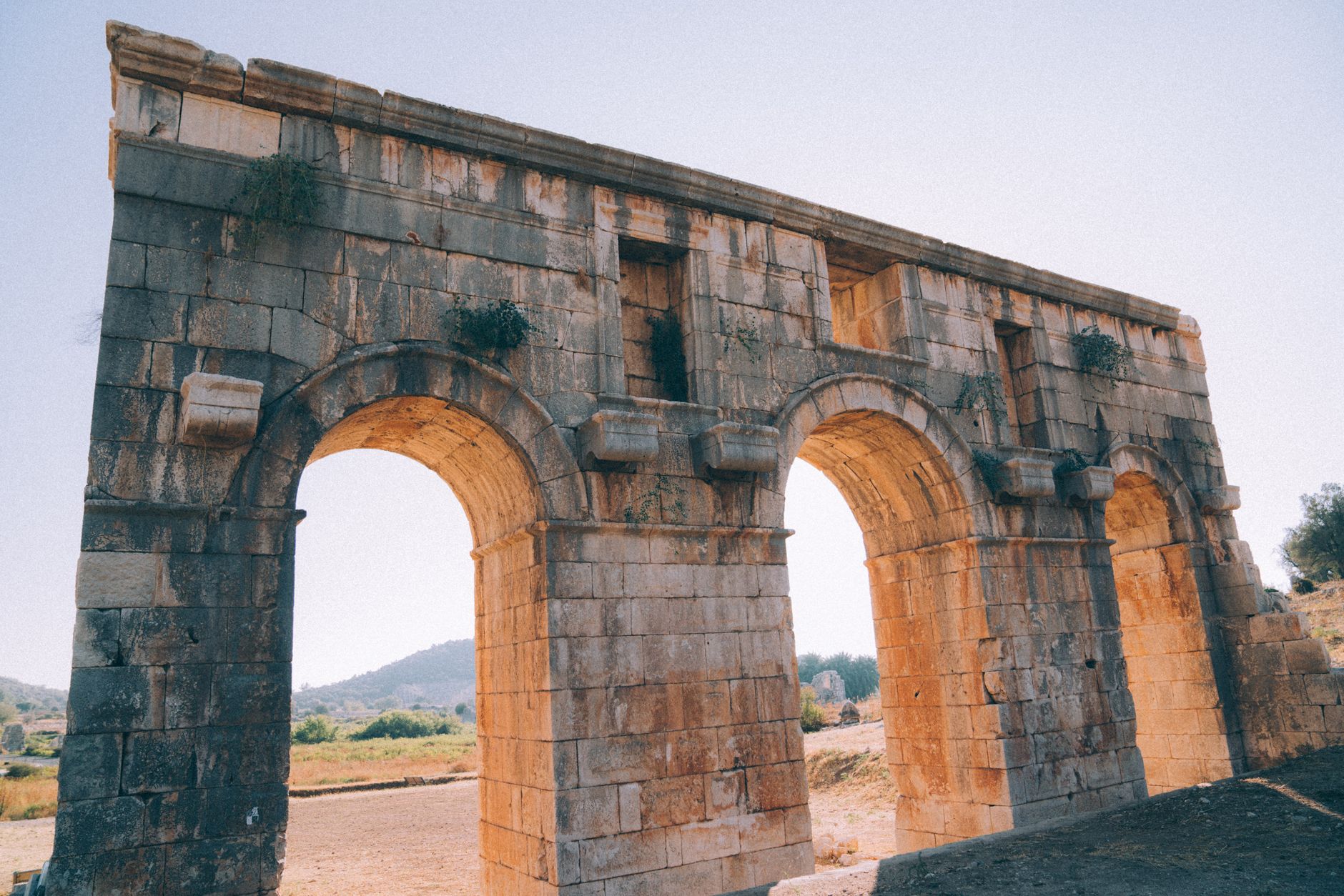
2 km after Gelemis village, the Roman Triumphal Arch (Metius Modestus), one of the most magnificent ruins in Patara, can be seen on the roadside. Triumphal arch, A.D. It was built at the end of the 1st century. Among the ruins that can be seen towards the hill are the Byzantine basilica and sacred areas. The theater is on the slope of the hill. There is a large cistern and a mausoleum on the hill where the theater leans. The old port is now a wetland.
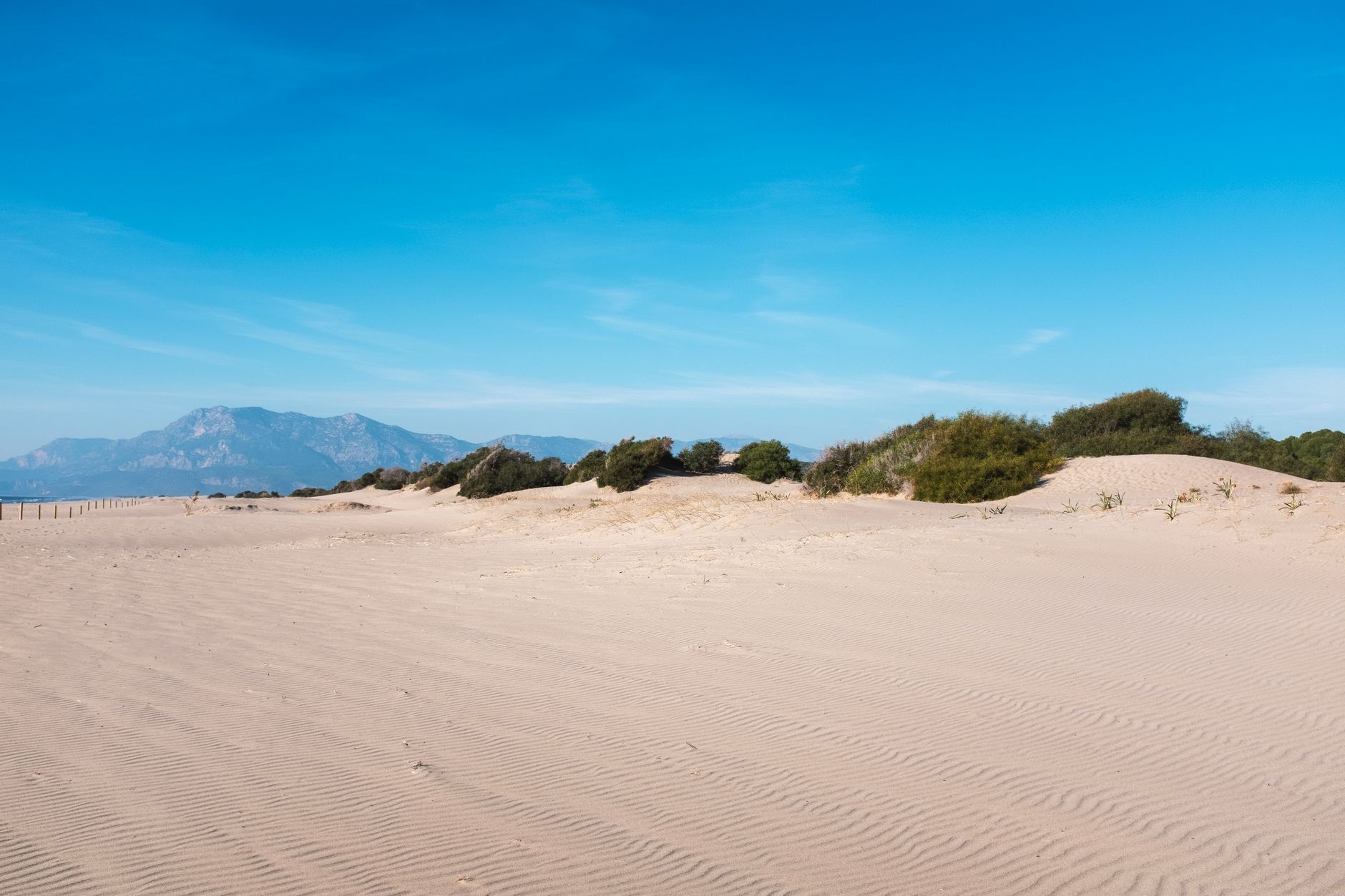
Patara beach is the longest and most magnificent of the surrounding beaches. 18 km. The depth of the long beach reaches 200-300 meters in places. The sand is fine. The sea is shallow. It is also suitable for windsurfing due to its almost constant wind. Patara beach is under protection because it is among the places where sea turtles (Caretta caretta) lay their eggs.
Sets have been created to prevent the sand dunes carried by the wind from Patara beach to the ancient city.
Due to its width and length, Patara beach has been used as a backdrop in desert scenes by Yeşilçam films in the past. Today, it appears as a beach where naturists and nudists can easily swim and sunbathe naked.
The ancient city of Patara is located at the southwestern end of the fertile Xanthos valley between Fethiye and Kalkan. When we turn from the main road to the Gelemis road, the 5 km road takes us to the ruins of Patara. In recent excavations, B.C. VII. The discovery of ceramics and coins from the 19th century allows us to take the history of Patara back further.
Patara, known as the birthplace of the god Apollo, is one of the most important and oldest cities of Lycia. Hittite King IV. Tudhaliya (1250 – 1220 BC) said during the Lukka expedition, “I made votive offerings and gifts, erected stelae, and built sacred places opposite Mount Patar.” We understand from this that in the Hittite Age, Patara existed under the name Patar.
Patara has continued to be an important city throughout history in all ages, as it is the only place in the Xanthos valley that can be opened to the sea. New excavations are very important in terms of revealing its ancient history. Therefore, for now, the history of the city dates back to B.C. VI. and we can date it back to the 5th century. The city, which was saved from destruction by opening its gates to Alexander, was restored in B.C. after Alexander’s death. Antigonos in 315 and B.C.
It could not survive the invasion of Demetrios in 304. Later, it was taken over by Ptolemiaios and Philadelphos in Egypt, and although its name was Arsinoe for a while during the reign of the Egyptian kings, this name was not adopted later, and Patara was founded in B.C. In 190 III. It was captured by Antiochus. Livy’s B.C. II.
The phrase “Caput gentis”, that is, the capital of the lineage, which he said for Patara in connection with the great events of the Antiochus period at the turn of the century, elevates it to the top of other cities.
Like Pınar, Xanthos, Olympos and Myra within the Lycian Union, Patara had three voting rights. Union meetings were often held in Patara, which was the port of the union. Patara, which did not lose its importance after coming under Roman rule, maintained its importance not only as a center where Roman governorships handled their judicial affairs, but also as a naval base through which Rome established connections with the eastern provinces.
Patara was also a port where the grains transported from Anatolia to Rome were stored and stored. For this reason, a large grain warehouse was built here, as in Andriake, during the time of Emperor Hadrian. Roman Emperor Hadrian came to Patara with his wife Sabine and rested here for a while. Patara, which was the capital of the provinces of Lykia and Pamphylia during the Roman Empire, also became famous as an important oracle center of Apollo.
Ancient writers record that prophecies were made here in winter and on Delos in summer. The city continued its importance during the Byzantine period and became an important center for Christians. Because Saint Nicholas, known as “Santa Claus”, is from Patara. Also St. Paul boarded the ship from Patara to go to Rome. Thus, it became an Episcopal center during the Early Christian period. Presided over by Emperor Constantine, A.D.
The fact that Eudemos, the only authorized signatory of Lykia at the Nikaia consul in 325, was the Bishop of Patara is proof of his popularity in this giant of the city. Unfortunately, after this, bad luck started in Patara, and as if the gods and holy people turned away from this place, the 1600 m long and 400 m wide harbor was filled with sand. Thus, the ships could not dock, which caused Patara to gradually lose its importance.
Patara, which is covered with sand day by day, has survived to this day as the beauty sleeping under the sand.
Places to visit around: Xantos, Letoon, Sdyma, Pınara, Tlos and Telmessos are some of the ancient cities you can visit during the day. You can also include the natural wonder Fethiye Saklıkent Canyon and Ölüdeniz in your tour. Another very close place is Kalkan (Kaputas) and the Blue Cave. Horse safari in the dunes. In Patara, there is a farm called “Sultan Han”, owned by İlhan Çırpan, which organizes horse tours.
There are 10 Hafringer breed horses on the farm, which started to be trained last year. These horses, which were used to pull gun carriages in the German war, could walk 60-70 kilometers a day. The foals produced at the Karacabey stud farm from their Austrian mothers have easily adapted to the mountain roads and sand dunes of Patara. The time of the horses with names such as Rüzgar, Nazlı, Arzu, Babür is 20 Marks. Horse rides are held in the cool morning and evening hours.
These trips, accompanied by a guide and with 8 horses, start between 06:00-07:00 in the morning. The docile horses, which are fed, watered, cleaned and whose manes are combed, follow the directions of the guests according to their wishes. During these trips, which are carried out on very valuable custom-made American cowboy saddles; The first step is along the canal, the second step is the green valley, the third step is the sand dunes and the sea. Along the way, you pass through forests, valleys and ancient cities.
Even if you have never ridden a horse before, you can become a horse rider in 10 minutes, based on the information given at the farm and with 3-4 rounds of trials. Reservation: (0242) 843 51 60Sunset from the sand dunesAnother pleasure in alternative tourism is experienced in the sand dunes.
Watching or photographing the wave movements on the sand dunes, which first turn yellow and then turn red at sunset, the shadows and the hill silhouettes with one side left in darkness can be a reason to come to Patara in itself. Footprints in the sand covered by the wind, sand dunes reshaped, idyllic compositions that appear before the sun setting into the sea are fascinatingly beautiful.
“Canoeing” adventure on Eşen Stream, Indians of Xantos… One of the most popular activities of recent years; Canoe trips on Eşen Stream. Now, Eşen Stream originates from Saklıkent Canyon and one of its branches passes through Kınık; We go sightseeing in canoes designed just like the Indians.
The river flows beneath you with all its anger. The best or even the only thing you can do at that moment; Keeping the bow of the boat you are on upright and trying not to topple over. Of course, stay away from the surrounding rocks as much as possible… One of the alternative tourism types that has increased in recent years is rafting. Especially the southern beaches are full of rafting enthusiasts throughout the year. Most of the rivers originating from the mountains and fed by small streams are suitable for rafting.
One of them is Eşen Stream. The adventure continues with many activities and excitement throughout the day in Eşen Stream, which originates from Saklıkent Canyon and one of its branches passes through Kınık. Local and foreign tourists participating in this adventure have the opportunity to have fun all day long. You stay afloat for about 4 hours on the 16 km long Eşen Stream, which starts under the bridge in Kınık and continues to Çayağızı. The canoe journey starts at 11:00 in the morning and continues until 17:30 with various breaks.
Canoes and their technical specifications: Canadian type polyester canoes, generally for two people. Families can sometimes take their children with them. A canoe weighs 60 kilos. However, these canoes have a carrying capacity of approximately 200 kilos. These canoes, which maintain their speed and are easy to turn, were designed in the same way as the Indians.
The tour agency provides life jackets, boats, paddles, food, beverages, transportation and guidance services to its insured guests. During the canoe crossing, there are always 3-4 guides among the group and they come to the aid of the guests in difficult situations. The crossings begin at the end of March and continue until the beginning of November. Meanwhile, guides canoe and experience activities among themselves on moonlit nights.
The group that will participate in the canoe crossing like Indians gathers in front of Dardanos Travel agency in Gelemis Village at 10:30 in the morning and comes to the banks of Eşen Stream by minibuses. Agency manager Mete Albayrak teaches how to canoe according to the language of the group, what to see, how to use the paddles, flat pedal-reverse pedal movements, turns, how to pass waterfalls, in short, the tricks of all these.
Those who get into their canoes impatiently lose themselves in the flow of the river at regular intervals. And coming to the first waterfall point…
Guides Polat Korkmaz and Recep Tunç, who had previously settled at the waterfall return, help novice canoeists here. The canoeists, who have successfully passed the places where the Eşen Stream flows slowly, sometimes wildly, the area where the current hits the opposite shore and comes back, and the waterfall points, arrive at their first resting place. This is the mud bath, which can be reached approximately half an hour after leaving. The soil with the highest amount of minerals is clayey.
But since it does not contain sulfur, it is odorless. Mud pools consist of small ponds with a depth of 50-60 cm. At first, the mud is carefully applied to the body like a cream, but after a half-hour break, it turns into a mud bath.
The tourists, covered in mud from head to toe, diving headfirst into the tiny lake and becoming unrecognizable, after having their photos taken in this state; This time, they wash off their mud by diving into the Eşen Stream, which has clean mountain water at 16 degrees, and continue their journey by drinking the offered cold soft drinks.
After passing the eucalyptus trees, oleanders, reeds and turns on both sides of the stream, you will have a lunch break in the winding stream, 6.5 kilometers away from the exit. After eating the grilled food with appetite, this adventure ends with a canoe crossing in Çayağızı in the evening. To participate in the canoe crossing, Turkish money is paid to Dardanos Travel agency for 35 marks per person.
Those who participate in rafting must bring a swimsuit, shorts, water-resistant shoes and a t-shirt.
Dardanos Travel AgencyTel: (0 242) 843 51 51Fax: (0 242) 843 51 10
Sunset in Xanthos One of the places frequented by tourists coming to Kınık is the ancient city of Xanthos. If you decide to visit Xanthos, do not forget to watch the sunset and photograph the silhouetted ruins. Xanthos, one of the most important cities of Lykia, means “Yellow” in Hellenic. The most striking historical structure in the ancient city, which lived independently until Persian rule, is the war monument.
This tomb monument, which is 8.87 meters high, consists of a massive pier carved from the rocks and a small burial chamber surrounded by a frieze on all four sides. The reliefs of the mausoleums in this room, covered with a capstone, were taken to London by British Fellows in 1842. In their place were plaster copies taken from the originals. The reliefs depict the gifts presented to the grave owner and his wife by other family members.
Half-bird-half-woman creatures called Sirens in the north and south symbolize babies and carry the soul of the dead to the sky. This tomb dates back to B.C. It is estimated to date back to 470-480.
You May Like
Aspendos Ancient Theater Travel Guide