Some palaces are monuments to a dynasty’s rise, but Mandalay Palace is a monument to a monarchy’s fall. Built at the foot of the sacred Mandalay Hill in central Myanmar, this vast golden citadel was the last royal palace of the Burmese kings, raised in defiant splendor at the very moment when the ancient kingdom was about to be swallowed by the British Empire.
You come expecting a royal palace and find a place layered with splendor and sorrow, a great square of walls two kilometers on each side, ringed by a wide moat and golden-spired bastions, enclosing the reconstructed teak halls where the last kings of Burma once sat upon the Lion Throne. Here the ancient monarchy reached its final flowering before its swift and tragic end.
This is the story of Mandalay Palace, from the visionary king who built it and the dynasty it served, through its golden halls and its Lion Throne, to the fall of the last king, the fires of war that consumed it, and its rebuilding in the modern age. Come and cross its moat with me, and walk the last royal city of Burma beneath the sacred hill.
In This Article
- The Golden Citadel Beneath the Sacred Hill
- The Dynasty That Ruled the Last Kingdom
- The Square of Walls and the Wide Moat
- A Royal City Aligned With the Cosmos
- The King Who Built a New Royal City
- A Palace of Teak, Tiers, and Gold
- The Lion Throne and the Seat of Kings
- The Watchtower That Survived the Flames
- The Last King and the Fall of the Throne
- When the Palace Became a Foreign Fort
- The Fire That Consumed the Royal City
- Raising the Golden Halls Again
- Walking the Last Royal City of Burma
The Golden Citadel Beneath the Sacred Hill
Approach Mandalay Palace across the broad moat that surrounds it, and you sense at once that you are coming to something that was meant to be the center of a world. The great square of walls, two kilometers on each side, encloses the last royal palace of the Burmese monarchy, and beyond it rises the sacred Mandalay Hill, so that the whole complex seems poised between the earthly power of the kings and the spiritual heights above.

The palace was built as a perfect square, its walls forming a vast citadel ringed by a wide moat, punctuated by golden-spired bastions and pierced by twelve gates, three on each side, each marked with a sign of the zodiac. This was a royal city laid out according to ancient cosmological principles, a diagram of order and majesty rendered in brick and teak and gold, the seat of the last kings of Burma.
Within the walls once stood a glittering array of teak buildings, halls, and pavilions, their roofs rising in tiers and their surfaces adorned with gold, the residence and seat of government of the Konbaung dynasty. Though the original palace was destroyed and what stands today is a reconstruction, the scale and the layout convey the grandeur of the vanished royal city that once flourished here.
To visit Mandalay Palace is to encounter the poignant final chapter of the Burmese monarchy, a golden citadel built at the very moment when the ancient kingdom was about to fall before the advance of empire. Come and cross its moat and pass through its gates, and you will step into the last royal city of Burma, a place of splendor and of sorrow at the foot of the sacred hill.
There is a particular poignancy to Mandalay that sets it apart from the great palaces that still stand intact, for here the visitor is always aware of loss, of the gap between the reconstructed halls and the vanished originals. Yet this very quality gives the palace its emotional power, a sense of a great and tragic history that hangs over the golden roofs and the wide moat.
The Dynasty That Ruled the Last Kingdom
Mandalay Palace was the seat of the Konbaung dynasty, the last ruling house of Burma, and to understand the palace is to understand this dynasty and the kingdom it ruled. The Konbaung had risen to power in the eighteenth century and forged a powerful state that at its height dominated much of mainland Southeast Asia, a formidable kingdom with a proud military and cultural tradition.

The dynasty ruled from a succession of capitals, for it was a Burmese royal custom to found new royal cities, and Mandalay was the last and most famous of these seats. The moving of capitals, and even of the buildings themselves as at Mandalay, reflected a conception of kingship in which the founding of a new royal city was an act of profound significance, a renewal of the monarchy and its mandate.
By the nineteenth century, however, the Konbaung kingdom faced a mortal threat in the form of the expanding British Empire, which had already fought two wars against Burma and annexed large portions of the country. The kingdom that ruled from Mandalay was thus the last independent remnant of a once-great state, holding out against the imperial power that had already swallowed so much.
It was against this backdrop of decline and danger that King Mindon built his new capital at Mandalay, a defiant assertion of Burmese royal splendor at a moment of gathering crisis. The palace stands as the final monument of the Konbaung dynasty, the last royal city of a kingdom that had once been among the great powers of the region and was now facing its end.
The Konbaung kings were fierce and often expansionist rulers whose campaigns reshaped the map of the region, and their court was a center of Burmese culture, art, and learning. The dynasty’s history was one of both great achievement and mounting peril, and the palace at Mandalay was the final expression of its long and eventful reign.
The Square of Walls and the Wide Moat
The fortifications of Mandalay Palace are among its most impressive surviving features, for while the buildings within were destroyed and rebuilt, the great square of walls and the wide moat remain much as they were, defining the vast citadel that enclosed the royal city. The scale of these defenses is remarkable, a perfect square with each side running for two kilometers, enclosing an enormous area at the heart of the city.

The walls were punctuated at regular intervals by many bastions, each crowned with a golden-tipped spire, so that the whole perimeter was marked by a rhythm of gilded points against the sky. Twelve gates pierced the walls, three on each side, and each gate was associated with a sign of the zodiac, reflecting the cosmological principles that governed the layout of the royal city.
Beyond the walls lay the moat, wide and deep, encircling the entire citadel with a ring of water crossed originally by wooden bridges. The moat was both a practical defense and a thing of beauty, and it remains one of the most striking features of the palace today, its broad expanse reflecting the walls and the golden bastions in a scene of considerable grandeur.
These fortifications made Mandalay a genuine citadel, a defended royal city in the tradition of the great walled capitals of Asia, even if in the event they could not save the kingdom from the swift British conquest. The walls and moat that survive give the best sense of the original scale and ambition of the royal city, and to walk or drive around the great square is to appreciate the magnitude of King Mindon’s creation.
Driving or cycling around the perimeter of the moat is one of the classic experiences of Mandalay, offering ever-changing views of the walls and the golden bastions reflected in the water, and conveying better than anything the vast scale of the royal city. The moat has become one of the defining images of Mandalay, a broad ribbon of water framing the last citadel of the Burmese kings.
A Royal City Aligned With the Cosmos
Like the great royal cities of the Buddhist and Hindu traditions across Asia, Mandalay was conceived not merely as a fortress and residence but as a sacred diagram, a royal city laid out according to cosmological principles to reflect the order of the universe and the king’s central place within it. The precise square of the walls, the arrangement of the gates, and the placement of the buildings all carried symbolic meaning.

The king in the Burmese tradition was a figure of great religious significance, a defender and patron of the Buddhist faith and, in the ideal, a righteous ruler whose reign upheld the cosmic and moral order. The palace was the setting for this sacred kingship, its layout expressing the hierarchy that placed the king at the center, the pivot around which the kingdom and the cosmos were arranged.
The choice of Mandalay itself, at the foot of the sacred Mandalay Hill, reflected this fusion of the royal and the religious, for the hill was a place of great Buddhist significance, and the founding of the royal city beneath it linked the monarchy to the sanctity of the site. King Mindon, a devout patron of the faith, made Mandalay a great center of Buddhism as well as the seat of his throne.
To understand Mandalay Palace fully, then, is to see it as more than a fortress or a residence, but as a sacred royal city, an attempt to embody in brick and teak and gold the ideal of righteous Buddhist kingship at the center of an ordered world. This spiritual dimension gives the palace a depth of meaning beyond its political and military role, and it connects Mandalay to the great tradition of sacred royal cities across Asia.
The alignment of the palace with the cardinal directions and the marking of its gates with the signs of the zodiac reflected a worldview in which the royal city was a microcosm of the ordered universe, and the king its living center. This sacred geometry was not mere decoration but the very principle on which the whole royal city was conceived and built.
The King Who Built a New Royal City
The founder of Mandalay Palace was King Mindon, one of the last and most capable rulers of the Konbaung dynasty, who came to the throne in a time of mounting danger for the Burmese kingdom. Determined to create a worthy capital and, according to tradition, moved by Buddhist prophecy, he resolved to build a magnificent new royal city at the foot of Mandalay Hill, and construction of the palace began in the late 1850s.

The building of Mandalay was a great undertaking, and in a striking act of continuity, Mindon had the wooden buildings of the previous royal palace at Amarapura dismantled and transported to the new site, carried by elephants to be reassembled at Mandalay. Thus the new palace incorporated the fabric of the old, a physical link between the successive capitals of the restless Burmese monarchy.
King Mindon was a reformer and a devout patron of Buddhism, and under his rule Mandalay became not only a royal capital but a great center of the faith, the site of important religious councils and works. The palace he built was the heart of this flourishing, the seat of a king who sought to strengthen and modernize his kingdom even as the shadow of British power fell ever more heavily upon it.
Mindon’s reign was, in many ways, the last golden age of independent Burma, a final flowering of the ancient monarchy before its fall. The palace he raised at Mandalay was the crowning expression of that age, a royal city built with all the artistry and devotion of the Burmese tradition, and it would witness both the splendor of the dynasty and, all too soon, its tragic end.
Mindon is remembered as one of the wisest of the Burmese kings, a ruler who sought to reform his administration and to strengthen his kingdom against the gathering storm, and who convened a great Buddhist council at Mandalay that produced a famous edition of the scriptures. His palace was the setting for these achievements, the heart of a reign that represented the last constructive chapter of the independent monarchy.
A Palace of Teak, Tiers, and Gold
The buildings of Mandalay Palace were masterpieces of Burmese architecture, constructed almost entirely of teak, the great tropical hardwood, and adorned with the gold and intricate ornament that distinguished the royal buildings of Burma. Their roofs rose in successive tiers, the number of tiers indicating the importance of the building beneath, culminating in the soaring spire that marked the very center of the palace and the kingdom.

At the heart of the complex stood the great audience halls and the royal apartments, including the residence of the king, and above all the halls that housed the thrones of the monarchy. The buildings were arranged according to a precise plan, with the ceremonial and public structures toward the east and the private royal apartments beyond, the whole laid out to express the order and hierarchy of the court.
The use of teak gave the palace its distinctive character, warm and richly carved, but it also made it terribly vulnerable, as the tragic fate of the original buildings would show. For all their beauty, these were structures of wood, and wood burns, a vulnerability that hung over the palace throughout its existence and that would ultimately claim the original buildings in the fires of war.
The gilded roofs and spires of Mandalay must have been a breathtaking sight in the palace’s heyday, catching the fierce tropical sun and blazing gold above the walls, proclaiming the majesty of the Burmese kings. Even in reconstruction, the tiered roofs and golden spires convey something of that vanished splendor, a glimpse of the glory of the last royal city of Burma.
View on Google Maps (21.991, 96.094)
The Burmese mastery of woodcarving reached extraordinary heights in the royal buildings, and old accounts and the few surviving related structures, such as a monastery built from a palace building removed before the fire, testify to the breathtaking intricacy of the original craftsmanship. In these survivals we glimpse the artistry that the flames of war destroyed within the palace itself.
The Lion Throne and the Seat of Kings
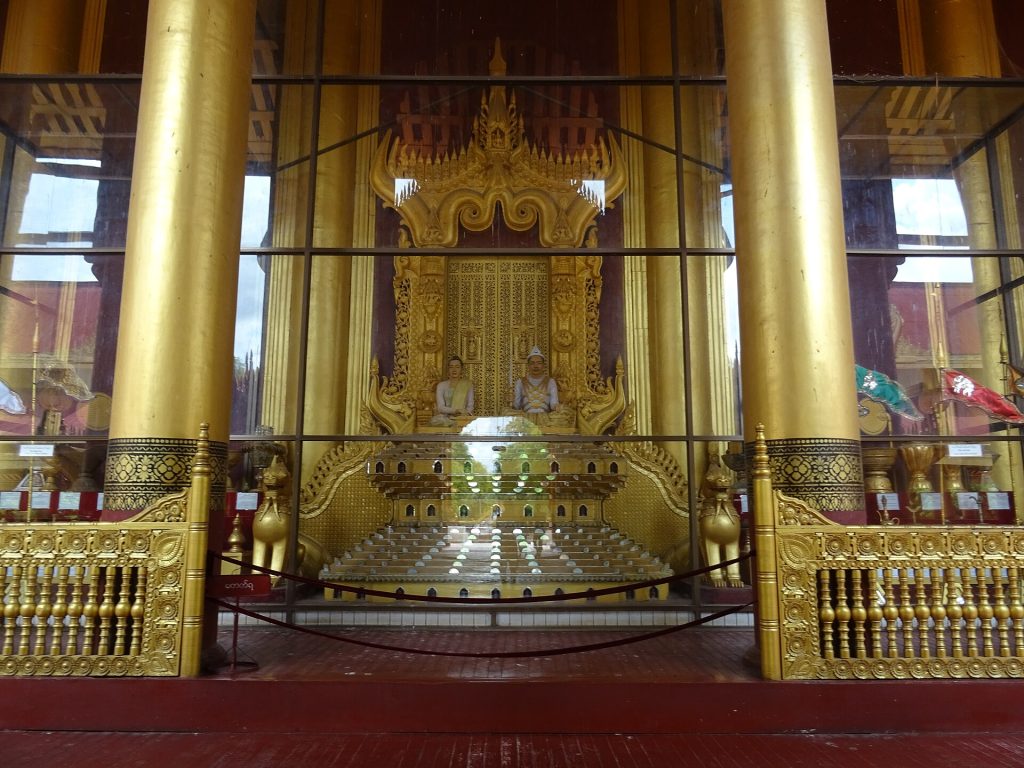
At the ceremonial heart of Mandalay Palace stood the great audience hall, and within it the Lion Throne, the chief of the eight thrones of the palace and the very seat of Burmese royal power. It was here, upon this throne, that the king would sit in state to receive his court and to conduct the highest affairs of the kingdom, the living embodiment of the monarchy at the center of the royal city.

The eight thrones of the palace were each associated with different functions and occasions, and each was named and adorned according to its purpose, but the Lion Throne in the great audience hall was the supreme seat, reserved for the most important ceremonies of state. To approach it was to approach the sacred center of the kingdom, the point where all the majesty of the monarchy was concentrated.
The throne room and its throne were designed to overwhelm the beholder with the splendor and authority of the king, the culmination of the whole processional approach through the halls of the palace. Here the elaborate ceremonies of the Burmese court unfolded, the audiences and the rituals that affirmed the king’s role at the apex of the social and cosmic order.
The original Lion Throne, like so much of the palace, has its own dramatic history, and the thrones of Mandalay became symbols of the vanished monarchy after the fall of the kingdom. To stand in the reconstructed audience hall and imagine the king enthroned in majesty is to glimpse the lost world of the Burmese court, the ceremonial heart of a monarchy that was about to be swept from the stage of history.
The thrones of Mandalay were not merely furniture but sacred objects, charged with the majesty and legitimacy of the monarchy, and their fate after the fall of the kingdom became bound up with the story of Burmese national identity. To contemplate the Lion Throne is to contemplate the whole vanished institution of Burmese kingship, and the abrupt violence of its ending.
The Watchtower That Survived the Flames
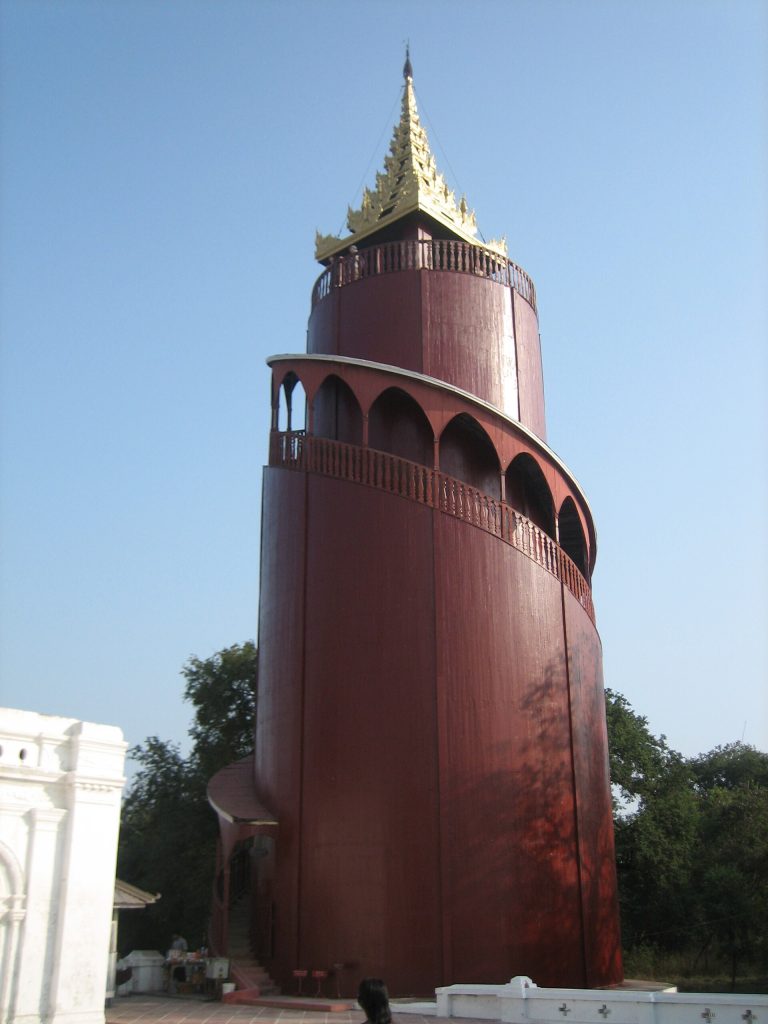
Among the many buildings of Mandalay Palace, one has a special significance, for it is one of the very few original structures to survive the destruction of the palace in the Second World War. This is the great watchtower, a tall spiraling structure rising high above the palace grounds, from which the king and his court could survey the royal city and the surrounding landscape.

The watchtower rose many meters above the palace, crowned with a tiered roof, a landmark visible across the royal city and a symbol of the surveillance and authority of the monarchy. From its heights, the whole layout of the palace could be seen, the halls and pavilions arranged in their precise order within the great square of the walls, the moat beyond, and the sacred hill rising in the distance.
That the watchtower survived when almost everything else was destroyed makes it especially precious, one of the few authentic remnants of the original nineteenth-century palace amid the modern reconstruction. In its weathered fabric, the visitor can touch the genuine palace of the last Burmese kings, a survivor of the flames that consumed the rest.
Alongside the watchtower, only a very small number of original structures came through the destruction, making these survivors doubly valuable as links to the vanished palace. The watchtower stands today as a poignant reminder of what was lost and of what, against the odds, endured, a sentinel that has watched over the royal city through its glory, its fall, and its long afterlife.
Climbing the watchtower today, by a spiraling stair, rewards the visitor with a sweeping view over the entire palace grounds, the reconstructed halls laid out below and the sacred hill rising beyond, a prospect that helps to make sense of the whole vast layout of the royal city. It is a rare chance to see an ancient palace from the very vantage its builders used.
The Last King and the Fall of the Throne
The splendor of Mandalay was not to last, for the palace that King Mindon built would witness, within a generation, the fall of the Burmese monarchy itself. Mindon was succeeded by King Thibaw, who would prove to be the last king of Burma, and whose reign coincided with the final, fatal confrontation between the ancient kingdom and the expanding power of the British Empire.

Thibaw’s reign was troubled from the start, marked by court intrigue and by the mounting pressure of the British, who controlled much of Burma already and coveted the rest. The kingdom that Thibaw ruled from Mandalay was the last independent remnant of Burmese sovereignty, and it existed in the shadow of an empire that was steadily closing in upon it.
The end came swiftly and with little warning. In the course of the third and final war between Britain and Burma, British forces advanced upon Mandalay, and in late 1885 they captured the palace and the king with startling speed. The ancient monarchy that had endured for centuries was extinguished almost overnight, and the last king of Burma became a captive of the empire.
The fall of Mandalay marked the definitive end of Burmese independence and the absorption of the whole kingdom into the British Empire. King Thibaw and his queen were taken from their palace and sent into exile, never to return, and the golden citadel that Mindon had built as the seat of a proud monarchy became, at a stroke, a possession of a foreign empire. The last royal city of Burma had fallen.
The speed of the kingdom’s fall astonished contemporaries, for the ancient monarchy that had endured for so long was extinguished in a matter of weeks. The suddenness of the collapse only deepened the sense of tragedy, the abrupt ending of a whole world of royal ceremony and tradition that had seemed, within its golden walls, so permanent and so secure.
When the Palace Became a Foreign Fort
With the fall of the monarchy, the great palace at Mandalay suffered the indignity of conquest, and the British converted the royal city of the Burmese kings into a military installation of their empire. The compound was renamed after a British official, becoming Fort Dufferin, and the sacred halls and pavilions of the monarchy were put to the prosaic uses of a colonial garrison.

The exiled King Thibaw, meanwhile, spent the rest of his life far from his palace, held in captivity in India, dying in exile without ever seeing Mandalay again. The removal of the king and the transformation of his palace into a foreign fort was a profound humiliation, the erasure of the ancient monarchy and the assertion of imperial dominance over the conquered kingdom.
For decades the royal city served as a British military base, its royal buildings standing amid the barracks and installations of the colonial army, a strange juxtaposition of Burmese royal splendor and imperial military occupation. The palace that had been the throbbing heart of an independent kingdom became a symbol of that kingdom’s subjugation, its glory preserved but its meaning transformed.
This colonial chapter in the palace’s history reflects the wider fate of Burma under British rule, the long period of imperial domination that followed the fall of the monarchy. The golden citadel endured through these years, its buildings still standing, but the world it had been built to serve was gone, and the palace waited, though no one could have known it, for the far greater catastrophe that the twentieth century would bring.
The Fire That Consumed the Royal City
The greatest tragedy in the history of Mandalay Palace came during the Second World War, when the royal city, by then a military site, was caught up in the ferocious fighting that swept through Burma. The Japanese occupation forces used the palace compound as a supply depot, and this made it a target, with catastrophic consequences for the irreplaceable teak buildings of the monarchy.

In the course of the fighting to retake the area, the palace was subjected to bombardment and fire, and the great wooden buildings, so beautiful and so vulnerable, went up in flames. Almost the entire palace, the halls and pavilions and royal apartments that King Mindon had built and that had housed the last kings of Burma, was consumed, reduced to ashes in the violence of the war.
The loss was very nearly total. Of all the many original buildings of the palace, only a tiny handful survived the flames, chief among them the royal mint and the great watchtower. Everything else, the accumulated splendor of the last royal city of Burma, was gone, one of the countless cultural tragedies inflicted by the war upon the heritage of the world.
The destruction of Mandalay Palace was a devastating blow to the cultural memory of Burma, the physical erasure of the last seat of its ancient monarchy. Where once had stood the glittering teak halls of the kings, there remained only ruins and empty ground, and it seemed that the golden citadel of the Konbaung dynasty had passed forever into memory, its splendor surviving only in old photographs and in the accounts of those who had known it.
The destruction of Mandalay was part of the wider devastation that the war brought to Burma, one of the most fought-over lands of the entire conflict, and the loss of the palace was mourned as a wound to the soul of the nation. That the last physical seat of the Burmese monarchy should perish in a foreign war, decades after the monarchy itself had fallen, was a final cruel twist in the palace’s tragic story.
Raising the Golden Halls Again
Yet the story of Mandalay Palace did not end in the ashes of the war, for in the modern era a great program of reconstruction sought to raise the vanished royal city once more. Beginning in the late twentieth century, the authorities undertook to rebuild the palace, recreating the halls and pavilions that had been lost, so that the layout and the splendor of the royal city might be restored to the Burmese people.
The reconstruction was based on old records, photographs, and plans, and it aimed to reproduce the appearance of the original palace, its tiered roofs and golden spires rising once again within the great square of the walls. The rebuilders used a combination of traditional forms and modern materials, so that the reconstructed palace, while faithful in its overall design, is not in every respect a replica of the original.
This has led to some criticism from those who feel the reconstruction falls short of the artistry of the vanished original, and it is true that a rebuilt palace can never fully recapture the authentic fabric and craftsmanship of what was lost. Yet the reconstruction serves an important purpose, restoring to Mandalay the physical presence of its royal heritage and allowing visitors to experience the layout and scale of the last royal city of Burma.
The rebuilt palace stands today as a monument both to the vanished monarchy and to the determination to reclaim a lost heritage, a golden citadel raised anew upon the site of the old. Amid the reconstructed halls, the surviving original structures like the watchtower stand as precious anchors to the authentic past, and together they allow the story of Mandalay to be told and its splendor, in some measure, to live again.
For all the debates about the fidelity of the reconstruction, the rebuilt palace serves an undeniable purpose in restoring to the Burmese people a tangible link to their royal heritage, a place where the story of the last kingdom can be told and its splendor imagined. In a nation that lost so much of its past to war and upheaval, the reclaiming of Mandalay carries a significance that goes beyond questions of authenticity.
Walking the Last Royal City of Burma
Visiting Mandalay Palace today is an experience shaped by both splendor and poignancy, an encounter with the reconstructed grandeur of a vanished monarchy on the site where its last royal city stood. The great square of walls and the wide moat remain much as they were, and to cross the moat and pass through the gates is still to enter a space laid out according to the cosmological vision of the Burmese kings.

Within the walls, explore the reconstructed halls and pavilions, with their tiered roofs and golden ornament, and picture the glittering court that once filled them. Seek out the great watchtower, one of the few original survivors, and climb it if you can for the view over the palace grounds and toward the sacred Mandalay Hill, the same prospect that the kings and their court once surveyed.
Take the time to reflect on the layered history of the place, the golden age of King Mindon, the tragic fall of King Thibaw and the end of the monarchy, the long colonial occupation, the terrible destruction of the war, and the modern rebuilding. Each layer adds to the meaning of the site, and the palace rewards the visitor who comes ready to feel the weight of this poignant history.
Come to Mandalay Palace, then, not expecting an untouched ancient monument but ready to encounter the reconstructed heart of the last royal city of Burma, a place where the splendor of a vanished monarchy has been recalled from the ashes. Walk its grounds, climb its watchtower, and remember the kings who ruled here and the kingdom that fell, and Mandalay will reward you with one of the most moving encounters with history that Myanmar can offer.
As you leave, pause to look back at the golden roofs rising within the great square of walls, framed by the sacred hill beyond, and consider the extraordinary arc of history that this single site contains, from the golden age of an independent kingdom to conquest, destruction, and rebirth. Few places tell the story of a nation’s fate so completely as the last royal city of Burma beneath its holy hill.
Castles Nearby
If Mandalay Palace has moved you, continue your journey through the great citadels of Asia:
You May Like
Mafra, the Palace a King Built From a Vow


One thought on “Mandalay Palace: The Last Royal City of Burma”