Some places overwhelm you not with a single monument but with an entire vanished world, and Angkor Thom is one of them. The last great capital of the mighty Khmer Empire, this fortified sacred city in the jungles of Cambodia is a walled metropolis on a colossal scale, ringed by ramparts and a broad moat, entered through monumental gates crowned with enormous serene faces that gaze out over the forest.
You come expecting ruins and find instead a lost civilization made stone, a city that once teemed with tens of thousands of people, its heart the extraordinary Bayon temple with its two hundred smiling faces. Here the arts of war and worship were fused into a single sublime creation, a fortress that was also a model of the cosmos, built by the greatest of the Khmer god-kings.
This is the story of Angkor Thom, from the empire and the king that built it, through its mighty walls and its faces and its churning gods and demons, to its long decline, its abandonment to the jungle, and its rediscovery as one of the wonders of the world. Come and pass through its gates with me, and stand beneath the smiling faces of a lost empire.

In This Article
- The City of a Thousand Smiling Faces
- The Empire That Ruled Southeast Asia
- The Mastery of Water That Made It Possible
- Gods, Demons, and the Churning of the Ocean
- The Faces That Waited in the Forest
- The King Who Built the Great City
- The Ramparts and the Moat of the Great City
- The Monumental Gates and Their Guardians
- The Bayon and Its Two Hundred Faces
- The Royal Terraces and the Vanished Palace
- The Vanished City of Wood and Life
- The Slow Fall and the Great Abandonment
- Walking Among the Faces of a Lost Empire
The City of a Thousand Smiling Faces
Nothing quite prepares you for the moment you first meet the faces of Angkor Thom. As you pass through the great southern gate of the ancient Khmer capital, an enormous serene countenance gazes down at you from the tower above, eyes half-closed, lips curved in a faint and enigmatic smile. And this is only the first of many, for at the heart of the city, in the temple called the Bayon, more than two hundred such faces gaze out in every direction, watching over the ruins of one of the greatest cities of the medieval world.
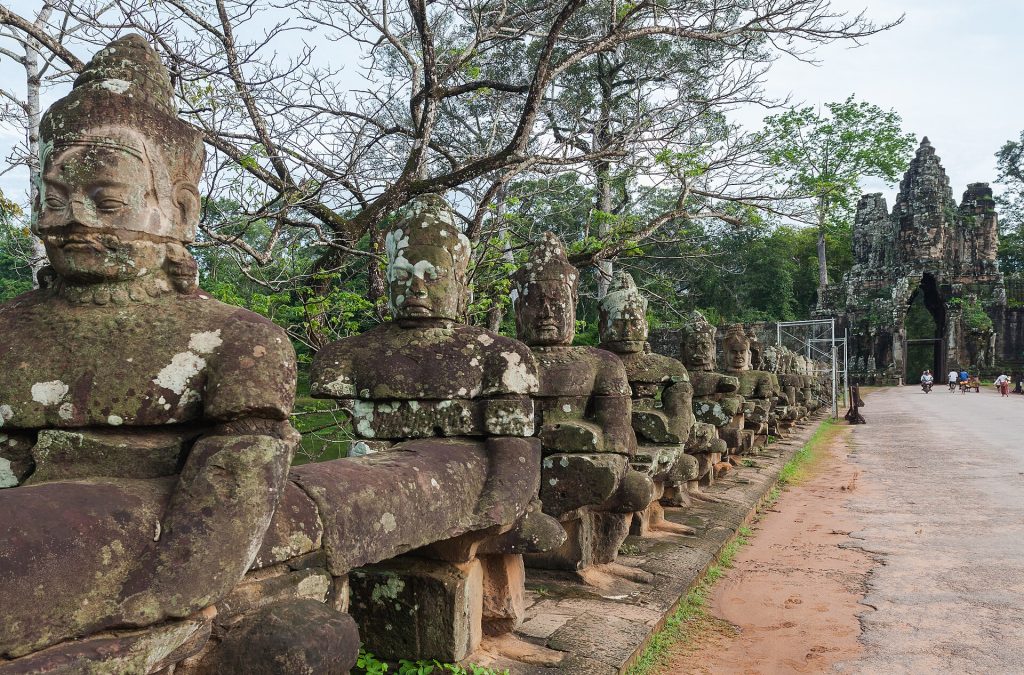
Angkor Thom, whose name means the Great City, was the last and most enduring capital of the mighty Khmer Empire, a fortified royal city set within the vast temple complex of Angkor in what is now Cambodia. It was a walled city on a colossal scale, its ramparts enclosing a square some three kilometers on each side, ringed by a broad moat and entered through monumental gates crowned with those unforgettable faces.
To wander through Angkor Thom is to move through the remains of a city that once teemed with life, home to a population of many tens of thousands, the political and religious heart of an empire that dominated Southeast Asia. Though the wooden buildings of the ordinary city have long since vanished, the great stone monuments endure, half-reclaimed by the jungle, their faces and towers rising from the green in a scene of haunting beauty.
This was a fortress as much as a temple-city, its high walls and wide moat designed to defend the sacred center of the Khmer world. Come and pass through its gates and stand beneath its smiling faces, and you will encounter one of the supreme achievements of human civilization, a walled capital that fused the arts of war and worship into a single magnificent whole.
There is a quality of encounter to Angkor Thom that few other monuments can match, a sense that the city is looking back at you as much as you are looking at it. Those great faces, gazing out with their faint enigmatic smiles, create an atmosphere quite unlike any other ruin, at once serene and uncanny, and it lingers in the mind long after you have left the shadow of the gates.
The Empire That Ruled Southeast Asia
To understand Angkor Thom, you must understand the Khmer Empire that built it, one of the most powerful and sophisticated civilizations of the medieval world. From its heartland around the great lake of Cambodia, the Khmer Empire rose over the centuries to dominate much of Southeast Asia, its power resting on a genius for water management that allowed it to sustain a vast population and to build on a scale unmatched in the region.

The Khmer kings were regarded as god-kings, divine or semi-divine rulers who mediated between heaven and earth, and they expressed their power and their piety through the construction of magnificent temples and cities. Over the centuries they raised the great complex of Angkor, an enormous sprawl of temples, reservoirs, and cities that was the largest urban settlement of the pre-industrial world.
The wealth that made all this possible came from the land and the water, from the sophisticated systems of canals and reservoirs that captured the monsoon rains and the floods of the great lake, allowing the Khmer to grow abundant rice and to feed a population of extraordinary size. This mastery of water was the foundation of Khmer greatness, the engine that drove the empire and made possible its monumental building.
At the height of its power, the Khmer Empire was a civilization of dazzling achievement, its arts, architecture, and engineering among the finest of the age. Angkor Thom was the culminating expression of this civilization, the great fortified capital raised at the peak of Khmer power, and to walk its ruins is to encounter the achievement of one of history’s most remarkable empires.
The achievements of the Khmer were all the more remarkable for the environment in which they were wrought, a land of monsoon and flood, of dense forest and difficult terrain, which the Khmer bent to their will through sheer ingenuity and organization. That they built the largest city of the pre-industrial world in such a setting is a testament to a civilization of the very first rank.
The Mastery of Water That Made It Possible
The secret behind the greatness of Angkor Thom, and of the whole Khmer civilization, lay not in stone but in water. The Khmer were among the most accomplished hydraulic engineers of the ancient world, and their mastery of water was the true foundation of their empire, the achievement that made possible the vast population and monumental building of Angkor.

Across the landscape around their capital, the Khmer built an immense system of canals, channels, and enormous reservoirs, capturing the abundant rains of the monsoon and the floodwaters of the great lake, storing them, and distributing them to the rice fields that fed the empire. This allowed the Khmer to grow rice in great abundance and to sustain a population far larger than the land could otherwise have supported.
The moat that ringed Angkor Thom was itself part of this vast hydraulic system, not merely a defensive feature but a component of the water management that was central to Khmer life. The whole landscape of Angkor was engineered, shaped by human hands to capture and control the water on which everything depended, an achievement of engineering as impressive in its way as the great temples themselves.
This mastery of water was the engine of Khmer greatness, and, many scholars believe, its eventual failure may have contributed to the empire’s decline. The great hydraulic systems required constant maintenance and were vulnerable to disruption, and when they faltered, the foundation of Khmer power was undermined. The city of stone that we admire rested, in the end, upon a hidden empire of water.
Gods, Demons, and the Churning of the Ocean
One of the most extraordinary features of Angkor Thom is the great sculptural tableau that lines the causeways leading to its gates, depicting one of the central myths of Hindu cosmology, the churning of the sea of milk. On one side of each causeway stand rows of gods, and on the other rows of demons, and between them they grasp the body of an enormous serpent, using it to churn the cosmic ocean.
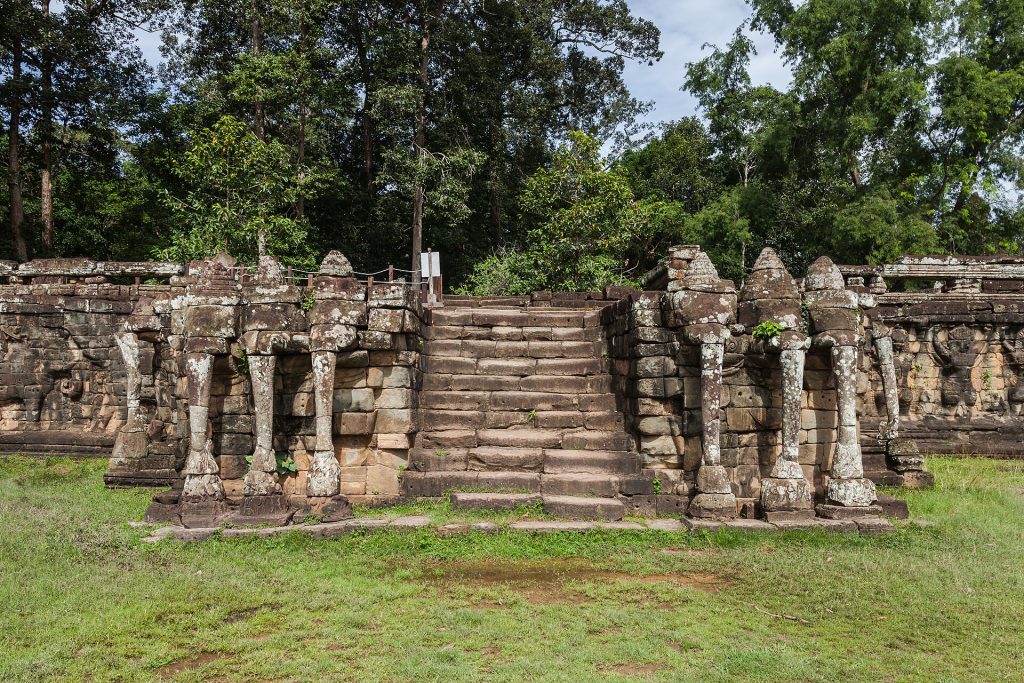
In the myth, gods and demons together churned the sea of milk in order to produce the elixir of immortality, using a great serpent coiled around a mountain as their churning rope. The Khmer rendered this cosmic drama in stone at the very threshold of their capital, so that to enter the city was to pass through a representation of the churning of the universe itself.
The meaning of this placement has been much discussed, but it clearly reflects the profound symbolic conception that underlay the whole city, the idea of Angkor Thom as a model of the cosmos, its gates and causeways charged with religious meaning. The gods and demons churning the ocean may represent the maintenance of cosmic order and balance, the very order that the god-king existed to uphold.
To walk between these great ranks of figures, gods on one hand and demons on the other, each straining upon the serpent, is to feel the depth of the spiritual vision that shaped Angkor Thom. This was no mere fortress but a sacred diagram of the universe, and its sculptures transform the approach to the city into a passage through the very myths that gave meaning to the Khmer world.
The Faces That Waited in the Forest
For centuries after its abandonment, Angkor Thom lay wrapped in the embrace of the jungle, its temples and walls overgrown, its great faces gazing out not over a bustling city but over a silent forest. Though the site was never entirely forgotten, and local people and pilgrims continued to know and visit the great temples, the full grandeur of the city slumbered beneath the encroaching vegetation.

The modern rediscovery and study of Angkor brought renewed attention to the great city, and over the following generations an enormous effort of clearing, documenting, restoring, and preserving the monuments was undertaken. The jungle was cut back, the temples stabilized, and the wonders of Angkor Thom revealed once more to the world, emerging from the forest like a dream made stone.
The relationship between the monuments and the jungle remains one of the most evocative aspects of Angkor, and at some of the temples the great trees have been deliberately left entwined with the stone, their roots draped over walls and towers in scenes of extraordinary romantic beauty. This union of nature and architecture has become one of the iconic images of Angkor, a symbol of the passage of time and the reclaiming power of the forest.
Today the monuments of Angkor Thom are protected as part of one of the most celebrated archaeological sites on earth, drawing visitors from every corner of the world and recognized as a heritage of outstanding universal value. The faces that waited so long in the forest now gaze out over a steady stream of admirers, and the great lost city has taken its place among the acknowledged wonders of human civilization.
The King Who Built the Great City
The founder of Angkor Thom was Jayavarman the Seventh, the most celebrated of all the Khmer kings and one of the great builders of history. He came to the throne in the late twelfth century, at a moment of crisis for the empire, after the capital had been sacked by an invading enemy, and he restored Khmer power and inaugurated the most ambitious building program the empire had ever seen.

Jayavarman built Angkor Thom as his capital, a fortified city to replace the vulnerable center that had fallen to the enemy, and he lavished upon it the full resources of his restored empire. An inscription of the time captures his devotion to the city with a beautiful image, describing the king as the groom and the city as his bride, a union of ruler and capital in a bond of love and creation.
Unlike many earlier Khmer kings, Jayavarman was a devotee of Buddhism, and this faith shaped the character of his great city, above all the extraordinary Bayon temple with its serene faces, which are widely thought to reflect Buddhist ideals. Under Jayavarman, the Khmer Empire reached perhaps its greatest extent and its most feverish pitch of construction, as temples, hospitals, and roads spread across his domains.
The reign of Jayavarman the Seventh was the last great flowering of the Khmer Empire, a burst of energy and creation that produced its most iconic monuments before the long decline that would follow. Angkor Thom stands as his supreme creation, the great fortified capital that embodies his vision, his faith, and his boundless ambition, the masterpiece of the greatest of the god-kings of Angkor.
Jayavarman was also a great builder of hospitals and rest houses, and inscriptions record his concern for the welfare of his people, casting him as a ruler who saw his power as a means of doing good on a vast scale. Whatever the reality behind the royal propaganda, the sheer volume of his construction transformed the Khmer landscape and left a legacy that has endured for eight centuries.
The Ramparts and the Moat of the Great City
Angkor Thom was, first and foremost, a fortress, and its defenses were conceived on a scale to match the grandeur of the empire that built it. The city was enclosed by a great square of laterite walls, each side running for three kilometers, rising some eight meters high, a formidable barrier of stone that sealed off the sacred and royal heart of the Khmer world from any enemy who might approach.

Beyond the walls lay a broad moat, a wide ring of water encircling the entire city, a formidable additional line of defense and also a component of the sophisticated water management for which the Khmer were famous. To cross the moat and reach the gates, one had to pass along great causeways, and these causeways were themselves among the most extraordinary features of the whole city.
The scale of the fortifications reflected the lessons of hard experience, for Jayavarman had built his new capital in the aftermath of the sacking of the earlier center, determined that his city should be secure against any future assault. The high walls and wide moat were the answer to that determination, transforming the royal city into a mighty stronghold at the heart of the empire.
Yet even these great defenses were more than merely military, for like everything in the Khmer conception, they carried symbolic meaning, the walls and moat representing the mountains and oceans that ringed the cosmos in Hindu and Buddhist cosmology. The city was thus a model of the universe as well as a fortress, its ramparts marking the boundary of a sacred and ordered world.
View on Google Maps (13.4413, 103.859)
The choice to build so mighty a system of walls and moat also reflected the confidence and the resources of Jayavarman’s restored empire, the ability to mobilize enormous labor for a project on this scale. The fortifications were a statement of power as much as a means of defense, proclaiming to all who approached the strength and the permanence of the god-king’s capital.
The Monumental Gates and Their Guardians
The gates of Angkor Thom are among the most spectacular monuments of the entire Khmer world, and passing through one of them is an experience no visitor forgets. There were five great gates in all, set at the cardinal points and along the axis to the royal palace, each a towering structure of stone crowned with the enormous faces that are the signature of the city, gazing out in the four directions.

The approach to each gate was made along a causeway crossing the moat, and these causeways were lined with the most remarkable sculptures, rows of stone figures depicting gods on one side and demons on the other, each row grasping the body of a great serpent. These sculptures represent a famous scene from Hindu mythology, the churning of the sea of milk, in which gods and demons pull upon a serpent to churn the cosmic ocean and produce the elixir of immortality.
To walk along one of these causeways, past the great ranks of gods and demons, and to pass beneath the towering faces of the gate, is to enter the sacred city through a threshold heavy with cosmic symbolism. The whole experience was designed to impress upon the visitor the sacred and ordered nature of the world they were entering, the realm of the god-king at the center of the universe.
The gates were both defensive strongpoints, controlling access to the walled city, and profound religious statements, their faces and sculptures embodying the spiritual vision of the Khmer. In them, the arts of fortification and of sacred architecture were fused into a single sublime creation, and they remain, centuries after the city was abandoned, among the most awe-inspiring monuments of the ancient world.
The faces upon the gate towers, echoing those of the Bayon at the center, unified the whole city under a single serene gaze, so that wherever one stood, within or without, one was watched over by these vast countenances. It was a stroke of artistic and spiritual genius, binding the fortifications and the temple, the defenses and the faith, into a single overwhelming vision.
The Bayon and Its Two Hundred Faces
At the very center of Angkor Thom stands the Bayon, the state temple of Jayavarman and the crowning masterpiece of his city, one of the most extraordinary and enigmatic monuments ever raised by human hands. It is a mountain of stone, its many towers each carved with enormous serene faces, so that from every angle the visitor is met by the gaze of these vast, half-smiling countenances, more than two hundred of them in all.
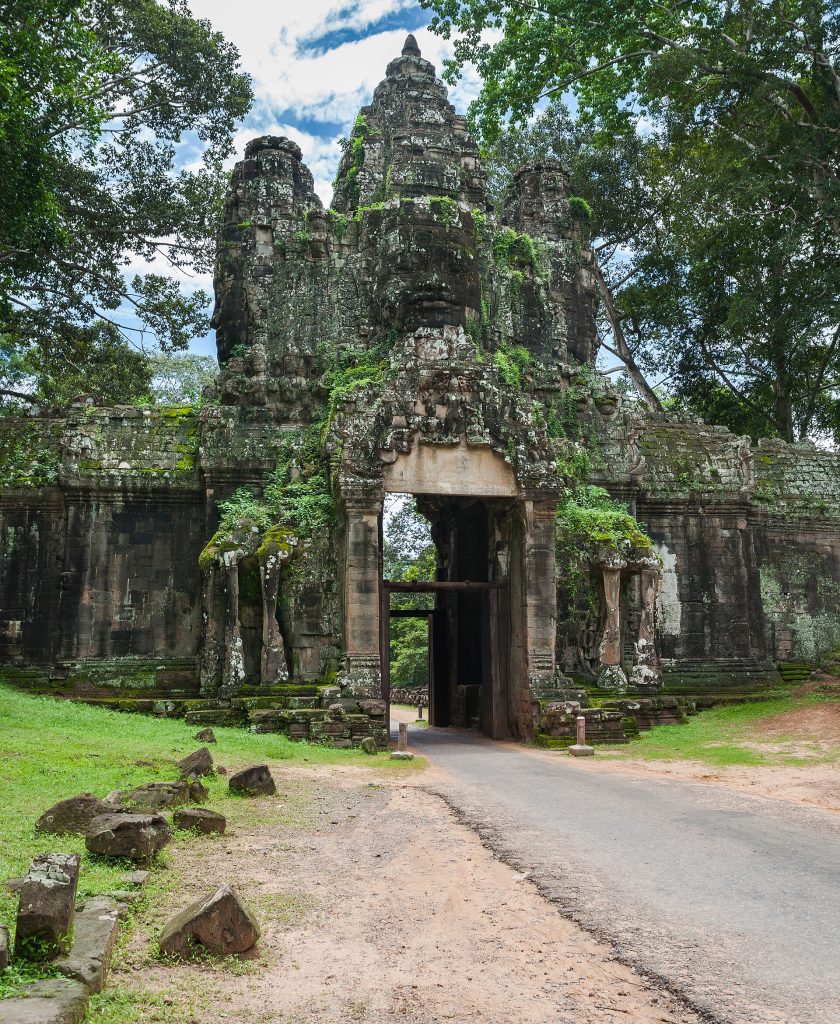
The meaning of the faces has been debated for generations. Many scholars believe they represent a bodhisattva, an enlightened being of Buddhist tradition, radiating compassion in all directions, while some see in them the features of Jayavarman himself, the god-king gazing out over his realm. Whatever their precise meaning, their effect is overwhelming, an atmosphere of serene and mysterious presence that fills the whole temple.
Beyond the faces, the Bayon is adorned with extraordinary bas-reliefs, carved galleries depicting not only the great myths and the wars of the Khmer but also, remarkably, scenes of everyday life, markets and cooking and fishing and festivals, offering a precious window into the daily world of the Khmer people. These carvings make the Bayon a treasure not only of art but of history, a record of a vanished civilization in stone.
To stand within the Bayon, surrounded by its towers and its gazing faces, is one of the great experiences that travel can offer, a sense of being watched over by a serene and ancient presence, of standing at the sacred center of a lost empire. It is the heart of Angkor Thom, the spiritual and symbolic core of the great city, and one of the supreme achievements of the art of Cambodia and of the world.
The Bayon rewards the patient and repeated visit above almost any other monument at Angkor, for its faces change with the light and the angle, revealing new aspects at every turn, and its labyrinth of galleries and towers seems to shift and surprise as one explores. Many visitors find themselves returning to it again and again, drawn back by its inexhaustible mystery and its incomparable atmosphere.
The Royal Terraces and the Vanished Palace
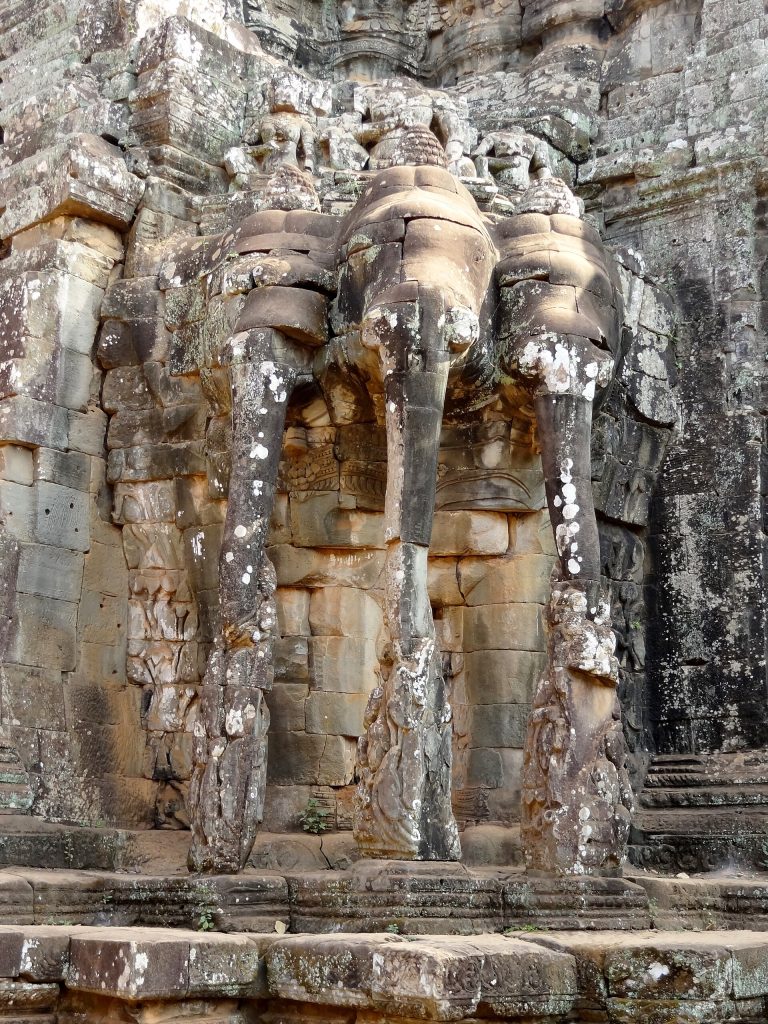
Near the center of Angkor Thom, close to the site of the vanished royal palace, stretch the great royal terraces, long raised platforms of stone from which the king would preside over ceremonies and review his forces. Chief among them is the Terrace of the Elephants, a magnificent structure hundreds of meters long, its walls carved with parades of elephants and other creatures, a grand stage for the display of royal and imperial power.

From this terrace, the god-king would look out over the great square before the palace, watching military parades, receiving processions, and presiding over the great ceremonies of state. The carvings that adorn it, the elephants, the hunting scenes, the mythical creatures, bring vividly to life the pomp and spectacle of the Khmer court at the height of its glory.
Nearby stands another remarkable structure, the Terrace of the Leper King, adorned with intricate carvings and named for a statue found upon it, its meaning wrapped in legend and mystery. Together these terraces formed the ceremonial heart of the royal precinct, the setting for the public life of the king and the great occasions of the empire.
The royal palace itself, built of wood, has long since vanished, as have almost all the secular buildings of the city, leaving only these great stone terraces to mark where the heart of Khmer government once beat. To stand upon them and gaze out over the empty space where the palace and the parades once were is to feel keenly the passing of the empire, and to sense the ghostly presence of the vanished court of Angkor.
Standing on the Terrace of the Elephants and looking out over the great open space, you can almost hear the trumpeting of the war elephants and the thunder of the parades that once filled it, the spectacle of the Khmer state in all its pomp. These terraces are among the most evocative spots in the whole city, the stage on which the public drama of the empire was performed.
The Vanished City of Wood and Life
It is easy, wandering among the great stone temples of Angkor Thom, to forget that they were once surrounded by a vast and living city, home to a population estimated in the tens or even hundreds of thousands. The stone monuments that survive were the sacred and royal core, but around them spread a great secular city of houses, markets, and workshops, built of wood and other perishable materials that have entirely vanished.
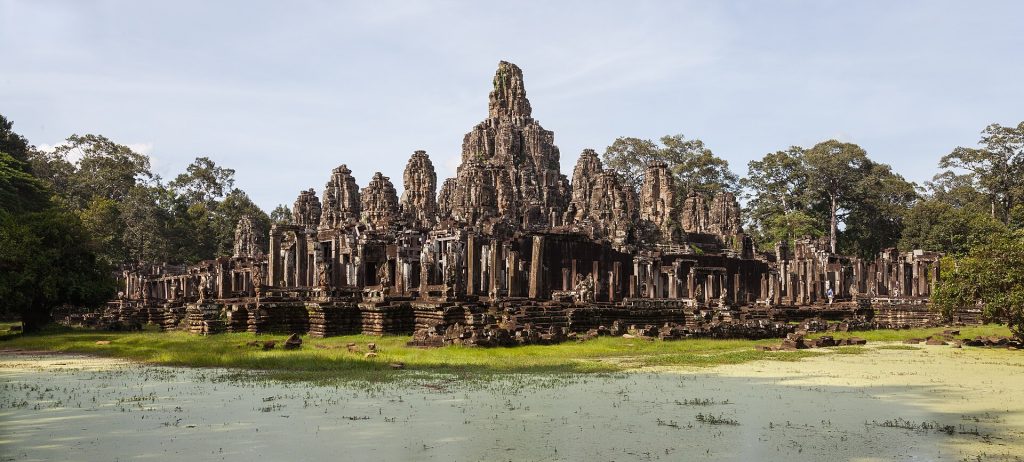
This vanished city was the largest urban settlement of its age anywhere in the world, a teeming metropolis sustained by the extraordinary water management of the Khmer. Its people, the farmers, artisans, merchants, priests, and officials who made the empire function, lived and worked in the space enclosed by the great walls, going about their lives in the shadow of the temples and the gazing faces of the Bayon.
We know something of this daily life from the carvings of the Bayon, which depict ordinary scenes with wonderful vividness, and from the account of a Chinese diplomat who visited the city near the end of its glory and left a precious description of its life and customs. Through these sources, the vanished city comes partly back to life, its markets and festivals and daily routines glimpsed across the centuries.
To imagine Angkor Thom fully is to populate its now-empty spaces with this vanished multitude, to picture the great city not as a silent ruin but as a bustling capital at the heart of a mighty empire. The stone temples we see are but the surviving skeleton of a living city, and to understand them is to remember the great and populous metropolis that once surrounded them and gave them their meaning.
The account left by that visiting Chinese diplomat is one of the most precious documents to survive about any ancient city, describing the customs, the trade, the religion, and the daily rhythms of Angkor near the end of its glory. Through his eyes we glimpse the great city as a living place, and his testimony has helped generations of scholars to reconstruct the vanished world within the walls.
The Slow Fall and the Great Abandonment
The glory of Angkor Thom did not last forever, and the centuries after Jayavarman saw the slow decline of the Khmer Empire that had built it. The precise causes of that decline are debated, and likely many, including the immense strain of the great building programs, shifts in religion and trade, the failure of the intricate water systems, and the pressure of rising rival powers on the empire’s borders.
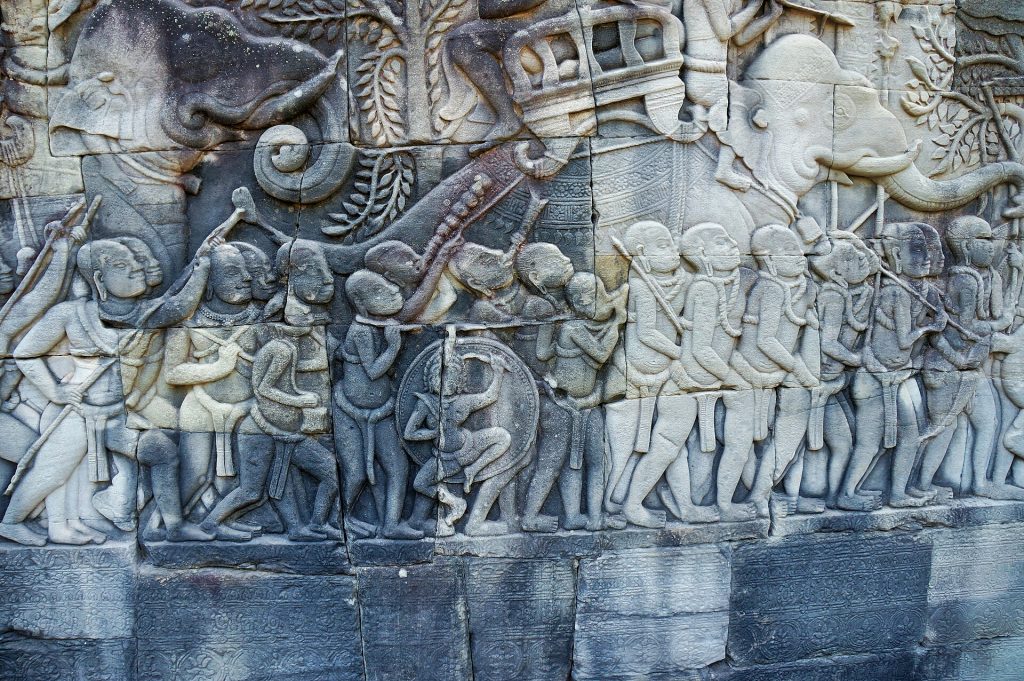
Among the decisive blows was the growing power of the Ayutthaya kingdom to the west, whose armies attacked the Khmer and put ever greater pressure on the capital. As the threat mounted and the empire weakened, the Khmer rulers eventually abandoned Angkor and moved their capital southward, toward the site of the modern Cambodian capital, closer to the trade routes and further from the Ayutthaya menace.
By the early seventeenth century, the great city of Angkor Thom lay largely abandoned, its temples left to the encroaching jungle, its population dispersed. The mighty capital that had been the heart of an empire fell silent, its wooden city rotting away, its stone monuments slowly swallowed by the forest, though some, like the great temples, were never entirely forgotten and continued to draw pilgrims.
For centuries the great city slumbered in the jungle, its walls and temples wrapped in vegetation, until the modern age brought renewed attention and the great work of clearing, studying, and preserving the monuments of Angkor. The abandonment of Angkor Thom marked the end of the classical age of Khmer civilization, but the city it left behind would endure to become one of the wonders of the world.
The decline of Angkor was not a sudden collapse but a long, slow ebbing, and the great city was never entirely emptied at a stroke. Yet the shift of the capital and the retreat of Khmer power marked the definitive end of the classical age of Angkor, and the great fortified city that Jayavarman had built with such love gradually passed from a living capital into a haunting monument to a vanished greatness.
Walking Among the Faces of a Lost Empire
Visiting Angkor Thom today is one of the great experiences that the world of travel can offer, an encounter with a lost civilization amid scenes of extraordinary beauty. The ancient city lies within the vast archaeological park of Angkor, near the modern town of Siem Reap, and it rewards the visitor who comes ready to explore its many monuments and to absorb the atmosphere of the great vanished capital.
Begin, as travelers have for centuries, by passing through one of the great gates, ideally the famous southern gate with its towering faces and its causeway of gods and demons, for there is no finer introduction to the wonders that await within. Then make your way to the Bayon at the center, and give yourself ample time to wander among its towers and its gazing faces and to study its remarkable bas-reliefs.
Explore the other great monuments too, the royal terraces with their carved elephants, the pyramid temple of the Baphuon, and the quieter corners where the jungle still presses close, and allow yourself to feel the scale and the mystery of the city. Come early or late in the day if you can, when the light is soft and the crowds are thinner, and the faces of the Bayon take on their most magical aspect.
Above all, come to Angkor Thom ready to be moved, for this is not merely a collection of ruins but the surviving heart of one of the greatest civilizations of the medieval world, a fortified sacred city whose smiling faces have gazed out over the jungle for eight centuries. Stand beneath them, walk the ancient causeways, and let the lost empire of the Khmer work its spell upon you. It is an experience you will carry with you for the rest of your life.
Give yourself more than a single hurried visit if you possibly can, for Angkor Thom is too vast and too rich to be absorbed in one pass, and its monuments reward the traveler who returns to them at different hours and in different lights. To spend several days among the temples of Angkor is to let their spell deepen, and to come away with a sense of the lost Khmer world that a brief visit can only hint at.
Castles Nearby
If Angkor Thom has captivated you, continue your journey through the great citadels of Asia:
You May Like

Fort Cornwallis: The Star Fort Where Penang Began