Some fortresses are remembered for the battles they fought, but Fort Cornwallis is remembered for the city it created. Standing at the northeastern tip of Penang island in Malaysia, this star-shaped colonial fort never once fired its guns in anger, yet it marks the very spot where the British founded the settlement that grew into George Town, one of the great port cities of Southeast Asia.
You come expecting a mighty fortress and find instead a low, geometric star fort by the sea, its bastions and silent cannon pointing out over the strait, its walls enclosing a peaceful green enclave at the heart of a vibrant heritage city. Here a sea captain founded a colony, a trading company built an empire, and a whole multicultural city was born.
This is the story of Fort Cornwallis, from the captain who founded it and the company that built it, through its star-shaped walls and its legendary cannon, to the great city of George Town that grew around it. Come and walk its ramparts with me, and stand at the place where Penang began.

In This Article
- The Star-Shaped Fort on the Edge of the Strait
- The Company That Built an Empire of Trade
- The Harbor That Commanded the Strait
- Life in the Early Colony
- A Fortress at the Heart of a Heritage City
- The Sea Captain Who Founded a Colony
- The Geometry of the Star Fortress
- The Fort Rebuilt in Brick by Convict Hands
- The Fortress That Never Fought a Battle
- The Great Cannon and Its Legends
- The Chapel, the Lighthouse, and the Grounds
- The Fort That Gave Birth to a City
- Walking the Ramparts Where Penang Began
The Star-Shaped Fort on the Edge of the Strait
Stand at the northeastern tip of George Town on the island of Penang, where the land meets the busy waters of the strait, and you will find the largest surviving fort in all of Malaysia, Fort Cornwallis. Its low walls trace the distinctive angular shape of a star, the classic form of the European fortress in the age of gunpowder, and though it never fired its guns in anger, it stands as the birthplace of one of the great port cities of Southeast Asia.

Fort Cornwallis is not a towering castle of the medieval kind but a low, geometric fortress of the modern military tradition, its walls forming a star with projecting bastions at the corners, designed to allow defenders to sweep every approach with fire. This was the cutting edge of fortification in its day, the shape of forts built by European powers around the world in the age of cannon and empire.
The fort marks the very spot where the British began the settlement that would become George Town and the colony of Penang, one of the earliest British footholds in the region and a key stage in the building of their empire in the East. To visit Fort Cornwallis is to stand at the foundation point of a whole city, the place from which modern Penang grew.
Today the fort sits at the heart of a historic city rich in the heritage of many cultures, a green and peaceful enclave of old walls, cannon, and colonial buildings by the sea. Come and walk its ramparts, and you will discover the origin of Penang and a fine example of the star-shaped fortress that European powers carried to every corner of the world.
There is a quiet, unhurried charm to Fort Cornwallis that suits its peaceful history, a sense of a place that has settled comfortably into its role as a monument and a green retreat within the busy city. The sea breeze, the old cannon, the low walls tracing their star against the waterfront, all combine to make it a serene and evocative spot, rich in history yet gentle in atmosphere.
The Company That Built an Empire of Trade
Fort Cornwallis was the creation not of the British crown directly but of the British East India Company, the extraordinary commercial and political organization that built much of the British empire in the East. To understand the fort is to understand this Company, a trading enterprise that came to rule vast territories and to command armies and navies of its own, blurring the line between commerce and conquest.

The Company sought bases and harbors along the great trade routes of Asia, points from which it could protect its shipping, control commerce, and project its power, and Penang was acquired precisely as such a base. Francis Light was a Company man, and the fort he founded was a Company fortress, part of the network of fortified trading posts through which the Company extended its reach across the East.
The acquisition of Penang gave the Company a valuable harbor on the route between India and China and the further reaches of the eastern seas, a place to shelter and supply its ships and to gather the trade of the region. Fort Cornwallis was built to secure this asset, the military anchor of a commercial venture that would grow into a cornerstone of British power in Asia.
In this the fort embodies the peculiar character of British expansion in the East, driven in its early stages not by the state but by a private company pursuing profit, yet building forts and founding colonies as it went. Fort Cornwallis stands as a monument to this age of company empire, the era in which a trading corporation laid the foundations of a colonial order that would endure for generations.
The blurring of trade and dominion that characterized the Company would eventually give way to direct rule by the British crown, but in the era when Fort Cornwallis was founded, it was the Company that reigned, and its forts and factories were the instruments of its power. Penang was among the jewels of this commercial empire in its early days, a base from which the Company’s influence spread through the eastern seas.
The Harbor That Commanded the Strait
The whole reason for Penang, and for the fort that guarded it, lay in the value of its harbor and its position, for the island commanded an important point on the maritime highways of the region. In an age when trade and power alike moved by sea, a good harbor at a strategic location was a prize of great value, and Penang offered exactly that.

The island lay along the routes that linked British India with the trade of the further East, the passage toward the vital waters of the strait and the markets of China and the East Indies beyond. A base here allowed the British to shelter and supply their ships, to gather the commerce of the surrounding region, and to establish a presence in waters where their rivals also contended.
Francis Light and the Company saw in Penang the potential to become a great free port, a place where the trade of many nations could gather, and to some degree this vision was realized as George Town grew into a thriving commercial center. The fort was the guarantor of this commercial promise, the strongpoint that secured the harbor and the settlement around it.
Though Penang would in time be overshadowed by other British ports established later in the region, it retained its importance as one of the earliest and most historic of the British settlements in the eastern seas. Fort Cornwallis, guarding its harbor, was the military foundation of this strategic outpost, the fortress that made possible the commercial dreams that drew the British to the island.
The establishment of Penang gave Britain a foothold that would prove strategically valuable for generations, a stepping stone in the building of a network of ports that came to span the region. Though the balance of British power in the eastern seas would shift over time, the founding of the settlement at Penang, guarded by Fort Cornwallis, marked an important early stage in that long process of expansion.
Life in the Early Colony
Around Fort Cornwallis there grew up the life of an early colonial settlement, a small and precarious world in its beginnings, clinging to the edge of the island and dependent on the fort for its security. The chapel within the fort, site of the colony’s first recorded marriage, is a touching reminder of the human dimension of this early settlement, the ordinary lives unfolding in the shadow of the ramparts.

The early colony was a rough and diverse place, drawing settlers, traders, laborers, and administrators from many origins, all gathered at this new outpost of British commerce and power. Life was shaped by the rhythms of trade and the sea, by the arrival and departure of ships, and by the ever-present awareness of the fort as the guarantor of the settlement’s safety.
The Company administration, centered on the fort, governed this growing community, and the fort served as the seat of authority and the symbol of order in the young colony. The business of running the settlement, collecting duties, administering justice, and managing the affairs of a diverse population went on within and around the fortress that anchored the whole enterprise.
As the decades passed and the settlement grew into the substantial city of George Town, the character of colonial life changed and matured, but the fort remained at its heart as the point of origin and the symbol of the colony’s foundation. To imagine the early colony is to picture this small world gathered around the fort by the sea, the beginning of the great city that would grow from it.
The diversity of the early settlement, drawing peoples from across Asia to the new port, set the pattern for the multicultural city that George Town would become, and even in those first decades the settlement was a meeting of many communities. This cosmopolitan character, present from the very founding of the colony, is one of the enduring legacies of the world that grew up around the fort.
A Fortress at the Heart of a Heritage City
Today Fort Cornwallis stands at the heart of a city celebrated for its extraordinary heritage, for George Town has been recognized as one of the finest surviving examples of a historic colonial trading city in Southeast Asia. The old center, with its wealth of heritage buildings and its living multicultural traditions, has made George Town a treasured destination and a place of global cultural importance.

The streets around the fort are lined with the architectural legacy of the many communities that have made George Town their home, the temples, mosques, churches, clan houses, and shophouses that reflect the city’s rich diversity. This living heritage, the product of centuries of trade and migration, gives George Town a character quite unlike anywhere else, and the fort stands as its historic anchor.
The recognition of the city as a heritage of outstanding universal value has brought a new appreciation of Fort Cornwallis and its place in the story of George Town, as the point from which the whole remarkable city grew. Efforts to preserve and interpret the fort have made it an important part of the heritage experience of Penang, a link to the origins of the colonial port.
To visit Fort Cornwallis today, then, is to visit not an isolated monument but the beating historic heart of a living heritage city, a fortress surrounded by the vibrant, multicultural fabric of George Town. The fort and the city are inseparable, and together they tell the story of one of the great port cities of the region, from its founding at the fort to its flourishing as a treasure of world heritage.
Walking from the fort into the surrounding streets, you pass almost seamlessly from the origin point of the city into the living heritage it produced, a continuity that makes George Town such a rewarding place to explore. The fort is the beginning of the story, and the city around it is the rich and ongoing continuation, the two forming a single historic whole.
The Sea Captain Who Founded a Colony
The story of Fort Cornwallis begins with a British sea captain named Francis Light, an adventurer and trader in the service of the British East India Company, who in 1786 took possession of the island of Penang and founded a settlement there. It was Light who chose the site at the tip of the island for his fort, and from that act sprang the whole colony and the city of George Town.

Light had negotiated the acquisition of the island from the local ruler, the Sultan of Kedah, and he saw in Penang a valuable base for British trade and naval power in the eastern seas, a harbor on the vital routes between India and the further East. He renamed the island in honor of the British royal heir, and set about establishing the settlement that his fort was built to protect.
The first fort that Light raised was a modest affair, a stockade of palm trunks with no permanent structures, a rough frontier fortification thrown up to secure the new settlement against pirates and other threats. It was the humble seed from which the substantial fort of later years would grow, the first mark of British power on the island.
Francis Light did not live to see his settlement flourish, dying only a few years after founding it, but his legacy endured in the colony he had established. Penang grew into an important British port, and Fort Cornwallis, named for a British governor-general, remained at its heart, the enduring monument to the sea captain who had founded a colony at the tip of the island.
Francis Light remains a figure of genuine historical importance, remembered as the founder of Penang and a key agent of British expansion in the region, and his choice of this site laid the foundation for everything that followed. The fort that bears not his name but that of a governor-general stands nonetheless as his lasting monument, the mark he left upon the island he acquired for the Company.
The Geometry of the Star Fortress
Fort Cornwallis is a fine example of the star fort, one of the most important developments in the history of military architecture. This distinctive form, with its angular, projecting bastions arranged around a central enclosure, was developed in Europe to meet the challenge of gunpowder artillery, which had rendered the tall, straight walls of medieval castles obsolete and vulnerable.

The genius of the star fort lay in its geometry. The projecting bastions at the corners allowed defenders to bring flanking fire to bear along the length of the walls, so that any attacker approaching the fortress could be caught in a deadly crossfire from multiple directions. There were no blind spots, no dead ground where an enemy could shelter, and the low, thick walls were designed to absorb and deflect cannon fire.
This form of fortification was carried by the European powers to every corner of their expanding empires, and star forts of this kind can be found from the Americas to Asia, the standard design for the defense of colonial settlements and trading posts. Fort Cornwallis is Southeast Asia’s representative of this global tradition, a textbook example of the star fort adapted to a tropical colonial setting.
Walking the ramparts of Fort Cornwallis today, you can trace the logic of the star design, the way the bastions project to command the walls, the low profile built to withstand bombardment, the whole geometric form expressing the science of fortification in the age of gunpowder. It is a fine and well-preserved example of a form that shaped the defense of colonial empires around the world.
View on Google Maps (5.4206, 100.3439)
The star fort was one of the great technological responses to the revolution in warfare brought about by gunpowder, and its geometric forms, worked out by military engineers over generations, represent a fascinating chapter in the history of architecture and science. That so complete an example should stand in Southeast Asia is a testament to the global reach of this European military tradition.
The Fort Rebuilt in Brick by Convict Hands
The modest wooden stockade that Francis Light first raised did not long suffice, and in the early nineteenth century, as the wider world was convulsed by the Napoleonic Wars and the security of the colony seemed more pressing, the British undertook to rebuild Fort Cornwallis in permanent form. Between roughly 1804 and 1810, the fort was reconstructed in brick and stone, creating the substantial fortress that survives today.

The rebuilding was carried out in large part by the labor of Indian convicts, prisoners transported to the colony and set to work on its construction, a common practice in the building of British colonial infrastructure in the region. Their toil raised the brick walls and bastions of the fort, and the substantial fortification that resulted was a considerable investment for the growing colony.
The rebuilt fort was surrounded by a moat, a wide and deep ditch adding to its defenses, though this moat was later filled in during the twentieth century in response to a public health concern, an outbreak of disease associated with the standing water. The filling of the moat altered the setting of the fort, but the walls and bastions themselves endured.
The reconstruction in brick transformed Fort Cornwallis from a rough frontier stockade into a proper colonial fortress, the largest of its kind in the region, a solid and permanent assertion of British power at the heart of the growing port of George Town. It is this early nineteenth-century fort, raised by convict hands, that the visitor explores today.
The Fortress That Never Fought a Battle
There is a striking irony at the heart of Fort Cornwallis, for despite all the effort and expense of its construction, despite its bastions and its guns and its moat, the fort never once engaged in battle. In all its long history, no enemy ever assaulted its walls, and its cannon never fired in anger against a hostile force. The mighty fortress proved, in the event, to be primarily an administrative center rather than a military one.

This peaceful history reflects the fortunate circumstances of Penang, which, despite the fears that prompted the fort’s construction, never faced the serious military threat that had been anticipated. The pirates and rivals against whom the fort was built never mounted a major assault, and the wars that convulsed the wider world largely passed the colony by, leaving its fortress untested.
Instead of a military stronghold, Fort Cornwallis served as the administrative heart of the colony, housing the offices and functions of the British administration and serving as the symbolic center of British authority on the island. Its guns pointed out to sea, ready for an enemy that never came, while within its walls the business of running a colony went quietly on.
There is something almost poignant in a great fortress that never fulfilled the martial purpose for which it was built, its guns forever silent, its walls never tested. Yet this peaceful history is also a blessing, for it meant that Fort Cornwallis was spared the destruction that befell so many fighting fortresses, and it survives today largely intact, a well-preserved monument to a colonial past that, at least here, was more peaceful than its builders feared.
The peaceful fate of Fort Cornwallis stands in poignant contrast to the many fortresses of the region that were battered by siege and war, and it is precisely this good fortune that has allowed it to survive so well. In a sense, the fort’s failure to fulfil its military purpose was its salvation, sparing it the destruction that has erased so many of its contemporaries elsewhere in the world.
The Great Cannon and Its Legends
Among the guns of Fort Cornwallis, one has a special fame and a story all its own: the great cannon known as the Seri Rambai, the most celebrated piece of artillery in the fort and the subject of local legend. This historic bronze cannon, with a long and complicated history of its own before it came to rest at Fort Cornwallis, has become one of the most beloved features of the site.

The Seri Rambai had passed through several hands over the centuries before the British acquired it and placed it upon the ramparts of the fort in the later nineteenth century. Its journey to Penang was long and eventful, and it arrived at Fort Cornwallis bearing the weight of a history that stretched back long before the founding of the British colony.
Around the great cannon there have gathered local legends and beliefs, and it has become an object of folk veneration, associated in popular tradition with fertility and the granting of wishes. Visitors and locals alike have long regarded the Seri Rambai with a certain reverence, and offerings and rituals have attached themselves to the old bronze gun over the years.
The Seri Rambai stands today as one of the highlights of a visit to Fort Cornwallis, a historic artillery piece rich in both military and folk history, pointing out over the strait from the ramparts of the fort. In its long journey and its accumulated legends, it embodies the layered history of the region, and it is among the most cherished treasures of the old fortress.
The reverence attached to the Seri Rambai reflects the way that historic objects can accumulate layers of meaning quite apart from their original purpose, becoming vessels for local belief and tradition. The old cannon, made for war, has become an object of hope and veneration, a striking example of how the meaning of a monument can be transformed by the communities that live alongside it.
The Chapel, the Lighthouse, and the Grounds
Within and around the walls of Fort Cornwallis stand a number of structures that add to the interest of the site and tell the story of colonial life on the island. Among them is a small chapel, one of the oldest surviving structures in the fort, which holds the distinction of being the site of the first recorded Christian marriage in the colony, a poignant reminder of the human lives that unfolded within the fortress.

In one corner of the fort rises a lighthouse, a skeletal steel structure erected in the later nineteenth century to guide ships safely along the coast and into the harbor. The lighthouse reflects the enduring maritime purpose of the site, for Penang was above all a port, and the fort that guarded its harbor was bound up with the ships and the trade that were the colony’s lifeblood.
The grounds of the fort contain other traces of its history, including the remains of buildings that served the administration and the garrison, and displays that tell the story of the fort and the founding of Penang. Old cannon line the ramparts, pointing out to sea, and the whole enclosure has the peaceful, green character of a historic site long since retired from any military purpose.
Together these features make Fort Cornwallis a rewarding place to explore, a compact but rich historic site where the story of colonial Penang is told through its buildings and relics. The chapel, the lighthouse, the cannon, and the walls all combine to evoke the world of the early British colony, the settlement that Francis Light founded and that grew into the great city of George Town.
These varied structures, the chapel, the lighthouse, the old administrative buildings, together sketch the outlines of the vanished colonial world that centered on the fort, each one a fragment of the life that once filled the fortress. To seek them out is to piece together the human story of the place, beyond the walls and the cannon, the lives that unfolded within the star-shaped fort by the sea.
The Fort That Gave Birth to a City
Fort Cornwallis was not merely a fortress but the seed of a city, for it was around this fortification that the settlement of George Town grew, spreading out from the fort to become one of the great port cities of Southeast Asia. The founding of the fort was the founding of the city, and the two have been bound together from the very beginning.
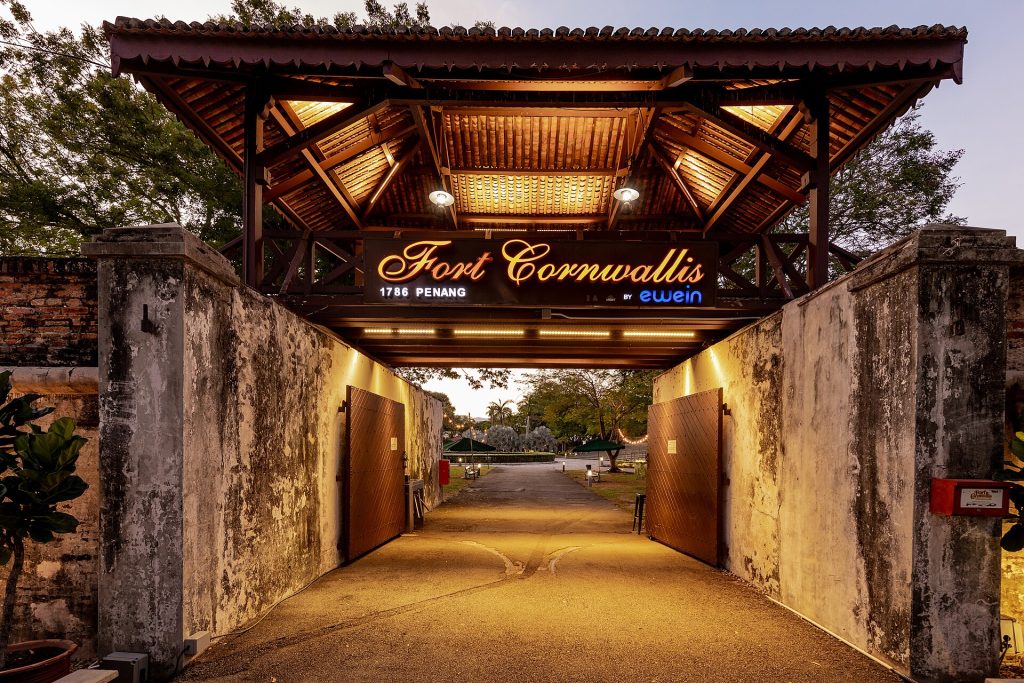
George Town developed into a bustling and cosmopolitan port, drawing merchants and settlers from across Asia and beyond, its population a rich mixture of Malay, Chinese, Indian, European, and other communities. This diversity, born of the city’s role as a trading crossroads, gave George Town a uniquely multicultural character that endures vividly to this day.
The layout of the old city, spreading out from the fort along the waterfront and inland, reflects its organic growth from the original settlement, and its streets are lined with the heritage buildings of many eras and cultures, the temples, mosques, churches, shophouses, and colonial buildings that tell the story of its diverse population. The whole historic center is a treasure of colonial-era urban heritage.
The recognition of George Town as a heritage of outstanding universal value has confirmed the importance of this remarkable city, and Fort Cornwallis stands at its heart as the point of origin, the fortress around which the whole city grew. To understand the fort is to understand the birth of George Town, and to appreciate the fort’s place at the very foundation of one of the great multicultural cities of the region.
The story of George Town is, in miniature, the story of the whole cosmopolitan world of the colonial-era port cities of Asia, places where the trade of the world brought together peoples of every origin into a rich and often uneasy coexistence. That this heritage survives so vividly in George Town makes the city, and the fort at its heart, a precious window into that vanished world.
Walking the Ramparts Where Penang Began
Visiting Fort Cornwallis today is a pleasant and rewarding experience, a chance to walk the ramparts where the city of Penang began and to explore a fine example of a colonial star fort by the sea. The fort sits within the historic heart of George Town, easily reached and set amid the rich heritage of the old city, making it a natural centerpiece for any exploration of Penang’s past.

Walk the ramparts and trace the star-shaped plan of the fort, examining the bastions and the old cannon that line the walls, and seek out the famous Seri Rambai with its legends and its long history. Visit the small chapel, one of the oldest structures on the site, and the lighthouse in the corner, and take in the displays that tell the story of the fort and the founding of the colony.
Take the time, too, to appreciate the setting, the fort’s position at the tip of the island where the land meets the strait, and the way the old fortress sits within the fabric of the living historic city around it. From the fort, you can venture out into the streets of old George Town, with its wealth of heritage buildings and its vibrant multicultural life.
Come to Fort Cornwallis ready to encounter the origins of Penang and a fine example of the colonial fortress, a star fort by the sea that never fought a battle but gave birth to a great city. Walk its ramparts, contemplate its silent guns, and reflect on the sea captain who founded a colony here, and the fort will reward you with a rich encounter with the colonial history of Malaysia and the birth of one of its most beloved cities.
From the ramparts you can look out over the same waters that drew Francis Light to the island more than two centuries ago, the strait busy still with the shipping that has always been the lifeblood of Penang. It is a fitting vantage from which to contemplate the whole arc of the city’s history, from the founding of the fort to the flourishing of the heritage city that surrounds it today.
Castles Nearby
If Fort Cornwallis has kindled your love of colonial-era fortresses, continue your journey with these remarkable sites:
You May Like
Fort San Pedro: The Oldest Fort in the Philippines


One thought on “Fort Cornwallis: The Star Fort Where Penang Began”