High on the hill at the heart of Baku’s walled old city, where the tangle of ancient lanes rises above the Caspian Sea, stands a complex of honey-colored stone buildings that once formed the very center of power in the eastern Caucasus. This is the Palace of the Shirvanshahs, the residence of the medieval rulers of Shirvan, and it is widely regarded as one of the pearls of Azerbaijani architecture and among the finest surviving monuments of the medieval Islamic world in the whole Caspian region.
Unlike the grand baroque and neoclassical palaces of Europe, this is a palace of a different order, built in the fifteenth century from the pale local limestone, its beauty lying not in gilding and marble but in the subtle carving of stone, the play of light on austere walls, and the harmonious grouping of buildings around courtyards on the sloping ground. It is a masterpiece of restraint, a royal complex whose dignity comes from proportion and craftsmanship rather than ostentation.
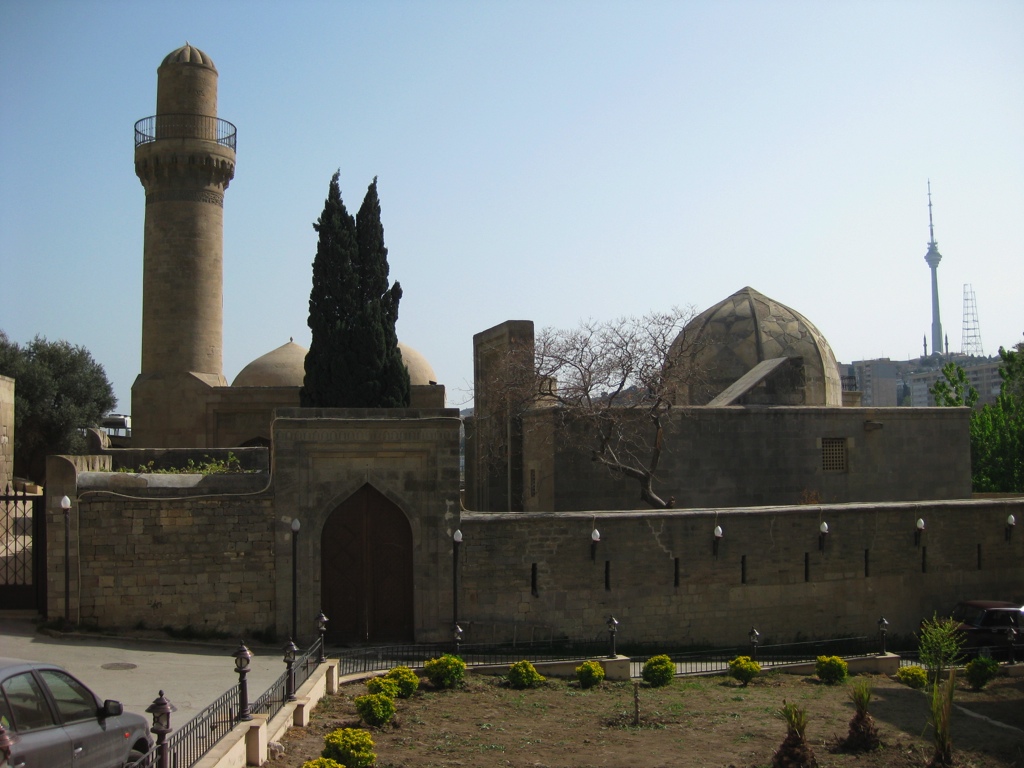
The palace is not a single building but a complex of structures, the main palace, a burial vault, a mosque with its slender minaret, a mausoleum for a revered scholar, a bathhouse, and other elements, all knitted together on the hillside. Together they tell the story of the Shirvanshah dynasty at the height of its power, when the rulers of Shirvan moved their capital to Baku and set about creating a residence worthy of their standing.
Over the following pages you will explore the whole story of this remarkable place, from the medieval dynasty that built it and the architecture that makes it so special, through its courtyards, tombs, mosque, and bathhouse, to its survival through centuries of conquest and its recognition today as a treasure of world heritage. Come and discover the stone palace on the hill above the Caspian.

In This Article
- The Shirvanshahs and Their Realm
- Moving the Capital to Baku
- A Complex, Not a Single Palace
- The Art of Carved Stone
- The Main Palace and the Divankhana
- The Mosque and Minaret
- The Burial Vault and Mausoleum
- The Bathhouse and Daily Life
- Conquest and the End of the Dynasty
- Rediscovery and World Heritage
- A Symbol of Azerbaijani Heritage
- See the Palace for Yourself
- Visiting the Palace Today
The Shirvanshahs and Their Realm
To understand the palace you must first meet its builders, the Shirvanshahs, one of the longest-lasting dynasties in the history of the Islamic world. For many centuries these rulers governed Shirvan, a region in what is now Azerbaijan lying between the Caucasus mountains and the Caspian Sea, and they maintained their identity and much of their independence through wave after wave of conquest and upheaval.
Shirvan was a land of strategic importance and considerable wealth. It sat astride trade routes linking the steppes of the north with Persia and the Middle East to the south, and its territory included fertile lands, valuable resources, and access to the Caspian. The Shirvanshahs drew on this wealth to sustain a sophisticated court culture, patronizing poets, scholars, and craftsmen, and the region became a notable center of Persian and Islamic learning.
The dynasty’s endurance was remarkable. Where other ruling houses rose and fell within a few generations, the Shirvanshahs persisted through the coming of Islam, the invasions of the Seljuk Turks, the devastation of the Mongols, and the campaigns of Timur, adapting and surviving where others were swept away. This longevity gave Shirvan a deep continuity of tradition that few other states in the region could match.
It was in the fifteenth century, under a vigorous line of rulers, that the Shirvanshahs reached a new peak of power and prestige, and it was then that they made the decision that would give us the palace we admire today, the transfer of their capital to the coastal fortress city of Baku.
The very title shah, meaning king, that these rulers bore speaks to their pretensions and their place in the Persianate world. Though they governed a comparatively small realm, the Shirvanshahs saw themselves as heirs to ancient traditions of kingship, and they cultivated a court culture that consciously echoed the great courts of Persia, from the poetry recited in their halls to the etiquette that governed their ceremonies.
Moving the Capital to Baku
For much of their history the Shirvanshahs had ruled from the inland city of Shamakhi, their traditional capital. But in the fifteenth century, following an earthquake and shifting political circumstances, the rulers turned their attention to Baku, a fortified port on the Caspian whose walls and harbor offered both security and access to maritime trade.
Baku was an ideal seat for a dynasty conscious of the dangers of its age. Ringed by walls and set beside the sea, the city could be defended against the land-based armies that periodically swept through the region, and its harbor connected Shirvan to the wider world of Caspian commerce. Moving the capital here was a strategic decision that reflected the realities of power in a turbulent era.
Having chosen Baku, the Shirvanshahs set about building a residence befitting their status at the highest point of the walled city, on the hill overlooking the sea. The elevated site was both practical and symbolic, placing the ruler literally above his subjects and giving the palace commanding views over the city, the harbor, and the Caspian beyond.
The construction of the palace complex over the course of the fifteenth century transformed this hilltop into the ceremonial and spiritual heart of Shirvan, a place where the ruler lived, worshipped, administered his realm, and would ultimately be buried, all within a single harmonious ensemble of buildings.
The move also reshaped Baku itself. As the new capital, the city drew resources, people, and prestige, and the building of the palace complex gave it a monumental heart that it had previously lacked. The decision of the fifteenth-century Shirvanshahs thus laid the foundations for Baku’s long career as the principal city of the region, a role it retains as the capital of modern Azerbaijan.
A Complex, Not a Single Palace
One of the most important things to understand about the Palace of the Shirvanshahs is that it is not a single monumental building but a complex of separate structures, each with its own function, grouped together on the sloping hilltop. This arrangement reflects the way medieval Islamic royal residences typically worked, as clusters of buildings serving the many needs of court and dynasty.

The principal structure is the main palace itself, a two-storey building that housed the residential and ceremonial functions of the court. Nearby stand the Divankhana, an elegant pavilion thought to have served for audiences or councils, the family burial vault, the court mosque with its minaret, the mausoleum of a revered scholar, and a bathhouse, along with other elements and remains.
The buildings are arranged across different levels of the sloping ground, connected by courtyards, stairs, and passages, so that moving through the complex is a matter of ascending and descending, discovering each structure in turn. This adaptation to the terrain is part of the complex’s charm, giving it a picturesque, unfolding quality quite different from the rigid symmetry of many later palaces.
Taken together, these buildings provided everything the Shirvanshahs required, a place to live and rule, a place to worship, a place to honor their scholars, a place to bathe, and a place to be buried, all unified by a shared architectural language of pale carved stone.
This scattering of buildings across the slope also had a practical logic. Separating functions into distinct structures, rather than piling them into one great block, allowed each building to be sized and oriented for its purpose, made the whole easier to build in stages over time, and reflected the way a medieval court actually operated as a set of overlapping communities, the ruler’s household, the religious establishment, the servants, and the guards.
The Art of Carved Stone
The defining characteristic of the palace’s architecture is its masterful use of the local limestone, a pale, warm-toned stone that the builders of Baku had worked for centuries. Rather than concealing this material beneath plaster and tile, the architects of the Shirvanshahs celebrated it, using the subtle carving of stone as their principal means of decoration and expression.
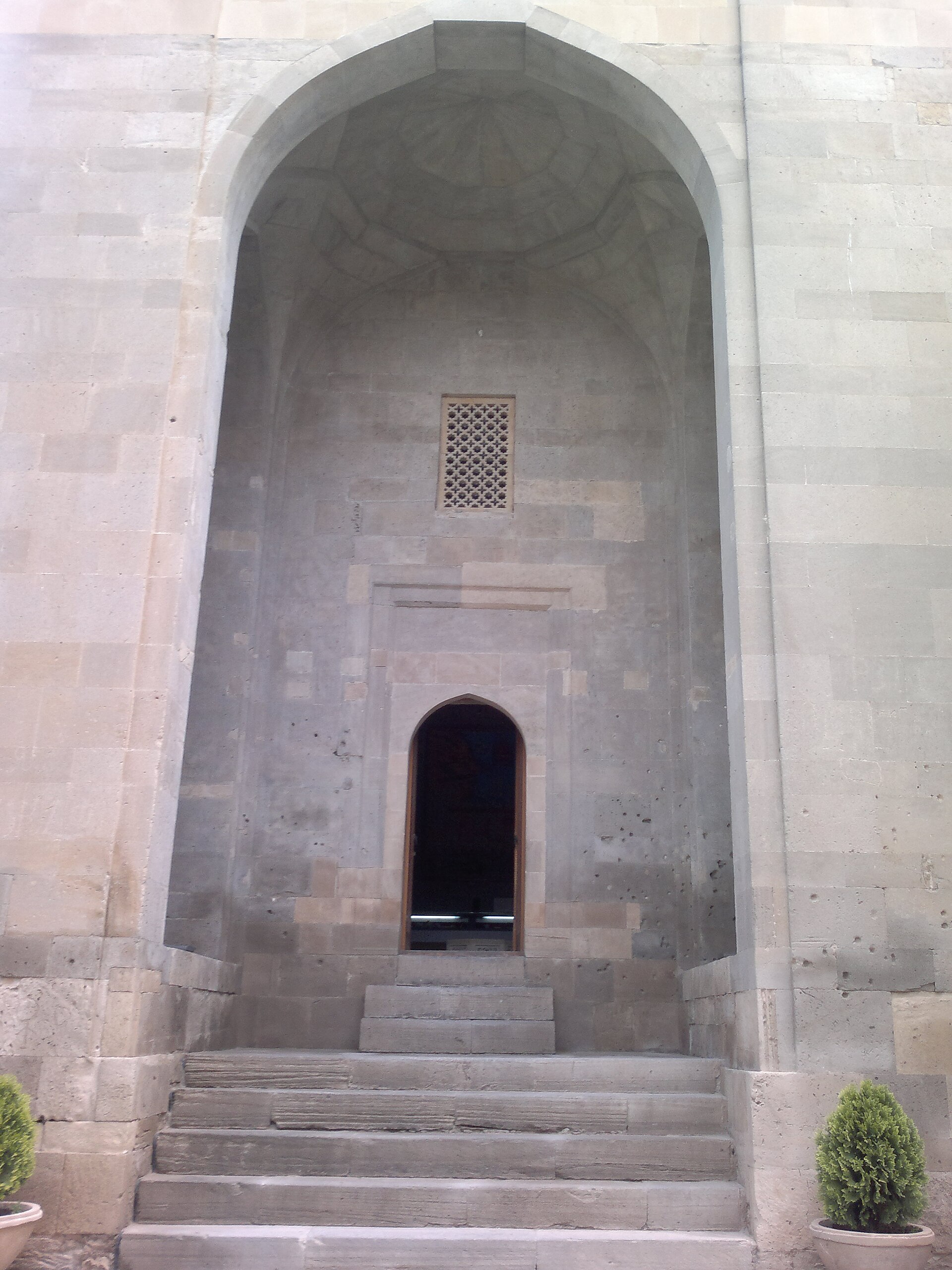
This restraint is what gives the complex its distinctive character. Where many Islamic palaces dazzle with brilliant ceramic tiles and intricate colored ornament, the Palace of the Shirvanshahs achieves its effect through the interplay of plain surfaces and carefully placed carving, through proportion, and through the way the pale stone catches the strong Caspian light. It is architecture of great sophistication expressed with remarkable economy.
The finest carving is concentrated where it matters most, around portals, on the Divankhana, and in the decorative details that reward the attentive visitor. Here the stone is worked into intricate patterns, inscriptions, and geometric designs, showing the high skill of the craftsmen who created them and providing points of richness against the calm of the broader walls.
The overall effect is one of serene, austere beauty, a palace that seems to grow naturally from the stone of the hill on which it stands, at once monumental and humane, grand yet never overwhelming. It is this quality that has earned the complex its reputation as a masterpiece of medieval Azerbaijani and Islamic architecture.
It is worth pausing to appreciate how deliberate this restraint was. The Shirvanshah builders were perfectly capable of lavish ornament, as the carved portals demonstrate, but they chose to deploy it selectively, trusting in the beauty of proportion and material to carry the greater part of the effect. This confidence in simplicity is a mark of the highest architectural maturity.
The Main Palace and the Divankhana
At the core of the complex stands the main palace building, a substantial two-storey structure that served as the residence and administrative heart of the Shirvanshah court. Its many rooms, arranged over two floors, housed the ruler and his household and provided the spaces needed for the business of governing Shirvan.

The building’s plan reflects the practical needs of a working court, with a mixture of larger and smaller rooms connected by passages and stairs. Though the original furnishings are long gone, the surviving architecture allows the visitor to sense the scale and organization of the ruler’s residence, and to imagine the life that once filled these now-empty stone chambers.
Close by is one of the most admired structures in the whole complex, the Divankhana, a graceful stone pavilion set within its own small courtyard and surrounded by an arcaded gallery. The exact purpose of the Divankhana is not certain, but it is generally thought to have served as a place for audiences, councils, or ceremonies, and its refined proportions and fine carving make it a jewel of the ensemble.
The Divankhana’s portal is especially celebrated for the quality of its carved decoration, and the pavilion as a whole represents the height of the Shirvanshah builders’ art, a small building of exceptional elegance that concentrates the beauty of the entire complex into a single perfect form.
Standing in the courtyard before the Divankhana, it is easy to see why this small pavilion has captivated visitors and scholars alike. Its arcade of arches, its careful symmetry, and the delicacy of its carving combine to produce an impression of perfect balance, a building that feels complete and inevitable, as though it could not have been made any other way.
The Mosque and Minaret
No royal complex in the Islamic world would be complete without a place of worship, and the Palace of the Shirvanshahs includes its own court mosque, built to serve the ruler and his household. The mosque is a relatively modest but dignified structure, its plain stone walls in keeping with the restrained aesthetic of the whole ensemble.

Rising beside the mosque is its slender minaret, one of the most recognizable features of the palace complex when seen from a distance. The minaret carries an inscription recording its construction, tying the building to a specific moment in the fifteenth century and to the ruler who ordered it, and its graceful vertical form provides a counterpoint to the low, spreading masses of the other buildings.
The mosque anchored the spiritual life of the court, the place where the Shirvanshahs performed their prayers and affirmed their role as Muslim rulers. In the medieval Islamic conception of kingship, the ruler was not merely a political leader but a protector of the faith, and the presence of the mosque at the heart of the palace expressed this dual responsibility.
For the visitor today, the mosque and its minaret are among the most evocative parts of the complex, a reminder that this was not only a seat of worldly power but a place of devotion, where the rhythms of prayer once ordered the days of the ruler and his court.
The quiet dignity of the mosque also tells us something about the Shirvanshahs’ understanding of their own role. A ruler who built modestly for God while building substantially for himself would have sent one message; here the restraint of the whole complex, palace and mosque alike, suggests a court that valued a certain sober elegance across every part of its life, sacred and secular together.
The Burial Vault and Mausoleum
Death and remembrance had their place within the palace complex as surely as life and worship. The Shirvanshahs built a family burial vault where members of the ruling dynasty were laid to rest, integrating the memory of the dead into the living heart of their residence in a way characteristic of many royal houses.

The burial vault is a solemn, dignified structure, its portal richly carved, its interior designed to receive the tombs of the royal family. Here the rulers who had governed Shirvan and their kin were interred, so that the dynasty’s past remained physically present within the complex, a constant reminder of the continuity that was the Shirvanshahs’ great strength.
Nearby stands another tomb of a very different character, the mausoleum built to honor a revered scholar and holy man associated with the court. That the Shirvanshahs chose to commemorate a man of learning and piety with his own mausoleum within the royal complex speaks to the value they placed on scholarship and religion, and to the close relationship between the court and the intellectual life of Shirvan.
These funerary structures add a note of gravity and reflection to the complex, reminding the visitor that the palace was not only a stage for the display of power but a place bound up with the deepest questions of memory, faith, and mortality.
Visitors often find the burial vault the most affecting part of the complex. There is something powerful in standing where a long line of rulers chose to be laid to rest at the very center of their own residence, refusing to separate the world of the living from the world of the dead, and insisting that the dynasty’s past remain always in view of its present.
The Bathhouse and Daily Life
Among the more unexpected but revealing parts of the complex are the remains of the palace bathhouse, or hammam, a facility that was an essential part of life in the medieval Islamic world. The bathhouse served the practical needs of hygiene but also functioned as a social space, a place of relaxation and gathering that was central to the culture of the time.
Built partly below ground to conserve heat, the bathhouse consisted of a series of chambers of varying temperature, through which bathers would progress, along with the systems needed to heat water and circulate warmth. Even in their ruined state, the surviving remains give a vivid sense of the sophistication of medieval engineering and the importance placed on cleanliness and comfort.
The presence of the bathhouse reminds us that the palace was a living community, not merely a set of ceremonial spaces. Alongside the grand halls and the mosque, the everyday needs of the ruler, his family, and his servants had to be met, and facilities like the hammam were part of the practical infrastructure that made courtly life possible.
For the modern visitor, the bathhouse offers a window into the human dimension of the palace, a reminder that beneath the grandeur of dynasty and architecture, this was a place where people lived their daily lives, washed, rested, and talked, century after century.
Bathhouses like this one were also, in a sense, democratic spaces within a hierarchical world, places where the ordinary business of the body brought people together across the divisions of rank that governed so much of medieval life. That such a facility was built into the heart of a royal complex reminds us how deeply the culture of the hammam was woven into the fabric of society in this part of the world.
Conquest and the End of the Dynasty
The golden age that produced the palace could not last forever. In the early sixteenth century the rising power of the Safavid dynasty of Persia overwhelmed Shirvan, and the long independence of the Shirvanshahs came to an end as their realm was absorbed into the expanding Safavid empire. The dynasty that had endured for so many centuries finally passed from the stage of history.

With the fall of the Shirvanshahs, the palace lost its original purpose as the residence of an independent ruling house. Baku and Shirvan passed under the control of a succession of powers over the following centuries, from the Safavids to other empires, and the palace was adapted, neglected, or repurposed according to the needs and priorities of each new master.
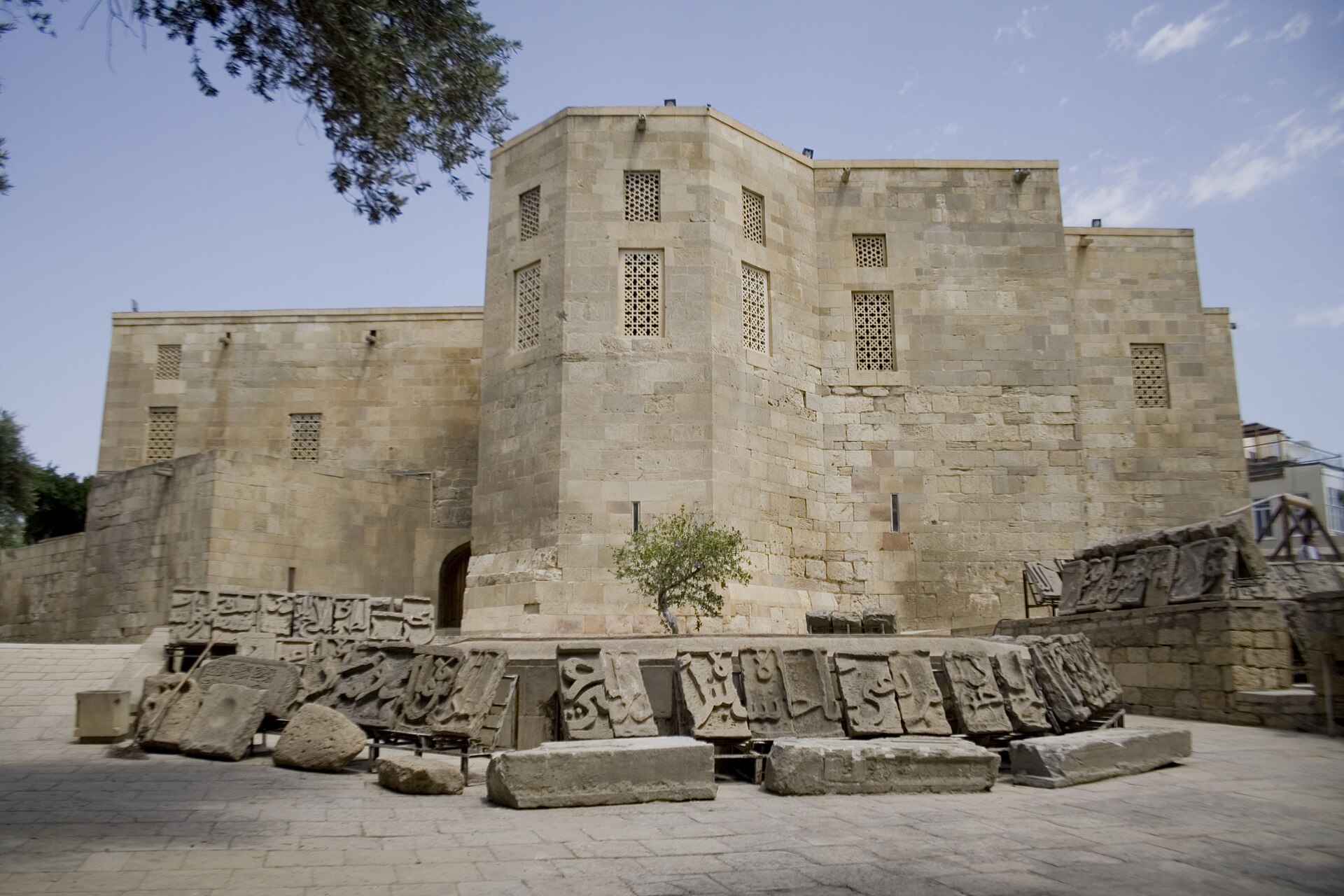
The complex bore the marks of these turbulent centuries. It suffered damage in various conflicts, and traces of later fighting can still be seen on some of its walls, a reminder that the peaceful monument admired by today’s visitors was once caught up in the violent struggles for control of the Caspian region.
Yet through all these changes the buildings endured, their solid stone construction allowing them to survive where less durable structures would have vanished. The palace remained standing on its hill, a silent witness to the passing of empires, waiting for an age that would once again recognize its value.
The story of the palace after the fall of its builders is, in a sense, the story of Azerbaijan itself over the following centuries, a land repeatedly fought over by greater powers, its fate decided by others, yet retaining through it all a core of identity and memory embodied in monuments like this one. The survival of the palace is inseparable from the survival of that identity.
Rediscovery and World Heritage
In the modern era, the Palace of the Shirvanshahs came to be appreciated once more, this time not as a functioning royal residence but as a monument of extraordinary historical and artistic value. Scholars studied its architecture and inscriptions, conservators worked to repair and stabilize the buildings, and the complex was recognized as a national treasure of Azerbaijan.

The palace’s significance was confirmed on the international stage when the walled old city of Baku, together with the Palace of the Shirvanshahs and the nearby Maiden Tower, was inscribed as a UNESCO World Heritage Site. This recognition placed the complex among the most important cultural monuments of the world and underlined its value not just to Azerbaijan but to all of humanity.
Careful restoration has allowed the buildings to be presented to visitors in a way that respects their historic character while making them accessible and intelligible. Today the complex functions as a museum, its rooms displaying artifacts and exhibitions that illuminate the history of the Shirvanshahs and the medieval culture of the region.
This transformation from abandoned relic to celebrated heritage site reflects a broader recovery of pride in Azerbaijan’s rich past, and the palace has become a powerful symbol of national identity, a tangible link to a golden age of independent rule and cultural achievement.
The work of conservation continues to this day, for a monument of this age and importance requires constant care. Specialists monitor the condition of the stone, address the effects of weathering and time, and study the complex to deepen our understanding of how it was built and used, ensuring that this masterpiece is passed on intact to future generations.
A Symbol of Azerbaijani Heritage
Today the Palace of the Shirvanshahs occupies a special place in the cultural imagination of Azerbaijan. As the finest surviving monument of the medieval Shirvanshah dynasty, it stands for a period when the region was governed by its own rulers and flourished as a center of art, learning, and architecture, and it embodies a deep continuity reaching back many centuries.
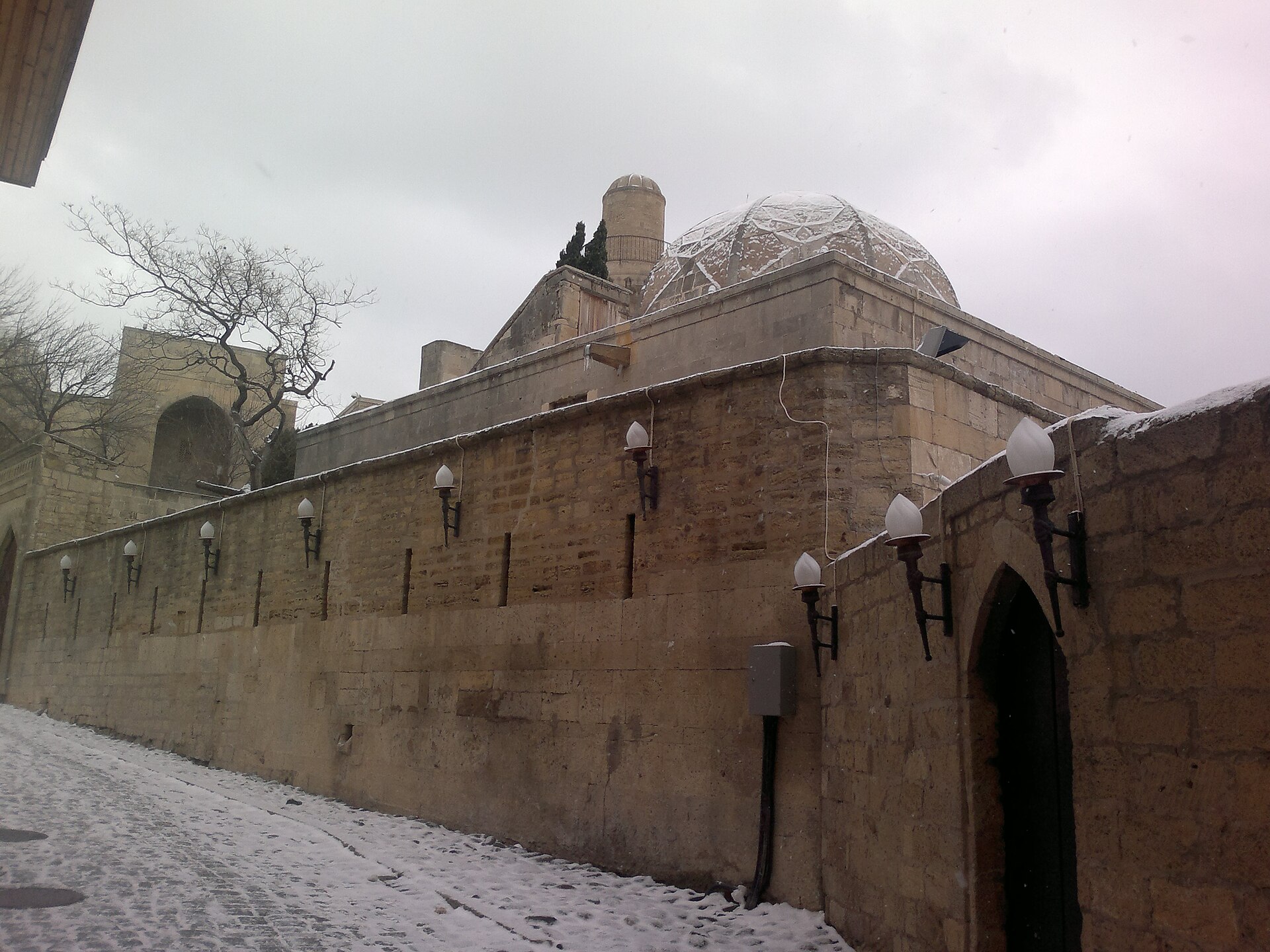
The complex features prominently in the national heritage, appearing in countless images of Baku and serving as a point of pride for Azerbaijanis conscious of their long history. Set within the atmospheric old city, it anchors a district that preserves the memory of medieval Baku amid the gleaming towers of the modern capital that has grown up around it.
The contrast between the ancient palace and the ultramodern city that surrounds it is itself part of the experience. Standing in the courtyards of the Shirvanshahs, with the honey-colored stone all around and the Caspian visible beyond the walls, the visitor is transported to another age, even as the skyline of twenty-first-century Baku rises in the distance.
In this way the palace serves as a bridge between past and present, a reminder to a rapidly modernizing nation of the depth and richness of its heritage, and a monument that continues to inspire pride and wonder in all who visit it.
See the Palace for Yourself
Words and photographs can convey much about the Palace of the Shirvanshahs, but there is no substitute for seeing the complex come to life, moving through its courtyards, catching the light on the carved stone, and sensing the way the buildings step down the hillside toward the sea. A video tour brings the atmosphere of the place to life in a way that description alone cannot.

The short film below offers a walk through the palace complex in Baku, taking in the main palace, the Divankhana, the mosque and minaret, the tombs, and the other structures that make up this remarkable ensemble. It is an ideal companion to everything you have read here, giving you a real feel for the scale, texture, and setting of the palace.
As you watch, pay attention to the beauty of the carved stone and the harmonious grouping of the buildings on the sloping ground, and imagine the centuries of Shirvanshah rulers who lived, worshipped, and were buried here. Then, when you visit Baku, you will recognize the palace on the hill not just as an old monument but as the enduring heart of a proud and ancient realm.
Visiting the Palace Today
For the modern traveler, the Palace of the Shirvanshahs is one of the essential sights of Baku and indeed of the whole Caucasus region. Located at the highest point of the walled old city, the complex is easily reached on foot through the atmospheric lanes of the historic quarter, and a visit can be combined with exploration of the surrounding medieval streets and the nearby Maiden Tower.

The complex is open to visitors as a museum, and you can explore the main palace, the Divankhana, the mosque, the tombs, the bathhouse remains, and the courtyards that connect them. Exhibitions within the buildings help to explain the history of the Shirvanshahs and the significance of what you are seeing, and the elevated site offers memorable views over the old city and the Caspian.
Practical details such as opening hours and admission can change, so it is worth checking the current arrangements before you go, and allowing yourself enough time to appreciate both the architecture and the exhibitions without rushing. The old city around the palace is compact and rewarding, and it is easy to spend a happy half-day exploring the whole area.
However you approach it, the Palace of the Shirvanshahs rewards the visitor who understands its story. This is not merely a picturesque group of old stone buildings but the surviving heart of a dynasty that ruled Shirvan for centuries, a masterpiece of medieval architecture, and a monument that continues to embody the history and pride of Azerbaijan.
Palaces Nearby
If the stone palace above the Caspian has drawn you into the world of the Caucasus and its courts, two more royal residences of the region make natural companions to a visit here, each telling the story of a different people and dynasty.
- The Summer Palace of the Sheki Khans — the dazzling painted pavilion of a mountain khanate, famed for its stained glass and frescoes.
- The Dadiani Palace at Zugdidi — the treasure-filled residence of the princes of Mingrelia in western Georgia.
You May Like
A Marrakesh Vizier and the Palace He Named Brilliance


2 thoughts on “How the Shirvanshahs Built Their Stone Palace Above Old Baku”