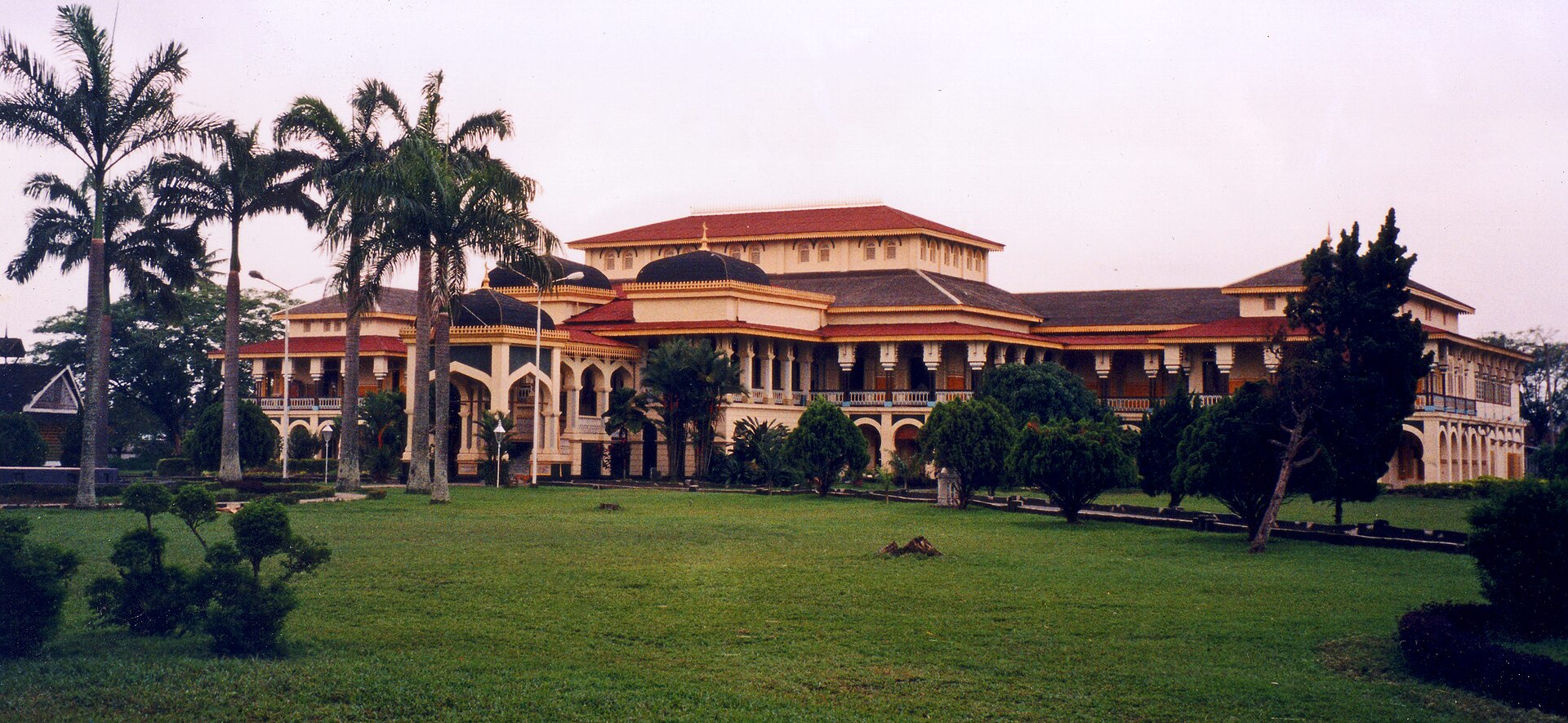
In the heart of Medan, the sprawling capital of Indonesia’s North Sumatra province, stands a palace unlike any other in the archipelago, a great yellow building crowned with domes and arches that seem to belong at once to the Malay world, to Mughal India, to the Ottoman east, and to colonial Europe. This is Istana Maimun, the palace of the Sultanate of Deli, and to step before its glowing facade is to encounter one of the most exuberant and eclectic royal buildings in all of Southeast Asia.
Built in the 1880s at the height of the region’s tobacco boom, the palace tells the story of a small but immensely wealthy Malay sultanate that rode the wave of a global plantation economy. The fertile lands around Medan produced some of the finest cigar wrapper tobacco in the world, and the fortunes it generated flowed into the coffers of the Sultan of Deli, who chose to spend a share of that wealth on a residence that would announce his standing to the world.
The result is a building of extraordinary richness. Painted in the golden yellow that was the royal color of the Malay courts, its arcades and horseshoe arches, its stained glass and chandeliers, its blend of Islamic and European motifs, make Istana Maimun a kind of architectural conversation between civilizations. It is a palace that could only have been built at a particular moment, when Sumatran wealth, Malay kingship, and the wider currents of the nineteenth-century world all met on the banks of the Deli River.
Across the pages that follow you will trace the whole story of this remarkable place, from the rise of the Deli sultanate and the tobacco fortune that paid for it, through the palace’s astonishing architecture and interiors, to its survival into the modern Indonesian republic as both a living royal residence and a beloved landmark. Settle in for a journey to the golden palace of Medan.
In This Article
- The Sultanate of Deli
- Building the Golden Palace
- An Architecture of Many Worlds
- The Facade and the Grand Entrance
- The Throne Room and the Great Hall
- Inside the Royal Apartments
- Heirlooms, Weapons, and Treasures
- Living Culture at the Palace
- The Grounds and the Neighboring Mosque
- From Sultanate to Republic
- Caring for a Living Landmark
- See Istana Maimun for Yourself
- Visiting Istana Maimun Today
The Sultanate of Deli
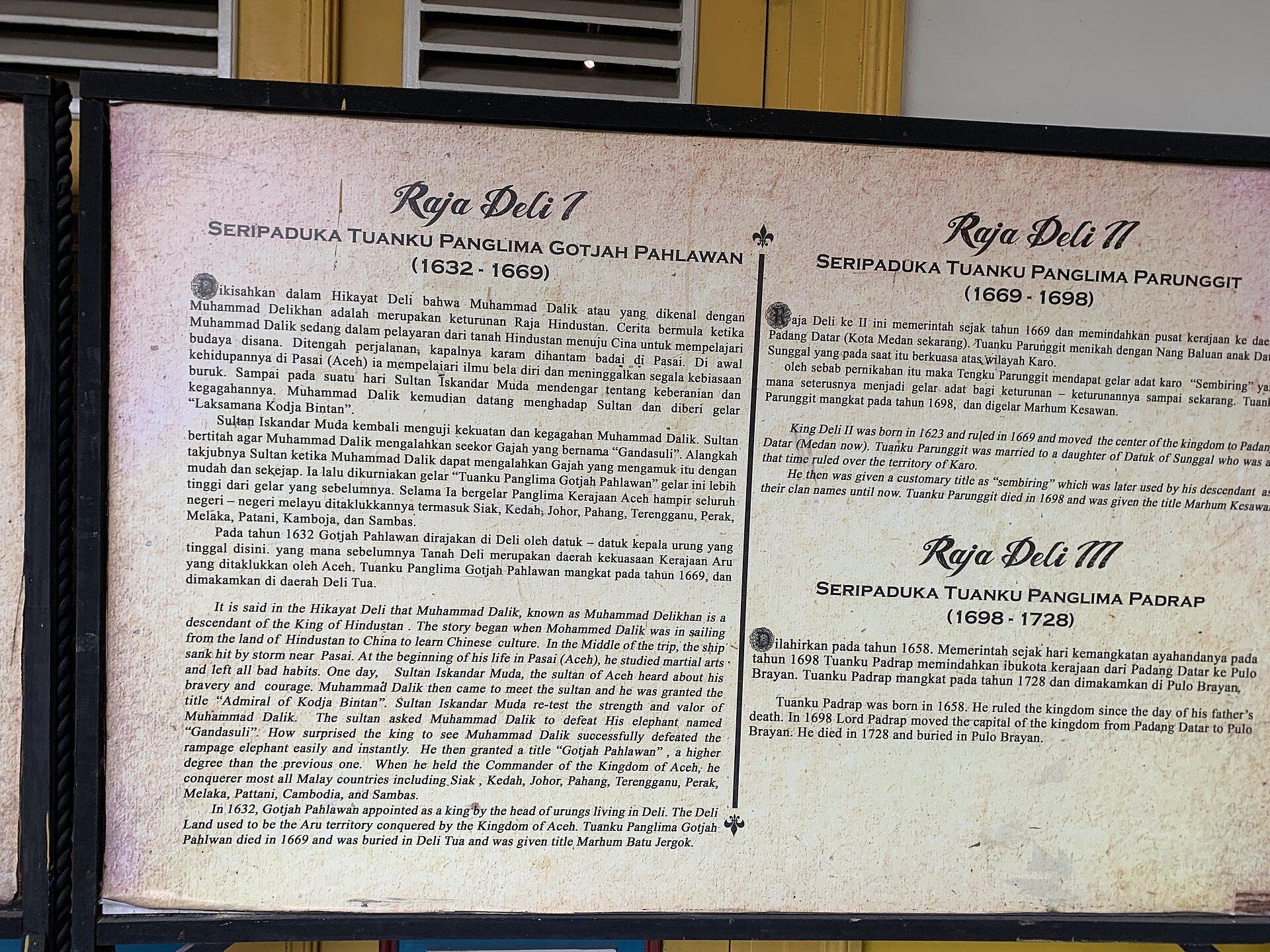
To understand the palace you must first understand the sultanate that built it. Deli was one of a cluster of small Malay states scattered along the east coast of Sumatra, kingdoms whose fortunes rose and fell with trade and whose rulers claimed descent from the great Malay dynasties of the region. For much of its history Deli was a modest power, overshadowed by larger neighbors and dependent on the ebb and flow of commerce passing through the Strait of Malacca.

That changed dramatically in the second half of the nineteenth century. The discovery that the soil and climate of the Deli region were ideally suited to growing tobacco of exceptional quality set off an economic transformation, as European planters, above all the Dutch, poured into the area to establish plantations. The land that had been sparsely settled forest became one of the most profitable agricultural zones in the entire colonial world.
The Sultan of Deli sat at the center of this boom. As the traditional ruler who controlled access to the land, he was able to negotiate concessions and royalties that made him and his court extraordinarily wealthy, even as the Dutch colonial administration tightened its grip on the region. The sultanate became a curious hybrid, a traditional Malay monarchy enriched and to some degree propped up by the machinery of European colonial capitalism.
It was against this backdrop of sudden wealth and shifting power that Sultan Ma’mun Al Rashid Perkasa Alam, who ruled in the later nineteenth century, resolved to build a palace worthy of his enhanced standing, a monument that would embody the golden age of Deli.
It is worth dwelling on just how unusual this arrangement was. In most of the colonized world, traditional rulers were either swept aside or reduced to figureheads with little wealth of their own. In Deli, by contrast, the very resource that drew the colonizers, the tobacco land, was one the sultan controlled, and this gave him a bargaining position and a source of income that few other indigenous rulers of the era could match. The palace is, in a real sense, a physical record of that rare and fleeting leverage.
Building the Golden Palace
Construction of Istana Maimun began in 1888 and was completed in 1891, a remarkably short span for a building of such ambition. The palace takes its name from the sultan who commissioned it, and its creation was very much an expression of his personal vision and the resources the tobacco economy had placed at his disposal.

The design is usually attributed to a European architect working in the service of the sultan, and this collaboration between a Malay patron and a Western designer helps explain the building’s remarkable stylistic fusion. The sultan wanted a residence that would reflect both his Islamic Malay identity and his engagement with the wider modern world, and the architecture was conceived to satisfy both ambitions at once.
No expense was spared in the materials and furnishings. Marble was imported from Italy, tiles and fittings came from Europe, chandeliers and mirrors were shipped in from abroad, and skilled craftsmen combined these imported elements with local traditions of woodwork and decoration. The palace was, in effect, a showcase of what the wealth of Deli could summon from across the globe.
When it was finished, Istana Maimun stood as the largest and grandest palace in the region, a bold statement of the sultanate’s prosperity and a physical embodiment of the golden age that the tobacco trade had brought to the east coast of Sumatra.
The choice of the name Maimun carried meaning too. Derived from an Arabic word associated with blessing and good fortune, it expressed the sultan’s hopes for his dynasty and his court, and it tied the building explicitly to the Islamic faith that underpinned the sultanate’s identity. A palace was never merely a house for a Malay ruler, it was a statement of legitimacy, piety, and ambition all at once.
An Architecture of Many Worlds
The most striking thing about Istana Maimun is the way it draws together architectural languages from across the globe into a single coherent, if flamboyant, whole. The overall form owes much to Malay and Islamic tradition, but woven through it are elements borrowed from Mughal India, the Middle East, Spain, and the classical architecture of Europe, producing a building that seems to belong everywhere and nowhere at once.
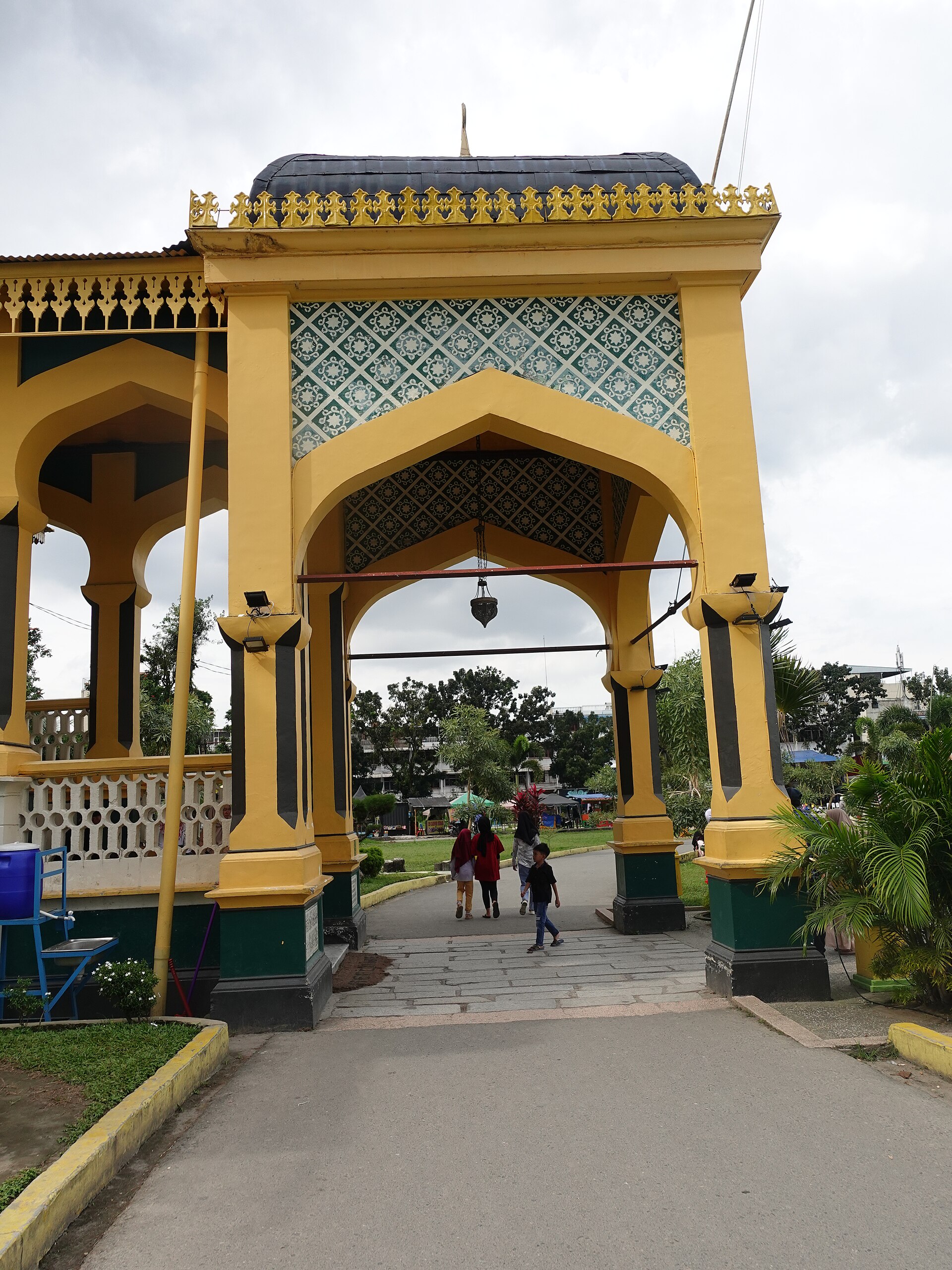
Islamic influence is everywhere apparent, most obviously in the horseshoe and pointed arches that march across the facade and define the interior spaces. These arches, echoing the great mosques and palaces of the Islamic world, give the building its rhythm and its sense of sacred dignity, and they are complemented by decorative motifs drawn from the rich vocabulary of Islamic ornament.
Yet mingled with these are unmistakably European features, columns and moldings in the classical manner, large glazed windows, and interiors arranged around a grand central hall in a way that recalls the reception rooms of European palaces. The result is not a clumsy collision but a genuine synthesis, in which each tradition is allowed to speak while contributing to a unified effect.
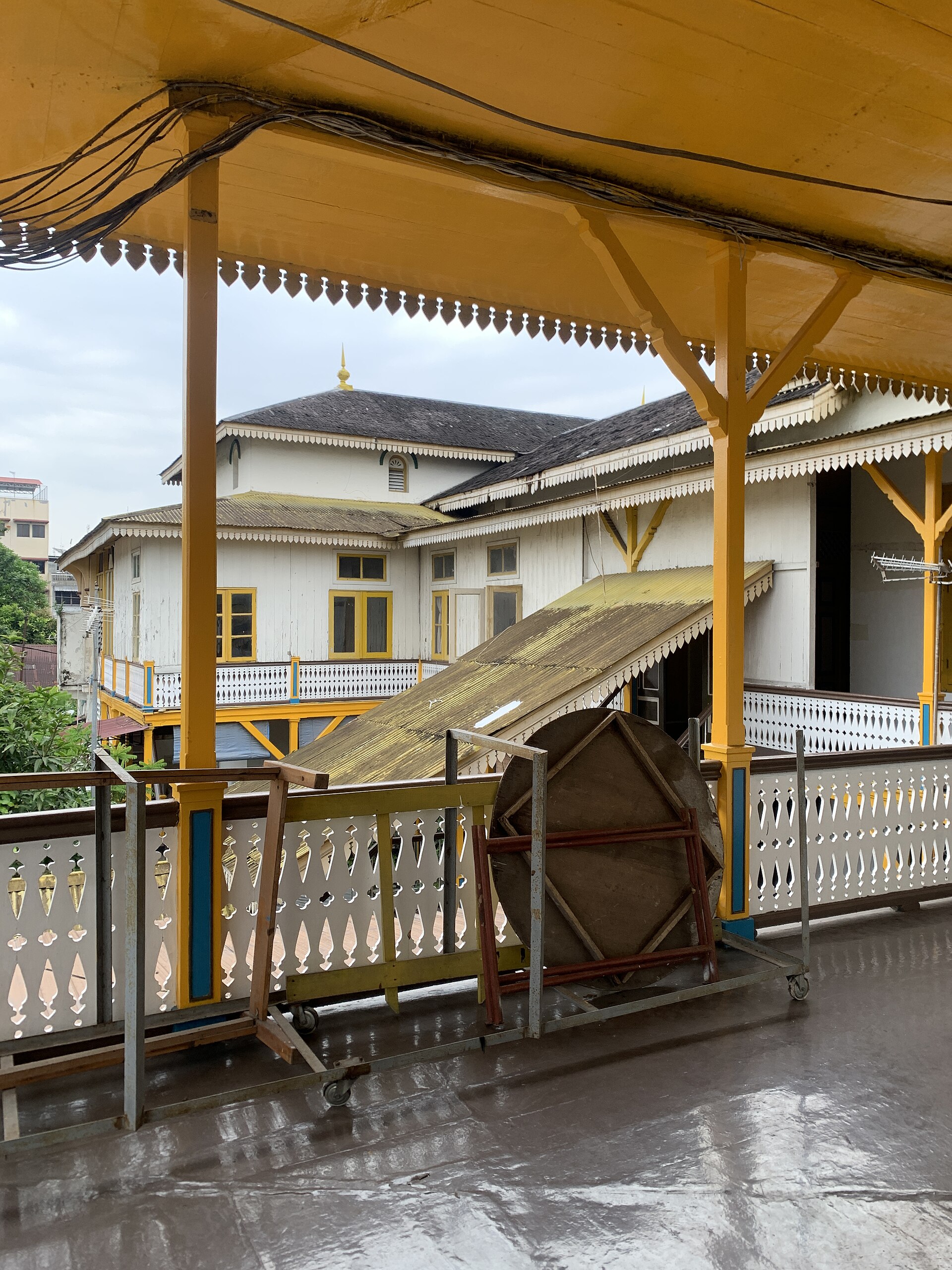
Crowning the whole composition is the palace’s signature color, a warm golden yellow that was the traditional royal color of the Malay world. Bathed in the Sumatran sun, the yellow walls seem almost to glow, and it is this luminous quality, more than any single architectural feature, that gives Istana Maimun its unforgettable presence.
This willingness to borrow freely from many traditions was not a sign of confusion but of confidence. The court of Deli saw itself as connected to a wider Islamic and cosmopolitan world, and the palace’s eclecticism proclaimed that the sultan was a modern ruler at ease with the currents of his age, able to command the finest ideas and materials from across continents and fuse them into something distinctly his own.
The Facade and the Grand Entrance
Approaching the palace, the visitor is confronted by a broad, symmetrical facade dominated by a projecting central pavilion reached by a wide staircase. The composition is designed to impress, to make clear from the first glance that this is the seat of a ruler, and the rising steps and the crowning roofline draw the eye upward toward the heart of the building.
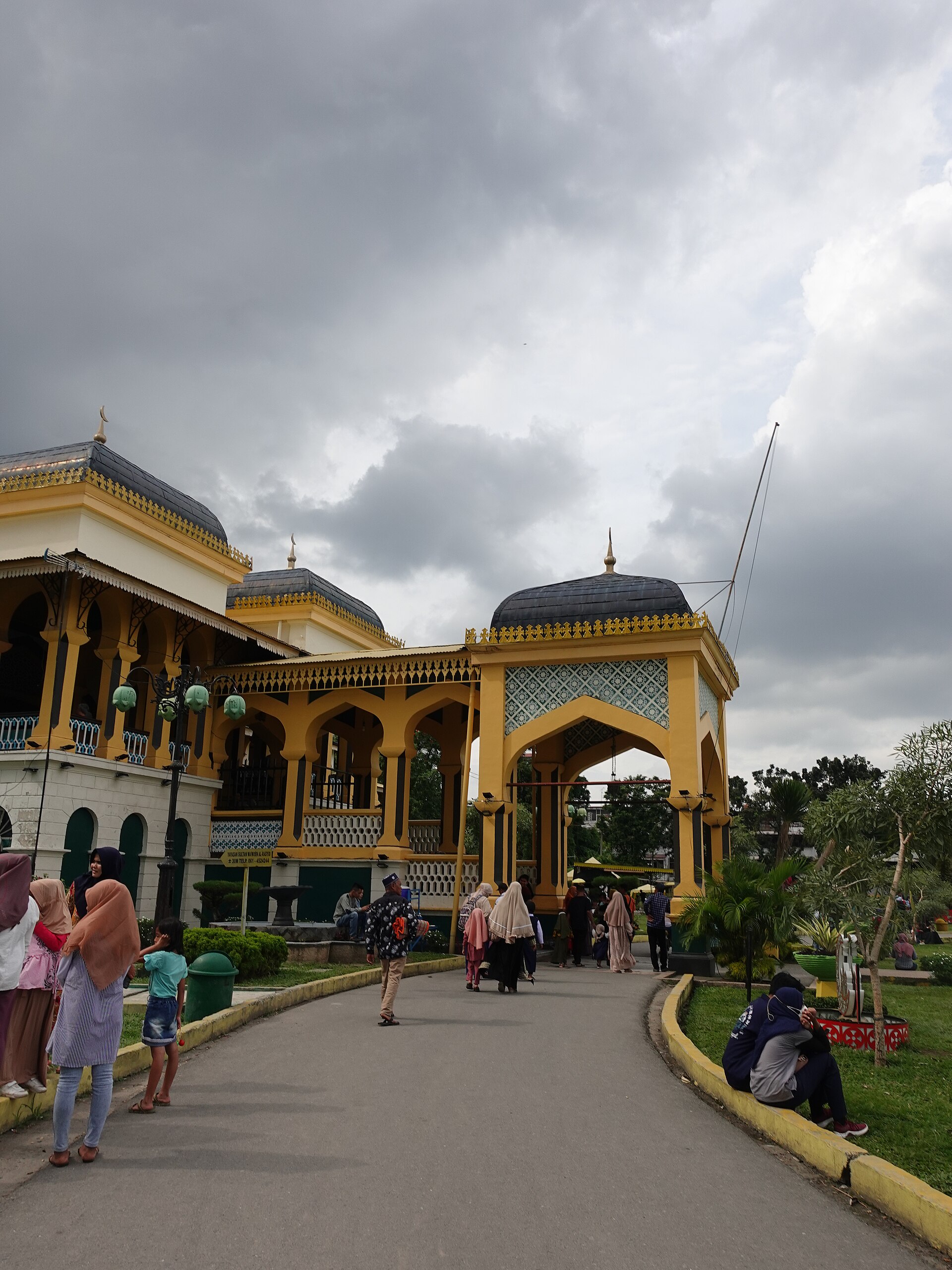
The staircase itself is a ceremonial device as much as a practical one. Ascending it, a visitor moves from the everyday world of the street and the gardens up into the elevated realm of the court, a physical enactment of the distance between subject and sovereign. At the top, the arched entrance frames the way into the palace’s principal spaces.
The facade’s arcades, with their repeating arches and slender columns, create a play of light and shadow that changes through the day, and the whole surface is enlivened with decorative detailing that rewards close attention. Even from a distance, the building reads as festive and welcoming rather than forbidding, an expression of a court confident in its wealth and its place in the world.
Set within its grounds, with open space before it, the palace has room to be seen and admired as a complete composition, and the approach to the grand entrance remains one of the great architectural experiences that Medan has to offer.
The symmetry of the design also carried a message. A balanced, ordered facade spoke of a balanced, ordered realm, and the careful proportion of the building was meant to reflect the harmony that a good ruler was expected to bring to his domain. In this sense the architecture was not just beautiful but political, an argument in stone and stucco about the nature of kingship.
The Throne Room and the Great Hall
The ceremonial heart of Istana Maimun is its great central hall, a vast and richly decorated space that served as the throne room and the setting for the most important functions of the court. Here the sultan received guests, held audiences, and presided over the ceremonies that expressed and reinforced his authority, surrounded by the accumulated splendor of his reign.

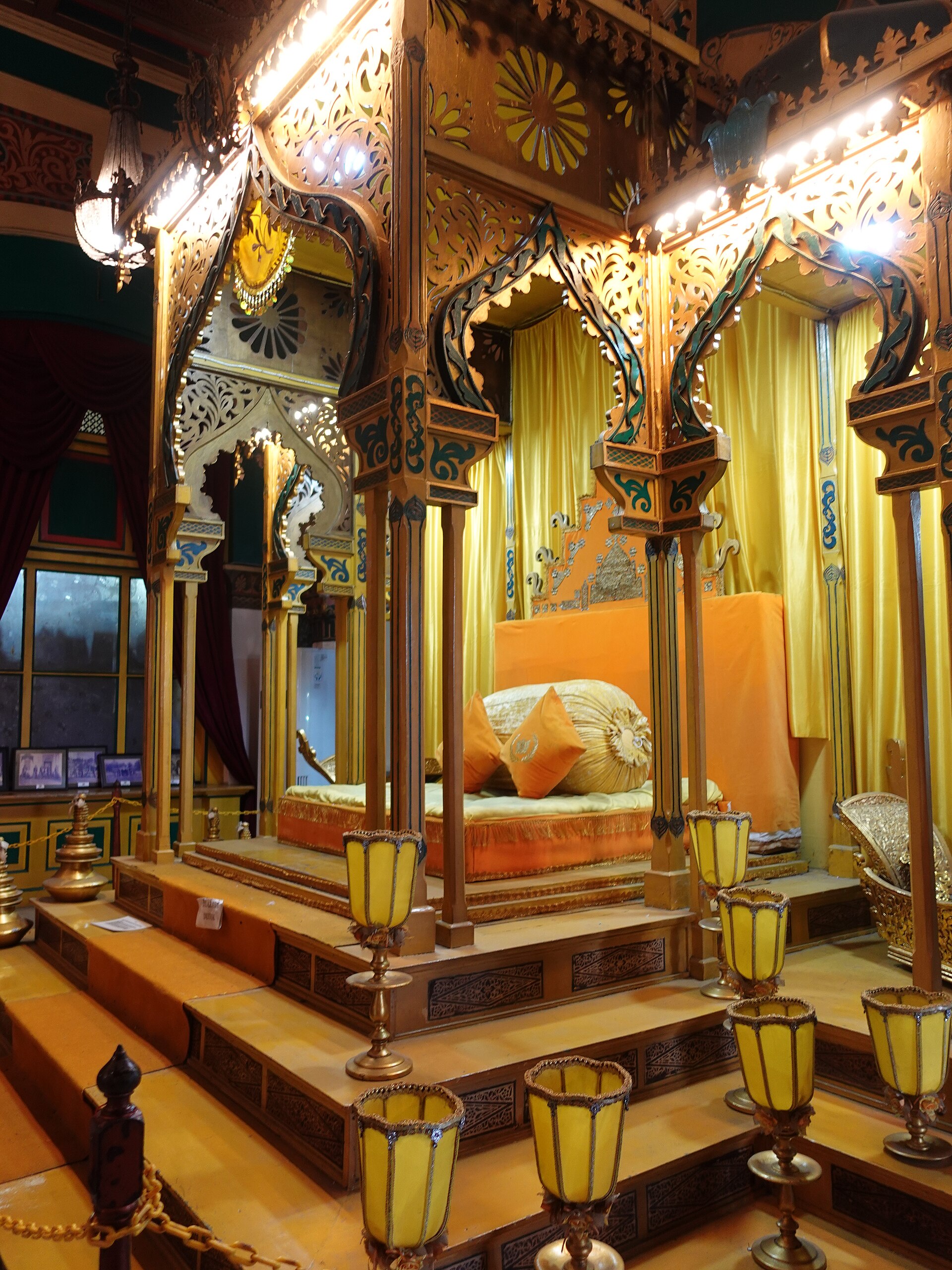
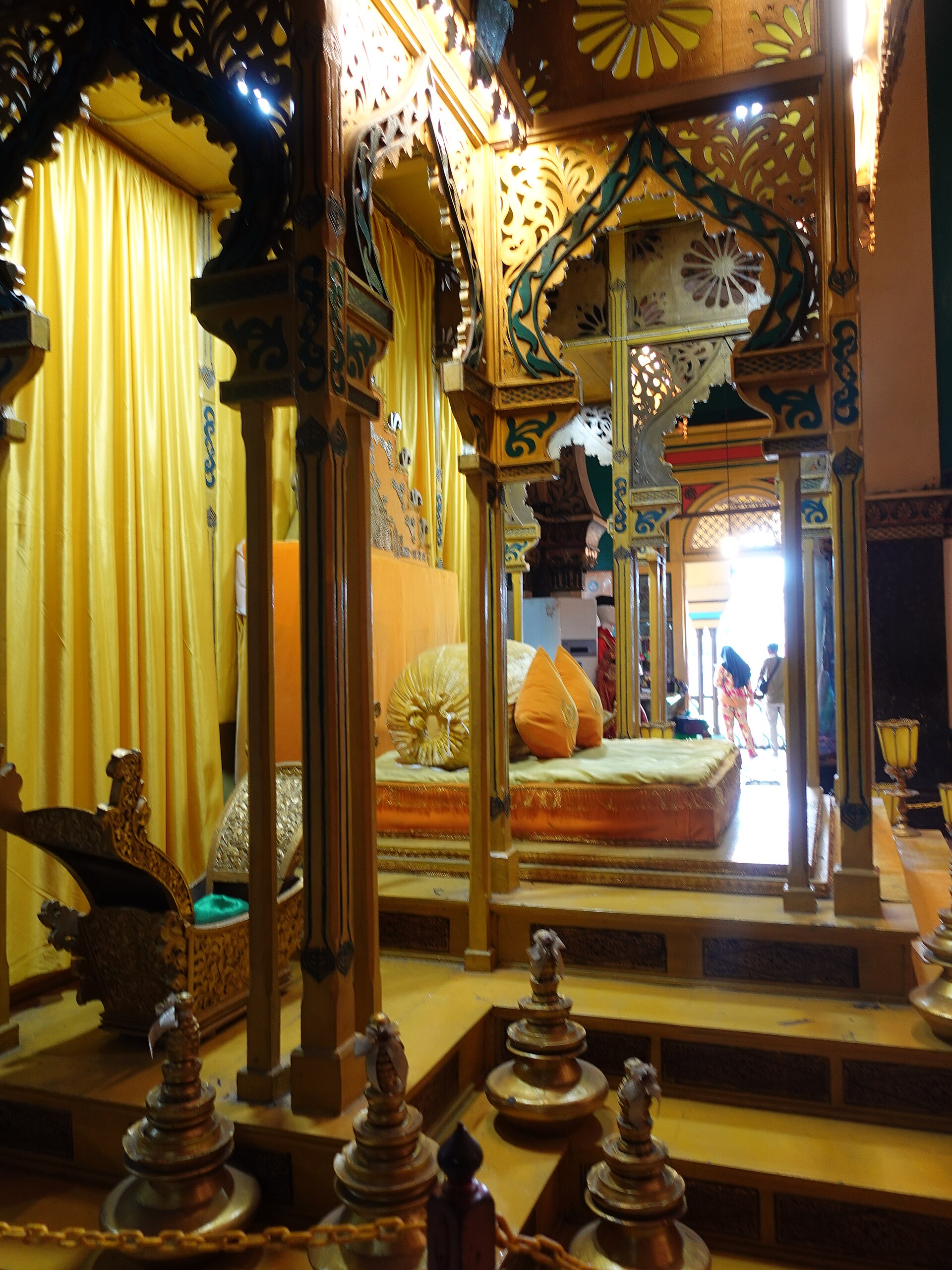
The hall is dominated by the royal throne, placed at its focal point and framed to draw every eye. Rendered in the royal yellow and richly ornamented, the throne is the symbolic center of the entire palace, the seat from which the ruler of Deli exercised his sovereignty, and it remains one of the most photographed features of the building.
Overhead, grand chandeliers hang from the high ceiling, and the walls and columns are worked with color and ornament that catch and reflect the light streaming through the windows. The effect is one of controlled magnificence, a space designed to overwhelm the visitor with a sense of the ruler’s wealth and dignity while remaining ordered and harmonious.
To stand in this hall today is to sense the atmosphere of a Malay court at its zenith, a place where the traditions of Islamic kingship, the wealth of the tobacco lands, and the wider currents of the nineteenth-century world all converged in a single dazzling room.
Every detail of the throne room was calculated to communicate hierarchy and order. The placement of the throne, the arrangement of the space around it, and the direction in which visitors approached all reinforced the distance between the ruler and those who came before him. In a Malay court, such spatial choreography was a language in itself, and the great hall was designed to speak it fluently.
Inside the Royal Apartments
Beyond the great hall, the palace contains a sequence of rooms that served the domestic and administrative life of the court. These spaces, though less overwhelming than the throne room, are richly furnished and give a vivid sense of how the sultan and his household actually lived amid the splendor of the golden age.
The furnishings blend the imported and the local in the same way as the architecture. European furniture, mirrors, and decorative objects sit alongside pieces made in the Malay tradition, and the whole is arranged with an eye to both comfort and display. The interiors reflect a court that was cosmopolitan in its tastes yet rooted in its own cultural identity.
Throughout the rooms, the royal yellow reappears in fabrics, hangings, and decorative details, tying the interiors together and constantly reminding the visitor of the color’s regal significance. Stained glass and glazed windows filter the tropical light, casting patterns of color across floors and walls and softening the heat of the Sumatran day.
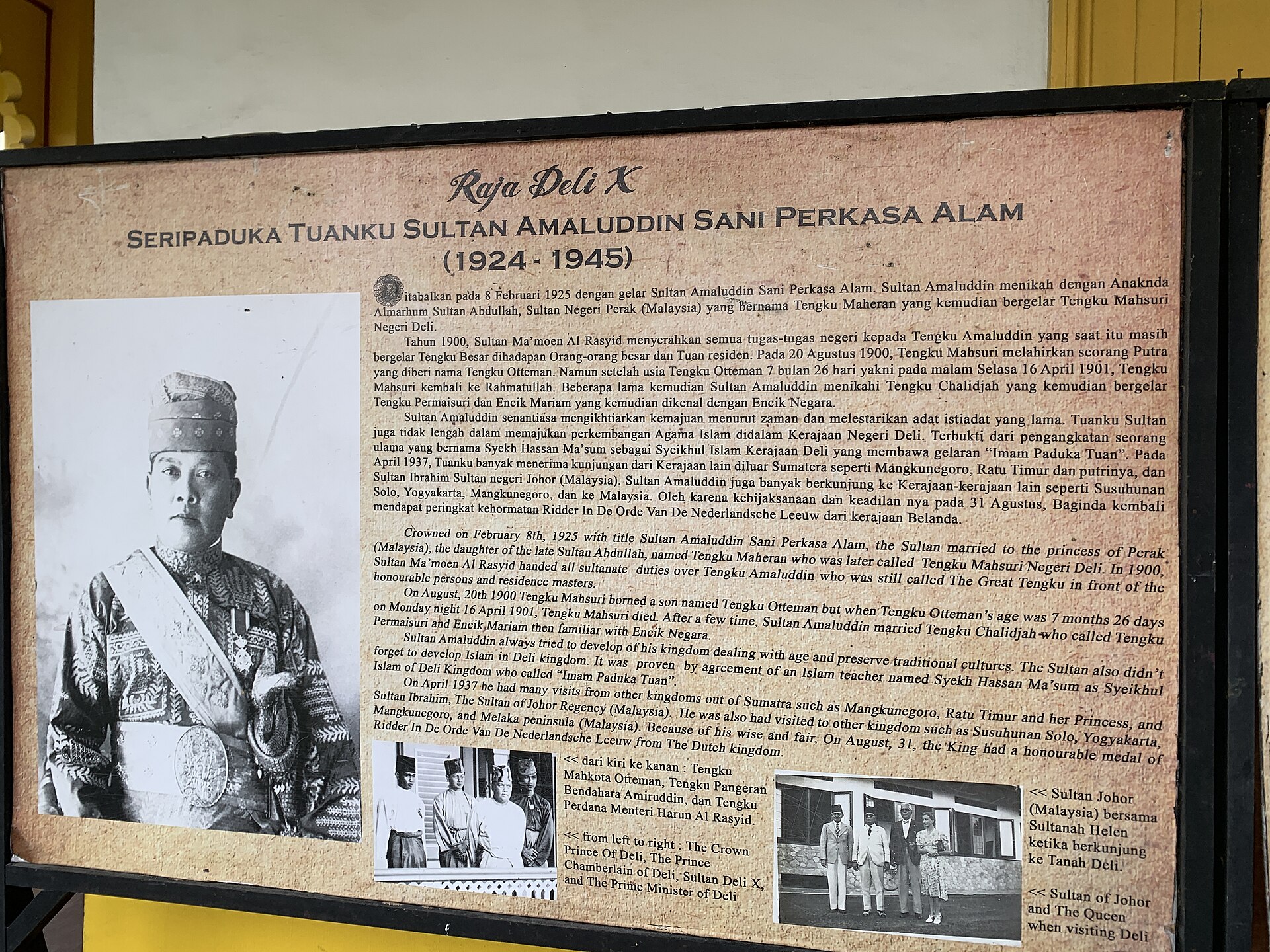
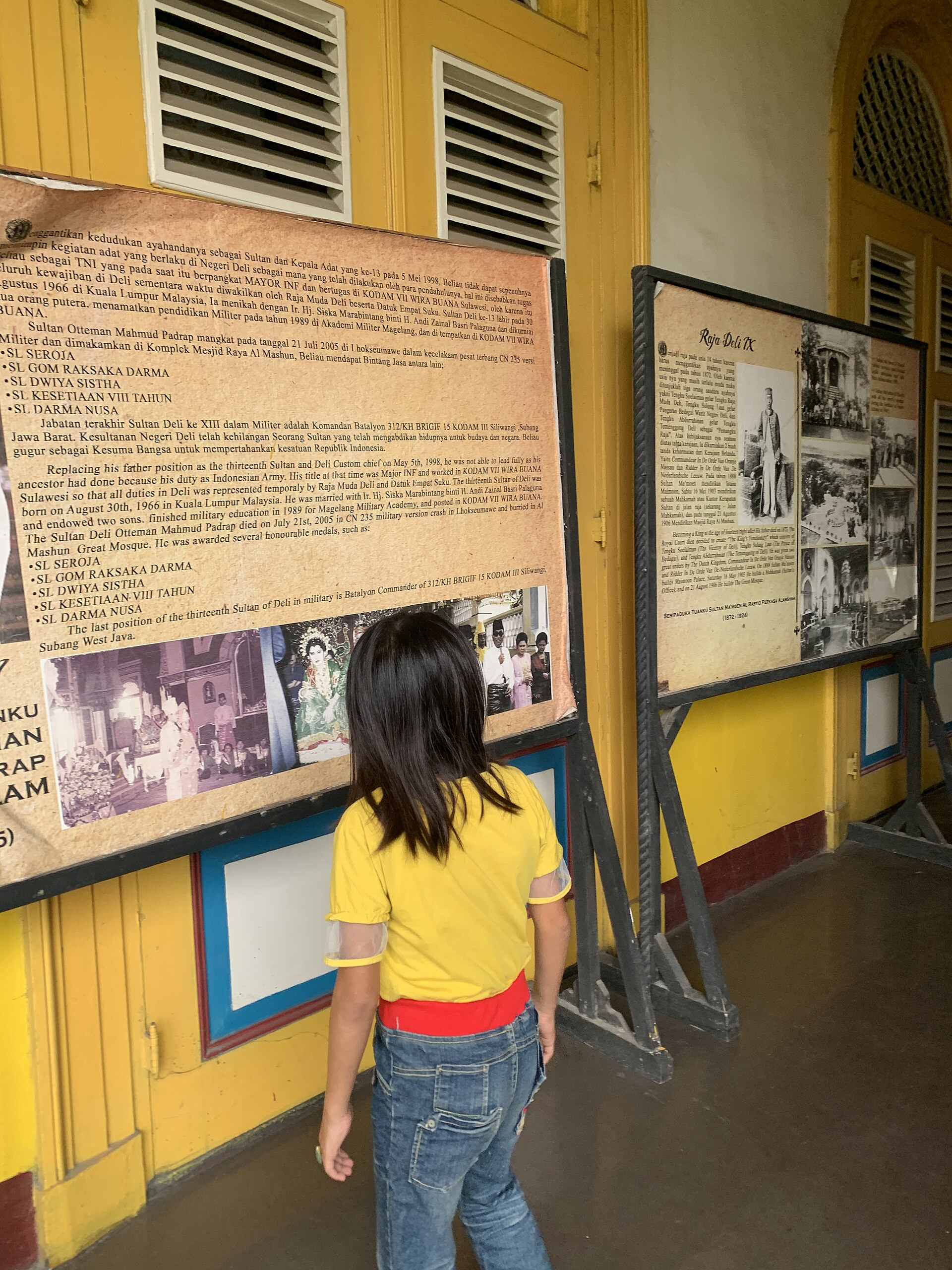
Many of these rooms preserve objects and heirlooms associated with the sultanate, from photographs and portraits to ceremonial items and personal effects, turning the palace into a repository of the dynasty’s memory as well as a stage for its former grandeur.
Living amid such splendor, the royal household inhabited a world carefully insulated from the everyday life of the city outside. The palace was designed to be a self-contained realm, complete with everything the court required, and its interiors express a way of life that combined the intimacy of a family home with the grandeur befitting a sultan and the constant demands of ceremony and display.
Heirlooms, Weapons, and Treasures
Istana Maimun is not merely an architectural showpiece but a living museum of the Deli sultanate, preserving a collection of objects that tell the story of the dynasty and its era. Among the treasures on display are weapons, including the distinctive Malay daggers and swords that were both practical arms and symbols of status and identity.
Ceremonial regalia and objects associated with kingship occupy a place of honor. These items, used in the rituals that marked the sultan’s authority and the great occasions of court life, connect the visitor directly to the traditions of Malay monarchy and to the specific history of Deli, and they carry a weight of meaning far beyond their material value.
The collection also includes photographs and documents that record the sultanate at the height of its wealth and influence. Images of past sultans, of court ceremonies, and of the palace in its early days allow visitors to see the building as it was when new, and to put faces to the rulers whose ambitions gave rise to this extraordinary place.
Together these objects transform a visit to the palace into an encounter with a whole vanished world, the world of the Malay courts of east Sumatra in the age of the tobacco boom, preserved within the golden walls that their wealth built.
For visitors interested in the material culture of the Malay world, these collections are a rare treasure. Objects of this quality and provenance, preserved in the very palace for which many of them were made, offer an unusually direct connection to a court that has otherwise passed into history, and they repay careful and unhurried attention.
Living Culture at the Palace
Unlike many former royal residences that have become purely historical monuments, Istana Maimun remains a place where the living culture of the Malay world can still be experienced. The palace regularly hosts performances of traditional music, and visitors may encounter musicians playing the instruments of the region within its halls and grounds.

These living traditions give the palace a warmth and vitality that a mere museum could never possess. The sound of traditional Malay music drifting through the arched galleries connects the present-day visitor to the cultural world that the sultanate embodied, and reminds us that the heritage preserved here is not only architectural but musical, ceremonial, and social.
The palace also remains a focus for the ceremonial life of the Deli community and the descendants of the sultanate. On important occasions the building comes alive with the rituals and gatherings that maintain the continuity of Malay court culture into the twenty-first century, even as the political power of the sultanate itself has long since passed.
For the traveler, this living dimension is part of what makes Istana Maimun so rewarding. It is not a dead relic but a place where past and present meet, where the traditions of a Malay court continue to be honored within the very walls that once expressed its power.
The Grounds and the Neighboring Mosque
The palace does not stand alone but at the center of a wider royal complex that once included all the buildings and spaces needed to support the life of the court. The grounds around Istana Maimun provide the setting that allows the building to be appreciated as a whole, and they remain a gathering place for both visitors and local residents.
Closely associated with the palace is the great mosque of Medan, the Masjid Raya, built a little later by the same sultanate as its principal place of worship. Though a separate building, the mosque is part of the same royal vision, and its own eclectic architecture, blending Islamic, Indian, and European elements, echoes the spirit of the palace and completes the picture of the Deli court’s ambitions.
Together the palace and the mosque anchor a district of Medan that preserves the memory of the sultanate at its height, and a visit to one naturally leads to the other. The pairing of a magnificent royal residence with an equally splendid royal mosque was a common feature of Malay and Islamic kingship, expressing the ruler’s dual role as political leader and defender of the faith.
Walking between these buildings, the visitor can appreciate how the sultanate sought to shape the whole urban landscape of its capital, leaving a legacy that continues to define the character of Medan to this day.
From Sultanate to Republic
The political fortunes of the Deli sultanate, like those of the other Malay states of Sumatra, were transformed by the great upheavals of the twentieth century. Dutch colonial rule, the Japanese occupation during the Second World War, and above all the Indonesian revolution and the birth of the republic reshaped the entire political order in which the sultanate had existed.
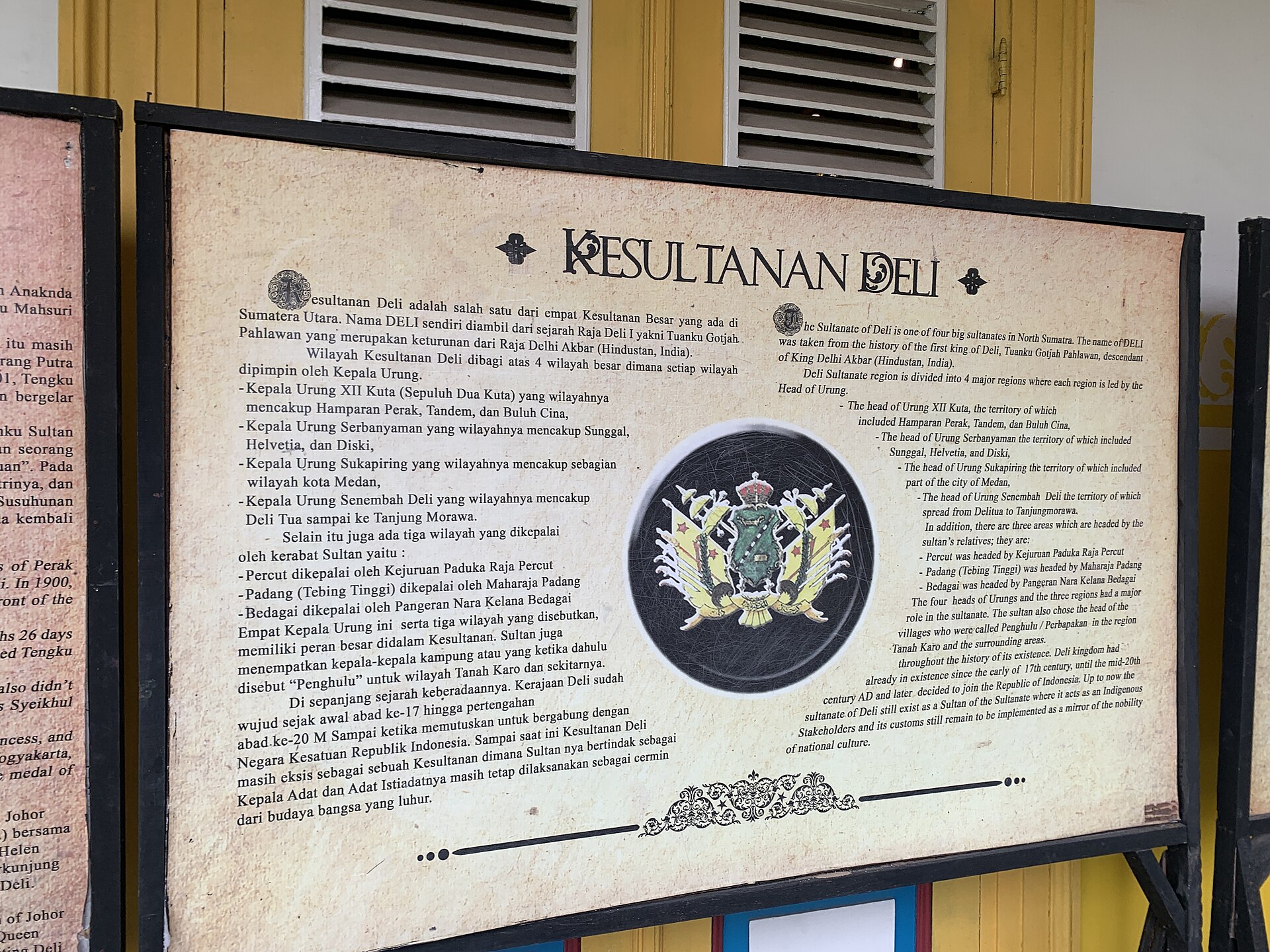
With the establishment of independent Indonesia, the traditional sultanates lost their formal political power, becoming cultural and ceremonial institutions rather than governing bodies. The Sultan of Deli remained as a symbolic figure and custodian of tradition, but the days when the ruler of Deli negotiated with planters and colonial officials over the wealth of the tobacco lands were gone forever.
Through all these changes, Istana Maimun endured. The palace remained associated with the royal family and continued to serve as a symbol of Deli’s heritage, even as the world around it was utterly transformed. Its survival is a testament both to the strength of its construction and to the enduring affection in which it is held by the people of Medan.
Today the palace stands as one of the most cherished landmarks of North Sumatra, a reminder of a distinctive chapter in Indonesian history when Malay kingship and global commerce combined to produce a golden age on the east coast of the island.
The transformation was not without pain and loss. The revolution of the 1940s brought violence to the Malay states of east Sumatra, and the old order did not pass away quietly. That the palace and the institution of the sultanate survived at all, even in reduced and ceremonial form, is a reminder of the resilience of tradition and of the attachment that many felt to the symbols of their shared past.
Caring for a Living Landmark
Preserving a building as elaborate and as heavily visited as Istana Maimun presents real challenges. The tropical climate of Sumatra, with its heat, humidity, and heavy rains, is hard on old buildings, and the imported materials and intricate decorations that make the palace so remarkable also make its conservation demanding.
The palace remains connected to the descendants of the sultanate, who retain a role in its stewardship, and this continuity of ownership has helped ensure that the building is cared for as a living heritage rather than abandoned to decay. At the same time, its popularity as a tourist destination provides both resources for its upkeep and a constant reminder of its value to the community.
Balancing the demands of tourism with the need to protect a fragile historic building is an ongoing task. The palace must accommodate the visitors who come to admire it while safeguarding the interiors, furnishings, and heirlooms that give it meaning, and those responsible for its care must constantly weigh access against preservation.
That the palace has survived and remains open, more than a century and a quarter after its completion, is a considerable achievement, and it reflects the deep pride that the people of Medan and the descendants of the sultanate take in this golden monument to their shared history.
Efforts to document and study the palace have also deepened understanding of its history and significance. Scholars and heritage specialists have examined its architecture, its collections, and its records, helping to ensure that the story of Istana Maimun is not only preserved in its walls but properly understood and passed on to future generations of visitors and Indonesians alike.
See Istana Maimun for Yourself
Photographs can capture the golden glow of the palace’s walls and the sweep of its arches, but they cannot quite convey the experience of moving through its spaces, hearing traditional music echo beneath the high ceilings, and sensing the layered history embedded in every room. Seeing the palace in motion brings its character to life in a way that still images cannot.
The short video below offers a visual tour of Istana Maimun, letting you take in the facade, the great hall with its throne, and the rich interiors that make the palace so extraordinary. It is an ideal companion to everything you have read here, giving you a feel for the atmosphere of the place before you visit in person.
As you watch, look for the interplay of the different architectural traditions that make the palace so distinctive, the Islamic arches, the European detailing, the Malay color and ornament, all combined into a single harmonious whole. Then, when you find yourself in Medan, you will recognize the golden palace not just as a pretty building but as the living heart of the Deli sultanate’s remarkable story.
Visiting Istana Maimun Today
For the modern traveler, Istana Maimun is one of the essential sights of Medan and indeed of the whole of North Sumatra. The palace is open to visitors, who can explore the great hall with its throne, admire the interiors and collections, and soak up the atmosphere of a Malay court preserved into the present day. It is an accessible and rewarding stop for anyone exploring the city.
The palace sits in the center of Medan, within easy reach of the city’s other attractions, above all the great royal mosque built by the same sultanate. A visit that combines the palace and the mosque gives a remarkably complete picture of the golden age of Deli, and both buildings lie close enough to be seen comfortably in a single outing.
Practical details such as opening hours and any charges can vary, so it is sensible to check the current arrangements before you go, and to allow enough time to appreciate both the architecture and the collections at a leisurely pace. Encountering a performance of traditional music, if your visit happens to coincide with one, adds greatly to the experience.
However you approach it, Istana Maimun rewards the visitor who understands its story. This is not simply a colorful old building but the enduring monument of a Malay sultanate that once rode the wave of a global boom, a golden palace that continues to embody the history, culture, and pride of Medan and its people.
Palaces Nearby
If the golden palace of Medan has captured your imagination, two more great seats of power in Southeast Asia are worth exploring, each a very different expression of the region’s royal and political traditions.
- Istana Negara, Kuala Lumpur — the official residence of the King of Malaysia across the strait, a modern royal palace of the Malaysian monarchy.
- Malacanang Palace, Manila — the riverside seat of the President of the Philippines, a colonial-era house at the heart of a nation’s political life.
You May Like
A Marrakesh Vizier and the Palace He Named Brilliance


One thought on “Istana Maimun: The Golden Palace of the Deli Sultanate in Medan”