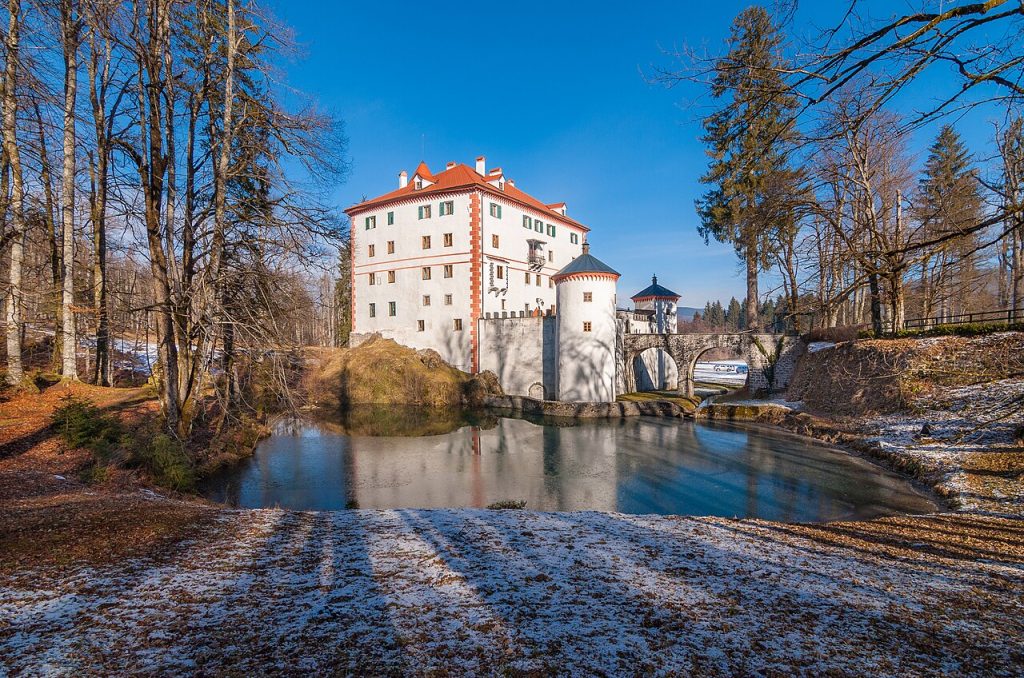
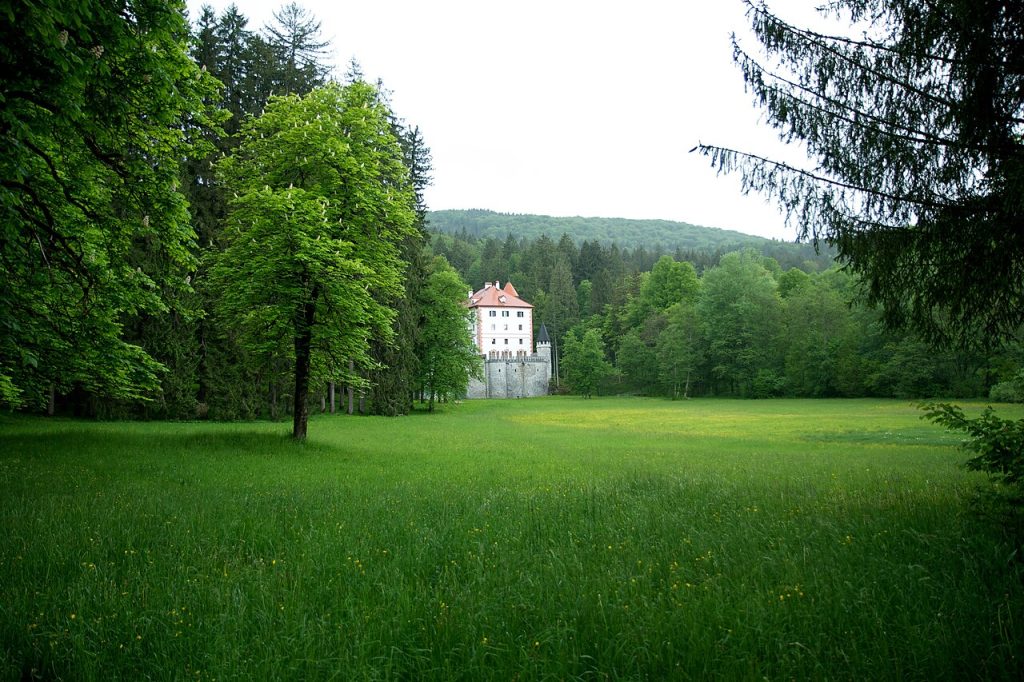
Drive south from Ljubljana for an hour, past the Postojna caves and the Cerknica lake that disappears every summer, and you come into the Loška dolina, a high valley of meadows enclosed by forest. At its far end, where the meadows meet the trees, a small white castle stands on a rock above a pond, with a bridge over the moat and a tower at one corner, and behind it the forest rises for thirty kilometres without a village to the mountain of Snežnik, the snowy one, on the Croatian border. This is bear country, the densest population of brown bears in Europe, and Snežnik Castle was built, bought and kept for the hunting.
What makes the castle exceptional is not its architecture, which is modest Renaissance, but its contents. In 1853 a Saxon prince, Otto Victor of Schönburg-Waldenburg, bought the estate as a hunting lodge, furnished it in the comfortable taste of the mid-nineteenth century, and his family kept it unchanged until 1945. The Yugoslav state then used it as a protocol residence for its leaders and, remarkably, left everything in place. Snežnik is the only castle in Slovenia whose original furnishings survive complete, down to the hunting trophies, the Egyptian room and the beds, and a restoration completed in 2010 has returned it to the condition of a hunting lodge waiting for the prince to arrive.
Walk with me across the bridge and through the rooms, and then into the forest. The contents are below.
In This Article
- The Loska Dolina and the Forest
- A Castle on a Rock: The Middle Ages
- Lambergs, Lichtenbergs and Auerspergs
- The Renaissance Castle and the Moat
- 1853: A Saxon Prince Buys a Hunting Estate
- The Forestry School and the Model Estate
- The Rooms That Nobody Emptied
- The Egyptian Room and the Hunting Hall
- Bears, Dormice and the Hunting Tradition
- 1945: The State Takes Over
- Tito’s Guests in the Forest
- The Restoration of 2008 to 2010
- The Park, the Pond and the Walks
- Sneznik on Video
- Visiting Sneznik Castle Today
- Palaces Nearby
The Loska Dolina and the Forest
The Loška dolina is a karst valley in Inner Carniola, a flat floor of meadows and villages surrounded by wooded hills, with the village of Stari trg at its centre and the castle at its southern edge, where the open land ends and the forest begins. The Snežnik forest beyond is one of the largest unbroken woodlands in central Europe, beech and fir rising to the bare summit of Snežnik at 1,796 metres, and it is home to bears, wolves, lynx and the red deer that the castle’s owners hunted.
Now, stop here on the road into the valley and look at the castle against the trees. It is small, white and square, with a tower at one corner, and it sits on a low rock with a pond on one side and a bridge on the other. Behind it the forest is a wall. The castle was never meant to dominate the landscape; it was meant to sit at the edge of it and watch.
A Castle on a Rock: The Middle Ages
A castle on the rock is first mentioned in 1268, when it belonged to the patriarchs of Aquileia, the ecclesiastical princes who held much of Carniola, and it guarded the road that ran from the Ljubljana basin through the valley toward the Kvarner coast. The mediaeval castle was a tower house on the rock with a wall around it, and the rock itself, a limestone outcrop in the flat valley with a spring at its foot, was the reason for the site. The pond below is fed by the spring and once served as a moat and a fishpond.
The castle passed from Aquileia to the counts of Ortenburg and the counts of Celje and then, in 1456, to the Habsburgs, who leased and sold it to the noble families of Carniola. Its mediaeval history is quiet; it was a frontier post on a secondary road, not a prize.
Lambergs, Lichtenbergs and Auerspergs
From the sixteenth century the castle belonged in turn to the Lambergs, who rebuilt it in the Renaissance; the Lichtenbergs, who held it through the seventeenth century; and the princes of Auersperg, the greatest magnates of Carniola, who owned it from 1707 to 1832 as one of their many estates and used it mainly for forestry and hunting. None of these families made it a principal seat, and the castle stayed small and plain, which is why it was cheap enough for a foreign prince to buy when it came on the market.
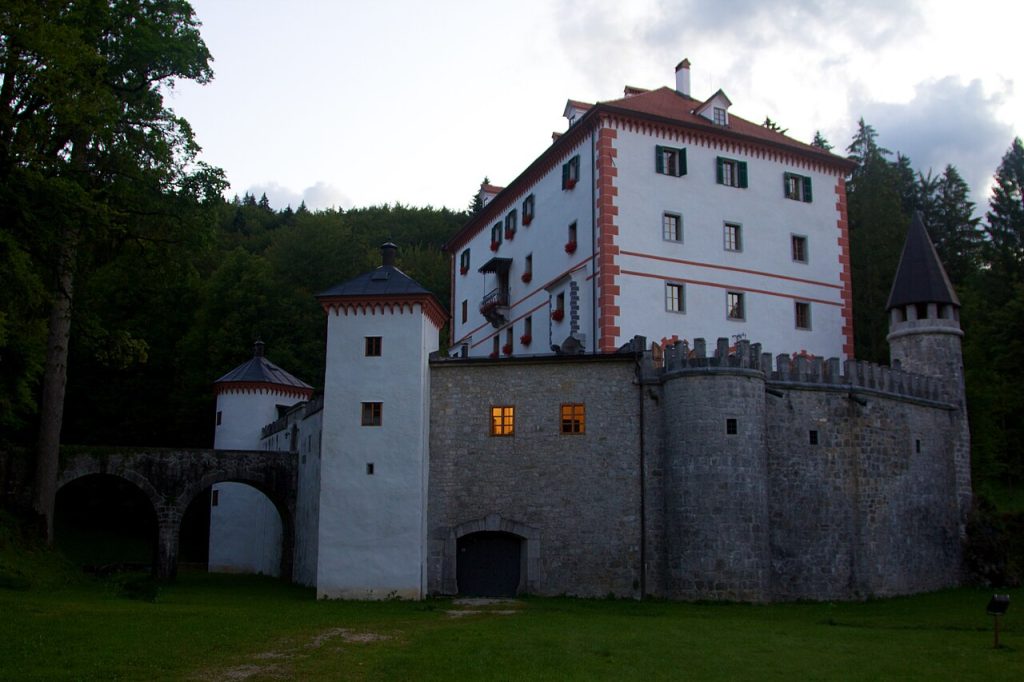
The coats of arms of the owners are carved over the gate and painted in the rooms, and the museum’s tour explains the succession. The Auerspergs’ long tenure left the castle in the hands of stewards, and the forest, rather than the house, was the estate’s value.
The Renaissance Castle and the Moat
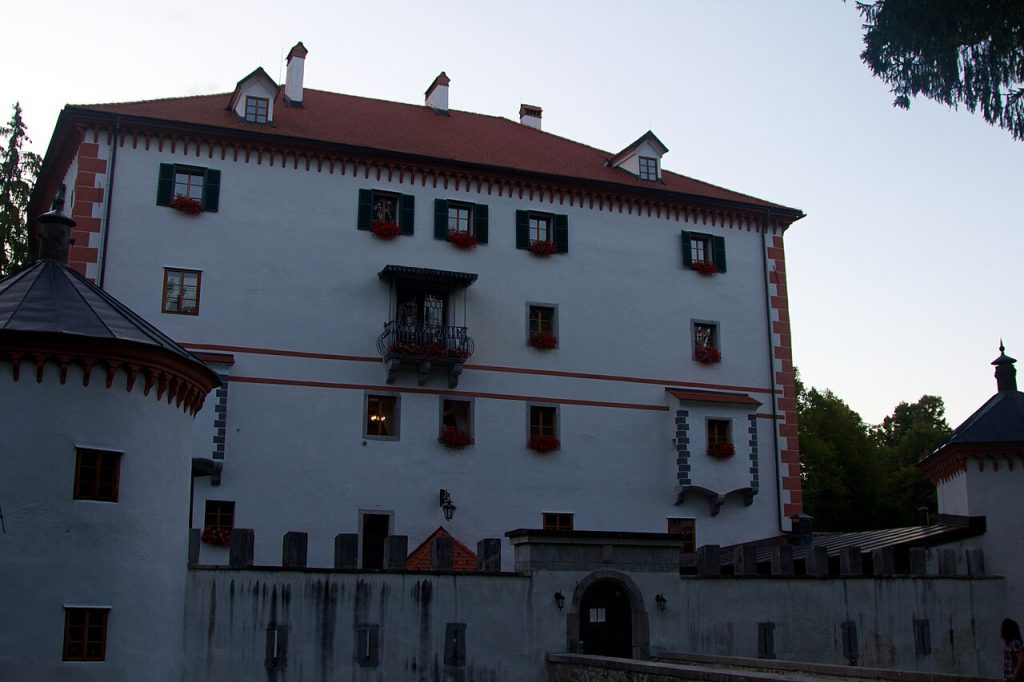
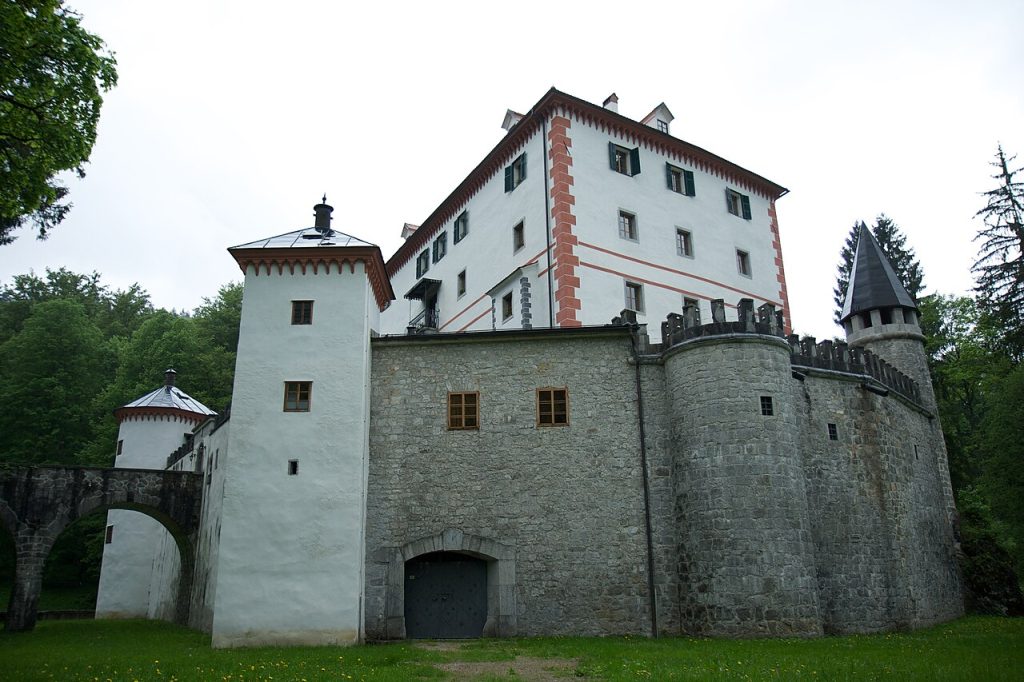
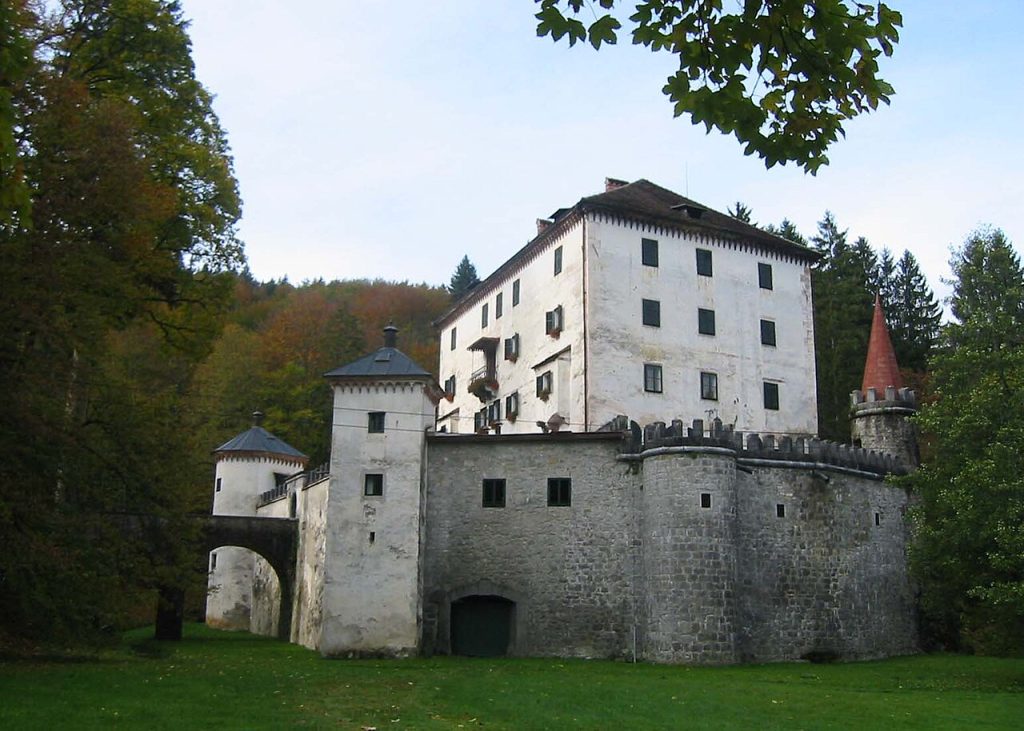
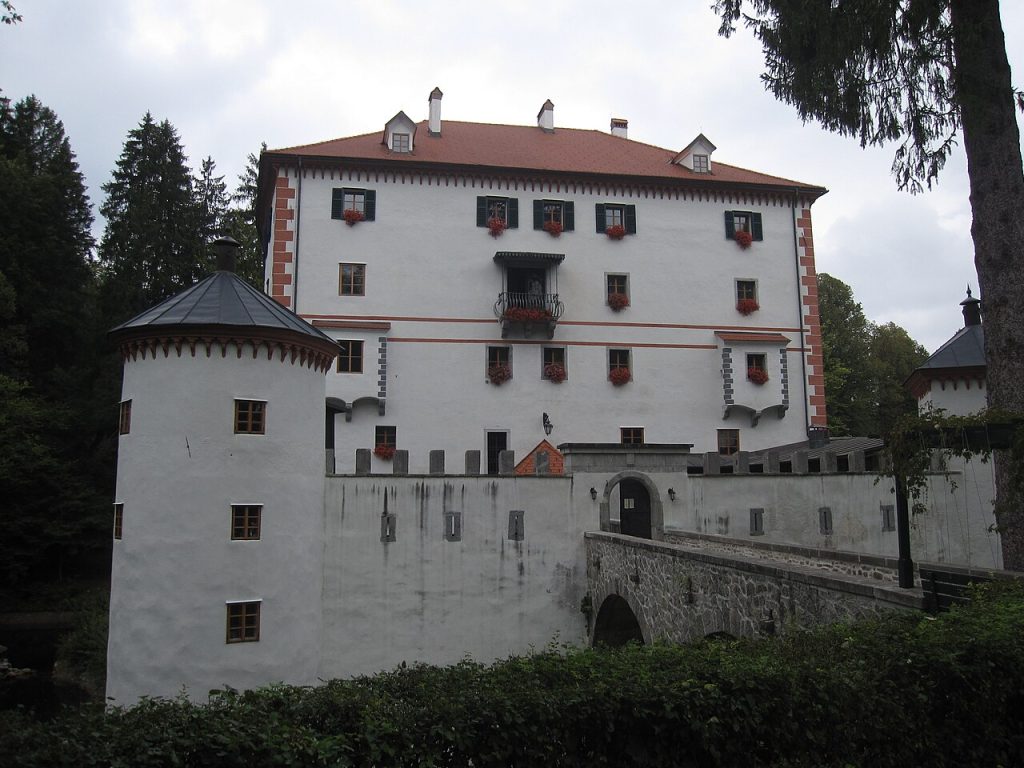
The Lambergs’ rebuilding in the sixteenth century gave the castle its present form: a compact three-storey block on the rock with a round tower at one corner, a walled courtyard, a gate reached by a bridge over the moat and plain rendered walls with small windows. The Renaissance details are modest, a portal, some window frames, a stair, and the building has the look of a fortified manor rather than a palace. Later owners added a Baroque chapel and nineteenth-century comforts but did not change the outline.
Walk around the rock and look at the castle from the pond side, where the walls rise straight from the water and the tower is reflected. It is the picture on every brochure, and in winter, with snow on the roofs and the forest black behind, it is one of the most atmospheric views in Slovenia.
1853: A Saxon Prince Buys a Hunting Estate
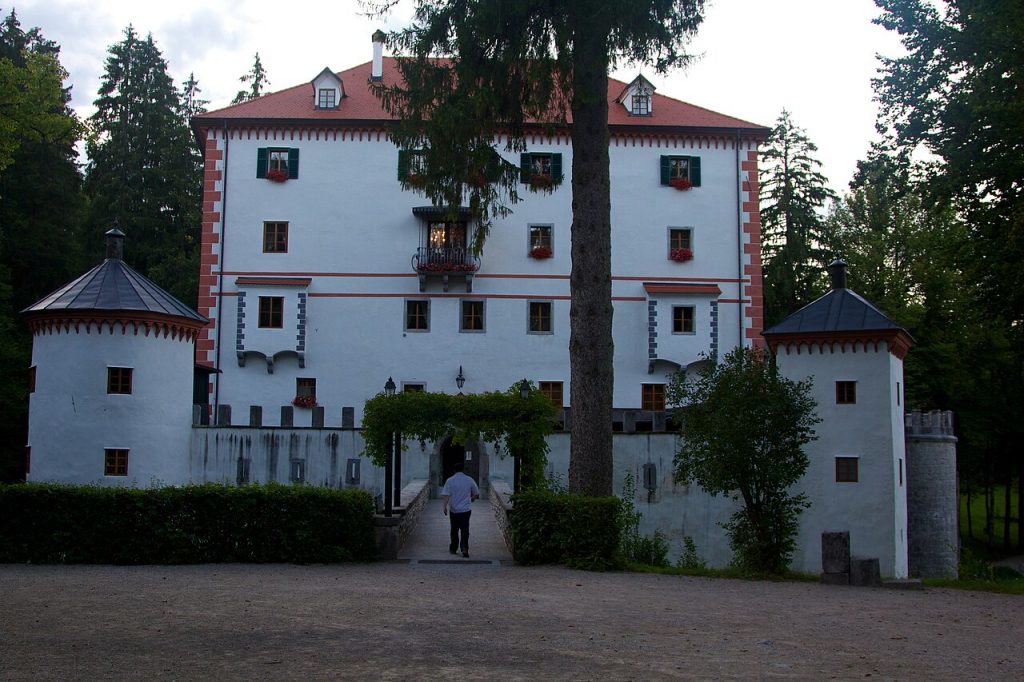
In 1853 the estate was bought by Prince Otto Victor I of Schönburg-Waldenburg, head of a wealthy Saxon family with lands around Glauchau and Waldenburg, who wanted a hunting ground in the Alps and found in Snežnik one of the largest private forests in the Habsburg empire. He paid for the castle and some twenty thousand hectares of woodland, and he and his heirs, especially his son Georg and grandson Hermann, made Snežnik a model estate: a hunting lodge, a forestry enterprise and a retreat from Saxony.
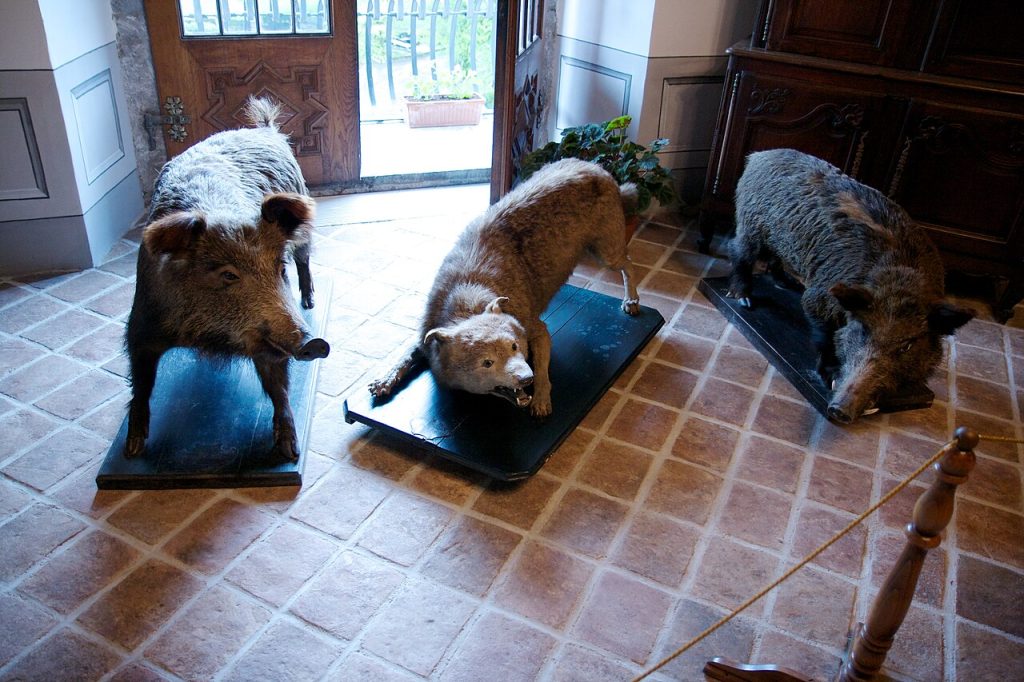
The Schönburgs refurbished the castle in the taste of the 1850s to 1880s, with comfortable rather than grand rooms, hunting trophies, family portraits and furniture brought from Saxony, and they came every autumn for the deer and bear hunting. Now, stop here in the entrance hall and look at the trophies: this is a house for men who came to shoot, and it has never pretended otherwise.
The Forestry School and the Model Estate
The Schönburgs were serious foresters. In 1869 they founded on the estate the first forestry school in Slovenia, training foresters to manage the vast woodland on scientific principles, and they employed German and Slovenian foresters who left a legacy of careful management that the state forest service inherited. The estate buildings beside the castle, the sawmill, the forester’s houses and the stables belong to this enterprise, and the forest around the valley is still managed on the Schönburgs’ lines, with selective felling and protection of old stands.
The school moved and closed, but its memory is kept in the castle’s displays, and the Snežnik forest is today a model of sustainable forestry and one of the great wildlife reserves of Europe. The prince who came for the hunting left the forest better than he found it.
The Rooms That Nobody Emptied
Here is Snežnik’s distinction. Almost every castle in Slovenia was emptied in 1945, its furniture dispersed, sold or destroyed. Snežnik was not. The Schönburgs’ rooms, the salons, the dining room, the bedrooms, the library and the hunting hall, survived with their furniture, paintings, carpets, stoves, lamps and ornaments in place, through the war, the expropriation and forty-five years of socialism. The castle is therefore a time capsule of a nineteenth-century aristocratic hunting lodge, and the museum presents it as such, with nothing added and nothing rearranged beyond what conservation required.
Walk the rooms slowly. The furniture is Biedermeier and historicist, the walls carry family portraits and hunting scenes, the stoves are Saxon and Viennese, and the whole has the slightly worn comfort of a house that was used. Few castle interiors anywhere feel so lived in.
The Egyptian Room and the Hunting Hall
Two rooms stand out. The Egyptian room, decorated around 1880 after a family journey to Egypt, has furniture in the pharaonic taste, wallpaper with lotus and papyrus motifs and ornaments brought back from the Nile, a fashionable oddity in a Carniolan forest. The hunting hall holds the trophies of a century of Schönburg hunting: antlers, bear skins, boar tusks and the stuffed heads of the forest’s animals, arranged as the family left them, with the guns and the hunting diaries that record each season’s bag.
Now, stop here in the hunting hall and read the diaries, which the museum displays: so many stags, so many bears, the weather, the guests. It is the record of a way of life that ended in 1945, and the room preserves it without comment.
Bears, Dormice and the Hunting Tradition
The Snežnik forest holds the densest population of brown bears in Europe, several hundred animals, and the castle’s hunting was always about bears as much as deer. Today the bears are protected and watched rather than shot, and the forest is a destination for wildlife tourism, with hides from which visitors can see bears at dusk. The estate buildings beside the castle house a museum of dormouse hunting, a Carniolan peasant tradition in which the fat edible dormice of the beech forests were trapped in autumn for their meat and fur, with the traps, the songs and the folklore.
The combination of a prince’s bear trophies and a peasant’s dormouse traps in the same place is very Slovenian, and it explains the relationship between the castle and the valley: the forest fed everyone, in different ways.
1945: The State Takes Over
The Schönburgs lost Snežnik in 1945, when the Yugoslav state expropriated German-owned property, and the family returned to Saxony, where their own castles were expropriated by the East German state in the same year. The castle on the rock passed to the forestry administration and then to the federal government, which, instead of emptying it, decided to keep it furnished as a guest house for the state. The decision was practical rather than cultural, but it saved the interiors.
The village meanwhile became part of socialist Yugoslavia, the forest was nationalised and managed by the state, and the castle, closed to the public, became a place of rumour: who stayed there, who hunted in the forest, what happened behind the moat.
Tito’s Guests in the Forest
From the 1950s until 1983 Snežnik was a protocol residence of the Yugoslav federal government, used by Tito and his ministers to receive foreign guests and to hunt in the forest. The rooms were kept as the Schönburgs had left them, with a few modern comforts added, and the hunting hall saw a new generation of trophies as communist officials and their visitors shot the same bears and stags that the princes had shot. The castle was maintained by the state and staffed by the forestry service, and it was in better condition in 1983 than many privately owned castles in the West.
In 1983 it was handed to the Slovenian museums and opened to the public as a museum of nineteenth-century castle life, the only fully furnished castle in the country. The transition from a leader’s hunting lodge to a museum was almost seamless, because nothing had to be found or bought; it was all still there.
The Restoration of 2008 to 2010
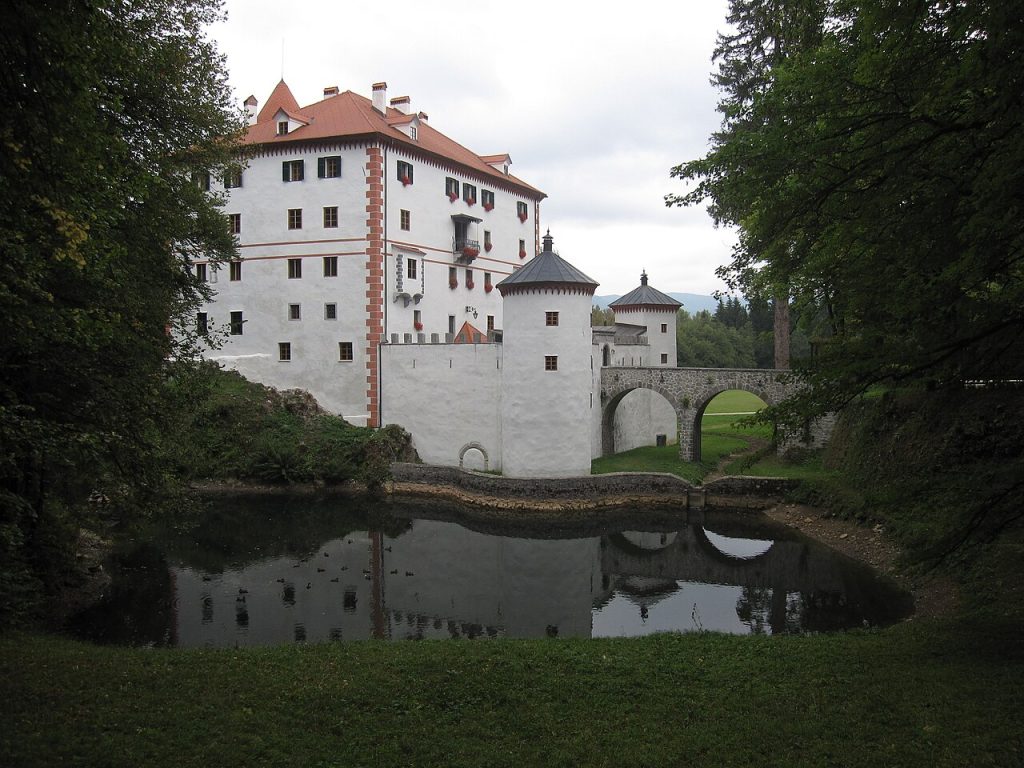
By the 2000s the building needed structural repair, and between 2008 and 2010 the Slovenian state carried out a complete restoration: the roof and walls were repaired, the moat and rock stabilised, the rooms conserved object by object, the textiles cleaned and the stoves relined. The museum reopened in 2010 with the rooms exactly as before but secure for another century, and with the estate buildings restored to house the dormouse museum, a café and the visitor centre.
The restoration was a model of its kind, prizing the integrity of the furnished rooms over any temptation to rearrange or modernise, and it has made Snežnik one of the most rewarding small museums in the country.
The Park, the Pond and the Walks
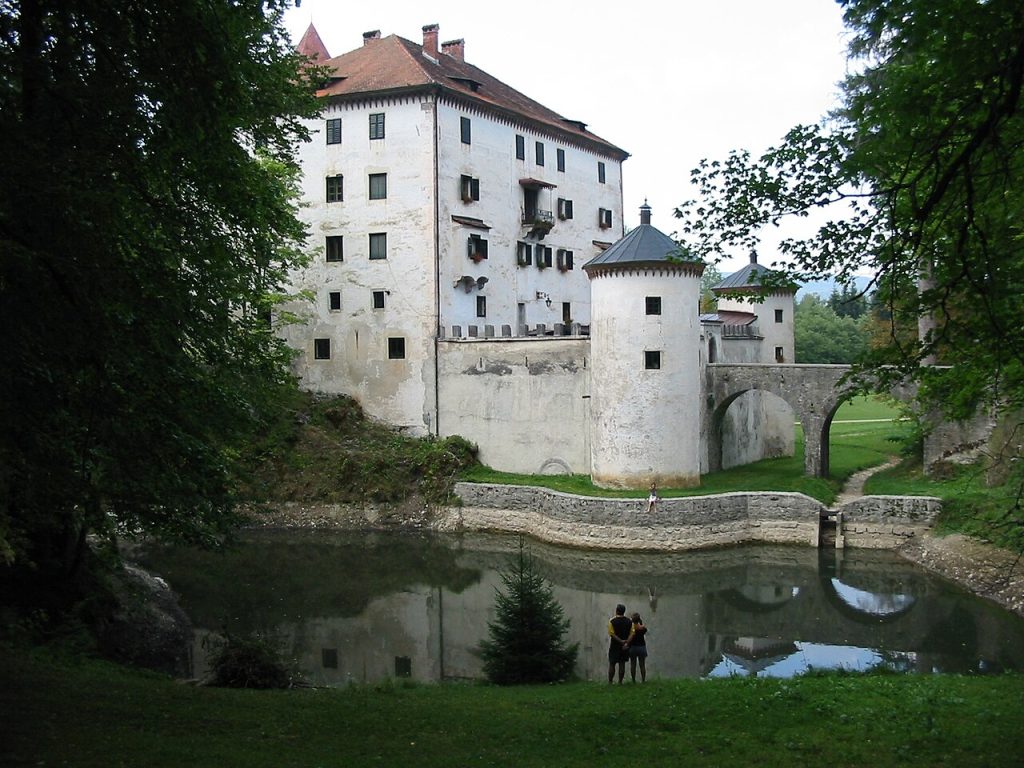
Walk around the pond and into the park, laid out by the Schönburgs with lawns, old trees and paths along the water, and then take one of the trails into the forest, which begin at the castle gate. The forest is enormous and it is easy to go for hours without meeting anyone; a marked trail leads to the ruins of the mediaeval Lož castle on a hill nearby and to the summit of Snežnik for serious walkers. Bear sightings are possible and, with a local guide, likely at dusk.
Now, stop here at the edge of the trees and look back at the white castle on its rock. The princes who bought it for the hunting, the leaders who kept it for the same reason and the museum that keeps it now all wanted the same thing: a house at the edge of the forest, and the forest itself.
Sneznik on Video
Before you plan your trip, take a few minutes to see Sneznik Castle in motion. The video below gives a good sense of the setting, the scale of the buildings and the atmosphere of the grounds.
Visiting Sneznik Castle Today
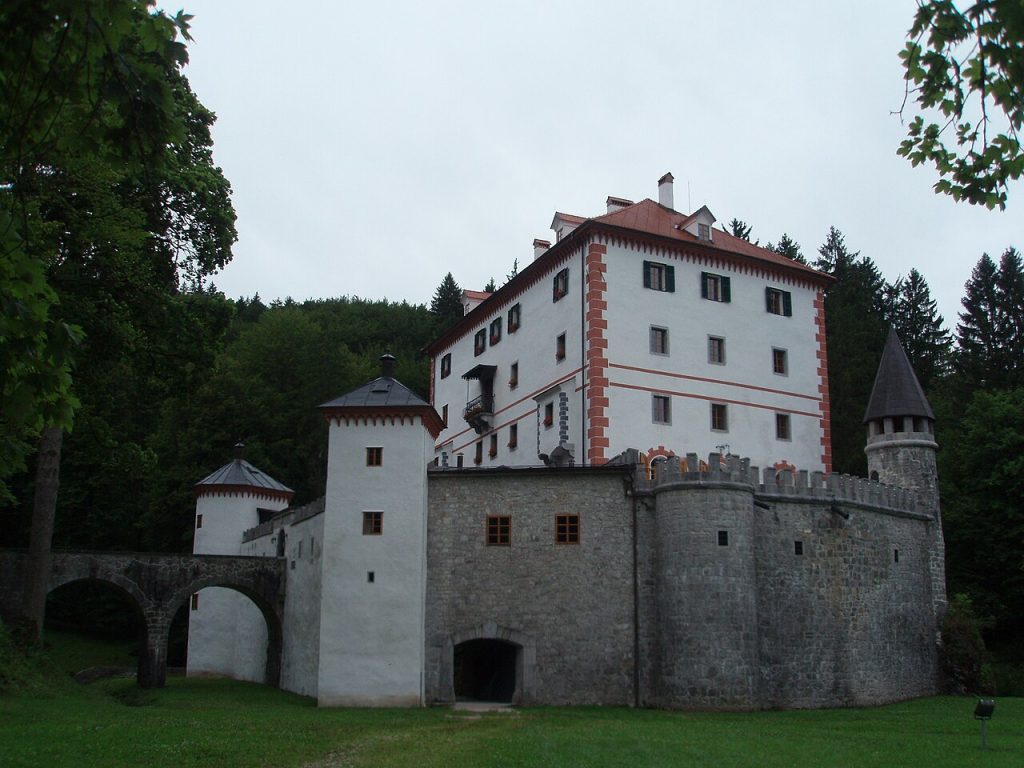
Snežnik Castle is open from spring to autumn, usually Tuesday to Sunday, and the furnished rooms are visited only on guided tours that start on the hour; tours in English are available, and the dormouse museum and café in the estate buildings are open the same hours. Allow an hour for the tour and as long as you like for the park and forest. In winter the castle opens on weekends and for the Christmas events, when it is at its most beautiful. Bear-watching trips from hides in the forest can be booked locally in the warmer months.
The castle lies at Kozarišče in the Loška dolina, about seventy kilometres south of Ljubljana by road via Cerknica; there is no useful public transport, so a car is needed. Combine it with the Cerknica lake, the Križna cave and Postojna. Ljubljana Castle is an hour and a quarter to the north. Here is the exact spot: Sneznik Castle on Google Maps.
Palaces Nearby
If you have enjoyed this palace, the region holds more remarkable residences. Here are two more well worth adding to your journey:
You May Like
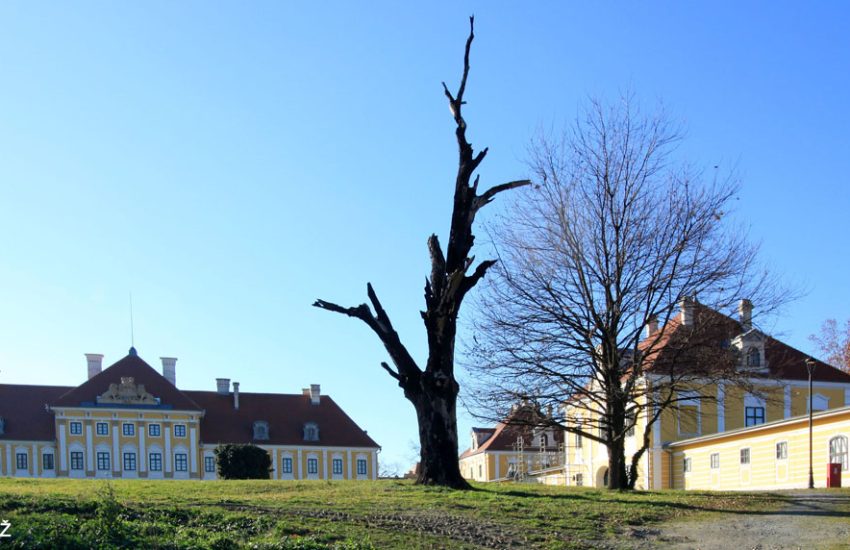
Eltz Manor in Vukovar and the Palace That Rose From the Rubble