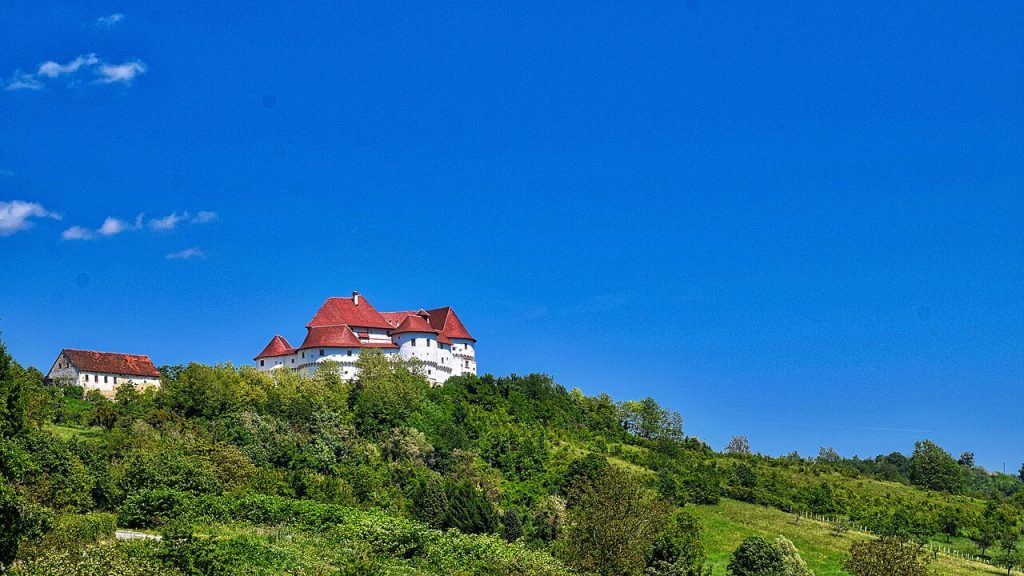
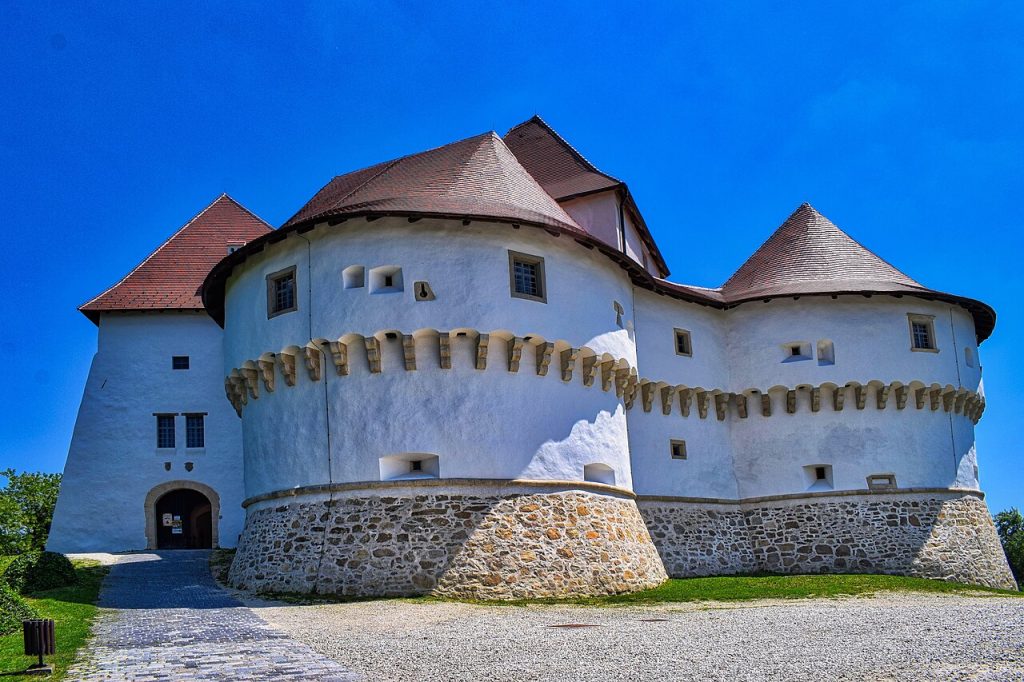
The Hrvatsko Zagorje, the hill country north of Zagreb toward the Slovenian border, is a landscape of vineyards, small churches and castles on every second hilltop, and Veliki Tabor is the one that everyone remembers. It stands on a steep hill above the village of Desinić, a pentagonal core of grey stone with four fat round towers, a ring of outer walls and a roof of red tiles, and it looks like a child’s drawing of a castle. It is also, by common consent, the most haunted building in Croatia, because of a girl named Veronika who, the story goes, loved a count’s son, was tried as a witch and was walled alive into one of the towers.
The castle was built at the beginning of the sixteenth century by the Ratkaj family, Hungarian nobles who held it for nearly three hundred years, on a site that the counts of Celje had fortified a century earlier against the Hungarians and the Turks. It survived Ottoman raids, peasant revolts and the slow decline of the Croatian nobility, was bought in 1919 by the painter Oton Iveković, who wanted to save it and could not afford to, and was finally restored by the Croatian state between 2007 and 2011 into a museum of the Zagorje’s castles and the Ratkaj’s world. The legend of Veronika is told on every tour, and a skull found in the wall during restoration keeps it alive.
Walk with me up the hill, through the gate and into the pentagonal courtyard, with the counts, the Turks, the painter and the girl in order. The contents are below.
In This Article
- The Zagorje and Its Hundred Castles
- The Counts of Celje and the First Fort
- Veronika of Desinic: The Legend
- The Ratkaj Family Arrives
- The Pentagon and the Four Towers
- Renaissance Arcades in a Fortress
- Against the Turks and the Peasants
- Baroque Comforts and the Chapel
- The Ratkaj Die Out and the Castle Fades
- The Painter Who Bought a Castle
- The Skull in the Wall
- The Restoration of 2007 to 2011
- The Museum and the Festival
- Veliki Tabor on Video
- Visiting Veliki Tabor Today
- Palaces Nearby
The Zagorje and Its Hundred Castles
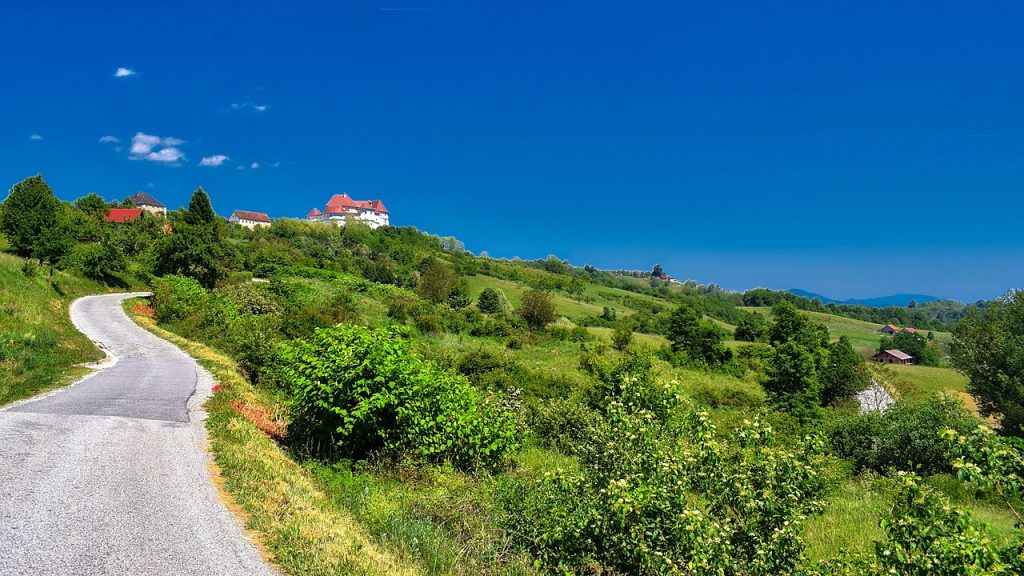
The Zagorje means the land beyond the mountain, the hills north of Zagreb’s Medvednica ridge, and it is the heartland of old Croatia: a rolling country of vineyards, cornfields, wooden chapels and manor houses that belonged to the Hungarian-Croatian nobility for six hundred years. The region has more castles per square kilometre than any other part of Croatia, from the great Trakošćan on its lake to dozens of smaller kurije, the country houses of the lesser gentry, and Veliki Tabor, near the Slovenian border, is the most complete and most dramatic of them.
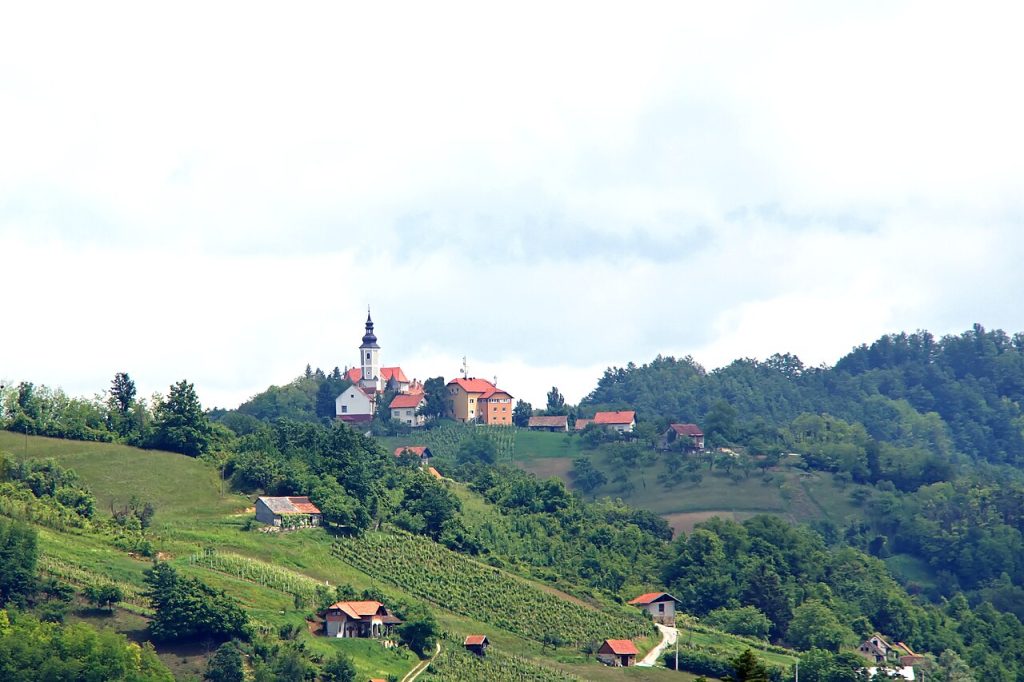
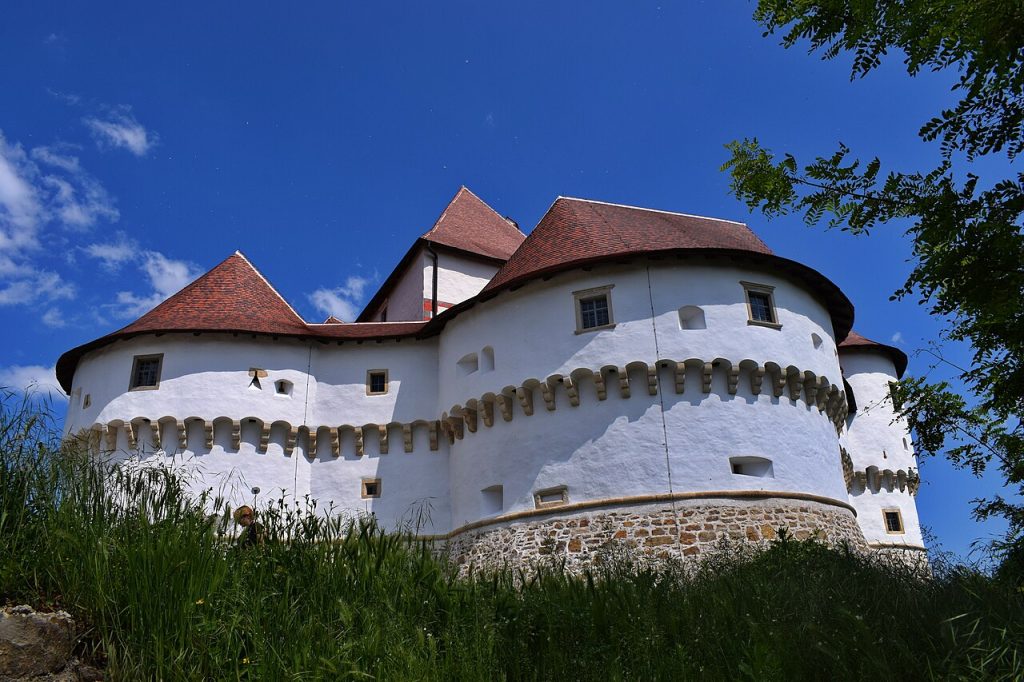
Now, stop here on the road from Desinić and look up. The castle sits on the summit of a steep hill, its towers rising above the trees, with the whole Zagorje spread out behind it and the Slovenian hills on the horizon. The name Tabor means a fortified camp, and the big Tabor, Veliki, was distinguished from a smaller fort, Mali Tabor, that stood on a neighbouring hill and has vanished.
The Counts of Celje and the First Fort
The hill was first fortified in the fifteenth century by the counts of Celje, the most powerful dynasty in Slovenia and the Croatian Zagorje at the time, who held estates on both sides of the present border and needed a fort against the Hungarians and, from the 1470s, the Ottoman raids. Of their work almost nothing survives above ground, but the site, the name and the legend belong to them, and when the Celje line died out in 1456 with the murder of Ulrich II in Belgrade, the estate passed through several hands before reaching the family that built the present castle.
The Celje connection matters for the story that follows. Frederick II of Celje, the father of Ulrich, is the man whose love affair gave Veliki Tabor its ghost, and the tale is set in the years around 1420, before the Ratkaj castle existed, in a fort on this hill that we can no longer see.
Veronika of Desinic: The Legend
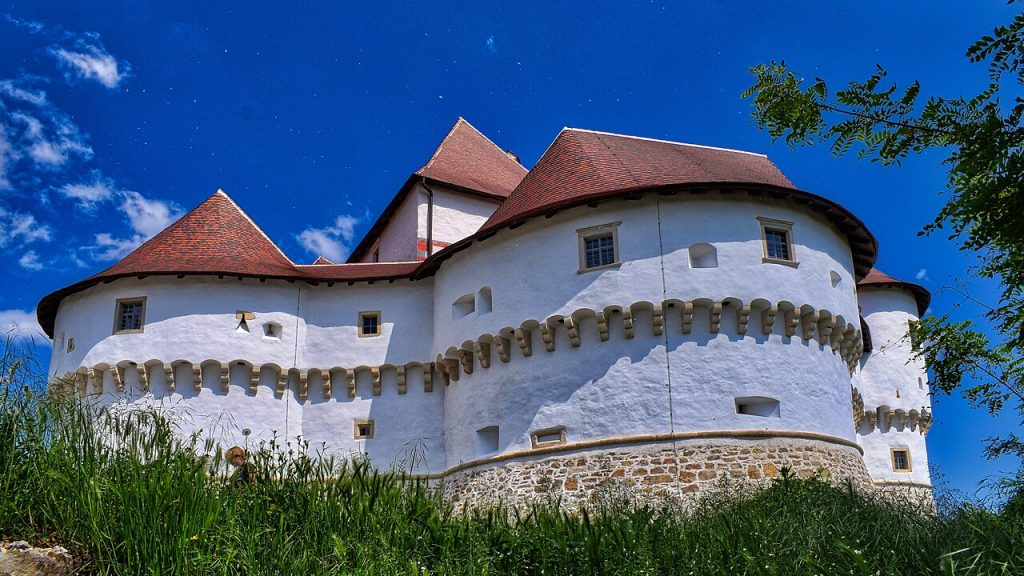
Here is the story every guide tells. Frederick II of Celje, heir to the counts, was married to Elizabeth Frankopan, a Croatian noblewoman, but fell in love with Veronika, a beautiful girl of humble birth from Desinić, the village below the castle. In 1422 Elizabeth was found murdered, Frederick was suspected, and he fled with Veronika and married her in secret. His father, Count Hermann II, furious at the mésalliance and the scandal, had Frederick imprisoned in a tower at Celje and Veronika hunted down. She was tried for witchcraft, the charge being that she had bewitched the heir; the court acquitted her, but Hermann had her drowned, or, in the version told at Veliki Tabor, walled alive into the tower of the fort on this hill.
The historical Veronika was probably drowned at Ojstrica Castle in Slovenia in 1425 and buried at Braslovče, where Frederick later built a chapel for her, and the Celje chronicle records the affair in some detail. But the Zagorje has claimed her, and the walled-up version has been told here for centuries. Now, stop here below the tower and listen: the guides say that on quiet nights a woman’s weeping can be heard in the walls.
The Ratkaj Family Arrives
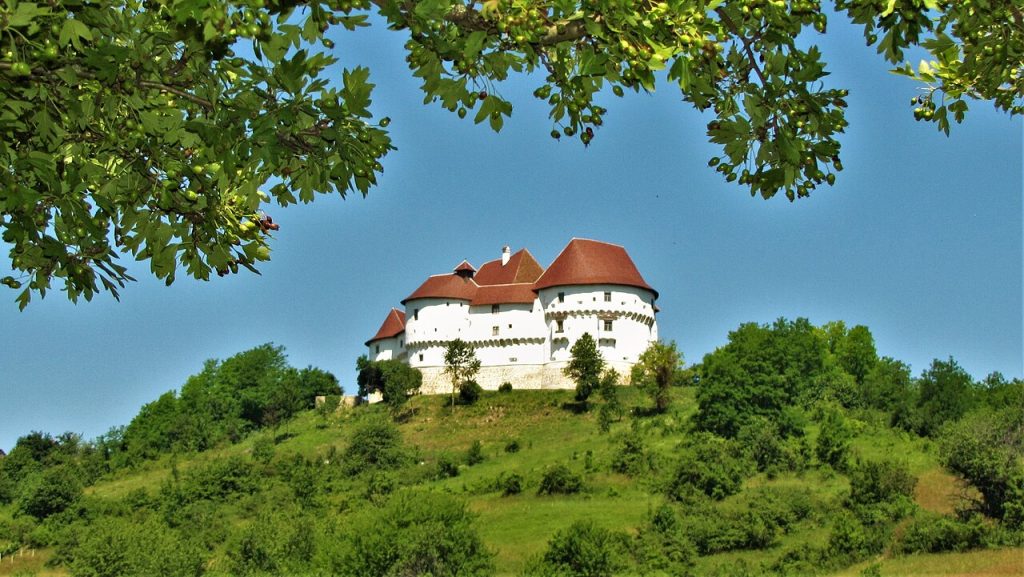
In 1502 King Vladislaus II granted the Tabor estate to Pavao Ratkaj, a Hungarian noble of the Rátkay family from Rátka, who had served the crown in Croatia and whose descendants would hold the castle until the family died out in 1793. The Ratkaj built the castle you see today, beginning with the pentagonal core and the towers in the first decades of the sixteenth century and adding the outer walls, the arcades and the chapel over the next two hundred years. They were soldiers against the Turks, officials of the Croatian parliament and, in the Baroque age, patrons of the arts, and one of them, Juraj Ratkaj, was a historian who wrote the first history of Croatia in the 1650s.
The family arms, a stork or a crane standing on one leg, appear over the gate and in the courtyard, and the museum’s rooms trace the Ratkaj through their three centuries. They were never magnates on the scale of the Zrinski or the Frankopan, but they held their hill against everything the sixteenth and seventeenth centuries sent.
The Pentagon and the Four Towers
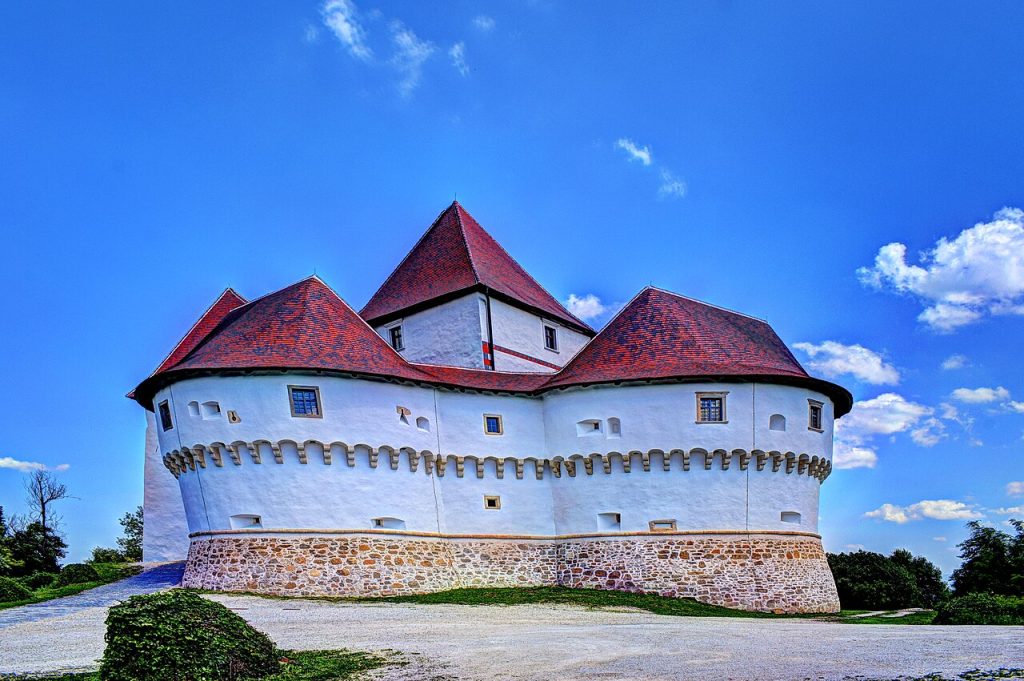
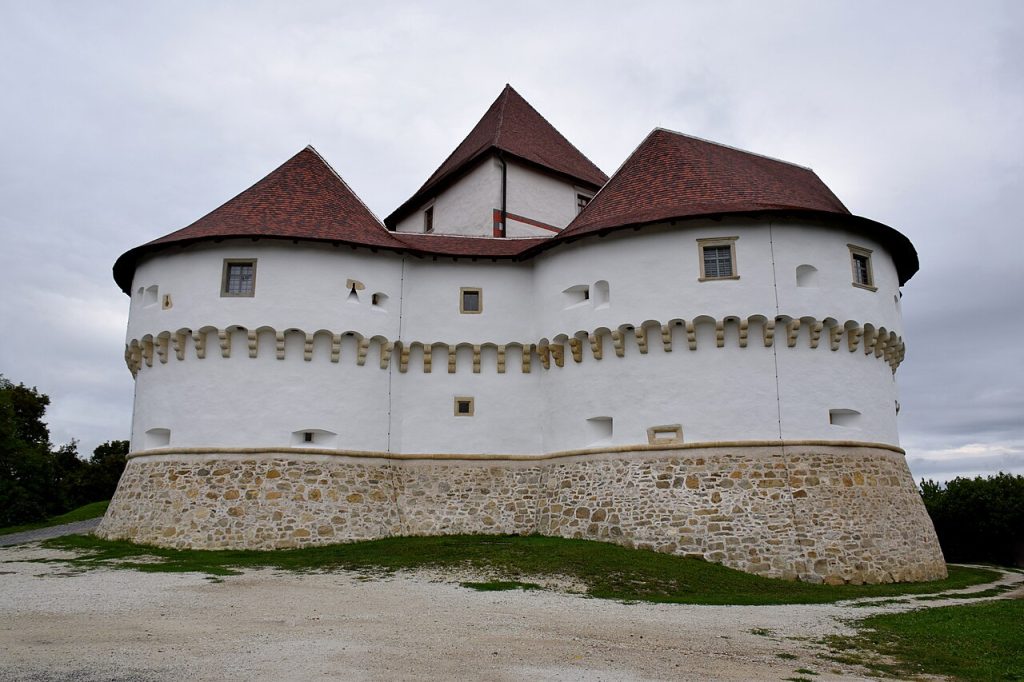
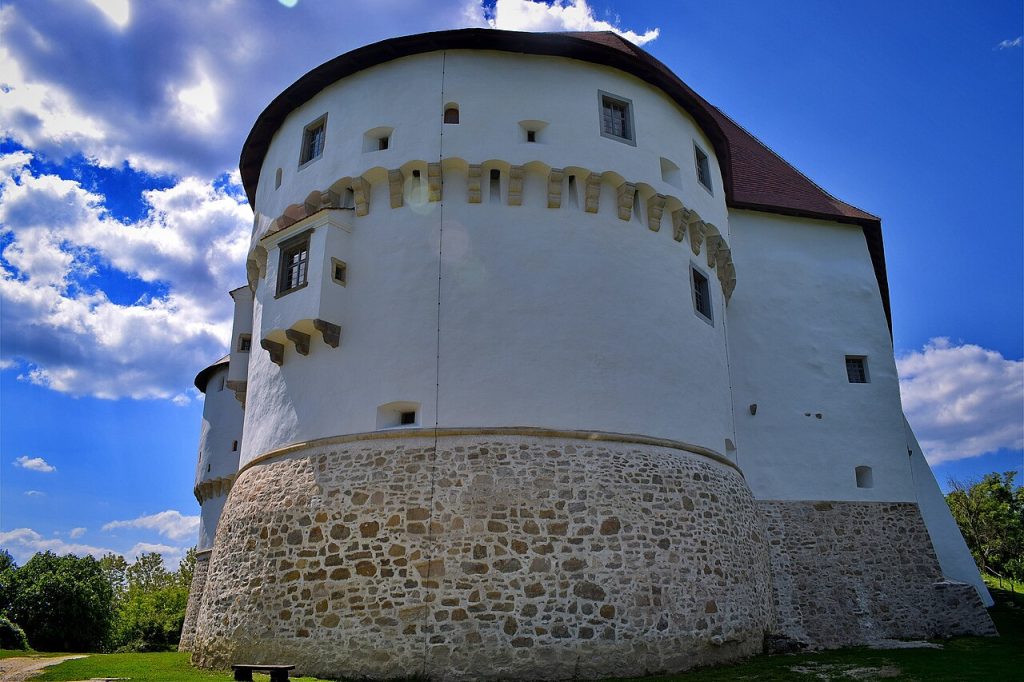
The heart of the castle is a pentagonal building of the early sixteenth century, three storeys high around a small courtyard, with four semicircular towers at four of the five corners. The towers are squat and thick-walled, built for firearms, with gun loops at several levels and conical tiled roofs; the fifth corner, facing the steepest slope, needed no tower. The plan is unusual, a compromise between the mediaeval tower castle and the Renaissance artillery fort, and it gives Veliki Tabor its unmistakable silhouette.
Walk around the outside and count the towers, then enter through the gate and look at the walls from within. The stone is local, grey and roughly dressed, and the thickness at the base is over two metres. This was a serious fortification on a frontier that saw Ottoman raids every few years, and it was built to be held by a garrison of a few dozen men.
Renaissance Arcades in a Fortress
Step into the inner courtyard and the fortress becomes a palace. Arcaded galleries run around the courtyard on three levels, with round arches on stone columns, added in the later sixteenth and seventeenth centuries to give the family covered access to the rooms and a touch of Italian elegance in a Croatian fort. The arcades are the castle’s architectural glory and the setting for the summer concerts and the film festival that the castle hosts.
Now, stop here in the courtyard and look up through the three tiers of arches to the sky. The contrast between the grim exterior and this airy, almost Venetian interior is the essence of Veliki Tabor: a family that needed walls against the Turks and wanted, inside them, to live like Renaissance nobles.
Against the Turks and the Peasants
The outer ring of walls, with its bastions and gatehouse, was added in the later sixteenth and seventeenth centuries as the Ottoman frontier moved closer and the raids grew more frequent. The Zagorje was never conquered by the Turks, but it was raided repeatedly, and every castle in the region was strengthened. The Ratkaj also had to face their own peasants: the great peasant revolt of 1573 under Matija Gubec swept through the Zagorje, and several castles were attacked before the revolt was crushed and Gubec executed with a red-hot iron crown in Zagreb.
The museum tells both stories, and the walls you walk are their physical record. Look at the gun loops in the bastions and at the gate with its murder holes; this was a working fortress into the eighteenth century, when the Ottoman threat finally receded and the castle could become a country house.
Baroque Comforts and the Chapel
In the eighteenth century the Ratkaj modernised the interiors in the Baroque taste, with stucco ceilings, tiled stoves and new windows, and built a chapel in one of the towers with a painted altar and a gallery for the family. The chapel, dedicated to St Peter, has been restored and is the most atmospheric interior in the castle. The rooms around the courtyard were refitted as salons, bedrooms and a library, and the castle in the 1700s was a comfortable if old-fashioned country seat with a garrison’s bones.
Look for the Baroque doors and the remains of painted decoration in the first-floor rooms, and for the large kitchen with its open hearth in the ground floor, which served the household for three centuries and has been restored with its utensils.
The Ratkaj Die Out and the Castle Fades
The last Ratkaj died in 1793 and the castle passed to the crown and then through a series of owners who used it as a farm, a store and a tenement for estate workers. The arcades were bricked up, the towers lost their roofs, the chapel was stripped and the walls began to fall. By 1900 Veliki Tabor was a picturesque ruin inhabited by a few families, admired by painters and photographers and ignored by everyone else.
It was a painter who saved it. In 1919, in the first year of the new Yugoslav kingdom, one of Croatia’s most famous artists bought the castle with the intention of restoring it, and the castle’s modern history begins with him.
The Painter Who Bought a Castle
Oton Iveković was the leading Croatian painter of national history, the man whose canvases of Gubec’s revolt, the arrival of the Croats on the Adriatic and the death of Petar Zrinski hung in every school, and he had painted Veliki Tabor as a backdrop for his historical scenes. In 1919 he bought it, moved in and set about repairs with his own money and his students’ labour. He reroofed parts of the castle, cleared the courtyard and lived in the tower rooms, painting the Zagorje from the walls.
The money ran out, as it always does, and Iveković sold the castle to the state in 1938, a year before his death. But he had kept the roof on for twenty years, and his paintings of the castle, several of which hang in the museum, fixed its image in the Croatian imagination. Now, stop here in the tower room where he lived and look out at the view he painted.
The Skull in the Wall
During repairs in the twentieth century a human skull was found embedded in a wall of the castle, and it was immediately identified as Veronika’s. It is displayed in a case in the castle, and the guides present it with a straight face and a raised eyebrow, since the historical Veronika died at Ojstrica, eighty kilometres away. The skull’s origin is unknown; walled-up remains are not unusual in old castles, where burials and building work overlapped, and it may be anyone.
It does not matter. The skull and the story are now part of the castle, and Veliki Tabor stages the legend every year in a theatrical performance in the courtyard, with Veronika, Frederick and the wicked count. Now, stop here in front of the case and decide for yourself; most visitors leave the question open.
The Restoration of 2007 to 2011
After decades of partial repairs under Yugoslavia, when the castle was a museum in poor condition, the Croatian state carried out a complete restoration between 2007 and 2011, funded with European help. The towers were reroofed, the arcades reopened and repaired, the chapel restored, the outer walls consolidated and the interiors refitted as a modern museum with climate control and lighting. The work was conservative and well judged, keeping the castle’s rough stone character while making it safe and usable.
The restoration also included archaeological excavation, which clarified the building’s phases and found the Celje-era foundations under the Ratkaj castle. The result is one of the best-presented castles in Croatia, and the restoration won national conservation prizes.
The Museum and the Festival
The museum occupies the rooms around the courtyard and presents the castle’s architecture and archaeology, the Ratkaj family, the castles and nobility of the Zagorje, the legend of Veronika and the work of Oton Iveković, with weapons, furniture, paintings and finds from the excavations. The kitchen, the chapel and the tower rooms are shown as period spaces, and the arcades and courtyard host concerts, theatre and, every summer, the Tabor Film Festival, a short-film festival that fills the castle with young filmmakers.
Now, stop here in the courtyard on a festival evening, with a screen under the arcades and the towers black against the sky, and consider how a fortress built against the Turks has become a cinema. The Ratkaj would be puzzled; Iveković, who loved the place for its drama, would understand.
Veliki Tabor on Video
Before you plan your trip, take a few minutes to see Veliki Tabor in motion. The video below gives a good sense of the setting, the scale of the buildings and the atmosphere of the grounds.
Visiting Veliki Tabor Today
Veliki Tabor is open year-round, usually Tuesday to Sunday, with longer hours in summer; the ticket covers the museum, the chapel, the towers and the walls, and guided tours in English can be booked. Allow ninety minutes, plus time for the view from the outer walls and the restaurant in the village below, which serves Zagorje dishes. The Tabor Film Festival runs in July and the Veronika performance in late summer.
The castle lies near Desinić, about seventy kilometres north-west of Zagreb and ten kilometres from the Slovenian border; a car is needed, and the drive can be combined with Trakošćan Castle, forty minutes to the east, and with Varaždin. Celje in Slovenia, the home of Veronika’s lover, is an hour to the north-west. Here is the exact spot: Veliki Tabor on Google Maps.
Palaces Nearby
If you have enjoyed this palace, the region holds more remarkable residences. Here are two more well worth adding to your journey:
You May Like