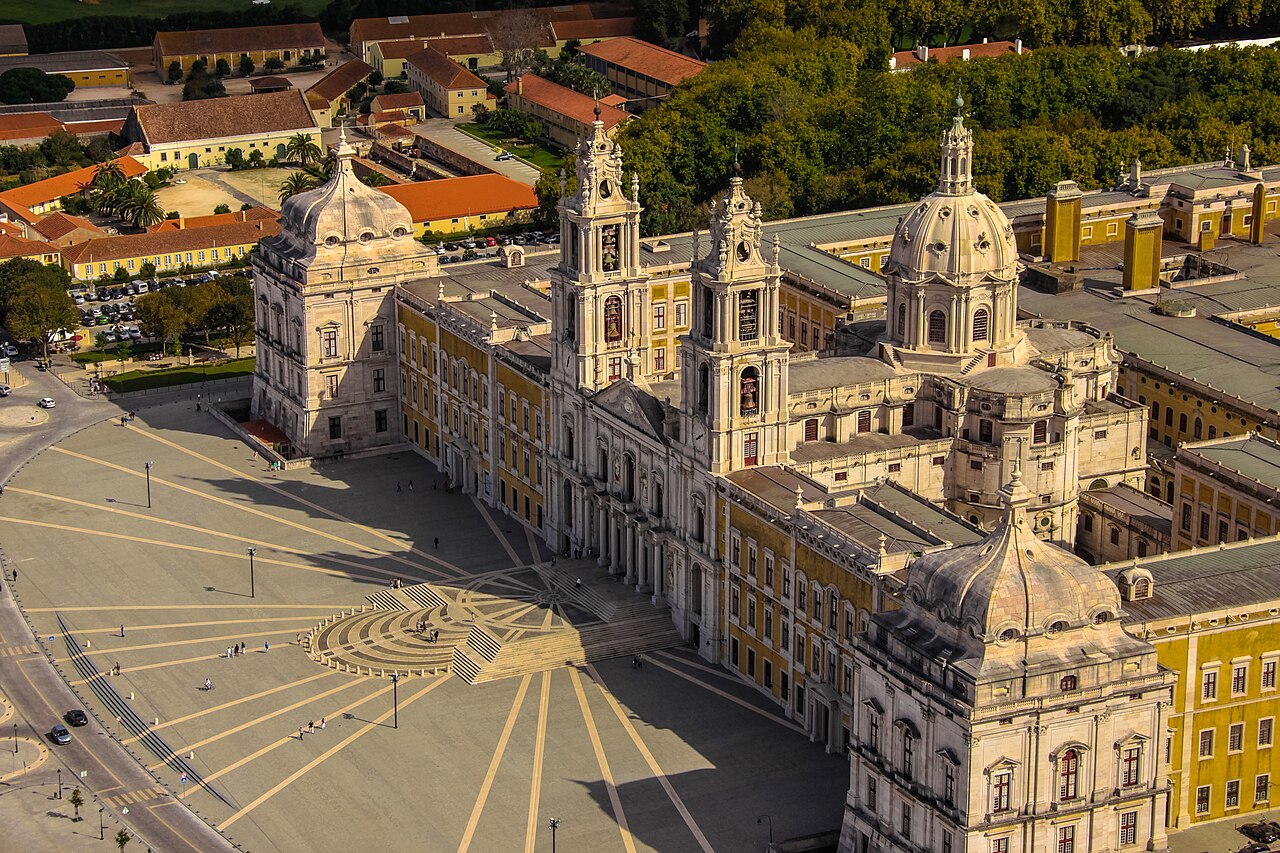
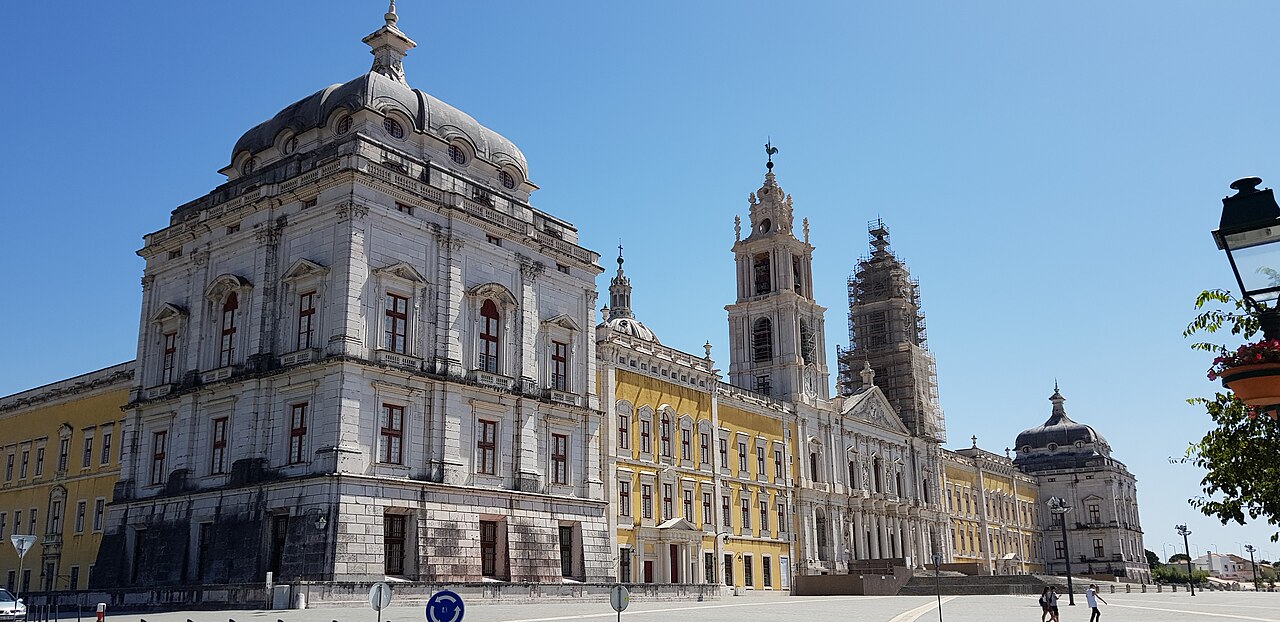
If you have ever stood in front of a building so large that your eyes cannot take it in all at once, you will understand the strange first impression Mafra makes. The main facade runs for well over two hundred metres, a wall of pale limestone that seems less like a single palace than an entire town folded into one continuous elevation. At its centre a domed church rises between two bell towers, and to either side the royal apartments stretch away toward corner pavilions that feel almost impossibly distant. You come expecting a palace and you find, instead, a whole world sealed behind one enormous front.
That world is the Palacio Nacional de Mafra, and it is one of the most ambitious things the Portuguese monarchy ever attempted. It is at once a royal residence, a basilica, a Franciscan convent, and one of the great libraries of the eighteenth century, all conceived as a single Baroque gesture and all built within a single generation. The gold that paid for it came from Brazil, the marble came from quarries across the kingdom and from Italy, and the labour came from tens of thousands of workers who lived, and in many cases died, in the shadow of the rising walls.
What makes Mafra so compelling is not only its scale but the tension inside it. Here is a building meant to glorify a king and his God, and yet the human cost of raising it became the raw material for one of the most famous novels in the Portuguese language. Here is a monument to religious devotion that also housed a hunting court and one of Europe’s finest collections of bells. To walk through Mafra is to feel that contradiction in every corridor: the sacred and the worldly, the sublime and the brutal, sitting side by side under the same vast roof.
In this guide you will trace the whole story, from the royal vow that set it in motion to the frantic decades of construction, the marvels of the basilica and the library, the daily life of the monks and the court, the wars that emptied its rooms, and what it is like to visit today. By the end you should be able to picture Mafra not as a static postcard but as a living place, shaped by ambition, faith, money, and the thousands of hands that built it.
In This Article
- How a King’s Promise Built a Palace
- The Staggering Scale of Building Mafra
- Baroque Ambition Written in Stone
- Stepping Into the Basilica
- The Library and Its Colony of Bats
- Through the Royal Apartments
- Sculpture, Tapestry, and the Roman Connection
- Life Behind the Convent Walls
- The Great Walled Park Beyond the Palace
- When the Court Fled and the Rooms Emptied
- The Bells That Made Mafra Ring
- What It’s Like to Visit Now
- See Mafra for Yourself
How a King’s Promise Built a Palace
The story of Mafra begins, as so many grand buildings do, with a wish. King John V had come to the throne in 1706 as a young man with an almost boundless sense of what majesty should look like, and by the standards of early eighteenth-century Europe he had the means to indulge it. Portuguese ships were bringing home astonishing quantities of gold from the mines of Brazil, and that river of wealth gave John V a freedom of action that few of his contemporaries could match. What he lacked, for a time, was an heir.

According to the tradition that surrounds the palace, the king and his queen, Maria Anna of Austria, longed for a child, and John V vowed that if he were granted one he would build a convent for the Franciscan friars. When his daughter Barbara was born in 1711, he considered the vow fulfilled and set about honouring it. What might have been a modest religious house instead grew, in the king’s imagination, into something far larger, and the plans expanded almost as soon as they were drawn.
You can read that expansion as pure vanity, and some of his critics did. But it also reflected a coherent idea of what a Catholic monarchy should project to the world. John V wanted a Portuguese answer to the great building programmes of Rome and Madrid, a statement that his small kingdom stood among the first rank of Christian powers. A convent alone would not say that. A convent joined to a royal palace and crowned with a basilica just might.
So the vow that started with a plea for children ended in one of the largest construction projects Europe had seen in generations. The site chosen was the town of Mafra, in rolling country north-west of Lisbon, far enough from the capital to feel like a retreat yet close enough to remain within the orbit of the court. There, on ground that had held only a modest earlier structure, the king’s promise began to take on the weight of stone.
It is worth pausing on the moment in which all this happened. Portugal in the early eighteenth century was a kingdom whose fortunes had been transformed almost overnight by the discovery of gold, and later diamonds, in its Brazilian colony. A country that had known lean years suddenly had wealth on a scale that could reshape its ambitions. Mafra was, in a sense, the physical form that this windfall took, a way of turning colonial gold into something permanent and visible at home. Understanding that context helps explain why a vow for a convent could swell into a project of such staggering size.
The Staggering Scale of Building Mafra
Construction began in 1717, and almost nothing about it was ordinary. The first stone was laid with great ceremony, but ceremony quickly gave way to the sheer logistical problem of raising a building of this size at speed, for John V was impatient to see it finished in his own lifetime. To meet that demand the site became a small industrial city, drawing labourers, stonemasons, carpenters, and craftsmen from across Portugal and beyond.
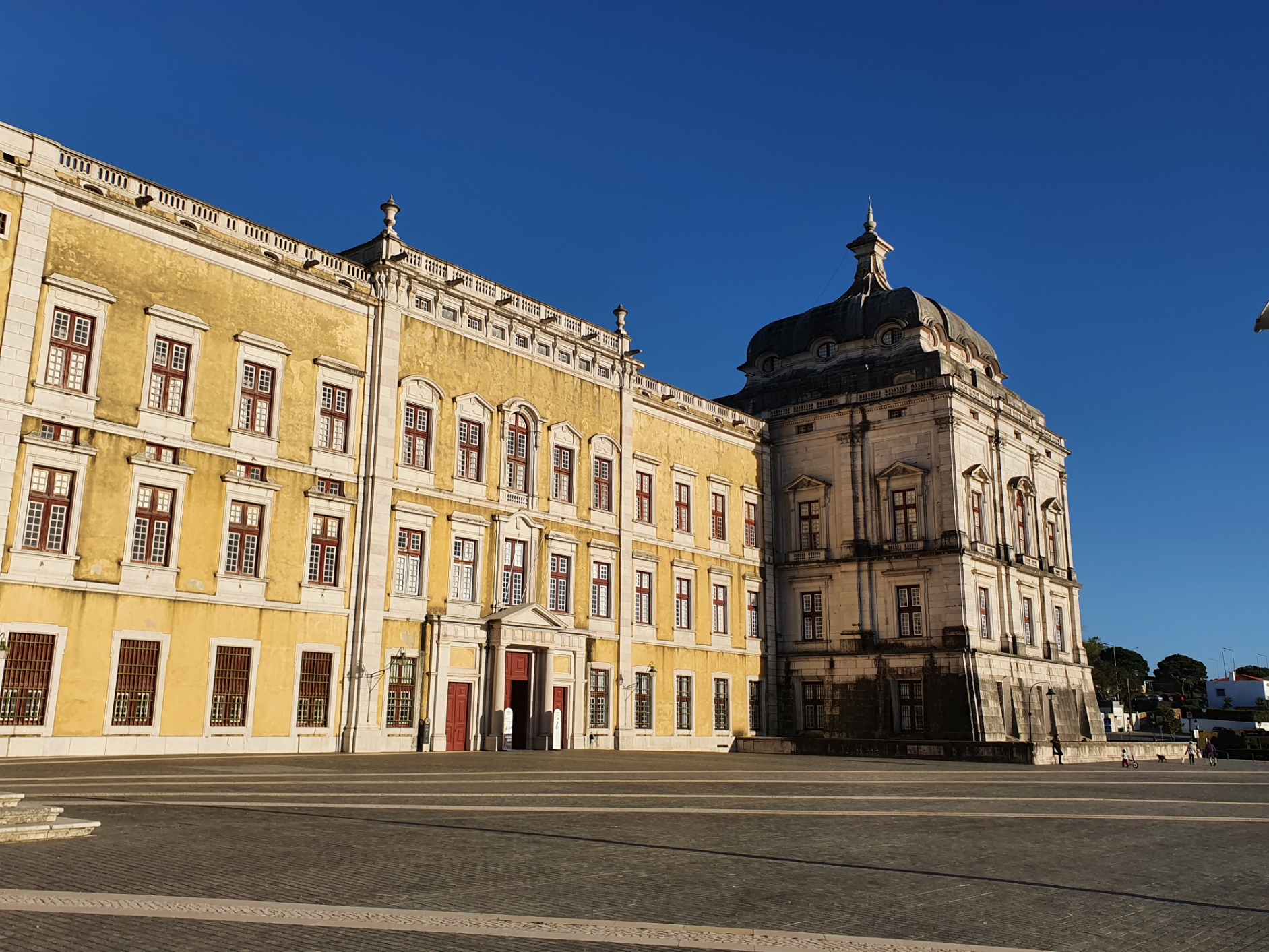
The numbers that come down to us are hard to absorb. At the height of the work, tens of thousands of people were employed at Mafra at once, with some accounts putting the peak workforce at close to fifty thousand. A dedicated corps of soldiers was assigned to keep order among this vast population, and infirmaries were set up to treat the sick and injured. Accidents were common, disease spread easily through the crowded camps, and many workers never returned home. The human toll of Mafra is not a footnote to its beauty; it is part of what the building is.
Materials arrived on a matching scale. Great blocks of local limestone were cut and hauled to the site, while coloured marbles were shipped in from quarries around the kingdom and imported from Italy for the finest interiors. Timber, iron, lime, and countless other supplies flowed toward Mafra along roads that struggled to bear the traffic. The logistics alone would have defeated a less determined patron, but the Brazilian gold kept the whole enterprise moving.
The basilica was consecrated in 1730, on the king’s forty-first birthday, in a celebration that lasted for days and was meant to announce Mafra to the world. Yet even then the complex was far from complete. Work on the convent, the apartments, and the vast interior programme continued for years afterward, and in truth a building this size is never entirely finished. What John V achieved, though, was remarkable: a monument of this ambition, largely realised within a single reign.
Baroque Ambition Written in Stone
The man who gave shape to the king’s ambition was Johann Friedrich Ludwig, a German-born architect who had trained in Rome and is usually known in Portugal as Joao Frederico Ludovice. His Roman education is written all over Mafra. The palace speaks the language of the Italian Baroque, with its columned church front, its great dome, and its confident sense of theatre, adapted to the sober pale stone of the Portuguese coast.

Ludovice’s plan is a masterpiece of symmetry. The long facade is organised around the central basilica, with the royal apartments extending in two great wings and terminating in square corner towers topped by bulbous cupolas. Behind this front the complex unfolds into a dense grid of courtyards, corridors, cells, and halls, with the convent occupying the rear and the ceremonial spaces threaded between. From the ground it can be hard to grasp how the pieces fit, but from the air the logic of the composition becomes clear.
What impresses visitors most is the way the building balances immensity with detail. The scale is almost intimidating, yet up close the stone is worked with precision, the mouldings crisp, the proportions carefully judged so that the whole never feels merely heavy. There is restraint here as well as grandeur; the exterior is less exuberant than many Italian churches of the period, relying on mass and rhythm rather than on riotous ornament.
Mafra also became a school in its own right. The workshops that gathered here, and especially the sculpture studio that formed around the project, trained a generation of Portuguese artists and craftsmen. In that sense the palace was not only a building but an institution, a place where skills were passed on and where a distinctly Portuguese Baroque matured. The influence of Mafra would ripple outward through the country’s art for decades to come.
For all the foreign influence, Mafra ended up feeling distinctly Portuguese. Ludovice and his successors worked with local stone, local light, and local craftsmen, and the sober grandeur of the result owes as much to the character of the place as to the models of Rome. The palace does not simply copy Italian precedents; it translates them into a Portuguese idiom, and that act of translation is part of what makes the building historically important as well as visually striking.
Stepping Into the Basilica
At the heart of Mafra stands its basilica, and it is here that the king’s vow finds its most direct expression. You approach it through the central section of the great facade, passing beneath the two towers, and step from the bright exterior into a cool, luminous interior lined with coloured marble. After the pale monotony of the outer walls, the richness inside comes as a genuine surprise.

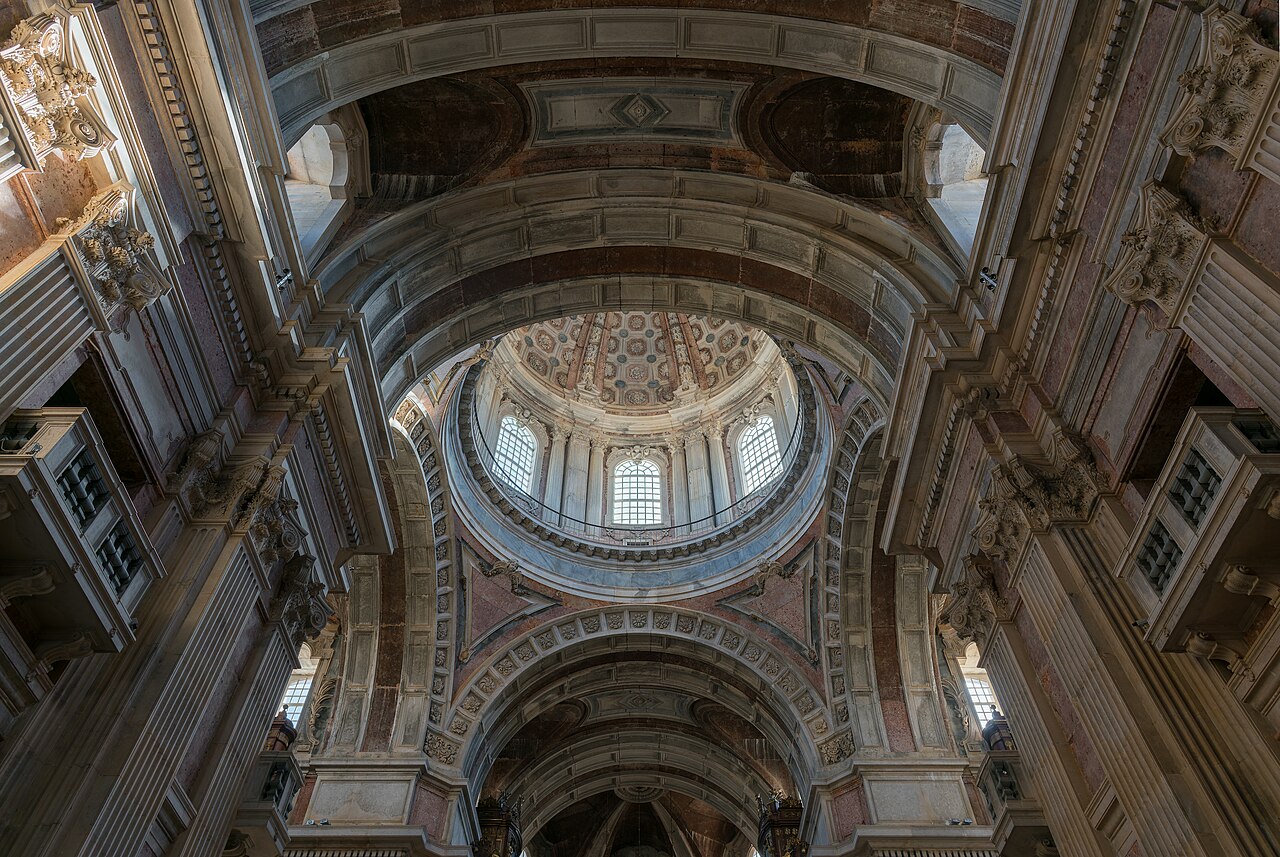
The church is built almost entirely of marble in shades of pink, grey, white, and yellow, arranged in patterns across the floors and walls so that the whole space seems inlaid rather than merely decorated. Above the crossing rises a dome that fills the interior with light, and the nave leads the eye toward the high altar with a calm, ordered grandeur. It is a space designed to make you feel small in the presence of something larger, and it succeeds.
Mafra’s basilica is famous for its sculpture as much as its architecture. A remarkable series of marble statues of saints, many carved by Italian masters, lines the interior, and the reliefs and altarpieces reflect the finest workmanship the king’s money could summon. This is not provincial art; it stands comparison with the great churches of Rome, which was precisely the point John V wished to make.
Yet for all its splendour the basilica remains a working church, consecrated space rather than museum. Services are still held here, and the sense of continuity matters. When you stand beneath the dome you are sharing the room with three centuries of worshippers, from the king who commissioned it to the pilgrims and tourists who fill it today, all drawn to the same still centre of this enormous building.
The Library and Its Colony of Bats
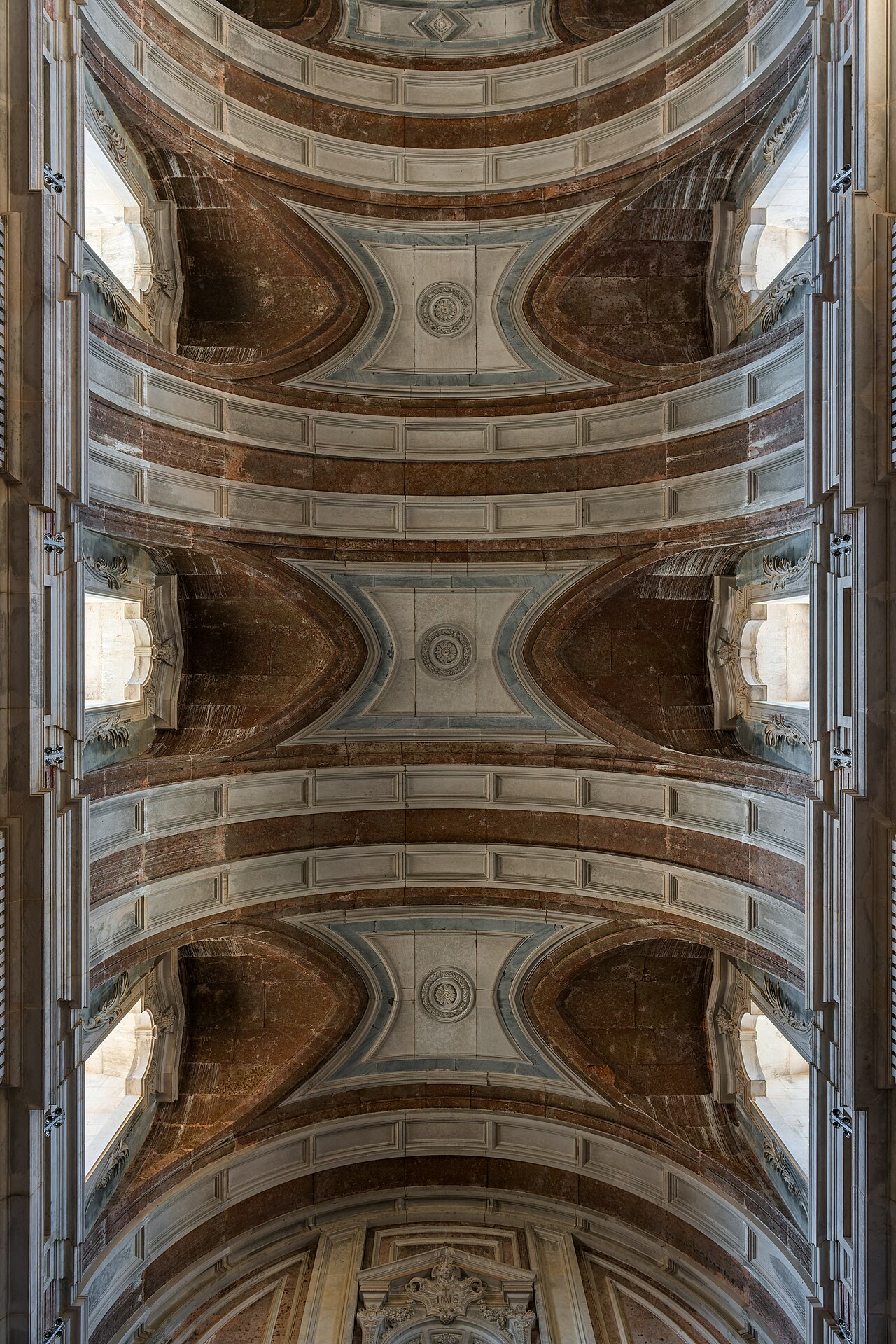
If the basilica is the soul of Mafra, the library is very often the room that visitors remember longest. It occupies the top floor at the rear of the palace, a single hall stretching for some eighty-eight metres beneath a high barrel vault, lined with two tiers of shelving in warm wood and reached by a gallery that runs around the upper level. When you walk in, the sheer length of the room seems to pull your gaze toward a vanishing point of books.
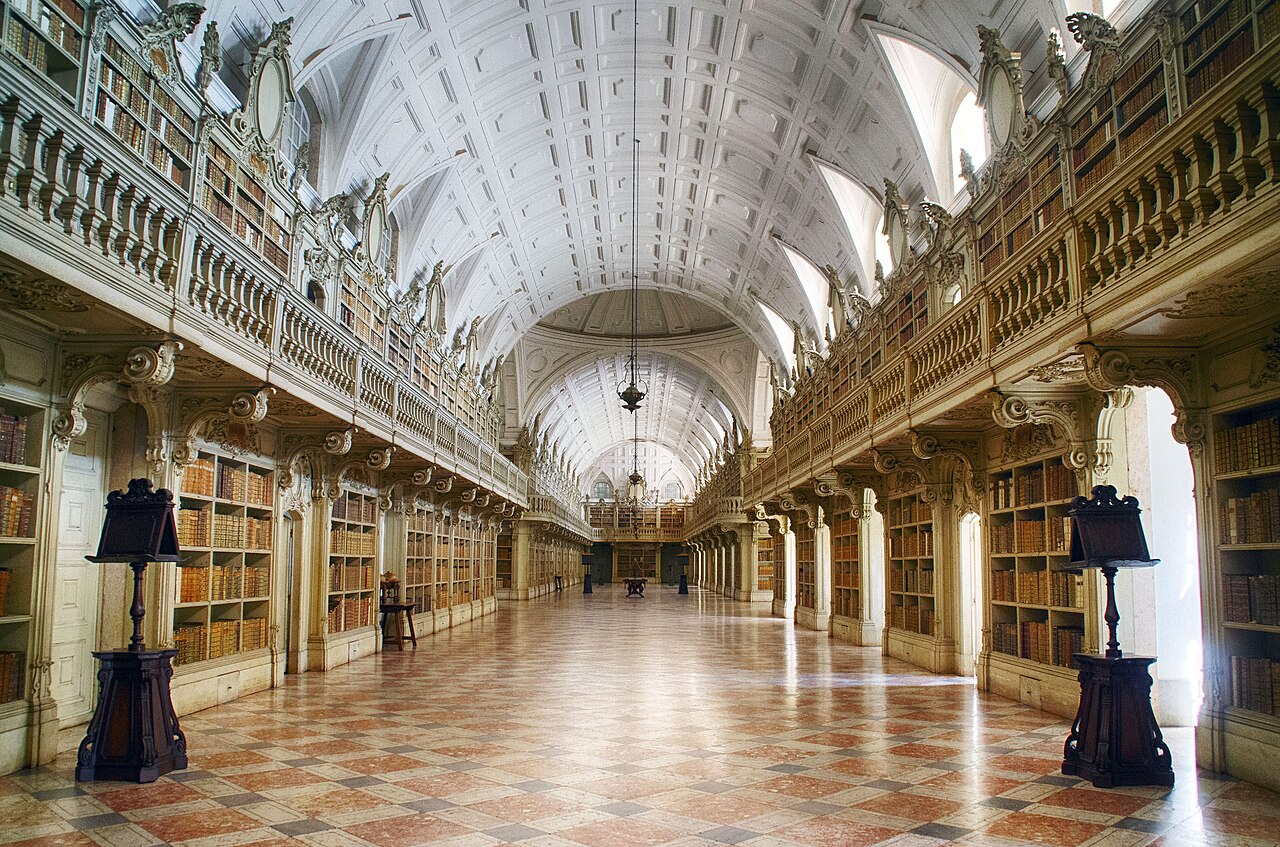
The collection is as impressive as the setting. The shelves hold tens of thousands of volumes, many of them rare, gathered across the eighteenth century and covering the whole range of learning of the age: theology, law, history, science, travel, and the classics. Bound in leather and gold, arranged with care, they turn the room into a portrait of Enlightenment knowledge as a Catholic monarchy understood it. This was a library meant to rival the great collections of Europe.
Mafra’s library is also home to one of its most charming curiosities: a resident colony of bats. For generations the small creatures have lived in the hall, emerging at night to feed on the insects that would otherwise devour the old paper and bindings. The staff protect the furniture with cloths and clean each morning, and in return the bats provide a natural form of pest control that has helped preserve the books for centuries. It is an unlikely partnership, and a beloved one.
To sit in that room, even for a moment, is to feel the ambition of John V in a quieter register than the basilica offers. Here the grandeur is turned toward the life of the mind, toward the idea that a great kingdom should not only build and pray but also read and remember. Of all the spaces at Mafra, the library may be the one that most clearly outlives the vanity of its founder.
Through the Royal Apartments
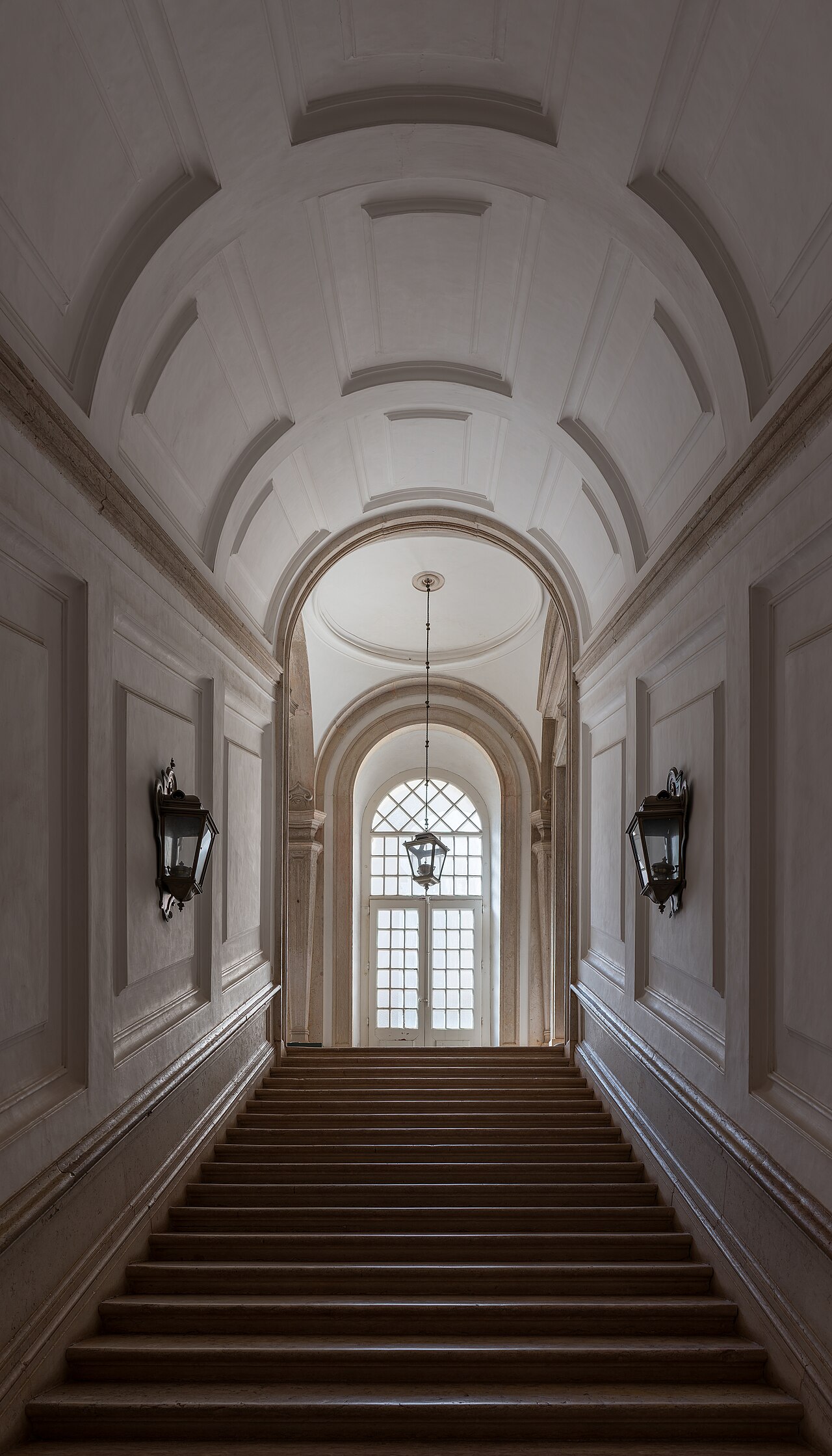
The royal apartments occupy the long wings that stretch to either side of the basilica, and moving through them gives you a sense of just how vast Mafra really is. The distances are almost comic: the king’s rooms sit at one end of the palace and the queen’s at the other, separated by corridors so long that servants must have measured their days in walking. This was a court designed on an imperial scale, even when the court itself was small.

The rooms themselves range from ceremonial halls to more intimate chambers, and their decoration reflects the changing tastes of the monarchs who used them over the following century. Frescoed ceilings, painted walls, period furniture, and hunting trophies fill the spaces, and the overall effect is less of a single frozen moment than of a building that was lived in, altered, and rearranged across generations. The hunting theme recurs often, a reminder of what drew the court to Mafra in the first place.
One of the pleasures of walking the apartments is the play of light through the enormous windows, which open onto the surrounding countryside and the great walled park beyond. From these rooms the royal family could watch the landscape they had claimed, and the sense of command that the views provide is part of the experience the architecture was designed to create.
It is worth remembering, as you pass through, that these rooms were often empty. Mafra was never a permanent seat of government, and for long stretches the vast apartments stood silent, opened only when the court came to hunt or to mark some occasion. That emptiness is part of the building’s character: a palace built for a monarchy that could never quite fill it, its endless corridors echoing with more absence than presence.
Sculpture, Tapestry, and the Roman Connection
Mafra was never meant to be an empty shell of fine architecture. From the beginning John V intended it to hold art worthy of its walls, and he spent lavishly to make that happen. The most celebrated result is the collection of marble sculpture, much of it commissioned from Italian workshops and shipped to Portugal at enormous cost. The saints who line the basilica are the public face of this effort, but the sculptural ambition ran through the whole project.
To feed that ambition the king established a sculpture school at Mafra, gathering Italian masters to work alongside Portuguese apprentices. Out of this school came a lineage of artists who would shape Portuguese sculpture for the rest of the century, most famously Joaquim Machado de Castro, whose later work includes the great equestrian statue of Lisbon. In this way Mafra acted as a bridge, carrying the techniques and sensibility of the Roman Baroque into Portuguese hands.
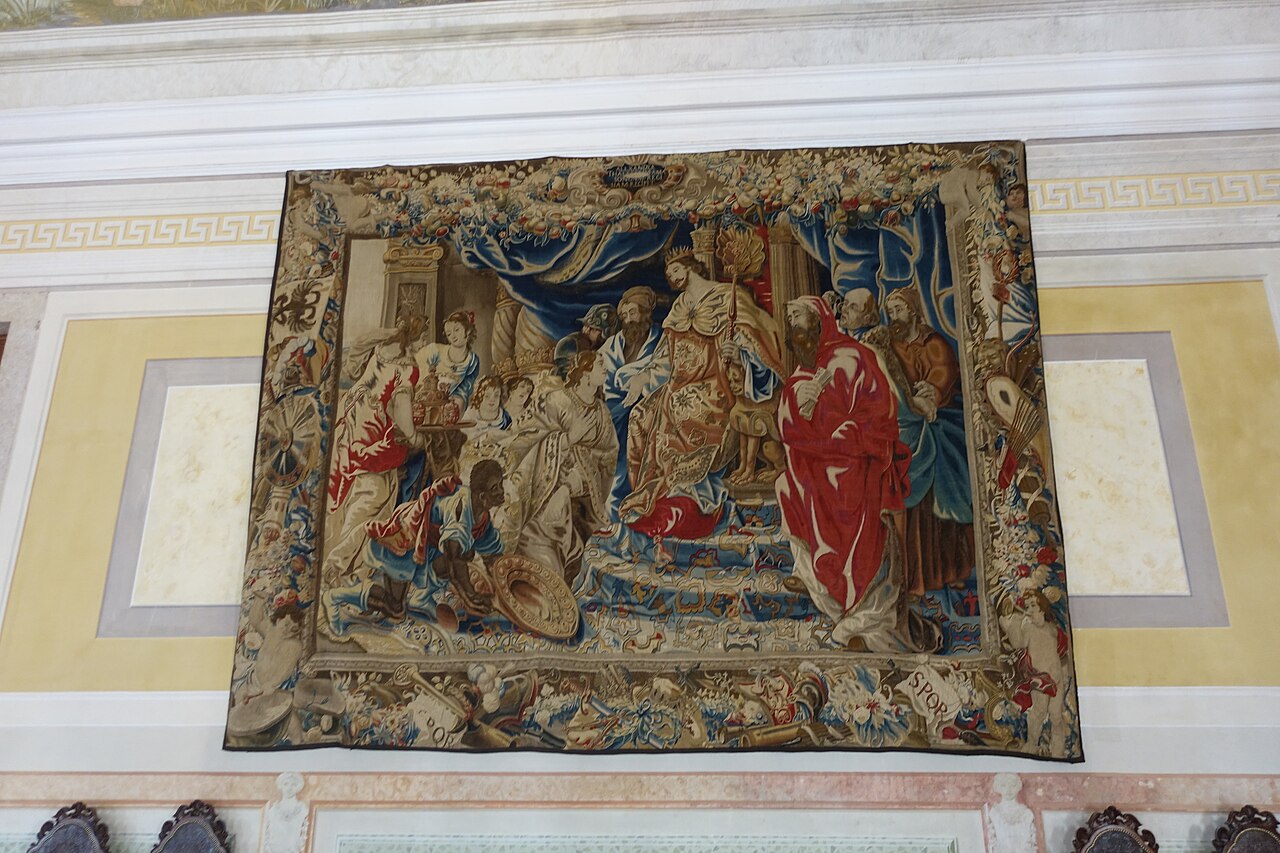
Beyond stone, the palace holds tapestries, paintings, liturgical treasures, and decorative furnishings that reflect the taste of the eighteenth-century court. Woven hangings warmed and adorned the great rooms, religious paintings filled the chapels and corridors, and precious objects of gold and silver served the basilica’s rich ceremonies. Together they turned the building into a treasury as well as a residence.
Not all of this survives in place, and the collections have been dispersed and rearranged over time. But enough remains to convey the original intention: that Mafra should be a total work of art, in which architecture, sculpture, painting, and craft all pulled in the same direction. The result is a building where you are rarely more than a few steps from something made by a master’s hand.
Life Behind the Convent Walls
For all its royal splendour, Mafra was founded as a convent, and for most of its history the largest population within its walls was not courtiers but friars. The convent occupies the rear of the complex, and its world was very different from the gilded apartments at the front. Here the architecture turns plain and functional, organised around cloisters and corridors that served the disciplined rhythm of religious life.
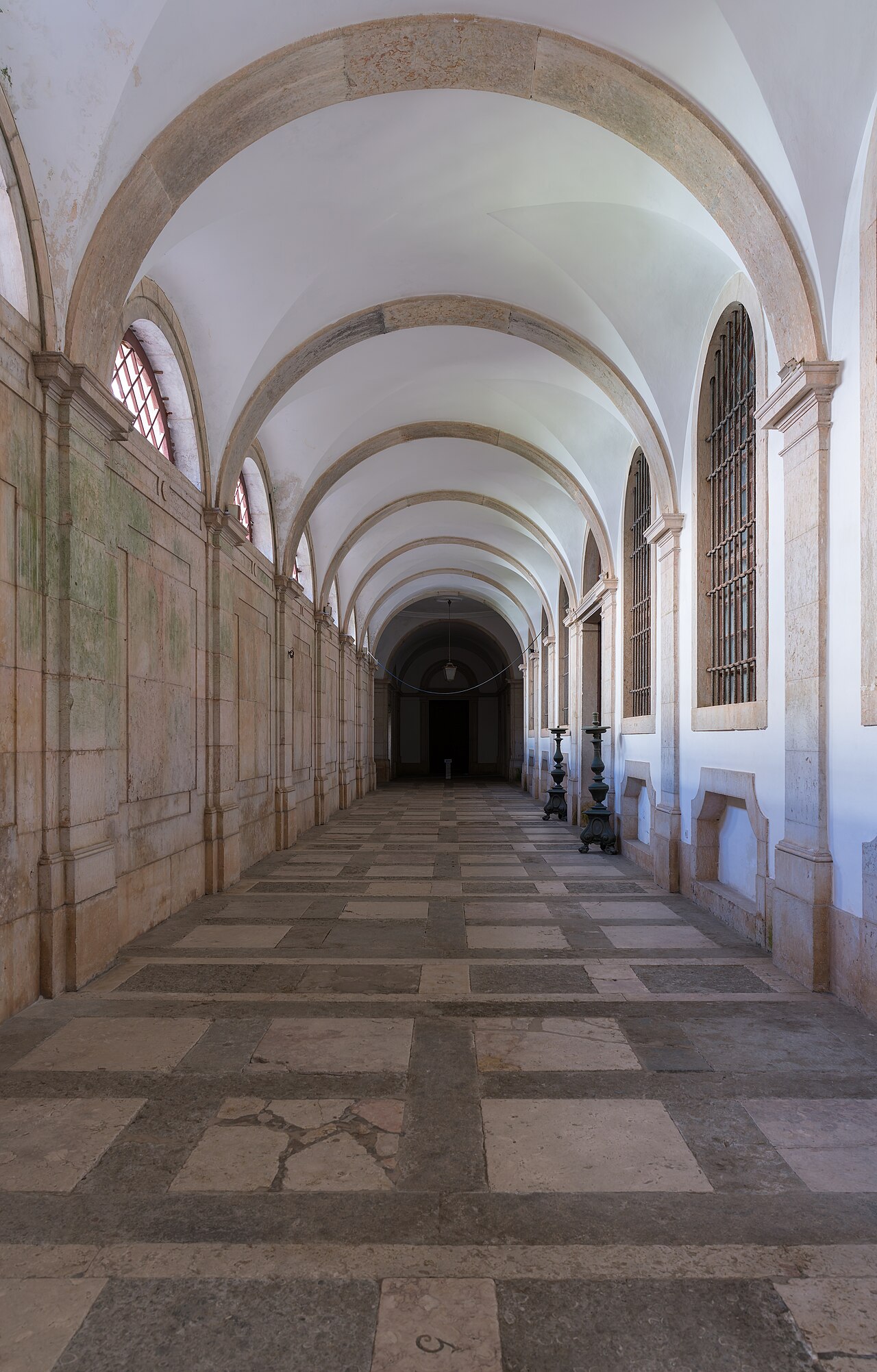
The friars who lived here followed the Franciscan rule, later joined and succeeded by other orders over the building’s history. Their days were structured by prayer, study, and work, and the convent was equipped to be largely self-contained. It held not only cells and chapels but an infirmary, a pharmacy, kitchens, and workshops, everything a community needed to sustain itself apart from the world outside.
The infirmary and pharmacy are among the most evocative surviving spaces. The pharmacy in particular, with its jars and instruments, offers a vivid picture of eighteenth-century medicine, while the infirmary wards remind you that this was a place where people were cared for and where they died. In a building so devoted to display, these rooms speak in a humbler and more human voice.
Walking the convent quarters after the royal apartments produces a strange doubling. The same king who filled one end of the building with marble saints filled the other with men who had renounced worldly things, and the two lived under the same roof for generations. That coexistence of pomp and austerity is one of the deepest truths of Mafra, and it is easy to miss if you visit only the grand rooms.
The Great Walled Park Beyond the Palace
One reason the court kept returning to Mafra had nothing to do with prayer. Behind the palace lies the Tapada de Mafra, an enormous walled hunting park created for the royal family, and for much of the building’s history it was the park as much as the palace that drew the monarchs north from Lisbon. Enclosed by a wall running for many kilometres, it turned the surrounding countryside into a private wilderness.
Inside the Tapada the kings and their guests hunted deer, wild boar, and other game across woods and open ground, following a pastime that was as much political theatre as sport. Royal hunts were occasions of display and alliance, where the court performed its own vigour and rank. The palace’s apartments, hung with trophies and hunting scenes, were designed with these expeditions in mind, and the whole ensemble makes more sense once you picture the park at its back.
The Tapada survives today as a protected natural area, and it remains one of the great pleasures of a visit to Mafra. Where kings once rode after deer, visitors now walk trails through woodland, watch birds of prey, and encounter the descendants of the same species that filled the royal hunts. The wall that once marked a private domain now encloses a place open to anyone who wishes to explore it.
There is something fitting in that transformation. The park was built to serve the pleasures of a single family, and it has become a shared inheritance, a green counterpart to the stone monument in front of it. Together the palace and its Tapada tell the full story of what Mafra was: not only a place of worship and residence, but a stage for the whole life of a court, indoors and out.
When the Court Fled and the Rooms Emptied
The grandeur of Mafra could not hold back the turbulence of history. By the end of the eighteenth century the flood of Brazilian gold that had paid for it was fading, and the monarchy that had built it faced dangers it could not simply outspend. When French armies invaded Portugal during the Napoleonic wars, the royal family made a fateful decision: rather than resist, they sailed for Brazil, taking the seat of the monarchy across the Atlantic.
Mafra suffered in the upheaval that followed. Occupying troops used the palace, its treasures were vulnerable to looting and dispersal, and the ordered life that had filled its corridors was broken. A building designed as a statement of royal permanence found itself caught up in the very European wars that were dismantling the old order, and it emerged from the period diminished.
The nineteenth century brought further blows. When the religious orders were suppressed in Portugal in 1834, the friars who had given the convent its purpose were expelled, and the great religious community at the core of the building came to an end. The palace passed increasingly into military and state use, its rooms repurposed, its original functions hollowed out. The monarchy itself would fall in 1910, taking with it the last reason for a royal palace at all.
For a place built with such confidence in its own future, this long decline is poignant. Yet it also preserved Mafra in a way that continued use might not have. Spared the constant remodelling that transforms so many living palaces, the building kept much of its eighteenth-century character, so that what survives is closer to John V’s vision than it might otherwise have been. Its emptiness became, in time, a form of preservation.
The Bells That Made Mafra Ring
Among all the treasures John V lavished on Mafra, few capture his character better than the bells. The two towers that flank the basilica hold a pair of carillons of extraordinary size and quality, together comprising nearly a hundred bells, and in their day they formed one of the largest and finest collections of their kind anywhere in the world. To build them the king turned to the great bell-founders of the Low Countries, the acknowledged masters of the craft.
A famous story clings to their commissioning. When the Flemish founders quoted the enormous price of the bells, the king is said to have doubled the payment, telling them he had no idea the bells were so cheap. Whether or not the tale is literally true, it perfectly captures the spirit in which Mafra was built: a monarch determined to prove that no expense was too great for his monument, and willing to make the point in front of foreign craftsmen.
The carillons are more than decoration. They are true musical instruments, capable of playing melodies across their many bells, and they were designed so that music could ring out over the palace and the town on feast days and great occasions. Standing in the square below when they sound is an experience unlike any other at Mafra, the whole enormous facade seeming to come alive with sound.
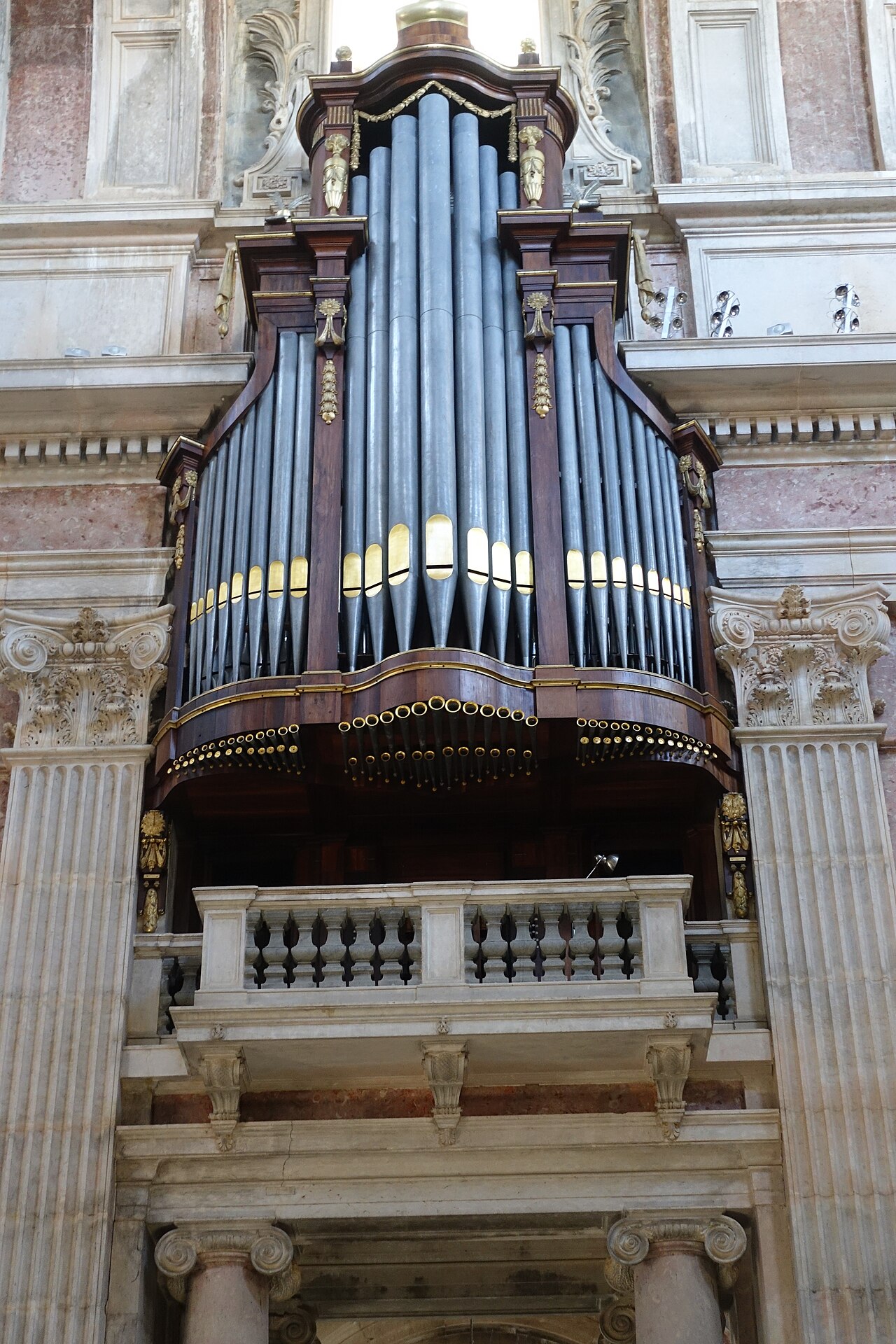
Alongside the bells, the basilica houses its own remarkable musical heritage in the form of six historic organs, built to play together as a single ensemble. This combination of great organs and vast carillons made Mafra a centre of sacred music, and efforts to restore and play these instruments have kept that tradition alive. The building was meant to be heard as well as seen, and its music remains one of its glories.
What It’s Like to Visit Now
Today the Palacio Nacional de Mafra is a national monument and museum, open to visitors who want to walk through the world John V built. It sits in the town of Mafra, an easy trip from Lisbon, and a visit can fill anything from a couple of hours to the better part of a day depending on how deeply you wish to explore. The scale means comfortable shoes are not a suggestion but a necessity.
View Mafra National Palace on Google Maps
A typical route takes you through the royal apartments, the basilica, the convent quarters with their infirmary and pharmacy, and, as the climax for most visitors, the great library. Each of these spaces rewards a slow pace, and the contrasts between them, from marble splendour to monastic plainness, are much of the point. Guided tours and information help make sense of the building’s history, and special access is sometimes offered to the bell towers and other areas.
The basilica remains a place of worship and can usually be visited without charge, while the palace and its collections require a ticket. The surrounding Tapada, the walled hunting park, is managed separately and is well worth combining with the palace if you have the time, offering a complete picture of what Mafra was and a welcome dose of open air after the endless corridors.
If you are planning a trip, you can find the palace and orient yourself using the map link below. However you approach it, give Mafra room to surprise you. It is a building that resists being taken in quickly, and its best moments often come when you pause, look up at a painted ceiling or down a corridor that seems to have no end, and let the sheer ambition of the place settle over you.
Practical details are worth checking before you go, since opening hours, ticket prices, and the availability of guided visits can change with the seasons and with ongoing conservation work. Arriving earlier in the day tends to mean quieter rooms, especially in the library, and leaves time to explore both the palace and the park without rushing. Mafra is the kind of place that repays patience, and the more time you can give it, the more it gives back.
See Mafra for Yourself
Words and photographs can only do so much with a building of this scale, where the impact comes from moving through space after space and feeling the distances stretch out around you. The short film below offers a closer look at Mafra’s exterior and interiors, letting you sense the proportions of the facade, the richness of the basilica, and the long perspectives that define the palace.
As you watch, keep in mind the story behind what you are seeing: a king’s vow, a fortune in Brazilian gold, tens of thousands of labourers, and a single generation of frantic building. Mafra is not just a beautiful monument but the record of an extraordinary act of will, and knowing that history gives every corridor and dome a deeper resonance.
Palaces Nearby
If Mafra has whetted your appetite for Portugal’s royal architecture, two more palaces within easy reach make natural companions to it, each telling a different chapter of the same story.
- Ajuda, Lisbon’s Unfinished Royal Palace — the neoclassical last home of the Portuguese monarchy, now a rich museum.
- Pena Palace, the Fairy-Tale Castle Above Sintra — Portugal’s vivid masterpiece of Romanticism on a peak above Sintra.
You May Like
The Bardo, a Palace of the Beys Filled With Roman Mosaics


One thought on “Mafra, the Palace a King Built From a Vow”