In the heart of Marrakech, behind high walls in the old medina, lies a palace whose name means brilliance, and it lives up to it. The Bahia Palace is a labyrinth of courtyards, gardens, and richly decorated rooms, a sprawling complex that draws visitors into a world of zellij tilework, carved stucco, and painted cedar ceilings. It is one of the great monuments of Moroccan architecture and among the most visited sights in the red city.
The palace was built in the late nineteenth century for the most powerful men in Morocco after the sultan himself, the grand viziers who governed the kingdom. It was created not as a fortress or a seat of government but as a magnificent private residence, a place of beauty and pleasure designed to display the wealth and taste of its owners and to house their large households.
What makes the Bahia so distinctive is its rambling, organic character. Rather than being built to a single grand plan, it grew piecemeal, its courtyards and rooms added over time as land was acquired, producing a maze of spaces that unfolds in surprising ways. To wander through it is to lose oneself in a world of shaded courts, cool rooms, and dazzling decoration.
In this guide you will explore the Bahia Palace from its origins under the viziers who built it, through its remarkable architecture and decoration, its courtyards, gardens, and household quarters, and its fate after the fall of its builders, to what it is like to visit today. By the end you will understand why this palace of brilliance is regarded as one of the jewels of Marrakech.

In This Article
- A Grand Vizier’s Dream in Marrakech
- The Power Behind the Throne
- The Meaning of Bahia
- A Palace Built Without a Single Plan
- The Courtyards and Riads
- Zellij, Stucco, and Cedar
- The Painted Ceilings
- The Quarters of the Household
- The Gardens of the Bahia
- The Fall After the Vizier
- A Monument of Marrakech
- Planning Your Visit to the Bahia
- See the Bahia Palace for Yourself
A Grand Vizier’s Dream in Marrakech
The Bahia Palace was begun in the later nineteenth century by a powerful figure at the Moroccan court, a grand vizier who had risen to great wealth and influence. He set out to create a residence in Marrakech worthy of his status, and the palace he started would be expanded by his son into the sprawling complex that survives today.
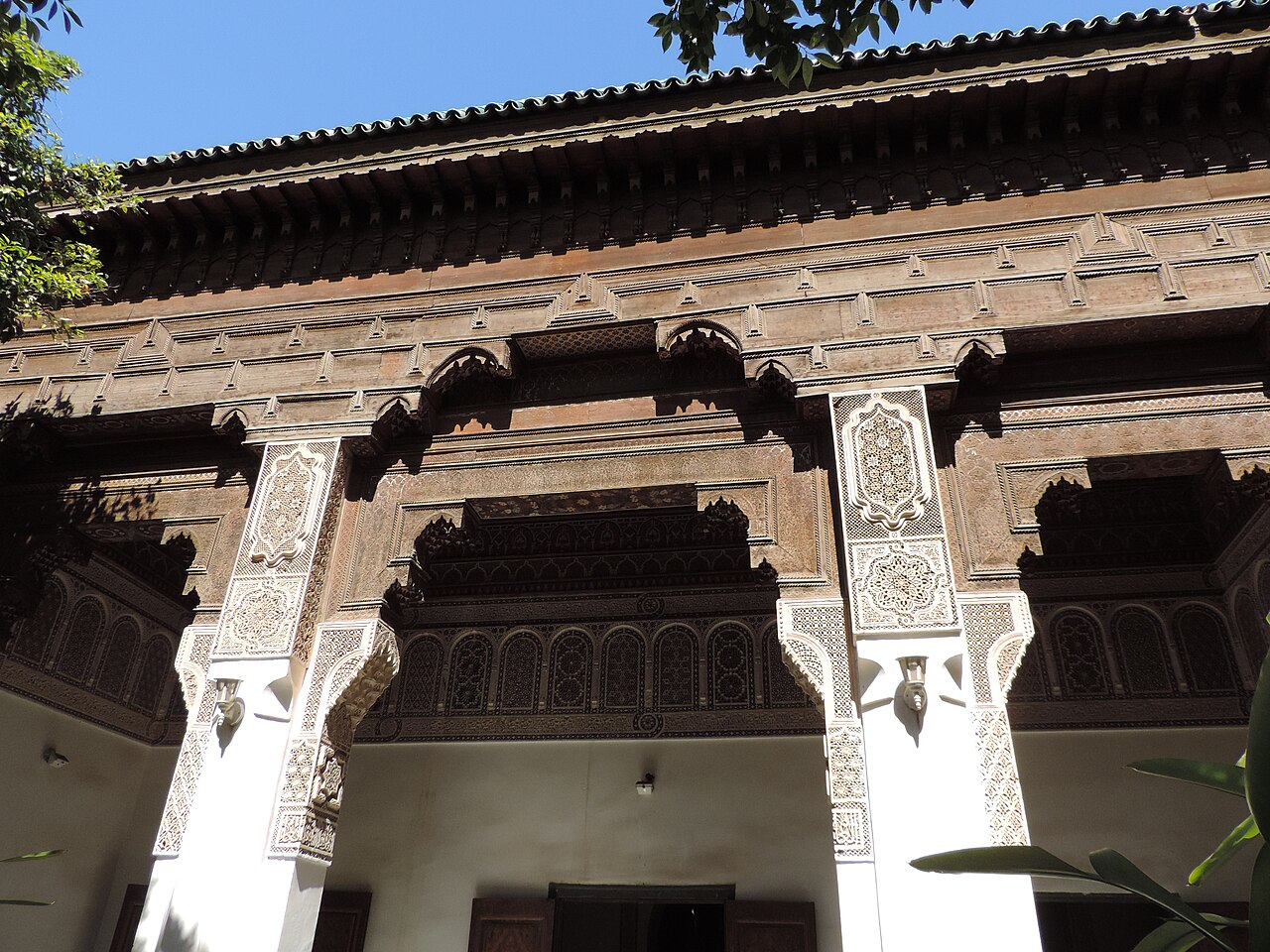
Marrakech at the time was one of the great cities of Morocco, a former imperial capital rich in history and culture, and it was a fitting setting for so ambitious a project. The builders acquired land in the medina and set about creating a palace of courtyards and gardens, drawing on the finest craftsmen and the rich traditions of Moroccan architecture.
The creation of the palace was a project of many years, and it reflected the enormous resources at the disposal of its builders. The most skilled artisans of Morocco were employed to decorate its rooms with tilework, carved plaster, and painted wood, and no expense was spared in creating a residence of the utmost beauty and luxury.
From these beginnings grew one of the largest and most magnificent palaces in Marrakech, a private residence on a scale that rivalled the palaces of the sultans themselves. The Bahia became a symbol of the power and wealth of the viziers who governed Morocco, and it remains a monument to their ambition and to the artistry of the craftsmen they employed.
Marrakech itself lent the project a special resonance, for the city had been an imperial capital under successive Moroccan dynasties and was steeped in the traditions of palace-building. To raise so grand a residence here was to place it within a long lineage of Marrakech palaces, and the Bahia drew on centuries of accumulated skill in the crafts that make Moroccan architecture so distinctive.
The Power Behind the Throne
The figure most associated with the Bahia Palace is the grand vizier who expanded it into its full glory, one of the most powerful men in the history of modern Morocco. As chamberlain and then grand vizier, he wielded enormous authority, effectively governing the kingdom and even acting as regent during the minority of a young sultan.

His rise to power was remarkable, and at the height of his influence he was the true power behind the throne, controlling the affairs of the state. The Bahia Palace was the physical expression of this power, a residence whose scale and splendour proclaimed his position at the very summit of the kingdom, second only to the sultan.
The vizier used the palace not only as a home but as a setting for the exercise of his authority and the display of his wealth. Its many rooms housed his large household, and its grand spaces provided settings for the receptions and gatherings through which power was exercised and alliances maintained in the political world of the court.
His dominance, however, depended on his personal position, and his story illustrates the precariousness of power in that era. The palace that celebrated his greatness would, after his death, become the setting for a dramatic reversal of fortune, and the fate of the Bahia is inseparable from the rise and fall of the vizier who made it magnificent.
The concentration of power in the hands of the grand vizier reflected the particular character of Moroccan government in this period, when able ministers could rise to dominate the state around the person of the sultan. The vizier’s mastery of court politics kept him at the summit for years, and the palace he built stands as a monument to a career that reached heights few could hope to attain.
The palace also served the practical purpose of gathering the vizier’s extended household and dependents under one roof, a physical expression of the network of family and clients through which power was exercised. In this sense the sprawling complex was not merely a display of wealth but an instrument of politics, housing the human relationships on which the vizier’s authority rested.
The Meaning of Bahia
The palace takes its name from the Arabic word Bahia, which means brilliance, beauty, or the beautiful. The name captures the essence of the palace and the intention behind it, to create a residence of dazzling beauty that would delight all who entered and proclaim the refinement of its owners.
According to tradition, the name is also connected to one of the wives of the vizier, and the palace is said to have been named in her honour. This association gives the name a personal and romantic dimension, linking the beauty of the palace to the affection of its builder, in a gesture typical of the age.
Whatever its precise origin, the name perfectly suits the palace, whose beauty is its defining quality. From the intricate tilework to the painted ceilings and the shaded courtyards, every element of the Bahia was designed to please the eye and to create an atmosphere of luxury and delight, fully justifying its brilliant name.
The name has become inseparable from the palace and is known to the many visitors who come to admire its beauty. It stands as a fitting title for one of the loveliest buildings in Marrakech, a palace whose very name promises the brilliance that its courtyards and rooms so abundantly deliver.
The naming of a palace for a beloved wife also fits within a wider tradition in which great buildings were dedicated to women of the household, linking architecture to affection and memory. Whether or not every detail of the story is certain, it lends the Bahia a human warmth, reminding visitors that behind the grandeur of the palace lay the lives and relationships of the people who made it their home.
A Palace Built Without a Single Plan
One of the most distinctive features of the Bahia Palace is that it was not built to a single unified plan but grew organically over time. As the builders acquired more land, they added new courtyards, gardens, and rooms, expanding the palace piecemeal into the sprawling and irregular complex that survives today.
This organic growth gives the palace its characteristic labyrinthine quality, a maze of interconnected spaces that unfolds in unexpected ways. Rather than the ordered symmetry of many great palaces, the Bahia offers a sequence of surprises, with courtyards and rooms opening one into another in an apparently endless succession.
The result is a palace that rewards exploration and evokes a sense of discovery. Visitors move from bright courtyards to cool, shaded rooms, from grand reception spaces to intimate corners, never quite sure what lies around the next turn. This quality of surprise and variety is one of the great pleasures of the Bahia.
The lack of a single plan also reflects the way the palace was created, over years and by different hands, as an expression of the growing power and wealth of its builders. Far from being a defect, this organic character has become one of the charms of the Bahia, giving it a richness and complexity that a more rigidly planned palace could never possess.
The absence of an overall plan also meant that the palace had no grand external facade to announce itself, in keeping with the Moroccan tradition of turning inward. From the streets of the medina, little of the splendour within is visible, and the palace reveals its beauty only once the visitor has passed through its entrance into the sequence of courtyards, a deliberate contrast between plain exterior and dazzling interior.
The maze-like quality of the palace can be disorienting, and visitors sometimes find themselves happily lost among its courtyards and passages. This very quality, however, is part of the experience the builders created, a sequence of spaces meant to unfold gradually and to reveal their beauty little by little, so that the palace can never be taken in at a single glance but must be discovered step by step.
The Courtyards and Riads
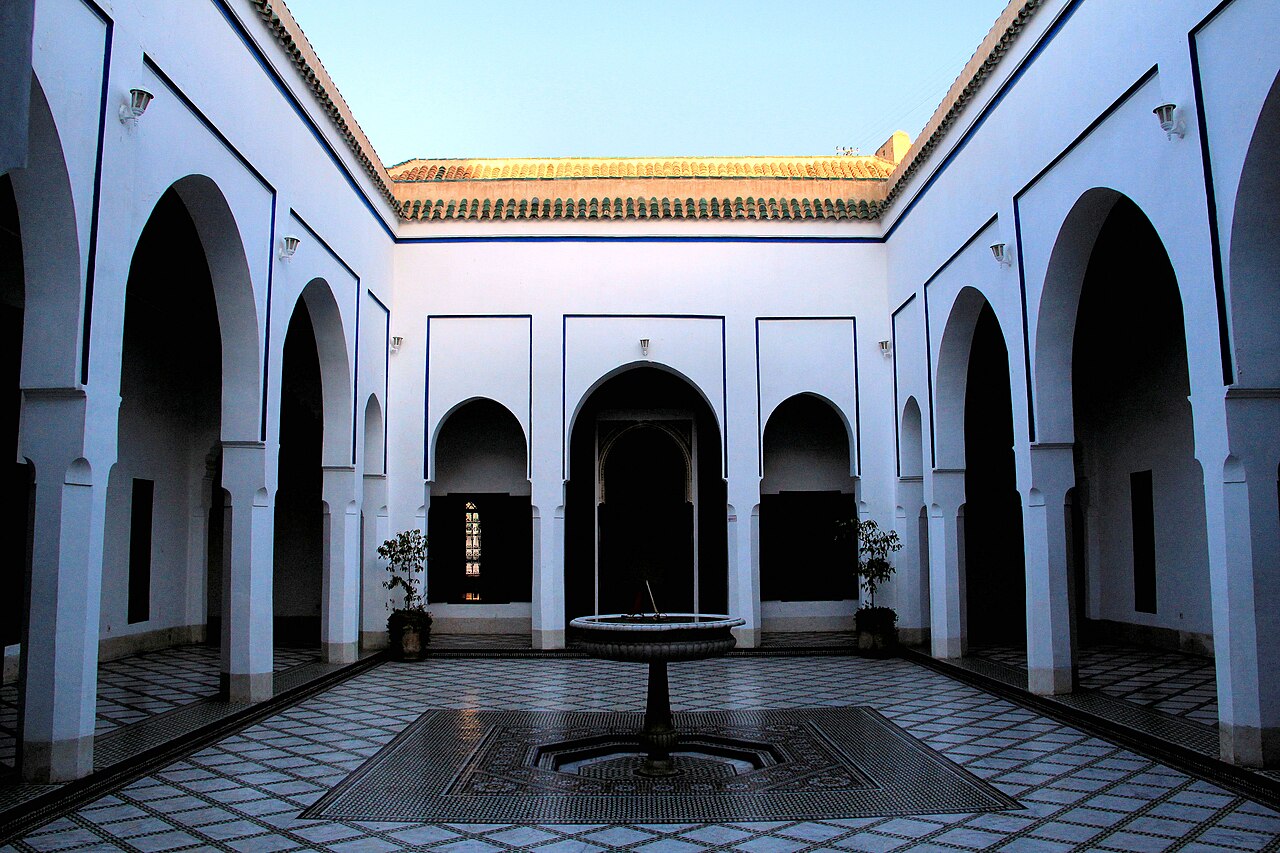
At the heart of the Bahia Palace are its courtyards, the open spaces around which the whole complex is organised in the tradition of Moroccan and wider Islamic architecture. These courts, some vast and paved, others planted as gardens, provide light, air, and beauty at the centre of the palace, and they are among its most memorable spaces.
The great courtyards are magnificent, paved with marble and zellij and surrounded by galleries and richly decorated rooms. The largest of them served as grand ceremonial spaces, their scale and decoration proclaiming the importance of the palace and providing settings for the gatherings and receptions of the household.
Alongside the grand courts are the riads, the traditional Moroccan garden courtyards planted with trees and flowers and cooled by fountains. These green courts, enclosed by the rooms of the palace, create oases of tranquillity and beauty, embodying the Moroccan ideal of the garden as a private paradise.
The interplay of paved courts and planted riads, of open space and shaded gallery, gives the Bahia its distinctive rhythm and atmosphere. Moving through the courtyards, visitors experience the genius of Moroccan architecture, which uses these open spaces to create comfort and beauty in a hot climate and to bring light and nature into the heart of the palace.
The grand court of the palace, with its vast expanse of paving and its surrounding rooms, is among the largest and most impressive spaces of its kind in Marrakech. Standing at its centre, one grasps the scale of the vizier’s ambition, for the court could accommodate great gatherings and served as a stage on which the power and hospitality of the household were displayed to visitors and petitioners alike.
Zellij, Stucco, and Cedar
The beauty of the Bahia Palace lies above all in its decoration, which showcases the great traditions of Moroccan craftsmanship. Three arts in particular give the palace its splendour: the zellij mosaic tilework, the carved stucco, and the painted and carved cedar wood, combined throughout the palace to dazzling effect.

Zellij, the art of geometric mosaic tilework, covers floors, walls, and fountains with intricate patterns in brilliant colours. Each piece is cut by hand and assembled into complex geometric designs of great precision and beauty, and the zellij of the Bahia is among the finest examples of this quintessentially Moroccan art.
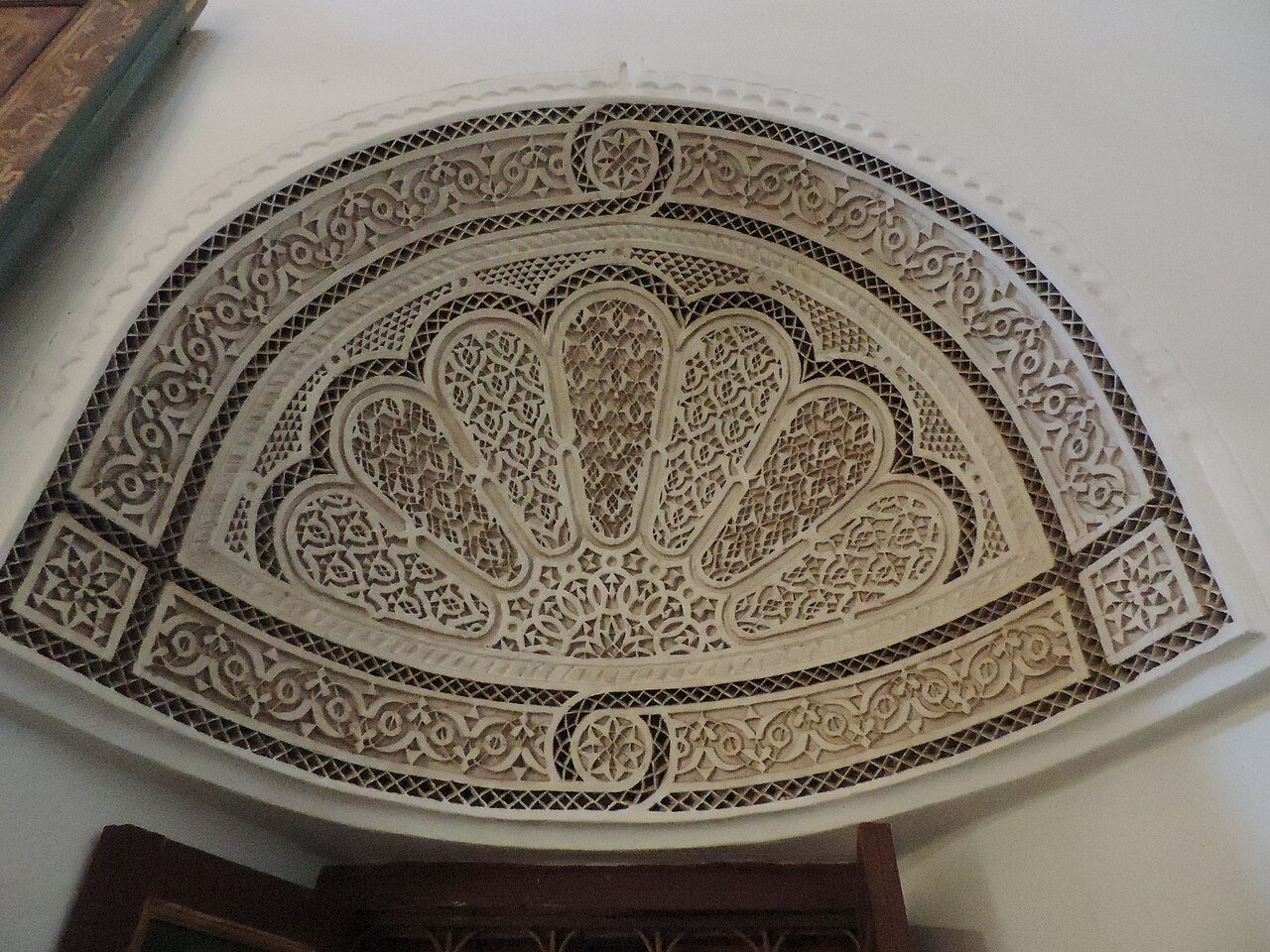
Carved stucco adorns the upper walls and arches, worked into delicate patterns of geometric, floral, and calligraphic ornament. This plasterwork, carved by hand with astonishing skill, creates surfaces of lace-like intricacy, and combined with the zellij below it fills the rooms with pattern and beauty from floor to ceiling.
The cedar wood of the ceilings, doors, and screens completes the decorative scheme, carved and painted in rich colours and patterns. The fragrant cedar, brought from the mountains of Morocco, was worked by master craftsmen into ceilings and fittings of great beauty, and together these three arts make the Bahia a showcase of Moroccan decoration at its finest.
The three great crafts of zellij, stucco, and cedar were traditionally practised by specialist artisans who trained for many years to master their trade, and the decoration of the Bahia gave employment to the finest of them. The palace thus stands as a record not only of the taste of its owners but of the skill of a whole community of craftsmen, whose art has been handed down through generations in the workshops of Morocco.
Standing in a fully decorated room of the Bahia, surrounded by zellij below, carved stucco above, and a painted cedar ceiling overhead, the visitor experiences the Moroccan aesthetic of total decoration, in which no surface is left plain. Far from feeling oppressive, the effect is harmonious, for the crafts were designed to work together, each occupying its proper zone in a unified scheme of overwhelming beauty.
The Painted Ceilings
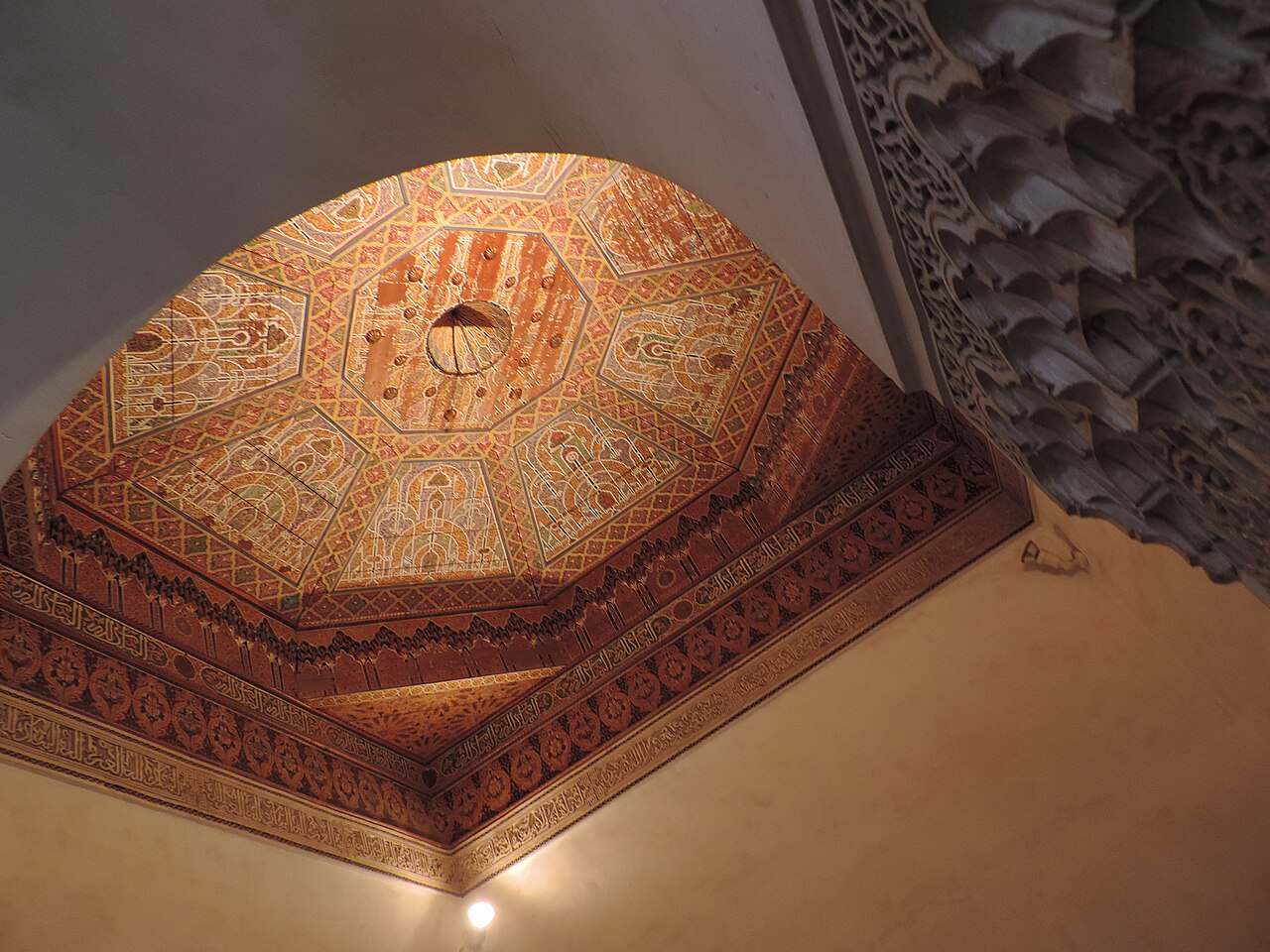
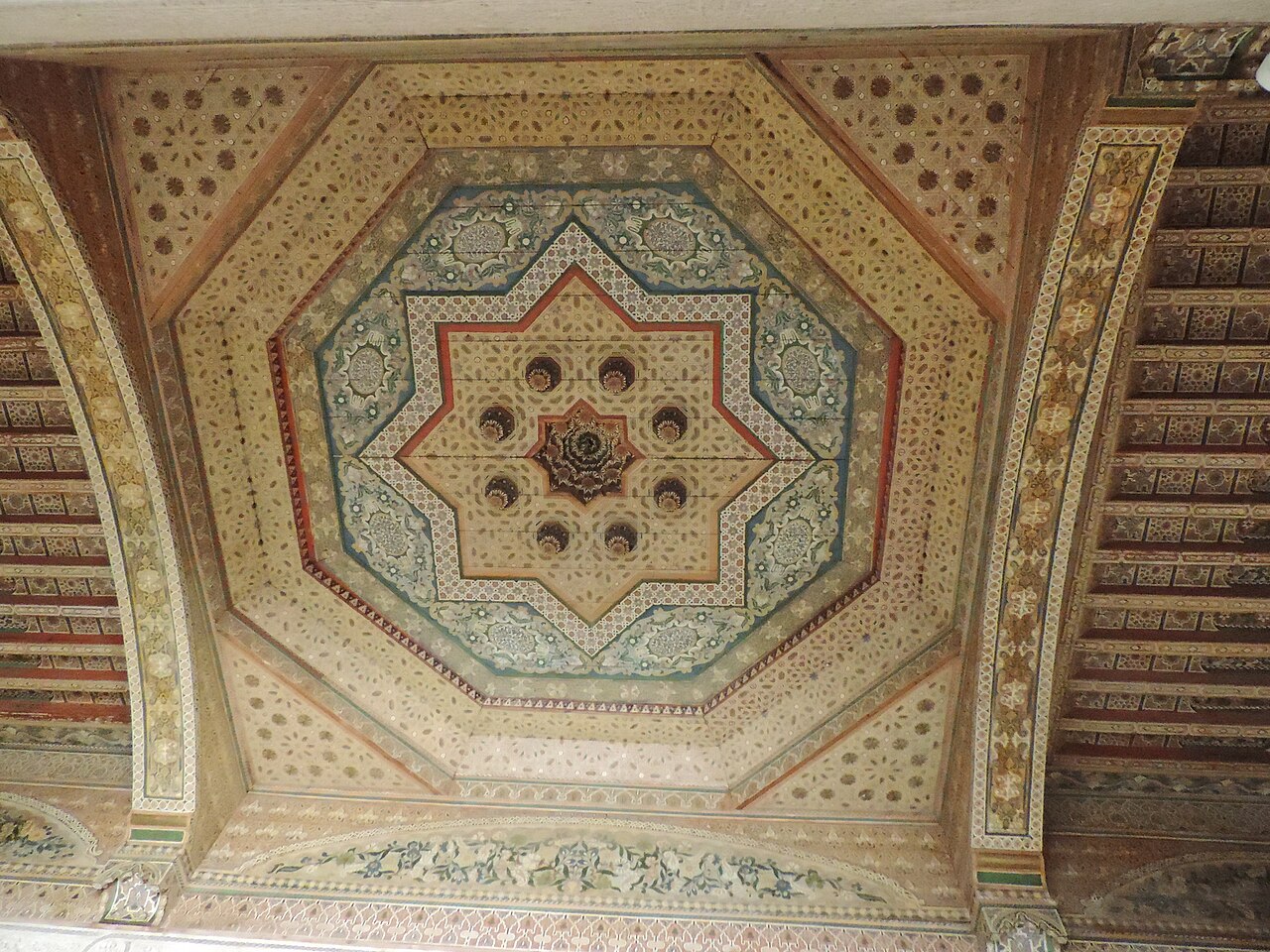
Among the greatest treasures of the Bahia Palace are its painted wooden ceilings, masterpieces of Moroccan decorative art that draw the eye upward in room after room. These ceilings, worked in cedar and painted in rich colours and gold, are among the most beautiful features of the palace and a highlight of any visit.

The ceilings display a dazzling variety of patterns, from intricate geometric designs to floral motifs and calligraphy, painted in vivid colours that have retained their brilliance. Each ceiling is a work of art in its own right, and the variety across the many rooms of the palace reflects the creativity and skill of the craftsmen who made them.
The tradition of painted cedar ceilings was one of the glories of Moroccan interior decoration, and the Bahia preserves some of its finest examples. The combination of the carved and painted wood overhead with the zellij and stucco of the walls below creates interiors of overwhelming richness, in which every surface is treated with care.
For visitors, the painted ceilings are among the most memorable sights of the Bahia, and looking up to admire them is one of the great pleasures of the palace. They embody the Moroccan love of decoration and the extraordinary skill of the country’s craftsmen, and they crown the beautiful rooms of the palace with surfaces of pure delight.
The making of these ceilings was a painstaking process, in which the cedar was first carved and then painted by hand, layer upon layer, to build up the rich patterns. The use of cedar was significant, for the wood is fragrant, durable, and resistant to insects, qualities that have helped the ceilings survive, and its warm tone provides a perfect ground for the brilliant colours of the paint.
The variety of the ceilings from room to room means that no two are quite alike, and part of the pleasure of moving through the palace is discovering each new design overhead. This diversity reflects the freedom given to the craftsmen within the shared vocabulary of Moroccan ornament, and it turns the simple act of looking up into a continual source of delight throughout the visit.
The Quarters of the Household
The Bahia Palace was built to house a large household, and its many rooms and courtyards include quarters for the family, the wives, and the numerous members of the vizier’s establishment. These living quarters, arranged around their own courtyards, reflect the social organisation of a great Moroccan household of the age.
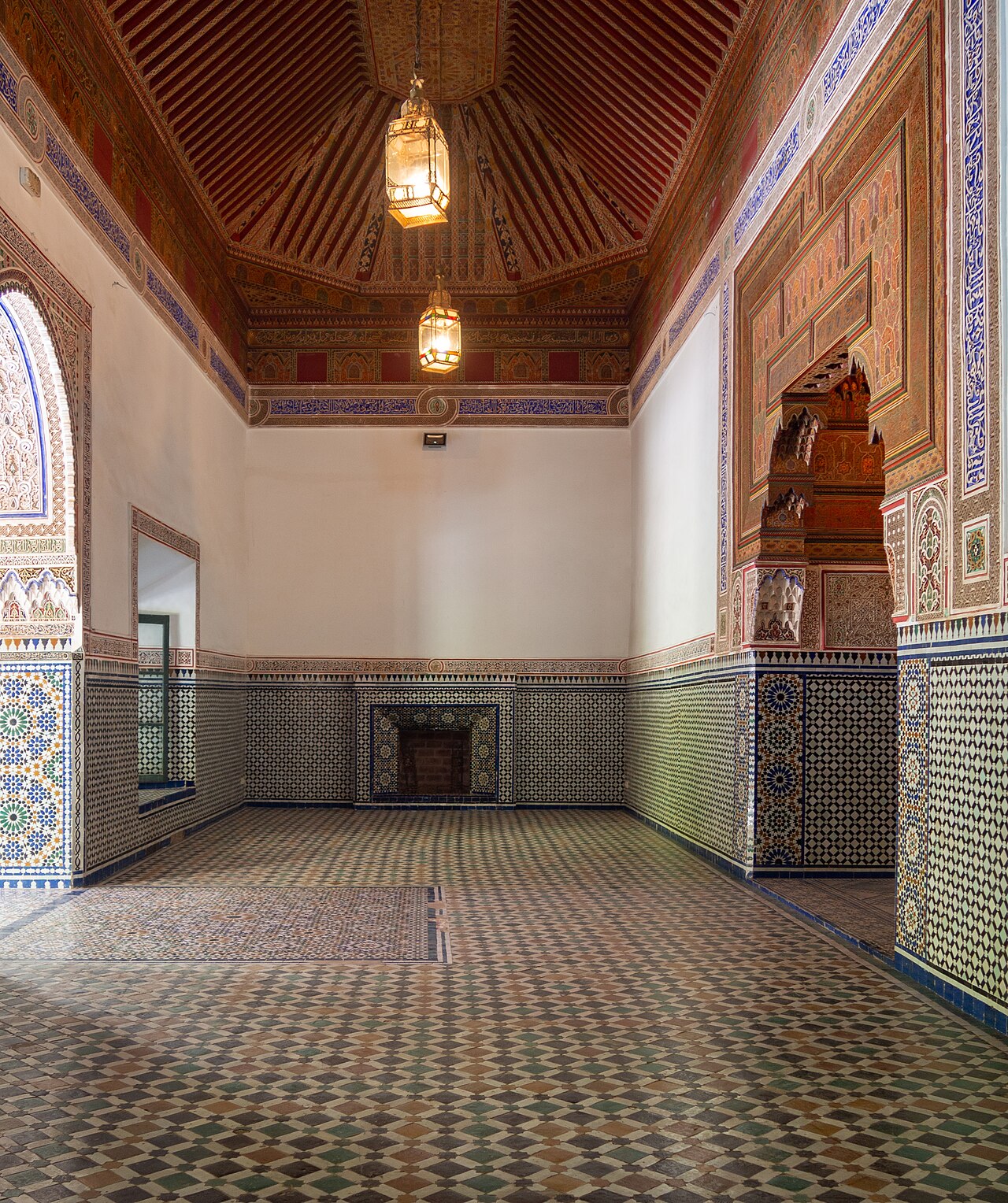
The quarters for the wives and family were decorated with the same care as the grand ceremonial spaces, with beautiful tilework, stucco, and painted ceilings, and arranged around pleasant courtyards and gardens. These more private areas of the palace provided comfortable and beautiful surroundings for the domestic life of the household.
The scale of the household reflected the wealth and status of the vizier, and the palace was designed to accommodate the complex social world of a great establishment, with its distinctions between public and private, family and servants. The arrangement of the rooms and courtyards reflects these social realities.
For visitors, the household quarters offer insight into the domestic life of a great Moroccan palace and the social world it was built to serve. Their beauty and their arrangement around private courtyards reveal how the ideals of comfort, privacy, and decoration shaped the living spaces of the household as much as the grand ceremonial rooms.
The arrangement of the household quarters around private courtyards reflected the importance placed on privacy and the separation of family life from the public functions of the palace. Screened from the grand ceremonial spaces, these areas formed a world of their own within the palace, and their beauty shows that the same care lavished on the rooms meant for display extended to the spaces of daily domestic life.
The Gardens of the Bahia
Gardens are an essential part of the Bahia Palace, in keeping with the Moroccan tradition in which the garden holds a central place as an image of paradise. The palace includes both the planted riad courtyards and larger garden spaces, filled with trees, flowers, and the sound of water.

The gardens are planted with fragrant and shade-giving trees, including citrus and other species suited to the climate of Marrakech, and adorned with fountains and channels of water. In the hot climate of the city, these green and watered spaces provide coolness and refreshment, as well as beauty and fragrance.
The Moroccan garden was designed as a place of repose and delight, an earthly paradise enclosed within the walls of the palace. The gardens of the Bahia embody this ideal, offering shaded walks, the scent of blossom, and the soothing sound of water, in deliberate contrast to the heat and bustle of the city beyond.
For visitors, the gardens are among the most delightful parts of the palace, offering respite from the sun and a sense of the Moroccan ideal of paradise made real. Together with the courtyards and riads, they make the Bahia a place of greenery and water as well as of tilework and stucco, a complete world of beauty within the medina.
Water was the lifeblood of these gardens, brought into the city through the ingenious irrigation systems for which Marrakech has long been known and channelled through the palace to feed its fountains and pools. The presence of running water in a hot and arid land was itself a mark of luxury, and the cool, green gardens of the Bahia would have seemed all the more miraculous against the surrounding heat.
The contrast between the enclosed gardens of the palace and the dense, bustling medina that surrounds it captures something essential about Moroccan urban life, in which private paradises are hidden behind plain walls. The Bahia’s gardens are among the finest expressions of this ideal, offering within the crowded old city a vision of green and watered tranquillity reserved for those who passed through its gates.
The Fall After the Vizier
The magnificence of the Bahia Palace was bound up with the power of the vizier who built it, and when that power ended, the fate of the palace changed dramatically. On the death of the great vizier, his fortune and possessions, including the palace, were seized, and his household was dispossessed in a sudden reversal of fortune.
This dramatic turn of events illustrates the precariousness of power and wealth in the era, when the fortunes of even the mightiest could collapse upon their death. The palace that had been the symbol of the vizier’s supremacy became, almost overnight, the object of confiscation, its treasures dispersed and its household scattered.
In the years that followed, the palace passed into other hands and other uses. During the period of the French protectorate over Morocco, the palace was used by the colonial authorities as a residence for high officials, and it served this function during the era of foreign rule, its grand rooms put to new purposes.
Through these changes of fortune and use, the palace survived, its beauty enduring beneath the shifting circumstances of its history. The dramatic fall of its builder and the later uses of the palace form a poignant chapter in its story, but they did not diminish the brilliance of the building, which came through to become one of the treasures of modern Marrakech.
The story of the confiscation of the vizier’s wealth became legendary, a cautionary tale about the dangers of rising too high in a world where fortunes depended on the favour of the ruler. Yet the very completeness of the seizure meant that the palace passed intact into new hands rather than being broken up, which in a strange way helped to preserve it as the unified monument that visitors admire today.
A Monument of Marrakech
Today the Bahia Palace is one of the most important historic monuments of Marrakech and a major attraction for visitors from around the world. Preserved and opened to the public, it allows visitors to explore its courtyards, gardens, and richly decorated rooms and to experience the splendour of a great Moroccan palace.

The palace stands among the essential sights of the Marrakech medina, which is celebrated for its outstanding heritage, alongside the city’s mosques, markets, and other monuments. Its beauty and historical importance make it a highlight of any visit to the city and a key part of its cultural heritage.
As a monument, the Bahia offers visitors a window into the world of the Moroccan elite of the nineteenth century and the extraordinary craftsmanship of the country’s artisans. It preserves the arts of zellij, stucco, and painted cedar in a setting of great beauty, and it educates visitors about the history and culture of Morocco.
The palace also serves at times as a venue for cultural events and exhibitions, keeping it alive as a living part of the city rather than a mere relic. In this way the Bahia continues to play a role in the cultural life of Marrakech, welcoming visitors and hosting events amid the beauty of its courtyards and rooms.
The enduring popularity of the Bahia among visitors from around the world has made it one of the emblems of Marrakech, its images familiar from countless photographs and travel accounts. For many, a visit to the palace is a highlight of a trip to Morocco, and its beauty has helped to shape the wider world’s image of the country’s rich architectural heritage.
The palace has also featured as a backdrop in films and productions drawn to its atmospheric beauty, further spreading its fame. This role in popular culture, alongside its status as a historic monument, has cemented the Bahia’s place among the most recognisable palaces of North Africa and a symbol of the enduring allure of Marrakech.
Planning Your Visit to the Bahia
The Bahia Palace lies in the medina of Marrakech, within the historic walled city, and is easily reached on foot through the atmospheric streets of the old town. As one of the major attractions of Marrakech, it is well set up to receive visitors, and it can be combined with the many other sights of the medina.
View the Bahia Palace on Google Maps
Visitors can explore the palace’s courtyards, gardens, and decorated rooms, admiring the tilework, stucco, and painted ceilings that make it so beautiful. The labyrinthine layout invites unhurried exploration, and part of the pleasure of a visit is wandering through the succession of courts and rooms and discovering their varied decoration.
As with any major attraction, it is wise to check current opening hours and ticket arrangements before visiting, and to be prepared for crowds, as the palace is very popular. Visiting earlier in the day can mean quieter courtyards and a more relaxed experience, and allows the beauty of the palace to be enjoyed at its best.
You can find the palace and plan your route using the map link below. Whether you come for the tilework, the painted ceilings, the gardens, or simply the pleasure of wandering through a great Moroccan palace, the Bahia offers one of the most memorable experiences in Marrakech. Give yourself time to explore its many courtyards and to savour the brilliance that gives the palace its name.
Because the palace can become very busy, especially in the middle of the day, patient visitors are rewarded by finding quieter moments in its farther courtyards, where the beauty of the decoration can be appreciated in relative calm. Taking the time to look closely at the details, from a single panel of zellij to a painted ceiling overhead, transforms a quick walk-through into a richer encounter with the artistry of the palace.
See the Bahia Palace for Yourself
A palace as beautiful as the Bahia is best appreciated in motion, and the short film below offers a closer look at its courtyards, gardens, and decorated rooms. It conveys the beauty of the zellij tilework, the intricacy of the carved stucco, and the splendour of the painted ceilings that make the palace so dazzling.
As you watch, keep in mind the story behind it: a grand vizier at the height of his power, a palace built without a single plan over many years, and a residence of brilliance that survived the fall of its builder to become one of the treasures of Marrakech. The Bahia Palace is a jewel of Moroccan architecture, a labyrinth of beauty at the heart of the red city.
Palaces Nearby
If the Bahia has drawn you into the palatial heritage of North Africa and the wider region, two more palaces make natural companions, each with its own character.
- __PH2__
- __PH3__
You May Like
The Bardo, a Palace of the Beys Filled With Roman Mosaics


