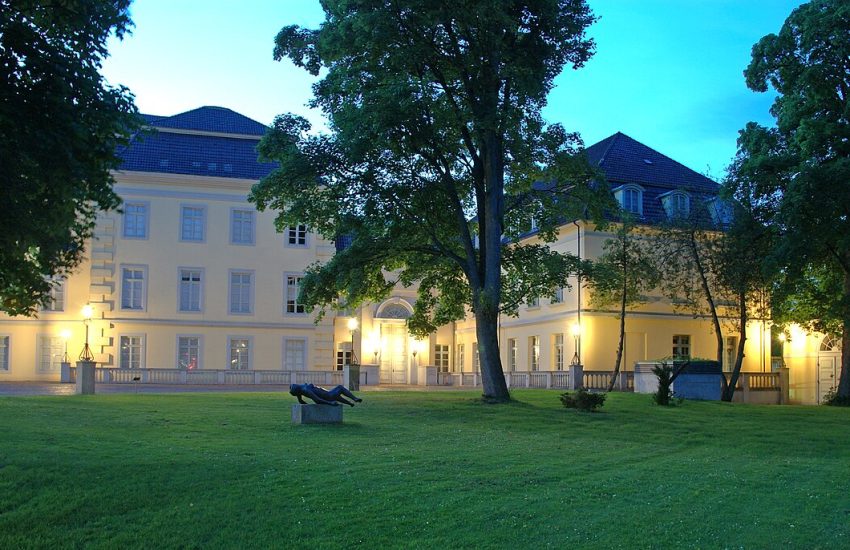
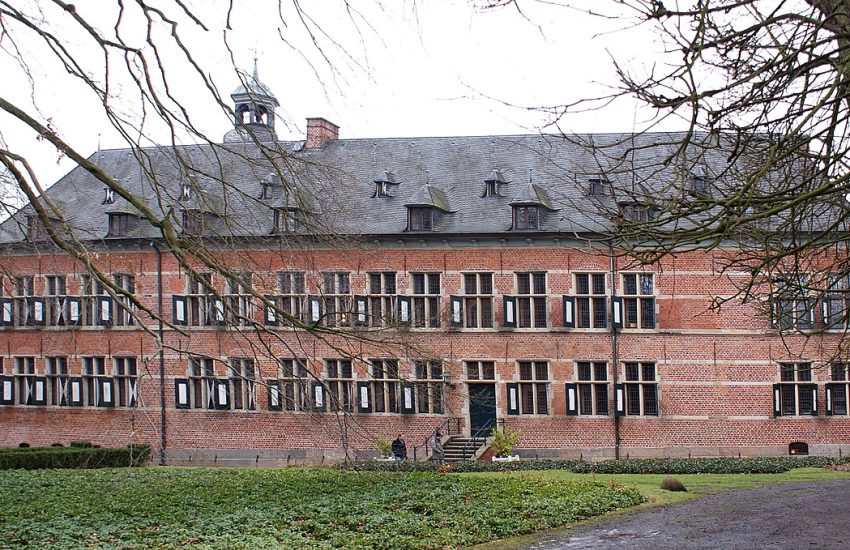
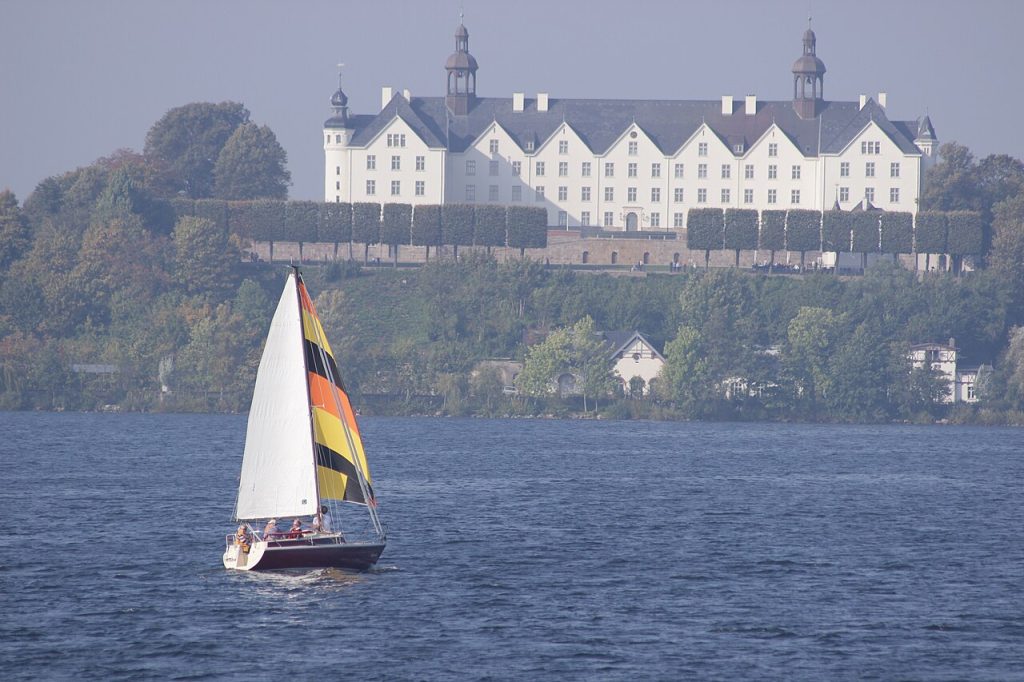
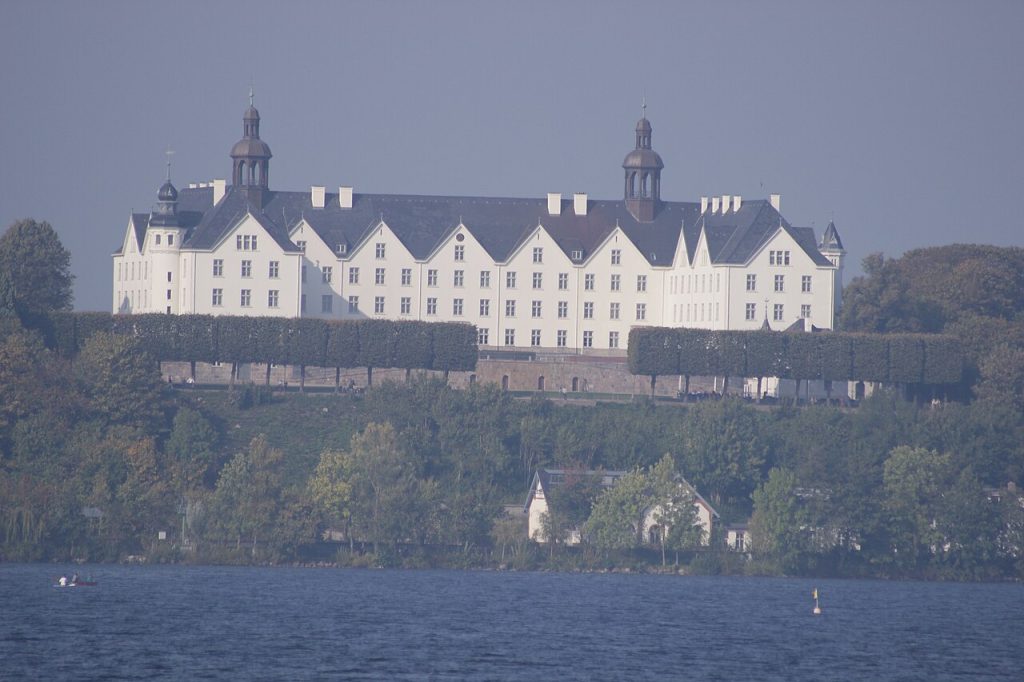
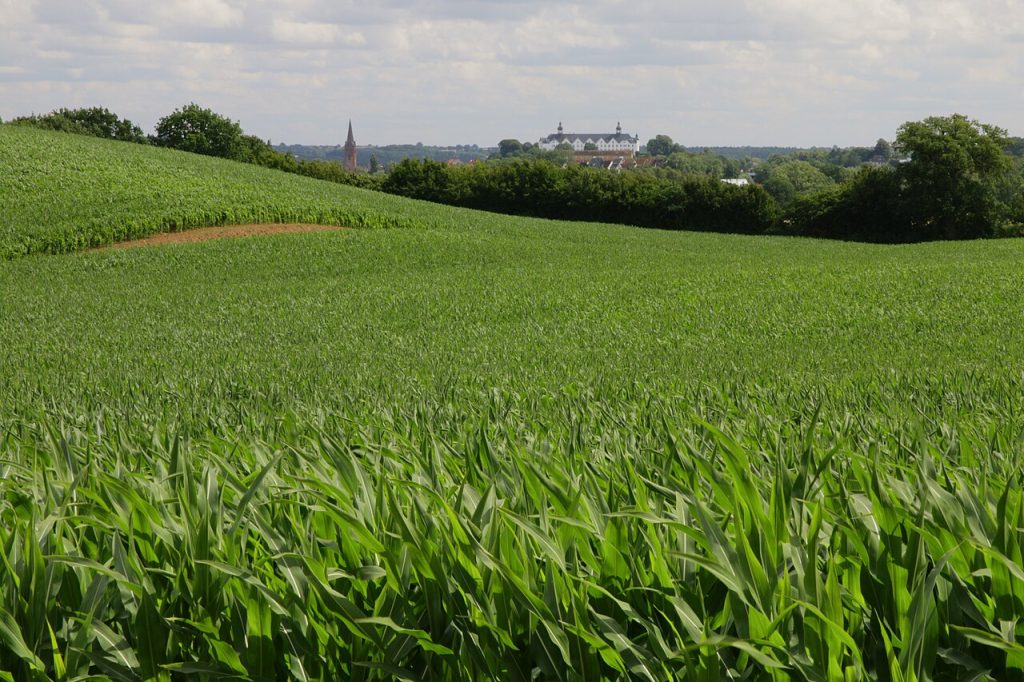
Approach Plön from the south along the lake and the castle is the first thing you see: a long white building with a steep red roof standing on the crest of a hill above the water, visible for miles across the Great Plön Lake. In a region of red-brick manor houses it looks almost Mediterranean, and that is not an accident. The dukes who built it in the 1630s wanted something that would be seen, and four centuries later it still is.
Plön Castle is one of the few great hilltop castles in Schleswig-Holstein, a land where most residences sit in moats and meadows. It was built as the seat of a small ducal line, became a Danish royal summer palace, trained Prussian cadets, educated the sons of the last German Kaiser, served the Nazi state as an elite boarding school, housed a state school for half a century and was then, in a twist nobody predicted, bought by an optician who turned it into an academy for his trade. The optician also paid for the restoration, which is why the white walls shine again.
Let me walk you up the hill, through the rooms and down to the lake, with the dukes, the cadets and the Kaiser’s sons along the way. Use the contents to skip ahead if you must.
In This Article
- The Largest Lake in the Land
- A Small Duchy With Big Ambitions
- Building in White: 1633 to 1636
- Renaissance Lines and a Baroque Interior
- Duke Friedrich Karl and the Baroque Court
- The Danish Kings Take Over
- Prussian Cadets on the Hill
- The Kaiser’s Sons and the Prinzenhaus
- The Dark Decade: An Elite School for the Reich
- Half a Century of Schoolboys
- The Optician Who Bought a Castle
- The Castle Garden and the Lake Shore
- Plon Town and the Chain of Lakes
- Plon on Video
- Visiting Plon Castle Today
- Palaces Nearby
The Largest Lake in the Land
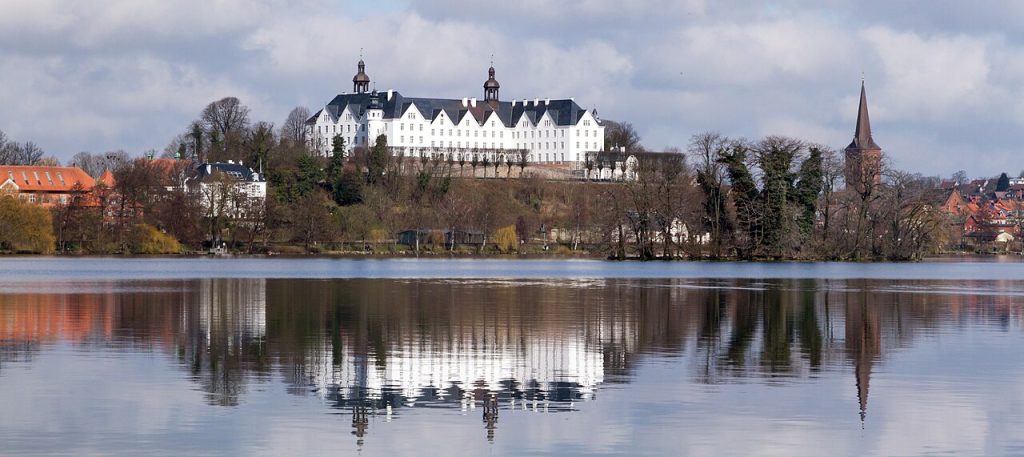
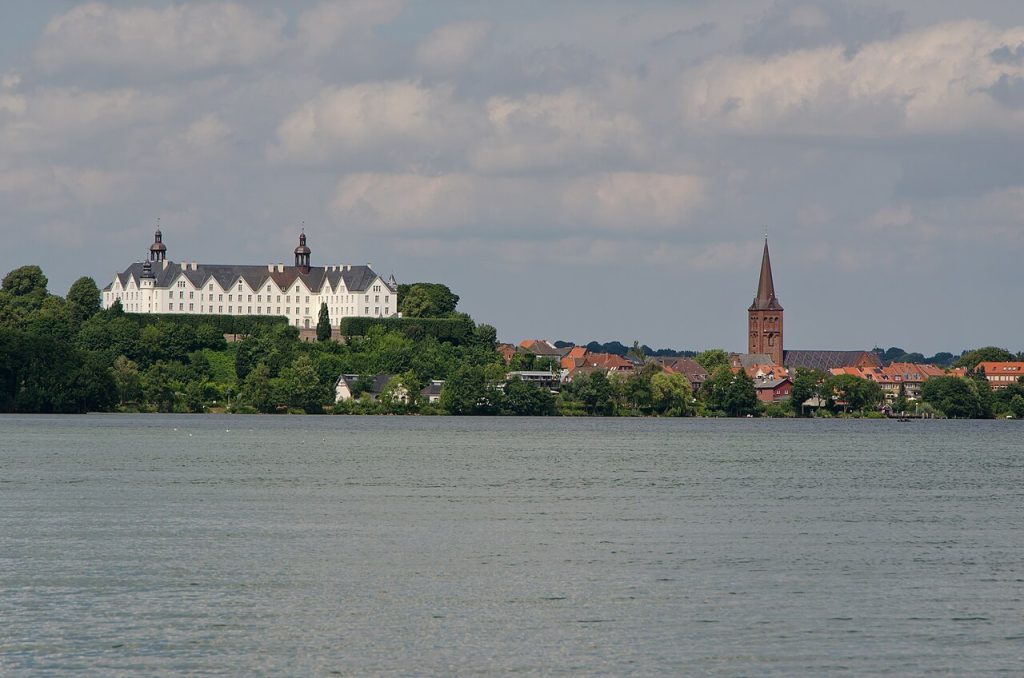
The Great Plön Lake is the largest lake in Schleswig-Holstein, some thirty square kilometres of water dotted with islands and surrounded by wooded hills. The town of Plön sits on a neck of land between it and a chain of smaller lakes to the north, and the castle hill rises directly above the big lake’s northern shore. From the terrace you can see the whole expanse, with sailing boats in summer and ice fishermen in hard winters.
Now, stop here at the bottom of the castle hill, by the lake, and look up. The hill is a natural moraine, steep on the lake side, and the castle sits along its crest like a ship on a wave. This was never a defensive site in the mediaeval sense; the dukes built here for the view and the breeze, and because a white palace on a green hill above blue water is as good a statement of princely status as the seventeenth century could devise.
A Small Duchy With Big Ambitions
The dukes of Schleswig-Holstein-Sonderburg-Plön were a classic example of the German petty prince. The Danish king Christian III had given his younger son John the Younger a scatter of estates in 1564, and John’s sons divided them again, so that by the 1620s there were ducal lines at Sonderburg, Norburg, Glücksburg and Plön, each with a title grander than its territory. The Plön line held the town, the lakes and a few dozen villages, which was enough to support a court if nobody looked too closely at the accounts.
Duke Joachim Ernst, who founded the line, was a man of taste who had travelled in Italy and served in the Danish army. He wanted a residence worthy of his rank, and he had the good sense to see that the hill above the lake would make any building look twice as grand as it was. In 1633, in the middle of the Thirty Years’ War, he began to build.
Building in White: 1633 to 1636
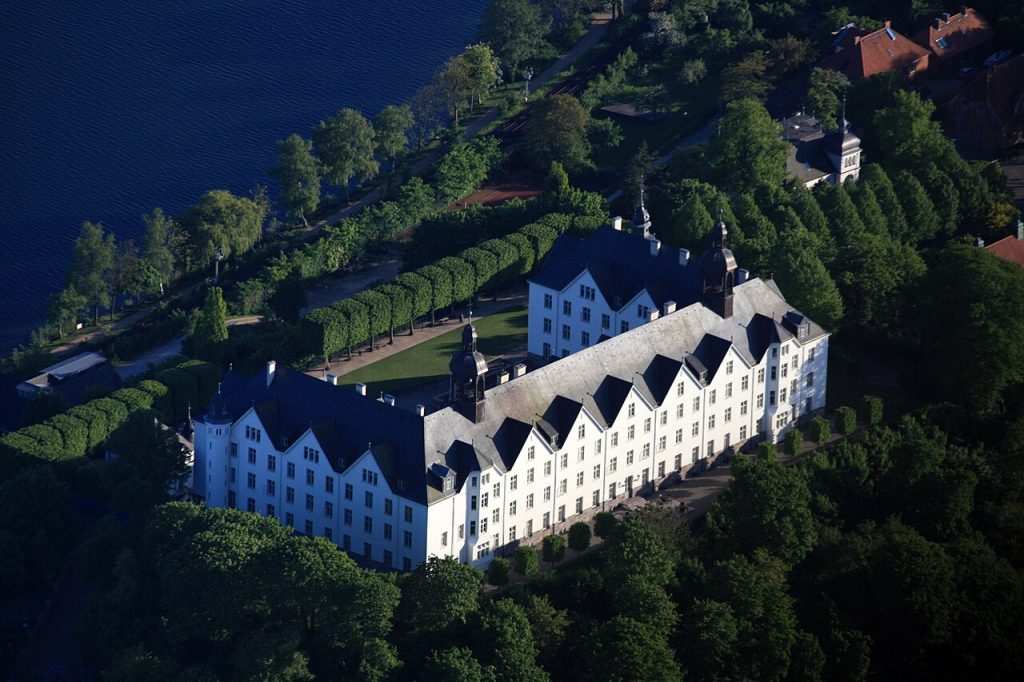
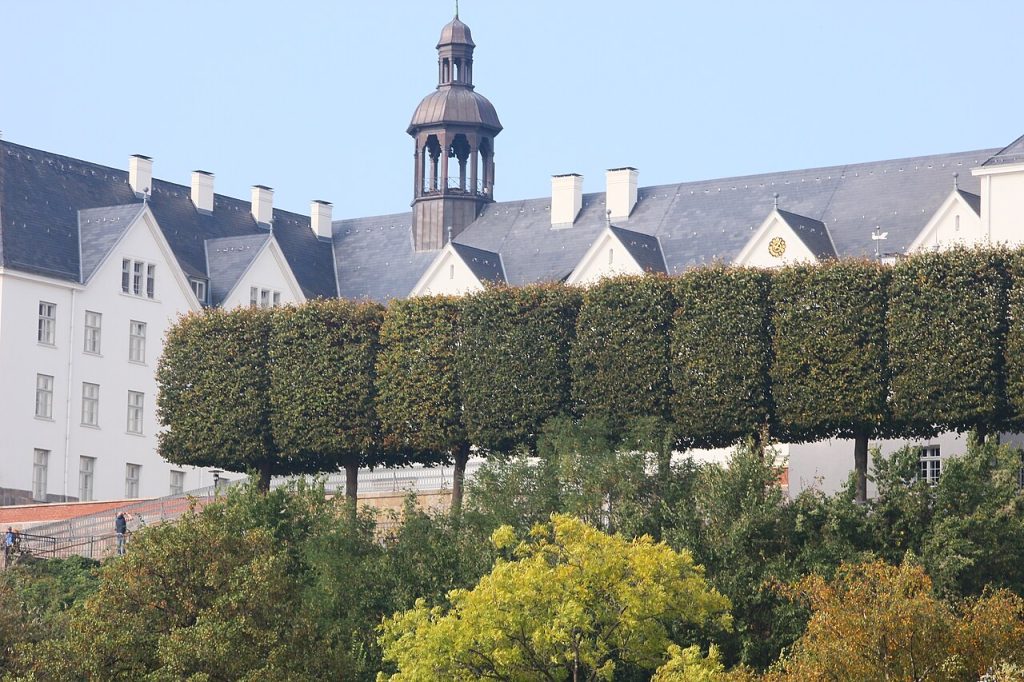
The castle went up with astonishing speed, between 1633 and 1636, while armies were marching across Germany. Plön escaped the worst of the war because of its remote position and Danish protection, and the duke evidently had money saved. The design, by an unknown master builder working in the Dutch-influenced manner of the Danish court, produced a long three-storey main block with short wings at each end, a steep roof and two slender towers on the lake side.
The white render is original to the concept. Brick was the building material, as always in the north, but the duke had it plastered and limewashed so that the castle would stand out against the hill. Later owners kept the colour, and the recent restoration reinstated it precisely. On a bright day the glare is almost too much; on a grey one the castle seems to float above the dark lake.
Renaissance Lines and a Baroque Interior
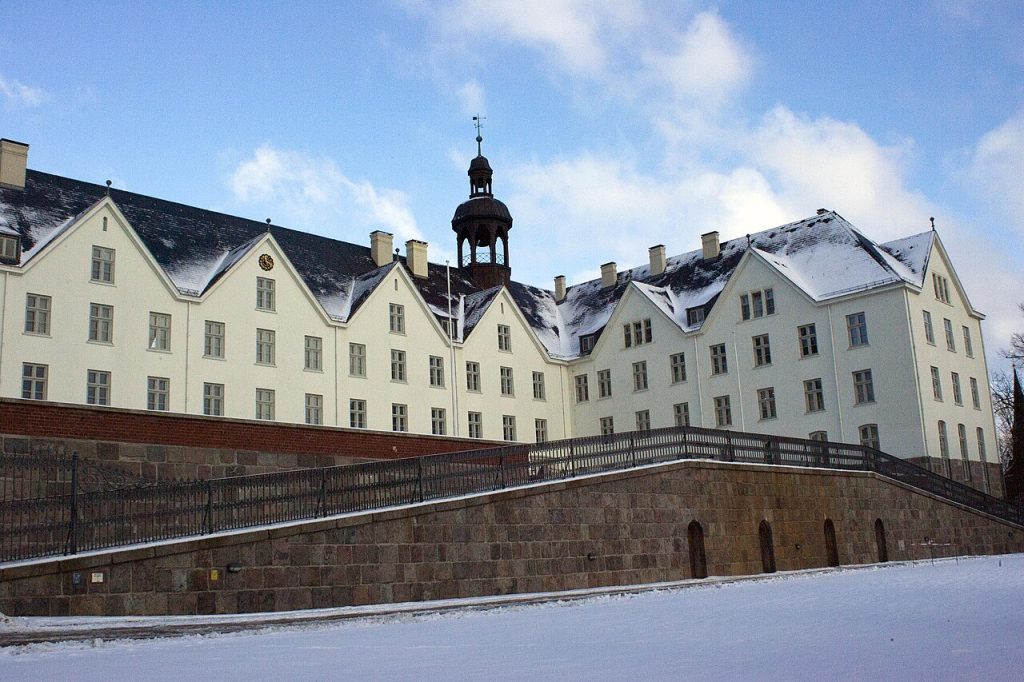
Walk along the terrace and look at the facade. The architecture is late Renaissance, with regular rows of windows, modest stone frames, a central portal and very little ornament, the sober style that Danish and North German builders favoured around 1630. The towers on the lake side are the only romantic touch, and even they are restrained. This is a building that relies on scale, colour and position rather than decoration.
Inside, the story is different. Every owner refurnished. The dukes added Baroque stucco and painted ceilings in the early eighteenth century, the Danish kings redecorated in a cooler classical taste, the Prussians stripped much of it out for classrooms and dormitories, and the twentieth century finished the job. The restoration of the 2000s recovered what it could, notably a fine Baroque staircase and several rooms with stucco ceilings, and the main hall is once again a space worthy of a duke.
Duke Friedrich Karl and the Baroque Court
The high point of ducal Plön came under Friedrich Karl, who ruled from 1729 to 1761. He had grown up in Prussian and Danish service, married a wealthy heiress and set about turning his little capital into a Baroque residence town. He modernised the castle interiors, laid out a formal garden on the slope toward the lake, built the Prinzenhaus garden pavilion that we will visit later, founded a court orchestra and kept a stable of horses that swallowed a large part of his income.
Now, stop here on the garden terrace and imagine the 1740s: the parterres below in full flower, a barge on the lake with musicians aboard, the duke and his guests dining on the terrace. It lasted a single generation. Friedrich Karl died in 1761 without a legitimate male heir, the Plön line was extinct, and the duchy passed by treaty to the Danish crown. The court dispersed, the orchestra was dismissed and the castle began its long second life as something other than a residence.
The Danish Kings Take Over
For the next century Plön belonged to the kings of Denmark, who ruled Schleswig and Holstein as dukes in personal union with their kingdom. The castle became an occasional royal summer residence. King Frederick VI stayed here, and his successor Christian VIII had the interiors redecorated in the 1840s in the fashionable style of the Danish Golden Age, with light colours and classical detail. Royal visits were rare, however, and for most of the year the castle stood quiet, administered by a steward and used for provincial government business.
The Danish century ended in 1864 when Prussia and Austria defeated Denmark and annexed the duchies. Plön passed to Prussia in 1866, and the Prussian state had a very specific idea of what to do with a large empty building on a healthy hill above a lake.
Prussian Cadets on the Hill
In 1868 the castle became a Royal Prussian Cadet School, one of a network of military boarding schools that prepared boys from the age of ten for officer careers. Dormitories were built in the former state rooms, a drill ground was levelled, service buildings for teachers and staff rose around the hill, and for fifty years the terrace echoed with marching and bugle calls. The cadets rowed and sailed on the lake, which gave Plön a reputation as the pleasantest posting in the system.
The cadet school changed the castle more than any owner since the dukes. The Baroque garden became a parade ground, interiors were partitioned, heating and plumbing were installed, and the surrounding slope filled with brick barracks and gymnasiums. Yet the main building survived intact, and the school’s prestige brought Plön its most illustrious pupils.
The Kaiser’s Sons and the Prinzenhaus
Here is the story every guide tells. Between 1896 and 1910 all six sons of Kaiser Wilhelm II were educated at Plön, not in the cadet barracks but in a special household set up in the Prinzenhaus, Duke Friedrich Karl’s Rococo garden pavilion below the castle. The princes attended lessons with the cadets, drilled with them, sailed on the lake and lived under the eye of tutors and officers chosen by their father, who wanted them to have a hard, plain, military upbringing far from the court in Berlin.
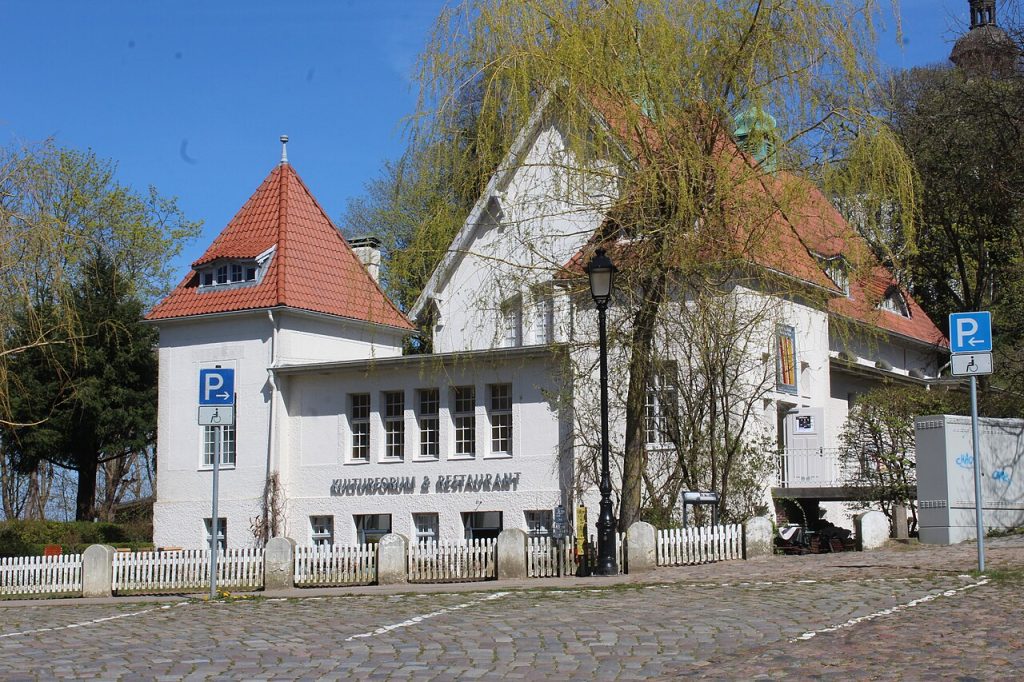
The Prinzenhaus itself is a jewel, a small pavilion with a central hall decorated in stucco and a garden terrace, restored in recent years and open on guided tours. Now, stop here in front of it and consider the irony: a building made for a duke’s pleasure garden became the schoolroom of the last German crown prince and his brothers, several of whom would spend the rest of their lives explaining what went wrong.
The Dark Decade: An Elite School for the Reich
After the cadet schools were abolished under the Treaty of Versailles, the castle became a state boarding school in 1920. In 1933 the new regime turned it into one of the first Nationalpolitische Erziehungsanstalten, the Napolas, elite boarding schools intended to raise a future Nazi leadership class. Plön was one of the model institutions of the system, with selected boys, paramilitary training, sailing on the lake and a curriculum built around ideology.
The school ran until the British arrived in May 1945. In the chaotic final weeks the area around Plön briefly served as the seat of the last Reich government under Admiral Dönitz before it moved to Flensburg. The castle emerged from the war undamaged but with a history that later owners had to confront, and the current exhibition does not shy away from it.
Half a Century of Schoolboys
From 1946 the castle was a state boarding school under the new Land of Schleswig-Holstein, educating boys and later girls from across the region for fifty-five years. Generations of pupils slept in the ducal rooms, ate in the hall and swam in the lake. The school kept the building alive but could not keep it in good repair; by the 1990s the roof leaked, the render was falling off, the heating was ancient and the cost of modernisation was far beyond the state’s budget.
In 2001 the school closed and the state put the castle up for sale. For a moment it looked as if Plön would become a hotel or stand empty. Then a buyer appeared whose business had nothing to do with castles, lakes or dukes.
The Optician Who Bought a Castle
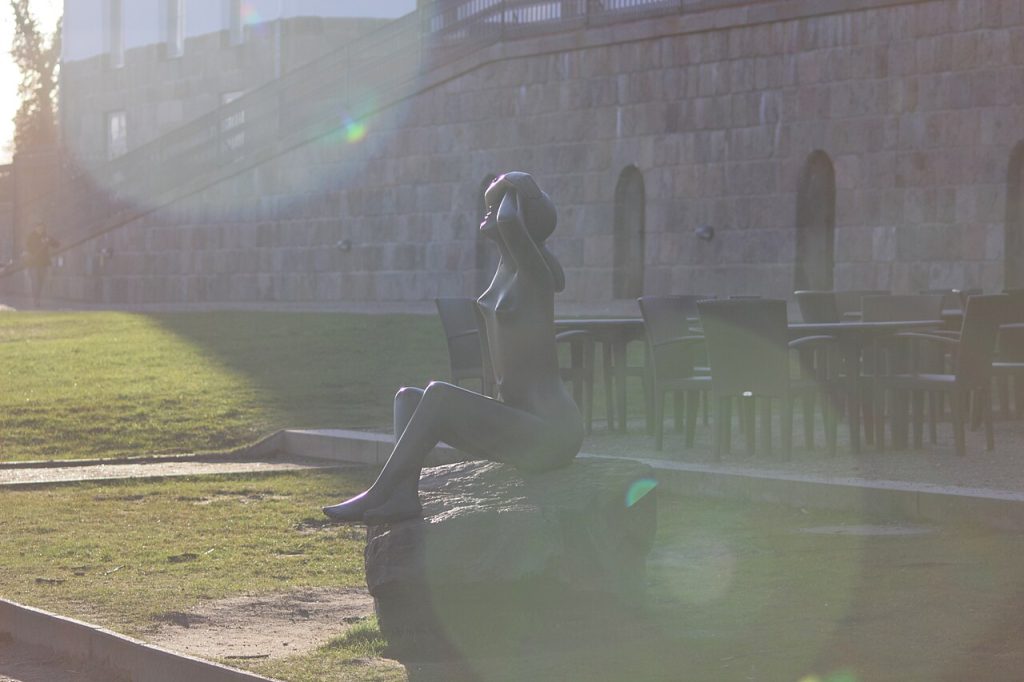
Günther Fielmann, founder of Germany’s largest chain of opticians, bought the castle in 2002 and spent several years and a sum reported to run well into tens of millions of euros restoring it. His purpose was practical: the Fielmann Akademie, a training institute for opticians from his company and the wider trade, with lecture halls, workshops, a library and accommodation. His condition was that the castle remain open to the public, with guided tours, concerts and events.
The restoration was exemplary. The white render was renewed, the roof rebuilt, the Baroque staircase and stucco ceilings conserved, the parade ground turned back into a garden and the Prinzenhaus restored separately by a foundation. Walk through the main hall today and you see a Renaissance castle in better condition than at any time since the dukes, paid for by eyeglasses. Fielmann died in 2024, but the academy continues.
The Castle Garden and the Lake Shore
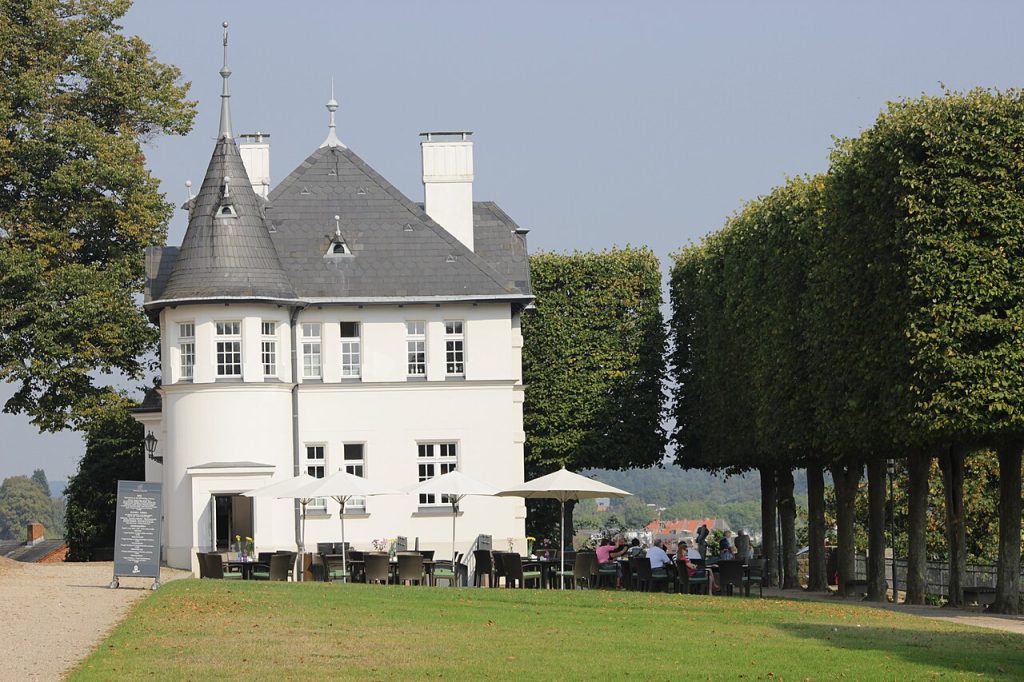
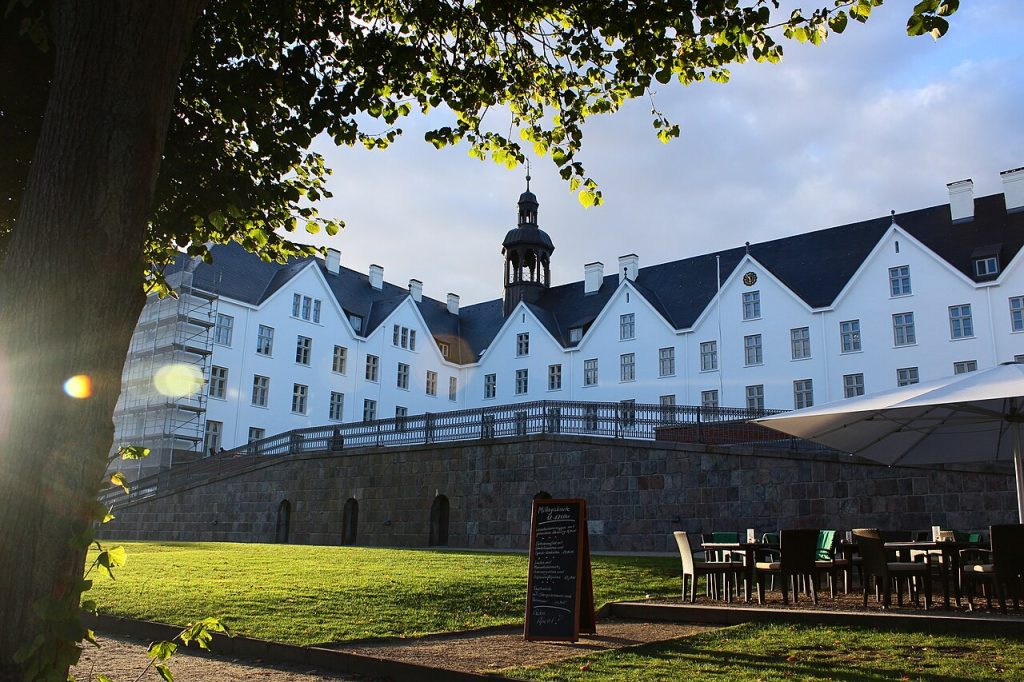
Walk out of the courtyard and down the slope. The garden that Friedrich Karl laid out and the cadets paved over was recreated in the 2000s as a terraced park with lawns, hedges and old trees, descending from the castle terrace to the lake shore. The views from the upper terrace across the water are the best in Plön, and in the evening the lake turns copper under the white walls.
At the bottom you reach the shore promenade, with boat hire, a bathing place and the start of the lakeside path. Now, stop here and look back up at the castle one more time. From this angle, with the towers against the sky, you understand what Joachim Ernst wanted in 1633: a palace that would own the landscape.
Plon Town and the Chain of Lakes
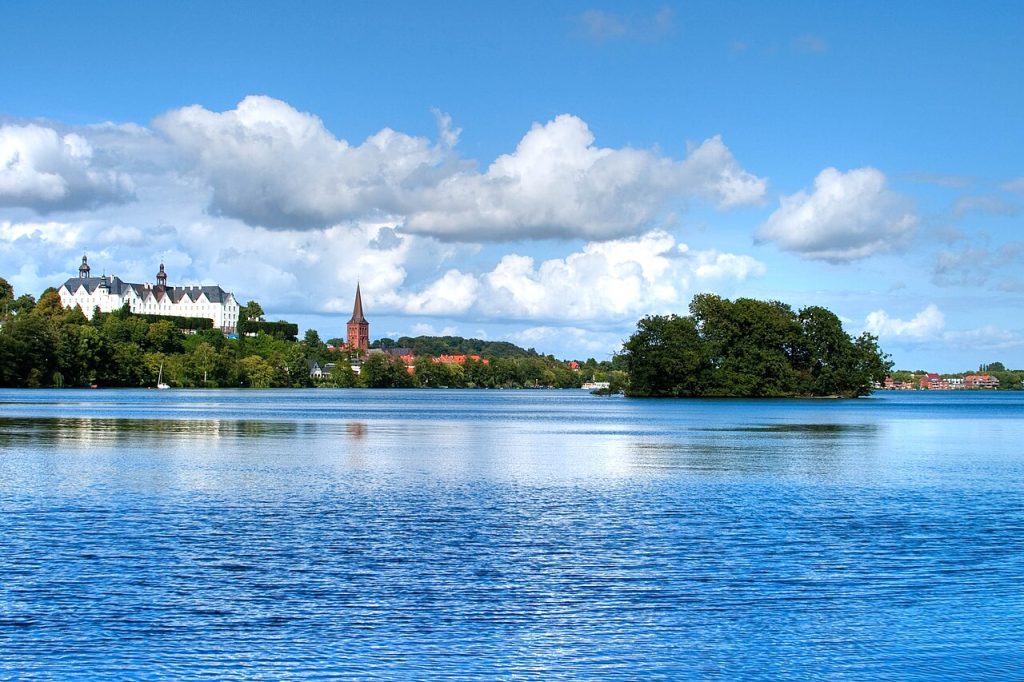
The town below the castle is small and pleasant, with a market square, a nineteenth-century church and a long main street that follows the ridge between the lakes. Plön is the gateway to the Holstein Switzerland nature park, and the chain of lakes to the north, connected by the river Schwentine, can be explored by boat, canoe or bicycle. The lake steamer makes a circuit of the Great Plön Lake in summer with the castle as the constant landmark.
If you have time, take the boat. From the water you see the castle as the dukes intended it to be seen and as every traveller since has described it, a white house on a green hill, with the woods of Holstein rolling away behind.
Plon on Video
Before you plan your trip, take a few minutes to see Plon Castle in motion. The video below gives a good sense of the setting, the scale of the buildings and the atmosphere of the grounds.
Visiting Plon Castle Today
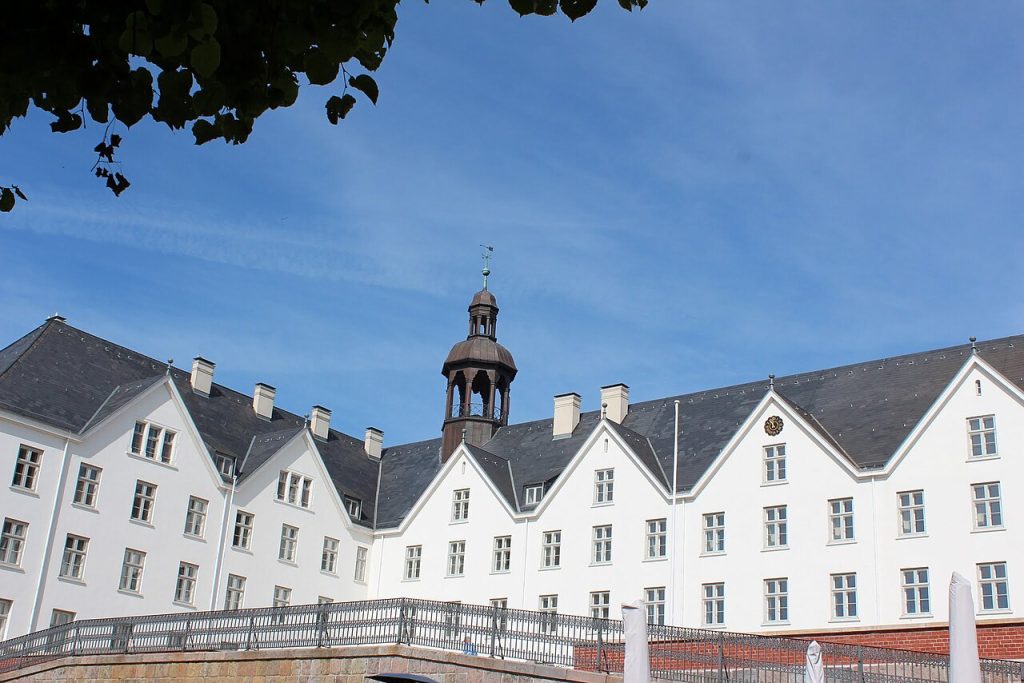
Plön Castle is a working academy, so the interiors are shown on guided tours offered several times a week in the warmer months and on selected days in winter; book ahead through the academy or the town’s tourist office. The terrace, courtyard and garden are open to visitors daily without charge, and the Prinzenhaus below the castle has its own tours and exhibitions. Allow an hour for the tour and another for the garden and the walk down to the lake. The lake steamer and boat hire are on the shore directly below.
Plön lies on the railway between Lübeck and Kiel, roughly an hour from Hamburg with one change; the castle is a ten-minute walk uphill from the station. Eutin is one stop east and makes an easy combined day. Here is the exact spot: Plon Castle on Google Maps.
Palaces Nearby
If you have enjoyed this palace, the region holds more remarkable residences. Here are two more well worth adding to your journey:
You May Like