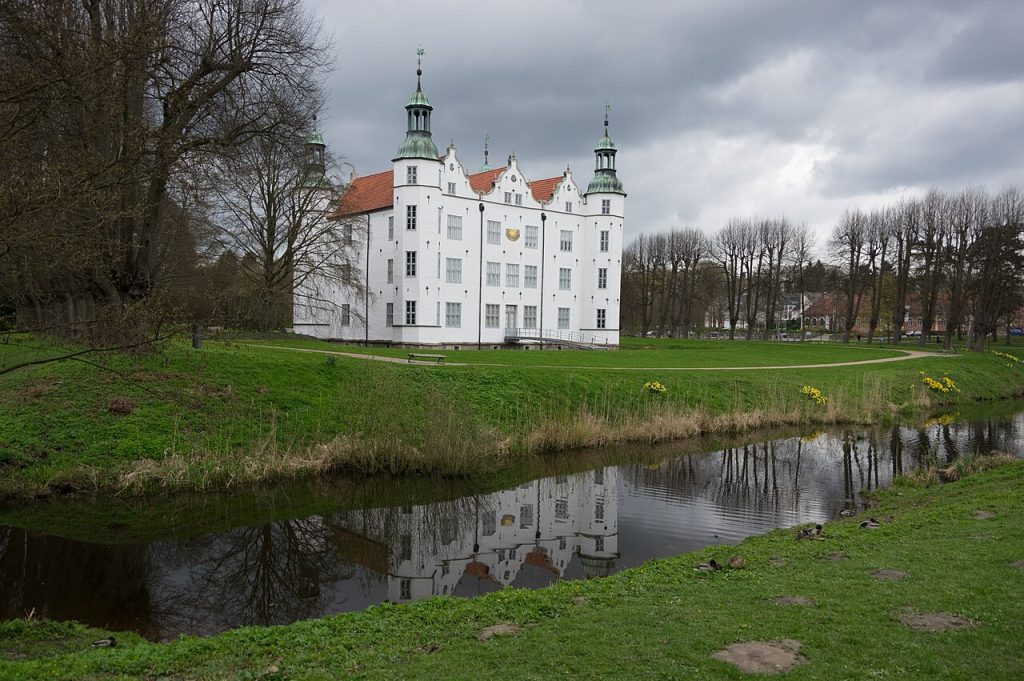
Twenty minutes by suburban train from the centre of Hamburg, in a commuter town of tidy streets and garden fences, stands a white Renaissance castle in a moat, with four corner towers and a church beside it. Most of the people on the train have never been inside. That is a pity, because Ahrensburg is one of the best-preserved sixteenth-century manor castles in northern Germany, and its interiors tell a story that runs from Danish knights to the sugar plantations of the Caribbean and back to the abolition of the slave trade.
The castle was built in the 1590s by Peter Rantzau, a member of the most powerful noble family of Schleswig-Holstein, and it stayed with the Rantzaus for a century and a half. In 1759 it was bought by Heinrich Carl Schimmelmann, a merchant who had made one of the greatest fortunes of the eighteenth century in sugar, slaves and Danish state finance. He gave the house its Rococo and classical interiors; his son Ernst, finance minister of Denmark, drafted the law that made Denmark the first European state to abolish the transatlantic slave trade. The family kept Ahrensburg until 1932, and since 1955 it has been a museum.
Walk with me across the bridge, through the panelled rooms and over to the church with its almshouses. The contents are below; the chapter on where the money came from is the one not to skip.
In This Article
- A Castle on the Edge of a City
- The Rantzaus, Kings in All but Name
- Peter Rantzau Builds in White: 1585 to 1595
- Four Towers in a Moat
- The Castle Church and the Houses of God
- Schimmelmann, the Richest Man in the North
- Sugar, Slaves and the Danish West Indies
- Rococo and Classicism Inside the Renaissance Shell
- Ernst Schimmelmann and the End of the Slave Trade
- Counts in the Country: The Nineteenth Century
- 1932: The Family Sells
- Rescue and the Museum Since 1955
- The Park and the Marstall
- Ahrensburg on Video
- Visiting Ahrensburg Palace Today
- Palaces Nearby
A Castle on the Edge of a City
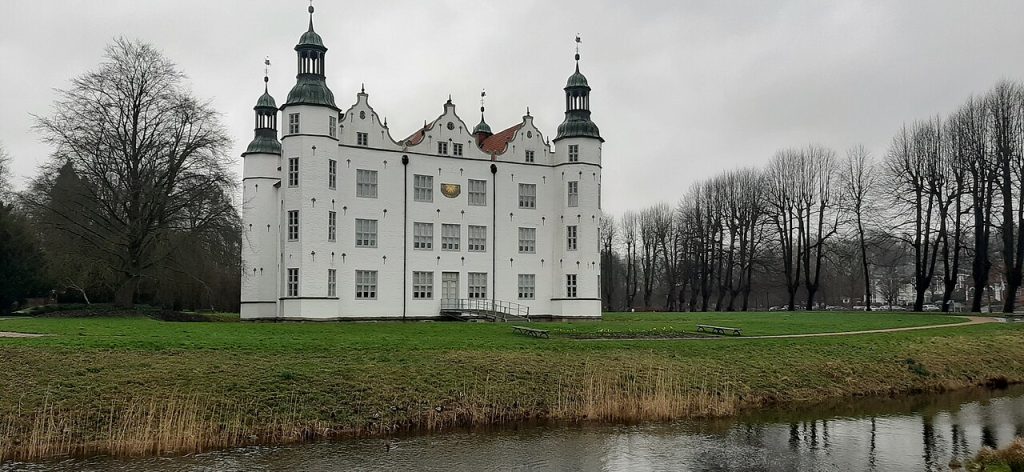
Ahrensburg today is a town of thirty thousand people on the north-eastern edge of Hamburg, inside the Schleswig-Holstein border but entirely within the city’s orbit. The castle stands at its heart, in a small park with a moat, beside the church and the main street, and the contrast between the sixteenth-century towers and the twentieth-century town is part of the experience. In Peter Rantzau’s day this was open country, forest and farmland two hours’ ride from the Hamburg gates.
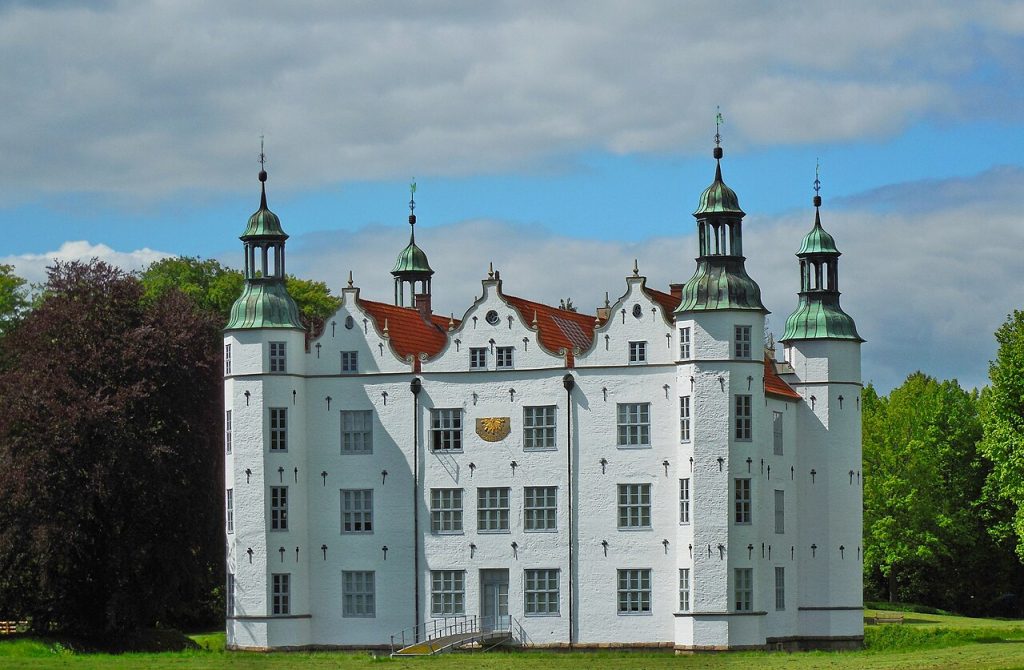
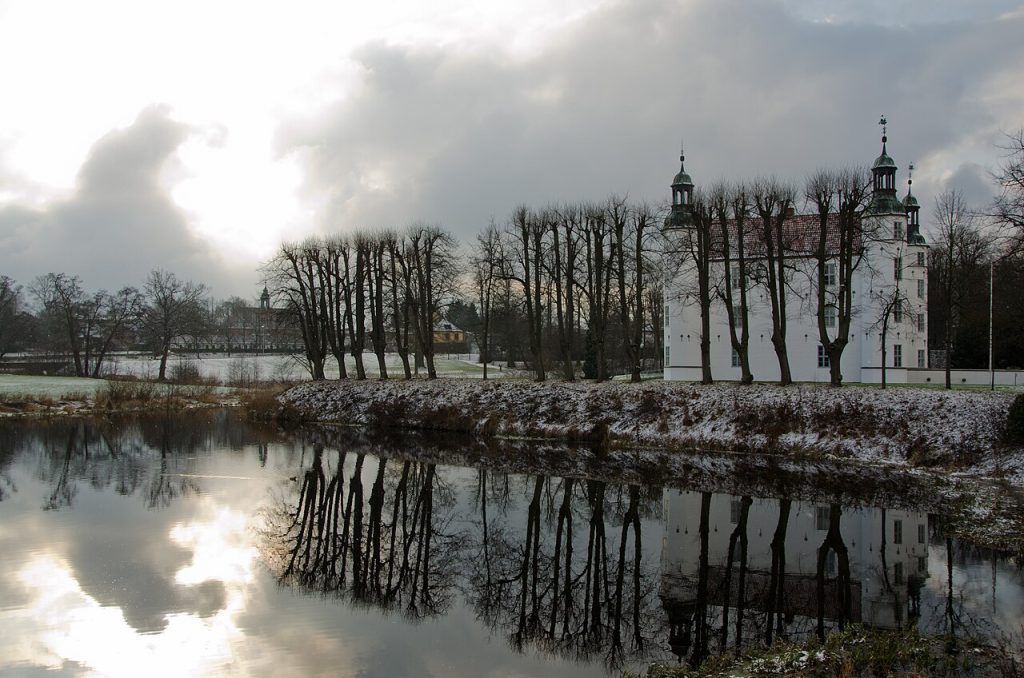
Now, stop here on the bridge over the moat and look at the house. It is white, four-square, with a tower at each corner and a steep red roof, and it is reflected in the water of the moat like its cousins at Glücksburg and Plön. The resemblance is not accidental: all three were built within a decade of each other by men who knew each other, in a style that had come up from the Netherlands through Denmark.
The Rantzaus, Kings in All but Name
The Rantzaus were the great family of sixteenth-century Schleswig-Holstein. Johann Rantzau was the Danish king’s general who won the civil war of the 1530s; his son Heinrich was royal governor of the duchies for forty years, a humanist, a builder of dozens of manor houses and the owner of so much land that people said the king ruled Denmark and Rantzau ruled Holstein. The family produced marshals, diplomats and bishops, and at its height held more than seventy estates.
Peter Rantzau, who built Ahrensburg, was a cousin in this network, a soldier and courtier who had served the Danish crown and received the Ahrensburg lands, formerly church property, as a reward. He wanted a house that announced his place in the family, and he had the Rantzau taste for building in the new Dutch manner.
Peter Rantzau Builds in White: 1585 to 1595
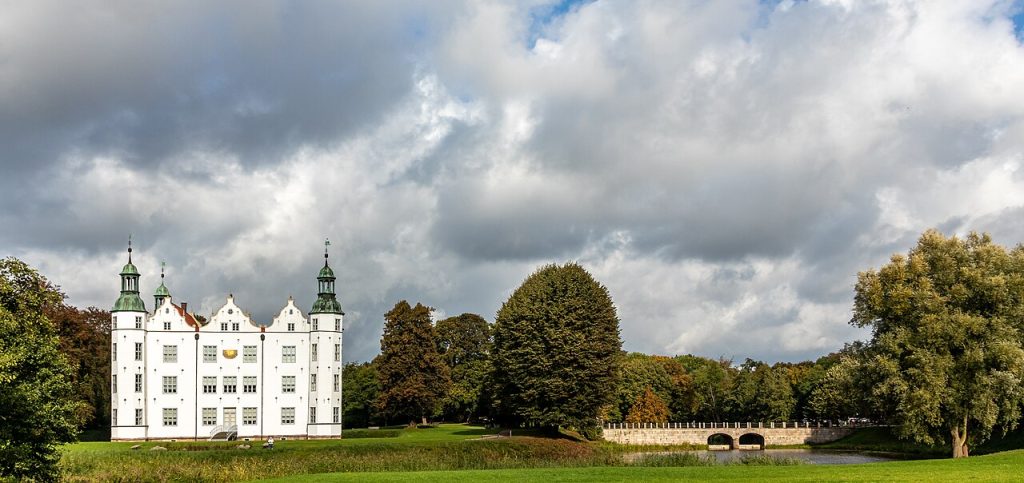
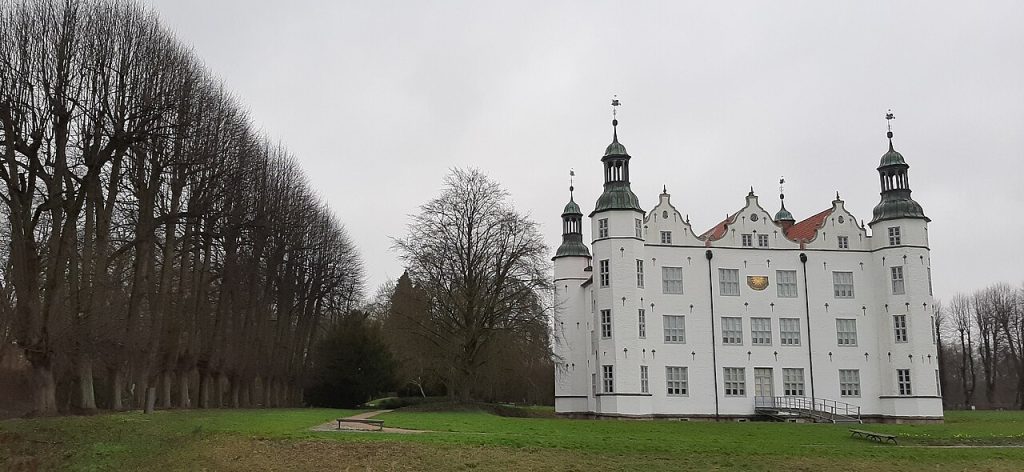
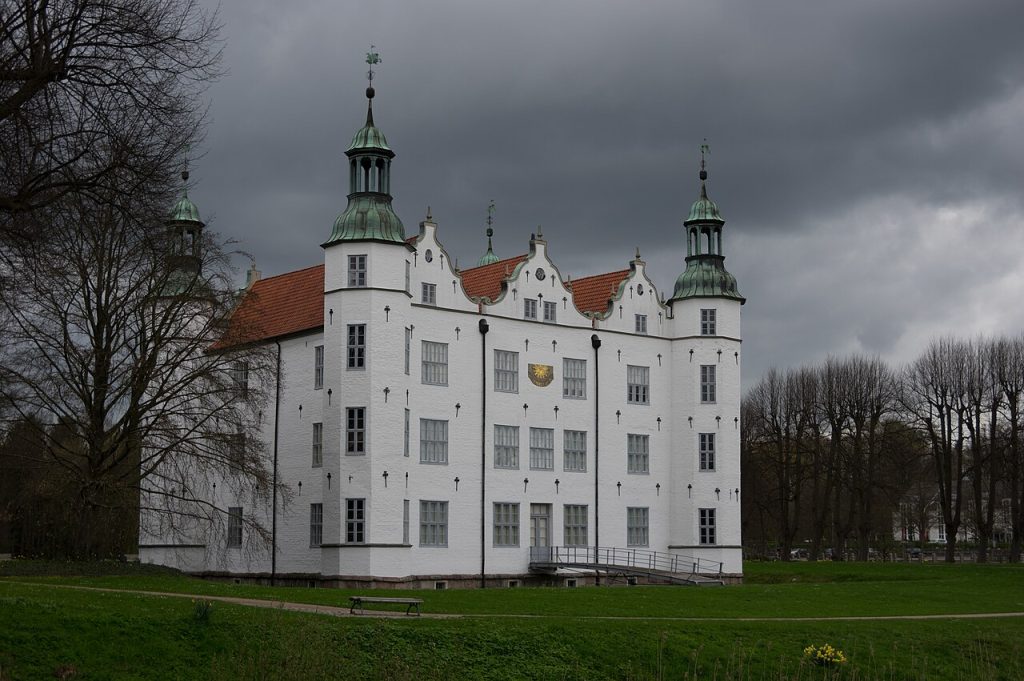
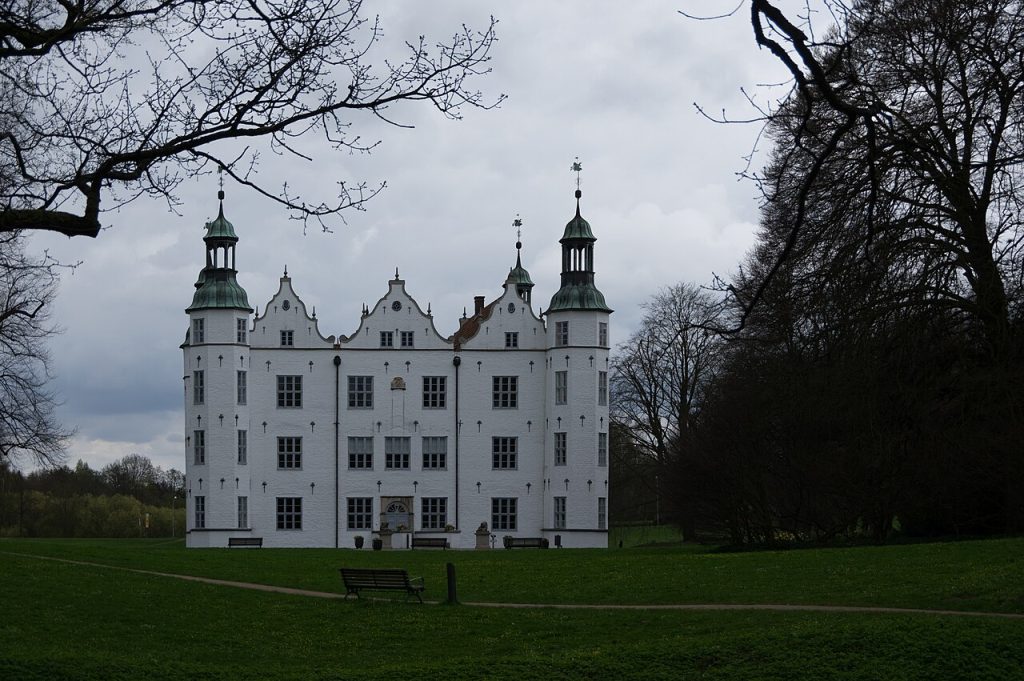
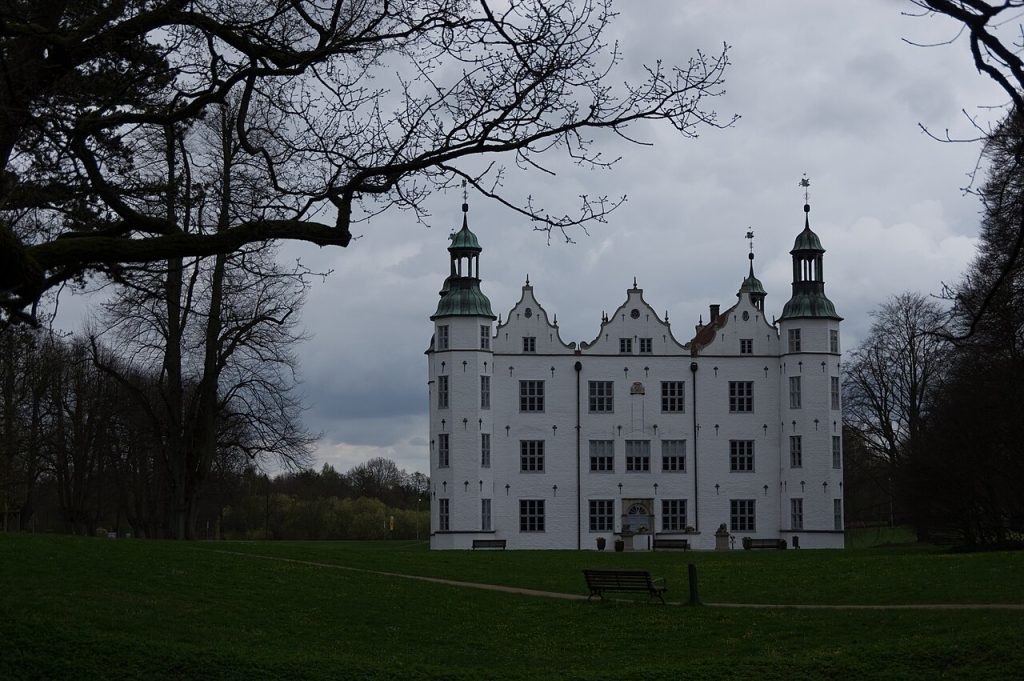
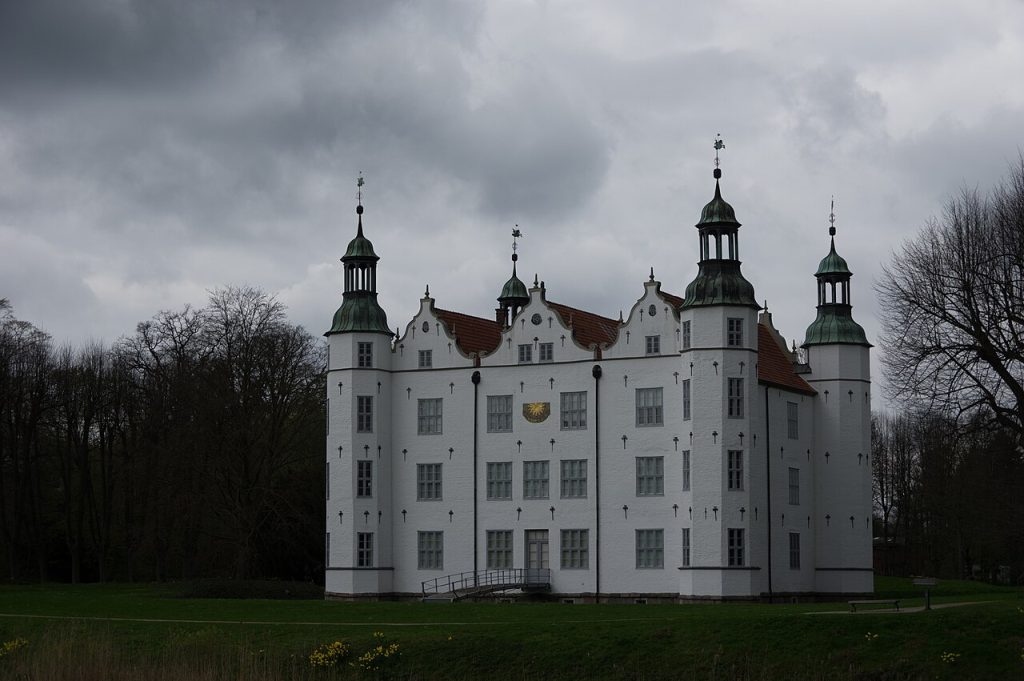
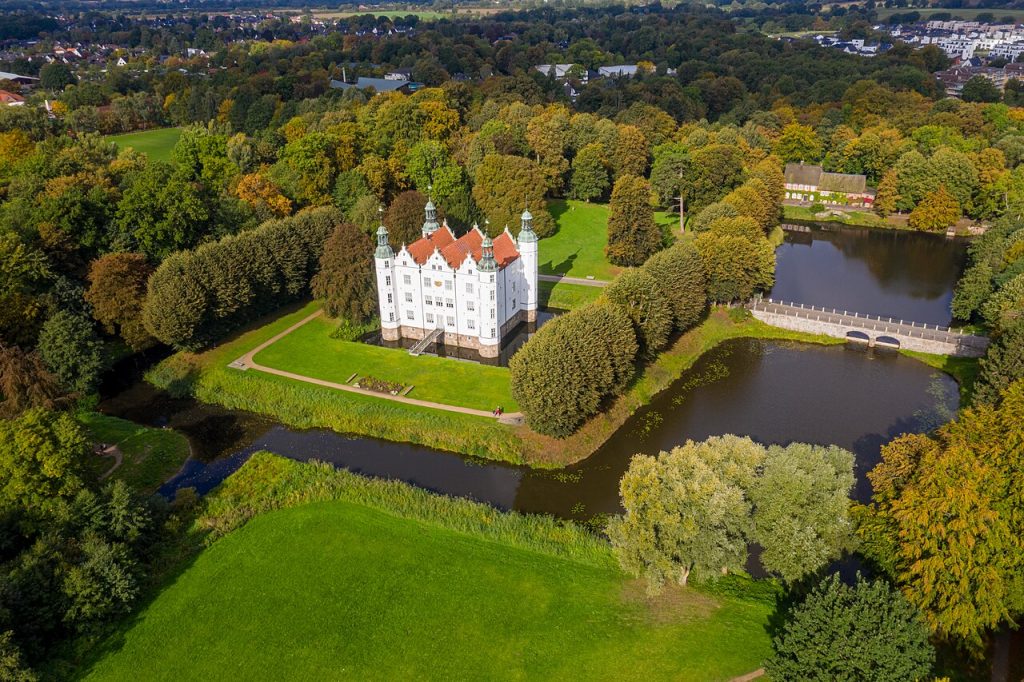
The castle was built between 1585 and 1595 by craftsmen who had worked on other Rantzau houses, and its model was Glücksburg, finished a few years earlier. It is a two-storey block on a nearly square plan, with a high basement, octagonal towers at the corners and a roof whose steepness betrays its date. The walls are brick, rendered white, with sandstone details around the portal and windows. A moat surrounds the whole, crossed by a bridge on the entrance side.
It was never meant to be defended seriously. The towers had no gun ports, the moat was a status symbol and a fishpond, and the large windows would have been a liability in a siege. Ahrensburg is a country house in the costume of a castle, built by a man who wanted to live well and to be seen living well, and it has kept that character through all its later changes.
Four Towers in a Moat
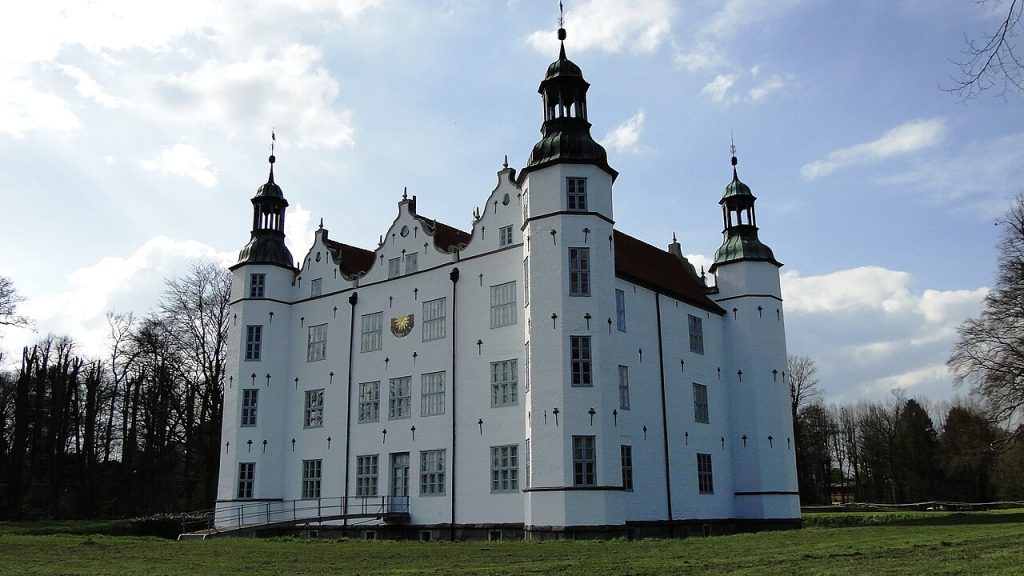
Walk the circuit of the moat and look at the details. The four towers are octagonal, each with its own small roof, and they house spiral stairs and closets rather than guards. The main portal carries the Rantzau arms and a Latin inscription; the windows are arranged in regular rows with the larger ones on the main floor. On the garden side a later terrace and steps were added for the Schimmelmanns.
The purity of the exterior is remarkable. Unlike most castles of this age, Ahrensburg was never enlarged with wings or dressed up with Baroque ornament; the Schimmelmanns, who could have rebuilt it entirely, chose to keep the Renaissance shell and modernise only the inside. What you see from the moat is essentially what Peter Rantzau saw in 1595.
The Castle Church and the Houses of God
Before going inside, cross to the church. Peter Rantzau built the Schlosskirche between 1594 and 1596 as an estate church, a plain brick hall with a tower and a Renaissance interior that includes a carved pulpit, the Rantzau family pew and memorials to the builder and his wife. Attached to the church on both sides are two long rows of tiny houses, the Gottesbuden, the Houses of God: twenty-four almshouses that Rantzau endowed for the poor of his estate, each with a single room and a garden plot.
The Gottesbuden are still inhabited by elderly residents of modest means under the terms of the original foundation, which makes them one of the oldest functioning charitable housing schemes in Germany. Now, stop here between the rows and look at the castle across the road. The builder of the white house also built these, and he asked to be remembered for both.
Schimmelmann, the Richest Man in the North
In 1759 the Rantzaus, impoverished and divided, sold Ahrensburg to a man who was everything they were not. Heinrich Carl Schimmelmann was the son of a Pomeranian merchant who had made his first fortune supplying the Prussian army in the Seven Years’ War, his second buying the Meissen porcelain stock that Frederick the Great had seized in Dresden and selling it in Hamburg, and his third as a banker and army contractor. He was ennobled by the Danish king, made treasurer of the kingdom and eventually a count, and by the 1770s he was probably the richest private individual in northern Europe.
Schimmelmann bought Ahrensburg as a country seat convenient for Hamburg, where his trading house stood, and for Copenhagen, where he served the crown. He also acquired Wandsbek, now a Hamburg district, and estates in Jutland, and he built a palace in Copenhagen that is now the Odd Fellows’ Mansion. Ahrensburg was his favourite, and he spent lavishly on it.
Sugar, Slaves and the Danish West Indies
Here is the chapter that the museum now tells plainly. In 1763 Schimmelmann bought four sugar plantations on the Danish islands of St Croix and St Thomas in the Caribbean, together with the roughly one thousand enslaved Africans who worked them, and a sugar refinery in Copenhagen. He also held a share in the Danish Guinea trade that shipped slaves from the West African coast. Sugar from the Caribbean refined in Denmark and sold across northern Europe became the core of the family’s wealth, and the plantations stayed in Schimmelmann hands for decades.
The gilded rooms of Ahrensburg were paid for by this. The museum’s exhibition does not hide it, and a visit today includes the plantation ledgers, the maps of St Croix and the uncomfortable arithmetic of how many human lives a Rococo stove represented. Now, stop here in the great hall and hold both facts at once: this is one of the loveliest interiors in Schleswig-Holstein, and it was bought with sugar cut by slaves.
Rococo and Classicism Inside the Renaissance Shell
Schimmelmann’s architects gutted the Rantzau interiors and installed a sequence of rooms in the newest Danish and Hamburg taste of the 1760s and 1770s. The great hall on the main floor has stucco ceilings and marble stoves; the dining room is panelled; the family rooms carry silk hangings and painted overdoors; and a staircase of carved oak connects the floors. Later generations added classical touches around 1800, so that the house inside is a dialogue between late Rococo lightness and early neoclassical calm.
The furnishings are largely original to the family, which is rare: Danish and Hamburg furniture, English clocks, Meissen and Fürstenberg porcelain, family portraits by Danish court painters, and a library. Look for the Schimmelmann portraits, the children painted in the 1770s and the fine collection of eighteenth-century stoves, which are the equal of any in the region.
Ernst Schimmelmann and the End of the Slave Trade
The story turns with the next generation. Ernst Schimmelmann, Heinrich Carl’s son, inherited Ahrensburg, the plantations and his father’s post as Danish finance minister. He was a man of the Enlightenment, a friend of Schiller, whom he supported financially, and of the Danish literary circle, and he came to regard the trade on which his fortune rested as indefensible. In 1792 he chaired the commission whose report led to the royal edict abolishing the Danish transatlantic slave trade from 1803, the first such ban by any European state, more than a decade before Britain’s.
The edict did not free the enslaved people on the islands, including his own, and Ernst kept his plantations while arguing for gradual emancipation, a compromise that historians still debate. Yet the man who sat in these rooms was both a slave owner and the author of the first legal step against the trade, and Ahrensburg is one of the few places where both halves of that story are told in the house where he lived.
Counts in the Country: The Nineteenth Century
After Ernst’s death in 1831 the Schimmelmanns settled into the life of Holstein country nobility. The plantations were sold, the Copenhagen connection faded after 1864 when Holstein became Prussian, and the counts lived at Ahrensburg as landlords, farmers and local notables. The castle was kept in good repair but not altered; the park was laid out in the English manner with a lake and old trees, and the Marstall and farm buildings were rebuilt in brick.
The town meanwhile grew. The railway from Hamburg to Lübeck arrived in 1865 with a station at Ahrensburg, and the village became a commuter town for Hamburg merchants who built villas along the new streets. By 1900 the castle was an island of the sixteenth century in a sea of the nineteenth, which is exactly how it feels today.
1932: The Family Sells
The economic crisis of the early 1930s broke the family’s hold. In 1932, after a hundred and seventy-three years, the Schimmelmanns sold Ahrensburg to a Hamburg businessman, and the castle entered a dangerous decade. It changed hands, stood partly empty, was used for offices during the war and housed refugees afterward. The furnishings were dispersed in part, the roof suffered and the moat silted up. By the early 1950s demolition or conversion into flats was seriously discussed.
What saved the house was a combination of local pride and Hamburg money. A group of citizens, businesses and the town council formed a foundation in 1955 to buy the castle, and it has owned and run it as a museum ever since.
Rescue and the Museum Since 1955
The Stiftung Schloss Ahrensburg restored the building in stages, repaired the roof and render, dredged the moat and, crucially, bought back much of the original furniture from the family and from the market, so that the rooms could be refurnished as the Schimmelmanns knew them. The museum opened in 1955 and has been developed since into one of the best presentations of aristocratic domestic life in northern Germany, with the sugar and slavery history added to the permanent exhibition in recent years.
The foundation also restored the church and the Gottesbuden and runs concerts, exhibitions and a popular Christmas market in the castle. For a town that nearly lost its landmark in the 1950s, the result is a quiet triumph, and the castle is once again the reason people get off the train at Ahrensburg.
The Park and the Marstall
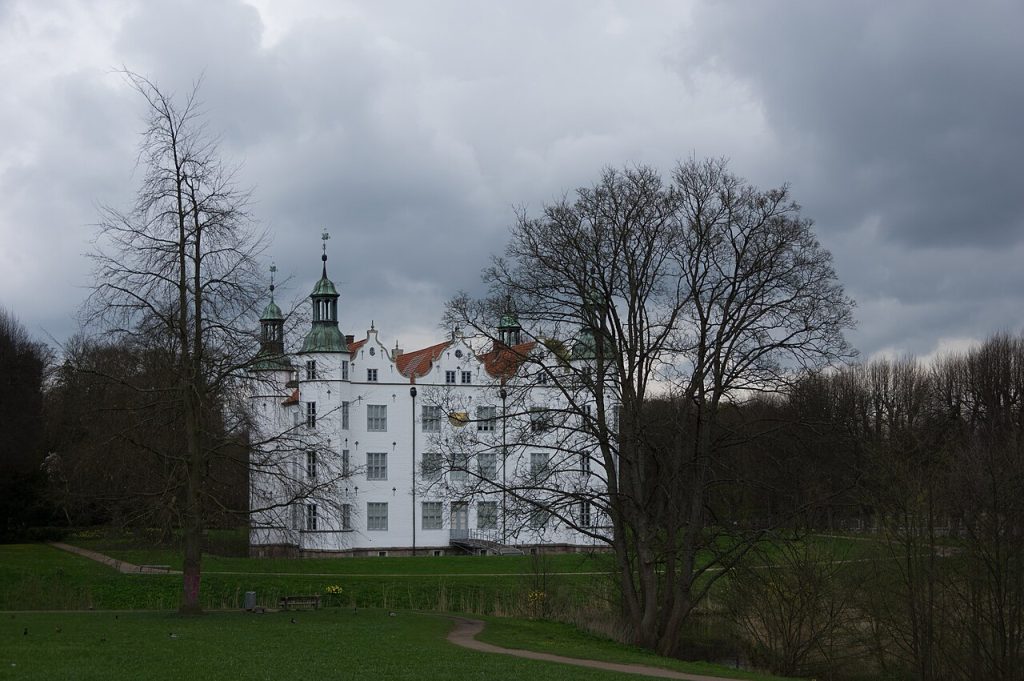
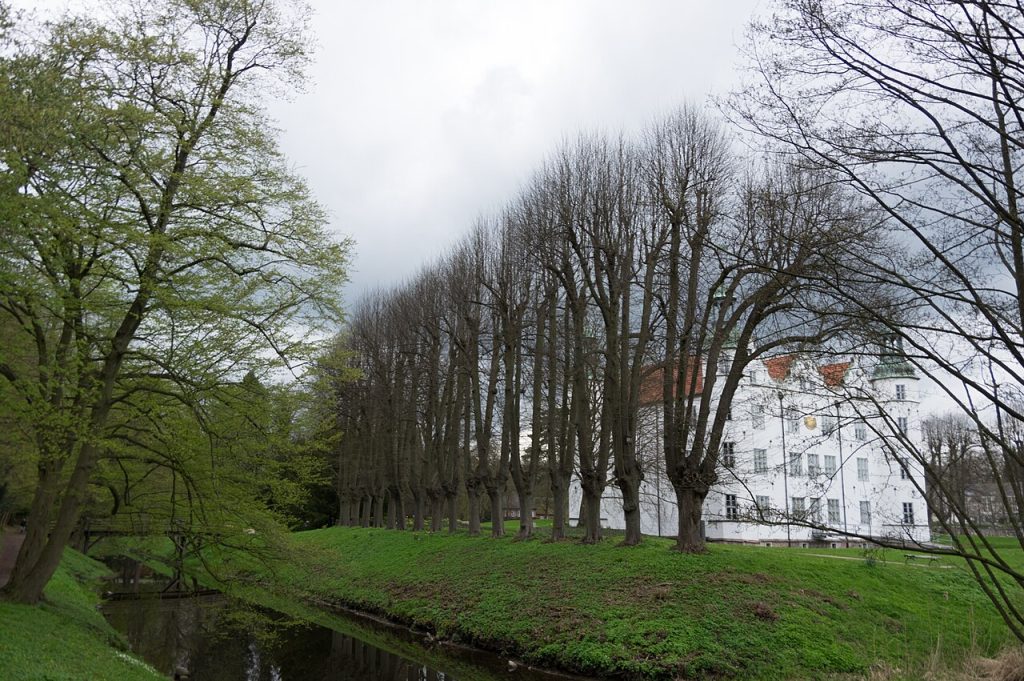
Walk around to the garden side and into the park. It was laid out in the nineteenth century as a landscape garden with a lake fed by the moat, winding paths and groups of old oaks and beeches, and it opens the castle to the countryside that still survives to the north. The brick Marstall, the former stables and coach house, has been converted into a cultural centre with a concert hall, and the old farm buildings house a restaurant.
Now, stop here at the lake and look back at the white house through the trees. The town has disappeared, the traffic is inaudible, and for a moment you are in the Holstein of Peter Rantzau, with the towers rising over the water as they did in 1595.
Ahrensburg on Video
Before you plan your trip, take a few minutes to see Ahrensburg Palace in motion. The video below gives a good sense of the setting, the scale of the buildings and the atmosphere of the grounds.
Visiting Ahrensburg Palace Today
Ahrensburg Palace is open as a museum from spring to autumn, usually Tuesday to Sunday, with reduced hours in winter; the visit is self-guided with information in English, and guided tours can be booked. Allow ninety minutes for the house, then cross the road to the church and the Gottesbuden and walk the park. The Marstall hosts concerts and the castle a Christmas market in December. The town centre with cafés is a five-minute walk.
From Hamburg the U-Bahn line U1 and regional trains reach Ahrensburg in about twenty-five minutes; the castle is a ten-minute walk from either station. Reinbek Palace lies twenty minutes south by car, and Glücksburg two hours north. Here is the exact spot: Ahrensburg Palace on Google Maps.
Palaces Nearby
If you have enjoyed this palace, the region holds more remarkable residences. Here are two more well worth adding to your journey:
You May Like


One thought on “Ahrensburg Palace and the Sugar Baron Who Bought a Renaissance Castle”