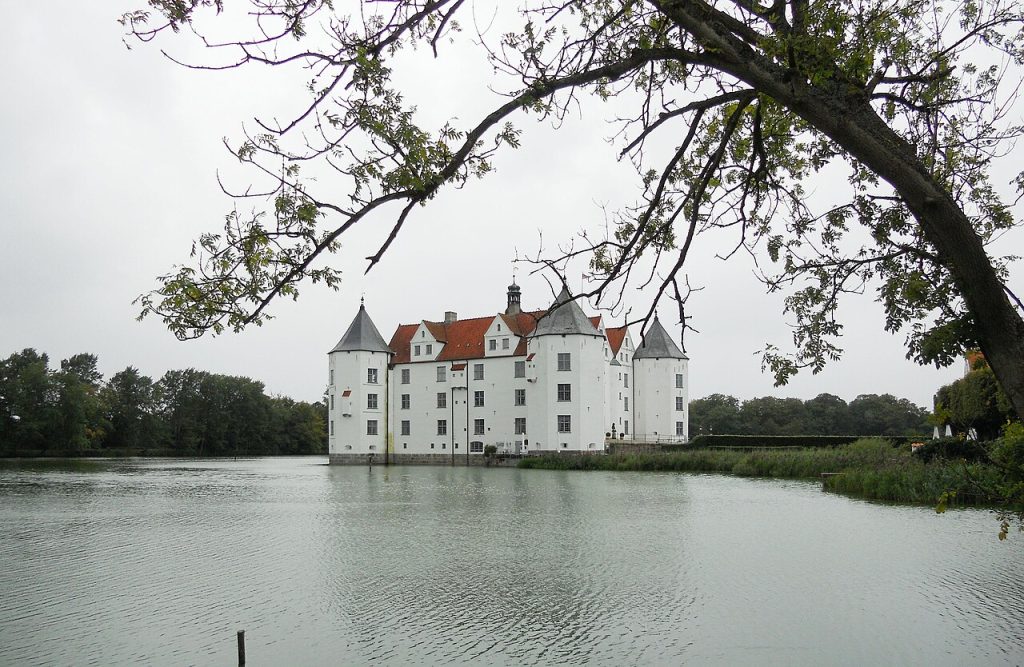
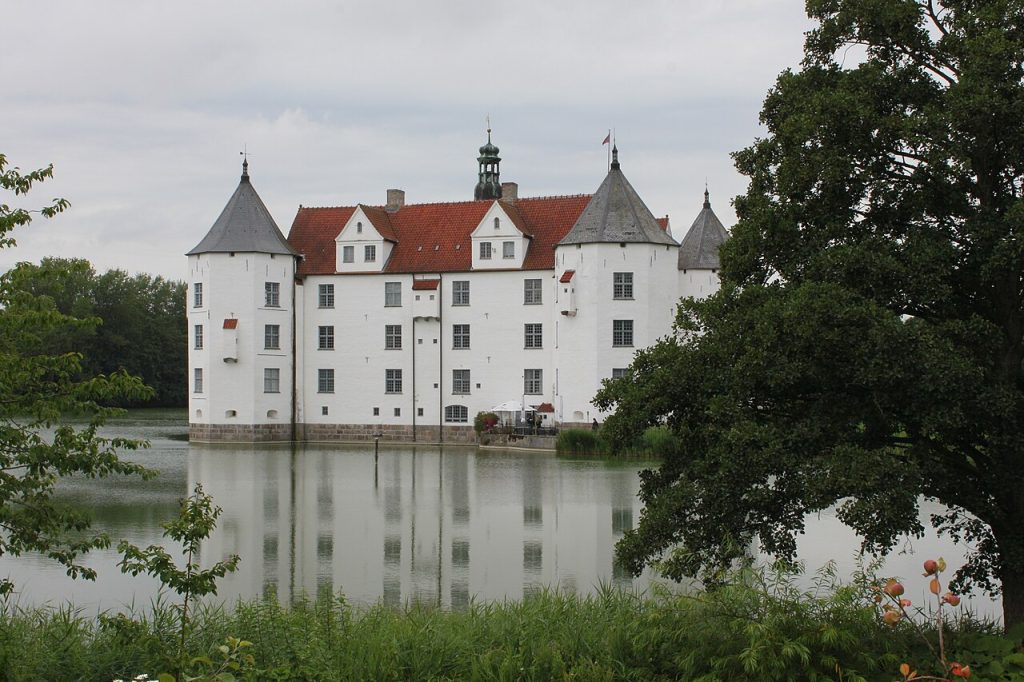
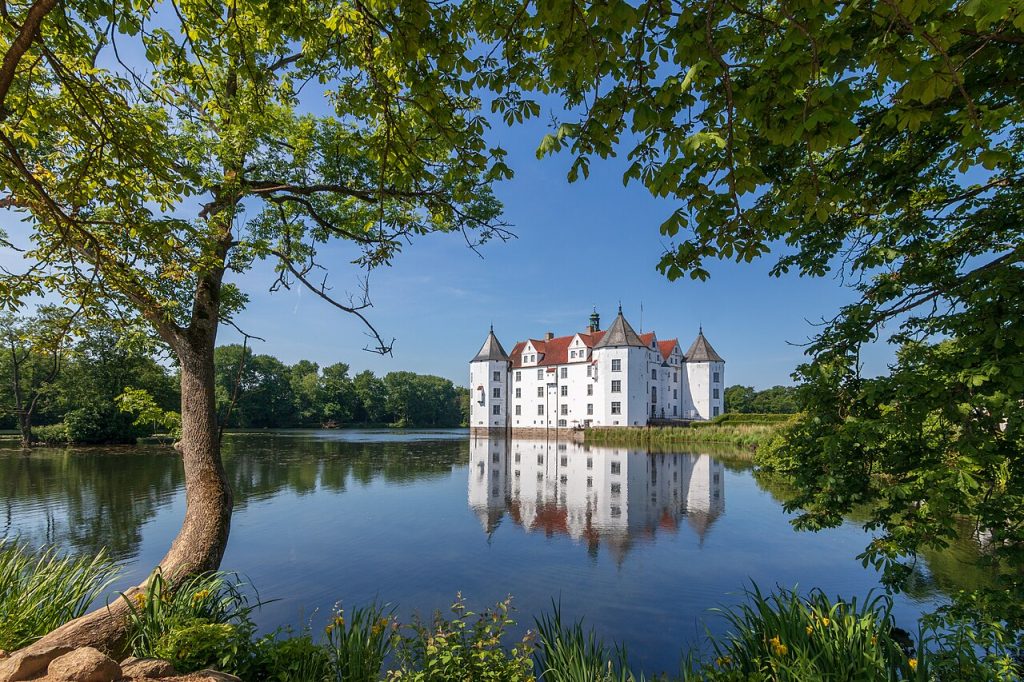
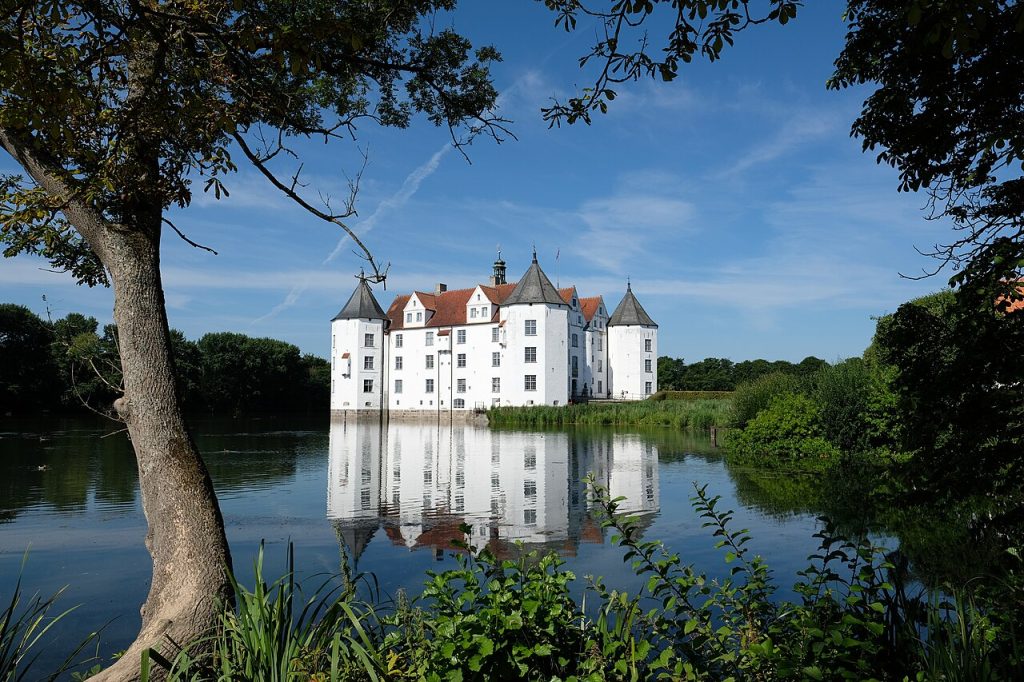
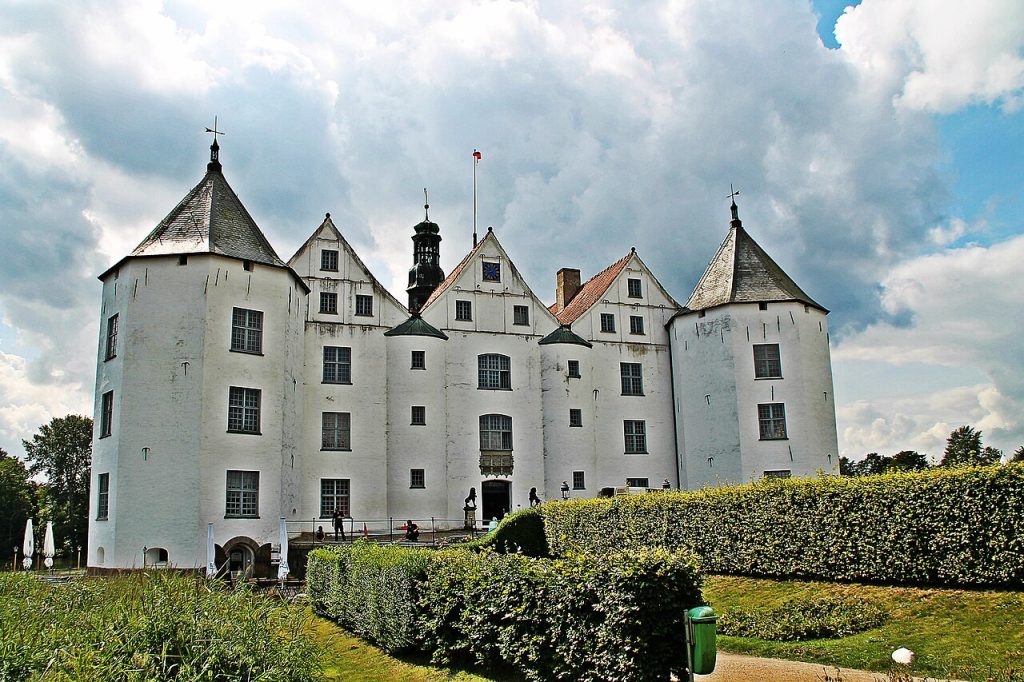
Some castles sit beside water. Glücksburg sits in it. The white cube with its four corner towers rises straight out of a lake near the Flensburg fjord, reflected so perfectly on a still day that photographs look doubled. It was built in the 1580s by a Danish duke on the site of a Cistercian abbey he had torn down, and he gave it a name from his motto, God Give Fortune With Peace, Gott Gebe Glück Mit Frieden. Fortune, at least, arrived. The family that took its name from the castle, the House of Schleswig-Holstein-Sonderburg-Glücksburg, went on to supply kings to Denmark, Norway and Greece and, through Prince Philip, a consort to the British throne.
Glücksburg is the most Danish of the Schleswig-Holstein castles, a reminder that this corner of Germany was ruled from Copenhagen until 1864 and that the border with Denmark is only a few kilometres away. Danish kings summered here, one of them died here, and the royal families of Scandinavia still regard it as a sort of ancestral home. Yet the building itself is pure North German Renaissance, white, square and severe, with interiors that hold some of the finest leather wall hangings in Europe.
Let me take you across the causeway and through the rooms, with the monks, the dukes and the kings in order. The contents are below.
In This Article
- A Castle Standing in a Lake
- The Abbey That Became a Castle
- Duke John the Younger and His Motto
- The White Cube and Its Four Towers
- Three Houses Under One Roof
- The Leather Wall Hangings
- The Chapel and the Vault of the Dukes
- The Danish Kings at Glucksburg
- A King Dies in the Castle: 1863
- Christian IX and the Family That Conquered Europe
- After 1864: Prussians and Princes
- The Twentieth Century and the Foundation
- The Rose Garden and the Lake Walk
- Glucksburg on Video
- Visiting Glucksburg Castle Today
- Palaces Nearby
A Castle Standing in a Lake
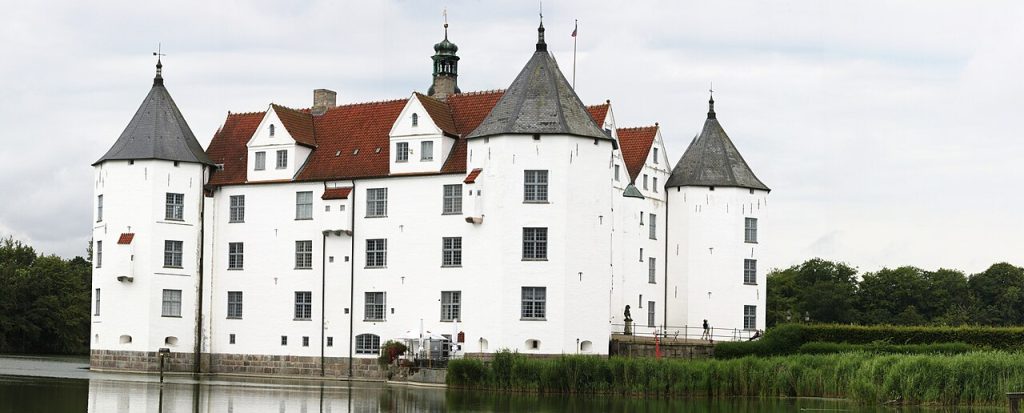
Start at the far end of the lake, where the path from the car park reaches the shore, and look across the water. The castle stands on a square platform of granite blocks in the middle of a lake that is entirely artificial. In the 1580s the builders dammed the little stream that ran through the valley, flooded the meadows and let the water rise around the new walls. The lake was a moat on a grand scale, a fishpond and a mirror, and it remains all three.
Now, stop here and notice how the castle seems to have no ground floor. The water laps directly against the base of the walls, and the only approach is a causeway from the north. On a calm morning the reflection is so exact that the building appears to hang in space, and the photographers who line the shore at dawn are not wasting their time.
The Abbey That Became a Castle
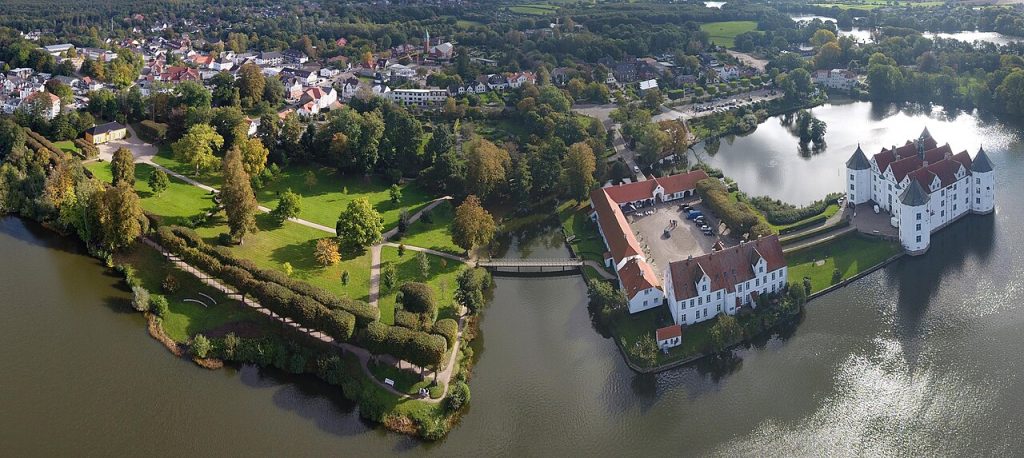
Before the castle there was a monastery. The Cistercian abbey of Rüde was founded here in 1210 in a damp wooded valley that suited the order’s taste for solitude, and for three centuries its monks farmed, prayed and drained the land. The Reformation reached Schleswig in the 1540s, the monastery was dissolved and its buildings passed to the Danish crown. When Duke John the Younger acquired the site in 1582 he had the abbey pulled down and used its stones in the foundations of his new house.
Nothing of the monastery is visible today except in the museum, where fragments of carved stone and floor tiles are shown, and in the ground plan, which archaeologists have traced under the lake. The monks’ graveyard lies somewhere beneath the water. It is a reminder that the serene white castle was built on an act of appropriation, which was entirely normal for the sixteenth century and explains why the duke felt the need to invoke God’s favour in the name.
Duke John the Younger and His Motto
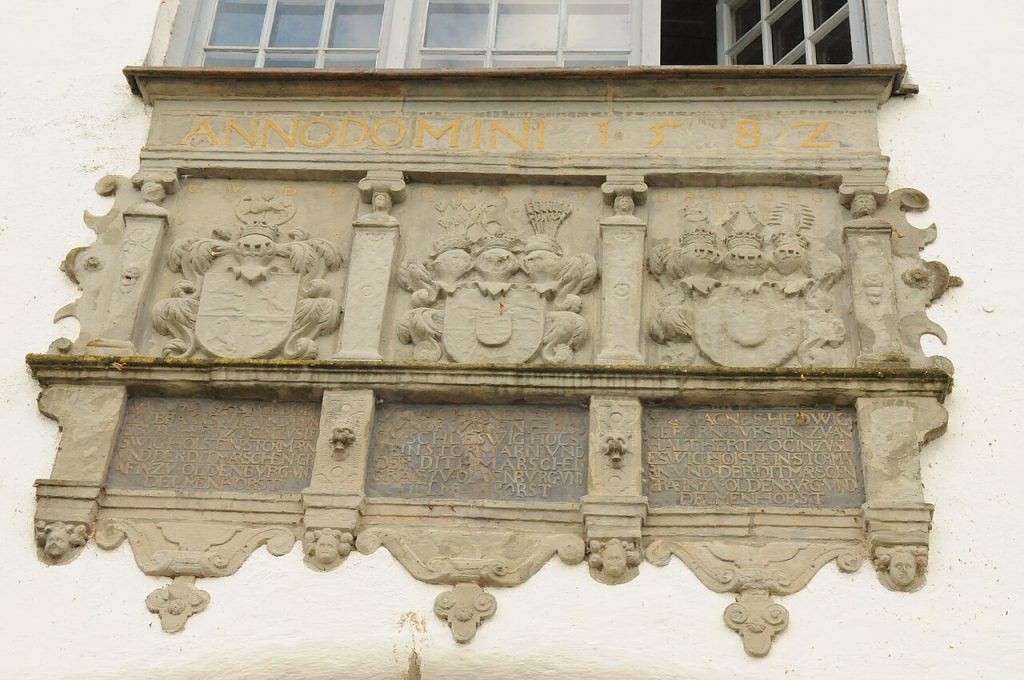
John the Younger was a son of King Christian III of Denmark, born in 1545 and endowed with a scatter of estates in Schleswig and Holstein when his elder brother became king. He was a tireless builder and an even more tireless father: he had twenty-three children, which obliged him to build residences for his many sons and led to the founding of the ducal lines of Sonderburg, Norburg, Plön and Glücksburg. Glücksburg was built between 1582 and 1587 under the master builder Nikolaus Karies, and the duke’s motto, Gott Gebe Glück Mit Frieden, was carved over the entrance and gave the castle its name.
John’s heirs divided his lands into ever smaller portions, and by the eighteenth century the Glücksburg dukes were princes in little more than name. Yet the family’s dynastic position, as legitimate descendants of the Danish royal house, would prove in the nineteenth century to be worth more than any territory.
The White Cube and Its Four Towers
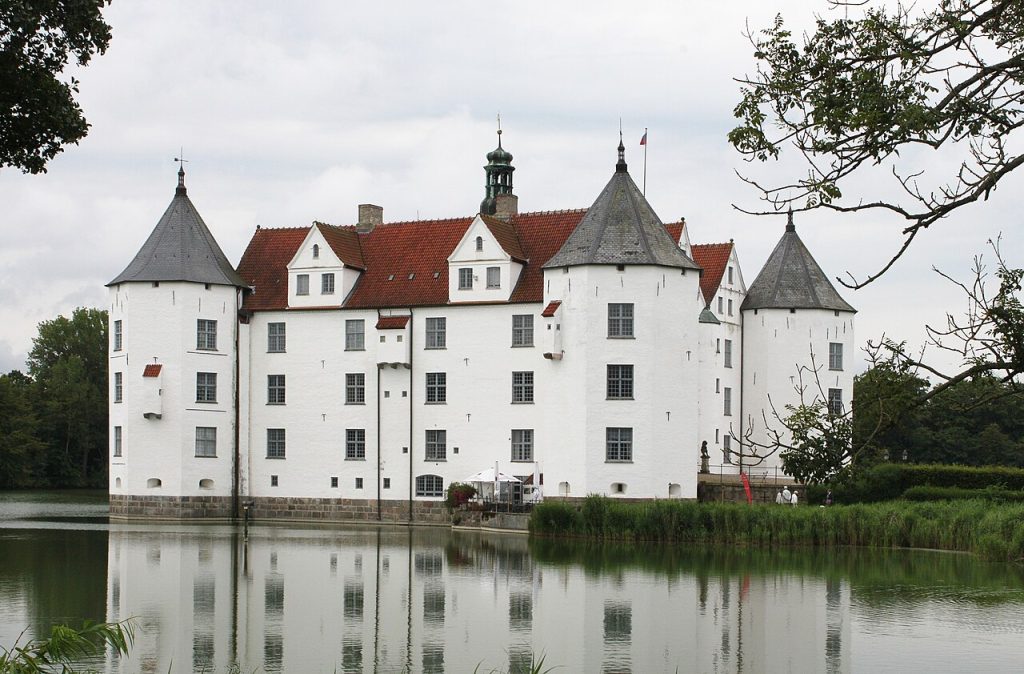
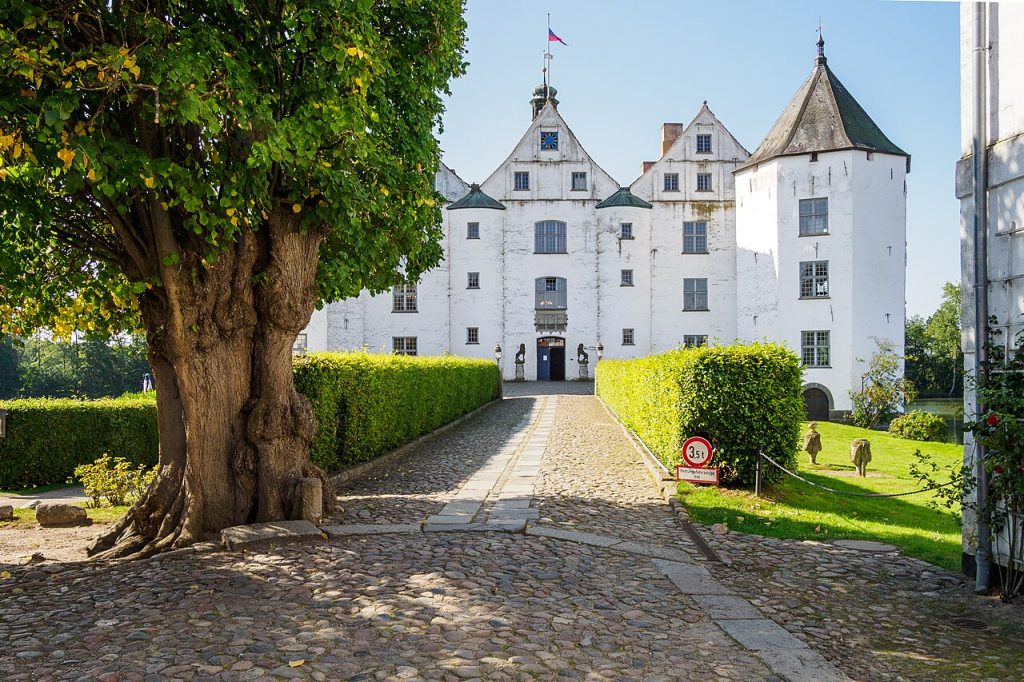
Walk the causeway and look up. Glücksburg is a cube, or very nearly: three tall storeys on a square plan of about thirty metres a side, with an octagonal tower at each corner and a steep roof. The walls are brick under white render, the windows are large and regularly spaced, and the only ornament is the sandstone portal with the motto and the dates. The style is the sober Renaissance of the Danish court, related to Kronborg and Frederiksborg but without their flamboyance.
The towers are the clue to the building’s character. They are not defensive but residential, each containing stairs and small rooms, and they give the block a vertical rhythm that keeps it from looking like a warehouse. The white colour, like Plön’s, was deliberate and has been maintained ever since. On the lake, against dark woods, the effect is of a sugar cube on a mirror.
Three Houses Under One Roof
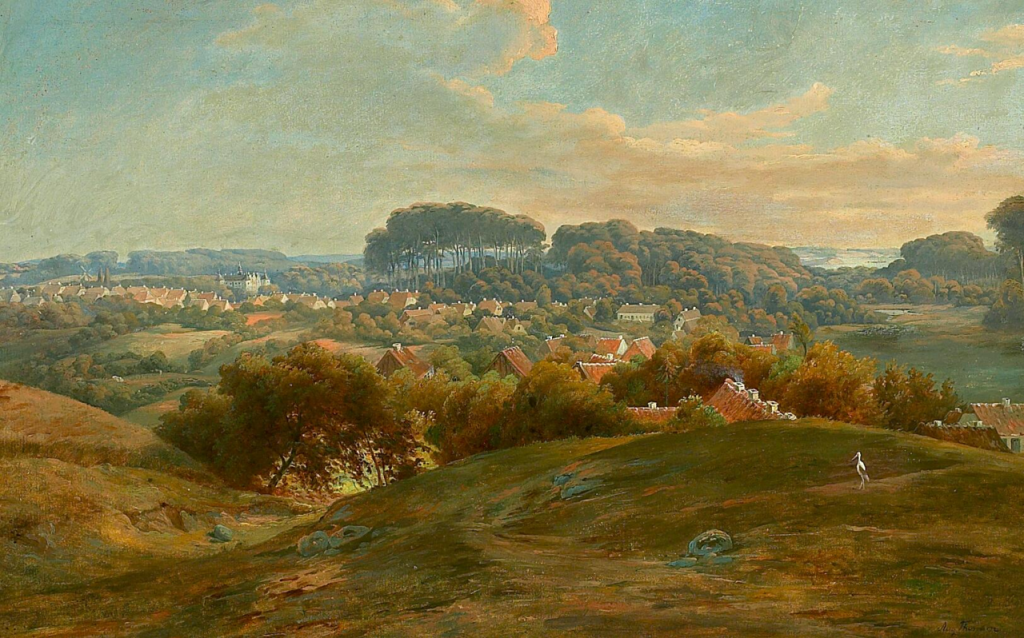
Step inside and the plan reveals itself. The cube is divided lengthwise into three parallel sections, each with its own rooms and stairs, so that the castle is in effect three narrow houses under one roof. This arrangement, found in several Danish castles of the period, let the duke, his duchess and their guests or grown children keep separate households while sharing the chapel and the great hall. It also made the building easy to heat in sections, which anyone who has spent a winter on the Flensburg fjord will appreciate.
The ground floor held the kitchens, the chapel and the servants; the first floor the state rooms and the ducal apartments; the top floor the family and guests. The museum tour follows this logic, and as you climb you move from the public to the private, from the Renaissance hall to the nineteenth-century bedrooms where Danish kings slept.
The Leather Wall Hangings
Here is the treasure most visitors do not expect. Several of the first-floor rooms are hung with gilt leather, Goldleder, wall coverings of embossed and painted calfskin made in the Netherlands in the seventeenth century. Leather hangings were the luxury wallpaper of the Baroque age, warmer than tapestry, more durable than silk, and almost all of them have perished through damp, fire and changing fashion. Glücksburg keeps a remarkable set, with patterns of flowers, birds and fruit in gold, red and green that glow in the light from the lake.
Look closely at the panels and you can see the seams where individual skins were joined, and the places where later restorers patched losses. Now, stop here and run your eye along the wall as the sun moves: the embossed gold catches the light differently from every angle, which is exactly the effect the makers intended for rooms lit by candles.
The Chapel and the Vault of the Dukes
The chapel occupies part of the ground floor, a plain Lutheran room with a carved Renaissance altar and pulpit, galleries and the ducal box. It is still used for services and for the christenings and weddings of the family, which is why Scandinavian royalty appears in the visitor book. Beneath the chapel lies the burial vault of the Glücksburg dukes, with rows of coffins from the seventeenth to the twentieth century, some of them richly ornamented, which can be seen on guided tours.
The vault is the dynastic memory of the house. Here lie the dukes who ruled a few parishes, and here too, in the modern coffins, members of the family who were cousins of kings. It is a sobering room after the gilt leather upstairs, and a good place to think about how little territory the family actually held and how much it eventually inherited.
The Danish Kings at Glucksburg
When the Glücksburg ducal line of the first creation died out in 1779, the castle reverted to the Danish crown, and for the next eighty-five years it was a royal summer residence. The kings of Denmark came to Glücksburg to hunt, to sail on the fjord and to show the flag in their German duchies, where loyalty to Copenhagen was increasingly uncertain. The rooms on the upper floors were refurnished in the light Danish Empire and Biedermeier styles, and much of that furniture is still here.
In 1825 King Frederick VI gave the title Duke of Glücksburg to a cousin, Wilhelm of Schleswig-Holstein-Sonderburg-Beck, creating the second Glücksburg line, the one that would conquer Europe’s thrones. Wilhelm did not live in the castle, which remained royal property, but his children grew up with it as the family’s symbolic home.
A King Dies in the Castle: 1863
On 15 November 1863 King Frederick VII of Denmark died at Glücksburg, in a bedroom on the upper floor that is shown on the tour. He was the last king of the old Oldenburg line, childless, and his death set off the Schleswig-Holstein crisis that had been brewing for decades. The succession in Denmark passed to Christian of Glücksburg, but the German population of the duchies disputed the new king’s right to Schleswig and Holstein, Prussia and Austria intervened, and within months Danish rule south of the Kongeå was over.
Now, stop here in the king’s bedroom and consider that a death in this quiet white castle redrew the map of northern Europe. The war of 1864 made Schleswig-Holstein Prussian, led directly to the Austro-Prussian War of 1866 and so to the German Empire. Glücksburg, the summer house of Danish kings, found itself in Germany.
Christian IX and the Family That Conquered Europe
Christian IX, who became king of Denmark in 1863, was the first monarch of the House of Glücksburg, and his children made the family’s fortune. His son Frederick succeeded him in Denmark; another son was elected King George I of Greece; his daughter Alexandra married the future Edward VII of Britain; his daughter Dagmar became Empress Maria Feodorovna of Russia, mother of Nicholas II; and his grandson Carl was chosen as King Haakon VII of Norway in 1905. Contemporaries called Christian the father-in-law of Europe, and the title was earned.
The reach of the house did not stop there. Prince Philip, Duke of Edinburgh, husband of Queen Elizabeth II, was a Glücksburg through his father, Prince Andrew of Greece, which means that King Charles III and his heirs belong by male descent to the family whose name is carved over the door of this castle. The museum’s portrait rooms trace the connections, and a family tree on the wall helps with the arithmetic.
After 1864: Prussians and Princes
After the war of 1864 the castle ceased to be Danish royal property and passed to the ducal family of Glücksburg, who were now subjects of Prussia though cousins of the kings of Denmark. The dukes used it as a residence, restored it in the historicist taste of the late nineteenth century and filled it with family portraits and furniture from their Danish connections. The castle thus remained in one family while the land around it changed hands, which is why its collections are so coherent.
The family’s position was delicate. They were German princes with a Danish surname and relatives on half the thrones of Europe, including the enemy thrones of 1914. The castle sat out the First World War quietly, and the border settlement of 1920, which returned northern Schleswig to Denmark after a plebiscite, left Glücksburg on the German side by a margin of a few kilometres.
The Twentieth Century and the Foundation
In 1922 the ducal family placed the castle, its contents and the park in a foundation to secure them against the uncertainties of the age, and the foundation still owns and runs it, with the current duke as its head. The castle survived the Second World War intact and briefly housed refugees in 1945. Since then it has been a museum, with the family retaining rooms for occasional use and the chapel for family occasions.
Restoration has been continuous rather than dramatic: the roof, the render, the leather hangings and the lake dam have all been renewed in turn. The foundation’s quiet stewardship means that Glücksburg has none of the scars of barracks or boarding school that mark Plön and Gottorf; it is a castle that has simply been lived in, carefully, for four hundred years.
The Rose Garden and the Lake Walk
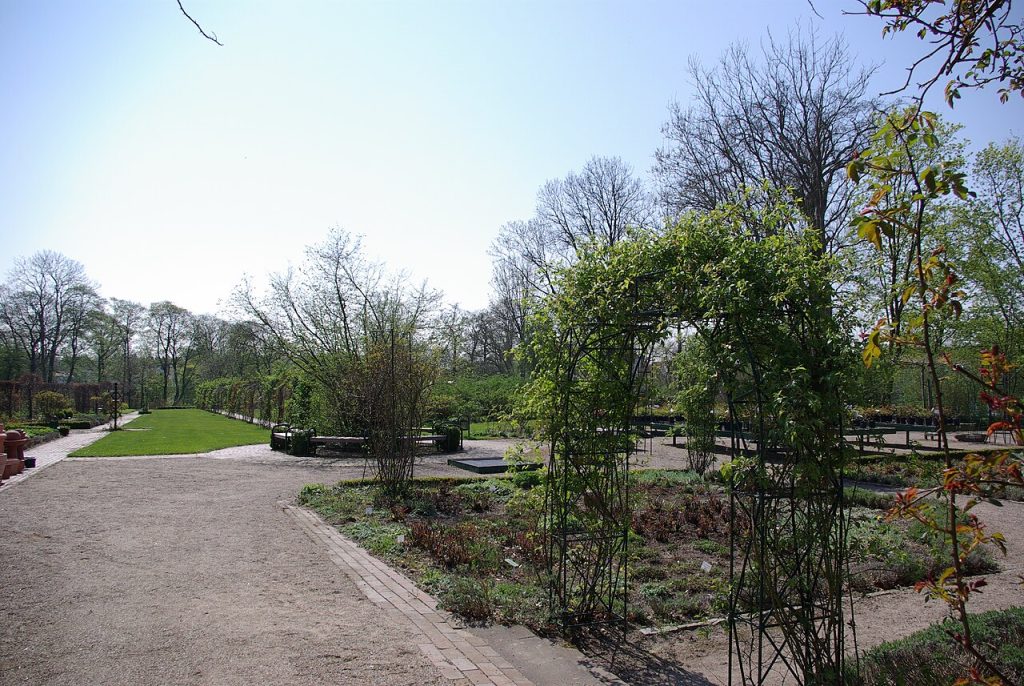
Leave the causeway and walk around the lake. A path circles the water in about half an hour, with the castle changing shape at every turn, and on the eastern shore lies the rose garden, a formal garden with hundreds of varieties that blooms from June to September and frames the castle in flowers for photographers. The old orangery and the estate buildings stand nearby, and the park beyond runs down toward the Flensburg fjord, where the ducal family kept its boats.
Now, stop here at the far end of the lake in the late afternoon, when the sun is behind you and the white walls turn gold in the water. This is the picture on every postcard of Schleswig-Holstein, and it is one of the few that is better in reality.
Glucksburg on Video
Before you plan your trip, take a few minutes to see Glucksburg Castle in motion. The video below gives a good sense of the setting, the scale of the buildings and the atmosphere of the grounds.
Visiting Glucksburg Castle Today
Glücksburg Castle is open daily from spring to autumn and on weekends in winter, with self-guided visits to the state rooms, the leather-hung chambers, the chapel and the royal apartments, and guided tours of the vault at set times. Allow ninety minutes inside and another hour for the lake walk and rose garden, which are free. The castle hosts concerts and a Christmas market and is a popular wedding venue, so check for closures on event days.
Glücksburg lies ten kilometres east of Flensburg on the south shore of the fjord; buses run from Flensburg station, and the drive from Hamburg takes about two hours. Gottorf Castle at Schleswig is forty minutes to the south, and Denmark is a short drive to the north. Here is the exact spot: Glucksburg Castle on Google Maps.
Palaces Nearby
If you have enjoyed this palace, the region holds more remarkable residences. Here are two more well worth adding to your journey:
You May Like


One thought on “Glucksburg Castle and the Cradle of the Royal Houses of Europe”