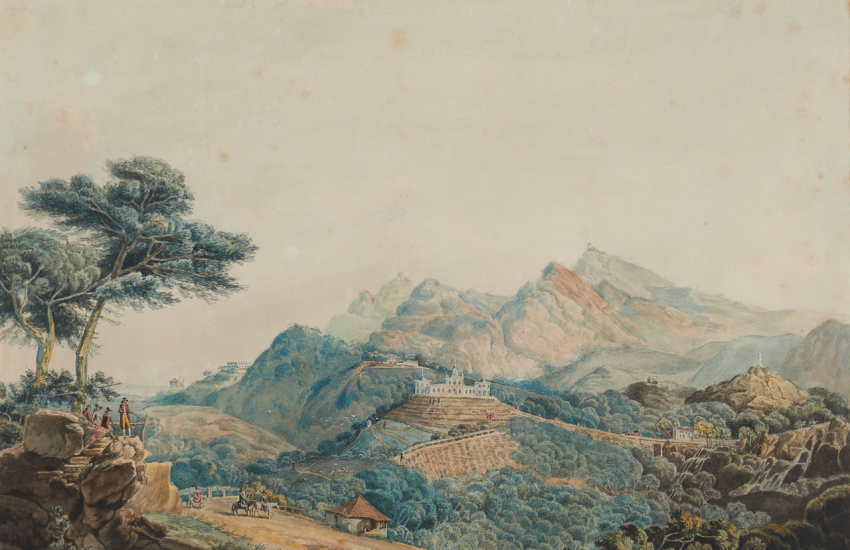
Eleven kilometres above Segovia, where the pine forests of the Sierra de Guadarrama climb toward the peak of Peñalara, a palace of pink stone, marble and glass stands at twelve hundred metres among gardens whose fountains throw mountain water forty metres into the air. It is the Royal Palace of La Granja de San Ildefonso, built from 1721 by Philip V, the first Bourbon king of Spain and grandson of Louis XIV, on the site of a farm, a granja, that had belonged to the monks of Segovia; homesick for the France of his childhood, the king made himself a Versailles in the sierra, with parterres, cascades and twenty-six monumental fountains that still run on nothing but gravity and snowmelt, and then found he could not bear to leave it even after abdicating his throne to live here.
La Granja is the most French place in Spain and the most Spanish of the French gardens. Its palace, remodelled by Juvarra and Sacchetti, holds Philip’s collections of tapestries and the tomb he shares with his formidable queen Elisabeth Farnese; its gardens, by the French master René Carlier and his successors, are the best preserved of their age anywhere, because the dynasty that built them never had the money to modernise them; and its royal glass factory, founded to glaze and mirror the palace, became one of the great manufactories of Europe and still blows glass today. After the granite severity of El Escorial, an hour away over the mountains, La Granja is the other face of Spanish kingship, and the second stop of this Iberian chapter.
Walk with me up the avenue from the village, through the state rooms and the tapestry galleries, out onto the parterre and down the cascade to the baths of Diana, with a homesick king, an Italian queen and a mountain of water in order. The contents are below.
In This Article
- A Farm in the Pine Woods
- Philip V, the Homesick Grandson of Louis XIV
- Elisabeth Farnese, the Queen Who Ruled
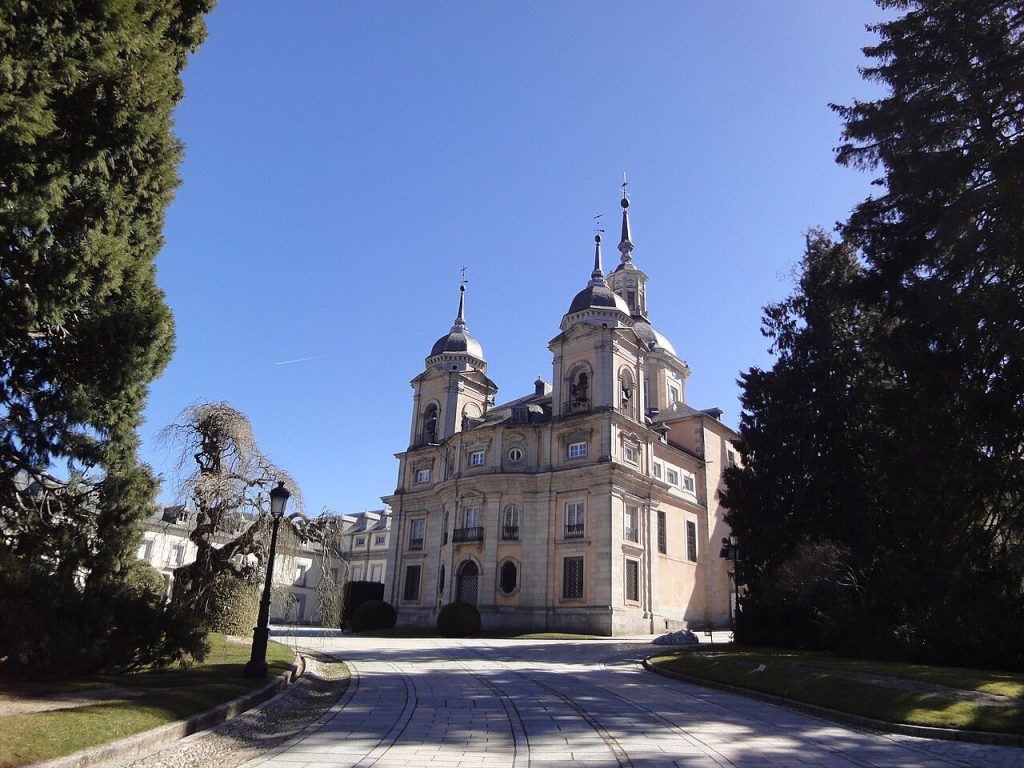
- The Palace of Juvarra and Sacchetti
- 1724: The King Who Abdicated and Came Back
- The State Rooms and the Tapestries
- The Collegiate Church and the Royal Tomb
- Carlier’s Gardens on a Mountainside
- The Twenty-Six Fountains
- El Mar, the Lake That Powers Everything
- The Royal Glass Factory
- Treaties, Summers and the Later Kings
- La Granja Today
- La Granja on Video
- Visiting La Granja Today
- Palaces Nearby
A Farm in the Pine Woods
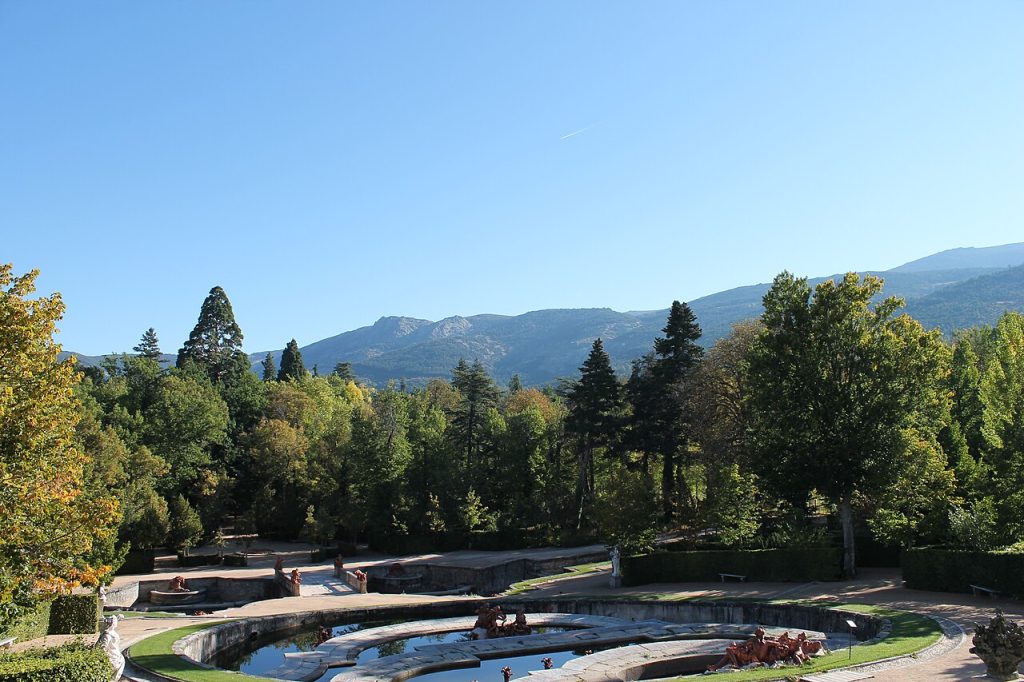
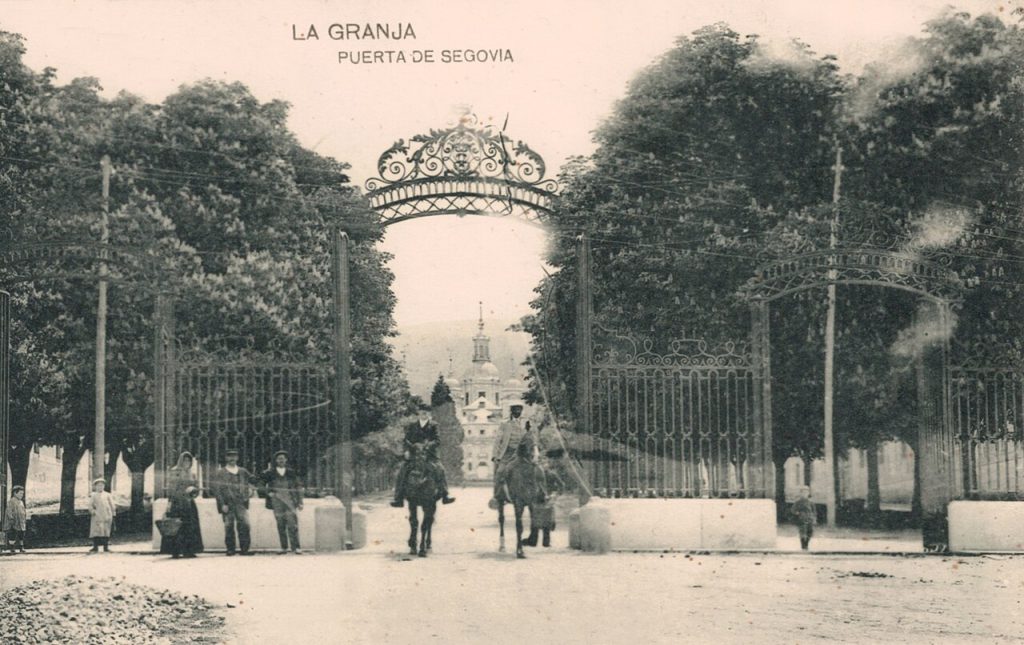
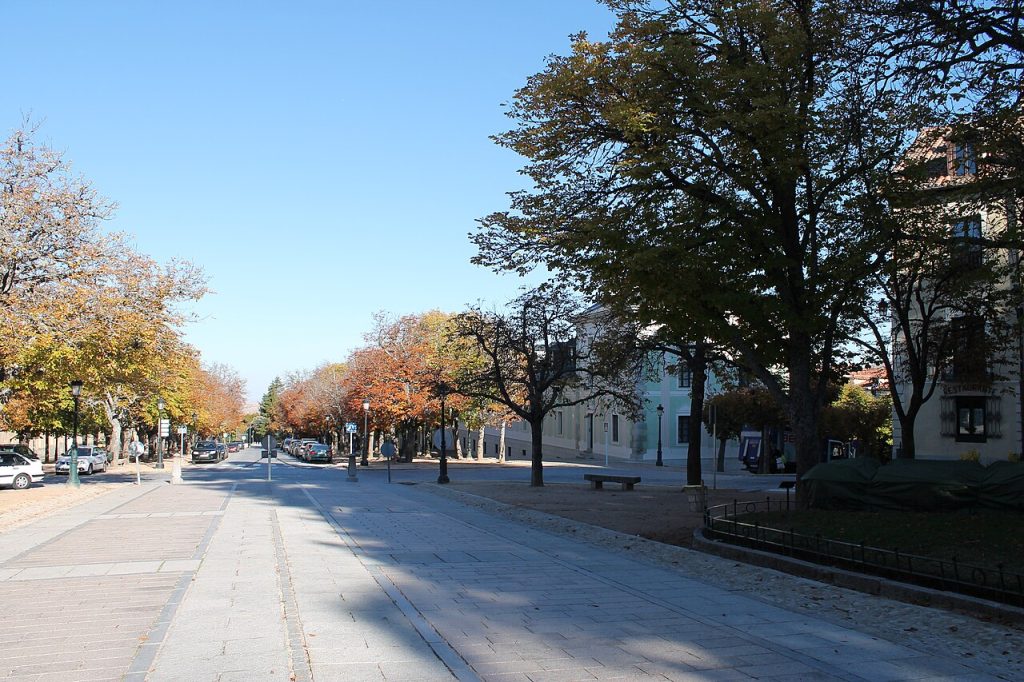
The site was a grange of the Hieronymite monks of El Parral in Segovia, with a small shrine of Saint Ildefonsus built by Henry IV of Castile beside a hunting lodge, in cool green country of pines, oaks and trout streams that the kings of Castile had hunted since the Middle Ages. Philip V came here hunting in 1717, fell for the place, bought the farm from the monks in 1720 and began building the next year; the village of San Ildefonso grew with the palace and keeps, around its royal core, the air of an eighteenth-century court town, with the houses of ministers and courtiers, the barracks of the guards and the long wall of the gardens running into the woods.
Now, stop here on the Plaza de los Dolores before the palace gates and breathe: at twelve hundred metres the air is mountain air, ten degrees cooler than Madrid in August, and that difference is half the reason everything around you exists.
Philip V, the Homesick Grandson of Louis XIV
Philip, Duke of Anjou, was born at Versailles in 1683, the second grandson of Louis XIV, and became king of Spain in 1700 when the last Spanish Habsburg, the tragic Charles II, died childless and left the empire to him; it took the thirteen-year War of the Spanish Succession to keep him on the throne, at the price of Gibraltar, Flanders and Italy. Philip remained French all his life, speaking Spanish reluctantly, and suffered from a crushing melancholia, in which he would not dress, rise or cut his hair for weeks; he was pious, dependent on his wives and tormented by scruples about the legitimacy of his crown, and La Granja was built as his refuge, the place where the gardens, the fountains and the cool woods recalled the Versailles and Marly of his childhood.
His reign of forty-six years, the longest in Spanish history, centralised the state on the French model and founded academies, factories and fleets; the king who could barely govern himself rebuilt the government of Spain.
Elisabeth Farnese, the Queen Who Ruled
Philip’s second wife, married in 1714, was Elisabeth Farnese of Parma, a sharp, strong-willed Italian princess who within days of arriving expelled the king’s favourite adviser and took control of her melancholy husband and, through him, of Spain; for thirty years Spanish foreign policy was bent to winning Italian thrones for her sons, and it worked, Charles getting Naples, and later Spain itself, and Philip getting Parma. At La Granja she was the real builder, directing the architects, importing Italian painters and marbles, buying for the palace the collection of classical sculpture that Queen Christina of Sweden had assembled in Rome, and filling the galleries with the Farnese taste of her childhood.
Widowed in 1746, she lived at La Granja in grand retirement until her own death in 1766; the palace is as much her monument as his, and the pair lie together in its church.
The Palace of Juvarra and Sacchetti
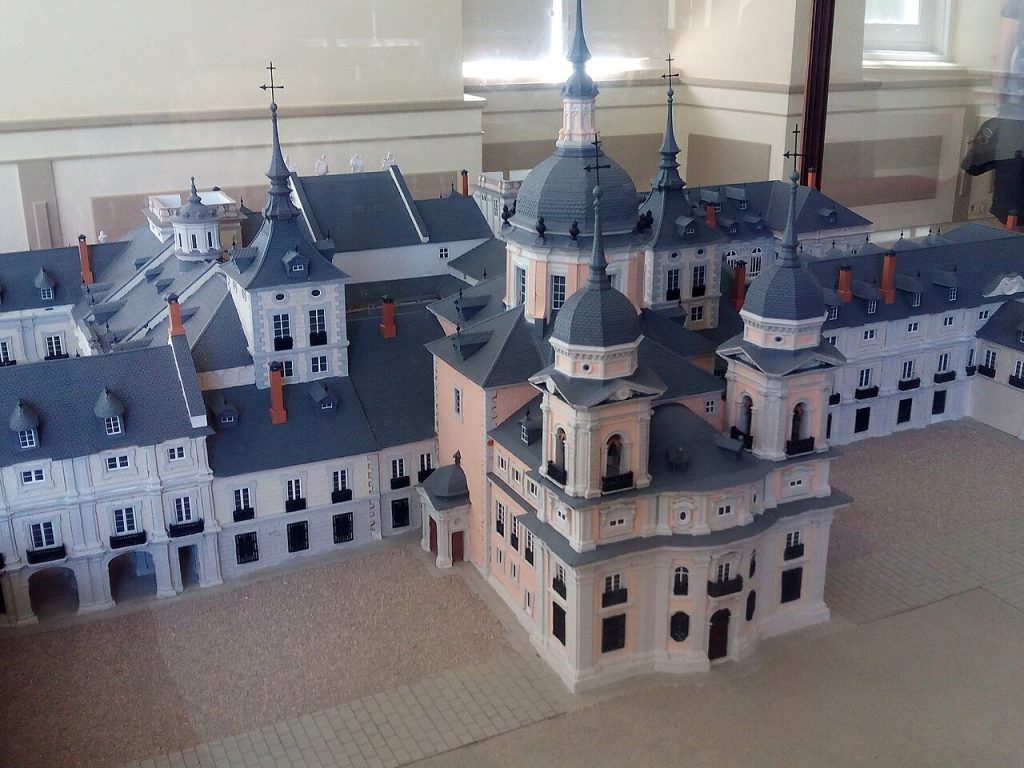
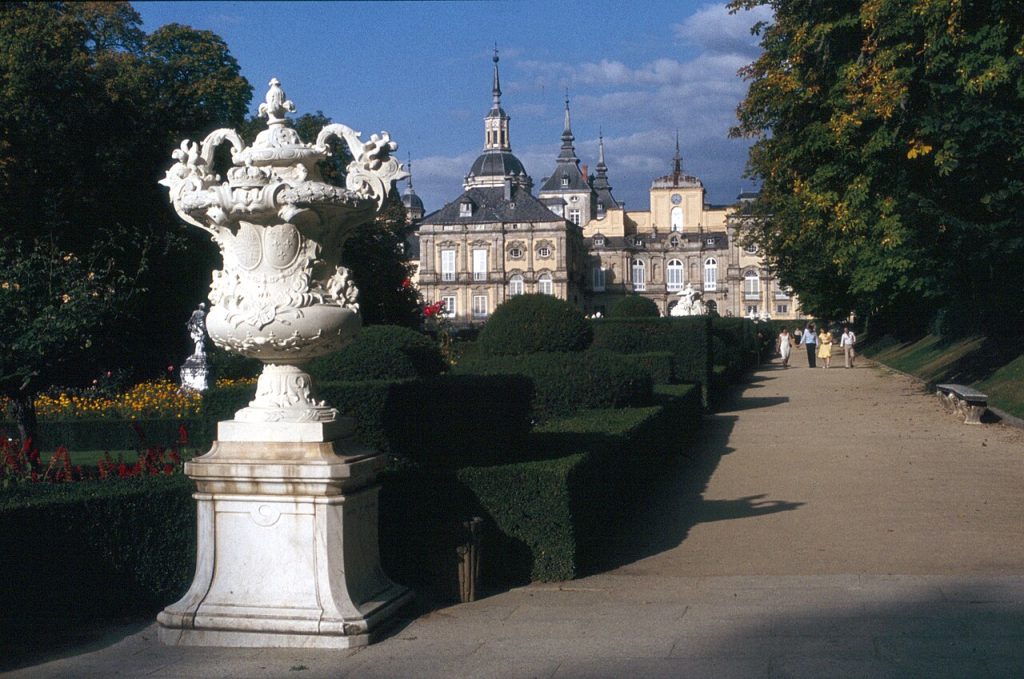
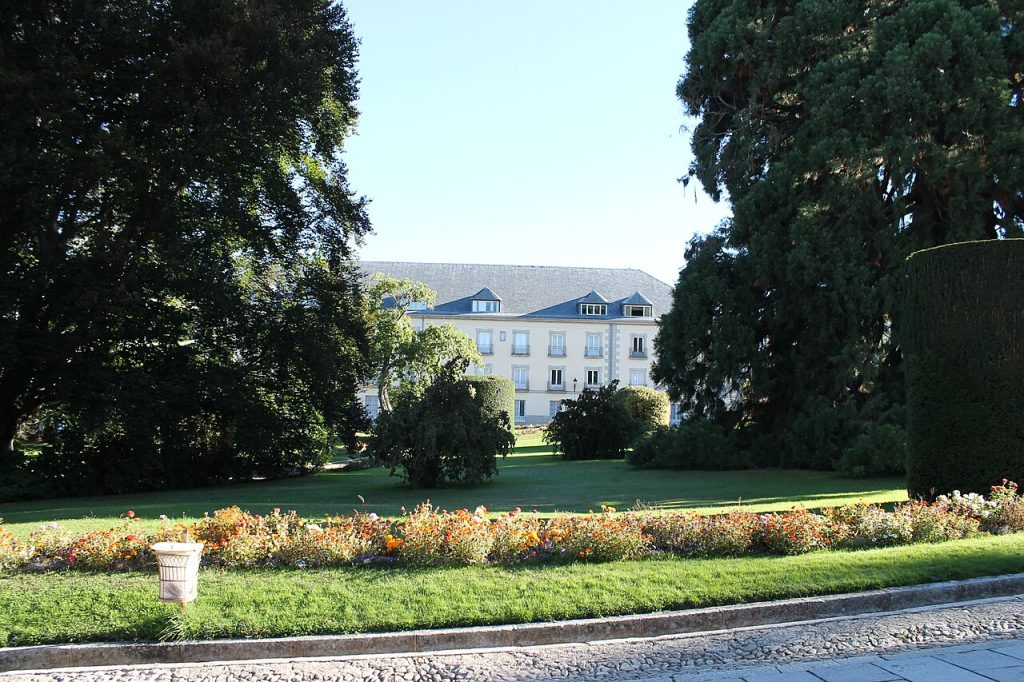
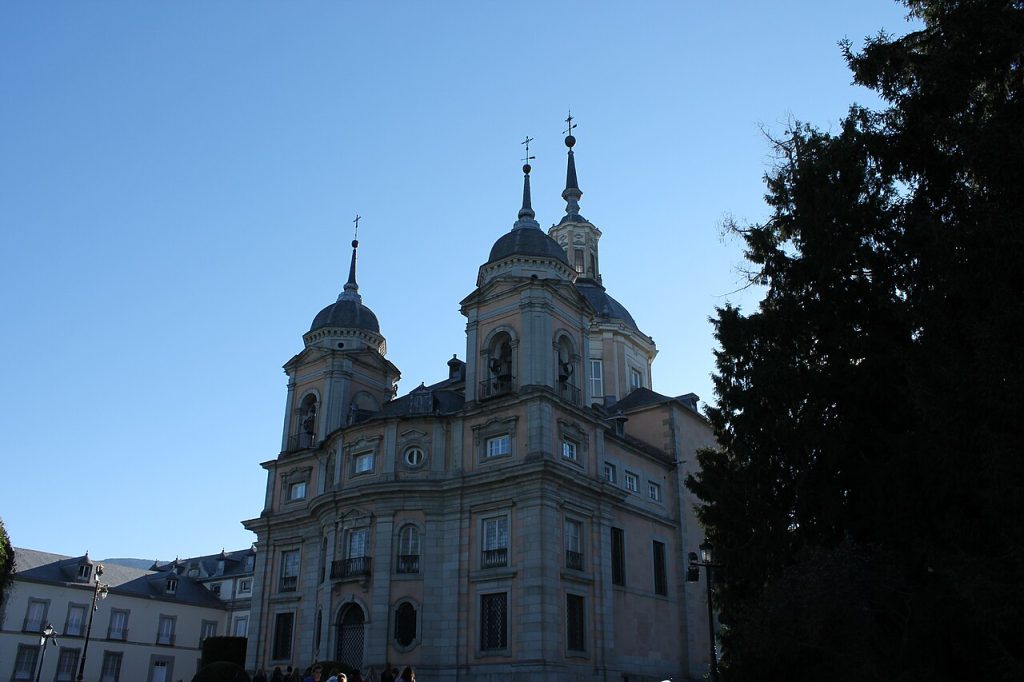
The first palace, by Teodoro Ardemans, was a Castilian alcázar with four towers wrapped around the old shrine, finished in 1723; the queen found it provincial, and through the 1730s it was wrapped in turn in Italian dress, with courtyards and wings by Procaccini and Subisati and, finally, the great garden facade of 1736 designed by Filippo Juvarra, the architect of Turin, and executed after his death by his pupil Giovanni Battista Sacchetti, a front of pink Sepúlveda stone and white Carrara marble with a colonnaded centre under sculpture and urns, facing the parterre and the mountain. The same pair would go on to build the enormous Royal Palace in Madrid after the old alcázar burned in 1734.
Now, stop here on the parterre and look at the facade with the peak of Peñalara behind it: Versailles faces a flat horizon, but La Granja’s garden front looks straight up at a two-thousand-metre mountain, and the surprise of that backdrop never wears off.
1724: The King Who Abdicated and Came Back
In January 1724 Philip stunned Europe by abdicating the Spanish throne to his seventeen-year-old son Luis and retiring with Elisabeth to the just-finished La Granja, intending to live as a private gentleman preparing his soul, and perhaps, the ambassadors whispered, keeping himself free for the French throne should his sickly cousin Louis XV die. The experiment lasted seven months: Luis I caught smallpox and died in August 1724, and Philip, tormented but persuaded by his confessor and his queen, resumed the crown he had sworn to God to renounce, reigning another twenty-two years with his melancholy deepening into nights when he believed himself a frog or dead. La Granja remained his true home, the court moving here every summer.
The abdication made the palace briefly the capital of a private kingdom of gardens; the fountains were being built through those very months, and the king watched the pipes being laid as his son reigned in Madrid.
The State Rooms and the Tapestries
The interior of the palace burned badly in 1918 and was restored over decades, so the visit mixes original rooms, marble halls with ceiling paintings by Panini’s and Giaquinto’s circles, the king’s japanned and mirrored cabinets, lamps and chandeliers of La Granja crystal, with museum galleries: above all the Museo de Tapices, one of the finest tapestry collections in the world, hanging the Honours series woven in Brussels for Charles V, Goya cartoons’ weavings and sixteenth-century Flemish masterpieces that the Spanish crown amassed when it owned Flanders. The sculpture galleries show Elisabeth’s purchase of Christina of Sweden’s antiques, and the private rooms keep portraits of the melancholy king and his managing queen.
Look for the Honours tapestries: woven in gold and silk for the emperor’s coronation, they are the grandest textiles ever made, and this quiet mountain palace is where they live.
The Collegiate Church and the Royal Tomb
At the centre of the palace, on the site of the old shrine of Saint Ildefonsus, the Royal Collegiate Church rises through the building with its dome and lantern, decorated in marble, jasper and bronze, with ceiling paintings by Bayeu; and in a chapel beside the high altar stands the tomb of Philip V and Elisabeth Farnese, a Baroque monument of marbles with their portrait medallions upheld by mourning figures. Philip refused burial in the Escorial pantheon of the Habsburgs he had supplanted, choosing to lie forever in the palace he loved, and his queen joined him; they are the only king and queen of Bourbon Spain who rest outside El Escorial, and the choice says everything about what La Granja meant.
Now, stop here before the tomb: the grandson of the Sun King, born at Versailles, lies on a Spanish mountain in a church attached to his own drawing rooms, as close to his gardens in death as he kept them in life.
Carlier’s Gardens on a Mountainside
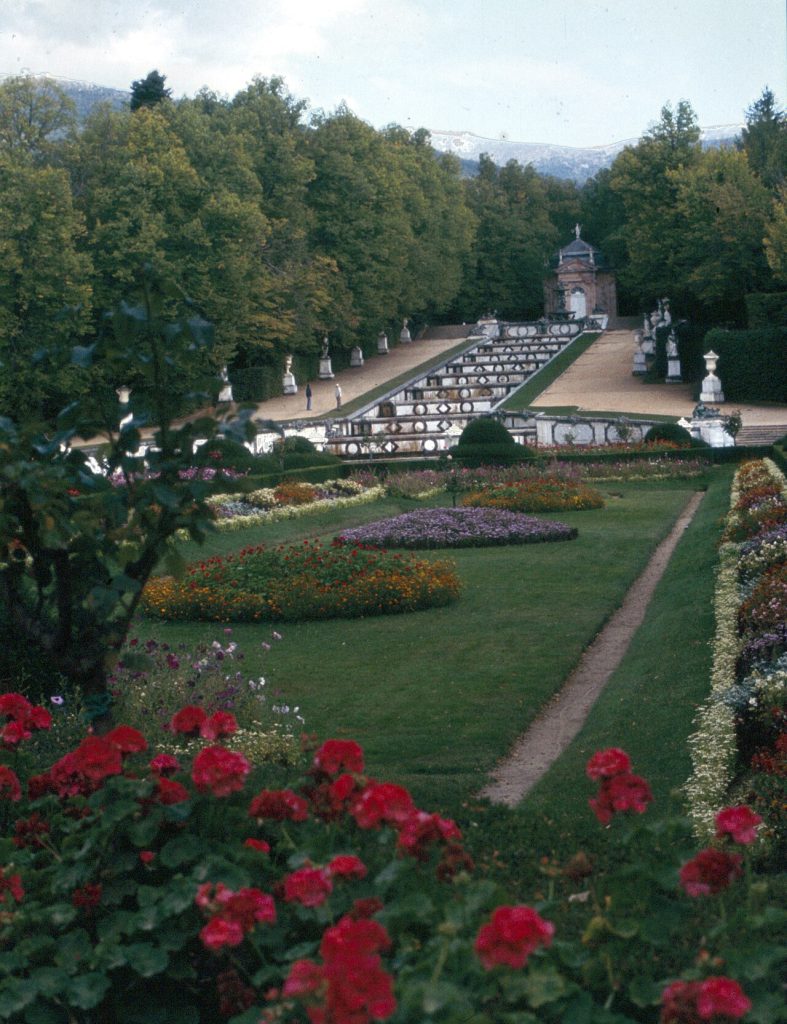
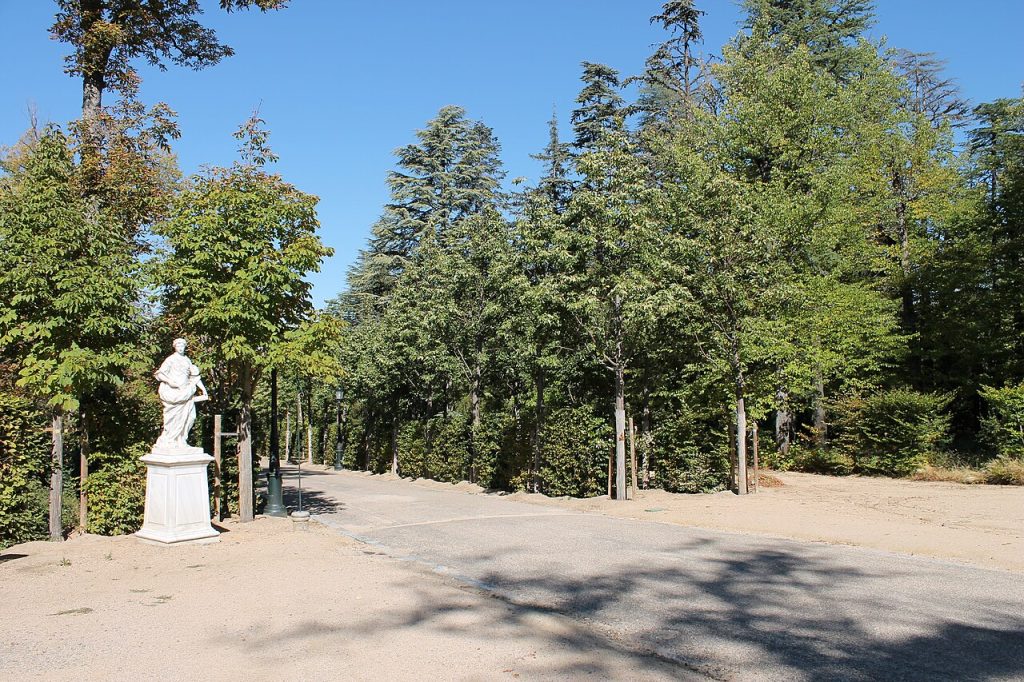
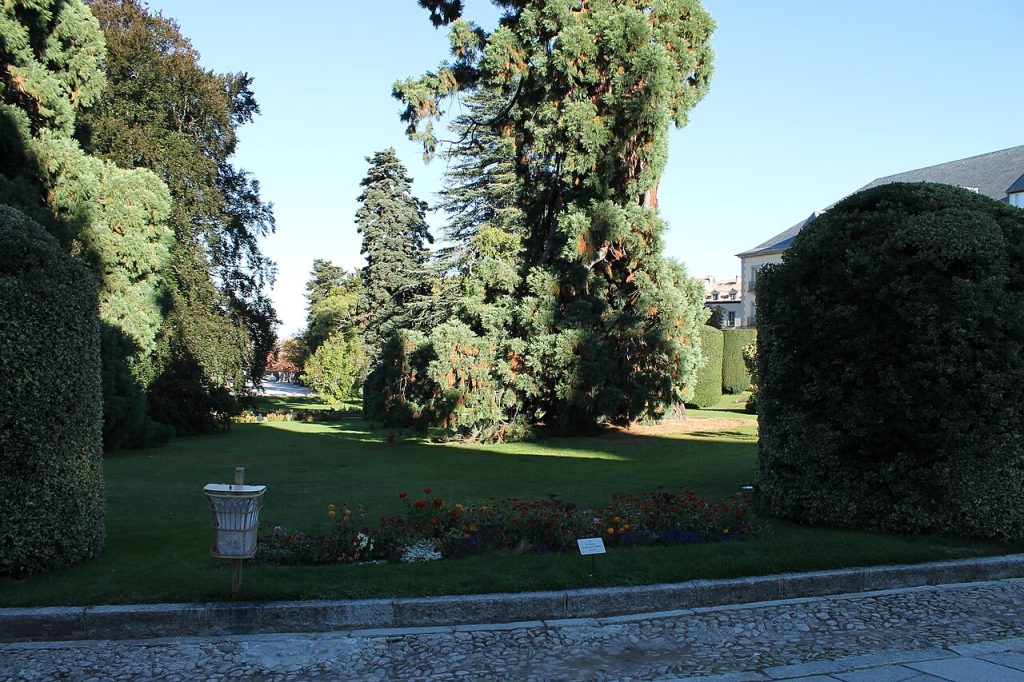
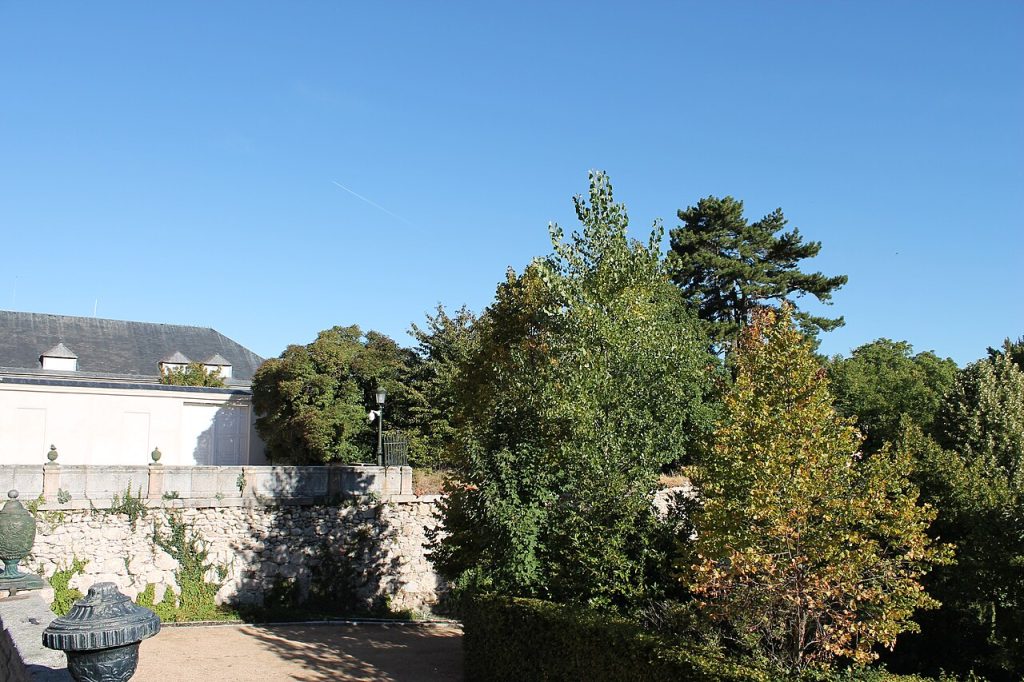
The gardens cover a hundred and forty-six hectares of mountainside, designed from 1721 by René Carlier, a pupil of the circle of Le Nôtre sent from France, and carried on after his early death by Esteban Boutelou and the sculptors René Frémin and Jean Thierry; where Versailles had to pump its water at ruinous cost, Carlier saw that the slope of the sierra could feed fountains by gravity alone, and he laid the parterres, avenues and bosquets up and down the hillside so that every axis ends in water, sculpture or the mountain itself. The woods beyond the formal gardens run into the royal pine forest, and the whole is enclosed by a wall ten kilometres around.
The gardens survive almost exactly as planted, because after 1746 no king had the money or the wish to change them; garden historians call them the best preserved ensemble of their generation in Europe, better preserved than Versailles itself.
The Twenty-Six Fountains
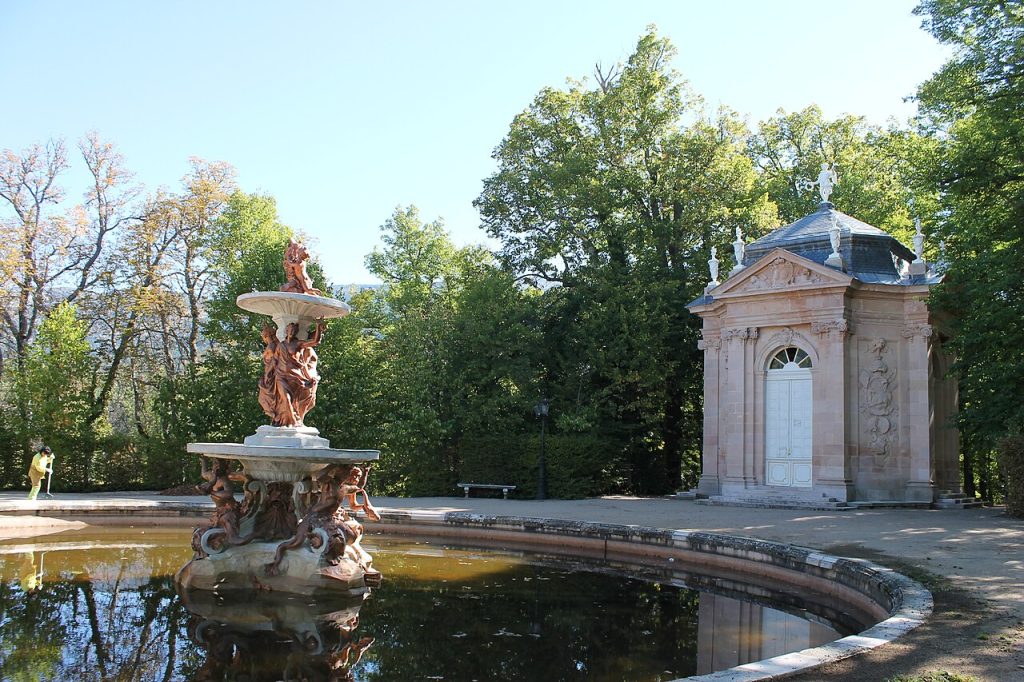
The twenty-six monumental fountains are the glory of La Granja: mythological groups cast in lead and painted to imitate bronze and gilt, by Frémin, Thierry and Bousseau, set in marble basins along the axes, the Cascade of white and rose marble falling from the palace parterre, the Fountain of the Frogs, the Baths of Diana, built last and grandest, before which Philip is said to have sighed that it had cost him three millions and amused him three minutes, the Race of Horses, the Basket, Neptune, Apollo and, highest of all, La Fama, whose single jet climbs more than forty metres, visible from Segovia. They run, as they always have, on gravity and snowmelt alone, with the original eighteenth-century lead pipes still doing the work.
The fountains play only on set days, a few at a time at 5.30 in the afternoon, and all together on the great days of 30 May, 25 July and 25 August, when half of Segovia comes up the hill; plan around those dates if you possibly can, because La Granja with the water flying is one of the sights of Europe.
El Mar, the Lake That Powers Everything
At the top of the gardens, against the pine woods at the foot of Peñalara, lies El Mar, the Sea, a reservoir dug in 1725 that gathers the streams of the sierra behind a stone dam; from it the water falls through the buried mains to the fountains below, each jet’s height fixed by nothing but the difference in level, a hydraulic system of the 1720s that has never been replaced and never needed to be. The walk up to El Mar, past the Baths of Diana and through the bosquets, takes half an hour and ends at a still sheet of water reflecting the mountain, with the palace roofs far below.
Now, stop here on the dam and consider the engineering: no pumps, no machines, just a lake, a slope and three centuries of lead pipe, still outperforming every modern fountain you have seen.
The Royal Glass Factory
In 1727 a Catalan glassmaker set up a furnace in the village to supply the palace’s windows, and under royal protection it grew into the Real Fábrica de Cristales, the Royal Glass Factory, whose enormous brick halls of 1770, among the finest industrial buildings of the century, produced the mirrors, chandeliers, and engraved tableware of the Spanish court, including mirrors larger than any France could blow, made by a secret casting process; the factory’s crystal lit and glazed every royal palace in Spain. It declined in the nineteenth century, revived in the twentieth, and now houses the National Glass Centre, a working museum where the furnaces still glow and glassblowers demonstrate the old techniques beside collections of three centuries of La Granja glass.
The factory is a ten-minute walk from the palace and worth an hour; watching a chandelier arm pulled from the furnace completes the story of the palace’s sparkle.
Treaties, Summers and the Later Kings
For two centuries after Philip the court moved to La Granja every July and August, and the palace gave its name to history: Charles III signed family compacts here, Charles IV the treaty of 1796 that bound Spain to revolutionary France, and in August 1836, in the event Spaniards still call the Sargentada de La Granja, mutinous sergeants of the garrison burst in on the regent María Cristina at night and forced her to restore the liberal constitution of 1812, a palace coup in a garden. Alfonso XIII summered here into the 1920s, adding tennis courts to the gardens of the fountains; after the fire of 1918 gutted the private apartments, restoration continued through the Republic and after.
The village kept its court trades, its glass and its cool-air summer visitors, and remains one of the pleasantest small towns in Castile, with suckling pig and judiones, the giant local beans, as its table’s pride.
La Granja Today
La Granja is run by Patrimonio Nacional with the other royal sites, and lives by its seasons: the fountain days of late spring and summer, the crowds of the three great jornadas, the mushroom and autumn-colour weeks of October when the gardens turn gold against the pines, and the silent snowy winters when the statues are boxed against frost and the village has the palace to itself. The palace hosts the tapestry museum and summer concerts, the gardens are free to enter most of the year, and the sierra above is now a national park, with Peñalara’s lakes a day’s walk from the palace gate.
Now, stop here a last time on the parterre at evening, when the day visitors have gone down to Segovia and the mountain shadow comes over the roofs. A sad French king built a garden to remember his childhood, and the garden outlived the sadness, the dynasty’s quarrels and the empire itself; the water still comes down from El Mar, and it still amuses for much longer than three minutes.
La Granja on Video
Visiting La Granja Today
The Royal Palace of La Granja de San Ildefonso is open Tuesday to Sunday, with a ticket covering the state rooms, the tapestry museum and the collegiate church, and a separate garden ticket on fountain days; the fountains run a few at a time on Wednesdays, Saturdays and Sundays at 5.30 pm from spring to midsummer, and all together on 30 May, 25 July and 25 August, so check the Patrimonio Nacional calendar before choosing your day. Allow two hours for the palace, two for the gardens and the walk to El Mar, and an hour for the Royal Glass Factory; the village restaurants serve Segovian roast and the great white judión beans of La Granja.
La Granja is eleven kilometres from Segovia by bus or taxi, and Segovia half an hour from Madrid by high-speed train from Chamartín; by car from Madrid take the A-6 and the Navacerrada pass, an hour and a quarter, and El Escorial lies an hour away on the far side of the sierra. Here is the exact spot: La Granja de San Ildefonso on Google Maps.
Palaces Nearby
You May Like
Bussaco Palace and the Hunting Lodge That Became a Hotel