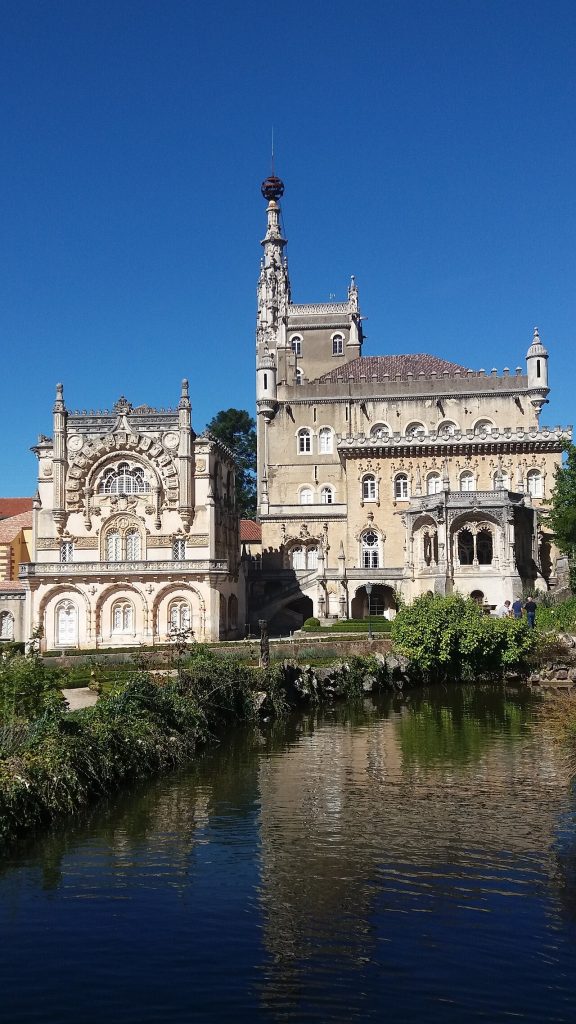
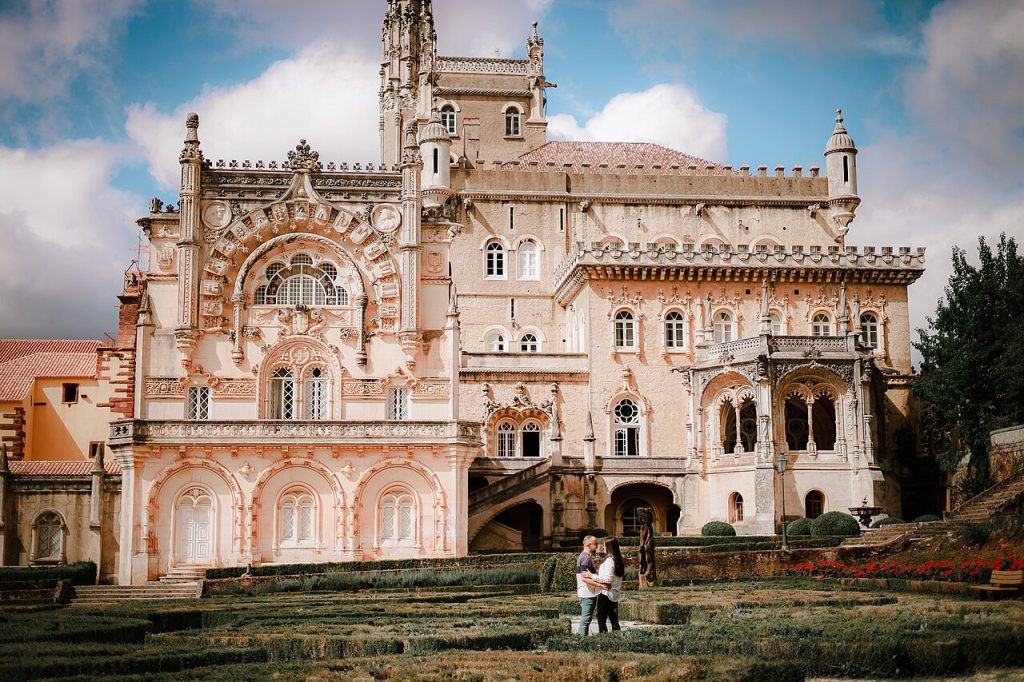
Halfway between Coimbra and the spa town of Luso, on a ridge of the Serra do Buçaco wrapped in one of the oldest planted forests in Europe, stands a palace of white limestone spiralled with carved ropes, armillary spheres and ogee arches, its tower a copy of Belém’s, its cloister a copy of the Jerónimos’, its terraces opening onto walks of cedars planted by barefoot monks four centuries ago. It is the Palácio do Buçaco, begun in 1888 as a hunting lodge for the last kings of Portugal in the grounds of a suppressed Carmelite hermitage, and it holds a double distinction: it is the final royal palace ever built in Portugal, finished just in time for the monarchy to fall, and since 1917 it has been the Bussaco Palace Hotel, which means that of all the palaces in this series, this is the one where you can simply book a room.
Bussaco’s layers run deeper than its stone. The walled forest around it, 105 hectares of cedars, tree ferns and chapels, was planted from 1628 by Discalced Carmelite monks as a sacred wilderness, protected by papal bulls that excommunicated tree-cutters and banned women at the gate; along its ridge in September 1810 Wellington’s Anglo-Portuguese army threw back Masséna’s French at the Battle of Bussaco, whose anniversary the palace’s azulejo panels illustrate at the foot of the grand staircase; and when the liberal state dissolved the monasteries in 1834, the crown inherited the holy wood and, two generations later, dropped into its middle a Neo-Manueline fantasy by an Italian opera scenographer. It is the seventh stop of the Iberian chapter, and the only one with a check-in desk.
Walk with me through the forest gate and up the monks’ cedar avenue, around the carved loggias and the azulejo staircase, through the Carmelite cloister next door and up to the battle’s ridge, with monks, generals, kings and hoteliers in order. The contents are below.
In This Article
- The Holy Forest of the Carmelites
- The Desert Convent of 1628
- Papal Bulls and the Wall of Excommunication
- 1810: Wellington on the Ridge
- 1834: The State Takes the Wood
- Carlos I and the Last Royal Project
- Luigi Manini, Scenographer Architect
- The Neo-Manueline Dream
- The Staircase and the Battle Tiles
- Brief Royal Days and the Fall
- 1917: The Palace Becomes a Hotel
- The Cellars and the Bussaco Wines
- Forest and Palace Today
- Bussaco on Video
- Visiting Bussaco Today
- Palaces Nearby
The Holy Forest of the Carmelites
The Mata Nacional do Buçaco is a walled forest of 105 hectares riding a ridge of the Serra do Buçaco at about 550 metres, where Atlantic weather piles mist onto the trees so that the wood drips and glows even in August; its famous cedars, the so-called Buçaco cypress brought, by tradition, from Mexico or Goa in the seventeenth century, stand among laurels, tree ferns, araucarias, sequoias and some 250 tree species, threaded by walks named for the cold fountain, the valley of the ferns and the stations of a Via Sacra whose chapels climb to the Cruz Alta viewpoint at the crest. The palace sits at the forest’s heart, white against perpetual green.
Now, stop here on the Avenida dos Cedros, the monks’ straight cedar walk, and look up: these crowns were planted by men who believed shade itself could be an act of prayer, and four centuries on, their argument still persuades.
The Desert Convent of 1628
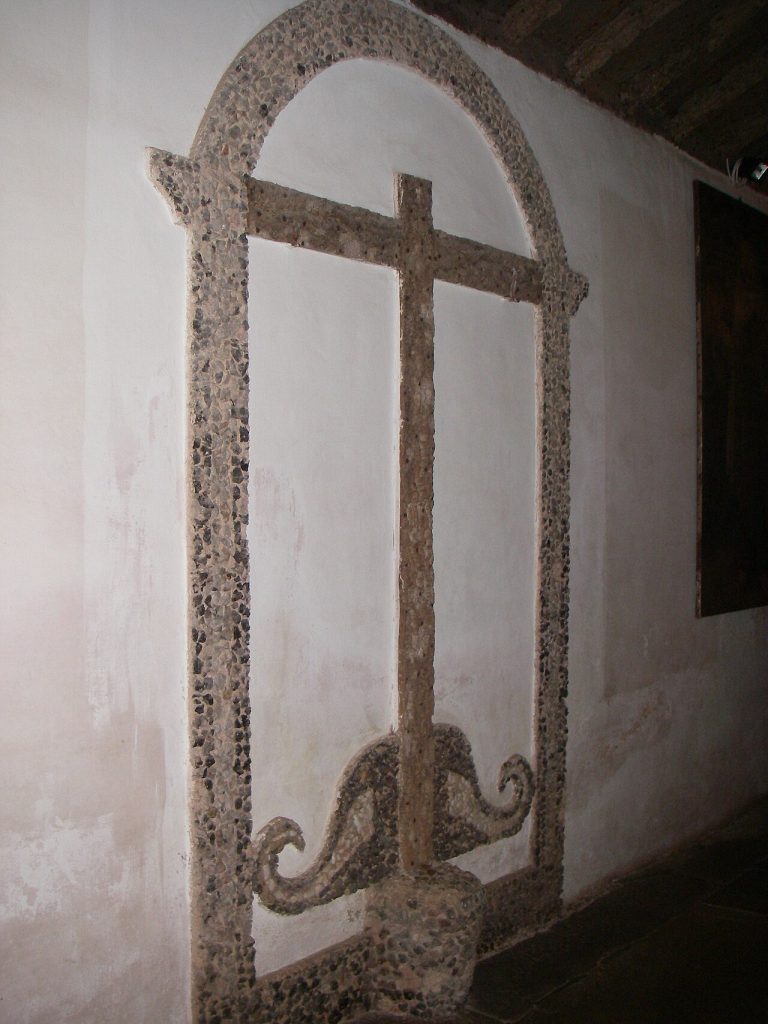
In 1628 the Discalced Carmelites, the reformed order of Teresa of Ávila and John of the Cross, chose Buçaco for a santo deserto, a desert in the mountains where friars lived in silence, each order keeping one such wilderness house; they walled the mountain, built a small convent with a church, a cloister and cells, and lined doors, ceilings and cell walls with cork against the fog’s chill, giving the Convento de Santa Cruz do Buçaco its homely, hobbit-like character, which survives beside the palace with its cork cloister, its shell-studded chapel and the cell where Wellington slept the night after his battle. Around the convent they planted, for two centuries, the forest as a living scripture, with hermitages for solitaries deeper in the trees.
The friars’ rule fed the wood: every novice planted trees, every path led to prayer, and the forest’s design, part orchard, part Calvary, part Eden, is the largest surviving work of Carmelite landscape theology.
Papal Bulls and the Wall of Excommunication
Rome armoured the holy wood in law: a bull of Gregory XV in 1622 forbade women to enter the enclosure, and Urban VIII in 1643 pronounced excommunication against anyone cutting or harming the trees, sentences carved in stone at the gates, where the Porta de Coimbra and the Porta da Rainha still pierce the long wall; the queen’s gate owes its name to a royal visitor admitted, like all her sex, no further than the threshold until the nineteenth century relaxed the ban. The bulls made Buçaco one of Europe’s first legally protected forests, two centuries before any state invented conservation, and the wood’s unbroken canopy is their monument.
Now, stop here at the Coimbra gate and read the threat over the arch: eternal penalty for a felled cedar; modern forestry codes fine you, but the Baroque church damned you, and the trees did better under the damning.
1810: Wellington on the Ridge
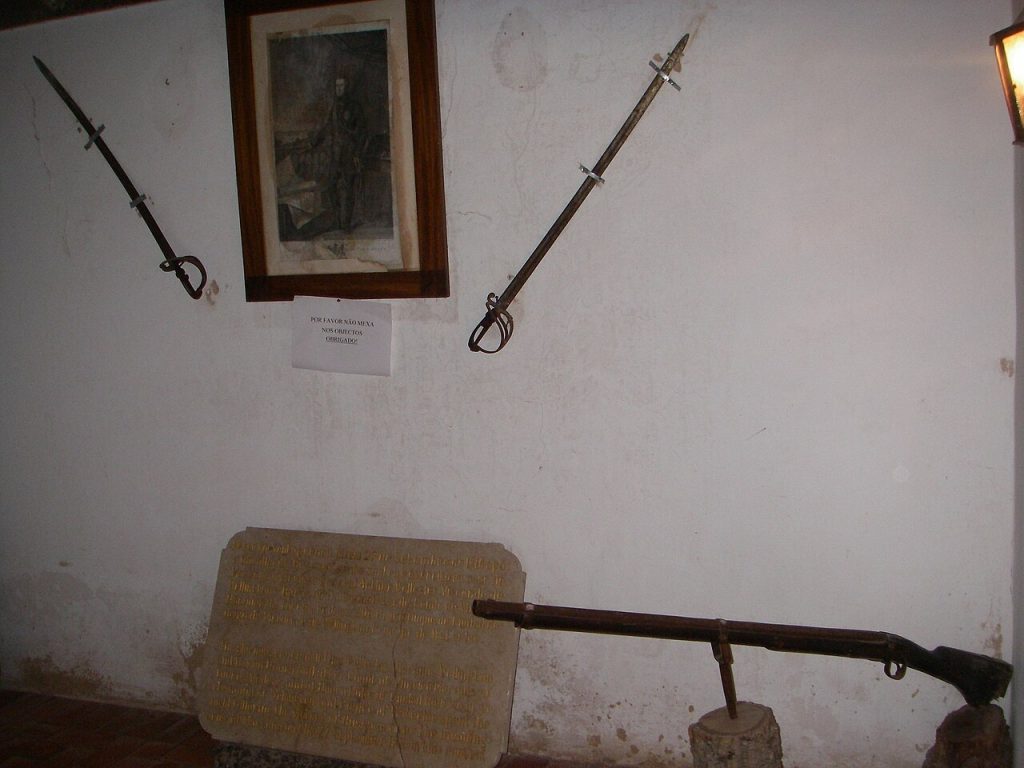
On 27 September 1810, during Napoleon’s third invasion of Portugal, Wellington drew his Anglo-Portuguese army along the Buçaco ridge above the convent wall and let Marshal Masséna’s columns climb at him out of the dawn fog; the French assaults broke on the reverse-slope line with some 4,500 French casualties against 1,250 allied, the new Portuguese regiments proved themselves beside the British, and though Masséna flanked the position days later and marched on Lisbon, he marched into the trap of the Lines of Torres Vedras and ruin. Wellington slept that night in a cork cell of the convent; a battlefield museum, the Cruz Alta obelisk and the annual 27 September commemorations keep the field.
The battle gave the future palace its iconography: when the monument-minded 1900s decorated the stairs, it was Bussaco 1810, not any king’s deed, that went onto the tiles.
1834: The State Takes the Wood
Portugal’s liberal revolution suppressed the religious orders in 1834, and the Carmelites walked out of their desert after two centuries; the forest passed to the state, which, rare mercy of the age, neither sold nor felled it but put it under the forestry services, opened the gates to women and picnickers, laid romantic paths to the hermitages and the fern valley, and planted the century’s new exotics, sequoias, palms and araucarias, among the cedars, so that the monks’ scripture gained a botanical appendix. Luso below grew into a fashionable spa on its famous water, and Buçaco became the promenade of convalescent Coimbra, a sacred wood turned public garden.
By the 1880s the picturesque state forest wanted only one thing fashionable taste could imagine, a royal pavilion at its centre, and the crown obliged beyond anyone’s expectation.
Carlos I and the Last Royal Project
The lodge was conceived in 1888, late in Luís I’s reign, and carried through under Carlos I, who came to the throne in 1889: an intelligent, stout, embattled king, a genuine painter and pioneering oceanographer, facing bankrupt treasuries, the humiliation of the British ultimatum over Africa in 1890 and a rising republican press, who wanted in Buçaco a retreat for hunting, painting and the family’s September weeks near the Luso waters. He would pay the project’s bills for twenty years and enjoy almost none of them: in February 1908 Carlos and his heir Luís Filipe were shot dead in their open carriage on Lisbon’s riverside square, the only regicide in Portuguese history, leaving his second son Manuel a throne with thirty-two months to run.
Thus the palace’s patron haunts it as an absence; his sea paintings hang in museums, and his unfinished hunting lodge became his dynasty’s accidental memorial.
Luigi Manini, Scenographer Architect
The design fell to Luigi Manini, an Italian from Crema trained as a scenographer at La Scala, who had come to Lisbon in 1879 to paint sets for the São Carlos opera and stayed to become the peninsula’s great architect of built fantasy; at Buçaco from 1888, and later at Sintra’s Quinta da Regaleira, he worked exactly as he had for the stage, composing picturesque silhouettes, towers, loggias and sculpted programmes meant to be read like an opera’s acts, with Portuguese works directors, the sculptor António Gonçalves and, after Manini’s 1894 departure, successors including Nicola Bigaglia carrying the lodge to completion about 1907. The construction wrapped and partly replaced the old convent’s quarters, keeping church and cork cloister beside the new halls.
A scenographer was the honest choice: the commission was precisely a stage set, the monarchy’s last self-portrait, and Manini gave it a professional’s conviction that no sober academician could have matched.
The Neo-Manueline Dream
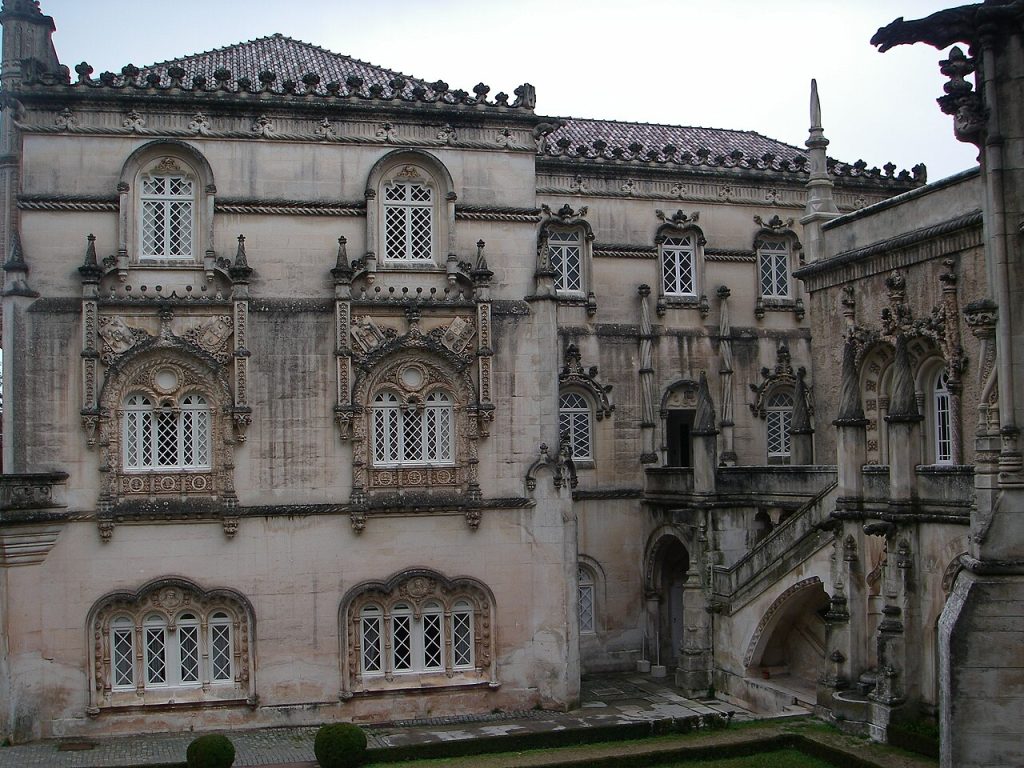
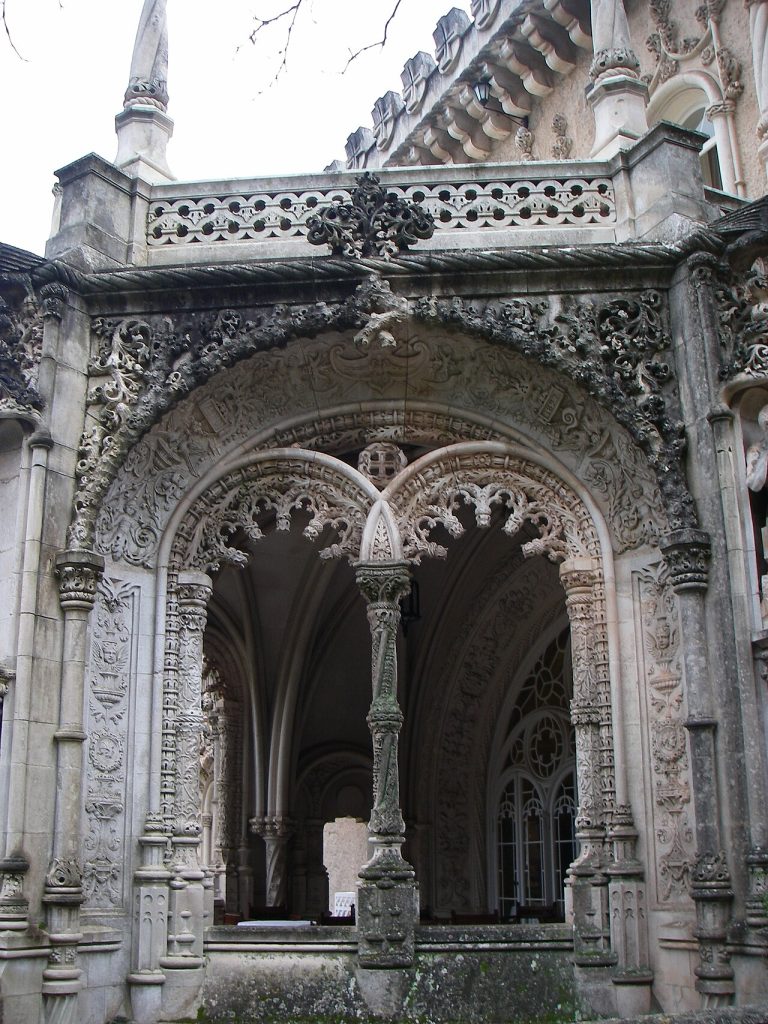
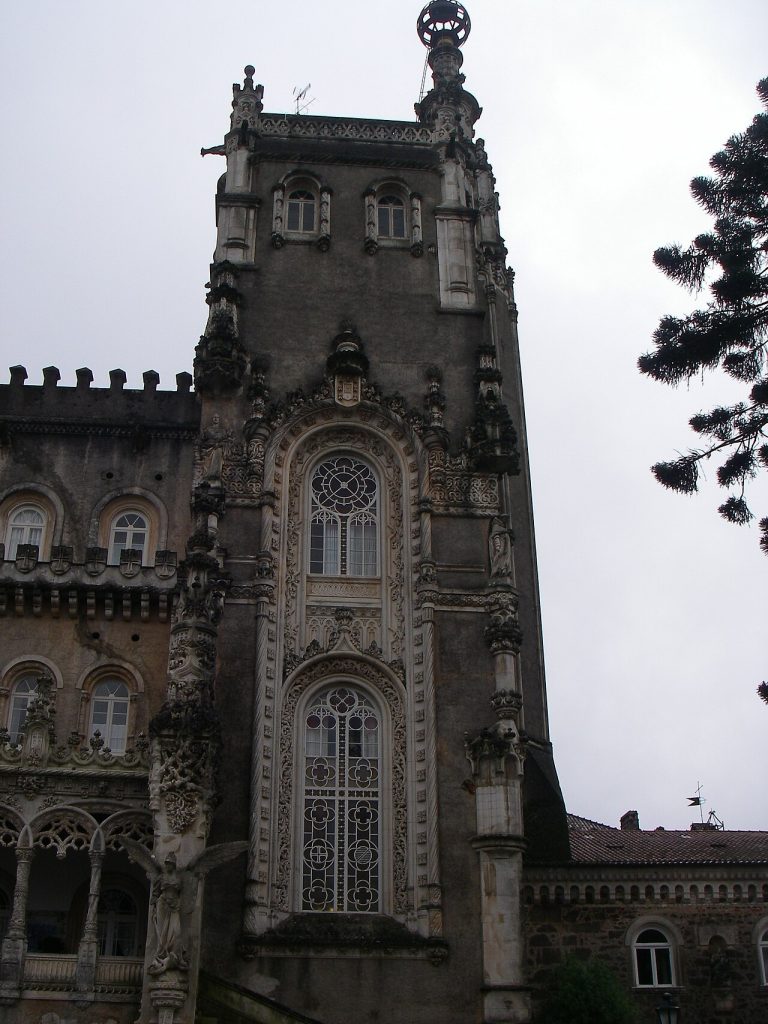
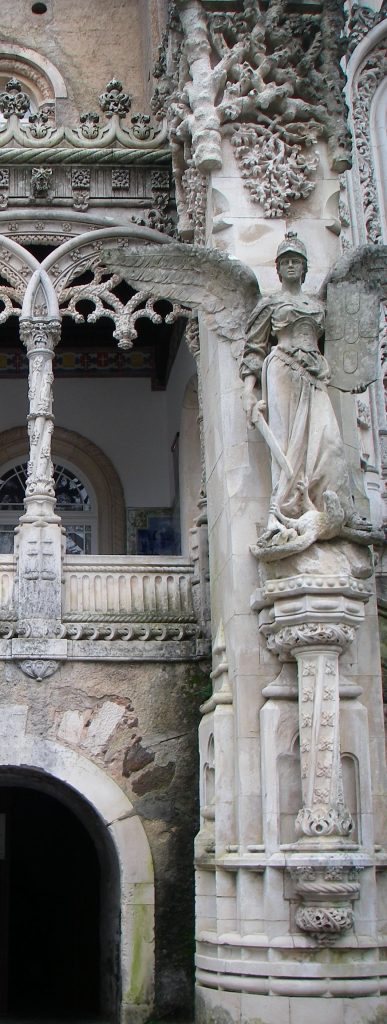
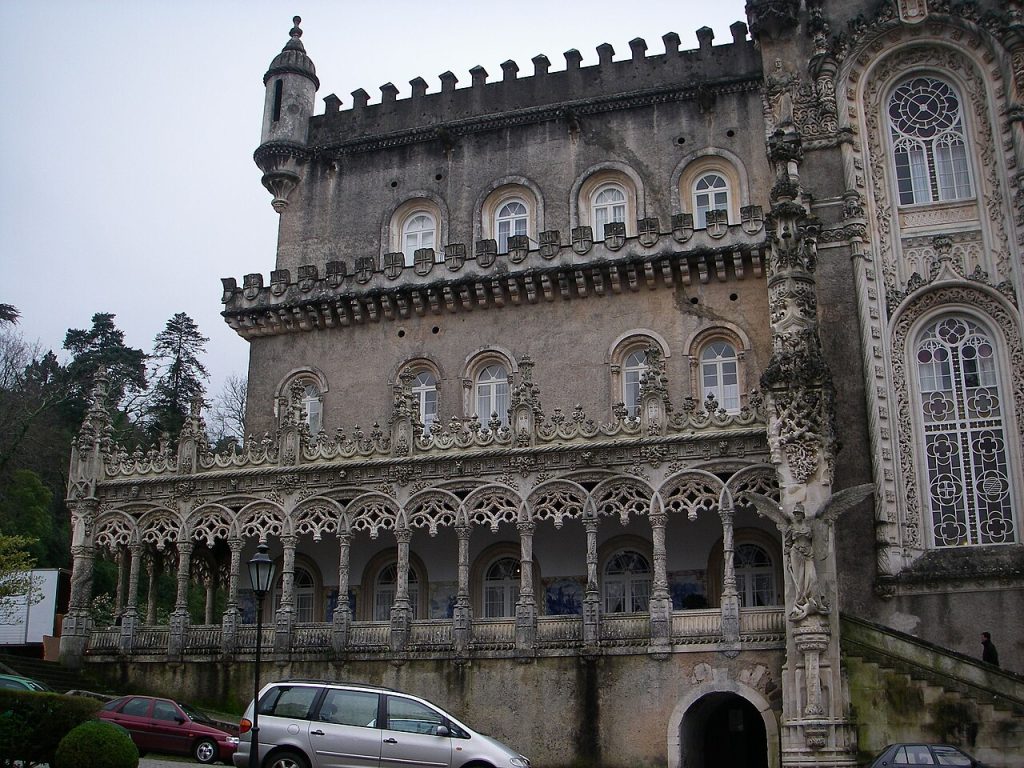
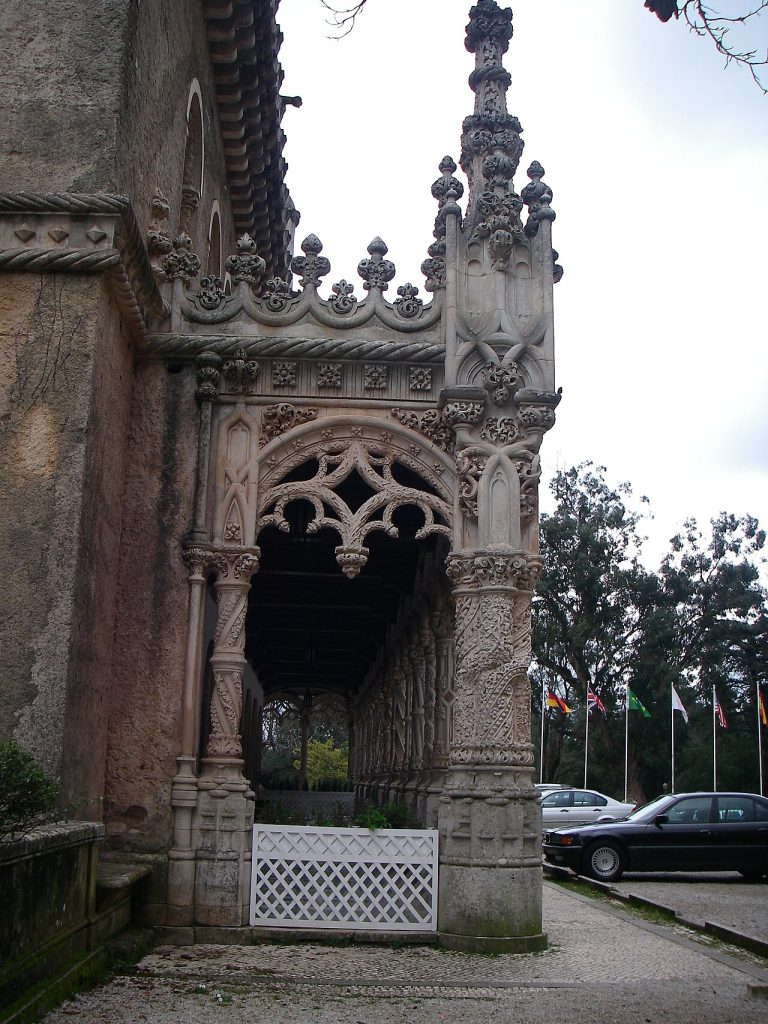
The style is Neo-Manueline, the nineteenth century’s revival of Manuel I’s discovery-age Gothic, and Bussaco is its masterpiece: the entrance tower paraphrases Belém’s, the arcaded gallery copies the Jerónimos cloister’s tracery, portals twist with carved ropes, artichokes, corals and armillary spheres, and a sculpted frieze of the discoveries parades caravels and heroes around the walls, the whole in bright Ançã limestone against the dark cedars; inside, the great hall rises through three storeys of arcades under an iron-and-glass roof, a Belle Époque atrium wearing sixteenth-century dress. Paintings by António Ramalho and carved furniture continue the national epic through the salons.
Now, stop here on the terrace loggia and run a hand along a limestone rope: the monarchy that built the originals owned the sea route to India; the one that built this owned a forest and a decade, and spent both on remembering.
The Staircase and the Battle Tiles
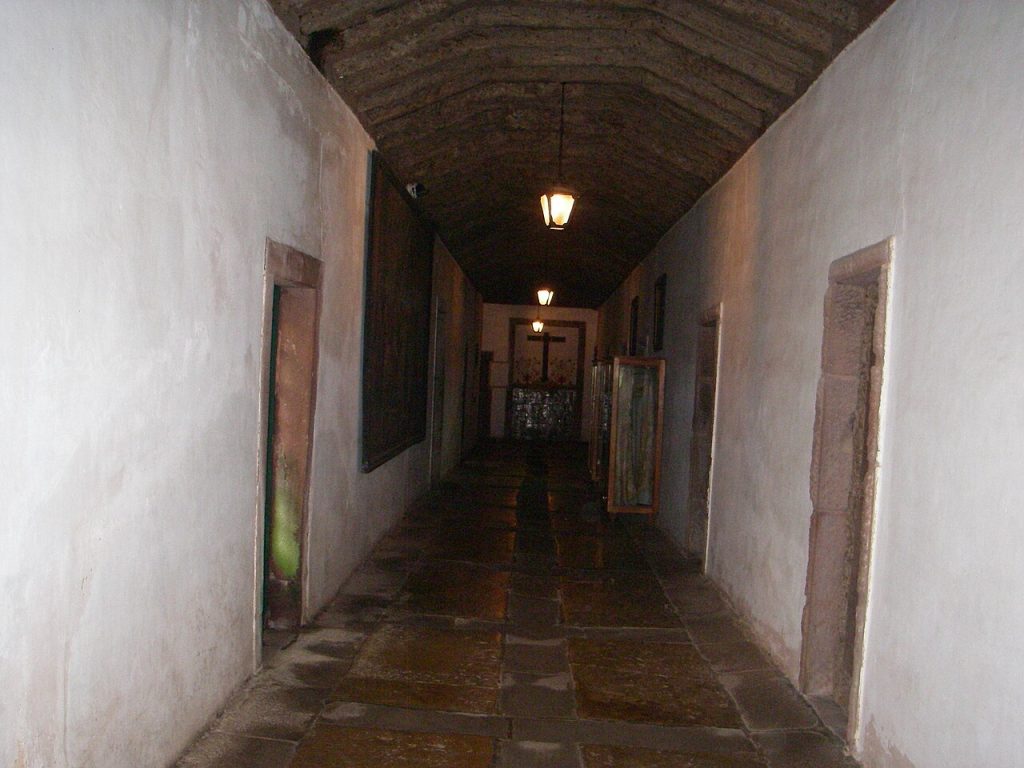
The grand staircase and galleries wear the palace’s most Portuguese skin: monumental blue-and-white azulejo panels by Jorge Colaço, the master who tiled Porto’s São Bento station, set between 1907 and the 1920s, showing the Battle of Bussaco in smoke and bayonets at the stair’s foot, episodes of the Peninsular War, and scenes from Camões’s Lusíadas and Gil Vicente, thousands of hand-painted tiles turning circulation space into a national picture book; war veterans’ descendants still come to find regiments named in the cartouches. The panels bridge the building’s two lives, begun for a king, finished for hotel guests, with no visible seam.
Climb the stair slowly and read it like the opera Manini intended: forest, battle, epic poem, dynasty, each landing a scene, and the audience now arrives with luggage.
Brief Royal Days and the Fall
The royal family’s use of the finished lodge was heartbreakingly short: Carlos visited the works, and after 1908 young Manuel II came for stays that gossip attached to the actress Gaby Deslys, the boy-king snatching private weeks in the cedars while his ministries fell; on 5 October 1910 the revolution proclaimed the republic from Lisbon’s city hall, Manuel sailed from Ericeira to exile in England, and the Buçaco lodge, barely aired, lost its purpose before its paint had cured. The new republic inventoried a palace it neither wanted as a residence nor dared to waste, while the forest around it remained the public’s.
Portugal’s monarchy thus ended with its newest palace unused, a stage set struck before opening night, and for seven years the state wondered what the play should be.
1917: The Palace Becomes a Hotel
The answer came in 1917: the state leased the palace to the hotelier Alexandre de Almeida, who opened the Palace Hotel do Bussaco as a grand hotel of the belle époque’s last breath, its royal suites, panelled dining hall and cedar silence drawing crowned exiles, statesmen and honeymooning Lisbon; Alfonso XIII of Spain stopped here fleeing his own revolution in 1931, wartime made it a whispering gallery of diplomats and, legend insists, spies from both sides over the consommé, and the guest book gathered presidents, marshals and film crews. The Almeida family’s company runs it still, with the dining room’s Ramalho canvases and Colaço tiles unmoved.
The conversion saved the building by using it: a palace with guests pays for its own roof, and Bussaco pioneered the pousada idea, heritage as hospitality, twenty years before the state network existed.
The Cellars and the Bussaco Wines
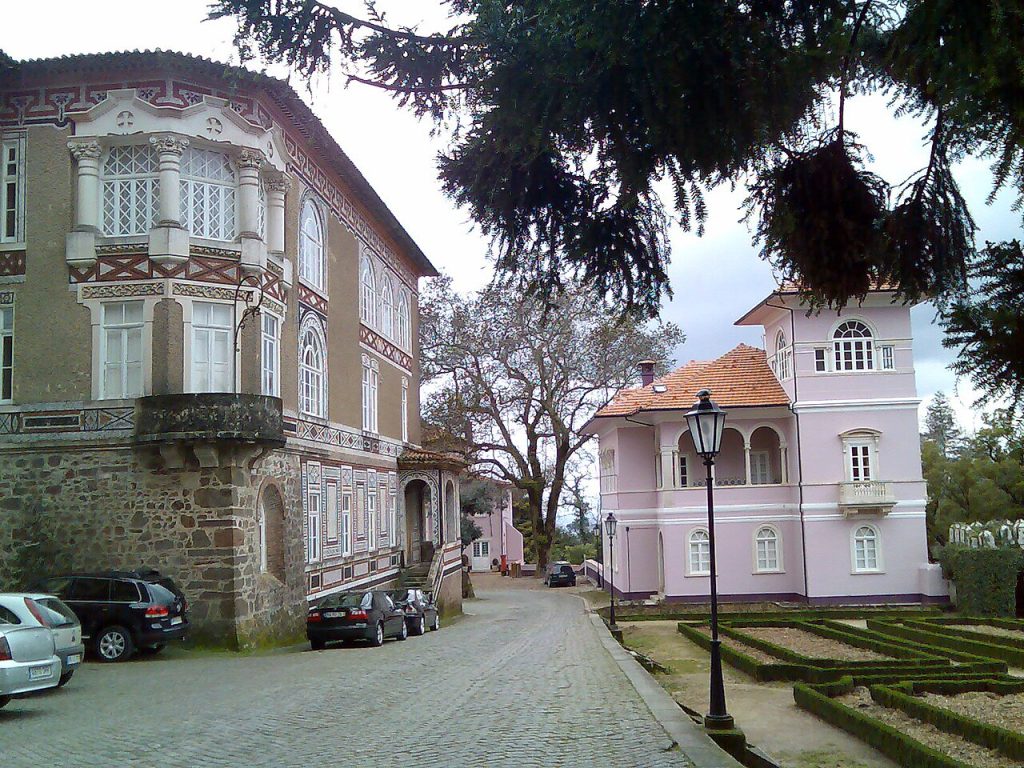
Beneath the terraces the hotel keeps one of Portugal’s quietest legends: the Buçaco wines, created from 1917 by the Almeidas, red and white blends drawn from Bairrada and Dão grapes, vinified and aged in the palace cellars, sold nowhere but in the group’s own dining rooms, so that drinking them has always required a pilgrimage; vintages going back to the 1940s rest in the candle-lit vaults, and wine writers who finally taste the old whites tend to use the word ghostly with approval. Cellar visits and tastings can be arranged, and the battle-year labels are the collectors’ grails.
Order a glass under the Lusíadas tiles and the building completes its circuit: monks’ water, kings’ stone, republic’s lease and a wine that exists only inside the story.
Forest and Palace Today
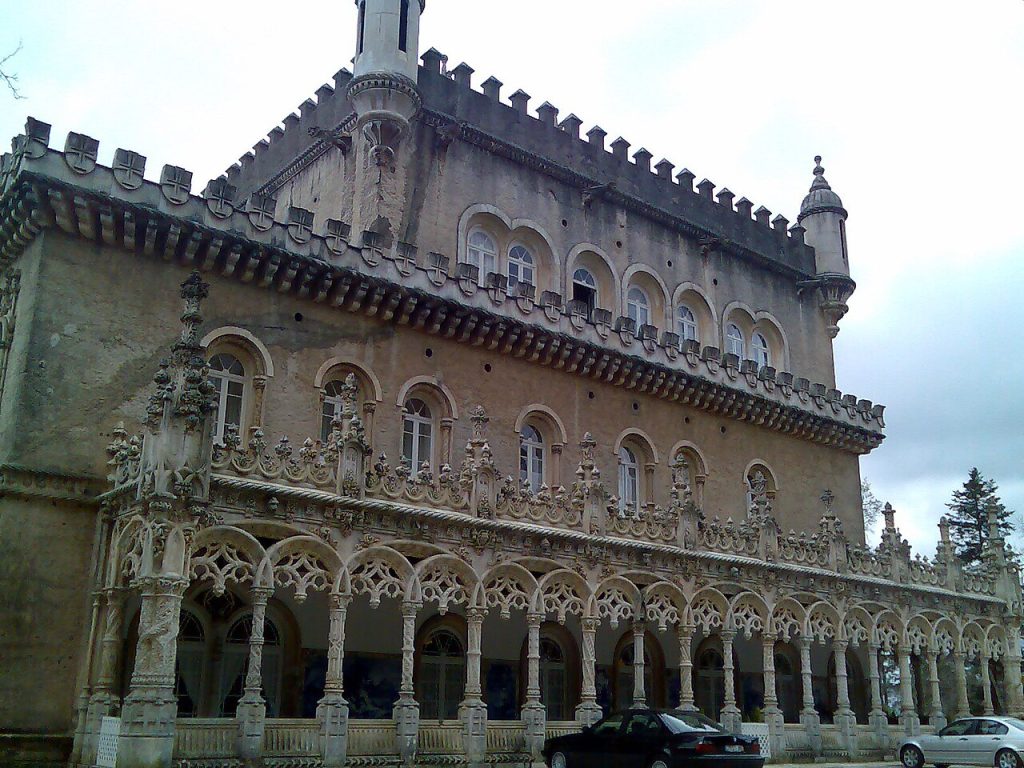
Today the ensemble lives in three keys at once: the Fundação Mata do Buçaco manages the forest’s trails, fern valley, hermitages and Via Sacra, fighting acacia invasion and replanting cedars; the hotel keeps its slightly time-stopped grandeur, neither museum nor resort, where non-guests may dine or take the terraces’ tea; and the battlefield museum and the convent’s cork cloister hold their anniversaries, with 27 September’s drums returning each year. The palace’s silhouette through the cedar crowns remains one of the sights of central Portugal, and winter mists still stage it better than any lighting designer could.
Now, stop here a last time on the terrace steps at dusk, with the forest breathing cold and the tower’s lace going grey. Monks planted a prayer, an army defended a ridge, a doomed dynasty built its farewell in stone, and a hotelier taught the farewell to serve dinner; Bussaco is history that will bring you breakfast, and there is nothing else quite like it in Europe.
Bussaco on Video
Visiting Bussaco Today
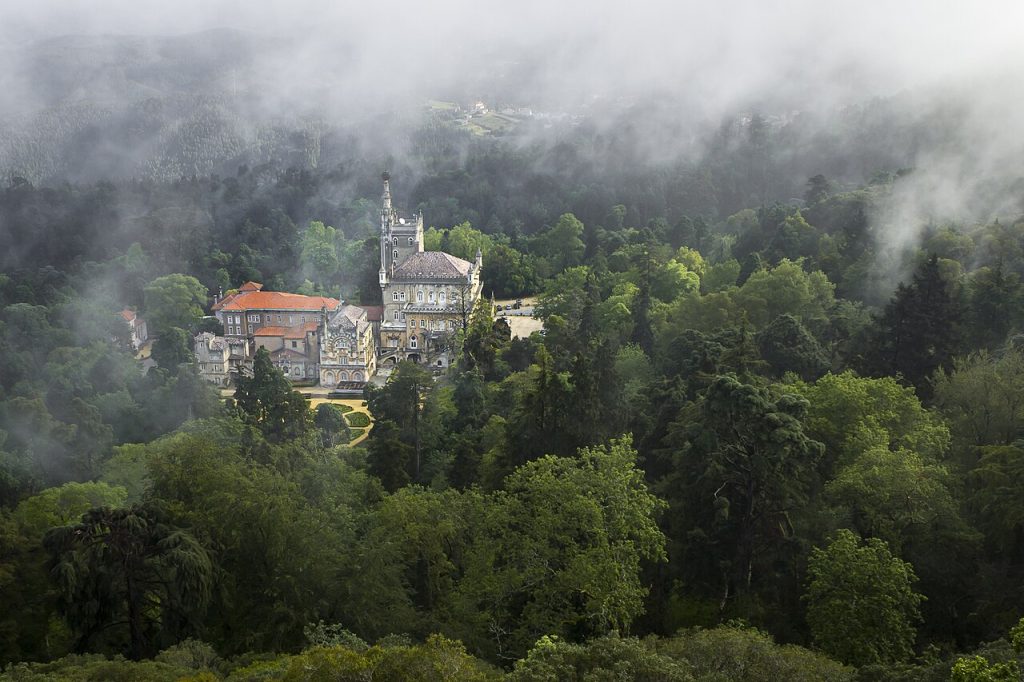
The Mata do Buçaco is open daily, with a vehicle toll at the gates and free entry on foot from Luso, half an hour’s climb; the palace’s public rooms, staircase tiles and terraces can be seen by visitors, with respect for hotel guests, and the convent of Santa Cruz, the battle museum and the Cruz Alta complete a half-day circuit, while dinner or a night in the hotel, booked well ahead for the historic rooms, turns it into the series’s one sleepable palace. Luso’s thermal town below adds its belle-époque casino quarter and the famous fountain where locals queue with bottles.
Buçaco lies 30 kilometres north-east of Coimbra: trains from Coimbra reach Luso-Buçaco station in forty minutes with a taxi or walk up to the gates, and drivers take the IP3 and N234, with Porto ninety minutes and Lisbon two and a half hours away; Sintra’s palaces are three hours south-west by motorway. Here is the exact spot: Bussaco Palace on Google Maps.
Palaces Nearby
You May Like
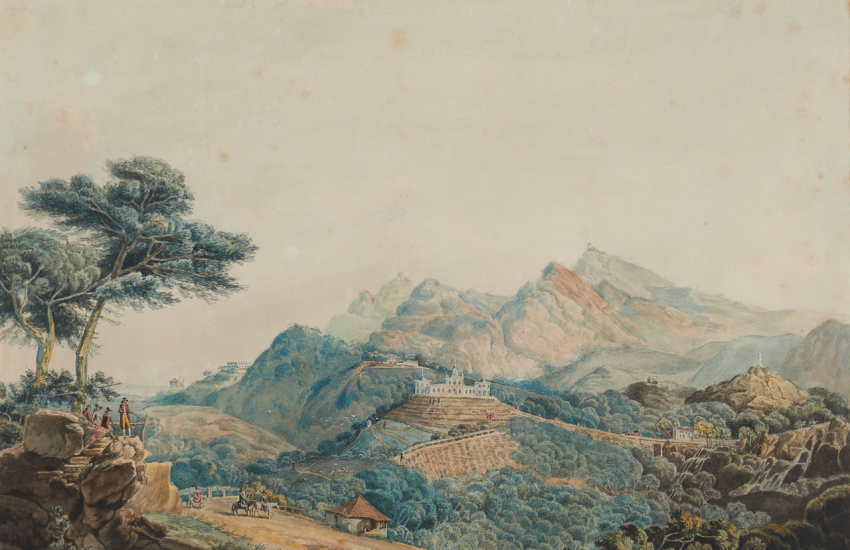
Monserrate Palace and the English Dream of Sir Francis Cook