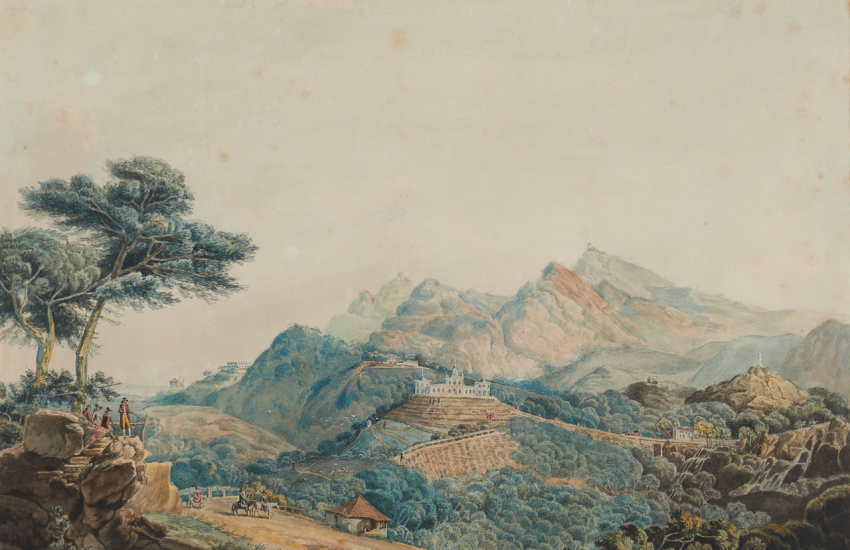
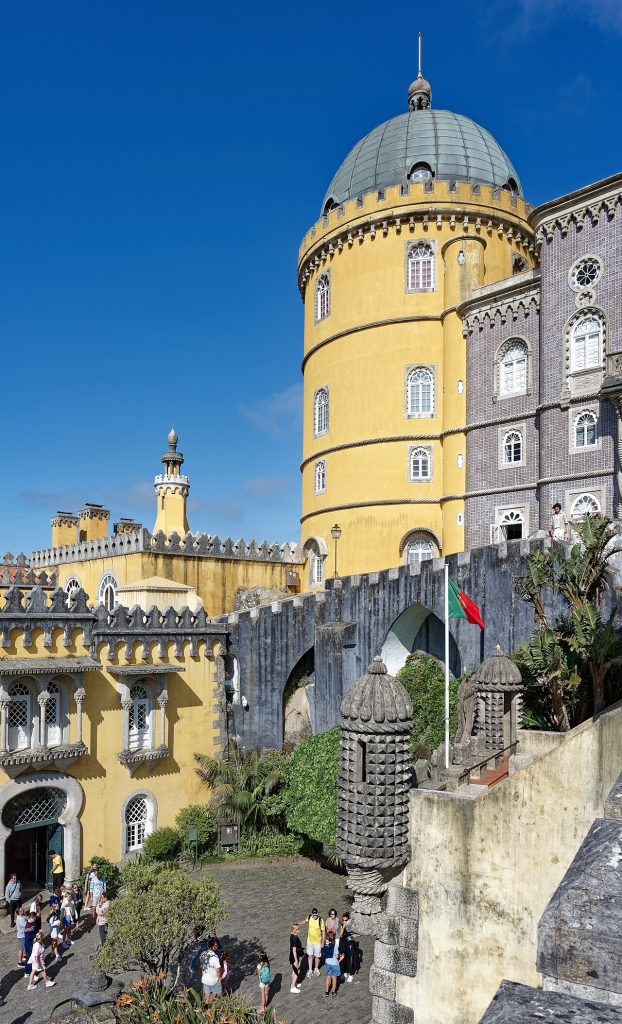
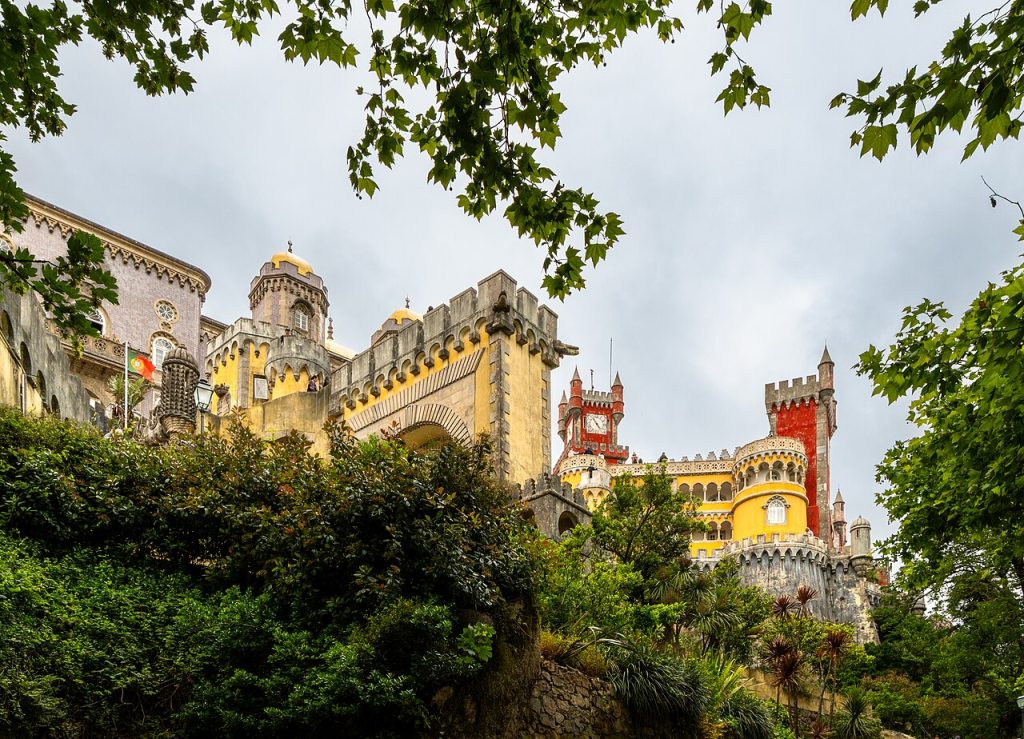
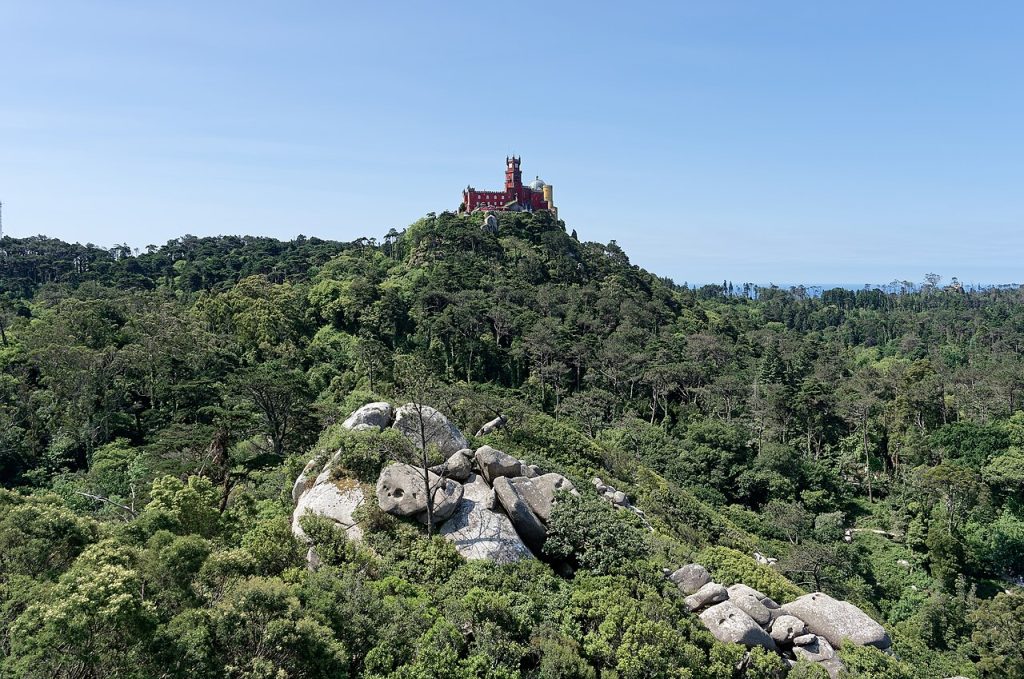
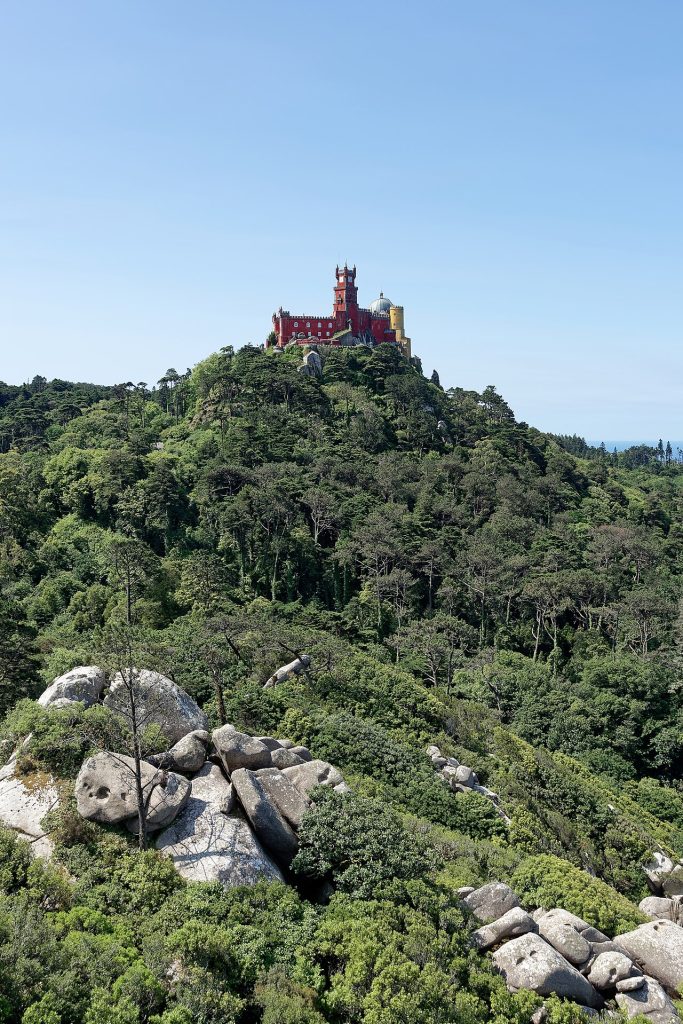
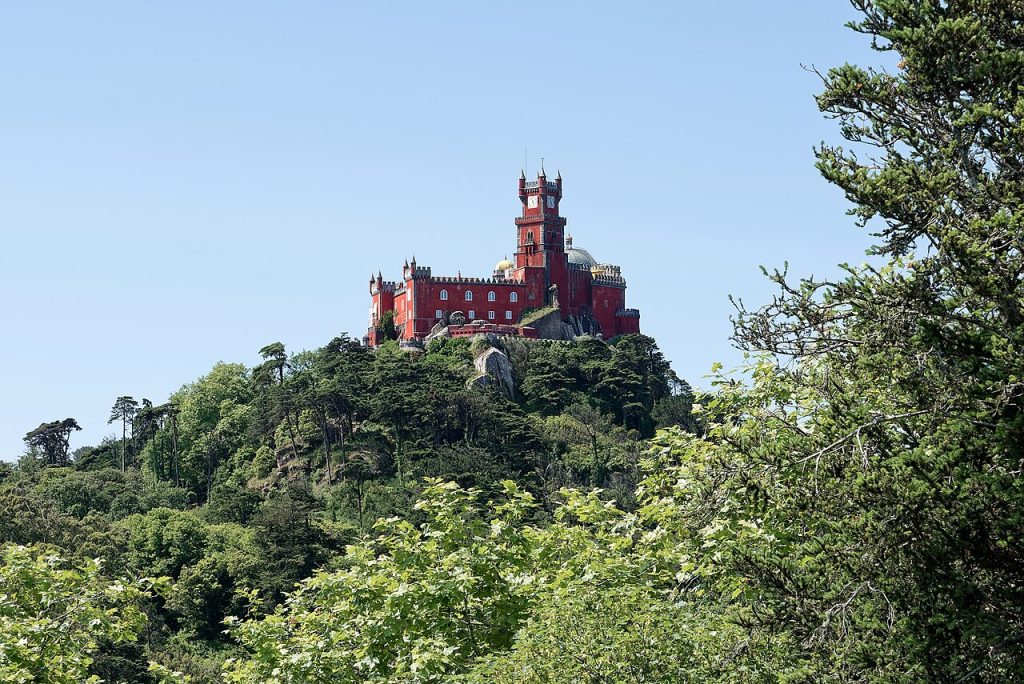
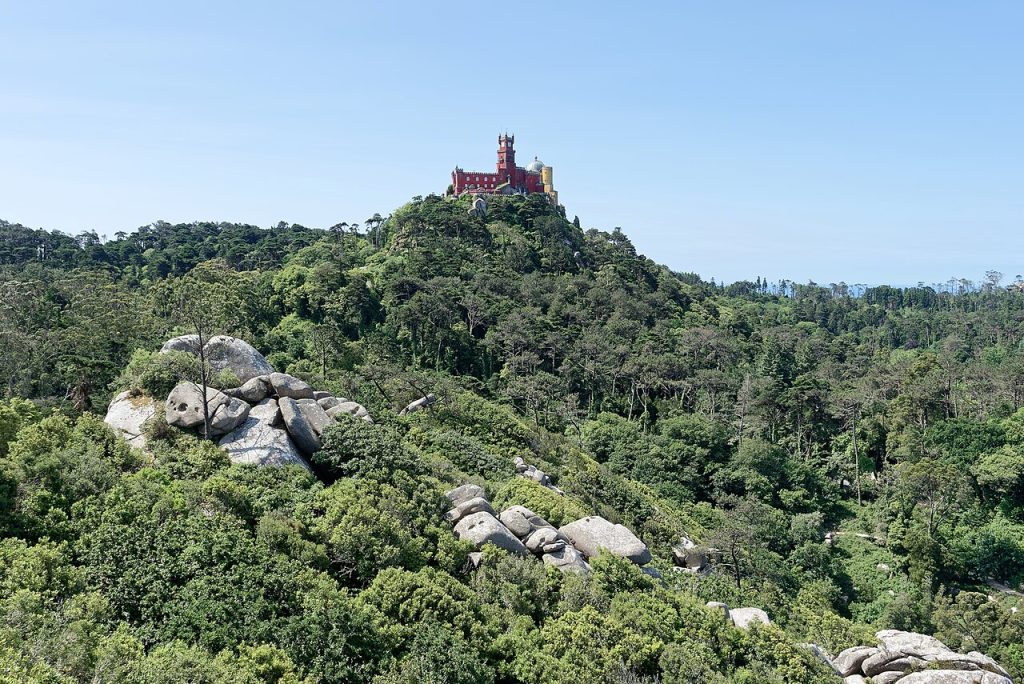
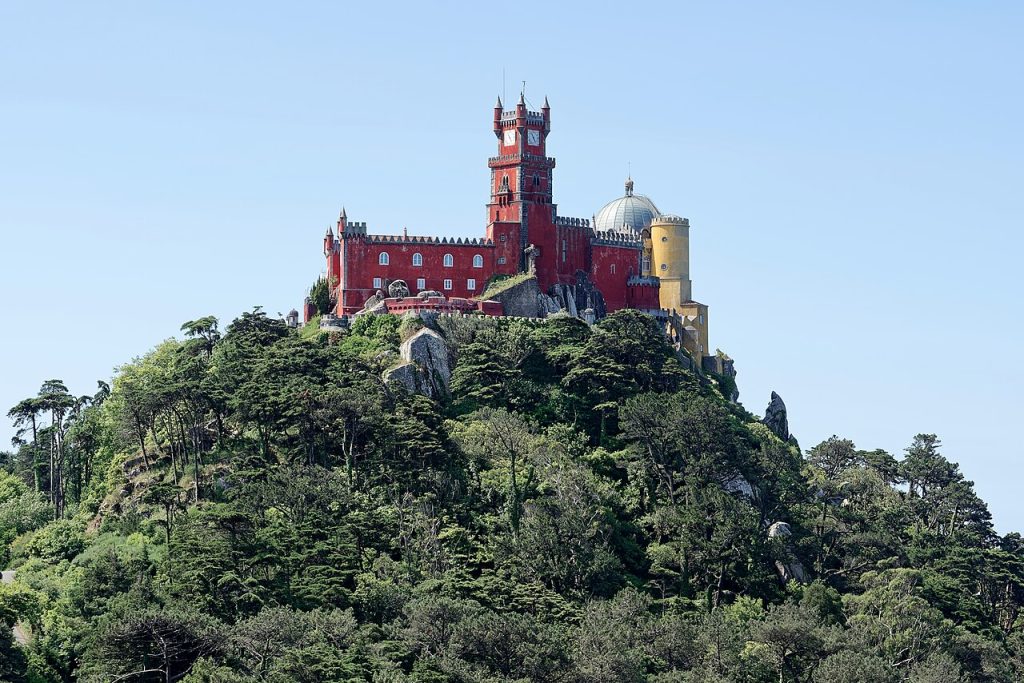
On the second-highest crag of the Serra de Sintra, five hundred metres above the sea and visible on a clear day from Lisbon, stands a castle coloured like no other in Europe: ox-blood red keep, chrome-yellow new palace, grey clock tower, domes, drawbridge, battlements and a gateway guarded by a sea-monster of carved stone, the whole rising out of a forest so dense and so foreign that the hill beneath disappears. It is the Palácio Nacional da Pena, built between 1839 and the 1850s by Ferdinand of Saxe-Coburg-Gotha, the German prince who married Portugal’s young queen and became, as Ferdinand II, the artist-king, o Rei-Artista; and it is, by the usual reckoning, the first full-blooded Romantic palace in Europe, begun the same decade as the Gothic revival itself and forty years before Ludwig II dreamed Neuschwanstein.
Pena began as a ruin and a love of ruins. On the crag stood the small Hieronymite monastery of Our Lady of Pena, founded by Manuel I in 1511, wrecked by the 1755 earthquake and emptied by the dissolution of 1834; Ferdinand bought the shell and the bare mountain around it in 1838 and spent two decades transforming monastery into palace and crag into park, keeping the old cloister and chapel at the heart of his new towers, painting the walls in colours that scandalised and delighted, and planting two hundred hectares of camellias, tree ferns and conifers from every continent so that the mountain itself became part of the architecture. With Pena this series’s Iberian chapter closes, on the hill above the two Sintra houses we have already walked.
Climb with me from the park gates past the lakes and the fern valleys, over the drawbridge and under the Triton’s arch, around the clock tower terrace and through the monastery cloister into the last queen’s rooms, with a ruined monastery, an artist-king and a mountain-sized garden in order. The contents are below.
In This Article
- The Crag of Our Lady of Pena
- Manuel I’s Monastery and the Earthquake
- Ferdinand II, the Artist-King
- Maria II and the Coburg Marriage
- Baron Eschwege and the Building of Pena
- A Grammar of All Architectures
- The Drawbridge and the Triton Gate
- The Cloister and the Chapel’s Altarpiece
- The Royal Rooms and Amélia’s Apartments
- The Park of Two Hundred Hectares
- The Countess of Edla and Her Chalet
- 1910: The Palace and the Republic
- Pena Today
- Pena on Video
- Visiting Pena Today
- Palaces Nearby
The Crag of Our Lady of Pena
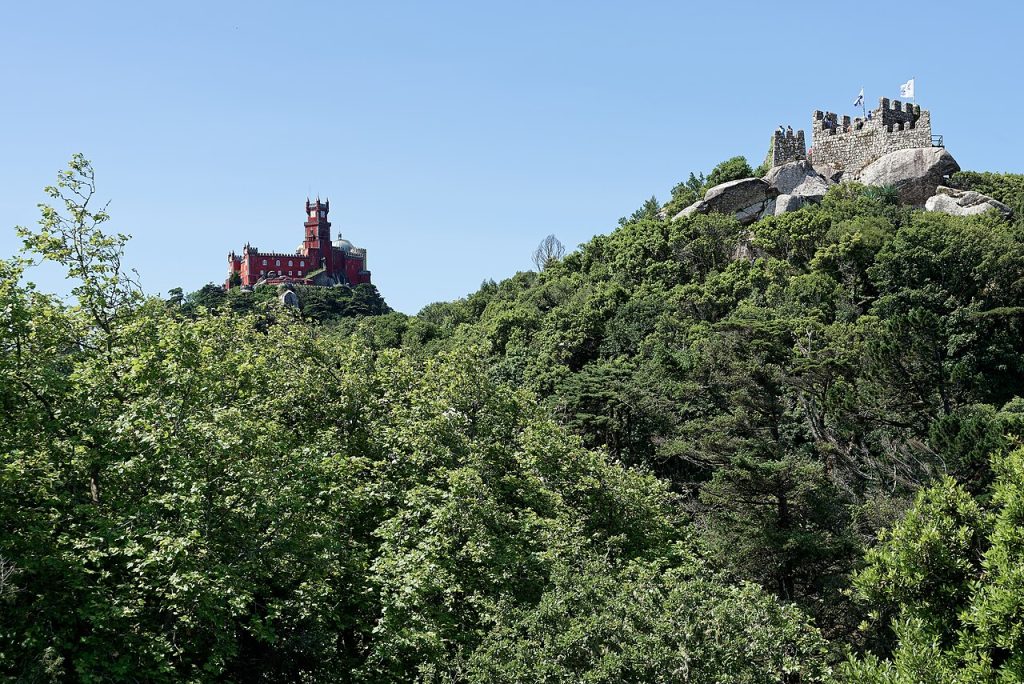
The crag of Pena, from penha, the rock, is a tooth of granite at 528 metres on the serra’s crest, a place of hermits since at least the twelfth century, when a chapel of Our Lady stood among its boulders and pilgrims climbed from the town below; the summit looks one way over the palace of the town, the Moorish castle on the next ridge and the plain to Lisbon’s bridges, and the other way down the green spine of the serra to Cabo da Roca, continental Europe’s westernmost point, with the Atlantic filling half the horizon. Mist is the mountain’s resident spirit, pouring over the battlements on summer afternoons and granting, on clear winter mornings, hundred-kilometre views.
Now, stop here on the Terrace of the Queen below the walls and look up at the silhouette: no drawing of Pena ever looks plausible, and the building’s first achievement is that the real thing persuades you instantly.
Manuel I’s Monastery and the Earthquake
In 1511 Manuel I, who by tradition had watched from this summit for Vasco da Gama’s returning fleet, gave the crag’s old chapel to the Hieronymites and built them a small monastery of stone, cloister, refectory and cells for eighteen monks, with an altarpiece of alabaster and black marble by the French sculptor Nicolas Chanterene that was among the finest Renaissance works in Portugal; for three centuries the monks kept their mountain station through lightning, which wrecked a tower in the 1740s, and then the great earthquake of 1 November 1755, which ruined the buildings around the surviving chapel. The patched remnant limped on until 1834, when the dissolution of the orders emptied it with every other cloister in the country.
Four years later a German prince climbing the serra found the ruin, the view and, he wrote home, the happiest site he knew; the monastery’s second life was about to be stranger than its first.
Ferdinand II, the Artist-King
Ferdinand of Saxe-Coburg-Gotha and Koháry, born in Vienna in 1816, first cousin of both Queen Victoria and her Albert, came to Lisbon at nineteen to marry Queen Maria II and became king consort, Fernando II, on their first son’s birth in 1837; Portugal got, almost by accident, the most cultivated royal it ever had, a serious etcher and watercolourist, a ceramicist with his own kiln, a cellist, a collector of armour, porcelain and paintings, president of the Academy of Fine Arts and the saviour, with his own purse, of the derelict monasteries of Batalha, Tomar and Jerónimos. The Portuguese, wary of the German at first, ended by loving him, and the press coined his lasting name, o Rei-Artista.
After Maria’s death Ferdinand twice declined offered crowns, Greece’s and Spain’s, preferring, he said, his garden on its rock; Pena was the self-portrait he worked at for forty years, and he died in 1885 within sight of it.
Maria II and the Coburg Marriage
Maria da Glória, born in Brazil in 1819, was given Portugal’s crown as a child by her father Pedro, emperor of Brazil, lost it to her absolutist uncle Miguel, and regained it at fifteen in 1834 when her father’s liberal army won the civil war; married at sixteen to a prince who died within months, she married Ferdinand in 1836 and with him anchored the battered constitutional monarchy through revolts and ministries, bearing eleven children and dying, worn out by the eleventh, in 1853 at thirty-four. She was stubborn, brave and dutiful, the Educator queen of the schoolbooks, and her sons Pedro V and Luís I carried the dynasty, the house of Braganza-Saxe-Coburg, to the century’s end.
Pena was the couple’s shared folly in its first years, the queen funding and teasing her husband’s battlements; her early death left Ferdinand a widower of thirty-seven with a palace half-risen, and he poured the rest of his life into finishing it.
Baron Eschwege and the Building of Pena
Ferdinand bought the ruin and the surrounding hill in 1838, and from 1839 his collaborator Wilhelm Ludwig von Eschwege, a Prussian mining engineer and geologist long in Portuguese service, part Humboldt and part clerk-of-works, translated the king’s sketches into granite: the old monastery was restored and coloured red as the Old Palace, and around and above it rose the New Palace in yellow, with the great round bastion, the clock tower, the tunnel gates and the encircling walk of battlements, structurally a modern building with iron and stucco doing medieval work. The shell was standing by 1847 and essentially finished by 1854; Eschwege set a carved portrait of himself, armoured, by one gate, the engineer as crusader.
King and baron worked like a two-man academy, Ferdinand drawing, Eschwege calculating, both revising on site; the palace has no single architect because it was, from first to last, a conversation.
A Grammar of All Architectures
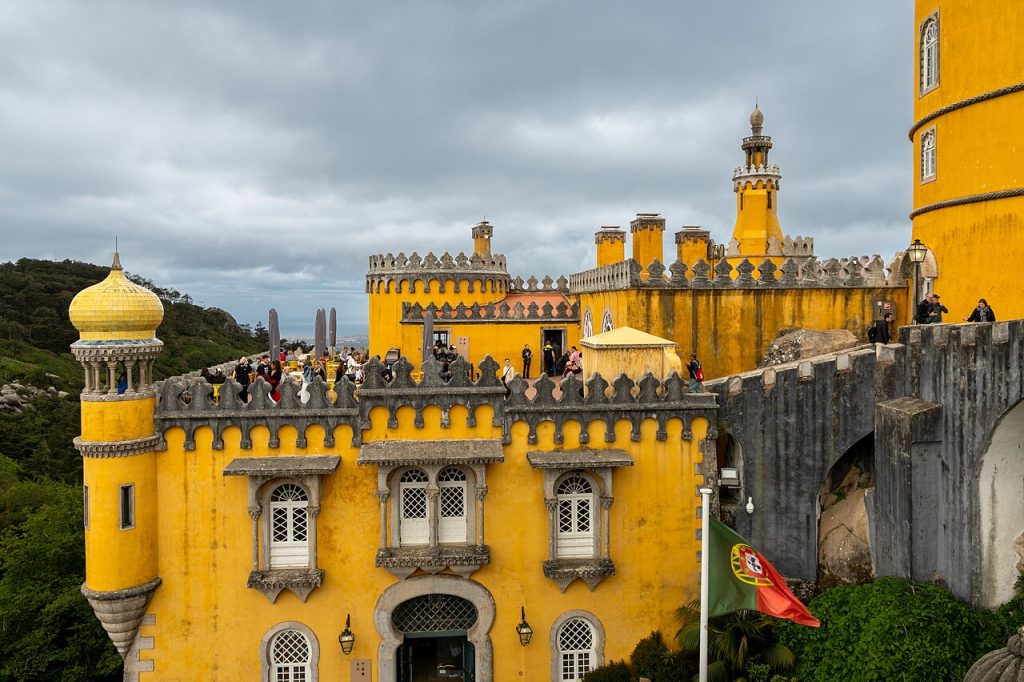
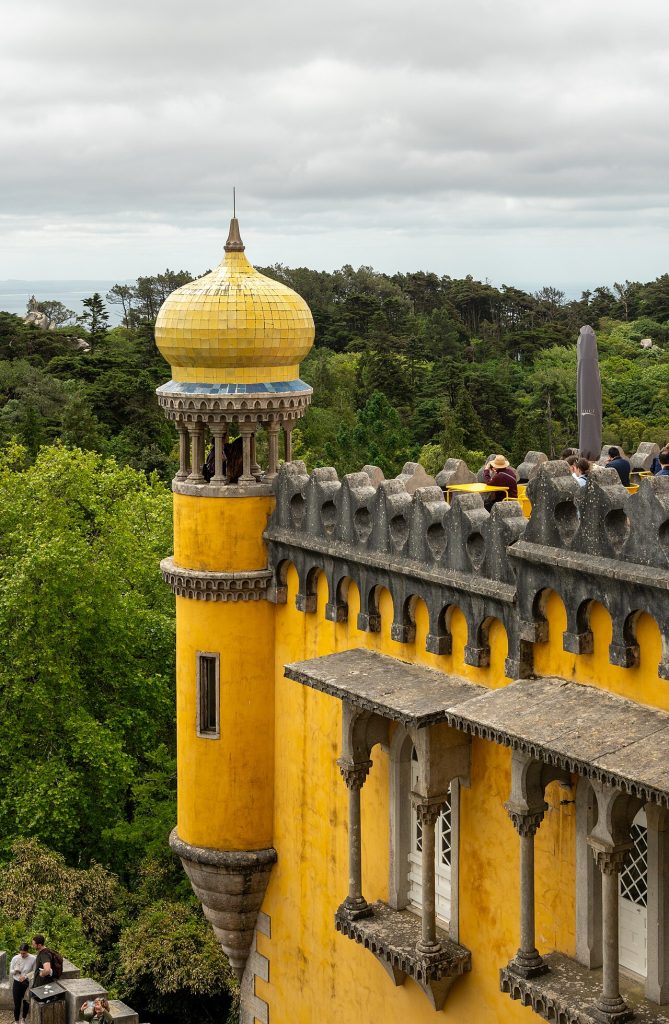
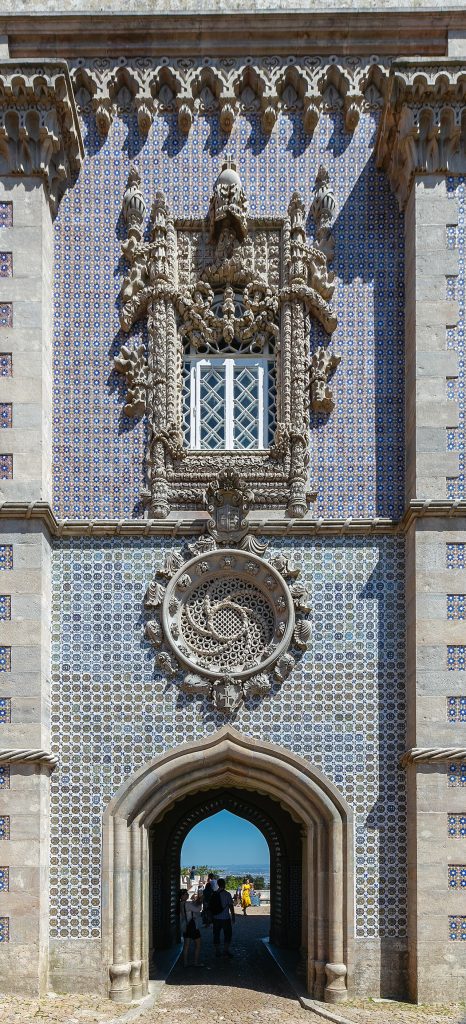
Pena’s style is all styles, on purpose: Manueline ropes and armillary spheres quote Belém and Tomar, whose chapter-window Ferdinand copied outright on the New Palace wall; onion domes and horseshoe arches salute al-Andalus; battlements, bartizans and the drawbridge play at the Gothic; tiled facades revive the azulejo tradition then at low ebb; and a minaret-like tower and Indian cusping stretch the empire’s memory to Goa. The programme is the Romantic century’s historicism, architecture as national memory-theatre, done here first and with a southern palette, red for the monastery’s age, yellow for the new work, that restorers recovered in the 1990s after a century of sober grey repainting.
Now, stop here on the Queen’s Terrace again with the sun out: the colours that purists once called circus paint are the design’s engine, and against black-green forest and white mist they do exactly what the artist-king intended, which is to make the mountain impossible to forget.
The Drawbridge and the Triton Gate
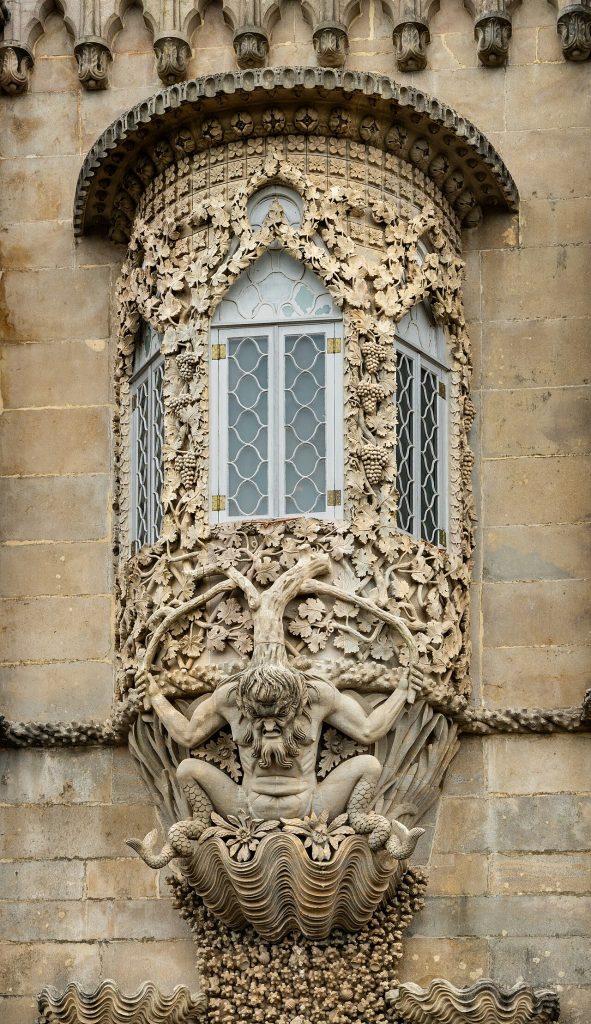
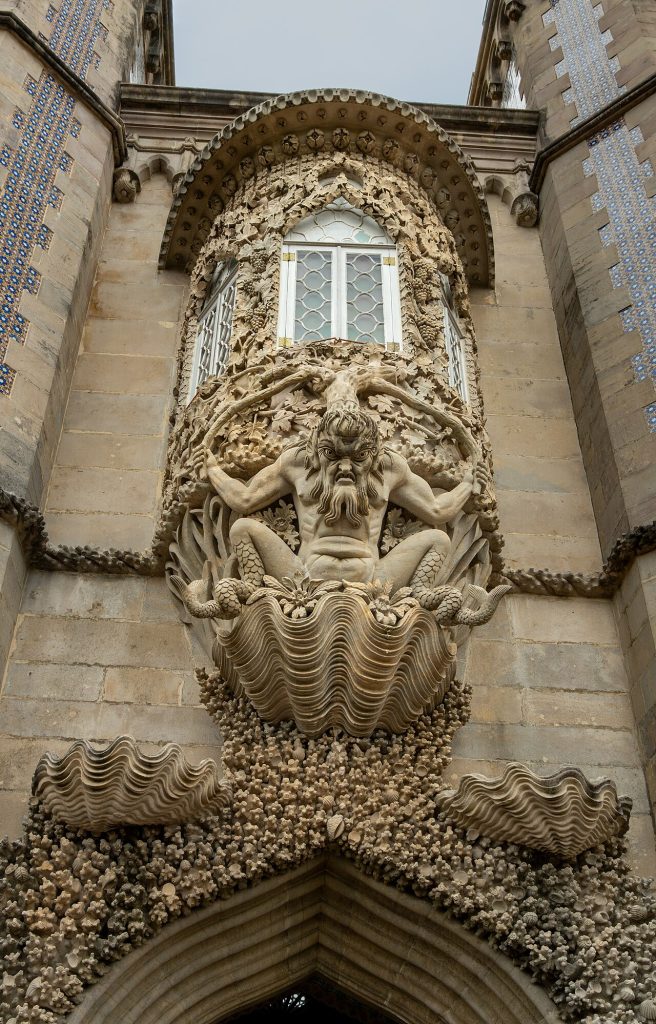
The visitor enters as Ferdinand scripted: through the outer gate and tunnel, across a drawbridge that does not draw, as the guides like to say, and up to the Triton Gate, where over the arch a colossal half-man of carved stone crouches in a giant shell, hair and beard streaming into vines that climb the window above, the newt-god of the threshold, read in the king’s circle as an allegory of the creation of the world from the sea, with the coral-encrusted window overhead as the tree of life rising from it. Monster and window together are the palace’s signature image, Manueline fantasy re-dreamed by German Romanticism.
Touch the shell’s rim as you pass, most visitors do, and note the theatre of the sequence, compression, darkness, reveal; the opera-loving century built its palaces in scenes, and this is Pena’s curtain-rise.
The Cloister and the Chapel’s Altarpiece
At the palace’s heart the monastery survives: the small two-storey cloister, its arches glazed against the mist, its walls dressed in green and white Hispano-Moorish tiles, with the monks’ refectory, now the dining room, and cells, now the king’s rooms, opening from it; and in the restored chapel stands Chanterene’s altarpiece of 1529, alabaster and black Sintra marble carved with the lives of Christ in Renaissance perfection, the one great treasure the earthquake and the centuries spared on the summit. Ferdinand, who could have cleared the old stones for symmetry, instead built his fantasy around them, the Romantic’s reverence for the authentic fragment at the core of the invented whole.
Now, stop here in the cloister and listen: wind over the crag, tiles ticking with damp, the same sounds the eighteen monks kept their offices against, one architectural skin deeper than the postcard palace.
The Royal Rooms and Amélia’s Apartments
The interiors walk through the dynasty’s whole arc: Ferdinand’s rooms in the old cells, dense with his collections’ survivors, armour, porcelain, his own watercolours; the Arab Room’s painted illusionistic vaults; the Great Hall with its stained glass and candelabra-bearing turbaned figures; the sacristy-turned-smoking-room; and then, in the New Palace, the apartments as the last royals left them in 1910, Carlos’s paint-stained studio, Amélia’s bedroom and bath, the telephone room, electric bells and English bathtubs fitted into the fantasy, kept as a time capsule because the republic locked the doors on the furniture. The kitchen below, copper by the hundredweight, still wears the monogram PP, Palácio da Pena.
The effect is unique among Romantic castles, which are usually empty stage sets: Pena was a lived house to its final morning, and the toothbrushes, so to speak, are still on the shelf.
The Park of Two Hundred Hectares
Around his castle Ferdinand made a park of two hundred hectares, planting the stripped, goat-bitten mountain with the world’s trees by the tens of thousands, North American sequoias and cypresses, Australian eucalypts and acacias, Asian cryptomerias, camellias by the avenue, tree ferns colonising the damp valleys, threaded with carriage drives, the Queen’s Fern Valley, five small lakes with swans and a duck-house tower, greenhouses, follies and view-seats, the whole designed on picturesque principles so that the palace appears and vanishes along every walk. The park merges uphill with the crag’s gardens and downhill toward the town, and its camellia collection was Europe’s talk in the 1860s.
Give the park the time the crowds deny it: most visitors see only the shuttle road, and the lakes, fern valleys and high knights’ garden are half-empty even in August, the best unqueued hour in Sintra.
The Countess of Edla and Her Chalet
In 1869 the widowed Ferdinand scandalised courts and delighted Sintra by marrying Elise Hensler, a Swiss-American opera singer he had heard in La Traviata, created Countess of Edla by his Coburg cousin; cultivated and strong-minded, she shared his gardens and his kilns, and together they built at the park’s far edge the Chalet of the Countess, an alpine cottage of cork-trimmed walls, painted woodwork and its own camellia garden, their private retreat from the palace’s own theatre. Ferdinand died in 1885 leaving Pena to her; the state, alarmed at the national symbol in private hands, bought it back in 1890, and Elise lived quietly in Lisbon until 1929. The chalet, gutted by fire in 1999, was restored and reopened in 2011.
Walk the half-hour to it if you can: the chalet is Pena’s coda in a minor key, the artist-king’s last house, built not for a dynasty but for a marriage.
1910: The Palace and the Republic
Pena’s last royal scene closed the story this chapter’s Sintra posts began: on 4 and 5 October 1910, as Lisbon rose, Queen Amélia was at Pena, and from here she joined her son Manuel II at Mafra for the drive to Ericeira’s beach and the royal yacht; the woman who had seen her husband and eldest son shot in 1908 left her mountain palace with hand luggage, and the family sailed to exile. The republic declared Pena a national monument, inventoried the rooms as they stood and opened the museum within months; Amélia was permitted one return visit in 1945, touring her untouched apartments in silence before, her attendants recorded, thanking the keepers at the door.
The palace thus passed from home to heritage overnight, its last private breakfast still, in a sense, on the table; few museums anywhere preserve so exact a final day.
Pena Today
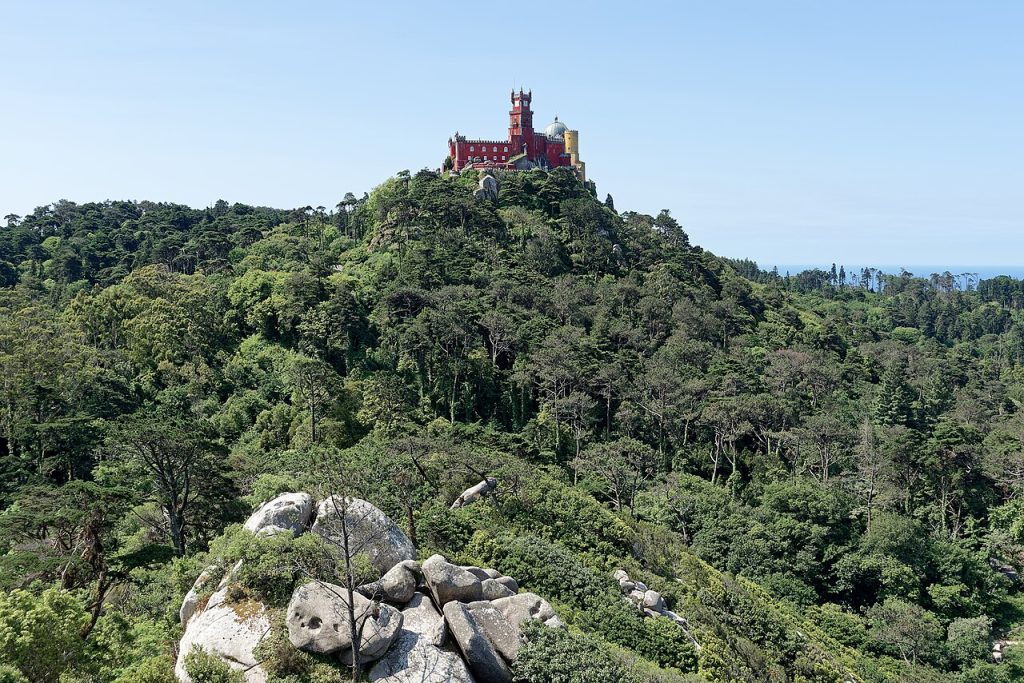
Pena today is Portugal’s most visited palace, with some two million tickets a year, the flagship of the Parques de Sintra company whose revenues restore the serra’s whole ensemble; the 1990s repainting recovered Ferdinand’s reds and yellows, the 1995 UNESCO listing of Sintra’s cultural landscape put Pena at its centre, and current work runs from the battlements’ lime renders to the park’s replanting against invasive acacia. The crowds are real, timed entry to the palace rooms now meters the worst crush, and the counsel of every local holds: come at opening or after four, or come in rain, when the mist performs and the terraces empty.
Now, stop here a last time on the clock tower terrace with the serra, the town palace’s two white cones and the Atlantic below. A German widower built, on a ruined cloister, Europe’s first Romantic palace and a forest to carry it; the style went north to Bavaria and the world came back to look. The Iberian chapter of this series ends on its highest point, and the mist, as usual, is already climbing the walls.
Pena on Video
Visiting Pena Today
The Palácio Nacional da Pena and its park are open daily, with timed palace tickets that sell out in season, book online with Parques de Sintra before you travel, and a park-only ticket for the gardens, lakes and chalet; allow an hour for the palace rooms and terraces, and two for the park, with the Cruz Alta summit and the Chalet of the Countess as the quiet prizes. Reach the gates by bus 434 from Sintra station and town palace, by tuk-tuk or taxi, or on foot up the steep, lovely Caminho de Santa Maria in about an hour; the shuttle inside the gates saves the last climb. First entry and the last two hours beat the crowds, and cloud is not a cancellation but a mood.
Sintra is forty minutes by train from Lisbon’s Rossio; drivers should leave cars in the town’s lower lots, for the hill road is one-way, narrow and merciless in season. The town palace and Monserrate, this chapter’s companions, fill the same day’s morning and late afternoon perfectly. Here is the exact spot: Pena Palace on Google Maps.
Palaces Nearby
You May Like
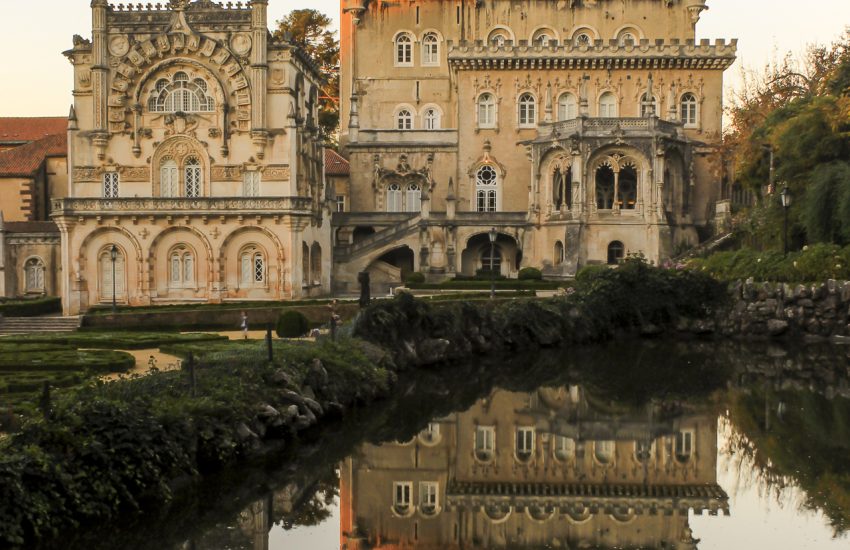
Bussaco Palace and the Hunting Lodge That Became a Hotel