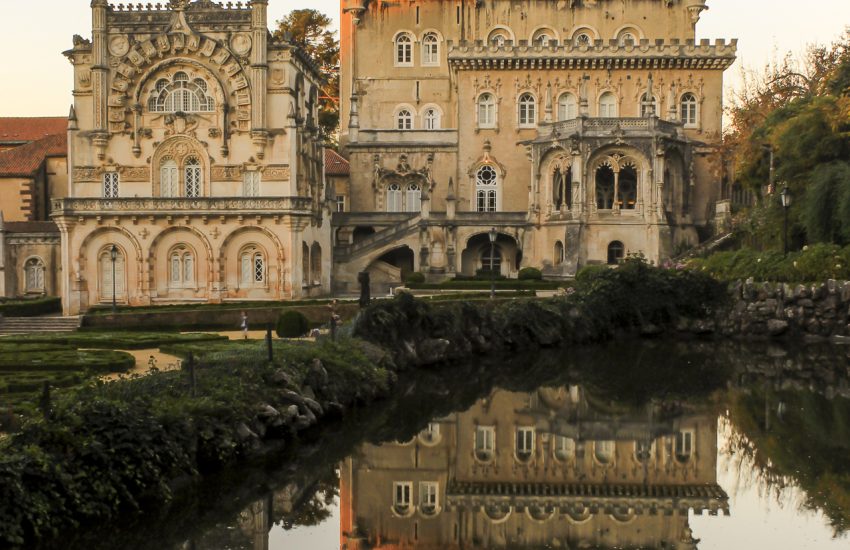
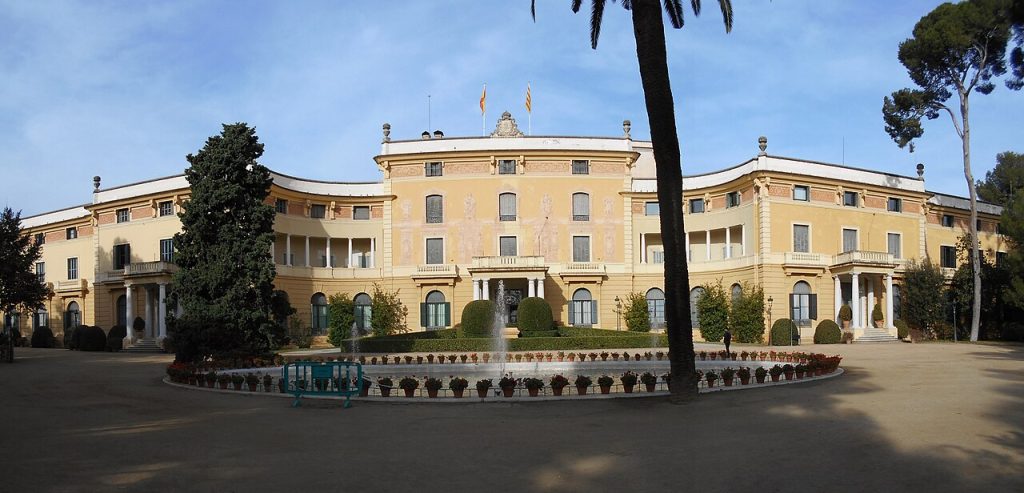
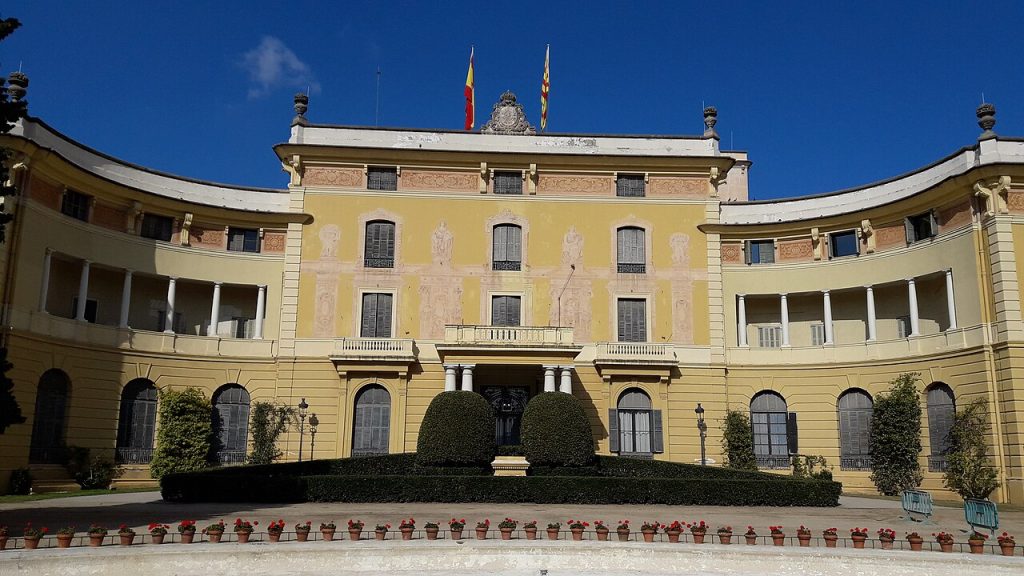
At the top of Barcelona’s Diagonal avenue, where the city rises toward the Collserola hills and the old village of Pedralbes, a long cream-coloured palace with green shutters and a central bow of Ionic columns looks south over cedars, cypresses and pools toward the sea. It is the Palau Reial de Pedralbes, the newest royal palace in Spain: created between 1919 and 1924, not by a king’s architects on a king’s land, but by the city of Barcelona and its great industrial families, who carved it out of the Güell estate, the same family and grounds where the young Antoni Gaudí had built his first commissions, and presented it to Alfonso XIII so that the monarchy would at last have a worthy roof in Spain’s industrial capital.
Pedralbes compresses modern Spain into one garden. A textile fortune’s country house became a royal palace by civic subscription; the king used it barely a handful of times before his crown fell in 1931; the Republic turned it into a decorative arts museum within two years; Franco kept apartments here for his Catalan visits; the restored democracy made it a museum again and then the seat of the Union for the Mediterranean, so that the halls built for a king now host Euro-Mediterranean diplomacy; and in the gardens, under the bamboo, stands a wrought-iron dragon gate and a little parabolic fountain by Gaudí, lost for decades and found again in 1983. It is the fourth stop of this Iberian chapter, and the counterpoint to the medieval Almudaina: a royal palace younger than the light bulb.
Walk with me up the Diagonal through the iron gates, across Forestier’s parterres to the columned facade, through the throne room and the queen’s rooms, and into the bamboo grove where a dragon made by Gaudí waits, with counts, kings, republics and diplomats in order. The contents are below.
In This Article
- The Top of the Diagonal
- Can Feliu and the Güell Estate
- The Young Gaudí at the Güell Gate
- 1919: A Palace by Subscription
- Alfonso XIII and the Catalan Question
- Bona and Nebot’s Palace
- The Throne Room and the Apartments
- Forestier, Rubió and the Gardens
- The Lost Gaudí Fountain
- 1929: The Exposition and the Royal Visits
- Republic, Museum and Civil War
- Franco’s Apartments and the Museums’ Return
- Diplomacy in the Garden Today
- Pedralbes on Video
- Visiting Pedralbes Today
- Palaces Nearby
The Top of the Diagonal
The Diagonal, the great avenue that Ildefons Cerdà sliced across his grid plan of Barcelona, climbs westward out of the business district into a leafier city of university faculties, consulates and football, for Camp Nou lies ten minutes downhill, and at its upper end the palace sits back from the traffic behind railings and a screen of cedars, its gardens absorbing the noise so completely that the change at the gate is physical. Uphill lies the old village of Pedralbes, petras albas, the white stones, with its superb fourteenth-century royal monastery, where Queen Elisenda’s Gothic cloister is one of the most serene places in Catalonia; the palace borrowed the village’s prestige along with its name.
Now, stop here at the main gate and look up the central walk to the facade: the composition, forecourt, parterre, bow of columns, is pure courtly Europe, and it was finished in the age of jazz, five years before the Chrysler Building.
Can Feliu and the Güell Estate
The land was assembled in the 1870s and 1880s by Eusebi Güell, the textile magnate, politician and greatest art patron of industrial Barcelona, who joined the old farms of Can Feliu and Can Baldiró, with their vineyards and masía farmhouses, into a country estate at the city’s edge, with a Caribbean-tinged mansion remodelled by Joan Martorell, stables, lodges and gardens; Güell’s fortune came from his father’s Cuban trade and his own mills, and his name survives across Barcelona in the Palau Güell, the Colònia Güell and the Park Güell, every one of them built for him by his protégé Gaudí. The Pedralbes estate was the family’s summer seat, where Güell entertained poets, bishops and King Alfonso’s grandmother’s ministers under the carobs.
Güell died in 1918 in his park above the city, and within a year his heirs had offered the heart of the Pedralbes estate for the project that became the palace.
The Young Gaudí at the Güell Gate
Between 1884 and 1887, before the Sagrada Família consumed him, the young Gaudí worked at Pedralbes for Güell, building the estate’s perimeter walls and entrance lodges, the Pavellons Güell that still stand at the upper corner of the grounds on Avinguda de Pedralbes: a gatehouse and stables of ochre brick and trencadís tile under parabolic vaults, guarded by the Porta del Drac, the dragon gate, a five-metre wrought-iron winged dragon whose gaping jaws and clawed wing actually moved when the gate opened, built to represent Ladon, the dragon of the garden of the Hesperides from Verdaguer’s Catalan epic L’Atlàntida, which the estate’s planting also evoked with orange trees. The dragon is one of the most startling iron objects of the nineteenth century.
Now, stop here at the dragon gate, two minutes’ walk up from the palace: the whole Gaudí story starts at this hinge, a banker’s garden fence that is also a national poem in iron.
1919: A Palace by Subscription
Barcelona in 1919 was Spain’s industrial capital and its most turbulent city, shaken by general strikes and gunmen, and its conservative elite wanted the king closer: a royal residence, they argued, would bind crown and city, reward Catalonia’s loyalty and perhaps soften Madrid’s centralism. A committee of the city council and the great families, led by the Güell heirs, who gave the land, raised funds by subscription, and between 1919 and 1924 the Güell mansion was rebuilt and doubled into a palace, presented to Alfonso XIII in 1926 when royal works accepted it into the crown’s patrimony; it was the only royal palace in Spanish history created by a city for its king.
The gesture carried an irony nobody missed later: the palace of civic monarchism was finished just as the monarchy entered the dictatorship of Primo de Rivera that would drag it down.
Alfonso XIII and the Catalan Question
Alfonso XIII was king from the moment of his birth in 1886, his father dead six months before, and ruled personally from 1902 over a parliamentary system he could not resist manipulating; polo-playing, motor-mad and brave, he survived an anarchist’s bomb on his wedding day in 1906, kept Spain out of the First World War, and backed the coup of General Primo de Rivera in 1923, a decision that fatally tied the crown to dictatorship. Barcelona was his most delicate front: Catalan industrialists wanted protection and home rule, Catalan workers wanted revolution, and the king’s visits were exercises in tightrope charm, reviewing fleets, opening expositions and speaking the few Catalan phrases his advisers allowed.
When the municipal elections of April 1931 went to the republicans, Alfonso left Spain without abdicating, to spare blood, he said; he had slept in his Barcelona palace only a handful of nights, and never saw it again.
Bona and Nebot’s Palace
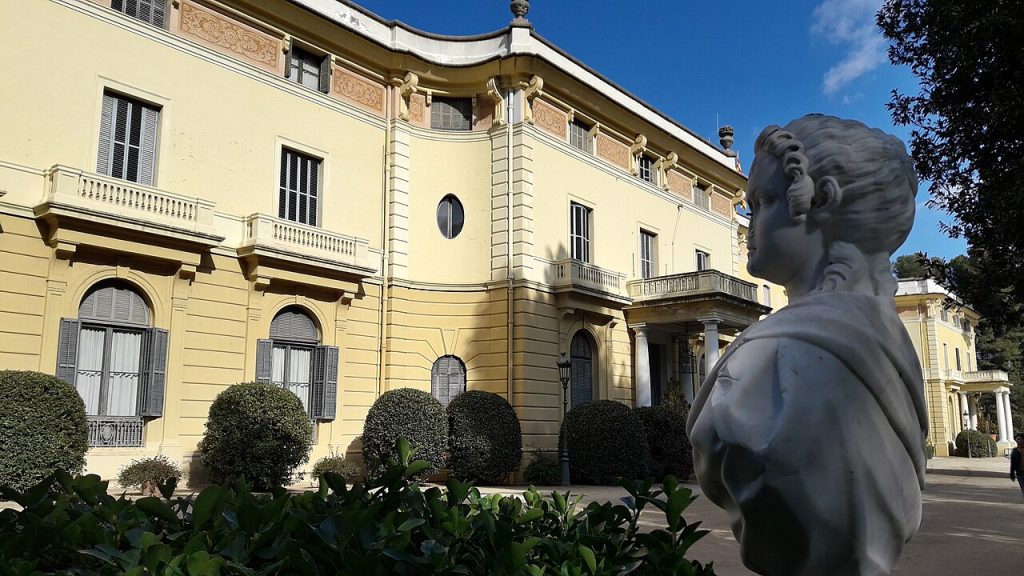
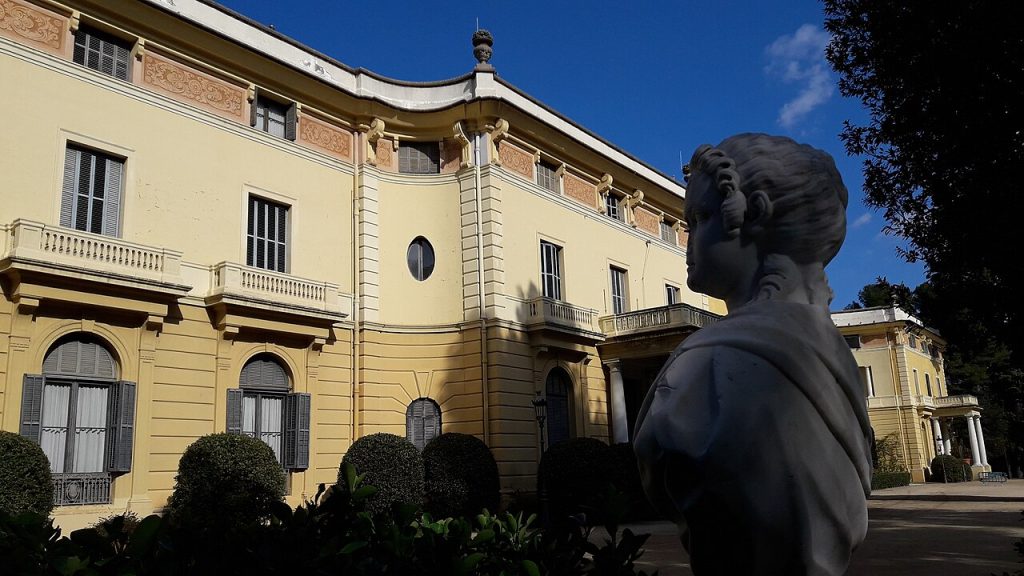
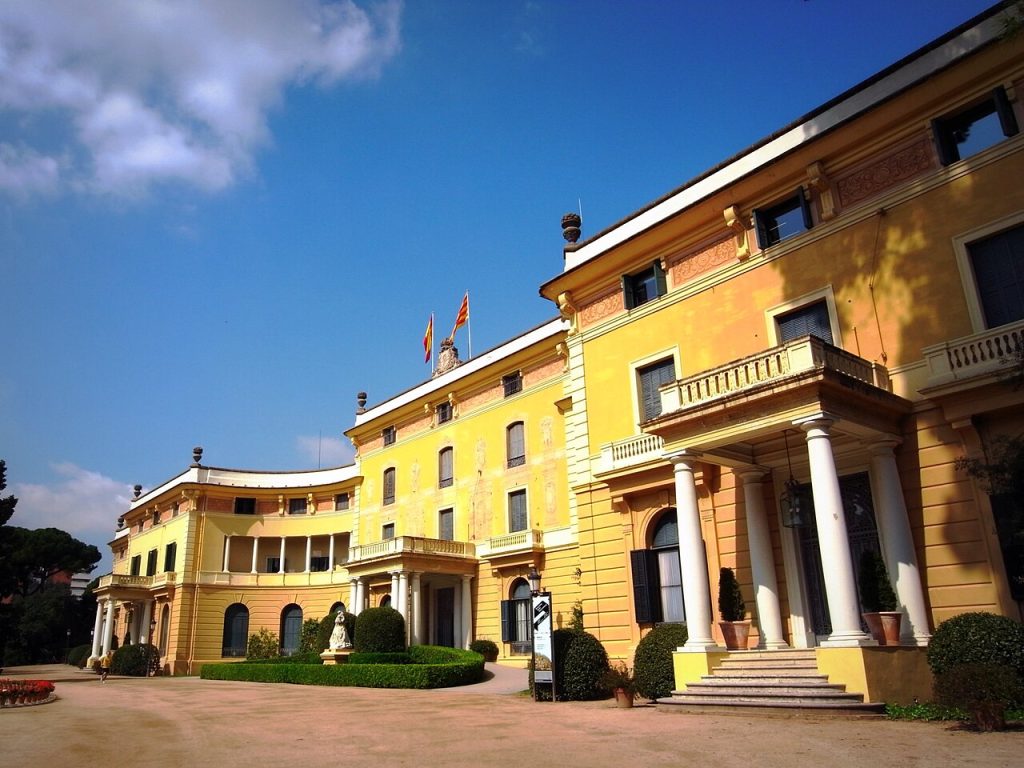
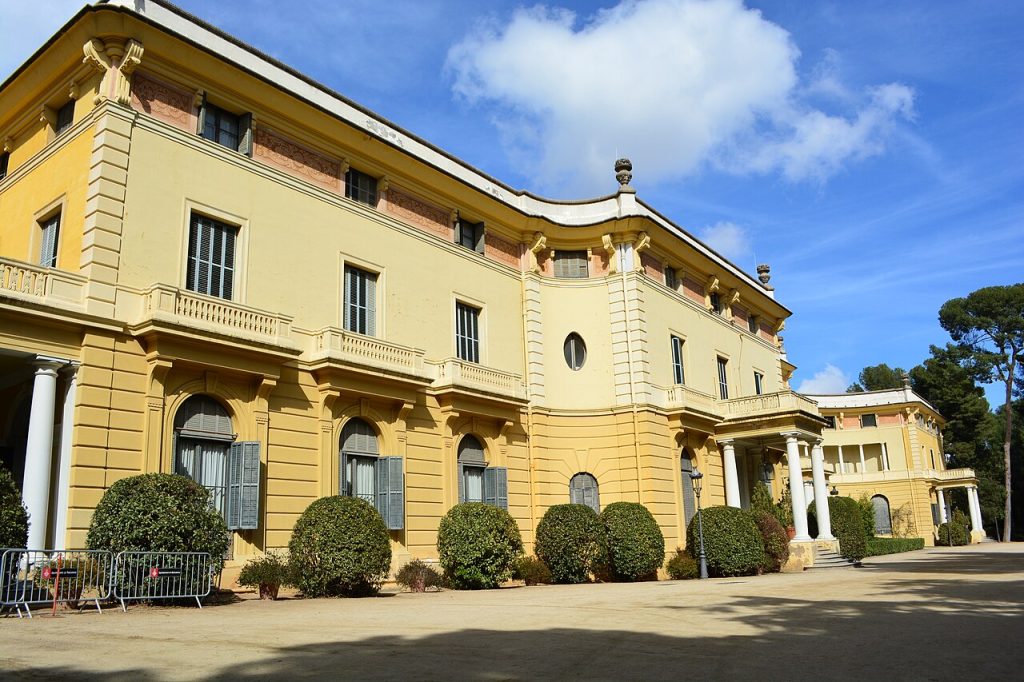
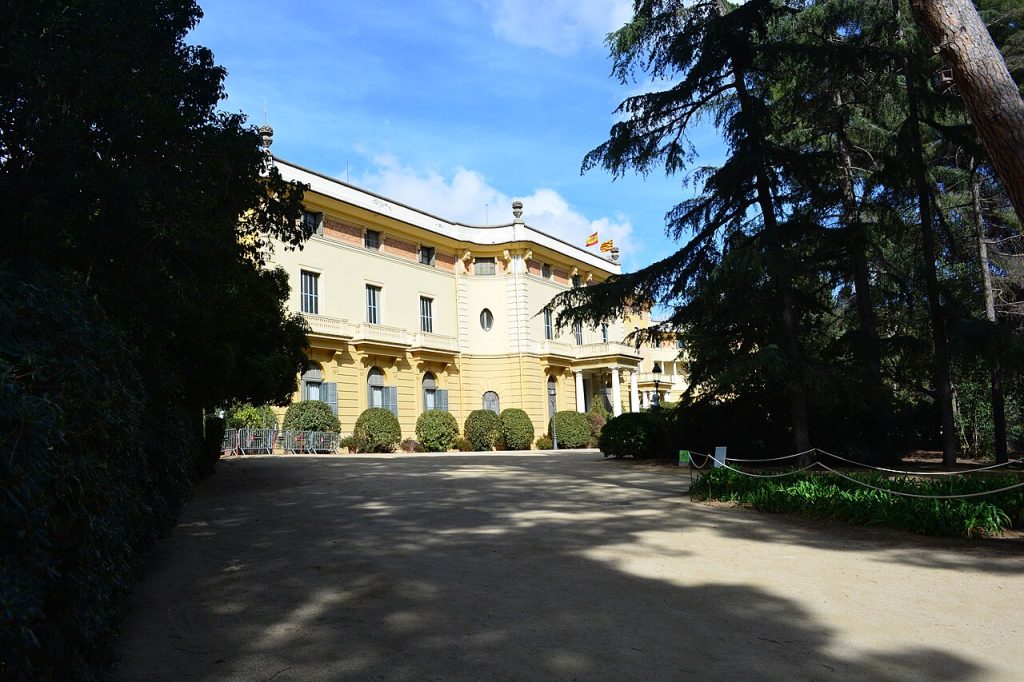
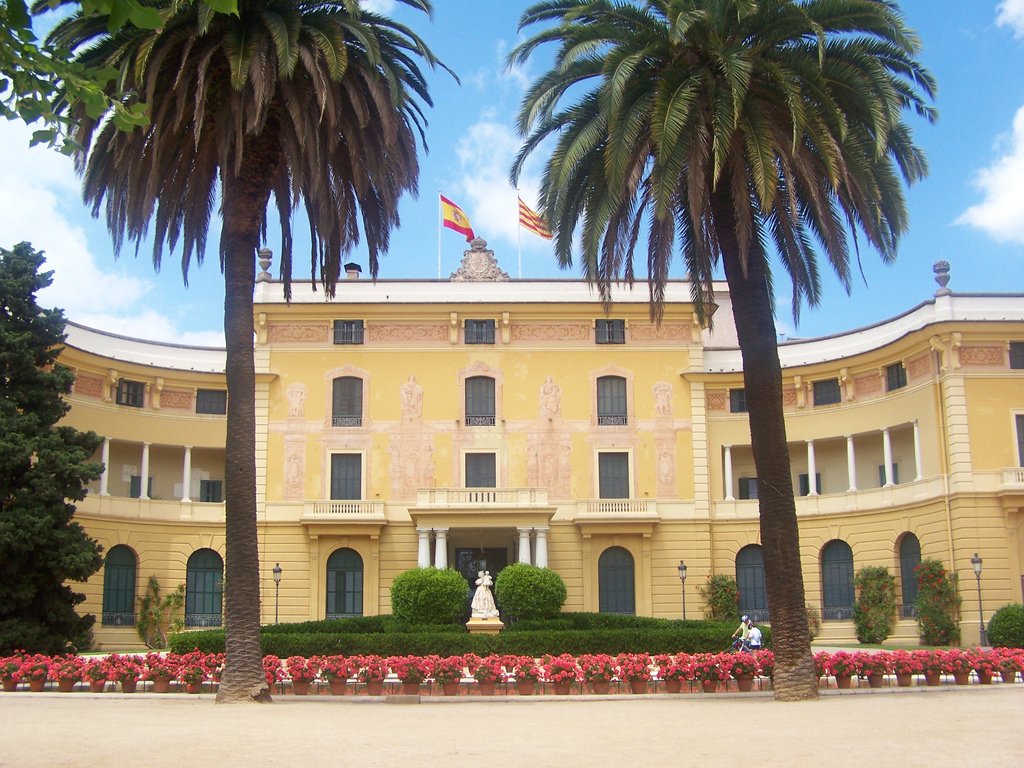
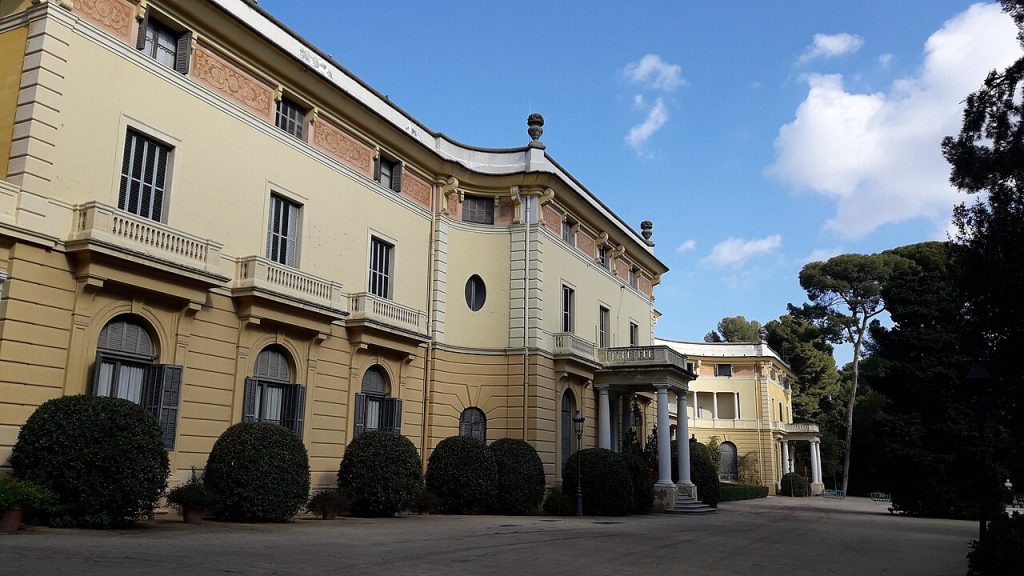
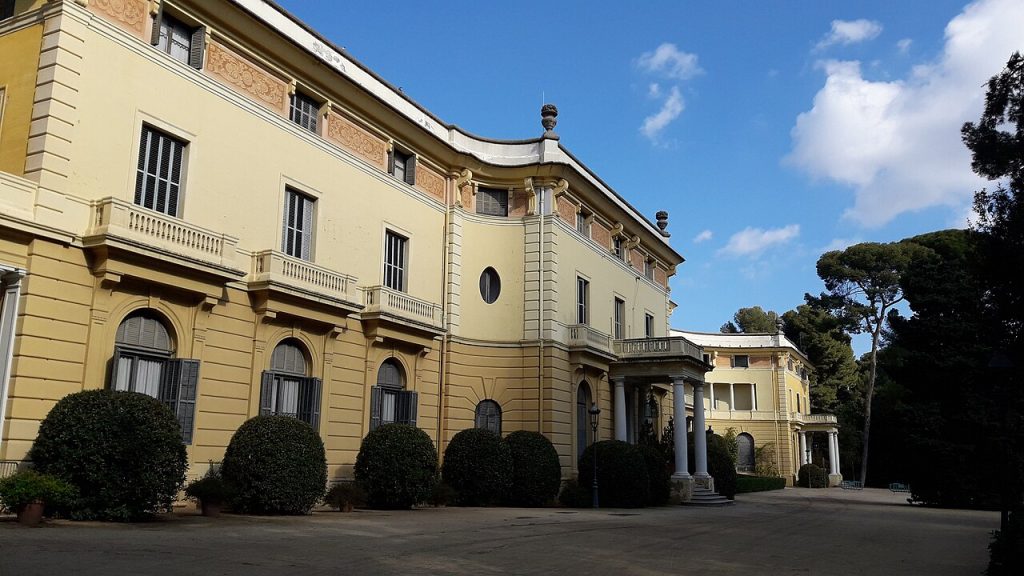
The architects Eusebi Bona and Francesc Nebot, working in Barcelona’s Noucentista classicism, the movement that answered modernisme’s curves with Mediterranean order, kept the Güell mansion as the core and wrapped it in a new palace: a main block with a semicircular central bow of giant Ionic columns, two advancing wings framing the garden court, cream stucco, green louvred shutters and balustraded roofs, a composition closer to an Italian royal villa than to the granite tradition of Castile. Inside, Catalan craft workshops supplied marbles, bronzes, coffered ceilings and glass, and the crown lent tapestries and paintings; the palace was deliberately a showcase of what Barcelona’s industries and ateliers could do.
The result is the only royal palace in the Noucentista style anywhere, a one-off in the catalogue of Europe’s residences, and its garden face at golden hour is among the most photogenic facades in the city.
The Throne Room and the Apartments
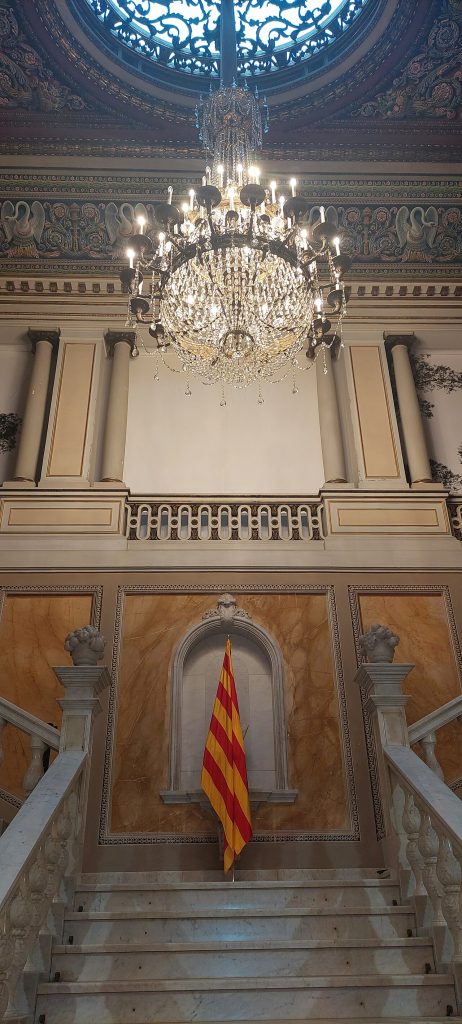
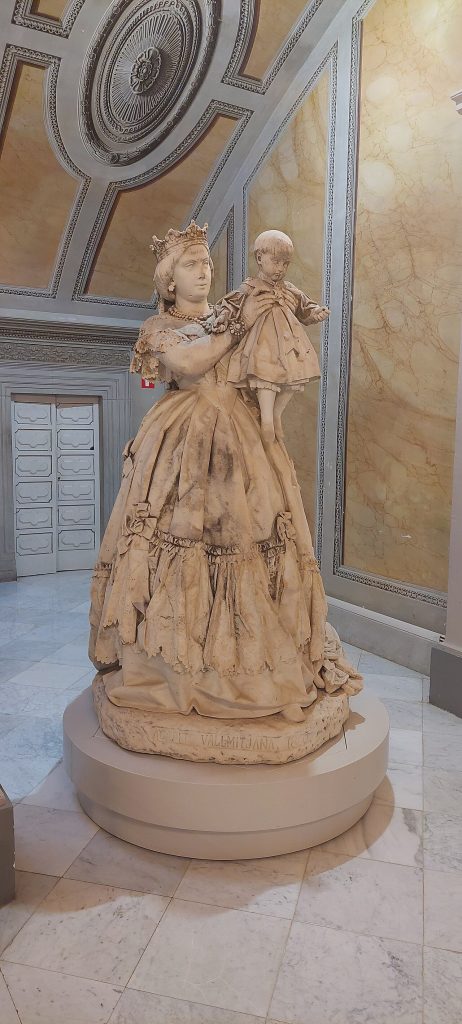
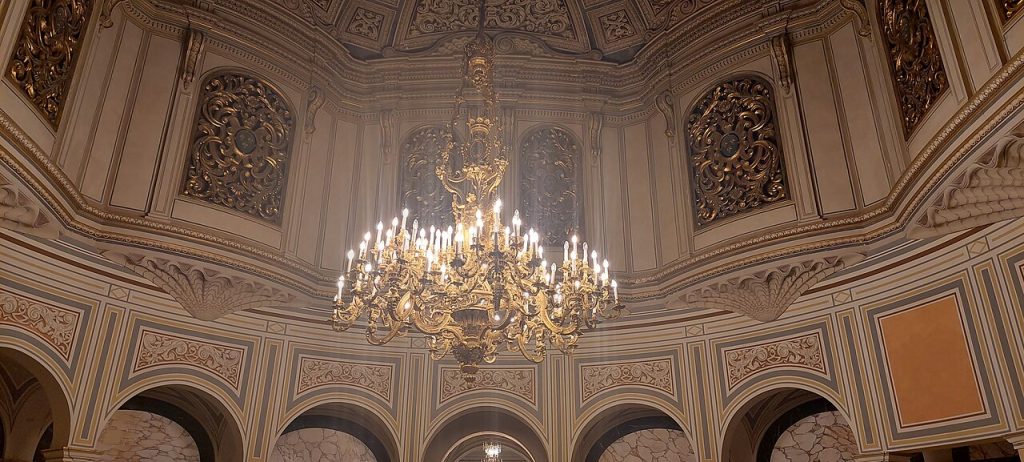
The state floor centres on the throne room under the bow of columns, with a ceiling of painted allegories, crimson hangings and the paired thrones on a dais, flanked by the hall of mirrors, the music room with its grand piano and Aubusson-style suites, the ambassadors’ saloon and the dining gallery, and, in the wings, the king’s and queen’s private apartments, bedrooms, baths of veined marble and dressing rooms fitted in the latest comfort of the 1920s, central heating, lifts and telephones, which made Pedralbes technically the most modern royal residence in Europe on the day it opened. Much original furniture survives in situ or in the national collections, and the rooms are shown on open days and heritage weekends.
Now, stop here in the throne room and count the reigns it served: Alfonso XIII a few nights, no king again for half a century, and today’s monarchs only as guests at dinners; the newest throne room in Europe is also its least used.
Forestier, Rubió and the Gardens
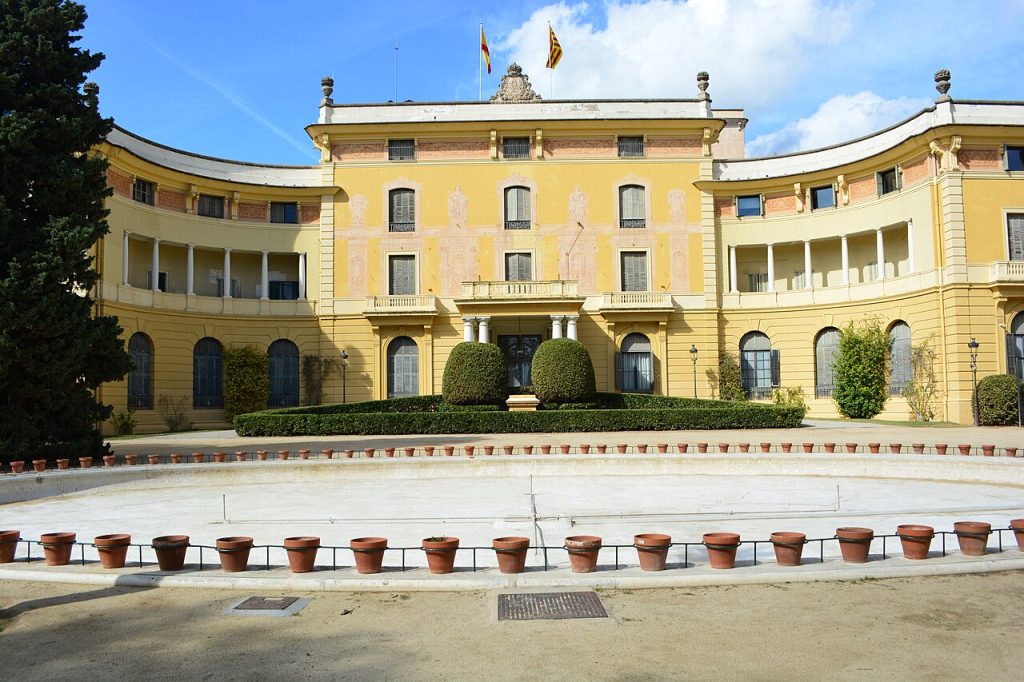
The gardens, seven hectares between the Diagonal and the palace, were laid out by the French master Jean-Claude Nicolas Forestier, the designer of Seville’s María Luisa park, with Barcelona’s own Nicolau Maria Rubió i Tudurí, director of the city’s parks, and they translate the French formal manner into Mediterranean planting: a central axis of parterres and a long pool reflecting the facade, walks of limes and bitter oranges, cedars of Lebanon, Himalayan cedars and enormous eucalyptus from the Güell plantings, bamboo groves, a stepped cascade, statuary including a copy of the Bargello’s drunken Bacchus, and ivy-clad pergolas. The gardens are a public park now, Barcelona’s quietest, used by students from the surrounding faculties and hosting an open-air festival each summer with concerts on the lawn.
Rubió’s rule was that nothing should out-scale the house; seventy years of growth have gently broken it, and the cedars now tower over the roofline, to the garden’s advantage.
The Lost Gaudí Fountain
In 1983 the garden historian and architect searching the overgrown corners of the park pushed into a bamboo thicket west of the palace and found, buried in green shade, a small fountain that archival work confirmed as Gaudí’s, built about 1884 for the Güell estate’s gardens: a parabolic arch of rough stone over a stone bench, with a spout in the form of a wrought-iron Chinese-whiskered dragon and, above, a pedestal that once carried a bust of Hercules, the hero of the Hesperides programme that the dragon gate continues uphill. Cleaned and conserved, the Hercules fountain is signposted now but still half-hidden, and most visitors to the gardens walk past the bamboo without suspecting it.
Now, stop here on Gaudí’s bench with the dragon trickling beside you: it is the quietest Gaudí in Barcelona, no queue, no ticket, just a young architect’s garden toy sleeping a century in the leaves.
1929: The Exposition and the Royal Visits
The palace’s brief royal heyday came with the International Exposition of 1929 on Montjuïc, the fair that gave Barcelona its magic fountain, its national palace and Mies van der Rohe’s German pavilion: Alfonso XIII and Queen Victoria Eugenia stayed at Pedralbes for the opening ceremonies, receiving delegations beneath the new ceilings, and the court’s automobiles ran shuttle between the Diagonal and Montjuïc through crowds that cheered the spectacle if not always the crown. These weeks, and scattered stays in 1930, were nearly the whole of the palace’s service as a living royal residence; the king’s final departure from Spain in April 1931 passed through Cartagena, and Pedralbes’s flag came down after barely five years.
The 1929 exposition bankrupted the city and the dictatorship alike, and the palace at its top corner remains the fair’s most intact interior ensemble, frozen on its opening day.
Republic, Museum and Civil War
The Second Republic seized the crown’s patrimony, and Barcelona moved fast: in 1932 the palace opened as the Museu de les Arts Decoratives, its royal rooms filled with ceramics, glass, furniture and textiles from medieval Catalonia onward, one of the first decorative arts museums in Spain, while the Generalitat under presidents Macià and Companys used the state floor for receptions of the autonomous Catalan government. During the Civil War the collections were crated against bombing, the gardens dug for shelters, and in the war’s last winter the fleeing Republic’s institutions passed through; Franco’s troops took the city in January 1939, and the palace, like Catalonia, changed masters again.
The decorative arts museum would occupy the palace, with interruptions, for eighty years, and generations of Barcelona schoolchildren knew the throne room only as the biggest gallery.
Franco’s Apartments and the Museums’ Return
Franco reserved the palace’s apartments for his Barcelona visits, sleeping here on his tightly staged descents on the city, and the regime used the halls for official banquets, so the palace spent four decades as part museum, part ghost residence, its visitor route closing whenever the dictator’s fleet of black cars came up the Diagonal. After 1975 the museums spread back through the building, decorative arts, ceramics and for a time the Cambó old masters and the carriage collection, until the collections moved in 2012 to the new Disseny Hub at Glòries; the palace then passed fully to institutional use, its rooms restored for protocol, its gardens confirmed as a public park, and its music festival, running since the 1970s revival, lighting the facade each July.
Every regime of twentieth-century Spain, monarchy, republic, dictatorship and democracy, kept its keys to this one house; no other building in the country collected the full set so neatly.
Diplomacy in the Garden Today
In 2010 the Palau Reial de Pedralbes became the headquarters of the Union for the Mediterranean, the organisation of forty-three European and Mediterranean states born of the 2008 Barcelona Process summit, and the palace built to reconcile a king with a city now hosts ministers from Rabat to Helsinki negotiating water, energy and universities beneath the throne room’s allegories; the 2018 EU summit on Brexit’s Gibraltar clauses was prepared in its dining gallery. Open days, Barcelona’s heritage weekends and the summer festival let the public through the state floor, and the gardens never closed at all, so the newest royal palace in Spain has settled into the most useful afterlife of any of them.
Now, stop here a last time on the garden axis at dusk, with the pool holding the lit facade and the cedars black against the sky. A century ago this was a gift meant to save a crown; the crown could not be saved, but the gift turned out to be for the city, and the city uses it every day.
Pedralbes on Video
Visiting Pedralbes Today
The gardens of the Palau Reial de Pedralbes are free and open daily from morning to dusk; the palace interiors open on guided visits, heritage open days such as 48H Open House and Santa Eulàlia, and during the Festival Jardins de Pedralbes each June and July, when concerts fill the lawn and the state floor can be seen before performances, so check the palace and festival websites when planning. Do not miss the Hercules fountain in the bamboo west of the main pool, and walk five minutes up Avinguda de Pedralbes to Gaudí’s dragon gate at the Pavellons Güell and fifteen more to the Gothic cloister of the Pedralbes monastery, the best half-day in uptown Barcelona.
The palace is at Avinguda Diagonal 686, on metro line 3 at Palau Reial station, fifteen minutes from Plaça de Catalunya, with the tram and Diagonal buses stopping at the gates; Camp Nou is one stop downhill. Here is the exact spot: Palau Reial de Pedralbes on Google Maps.
Palaces Nearby
You May Like
Pena Palace and the Romantic Hill of Ferdinand II