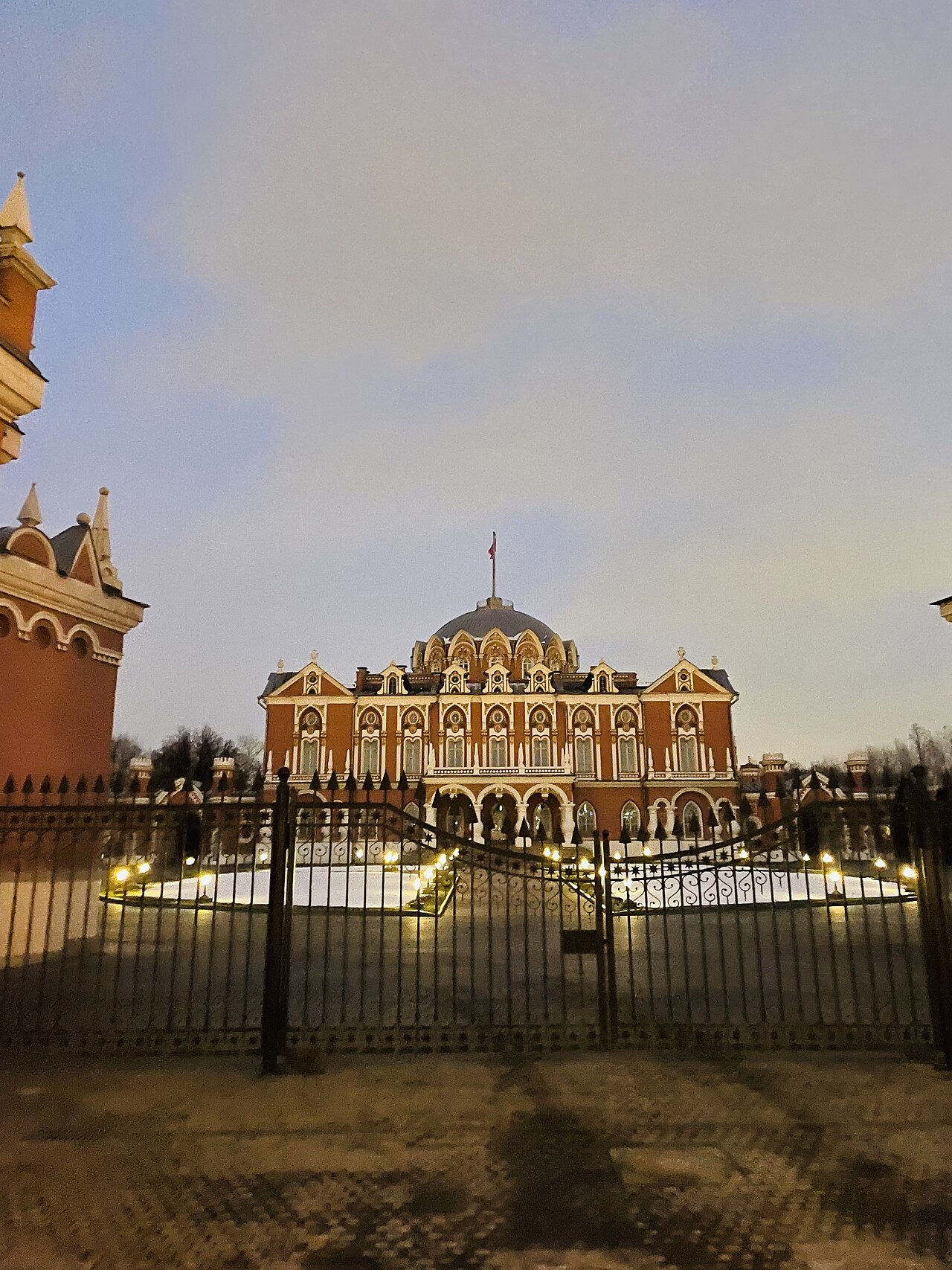
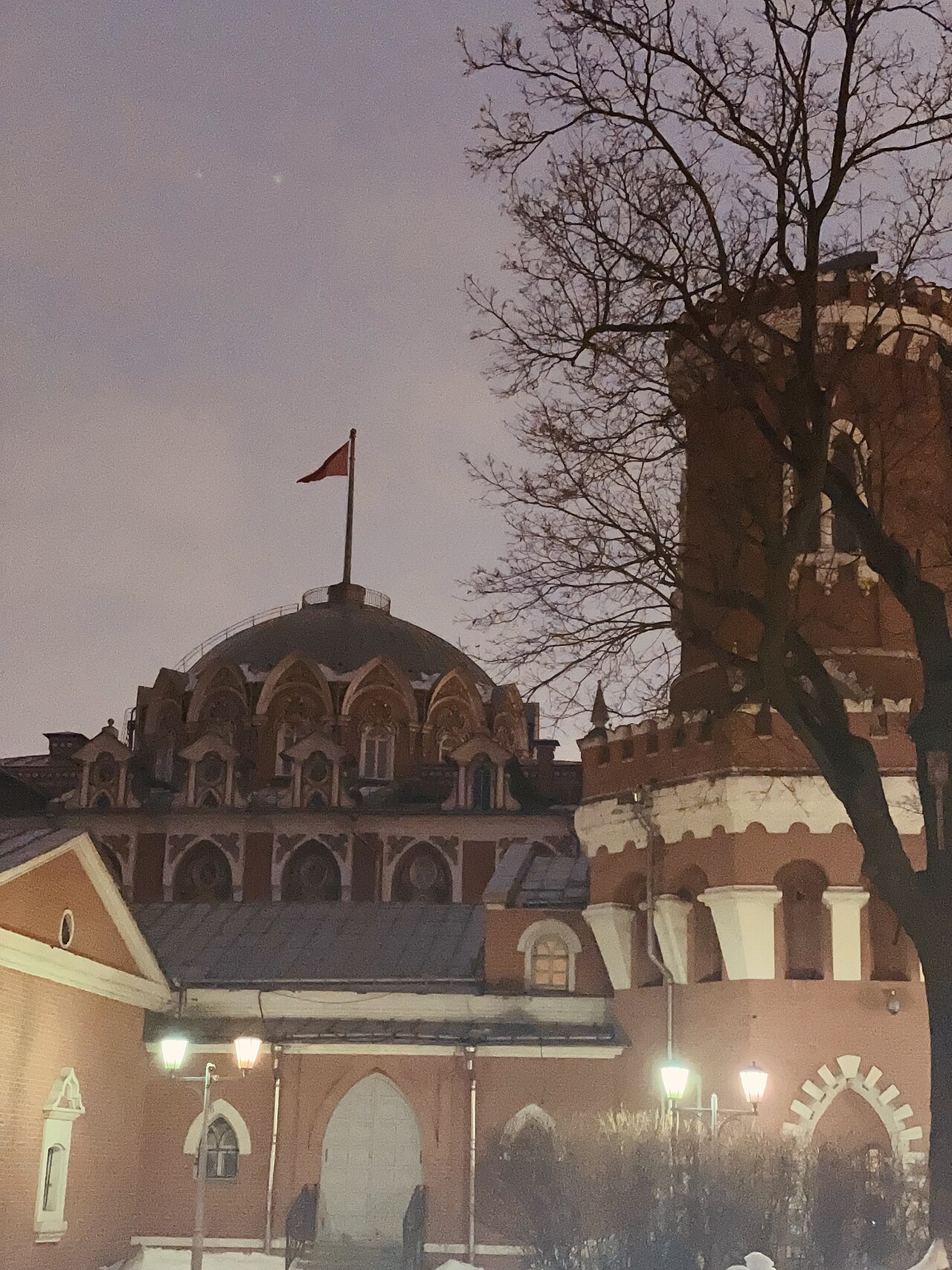
On Leningradsky Prospekt, where Moscow’s traffic pours toward the airport, the road suddenly passes a vision from another century: a russet-red castle of pointed white arches, pinnacles, and a great green dome, standing behind iron gates like a guest from a Gothic novel. This is the Petrovsky Travel Palace, built by Catherine the Great as the last overnight stop on the imperial road from St Petersburg, the place where tsars paused to rest, dress, and gather their processions before entering the old capital for coronation.
The palace owes its fame to two residents above all. Catherine herself, who in 1787 dismissed her guard here and let the people of Moscow throng her courtyard, a scene she described with delight; and Napoleon Bonaparte, who in September 1812 fled the burning Kremlin to this very building and watched Moscow’s fire from its windows, the days Tolstoy fixed in War and Peace and Pushkin in Eugene Onegin, which asks the palace directly to witness its own history.
This guide tells the whole story of Russia’s most romantic roadhouse: the victory over the Ottomans it commemorates, Matvei Kazakov’s red-and-white masterpiece that mixes Gothic arches with Muscovite ornament, coronation eves and the Khodynka tragedy, aviation generals and cosmonauts’ examinations, and the palace’s present life, in which, uniquely among Moscow’s monuments, you can book a room and sleep where emperors did.
- The Road Between Two Capitals
- A Palace for a Victory
- Kazakov’s Red Gothic
- Reading the Facades
- Catherine’s Nights Without Guards
- Paul and the Coronation Ritual
- Napoleon at the Windows
- After the Fire
- Coronation Eves of the Last Tsars
- The Khodynka Field Tragedy
- The Aviation Academy
- Restoration and Return
- A Palace You Can Sleep In
- Watch the Petrovsky Palace on Film
- Visiting the Petrovsky Palace Today
- Palaces Nearby
The Road Between Two Capitals
When Peter the Great moved Russia’s capital to the Baltic marshes in 1712, he created a problem no other empire had: the sacred city of coronations and the working city of government lay seven hundred kilometers apart, joined by a road that was, for most of the year, a trial of mud, ice, and bone-shaking log causeways. The journey took the court anywhere from several days by relay gallop to weeks with the full baggage train.
A chain of travel palaces, putevye dvortsy, grew along the route, at Tver, Torzhok, and lesser stations, where the sovereign could sleep, change horses, and receive local dignitaries in dignity rather than at a posting inn. The institution was practical, but its final link carried ceremony’s full weight: the last stop before Moscow had to stage the transformation of a traveling monarch into a crowned apparition entering the old capital.
Until the 1770s that final pause happened in borrowed quarters, and the empress who fixed it was Catherine the Great, a ruler with a flawless instinct for political theater. The spot chosen lay on the empty Khodynka meadow lands of the former Vysokopetrovsky monastery, whose name, honoring St Peter, conveniently echoed her dynasty’s founder; from monastery lands came the palace’s name, Petrovsky.
A Palace for a Victory
The palace was born from a peace treaty. In 1774 the treaty of Kuchuk-Kainarji ended Catherine’s first Turkish war in triumph: Russia gained the Black Sea steppe, free passage for its ships, and the standing of a Mediterranean power. The next summer Moscow staged celebrations on the Khodynka field of legendary scale, with pavilions representing captured fortresses, and the empress, riding the wave, ordered a permanent monument on the ground: a travel palace in the victory’s honor.
The commission went in 1776 to Matvei Kazakov, Moscow’s own great architect, and the work ran to 1780 with interiors finishing into the next decade. The brief was double: a functioning roadhouse for the court’s arrivals, and a victory monument legible to every traveler entering Moscow, which is why the building wears its symbolism so openly, crescent-topped details and oriental flourishes woven among Russian motifs, the defeated South embraced by the triumphant North.
Victory architecture was a family affair of the 1770s: at Tsaritsyno across the city, Vasily Bazhenov was building Catherine a Gothic fantasy estate for the same celebrations, and the two projects traded ideas and craftsmen. Tsaritsyno famously displeased the empress and stands part-ruin to this day; Petrovsky succeeded completely, which makes it the happy twin, the one Gothic dream of Catherine’s Moscow that was finished, loved, and lived in.
Kazakov’s Red Gothic
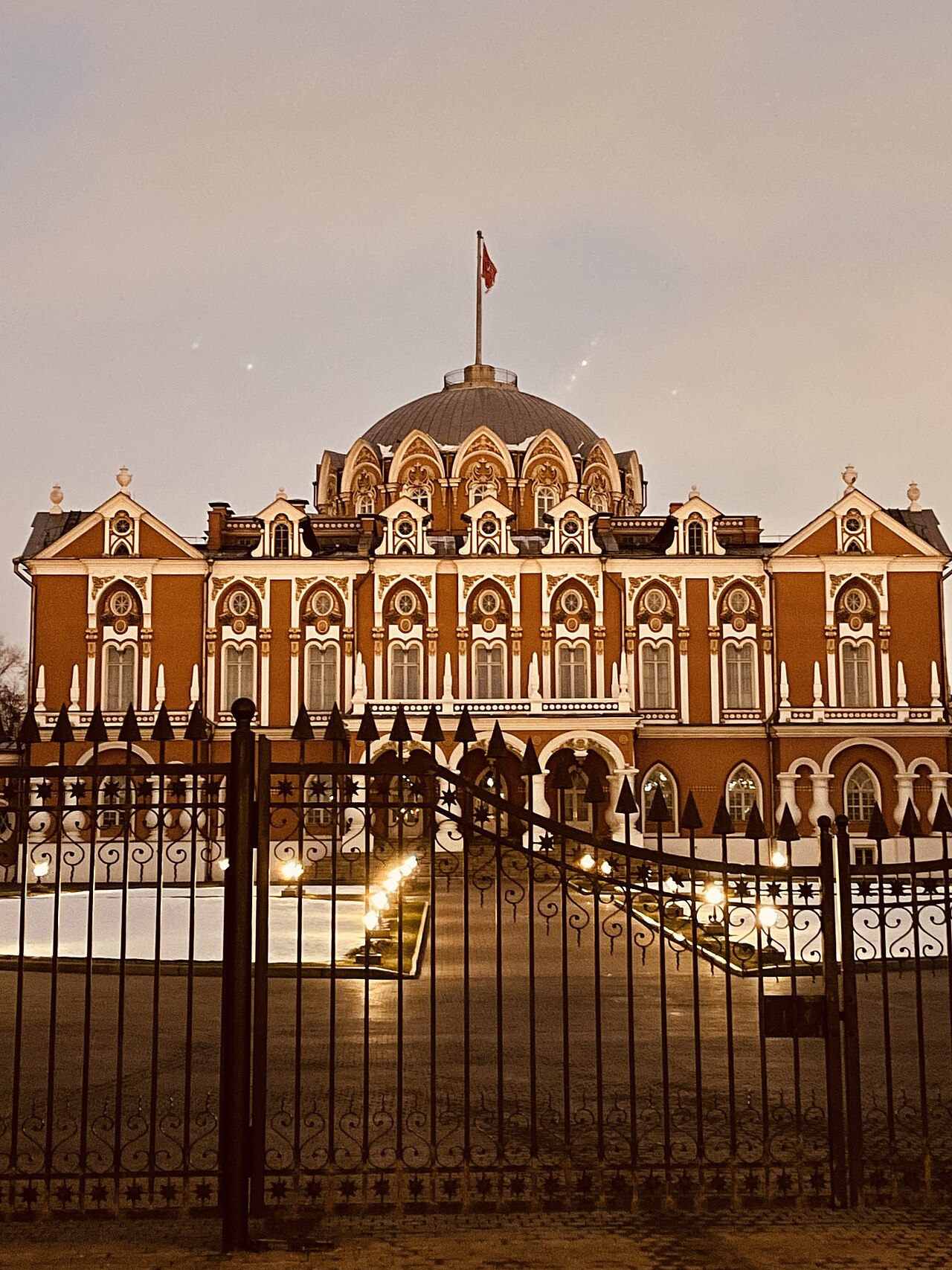
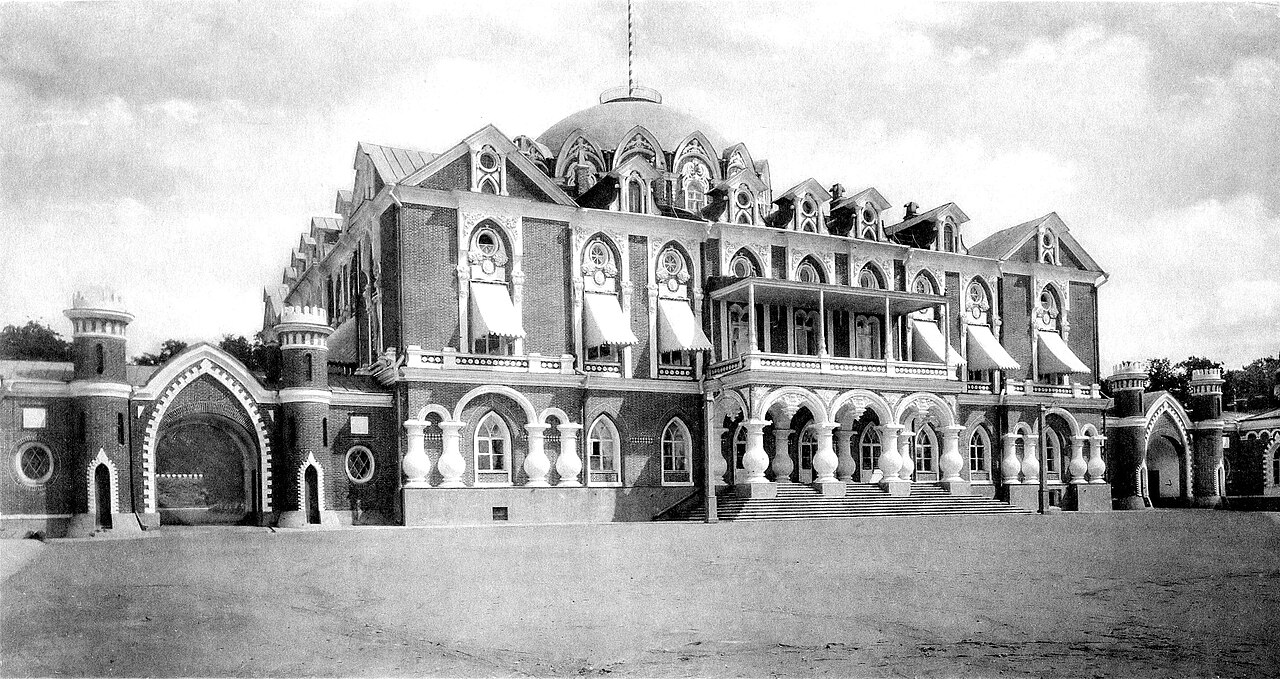
Matvei Kazakov built half of Catherine’s Moscow, the Senate in the Kremlin, the university, the Golitsyn hospital, assembly halls for the nobility, almost all of it in serene classicism. At Petrovsky he let imagination off the leash: the palace is his one great essay in what Russians call pseudo-Gothic, a romantic national style invented, with Bazhenov, from pointed arches, white stone lace on red brick, and the ornament of seventeenth-century Muscovy, pitcher-shaped columns, kokoshnik gables, hanging weights from old boyar porches.
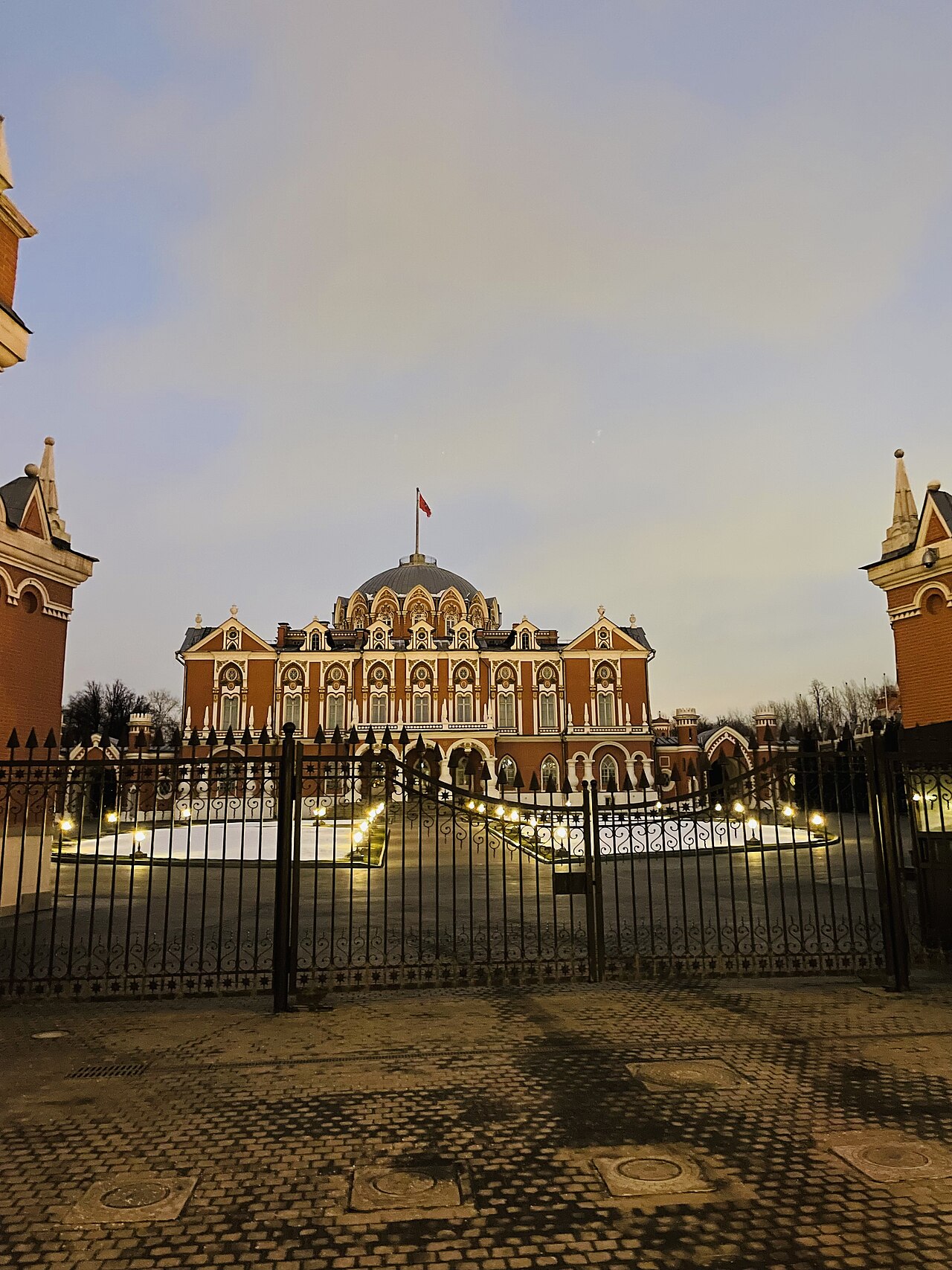
The composition, though, is pure classical discipline: a square main block under a monumental central dome, service wings curving forward to enclose a cour d’honneur, corner towers and gate turrets marshaled with parade-ground symmetry. The Gothic is costume on a classical body, which is exactly what makes the building photograph like a fairy tale while functioning like a machine for ceremony.
Kazakov’s dome deserves its own paragraph: an audacious brick shell sixteen meters across, carrying a painted heaven over the circular grand hall, with acoustics that made whispered conversation cross the room, a trick coronation guests never tired of testing. The architect kept the palace among his proudest works; his pupils’ albums record it lovingly, and through them its lacework spread into a century of Russian romantic building.
Reading the Facades
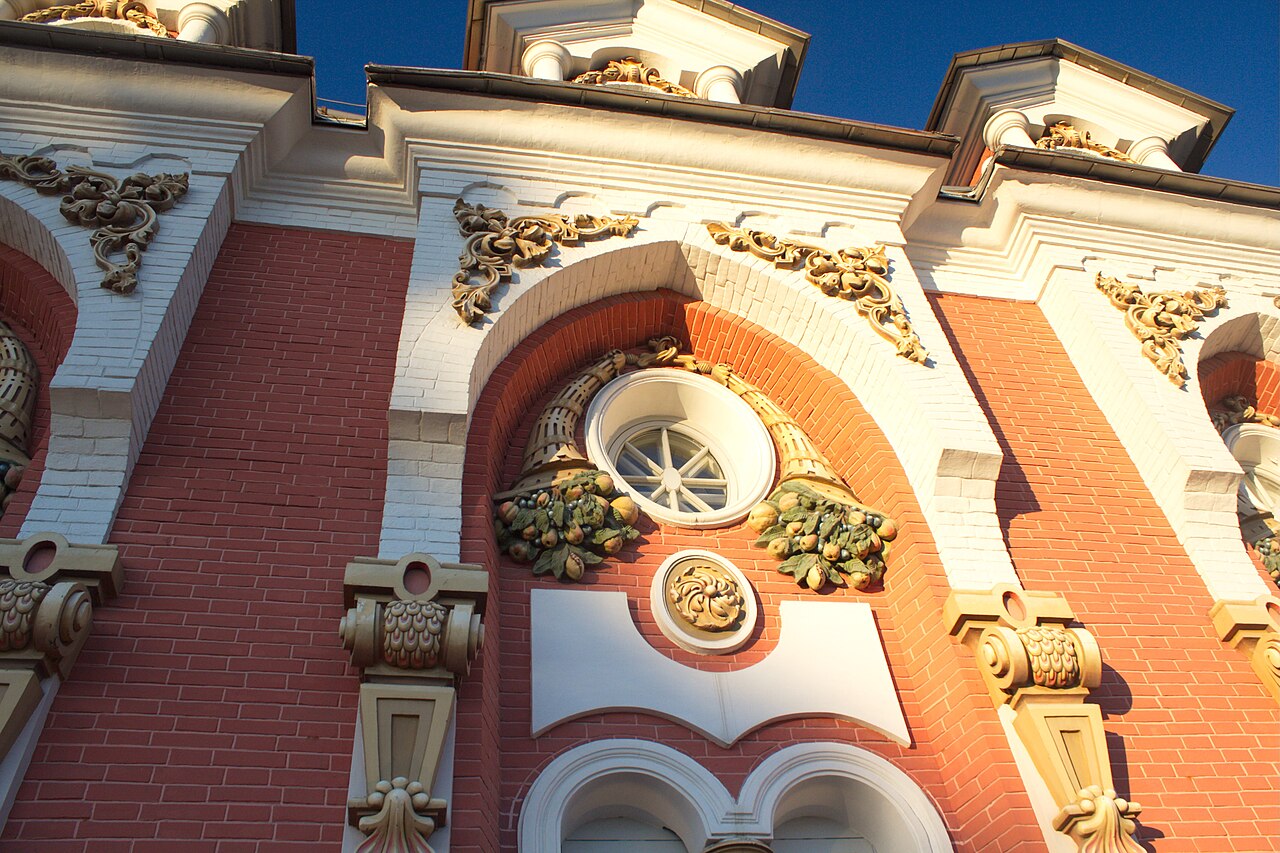
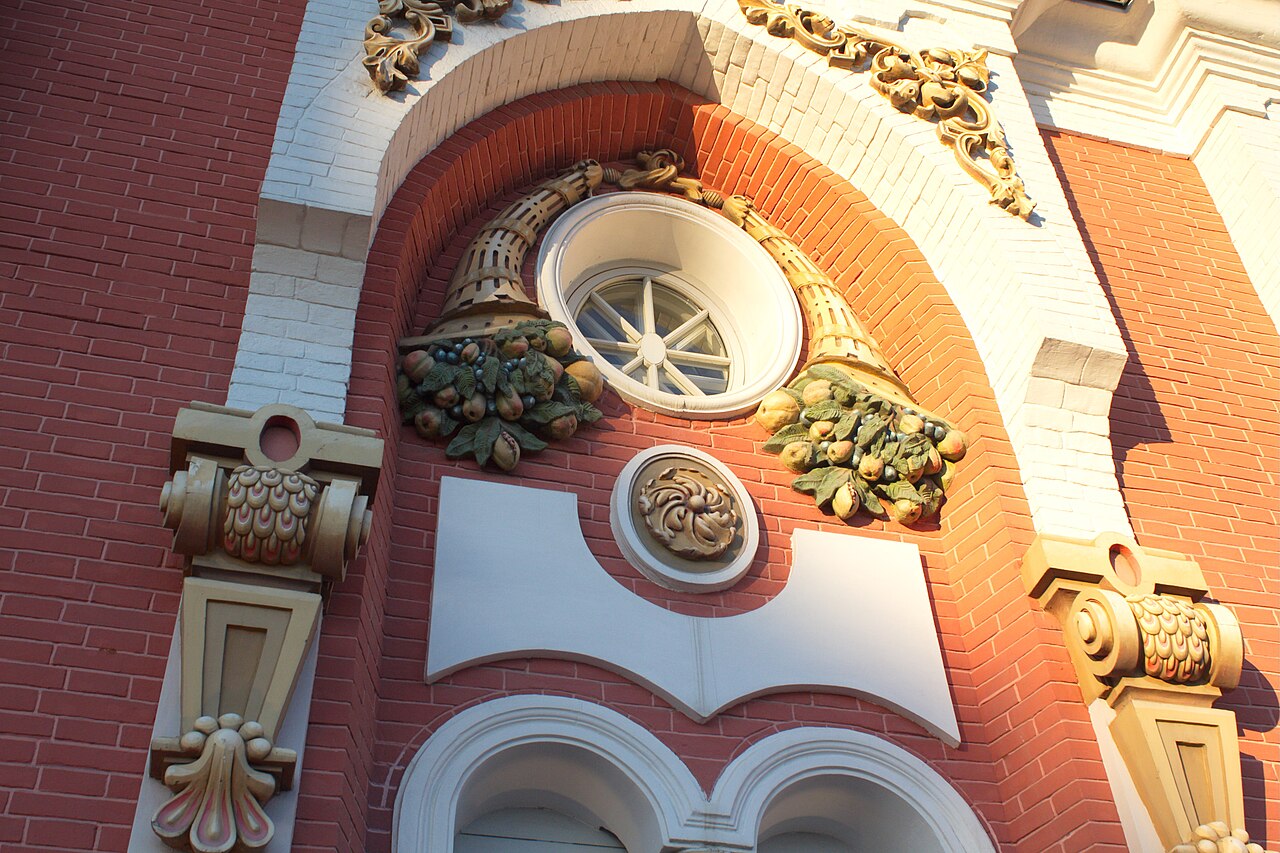
The palace rewards slow looking, because every detail argues. The pointed arches and pinnacles speak the European Gothic of chivalry and victory; the red brick with white trim is old Moscow’s own palette, the Kremlin walls’ colors domesticated; the bottle-shaped columns flanking windows are quotations from seventeenth-century church porches, the national past Catherine’s propagandists were busy ennobling. A traveler from Petersburg read, in one facade, the message that Europe’s most modern empress was also Muscovy’s legitimate heir.
Orientalist grace notes carry the Turkish victory: critics have long spotted minaret-like turrets and crescent curves among the towers, the defeated enemy displayed in ornament as captured banners were displayed in churches. The main gates’ iron tracery and the boundary towers, part fortress, part sugar decoration, complete a stage set that works from carriage distance and improves as you approach.
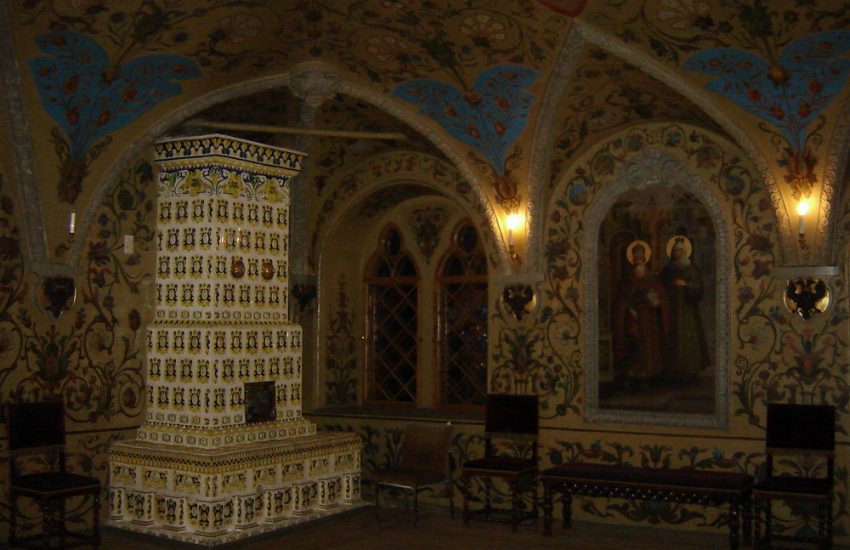
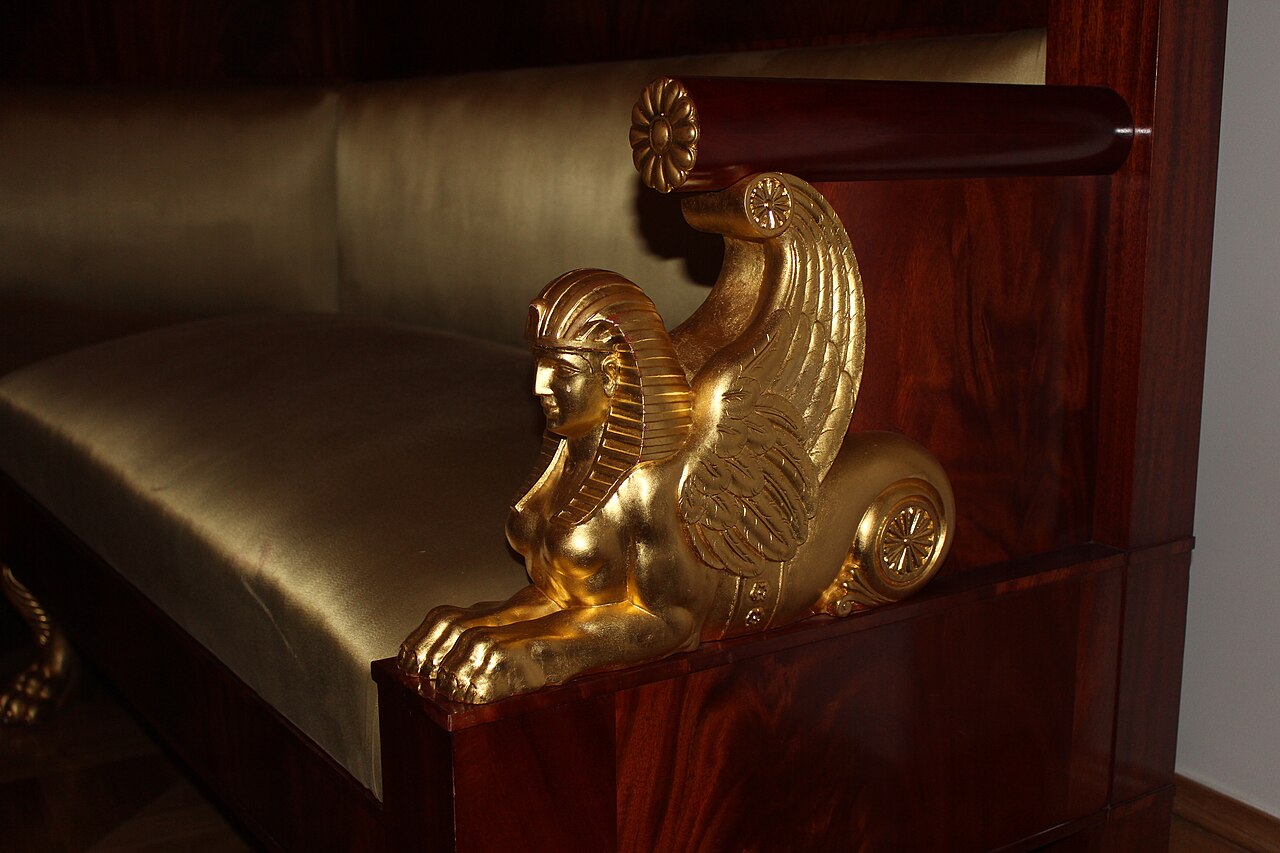
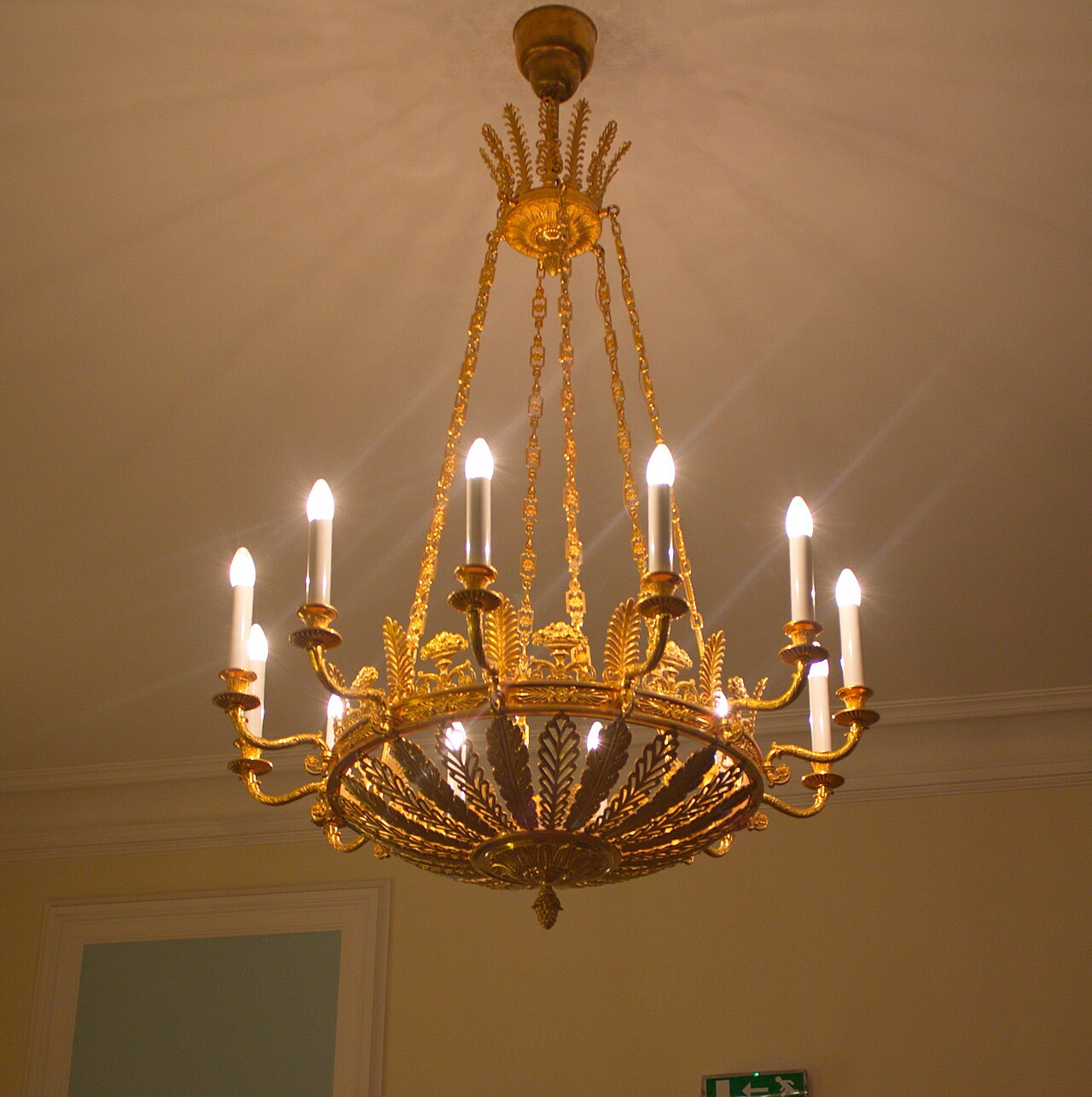
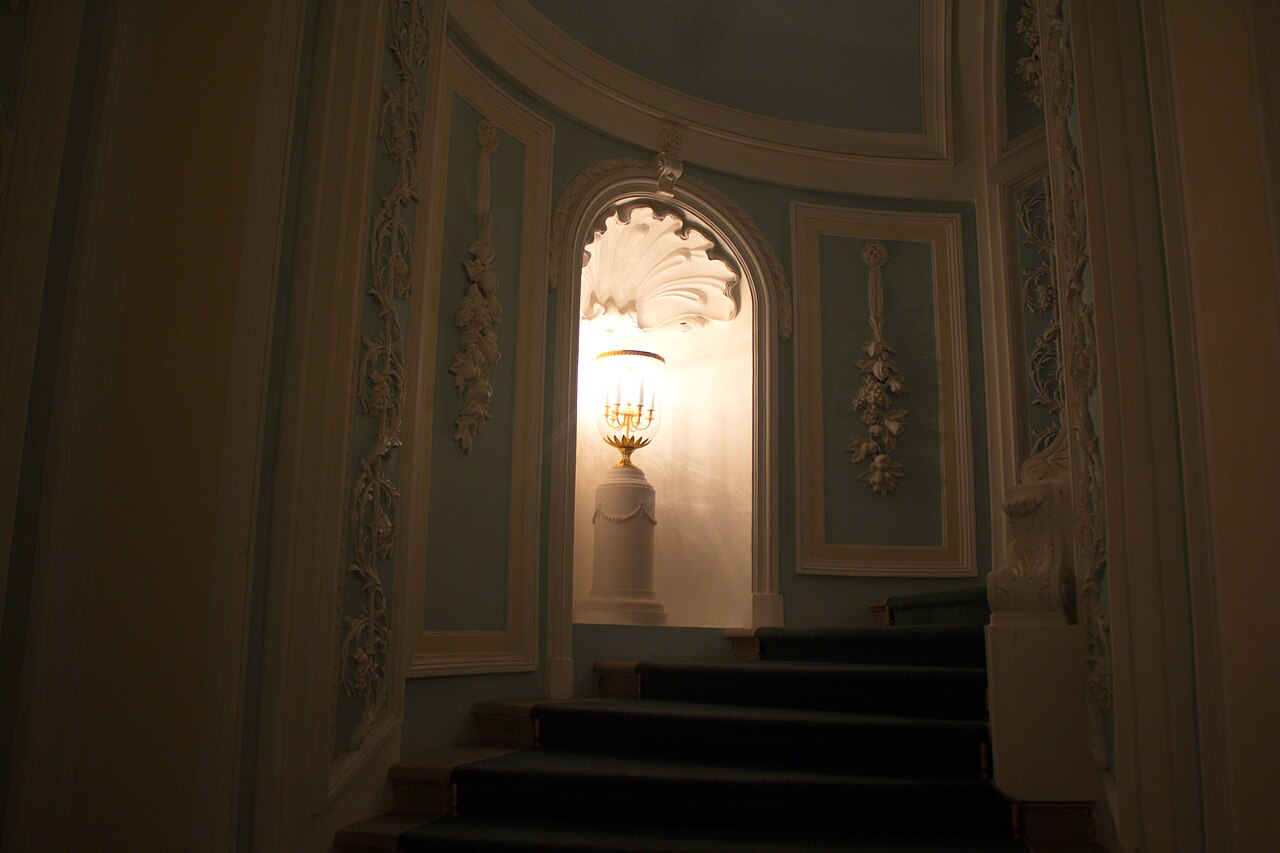
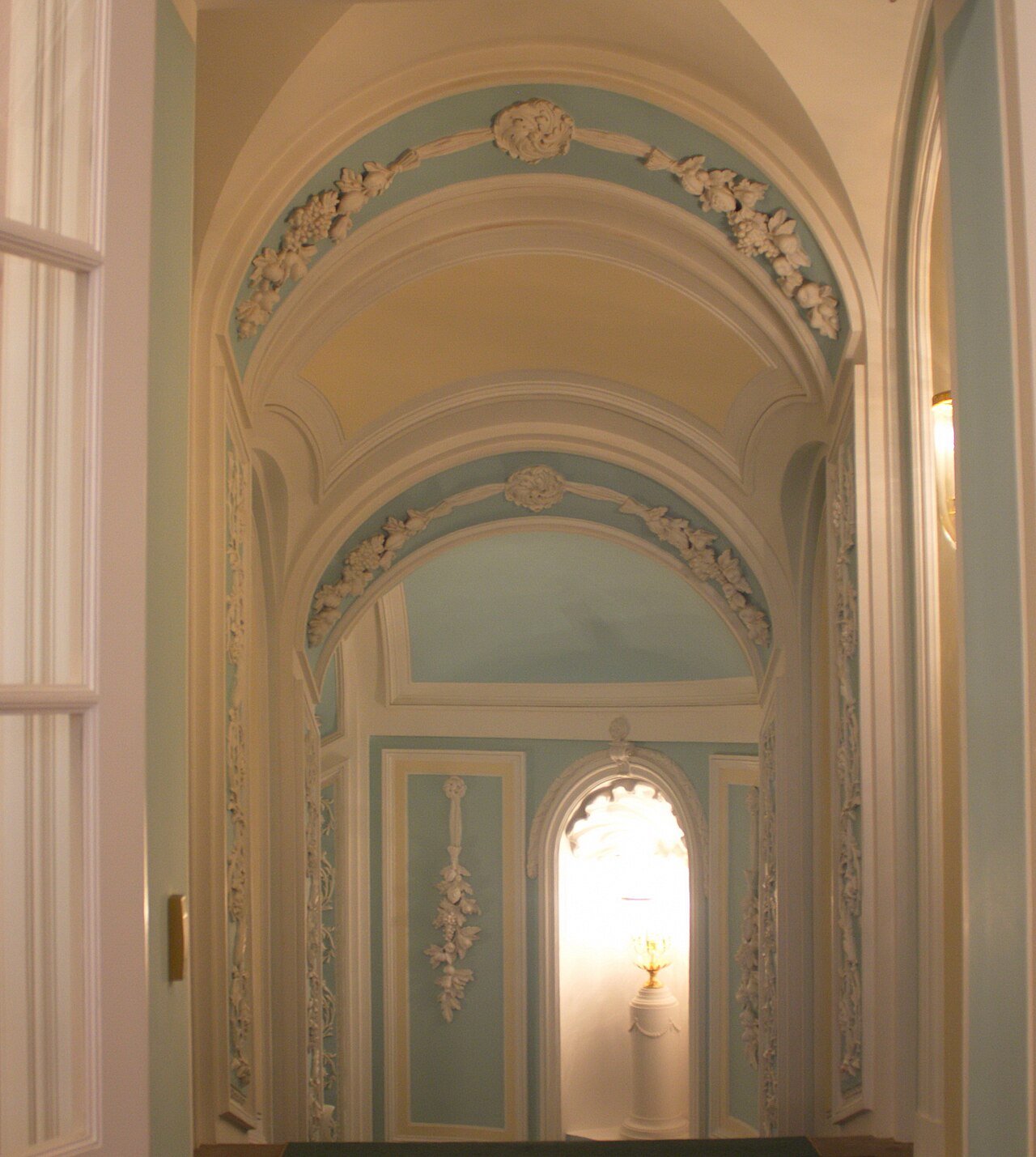
Inside, Kazakov arranged a travel palace’s practical poetry: the round domed hall for receptions at the center, four state suites radiating toward the corner rooms, service courts hidden in the wings. The grisaille painting under the dome, bas-reliefs, and faience stoves survive or have been returned, and the circular hall under its painted sky remains among the loveliest rooms in Moscow, which, given the competition, is a serious claim.
Catherine’s Nights Without Guards
Catherine the Great used her finished palace rarely but memorably. Arriving in 1785 and again in June 1787, returning from her great Crimean journey, she staged at Petrovsky a performance of trust that became part of her legend: she dismissed the military guard, declaring she wished to spend the night guarded only by her people. Muscovites by the thousand camped in the court and park around her windows, cheering each appearance, and the empress wrote to her correspondents, with evident satisfaction, of sleeping amid her children.
The gesture was calculated, everything Catherine did was, but its success was real: the usurper-empress who had taken the throne over her husband’s body in 1762 was, by the 1780s, mother of the fatherland to the Moscow crowd. Petrovsky’s open court, designed for processions, proved equally suited to popularity’s theater, a lesson her successors staged coronation after coronation.
From these stays, too, dates the palace’s enduring place in Moscow’s affections. The city adopted the red castle at its gates as its own welcome-house; descriptions of the era already treat an evening drive to Petrovsky’s groves as a fashionable pleasure, and the surrounding Petrovsky Park, formalized in the next century, grew from exactly that habit, the palace as the capital’s picnic horizon.
Paul and the Coronation Ritual
Catherine’s son Paul, crowned in spring 1797, fixed the palace’s ceremonial role into ritual law. He rested at Petrovsky before his solemn entry, and from then until the empire’s end every sovereign did likewise: the court arrived from Petersburg, the city polished itself, and for several days the red palace was Russia’s actual center, ministers reporting, regiments rehearsing, the old capital holding its breath beyond the gates.
The coronation entry became Moscow’s grandest recurring spectacle: from Petrovsky’s courtyard the procession unrolled down what is now Leningradsky and Tverskaya streets, hours of cavalry, carriages, and clergy, the sovereign riding to the Kremlin through triumphal arches. The palace’s position wrote the route, and the route in turn built the street: Tverskaya’s dignity as Moscow’s main avenue owes much to two centuries of crowned processions beginning at Kazakov’s gates.
Paul’s own relation to his mother’s buildings was usually vengeful, he loathed her memory, but Petrovsky he spared and used, perhaps because its victory was Russia’s rather than hers alone. His sons Alexander I and Nicholas I kept the custom; under Nicholas the palace was refreshed and the surrounding park laid out properly in 1827, with the summer theater and pleasure gardens that made Petrovsky Park the fashionable resort of mid-century Moscow.
Napoleon at the Windows
The palace’s most famous guest arrived uninvited. On 16 September 1812, his third day in a Moscow already burning, Napoleon abandoned the Kremlin as flames closed on its powder magazines; the escape, by his staff’s accounts, led along the river and through smoke-choked lanes where the emperor and his suite passed walls of fire. That evening he reached the Petrovsky Palace, the first intact imperial roof outside the inferno, and stayed four days while the city burned itself out.
From Kazakov’s windows the emperor of the French watched the glow consume his prize, and the scene entered literature twice over: Tolstoy in War and Peace has Napoleon at Petrovsky brooding over the magnanimity he will show, while Pushkin in Eugene Onegin apostrophizes the palace itself, gloomy monument of recent glory, watching the fire from which the conqueror, impatient, departed. Few buildings anywhere carry two such signatures on one week of their history.
Napoleon returned to the gutted Kremlin on 18 September to wait vainly for peace, and Petrovsky, in the war’s final irony, burned in its turn during the French retreat’s chaos, its dome collapsing, its suites wrecked by weather and plunder in the years after. The palace of victory over the Ottomans thus became a casualty of the Grande Armée, and its restoration a piece of the national resurrection that followed 1812.
After the Fire
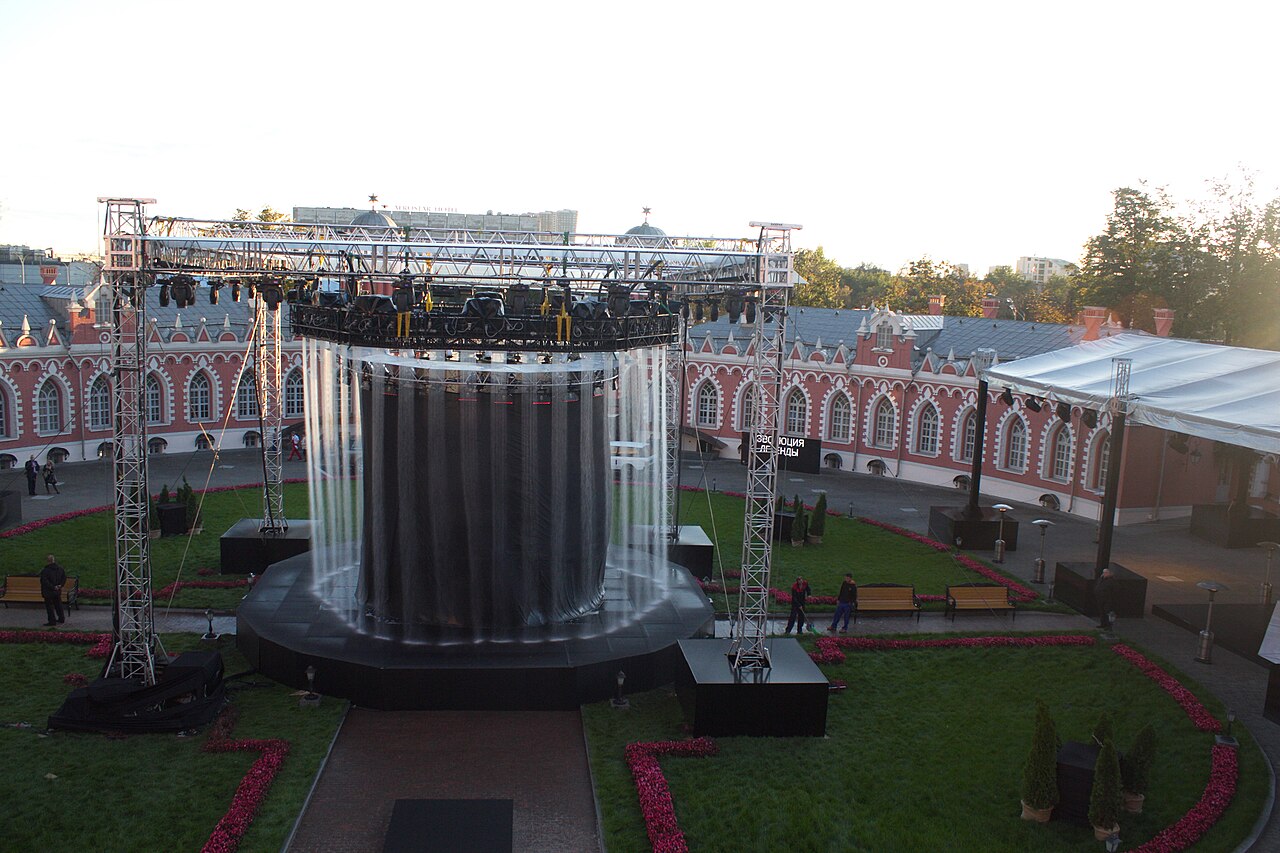
The palace stood half-ruined for a decade while Moscow rebuilt itself first; Alexander I ordered repairs, but the thorough resurrection came under Nicholas I in the 1830s, with the architect Ivan Tatishchev restoring Kazakov’s shell and the interiors in respectful period manner, the dome rebuilt, the round hall repainted, the suites refurnished for coronation service.
The restored palace returned to duty enlarged by sentiment: it was now also a monument of 1812, the building that had sheltered the invader and survived him, and guidebooks of the era present it in exactly that double light. Around it Nicholas’s park bloomed into the city’s pleasure ground, with the palace as its castle centerpiece; the fashionable drove out to promenades, the summer theater, and later the famous restaurants at the park’s edge, Yar among them, where Moscow’s gypsy choirs sang until dawn.
The nineteenth century added one more layer: aviation’s prehistory. The adjoining Khodynka field, the coronation meadow, became in 1910 Moscow’s first airfield, and pioneer aviators’ flights drew crowds past the palace gates, an accidental foreshadowing of the building’s twentieth-century fate.
Coronation Eves of the Last Tsars
The palace’s ceremonial zenith came with the century’s last coronations. Alexander II in 1856, Alexander III in 1883, and Nicholas II in 1896 each kept the Petrovsky vigil, and by then the ritual had grown enormous: the palace and park housed suites and chancelleries, illuminations turned the red towers into a light show, and the solemn entry from Petrovsky into Moscow was photographed, filmed in 1896 among cinema’s earliest newsreels, and reported worldwide.
For Nicholas II the palace framed both faces of the monarchy’s fate. From here on 9 May 1896 he rode his white horse into a jubilant Moscow, streets carpeted and bells drowning the bands; the young emperor recorded the day in his diary with rare emotion. The palace, freshly wired with electric light for the occasion, seemed to stand for an empire entering the modern age in its ancestors’ costume.
Four days after the crowning, the same windows looked out on catastrophe.
The Khodynka Field Tragedy
The coronation’s popular feast was set for 18 May 1896 on the Khodynka field beside the palace: free beer, sausage, and enameled souvenir cups for all comers, with the emperor to appear at the palace balcony. By dawn perhaps half a million people stood on a meadow still trenched and pitted from its military uses; when rumor ran that the gifts were short, the crowd surged, the ground gave underfoot, and in minutes 1,389 people were trampled or suffocated, with as many again injured.
The young tsar learned the scale of the disaster at Petrovsky. The court faced an impossible day: cancel the schedule, offending allies, or proceed amid the morgues. The emperor visited hospitals and paid for funerals, and the carts of the dead passed within sight of the palace gates; but that evening he and the empress attended the French ambassador’s long-planned ball, counseled by his uncles that diplomacy demanded it, and the dancing emperor became, in the revolutionary press’s telling, the era’s defining image.
Khodynka handed the new reign its nickname, Bloody Nicholas, years before 1905 confirmed it; among the people, the coronation field disaster was read as an omen of the dynasty’s end, and memoirists from Witte down treated it as exactly that. The Petrovsky Palace thus witnessed, within one week, the Russian monarchy at its most radiant and the first great crack in its foundation, a coincidence of history no other building can claim so precisely.
The Aviation Academy
After 1917 the travel palace’s road ran out of tsars, and in 1920 the building found its improbable third life: headquarters of the Zhukovsky Air Force Engineering Academy, the Soviet Union’s MIT of military aviation. For most of the century Kazakov’s Gothic housed laboratories, lecture halls, and the offices that trained the designers and commanders of Soviet air power; the park filled with academy buildings, and the palace’s silhouette became the badge of Russian aviation science.
The roll of those who studied or taught within these walls is the history of the Soviet sky: aircraft designers Yakovlev and Mikoyan among the graduates, cosmonautics’ chief theoretician lecturing, and in 1961 the academy enrolled the first cosmonaut detachment, so Yuri Gagarin, Titov, Tereshkova, and their comrades took examinations in the palace where Catherine had slept and Napoleon had brooded. Gagarin defended his diploma here in 1968 weeks before his death, a fact the guides never omit.
The military era preserved the structure and spent the interiors: partitions, linoleum, and institutional paint buried Kazakov’s rooms, though the dome’s shell and the main volumes survived intact. When the academy moved out at the century’s end, the city of Moscow received back a sound but exhausted monument, and for once in Russian heritage history, money, skill, and intent arrived together.
Restoration and Return
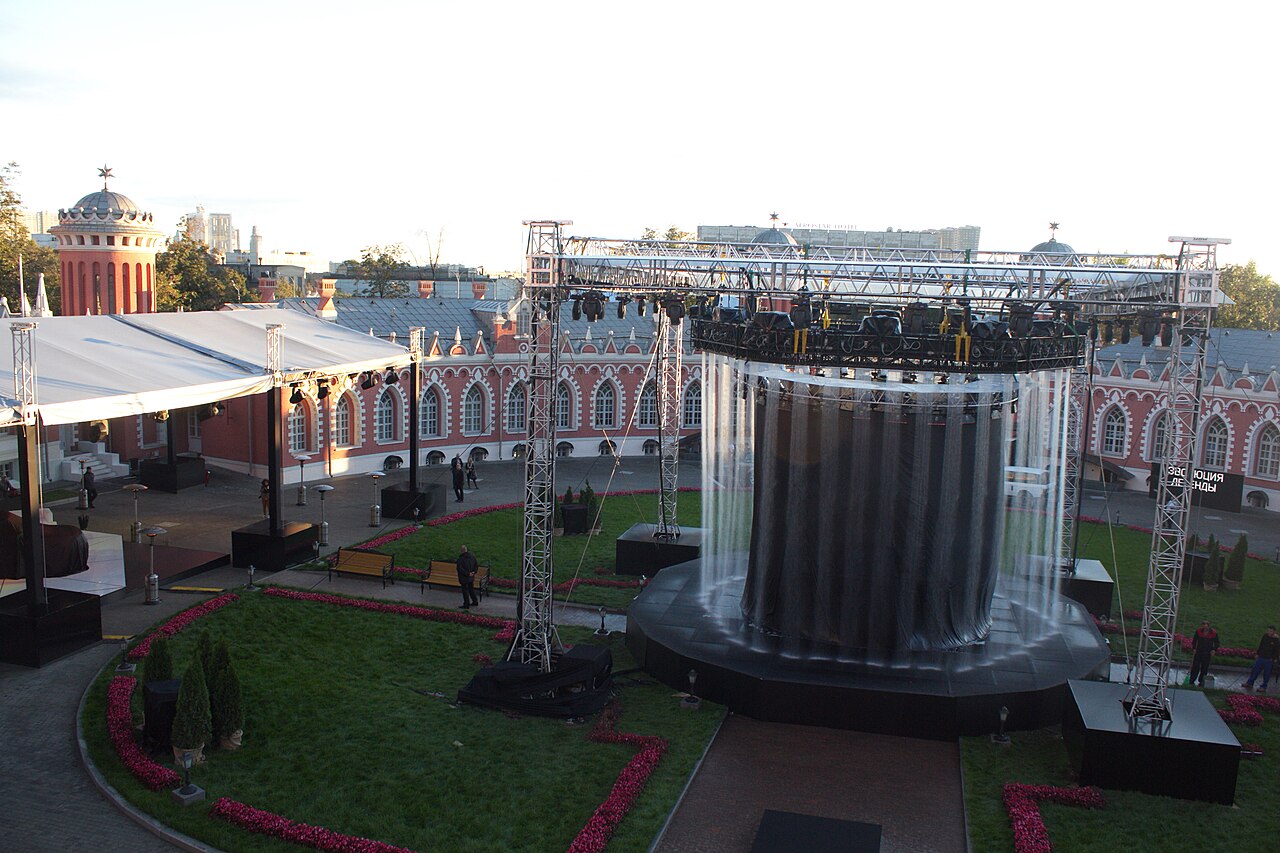
The restoration of 1998 to 2009 was among Moscow’s most thorough: structural repair of brick and dome, removal of a century’s institutional accretions, and the re-creation of the state interiors from Kazakov’s drawings, Tatishchev’s records, and surviving fragments, grisaille painting, stucco, parquets, and the round hall’s heaven returned by the city’s best workshops. The palace reopened in 2009 as the Moscow government’s House of Receptions, its courtyard again hosting ceremony.
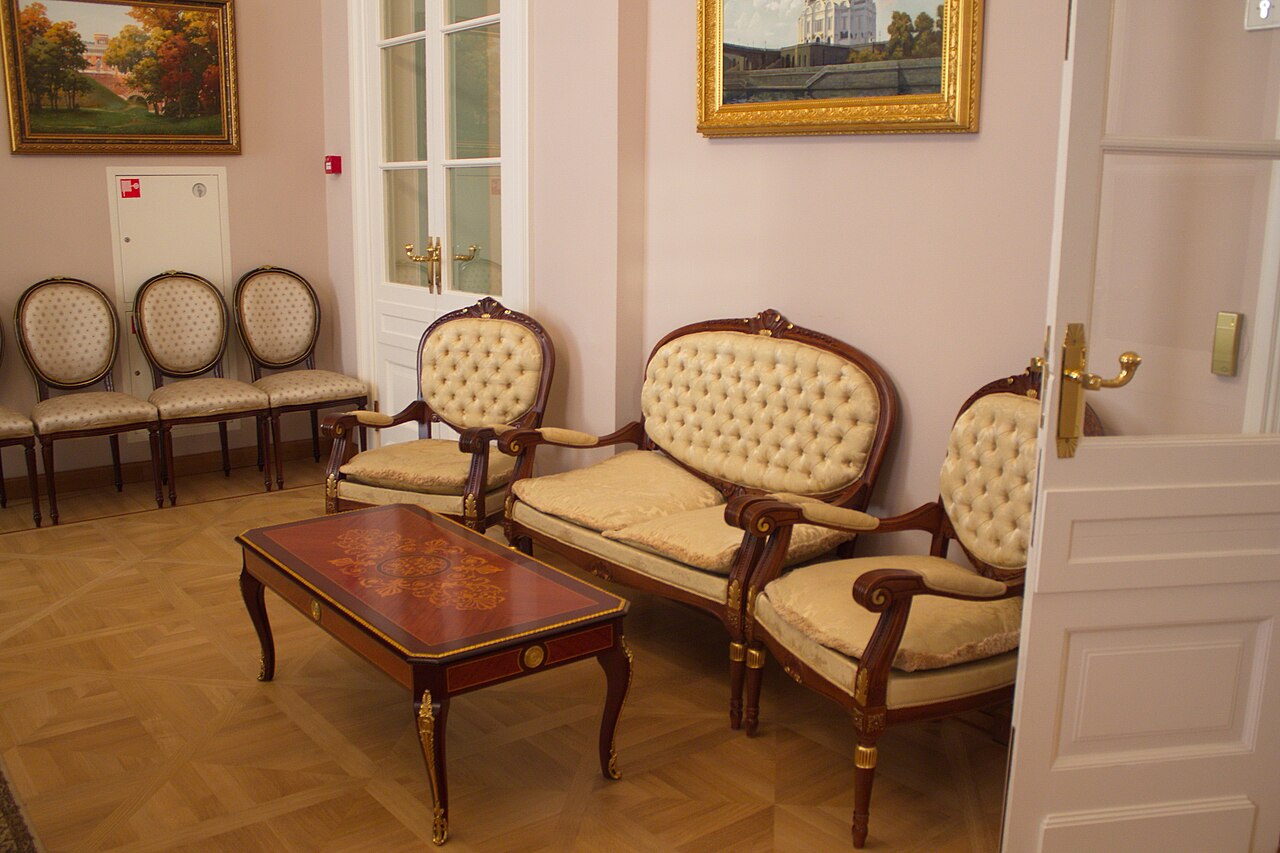
The restored palace balances three duties: official receptions for the city, a museum function with guided tours of the state rooms and an exhibition on the building’s lives, and, in the wings, a boutique hotel, with the result that the ensemble is maintained to state-visit standard while remaining genuinely accessible, a rarer combination in Moscow than it should be.
Around it, the park has been replanted toward its nineteenth-century plan, and the palace again plays its oldest role for travelers: the first beautiful thing you see entering Moscow from Sheremetyevo airport, the city’s welcome-house on the same northern road, greeting arrivals now as it greeted crowned ones, red towers first.
A Palace You Can Sleep In
Uniquely among Moscow’s imperial monuments, Petrovsky keeps its founding function: it still lodges travelers. The hotel in the restored wings lets guests breakfast under vaults where coronation suites were quartered, walk the courtyard at midnight when the gates close to the city, and sleep, as the brochures reasonably boast, in the palace of Catherine and Napoleon; the state rooms, meanwhile, host weddings and receptions, so the building earns its keep as it always did, by hospitality.
For the ordinary visitor, access is simple by Moscow standards: the park is free and open, the exterior viewable at any hour, and the interiors, the round hall, domed vestibules, and state suites, are shown on scheduled guided tours bookable through the city’s museum services, with occasional concerts in the hall as the best-value way inside.
The reward is a building that compresses the Russian imperial story into one courtyard: Turkish victory, Catherine’s theater of popularity, 1812’s fire, coronation glory and Khodynka’s shadow, the aviation century, and a careful modern resurrection. Moscow has larger palaces; it has none that watched more history go past its gates, which is precisely what a house built beside a road was for.
Watch the Petrovsky Palace on Film
Visiting the Petrovsky Palace Today
The Petrovsky Travel Palace stands on Leningradsky Prospekt in northern Moscow, directly above the Dinamo metro station, with the Petrovsky Park around it free to walk; the CSKA and airport express routes pass nearby, and the drive from Sheremetyevo airport offers the classic first view of the red towers. The state interiors are open on guided tours arranged through the Moscow city museum services, typically on set days with advance booking, and concerts in the round hall appear on city listings; the hotel in the wings takes ordinary reservations year-round, with the courtyard and facades at their photogenic best under evening lights or snow. You can find the palace on the map here: Petrovsky Palace on Google Maps.
Palaces Nearby
You May Like
Ostankino Palace and the Theater Built by Serfs