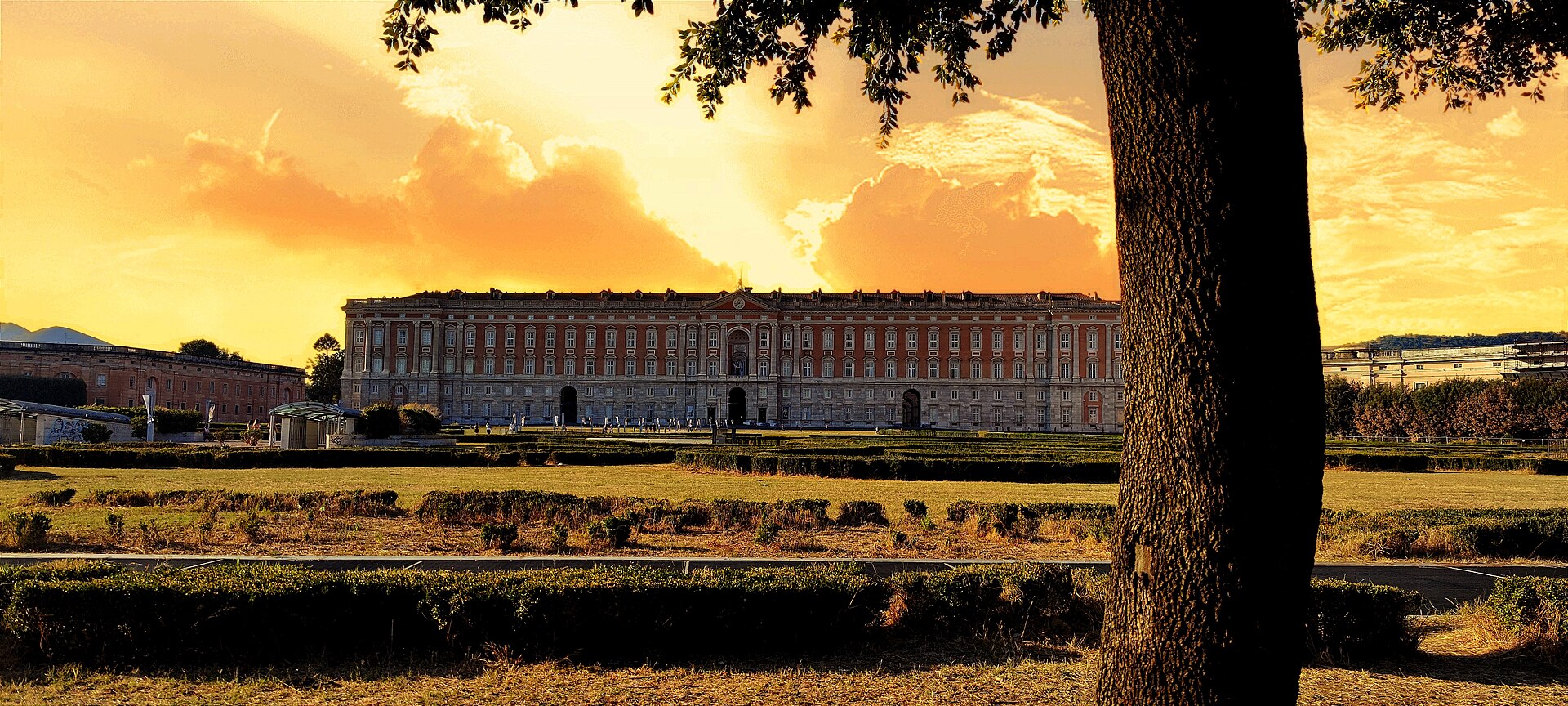
On the plain north of Naples, at the end of an avenue that runs dead straight for miles, rises a palace so vast that it is difficult to take in. The Royal Palace of Caserta, the Reggia di Caserta, is the largest royal residence in the world by volume, a colossus of the Italian Baroque built by the Bourbon kings of Naples to rival, and if possible to surpass, the great palace of Versailles. Its enormous facade stretches across the landscape, and behind it lie more than a thousand rooms and a park that extends for miles toward the distant hills.
Caserta was conceived on a scale to match the ambitions of a new dynasty. The Bourbon rulers of Naples, having established an independent kingdom in the south of Italy, wanted a palace that would proclaim their power and their place among the great courts of Europe, and they commissioned one of the most gifted architects of the age to build it. The result was a masterpiece of the late Baroque, monumental in scale and magnificent in every detail, a fitting seat for a kingdom that aspired to greatness.
Behind the immense facade lie interiors of great splendour, from a grand staircase that ranks among the most magnificent in Europe to royal apartments, a chapel, and a theatre, all decorated with the richness appropriate to a royal palace. But it is the park that is perhaps the greatest wonder of Caserta, a vast axis of water stretching for miles, its fountains and cascades peopled with sculpture and fed by a great aqueduct built to bring water across the mountains.
To visit Caserta is to encounter the Baroque dream of the total palace carried to its ultimate extreme, a building and a landscape conceived as a single overwhelming statement of royal magnificence. This is the story of the palace built to rival Versailles, of the king who commissioned it and the architect who designed it, and of the vast and glorious ensemble of palace, park, and water that stands today as one of the supreme achievements of the age.
In This Article
- The Largest Royal Palace in the World
- Charles of Bourbon and the New Kingdom
- Luigi Vanvitelli, the Architect
- A Palace of a Thousand Rooms
- The Grand Staircase of Honour
- The Royal Apartments
- The Throne Room
- The Palatine Chapel
- The Court Theatre
- The Great Park and the Axis of Water
- The Grand Cascade and Diana and Actaeon
- The Aqueduct and the English Garden
- Caserta Today: A World Heritage Masterpiece
The Largest Royal Palace in the World
The Reggia di Caserta holds the remarkable distinction of being the largest royal palace in the world by volume, a building of truly colossal proportions. Rectangular in plan and arranged around four great internal courtyards, it rises through five monumental storeys and contains an astonishing number of rooms, its scale exceeding that of any other royal residence ever built, including the great palaces that inspired it.
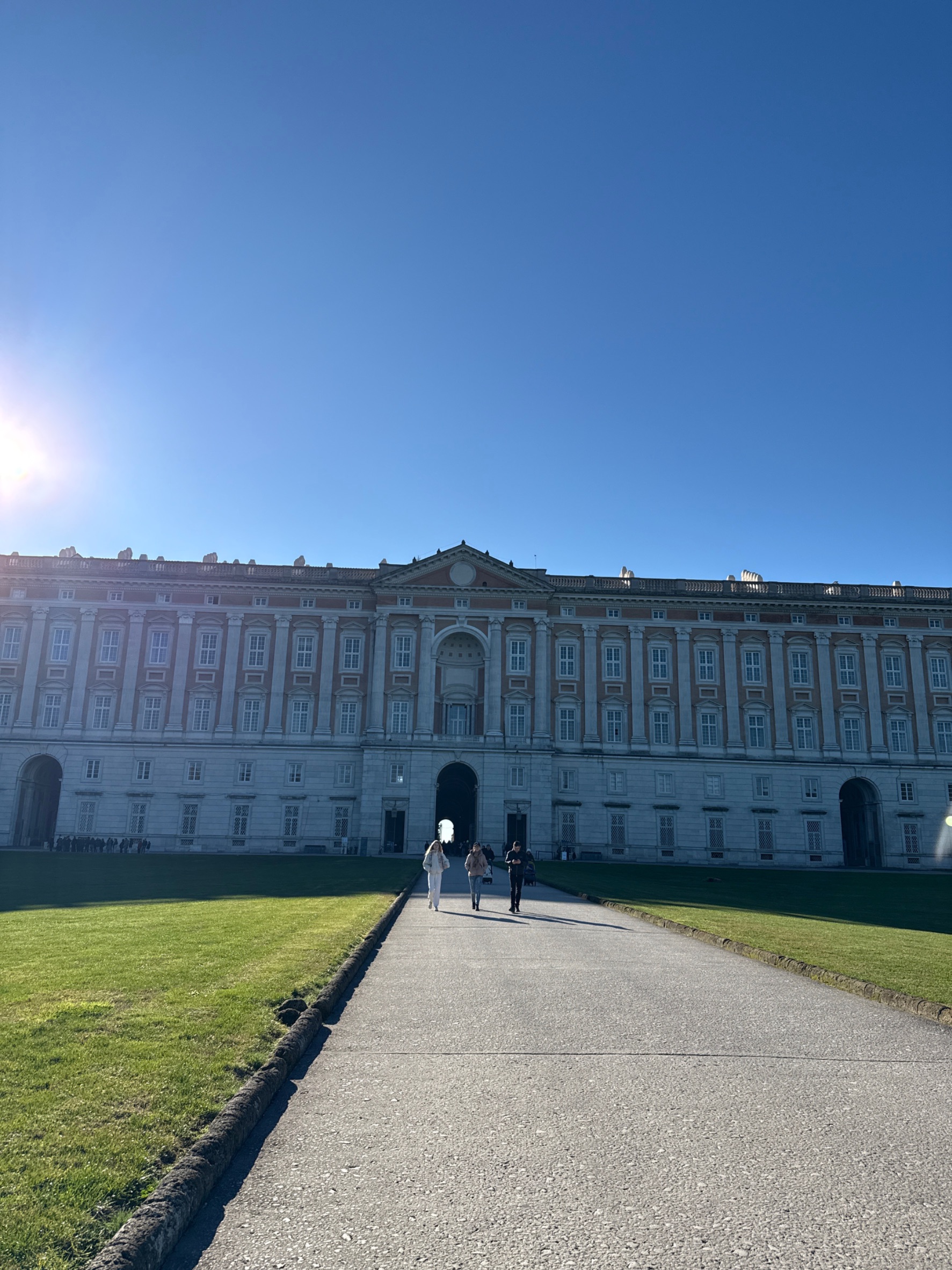
The palace was conceived as a deliberate rival to Versailles, the supreme model of royal magnificence in eighteenth-century Europe, and in sheer size it surpasses even that great model. Everything about Caserta was designed to overwhelm, from the vast length of its facades to the enormous scale of its interiors and the extraordinary extent of its park, all conceived to proclaim the power and ambition of the dynasty that built it.
Yet Caserta is not merely large; it is also a work of great architectural refinement, its immense bulk organised with a classical clarity and adorned with decoration of the highest quality. The genius of its design lies in the way such an enormous building is given order and harmony, so that it impresses not only through its size but through the coherence and elegance of its conception.
Set on the plain of Campania north of Naples, the palace and its park form an ensemble of extraordinary grandeur, a landscape shaped entirely by the will of a monarch. The straight avenue that approaches it, the vast facade that greets the visitor, and the great axis of water that stretches away behind form a single monumental composition, one of the most ambitious ever created in the service of a royal dynasty.
The comparison with Versailles was quite deliberate on the part of the palace’s builders, who set out not merely to imitate the French model but to exceed it, and in raw scale they succeeded. Yet Caserta is more than a mere exercise in surpassing a rival, for it possesses an architectural coherence and a grandeur of conception that make it a masterpiece in its own right, the supreme expression of the ambitions of the Italian Baroque at the very moment when that great tradition was drawing to its close.
Charles of Bourbon and the New Kingdom
The palace of Caserta was the creation of Charles of Bourbon, the king who ruled Naples and Sicily in the mid-eighteenth century and who would later become King of Spain. A member of the great Bourbon dynasty, Charles had established an independent kingdom in the south of Italy, and he was determined to give his new realm a capital and a court worthy of its status among the powers of Europe.
Charles envisioned a great new palace that would serve as the administrative and symbolic centre of his kingdom, a residence that would rival the greatest in Europe and proclaim the grandeur of the Bourbon monarchy of Naples. He chose a site on the plain some distance from Naples itself, partly for its healthier and more defensible position, and there he resolved to build his magnificent new seat.
The ambition behind Caserta reflected the wider aspirations of the Bourbon dynasty and of the age. This was a time when the great monarchies of Europe expressed their power through architecture on a grand scale, and Charles, as the founder of a new royal line in Naples, was especially eager to assert his dynasty’s magnificence in stone. The palace was to be the supreme expression of that ambition.
Charles laid the foundation stone of the palace with great ceremony, marking the beginning of one of the most ambitious building projects of the century. Though he would leave Naples to take up the throne of Spain before the palace was complete, the great project he had begun continued under his successors, and the palace of Caserta stands as the enduring monument to his vision of a magnificent Bourbon kingdom in the south of Italy.
Charles was one of the most capable and enlightened rulers of his age, a reforming monarch who did much to modernise his kingdom and to encourage the arts and sciences. The building of Caserta was part of a broader programme of royal patronage and public works through which he sought to raise the standing of his realm, and the palace was intended to be not merely a residence but the visible symbol of a confident and progressive monarchy at the head of a revived southern Italy.
Luigi Vanvitelli, the Architect
To design his great palace, Charles of Bourbon chose Luigi Vanvitelli, one of the most accomplished architects of eighteenth-century Italy. The son of a Dutch painter who had settled in Italy, Vanvitelli was a master of the late Baroque style, and he brought to Caserta both a grand vision and a superb command of architectural design, engineering, and decoration.
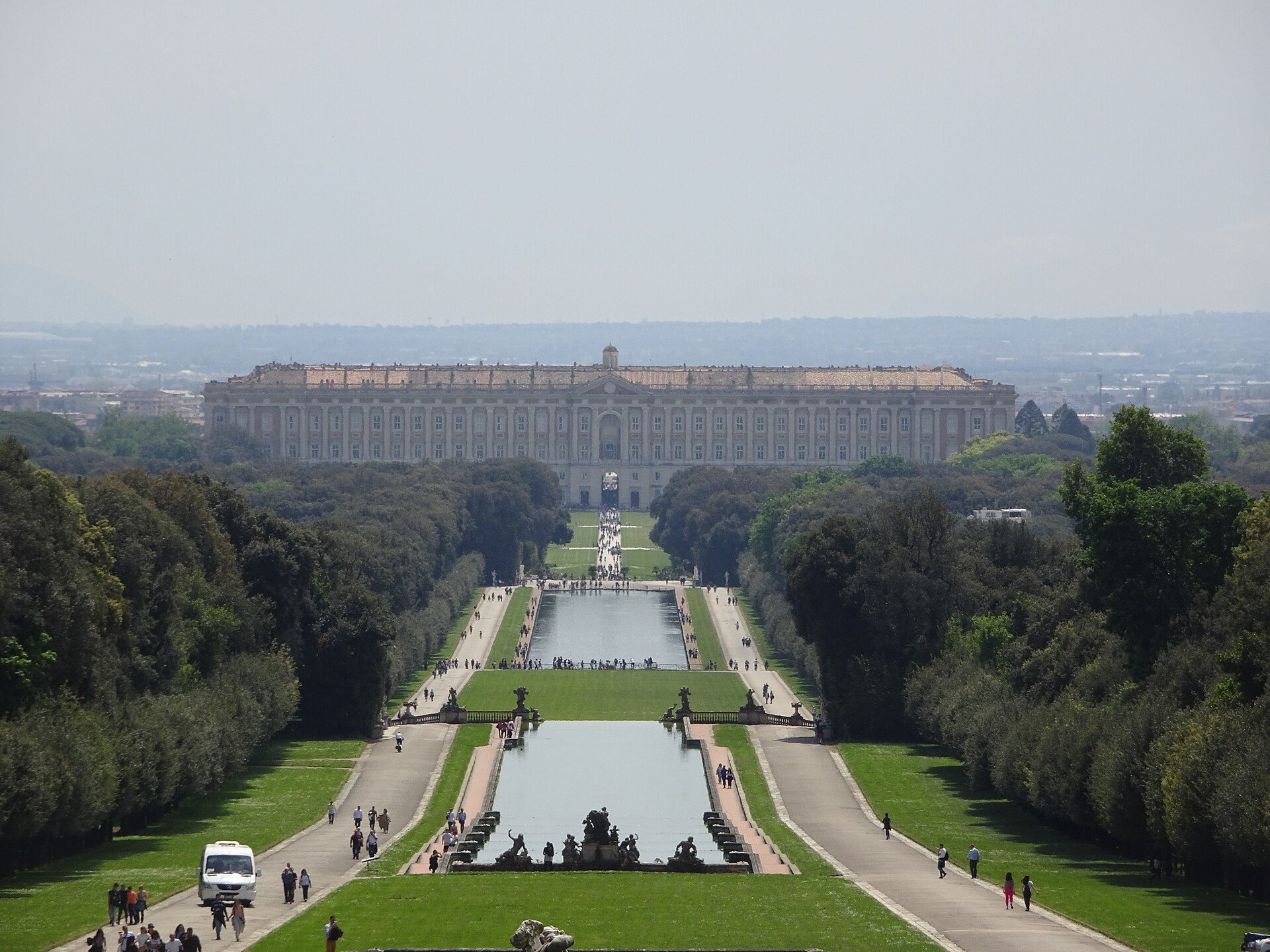
Vanvitelli conceived the palace on a monumental scale, planning not only the vast building itself but the entire ensemble of palace, park, and waterworks as a single unified composition. His design united the grandeur of the Baroque with a new classical clarity, creating a building that was both overwhelming in scale and harmonious in its ordering, a masterpiece of architectural planning.
The genius of Vanvitelli is displayed not only in the palace but in the extraordinary engineering that made the whole project possible, above all the great aqueduct he designed to bring water from distant mountains to feed the fountains of the park. He was an architect in the fullest sense, master of every aspect of his art, from the grandest overall conception to the finest decorative detail.
Vanvitelli devoted the last decades of his life to Caserta, and though he did not live to see it entirely completed, the work was carried on after his death by his son, who remained faithful to his father’s grand design. The palace stands as the supreme achievement of Vanvitelli’s career and one of the great monuments of Italian architecture, the crowning work of one of the finest architects of his age.
Vanvitelli’s achievement at Caserta was recognised throughout Europe as one of the great architectural feats of the age, and it influenced the design of palaces and public buildings far beyond Italy. His ability to marry overwhelming scale with clarity and refinement set a standard that few could match, and the palace secured his reputation as one of the last and greatest masters of the grand European tradition of Baroque architecture.
A Palace of a Thousand Rooms
The scale of Caserta is difficult to grasp until one contemplates the numbers. The palace contains well over a thousand rooms, arranged around four great courtyards and rising through five storeys, and its facades extend for a great distance in every direction. It is a building conceived not as a house but as a small city devoted to the life and government of a kingdom.
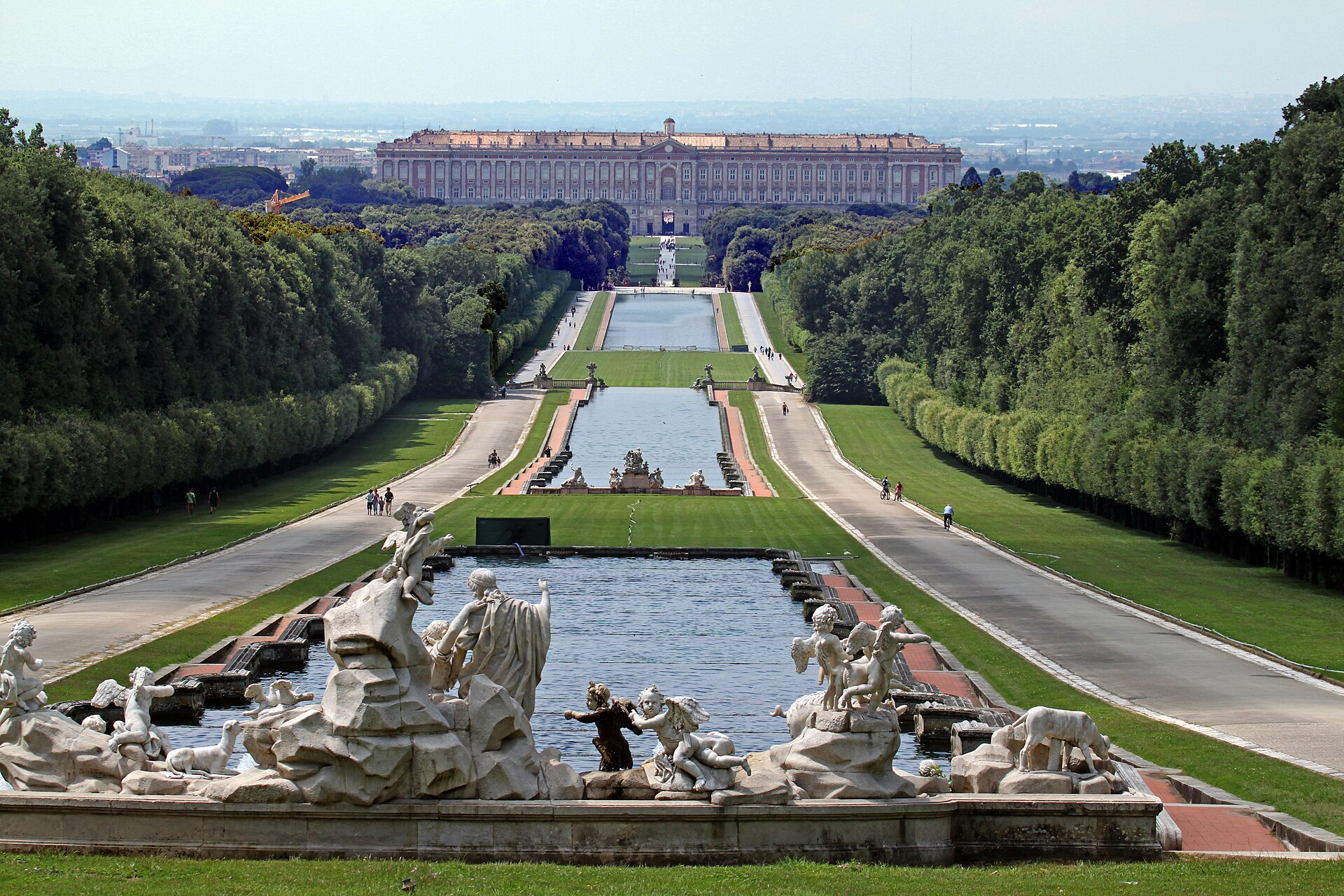
The plan of the palace is a model of clarity despite its enormous size. The four courtyards are arranged within a great rectangle, and the various parts of the building, the royal apartments, the chapel, the theatre, and the offices of state, are distributed within this vast framework in an orderly and logical fashion. The design imposes harmony upon immensity, a triumph of architectural planning.
At the centre of the palace, a great vestibule and the magnificent grand staircase form the heart of the building, from which the various apartments and spaces are reached. Vanvitelli designed these central spaces as the climax of the whole composition, the point at which the grandeur of the palace is most fully expressed, and they remain among the most impressive interiors in Europe.
The construction of so vast a building was an enormous undertaking that occupied decades and employed a great workforce, including, it is said, labourers drawn from far afield. The sheer effort required to raise such a palace reflects the ambition that lay behind it, and the completed building stands as a monument to the resources and determination of the Bourbon monarchy that willed it into being.
Contemporaries marvelled at the ambition of the enterprise, and the palace was regarded from the first as one of the wonders of the age. The organisation required to build and run so vast a structure was itself remarkable, and the completed palace functioned as a great administrative machine as well as a royal residence, containing within its walls the offices, services, and accommodation needed to govern a kingdom from a single monumental building.
The Grand Staircase of Honour
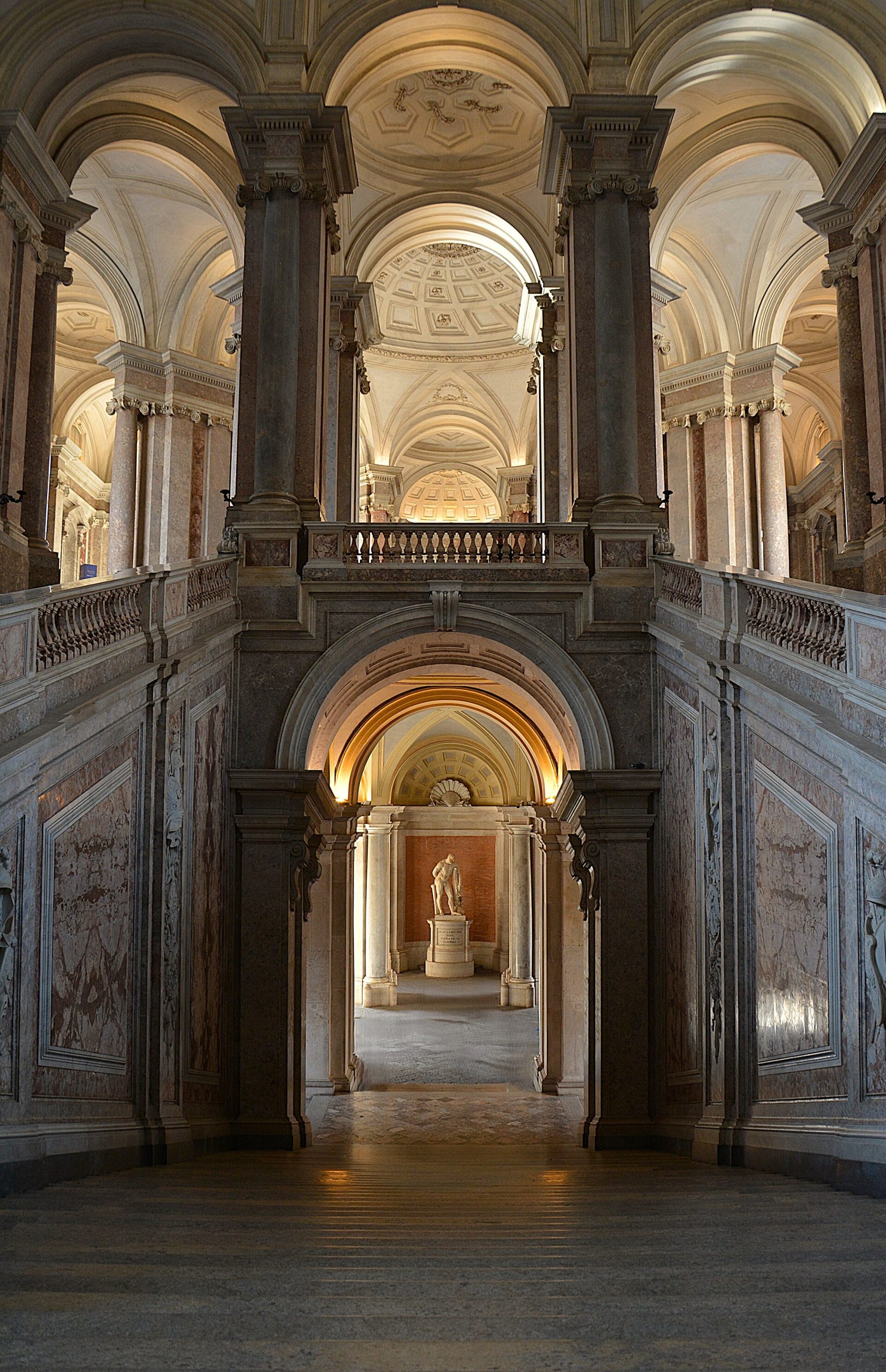
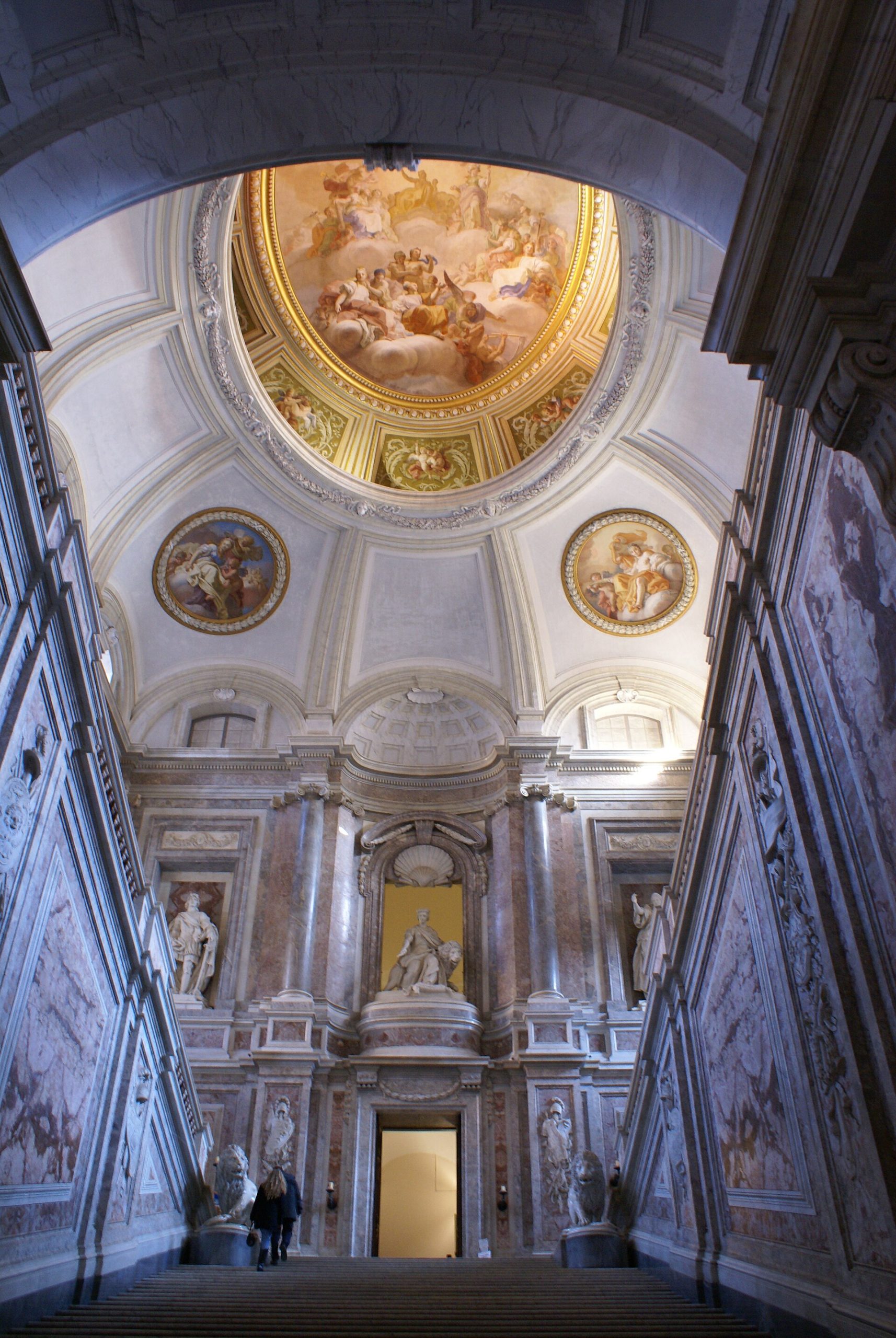
The most celebrated interior of Caserta is its Grand Staircase of Honour, a monumental stairway of marble that ranks among the most magnificent in the world. Rising in a great sweep from the central vestibule, it divides and returns in majestic flights, carrying the visitor upward toward the royal apartments in a spectacular display of architectural grandeur.
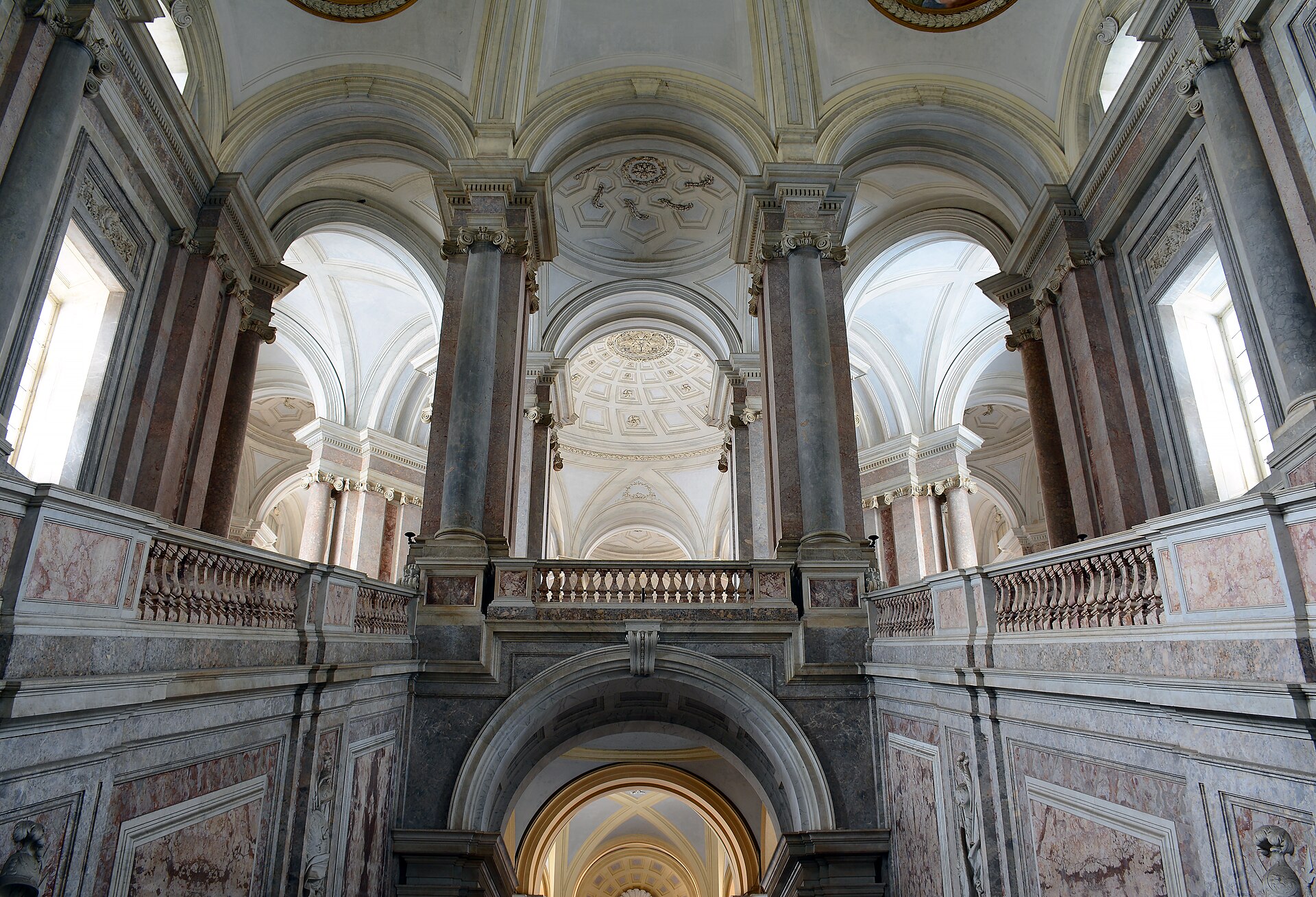
The staircase is a masterpiece of design and craftsmanship, built of fine marble and adorned with sculpture, including great stone lions that guard its lower flights. Above it soars a magnificent vaulted ceiling, richly decorated with painting and ornament, so that the whole space is filled with light and colour, an overture of splendour to the apartments beyond.
Vanvitelli designed the staircase as the ceremonial heart of the palace, the grand processional route by which important visitors would ascend to the presence of the king. Its scale, its richness, and its theatrical grandeur were intended to impress upon all who climbed it the majesty of the Bourbon monarchy, and it fulfils this purpose superbly.
The Grand Staircase of Honour is one of the supreme achievements of Baroque architecture, a space of overwhelming magnificence that has awed visitors for two and a half centuries. It represents the climax of Vanvitelli’s design and the high point of a visit to the palace, a spectacular introduction to the royal apartments and one of the most beautiful staircases ever built.
The design of the staircase was calculated to create a particular effect, for as visitors ascended they were gradually revealed to those waiting in the vestibule above, and the whole sequence of arrival and reception was choreographed as a piece of ceremonial theatre. This masterly manipulation of space and movement, so characteristic of the finest Baroque architecture, gives the staircase a dynamic quality that goes beyond mere magnificence.
The Royal Apartments
Beyond the grand staircase lie the royal apartments, a magnificent sequence of rooms that served as the residence of the Bourbon kings and the setting for the ceremonial life of the court. Richly decorated and furnished, they display the changing tastes of the successive reigns during which they were completed and used, from the exuberant late Baroque to the more restrained neoclassical style.
The apartments form a long enfilade of interconnected rooms, each richly adorned with painted ceilings, marble, gilding, fine furniture, and works of art. As the visitor passes from one room to the next, the decoration unfolds in a sequence of mounting splendour, designed to impress and to convey the magnificence of the monarchy that inhabited them.
Among the apartments are rooms decorated in a variety of styles reflecting the different periods of their completion, for the palace was furnished and adorned over many decades. Some rooms preserve the rich decoration of the eighteenth century, while others reflect the neoclassical taste of the age that followed, so that the apartments form a record of the evolving styles of the Bourbon court.
The royal apartments preserve the atmosphere of the court that once inhabited them, filled with the furnishings, paintings, and objects that adorned the daily life of the monarchy. To walk through them is to experience the private and ceremonial world of the Bourbon kings of Naples, and to appreciate the wealth and cultivation of one of the great courts of eighteenth-century Europe.
Successive rulers of Naples, and later of the Two Sicilies, continued to inhabit and adorn the apartments, so that the rooms accumulated the furnishings and the memories of several generations of the royal family. This long occupation gives the apartments a lived-in richness, and they preserve not only the grandeur of state but also traces of the more intimate domestic life of the dynasty that made Caserta its home across more than a century of rule.
The Throne Room
The grandest of all the royal apartments is the Throne Room, an immense and magnificent hall that served as the ceremonial centre of the palace and the setting for the most important occasions of state. One of the largest rooms in the palace, it is decorated with the utmost richness, its walls and ceiling adorned with gilding, sculpture, and painting celebrating the Bourbon monarchy.
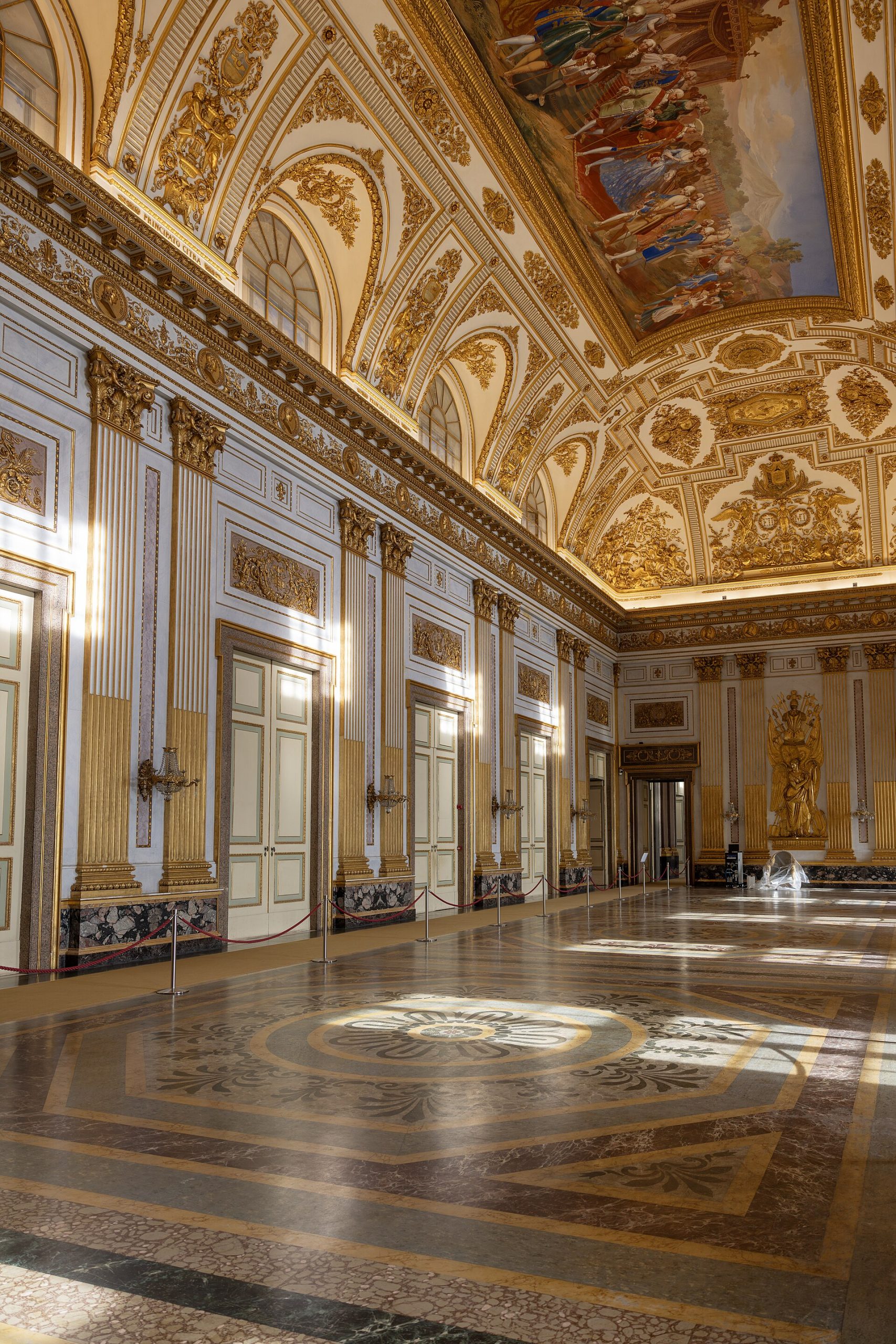
The room was designed to overwhelm with its magnificence, a fitting setting for the throne of the kingdom. Its great length, its richly decorated ceiling depicting scenes glorifying the dynasty, and its lavish ornament combine to create an atmosphere of imposing grandeur, the very image of royal power and ceremony in the grand manner of the age.
The Throne Room was completed in the nineteenth century, and its decoration reflects the taste of that period, though it remains faithful to the magnificence of the original conception. It was here that the kings of Naples held court and received their most important guests, amid surroundings designed to convey the full majesty of the Bourbon crown.
With its immense scale and its sumptuous decoration, the Throne Room represents the ceremonial climax of the palace, the room toward which the whole grand sequence of staircase and apartments leads. It embodies the ambition that lay behind Caserta, the desire to create a palace and a court to rival the greatest in Europe, and it remains one of the most magnificent rooms in the whole vast building.
The Palatine Chapel
Among the great spaces of the palace is the Palatine Chapel, the royal chapel that served the religious needs of the court and ranks among the most beautiful interiors of Caserta. Designed by Vanvitelli and inspired in part by the chapel at Versailles, it is a space of great richness and elegance, adorned with fine marbles, gilding, and painting.
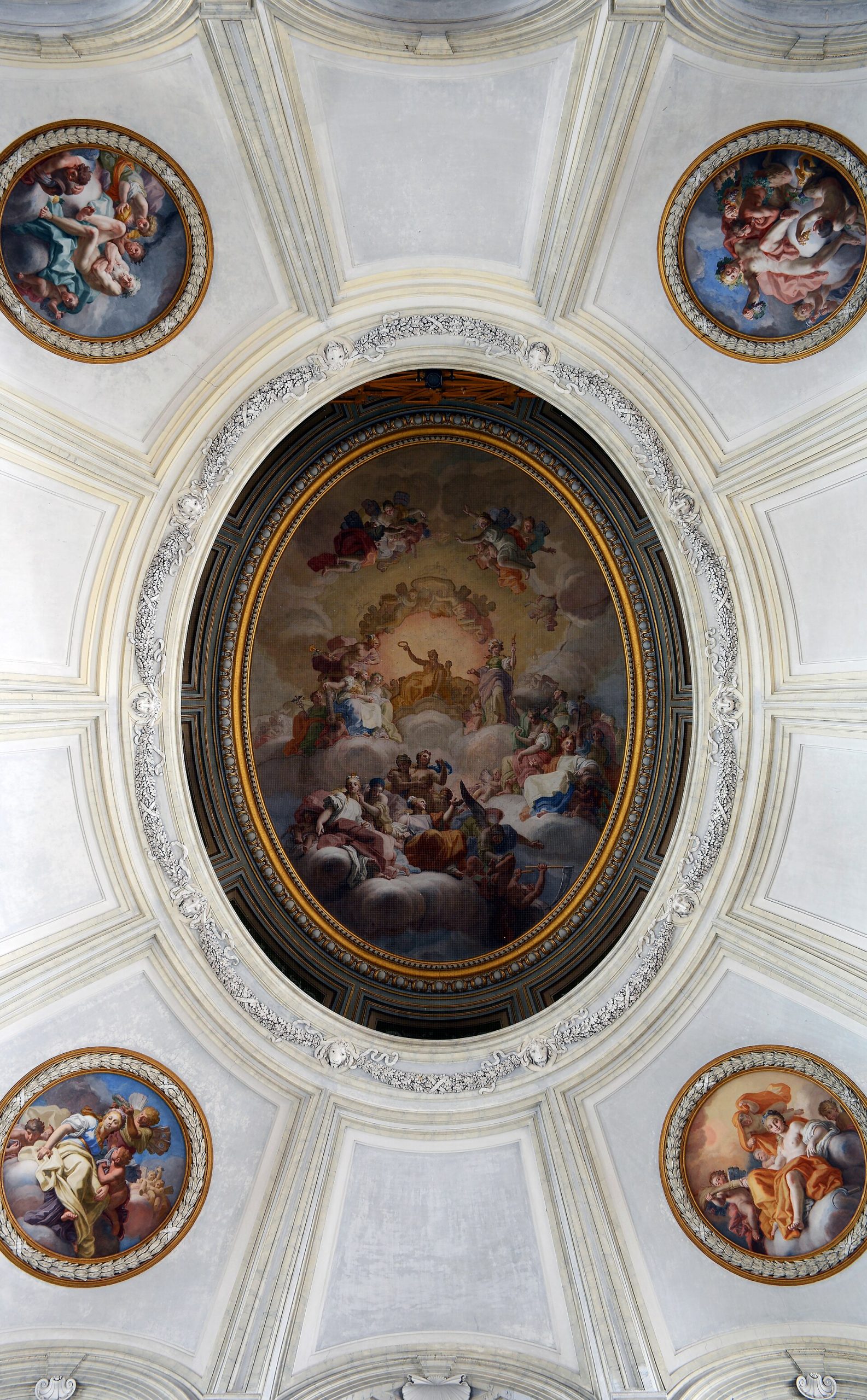
The chapel is a magnificent example of the decorative art of the age, its walls lined with coloured marbles, its altar richly adorned, and its whole interior conceived as a harmonious ensemble of the highest quality. It reflects the piety of the Bourbon court and the importance of religious ceremony in the life of the monarchy, and it provided a setting of appropriate splendour for the devotions of the royal family.
Like the rest of the palace, the chapel was conceived on a grand scale and executed with the finest craftsmanship, and it stands as one of the most beautiful of the palace’s many splendid spaces. Its design displays Vanvitelli’s mastery of the interplay of architecture, marble, and light, creating an atmosphere of solemn magnificence.
The Palatine Chapel completes the range of great spaces within the palace, uniting the religious and the magnificent in a single splendid interior. It reminds us that Caserta was conceived as a complete royal world, containing within its vast fabric everything required for the life, government, worship, and pleasure of a great court, all executed with the same ambition and the same superb quality.
The Court Theatre
Among the many spaces contained within the palace is a court theatre, a jewel-like auditorium built for the entertainment of the royal family and the court. A perfect example of the eighteenth-century theatre, it is richly decorated with tiers of boxes, gilding, and ornament, and it provided a magnificent setting for the musical and dramatic performances that were so important a part of court life.
The theatre reflects the great importance of music and spectacle in the culture of the eighteenth-century court, and especially in the kingdom of Naples, which was one of the great centres of opera and music in Europe. The court gathered here to enjoy performances amid surroundings of appropriate splendour, and the theatre was designed as a complete and self-contained world of entertainment within the palace.
Beautifully proportioned and richly adorned, the court theatre is one of the most charming spaces in the palace, a perfect miniature of the great opera houses of the age. Its horseshoe of boxes, rising in gilded tiers, and its richly decorated ceiling create an intimate and magnificent setting, a jewel within the vast fabric of the palace.
The presence of so fine a theatre within the palace underlines the completeness of Caserta as a royal world, in which every aspect of courtly life, from government and worship to pleasure and entertainment, was provided for on a magnificent scale. The court theatre remains one of the delights of the palace, a reminder of the brilliant cultural life of the Bourbon court of Naples.
The Great Park and the Axis of Water
If the palace is overwhelming, the park of Caserta is scarcely less so, a vast landscape that extends for miles behind the palace along a single monumental axis. This great central vista, running dead straight from the palace toward the distant hills, is one of the most spectacular garden compositions ever created, a triumphal way of lawns, avenues, fountains, and cascades stretching as far as the eye can see.
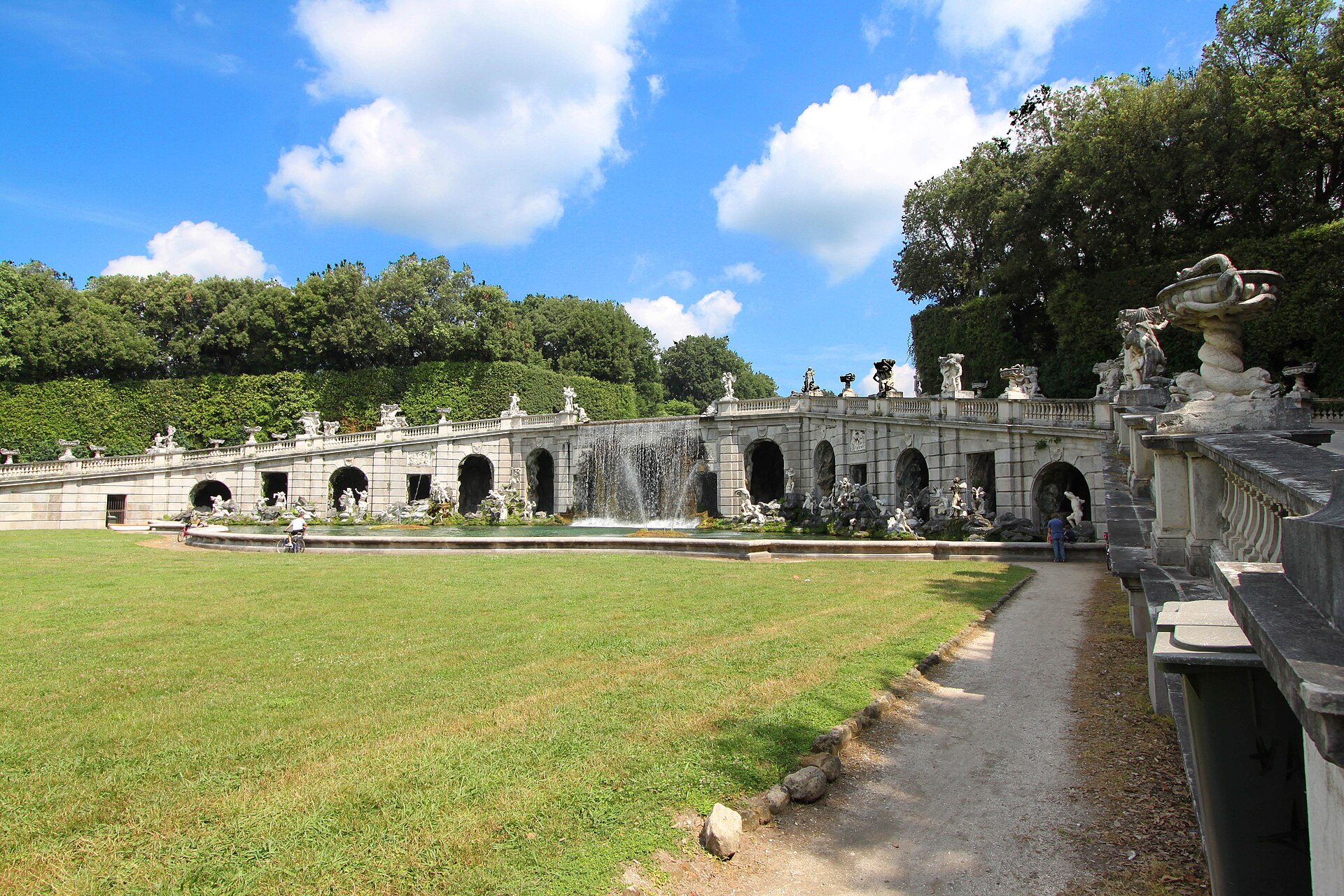
The park was conceived by Vanvitelli as an integral part of the whole composition, an extension of the palace’s grandeur into the landscape. Along the great central axis, a series of magnificent fountains and basins carries the eye onward toward the climax of the whole design, the great cascade at the far end, so that the park unfolds as a sequence of watery spectacles of mounting splendour.
The fountains along the axis are peopled with sculpture drawn from classical mythology, great groups of figures set amid the rushing and falling water, so that the park becomes an open-air gallery of Baroque sculpture. Each fountain tells a mythological story, and together they form a coherent programme celebrating the themes of nature, myth, and royal power, spread across the vast landscape.
The scale of the park is extraordinary, the central axis extending for some three kilometres from the palace to the great cascade, an achievement of landscape design unmatched in its ambition. To walk or ride along this great vista, from fountain to fountain toward the distant cascade, is to experience one of the supreme creations of the art of the garden, a landscape shaped entirely to glorify a monarchy.
The idea of extending the palace’s grandeur so far into the landscape reflected the Baroque conviction that architecture and nature should be united in a single grand design, subordinated to the will of the monarch. At Caserta this idea was carried to its ultimate conclusion, the great axis imposing a rigorous geometric order upon the natural landscape across an enormous distance, a demonstration of royal power over nature itself on a scale rarely attempted.
The Grand Cascade and Diana and Actaeon
At the far end of the great axis, where the park meets the rising ground of the hills, lies its magnificent climax: the Grand Cascade, a great waterfall that tumbles down the hillside into a broad basin below. Fed by the waters brought across the mountains by Vanvitelli’s aqueduct, the cascade is a spectacular sight, a torrent of water descending amid the greenery to feed the great chain of fountains that stretches back toward the palace.
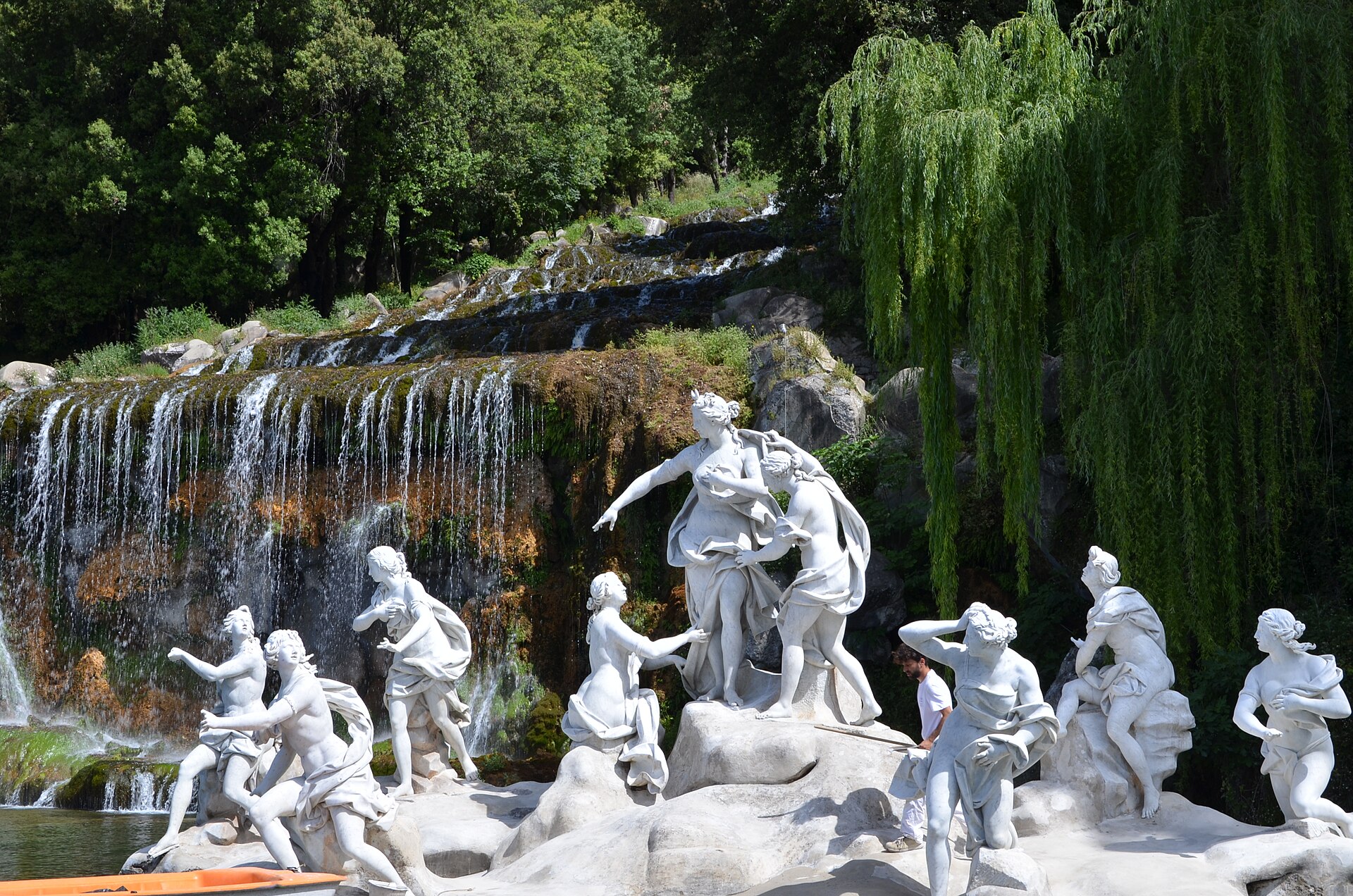
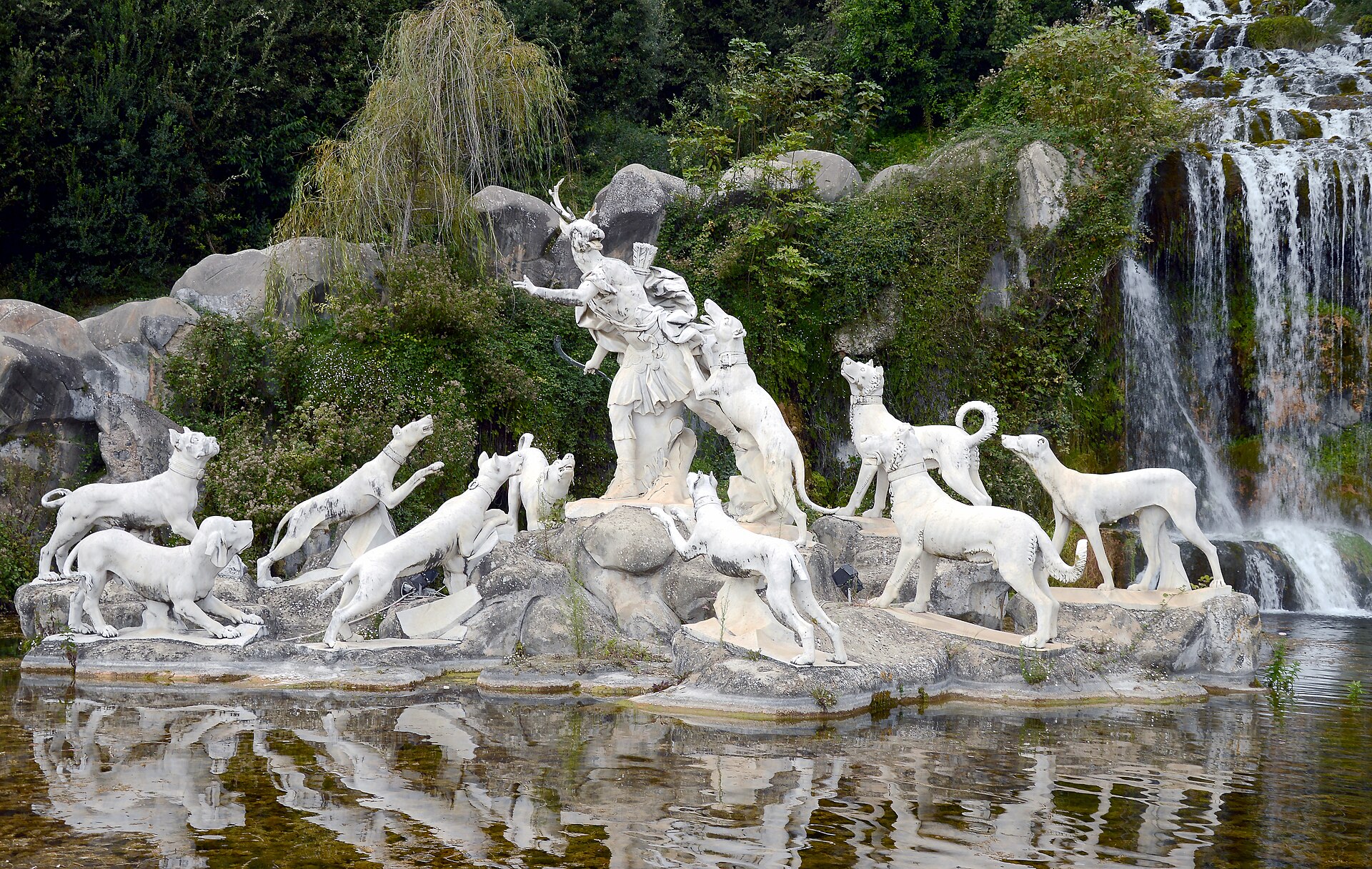
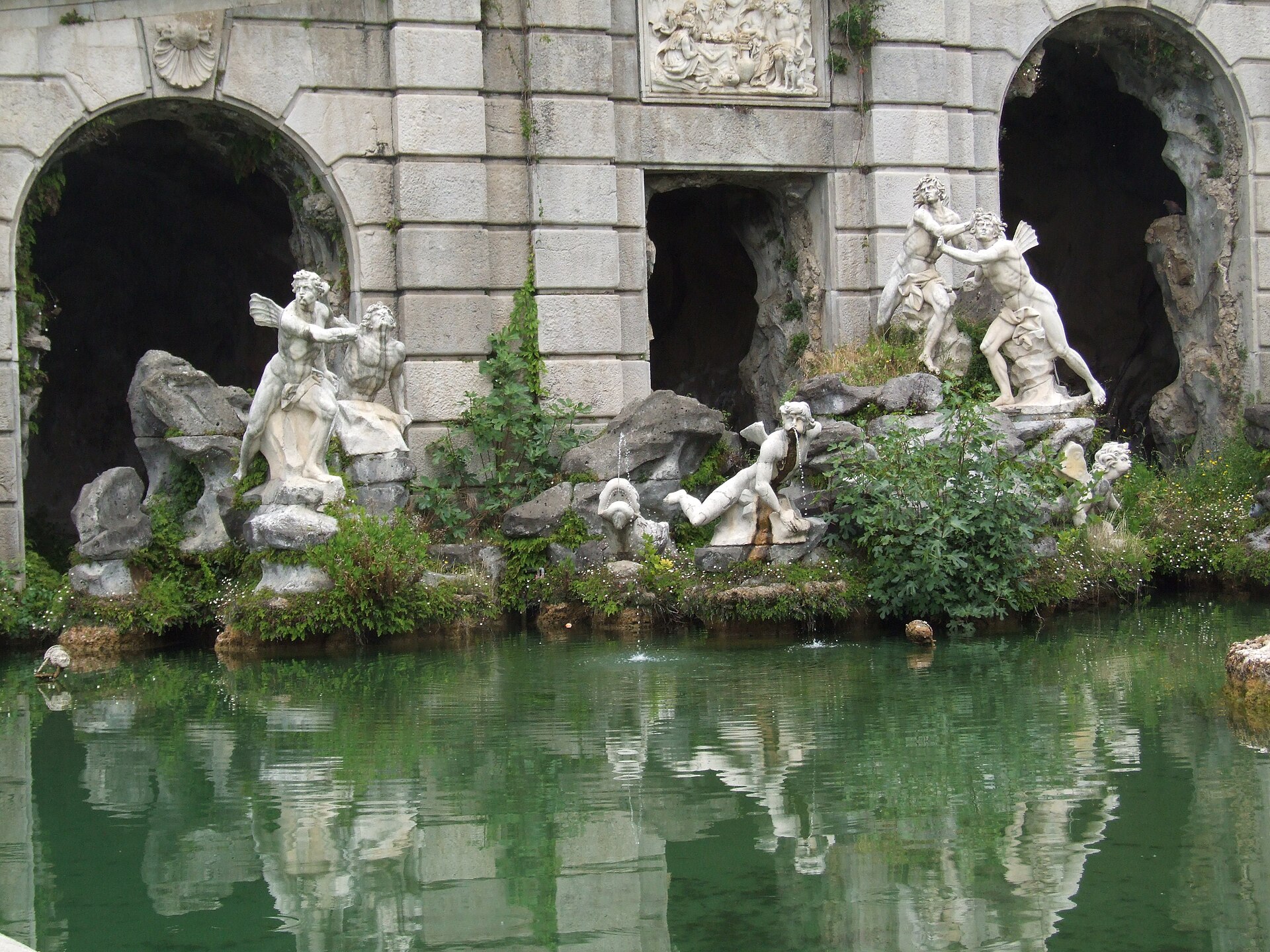
At the foot of the cascade stands one of the most celebrated sculptural groups in the whole park, depicting the myth of Diana and Actaeon. On one side, the goddess Diana and her nymphs are shown bathing, while on the other, the unfortunate hunter Actaeon, who has glimpsed the goddess, is depicted being transformed into a stag and set upon by his own hounds, a dramatic tableau rendered in marble amid the falling water.
The sculptural group of Diana and Actaeon is a masterpiece of Baroque sculpture, its figures full of movement and drama, set against the backdrop of the great cascade in a composition of extraordinary theatrical power. It forms the climax of the whole park, uniting sculpture, water, and landscape in a single overwhelming spectacle at the culmination of the great axis.
The Grand Cascade and its sculpture represent the triumphant conclusion of the park’s great design, the point toward which the whole vast composition leads. To stand at the foot of the cascade, amid the thunder of the falling water and before the dramatic sculpture of Diana and Actaeon, is to experience one of the great climaxes of any garden in the world, a fitting culmination to the grandest of royal parks.
The choice of the myth of Diana and Actaeon for the culminating sculpture was rich in meaning, for the story of the hunter destroyed for gazing upon the goddess spoke of the dangers of transgression and the power of the divine, themes appropriate to a monarchy that presented itself as almost sacred. The dramatic tableau thus carried a symbolic weight beyond its beauty, crowning the great watery axis with a scene of myth and moral resonance.
The Aqueduct and the English Garden
The great fountains and cascades of Caserta required an enormous supply of water, and to provide it Vanvitelli undertook one of his most remarkable achievements, the construction of a great aqueduct to bring water from distant mountain springs across many miles of countryside to the park. This engineering masterpiece, carried on great arches across valleys, was itself a work of extraordinary ambition, worthy of the ancient Romans.
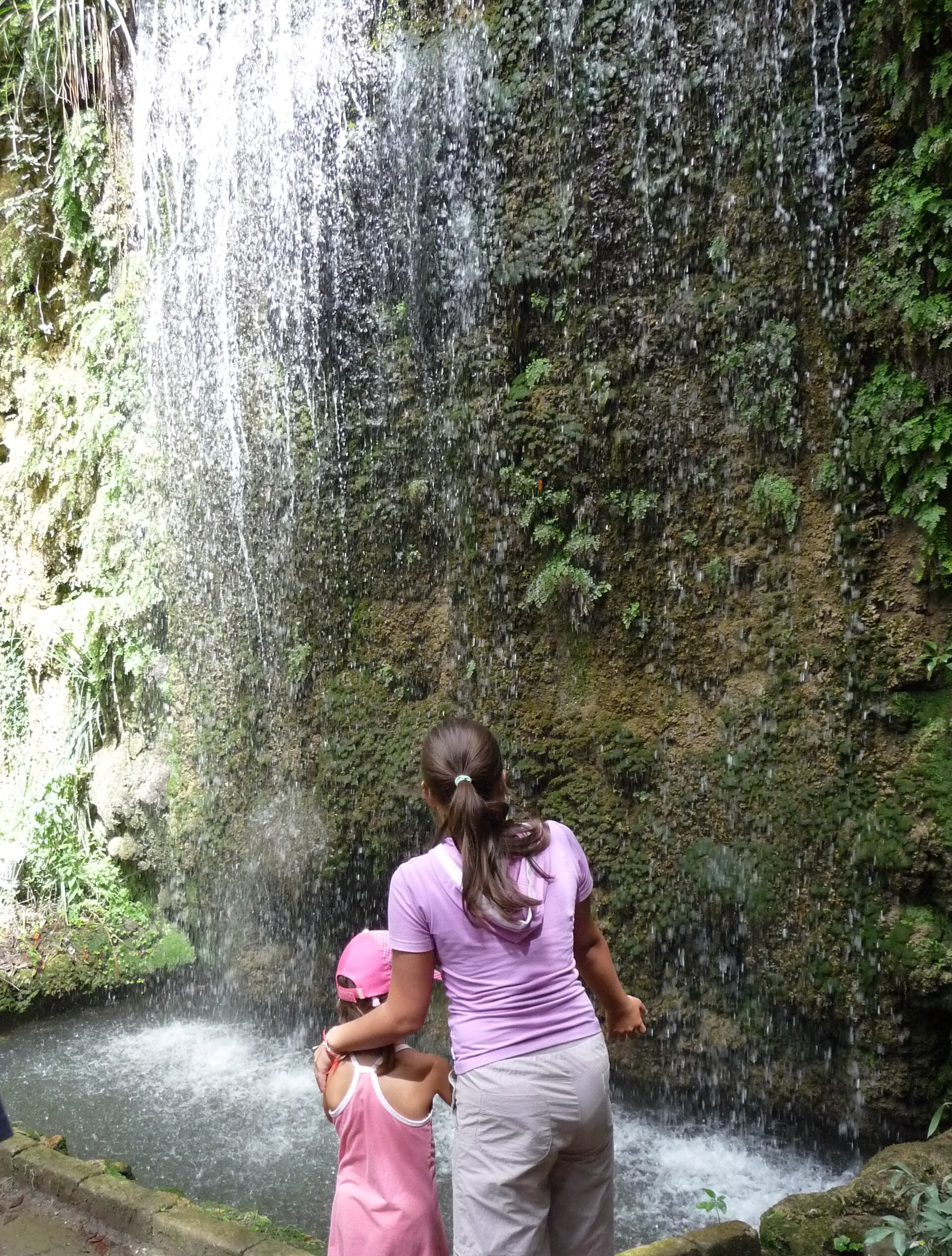
The aqueduct made possible the whole spectacle of the park’s waters, feeding the cascade and the chain of fountains that are the glory of Caserta. Its construction, across difficult terrain and over great distances, was a triumph of engineering, and it stands as a monument to Vanvitelli’s genius not only as an architect but as an engineer of the first rank.
In addition to the great formal park, Caserta possesses a beautiful English Garden, laid out in the later eighteenth century in the naturalistic style then coming into fashion. Created at the wish of the queen, it forms a delightful contrast to the formal grandeur of the main axis, with winding paths, exotic plants, artificial ruins, and a serene lake, a place of romantic beauty within the great royal park.
The English Garden was one of the earliest of its kind in Italy, and it introduced to Caserta the new taste for the picturesque and the natural that was spreading across Europe. With its exotic species, its follies, and its carefully composed naturalistic scenes, it complements the formal park, so that the grounds of Caserta unite the two great traditions of European garden design in a single magnificent landscape.
The aqueduct that made all this possible stretched for tens of kilometres across the countryside, carried in places on tiers of great arches that rival the aqueducts of ancient Rome, and it remains one of the most impressive works of eighteenth-century engineering in Europe. That such an enormous undertaking was carried out simply to feed the fountains of a royal park is itself a measure of the extraordinary ambition that lay behind the whole creation of Caserta.
Caserta Today: A World Heritage Masterpiece
In recognition of its outstanding importance, the Royal Palace of Caserta, together with its park, its aqueduct, and the associated industrial complex nearby, was inscribed on the UNESCO World Heritage List. It is celebrated as the swan song of the Baroque, the last great expression of that style before the classical age, and as a masterpiece that unites architecture, landscape, and engineering on an unrivalled scale.
View the exact location on Google Maps
Today the palace and its park are open to the public and rank among the most visited monuments in Italy. Visitors can explore the magnificent state apartments, the grand staircase, the chapel, and the theatre, and then wander or ride the length of the great park, from fountain to fountain along the vast axis toward the distant cascade, and enjoy the romantic beauty of the English Garden.
The palace has also become famous as a setting for films, its magnificent interiors and grand spaces serving as the backdrop for many productions that have sought a setting of royal or imperial splendour. This modern fame has brought the palace to new audiences around the world, adding to its long history a further chapter as one of the most recognisable of all royal residences.
More than two and a half centuries after Charles of Bourbon laid its foundation stone, the Reggia di Caserta endures as the largest royal palace in the world and one of the supreme achievements of the Italian Baroque. Grand beyond measure, magnificent in every detail, and set amid one of the most spectacular parks ever created, it stands as the ultimate monument to the ambition of a dynasty and the genius of its architect.
The palace continues to be studied and admired as one of the great achievements of European art, and ongoing programmes of conservation ensure that its vast fabric, its interiors, and its park are preserved for future generations. In its scale, its ambition, and its magnificence, Caserta remains without rival, a fitting conclusion to the great tradition of royal palace-building that had begun with Versailles and reached its ultimate expression on the plain of Campania.
You May Like
Blenheim Palace: The Baroque Masterpiece a Nation Built to Reward a Victory