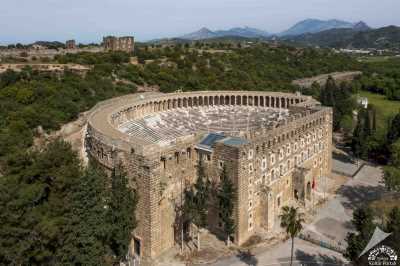
Aspendos Ancient City is famous for having the best-preserved Roman Period theater not only in Anatolia but in the entire Mediterranean world. The city was founded on the plain of a hill near Köprüçay (Ancient Eurymedon), one of the largest rivers of the region. Today, theaters and aqueducts are mostly visited in Aspendos, which owes its transportation and development with the Mediterranean to the nearby river and therefore the fertile lands around it. The ruins of other buildings belonging to the city are located on the plain of the hill on which the theater leans.
Historians mention that the Greek side won the war between the Greeks and Persians in 467 BC, known as the Battle of Eurymedon, by the river flowing near the city. Although Aspendos tried to resist Alexander the Great by fraudulent means, they ultimately surrendered and accepted the tax debt in return for the famous horses and gold raised in the city. The brightest period of the city, which came under Ptolemaic rule after the death of Alexander, was undoubtedly the Roman Empire period, when the famous theaters and waterways were built.
Antalya Provincial Culture and Tourism Directorate Archive
Aspendos Theater is one of the most distinguished representatives of Roman period theaters today, with its architectural features and well-preserved state. Dedicated to the gods and emperors of the time, the building displays the latest lines of Roman theater architecture and construction techniques. The theater, one of the magnificent buildings of its time, could seat 15-20 thousand people. It was built by the architect Zenon, son of Theodoros, during the reign of Emperor Marcus Aurelius (161-180 AD). It is understood from the Greek and Latin inscriptions on both sides of the entrance that it was built by two rich brothers of the city, Curtius Crispinus and Curtius Auspicatus.
Aspendos is one of the cities that continued its existence during the Byzantine and Seljuk periods. It is possible to see traces of Seljuk period repairs in the famous theater, especially in the monumental door addition in the middle of the exterior and in the dark red zigzag patterned plaster covering on the facade. One of the most important reasons why the stage building, where the Seljuk sultans stayed and was thought to have been arranged as a caravanserai, has remained intact until today is attributed to this Seljuk repair and preservation. Mustafa Kemal Atatürk also visited this place in 1930 and gave instructions for its repair and reuse.

General Directorate of Promotion Archive, Gülcan Acar
On the hill on which the theater rests, surrounded by city walls in places, there are ruins worth seeing, such as the agora, basilica, monumental fountain, parliament building, monumental arch, street and Hellenistic temple, which are important structures of the city center.
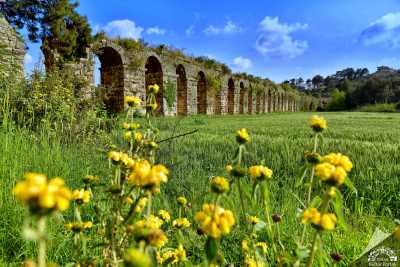
In addition to the theater, the other most important ruins that can be visited in the ruins are the aqueducts. The Aspendos waterway system is one of the best examples of ancient waterways preserved to this day. The general view is formed by the water pressure towers at both ends of the arched bridge, which is approximately 1 kilometer long and located north-south. While the city’s water was collected in pear-shaped cisterns carved into the bedrock, which can be seen in places on the hill, a more regular supply of water was achieved by developing the waterway system along with all the structures in the 2nd and 3rd centuries AD.
General Directorate of Promotion Archive, Gülcan Acar

The fact that such a small-scale city prints the most valid currency in the entire Mediterranean world and is equipped with monumental buildings is explained by the convenience of its economy. The most important export product that keeps the city’s economy afloat is the salt obtained from the nearby Lake Kapria, which is still dried and used in cotton farming today. Salt, which was sent to the Mediterranean markets via the navigable river along with other export products, became the city’s most important source of income. In addition, viticulture and winemaking, olives and olive oil, grain products and fresh fruit are the city’s other agricultural export products. Historians write that the horses bred in Aspendos were the most sought-after horses in the entire Near East and Mediterranean world.
“Ancient Aspendos City Theater and Aqueducts” has been on the UNESCO World Heritage Tentative List since 2015.
Source: “Aspendos”, Antalya from Past to Present II. Volume, Antalya Provincial Directorate of Culture and Tourism (2012)
Places to Visit in Antalya
Source: Antalya Provincial Culture and Tourism Directorate