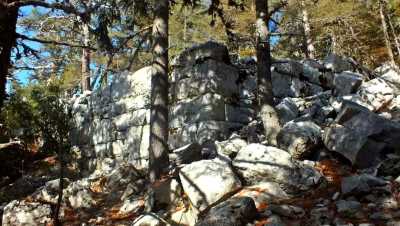
Mnara (Marmara), one of the most difficult ancient cities to reach in Anatolia, is located on a very high rocky hill at the summit of Kavaklı Mountain, at an altitude of approximately 1400 meters, within the borders of Kemer district of Antalya. The ancient city has a position that allows it to control a significant part of Eastern Lycia and to see the entire Gulf of Antalya up to Side with the naked eye.
Information about the history of the city is very limited. It is stated in ancient sources that the people of Mnaran plundered and damaged the crops of the people of Phaselis, and that Alexander the Great, who spent the winter in Phaselis during his Asian campaign, captured the city. According to the characteristics of many buildings, the settlement was founded in the Hellenistic period and was inhabited during the Roman period; It is understood from the findings in the city that the settlement shrank in the early Byzantine period and was abandoned in the 8th century.
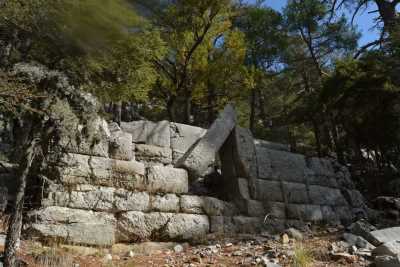
Mnara, which was an independent polis during the Hellenistic period, is also the center of the “Mnarşke” region mentioned in the Miliarium Lyciae. The city consists of a very steep, inaccessible rocky acropolis and the ruins of buildings at its foot. No remains of city walls were found, probably because they were not needed due to the natural inaccessibility of the hill. Only a tower-like ruin was seen at the lower level of the hill, at the point overlooking the sea and the valley.
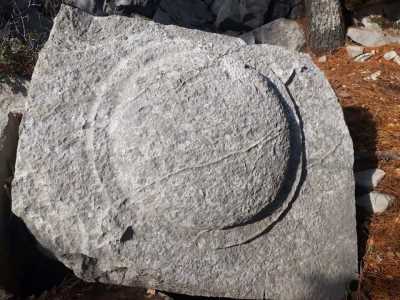
The ruins in Mnara are lined up in an east-west direction. The south of the summit was used as a quarry. In the southeast, there is a temple made entirely of marble, with four columns at the front and rich shield depictions, which can be reached by three steps. It is understood from the statue fragments on the surface that many statues were gifted to the temple. To the west of the temple, there are ruins of a large cistern and a building thought to be a heroon. To the northeast of the temple, almost at the top, there is a building with cliffs on both sides, without a stage building, where religious ceremonies are held. In the northwest of the city, ruins of buildings thought to be agora and bouleuterion (parliament building) supported by terrace walls can be found.
It may be quite difficult to reach the ancient city, which promises an unforgettable experience for hikers as well as archeology enthusiasts; However, at the end of the journey through the cedar forests, visitors are greeted by magnificent views.
Resources
“Mnara-Marmara (Kavaklıdağ)”, https://likyayolu.ktb.gov.tr/TR-236475/pafta-30-ovacik—goynuk-kanyon.html, 2023.
Nevzat Çevik, “The Book of Lykia”, Suna-İnan Kıraç Mediterranean Civilizations Research Institute, Antalya 2015, p. 494-498.
Source: Antalya Provincial Culture and Tourism Directorate