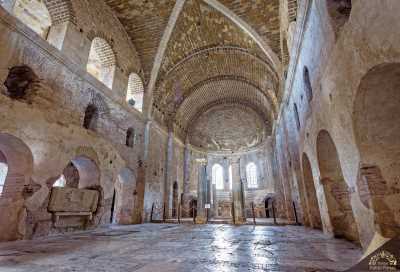
Myra Ancient City, located in and around today’s Demre district center, was founded on the plain of the same name. Rock tombs, Lycian inscriptions and coins show that Myra has existed since the 5th century BC. According to the information given by Strabo, Myra, one of the six major cities of the Lycian Union, is referred to as Myrrh in Lycian inscriptions. Myra Ancient City is especially famous for its Lycian period rock tombs, Roman period theater and St. Nicholas Church built during the Byzantine period.
General Directorate of Promotion Archive
The 2nd century AD is the period when Myra witnessed a great development. In the city, which was the metropolis of the Lycian Union, many buildings were built and repaired with the help of rich Lycian people. During the Byzantine period, Myra became one of the leading cities both religiously and administratively. It owes its fame, which has survived to this day, to the fact that St. Nicholas (Santa Claus) became the bishop of the city in the 4th century AD, and after his death, he became a saint and a church was built in his name. Myra lost its importance from the 7th century onwards due to earthquakes, floods, alluviums brought by the Demre Stream, and Arab raids, and turned into a small settlement in the 12th century.
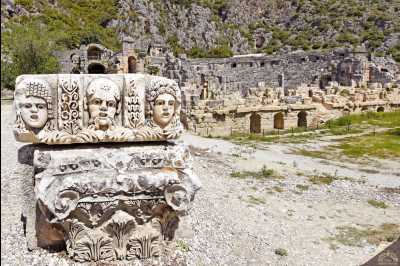
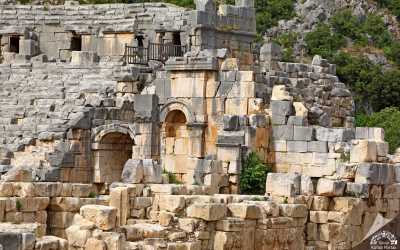
Today’s ruins consist of the theater located at the southern skirt of the acropolis and the rock tombs on both sides. According to the research, apart from the Roman period walls, which are in a very strong condition today, it is possible to find Hellenistic city wall ruins dating back to the 5th century BC on the acropolis hill and its surroundings. Located at the southern foot of the acropolis, the theater reflects the characteristics of a well-preserved Roman theater. The stage building is standing up to half of the second floor. There are rock tombs with reliefs or plains on both sides of the theater.
General Directorate of Promotion Archive
The tombs with reliefs depicting the dead and their relatives are interesting in the Myra tombs, which are the best examples of the wooden house architecture of the Lycians adapted to rock tombs. Additionally, many rock tombs with reliefs or inscriptions are lined up on top of each other or side by side on the south-facing face of the cliff. The ruins of the baths on the left of the road on the way to the city center near the theater are early and interesting examples of Roman period brick architecture.
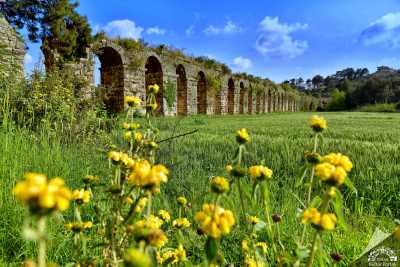
The city’s connection to the sea is provided by the navigable channel in the west of the Myros River (Demre Stream). Maritime transportation and trade of the region was also carried out from Andriake (Çayağzı) Port, located on the other side of the canal. The city’s water needs were met by channels carved into the rocks at the edge of the valley where the Demre Stream flows.
The fact that Myra, one of the six cities with three voting rights in the Lycian Union, is known as the “brightest city” shows how important a city it is. It is of particular importance that, on the coins of Myra minted under her name, Artemis, the mother goddess of the city, is represented in the form of Kybele, the oldest goddess of Anatolia. Myra, the capital of the Lycian province in the 5th century AD, was founded in St. The fact that it is the city where Paul and his friends stopped has a special significance in Christianity.
“Ancient Cities of the Lycian Civilization (Antalya and Muğla)”, including Myra, were recorded on the UNESCO World Heritage Tentative List in 2009.
Source: “Myra” Antalya from Past to Today (Volume II), Antalya Provincial Directorate of Culture and Tourism (2012)
Places to Visit in Antalya
Source: Antalya Provincial Culture and Tourism Directorate