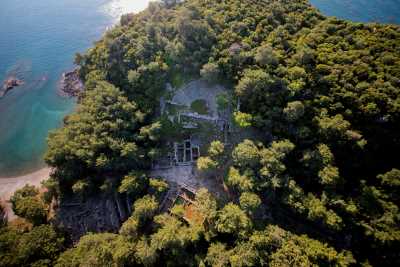
It is said that the Ancient City of Phaselis was founded by colonists from Rhodes in the 7th century BC on a small peninsula extending into the Mediterranean. The founding legend tells that the colonists responded to local people’s suggestions for corn or dried fish with requests for fish. Its geographical location shows that it is an important port city. It has three ports, one in the north of the peninsula, the other in the northeast and the third on the southwest coast. Its ports, agoras and ship depictions on city coins emphasize Phaselis’ commercial port identity.
General Directorate of Promotion Archive, Orhan Özgülbaş
Phaselis is sometimes shown as the city of Lycia and sometimes Pamphylia region. In fact, it is located between the borders of both regions. The city was ruled by Persians in the 5th century BC, Mausolos, the Satrap of Kayra, in the 4th century, and finally Pericles, King of the neighboring city of Lmyra. Their welcoming Alexander the Great with a golden crown in 333 BC is one of the most colorful pages in the history of the city. Phaselis, which changed hands many times after Alexander, became a member of the Lycian League in 167 BC and minted union coins. After being pillaged by the neighboring city Olympos and pirates for a while, it came under Roman rule in 43 BC, which was the beginning of the reconstruction and prosperity in the city that would last for at least 300 years. The city was visited by Emperor Hadrian in 129. The single-arched monumental arch at the entrance of the main street starting from the southern port was erected in memory of this visit.
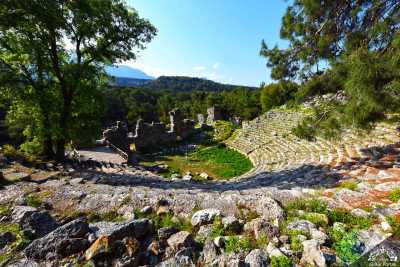
The 5th and 6th centuries were under Byzantine rule, and Phaselis was among the cities that participated in the Council of Chalcedon in 451. After the Arab raids in the 7th century, a new period of prosperity began in the 8th century. After the Seljuk siege in 1158, Phaselis lost its importance due to earthquakes and the loss of functionality of its port, and was completely abandoned from the beginning of the 13th century. Mostly ruins from the Roman and Byzantine periods have survived to the present day. These are lined up on both sides of the main street, which forms the main axis of the city and connects the north-south ports. The street widens between the agora and the theater, forming a small square. Steps in the southeast corner of the square provide access to the theater and the acropolis. The theater is a typical small-sized Hellenistic Period theatre. It is understood from the ruins that the stage building was added during the Roman period, and that in the Late Byzantine period, the stage building wall was partially part of the new walls that protected the city. To the right of the bend at the entrance of the ruins, the old walls of the city (3rd century BC) and the ruins of foundations that may be temples or monumental tombs can be found. The hillside behind the northern port is the cemetery area of the city.
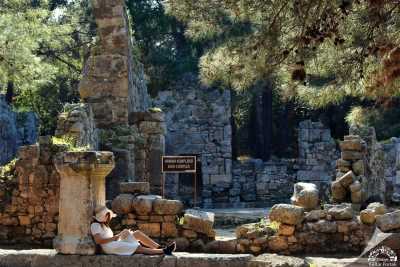
Photo: Servet Uygun
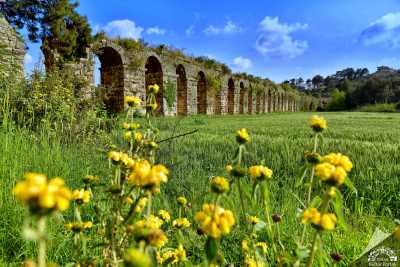
The most monumental structure that has survived to the present day is the aqueducts. The water the city needed was brought from the spring located on the hill in the north. While the water needs of the city were met by wells and cisterns in the early periods, it was possible to bring water from long distances with these aqueducts built in the Roman period; Water was distributed to every part of the city through pipes and canals.
Photo: Gülcan Acar
There are three agoras, one opposite the theater and the other two on the right of the main street leading to the southern port. Inside the agora opposite the theater, there are today the ruins of a small basilica from the Byzantine period. Two other important ruins of the city are the ruins of two baths, one small and the other large, in the city square. Especially the small bath ruins provide information about the heating system of the Roman Bath. Historians write that the chief goddess of the city was Athena, the goddess of war and wisdom. It is thought that the Temple of Athena and other important structures, which have not yet been found, are located on the acropolis hill covered with forest today.
“Ancient Cities of the Lycian Civilization (Antalya and Muğla)”, including Phaselis, were recorded on the UNESCO World Heritage Tentative List in 2009.
Source: “Phaselis”, Antalya From Past to Present II. Volume, Antalya Provincial Directorate of Culture and Tourism (2012)
Places to Visit in Antalya
Source: Antalya Provincial Culture and Tourism Directorate