Termessos Ancient City is an important ancient city founded by the Solyms, descendants of the Luwians, one of the oldest peoples of Anatolia, in the southwestern part of the Pisidia Region called Milyas, in the valley between the peaks of Solymos Mountain, which is today called Güllük. It is one of the most striking ruins protected within the forest and is located within the National Park of the same name. Güllük Mountain (Termessos) National Park is a special region that hosts endangered animals as well as rich vegetation. The ruins on Güllük Mountain can be reached by using the private road climbing to the left from the 24th kilometer of the Antalya-Korkuteli highway.
The city’s rise to the stage of history occurred when Alexander the Great besieged the city in 333 BC and the people of Termessos made a strong defense and did not surrender the city. After Alexander’s death, the city was taken by the Ptolemies. The people of Termessos, who captured the neighboring city of Isinda in 189 BC, were punished by Manlius Vulso, the Commander of the Roman Forces in Anatolia, upon the complaint of the people of Isinda. Most likely, there was a war between Termessos and the Lycian League around the same time. In 71 BC, it was accepted and approved by the Roman Senate that Termessos, which had a “friendship and alliance” with Rome, was independent in its affairs and would make its own laws.
General Directorate of Promotion Archive
It is known that Amyntas of Galatia ruled Termessos and other cities of Pisidia from 36 to 25 BC. It is understood from the coins minted that the city maintained its independence during the Roman Empire period. There is no information about the situation of the city during the Byzantine period and subsequent periods.

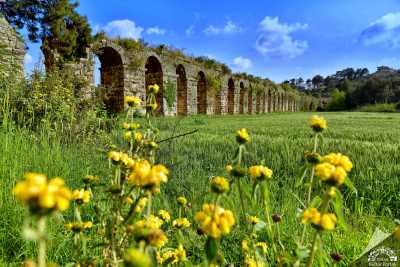
The city of Termessos did not witness a new settlement after it was abandoned, and apart from earthquakes and natural destruction, it can be shown as one of the ruins that are quite solid and well preserved. The ruins of the city begin with the Hellenistic Period city walls located near Yenicekahve on the Antalya-Korkuteli highway and continue to the top of Güllük Mountain. When you follow the path that climbs to the city after the parking lot, you will see the steps and monumental entrance of the Ionic temple built during the reign of Emperor Hadrian on the right. If you continue climbing southwards from the area where the lower city walls and water source are located, you will reach the Gymnasium on the left, the first floor of which has survived in some places. In the southwest of the building, which consists of many rooms and halls, there is a colonnaded street with shops behind them. In the immediate vicinity, canals can still be seen, showing the perfection of the sewer network. When you reach the plain, you can reach the area where many official buildings of the city are located, on the left of the path leading to the forest observation point. The first ruins on the plain belong to the agora. The portico or stoa in the west, II. It was built during the time of Attalos (159-138 BC) and is in the Doric order. To the east of the agora, there is a theater leaning on the hillside and overlooking the Gulf of Antalya. Approximately 100 meters southwest of the theater is the parliament building, standing up to roof height. On the plain to the east of the agora, 5 interconnecting cisterns are unique in terms of depth and width. In the southwest of the city are the ruins of a Roman-style villa called the Founder’s House. The building, whose facade wall is in the Doric order and reaches a height of 6 meters, was named the Founder’s House due to the inscription on the left side of its door.
Antalya Provincial Directorate of Culture and Tourism
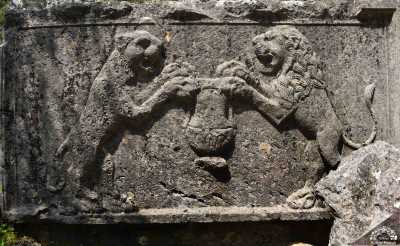
Termessos has many temples and very large cemetery areas. The diversity and decorations of their graves are quite rich. Among these, the tomb of Alketas (319 BC), one of the important commanders of the era of Alexander the Great, and others are also important in terms of shedding light on the history of the city. Next to the monumental graves, many sarcophagi with shield motifs depicting warriors occupy a large area in the cemetery. The most interesting work from Termessos in the Antalya Museum is the Dog Sarcophagus exhibited in the Sarcophagus Hall. The poetic inscription written by the owner of the dog named Stefanos is of particular importance as it is unique.

Termessos has been one of the cities that made the best use of the opportunities offered by nature with its settlement style and defense systems. Güllük Mountain-Termessos National Park, which is recommended as a world heritage with its natural and cultural values, has been on the UNESCO World Heritage Tentative List since 2000.
Source: “Termessos” Antalya from Past to Today [II. Volume], Antalya Provincial Directorate of Culture and Tourism (2012)
Places to Visit in Antalya
Source: Antalya Provincial Culture and Tourism Directorate