In the eastern reaches of Bali, in the town of Semarapura, stands the remnant of what was once the most revered royal court on the island. The palace of Klungkung, home to the Dewa Agung, the ruler regarded as first among all Balinese kings, is today a place of painted pavilions, tranquil moats and deep historical memory. What survives is only a fragment of the original complex, yet that fragment is among the most beautiful and meaningful sites in all of Bali.
You come to Klungkung to stand at the symbolic heart of traditional Balinese kingship, and to gaze up at ceilings that tell the whole story of the cosmos in glowing color. The famous Hall of Justice, with its extraordinary painted roof, and the serene floating pavilion set in its water garden, together offer a window into a courtly world of art, law, religion and tragedy.
In this guide you will get to know the palace beyond its picturesque surface. We will explore the rise of the Klungkung dynasty, decode the astonishing ceiling paintings, wander the water garden, confront the searing events that ended the kingdom, and understand why this quiet complex still resonates so powerfully with the Balinese. By the end you will see why Klungkung is far more than a pretty ruin.
In This Article
- Arriving at the Palace of Klungkung
- The Court of the Dewa Agung
- From Gelgel to Klungkung
- The Kertha Gosa, Hall of Justice
- Ceilings That Tell the Cosmos
- The Floating Pavilion
- The Water Garden of Taman Gili
- The Great Gate and What Remains
- The Tragedy of the Puputan
- A Living Heritage
- The Kamasan Painting Tradition
- A Closer Look on Film
- The Palace of Klungkung Today
Arriving at the Palace of Klungkung
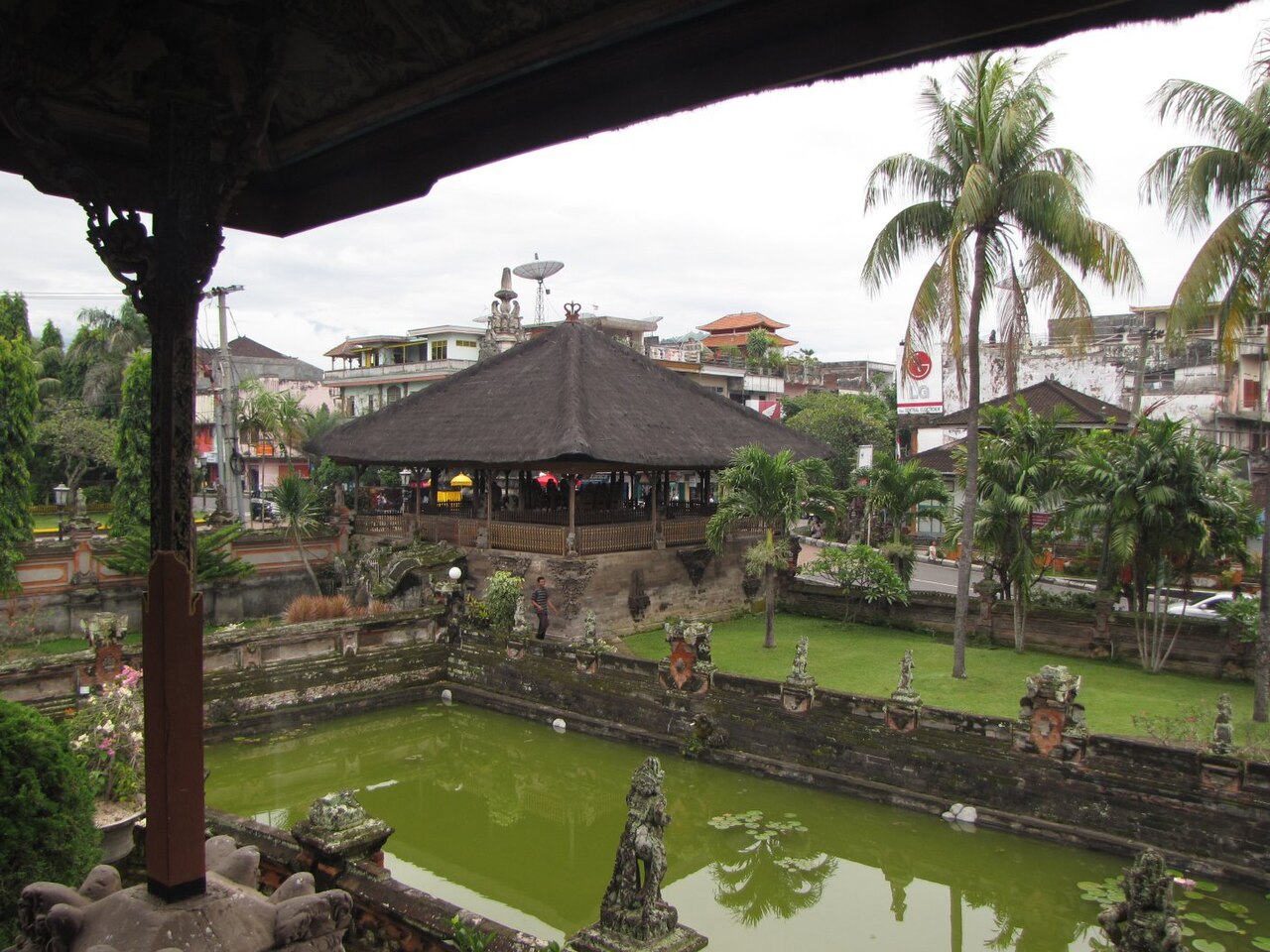
Your first impression of the Klungkung palace complex is of a compound both intimate and charged with significance. Rather than a single sprawling building, you find a walled enclosure containing a handful of exquisite structures set among lawns and moats, each one dense with meaning and artistry.
At the center of it all rise the two celebrated pavilions, their tiered roofs and open sides inviting you in, their painted ceilings drawing your eye upward almost immediately. Even before you understand what you are looking at, you sense that this is a place of unusual importance.
The scale here is human and approachable, which only deepens the impact. You can walk among the pavilions, pause beside the still water, and feel close to the world of the court in a way that grander, more forbidding palaces rarely allow.
Take a slow first circuit of the grounds before examining any single feature in detail. Getting a feel for the whole enclosure, its gates, its greenery and its quiet moats, prepares you to appreciate the treasures it contains.
The contrast with the ordinary town around the enclosure is striking. Step through the gate and the noise of the street falls away, replaced by the hush of a place still charged with the memory of kings.
There is a gravity to the compound that visitors often feel before they can name it. This was the sacred center of an island’s kingship, and something of that weight still lingers among the pavilions.
Wherever you turn within the enclosure, your eye is caught by something worth pausing over, a carved detail, a reflection in the moat, a glimpse of painted color beneath a roof. It is a compact site that rewards unhurried attention.
By the time you have completed that first slow circuit, you will already sense that Klungkung is a place to be absorbed rather than merely ticked off, one that repays every extra minute you give it.
For all these reasons, Klungkung deserves to be approached not as a quick photo stop but as a place to dwell in, however briefly, and to carry away in memory.
The Court of the Dewa Agung
To understand Klungkung, you must understand the special status of its rulers. The Dewa Agung of Klungkung was regarded as the paramount king of Bali, the senior figure to whom the other Balinese royal houses looked with respect. This was the ceremonial and spiritual apex of the island’s traditional order.

That preeminence gave the court at Klungkung an aura beyond its actual political power. Even when other kingdoms grew strong, the Dewa Agung retained a unique prestige, seen as the legitimate heir to the grand traditions of Bali’s classical age.
The palace was the seat of this exalted authority, a place where kingship was bound up with religion, art and cosmic order. To rule from here was to embody the ideals of Balinese civilization at their most refined.
Keeping this status in mind transforms how you see the site. Every pavilion and painting was an expression of a kingship understood as sacred, a link between the human world and the divine order that the paintings themselves depict.
The other rulers of Bali might act independently in practice, yet they continued to acknowledge the special dignity of the Dewa Agung, a recognition that placed Klungkung at the symbolic summit of the whole island.
This distinction between prestige and raw power is subtle but important. The Dewa Agung reigned over the imagination of Bali even where he did not command its armies, and the palace was the stage for that spiritual sovereignty.
The palace, then, must be read as the physical expression of this sacred kingship, every element designed to reinforce the ruler’s role as a bridge between the human and divine orders.
This is why a visit to Klungkung feels different from a visit to a merely political capital; you are standing at what the Balinese themselves regarded as the spiritual center of their island world.
It is a status without exact parallel elsewhere, and appreciating it is the key that unlocks the deeper meaning of everything preserved here.
From Gelgel to Klungkung
The Klungkung dynasty traced its roots to the earlier court of Gelgel, which had been the great center of Balinese power in the classical age. When that older seat declined, the royal line established itself at Klungkung, carrying with it the prestige and traditions of its predecessor.
This inheritance mattered enormously. By presenting themselves as the direct continuation of the Gelgel court, the rulers of Klungkung claimed the mantle of the golden age of Balinese culture, when art, literature and religion had flourished under royal patronage.
The move to Klungkung was thus far more than a change of address. It was the transplanting of a whole civilization’s memory, a deliberate assertion of continuity with the most glorious chapter of the island’s past.
As you explore the palace, remember that you are standing at the end of a long dynastic thread reaching back through Gelgel to the very origins of classical Balinese kingship. Klungkung was the guardian of that heritage.
The court of Gelgel had presided over a flowering of Balinese arts and letters, and its memory carried an almost mythic weight. To inherit that legacy was to inherit a whole cultural ideal, not merely a crown.
When the seat shifted to Klungkung, the rituals, the artistic traditions and the sacred prestige of the older court travelled with it. In this way the new palace became the living continuation of Bali’s classical golden age.
Later Balinese looked back on this lineage as the backbone of their cultural identity, and the rulers of Klungkung were careful to present themselves as its faithful guardians, custodians of an inheritance far older than themselves.
Understanding this dynastic continuity helps explain the reverence in which Klungkung was held, for it was not simply one kingdom among many but the acknowledged heir to the island’s most illustrious royal tradition.
That sense of being at the culmination of a long and sacred lineage is part of what gives Klungkung its unique atmosphere among the historic sites of Bali.
The Kertha Gosa, Hall of Justice
The most famous structure at Klungkung is the Kertha Gosa, the royal Hall of Justice. Here, in an open pavilion, the highest legal cases of the realm were once heard, with judges seated beneath a ceiling painted with scenes of cosmic reward and punishment. Law and religion met directly overhead.

The setting was no accident. Those who came before the court would look up to see vivid depictions of the fates awaiting the wicked and the virtuous in the afterlife, a powerful reminder that earthly justice was but a reflection of a higher, divine order.
There is something profoundly moving about a courtroom that placed the cosmos itself on its ceiling. The message was clear: judgment here was answerable to the gods, and every verdict carried weight beyond the human world.
Standing beneath the painted roof, you feel the weight of that idea. The Kertha Gosa was not merely a place of law but a theater of moral instruction, where the very architecture taught the consequences of good and evil.
The judges who once sat here did so quite literally under the gaze of the divine, surrounded by images of cosmic consequence. Few legal settings anywhere have so directly fused the earthly and the sacred.
It is worth imagining the scene: a case unfolding below, the accused and the accusers, and above them all the painted heavens and hells, silently insisting that true justice belongs to a higher court than any on earth.
That fusion of law, art and religion makes the Kertha Gosa unique among the world’s historic courtrooms, a place where architecture itself delivered a moral verdict.
Generations of visitors have left the pavilion with the same lingering impression, that they have witnessed a place where the very idea of justice was raised to a cosmic scale.
Even today, knowing the pavilion’s original purpose lends every glance upward a new seriousness, as though the old court were still quietly in session overhead.
Ceilings That Tell the Cosmos
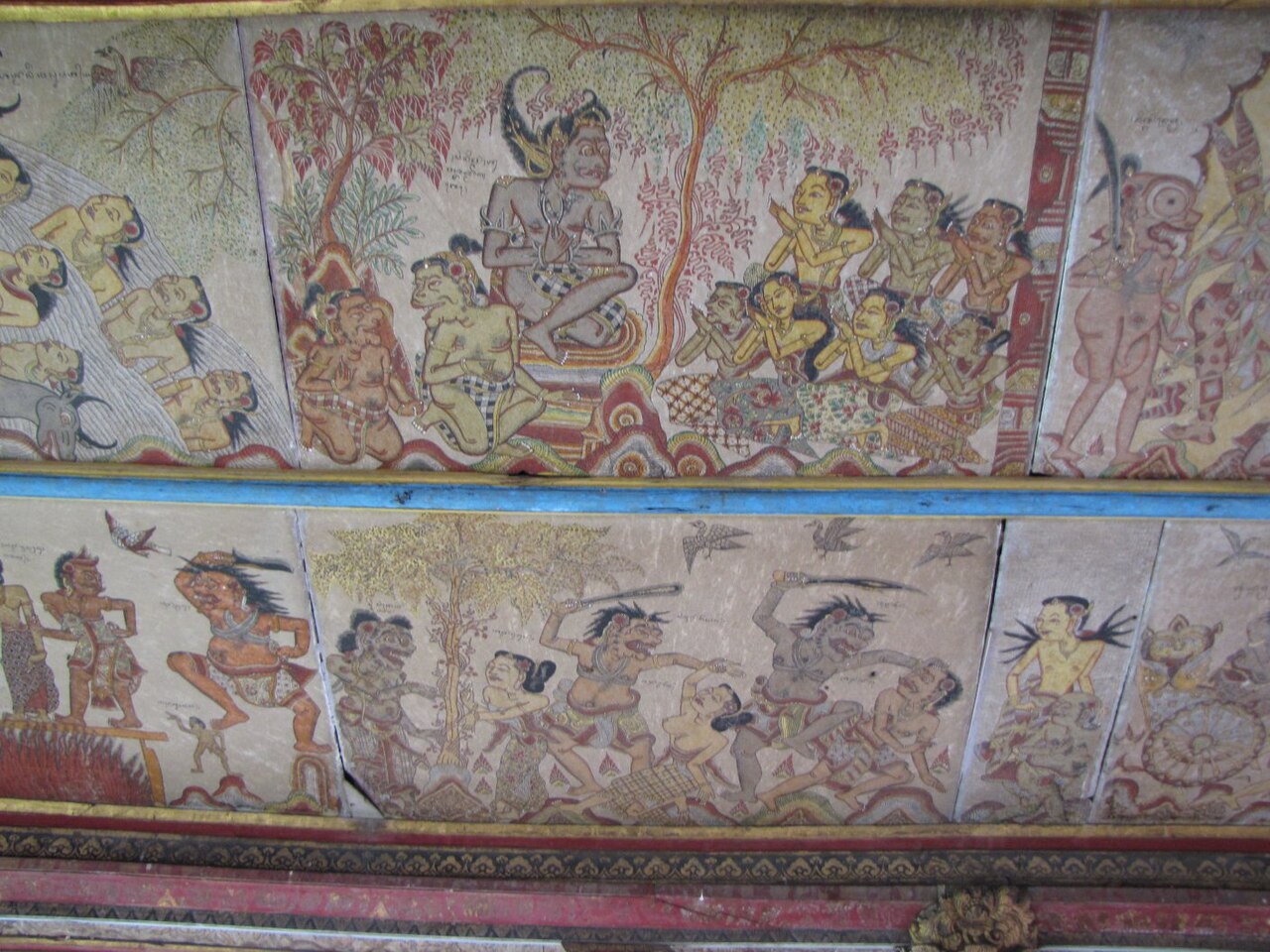
The painted ceilings of Klungkung are among the greatest treasures of Balinese art. Executed in the traditional Kamasan style, with its distinctive flat figures and rich detail, they unfold across the roof in tiers, telling stories drawn from Balinese religious and epic tradition.

Among the most striking narratives is the journey of a hero through the afterworld, confronting the torments of the damned and the rewards of the righteous. Panel by panel, the paintings guide the eye through a moral and cosmic journey of extraordinary vividness.
To read these ceilings is to enter the Balinese imagination at its most intense. Demons, deities, punishments and paradises crowd the panels, each rendered with the precise conventions of a centuries-old artistic language that still feels startlingly alive.
Give yourself plenty of time here, and let your eyes travel slowly across the tiers. The paintings reward patient looking, revealing new details and stories the longer you gaze, and they remain the single most unforgettable feature of the entire site.
The tiered arrangement of the panels guides the viewer through successive stages of the narrative, so that the ceiling functions almost like a great illustrated scroll unrolled overhead. It is storytelling on an architectural scale.
Scholars have long studied these ceilings for what they reveal about Balinese cosmology and belief, yet no amount of study quite prepares you for the visceral impact of standing beneath them and looking up.
The endurance of these paintings, restored and maintained over the years, allows us to experience something very close to what visitors centuries ago would have seen when they raised their eyes to the roof.
No photograph quite conveys the cumulative effect of the tiers of imagery pressing in overhead; it is an experience best had in person, standing quietly beneath the painted heavens.
Each visit seems to reveal something new, a small figure or scene overlooked before, so that even those who return again and again find fresh reasons to gaze upward in wonder.
The Floating Pavilion
Beside the Hall of Justice lies the Bale Kambang, the floating pavilion, set in the middle of a moat so that it seems to hover upon the water. Reached by a small bridge, this serene structure is one of the most enchanting sights in Bali, a vision of courtly grace mirrored in the still pool around it.
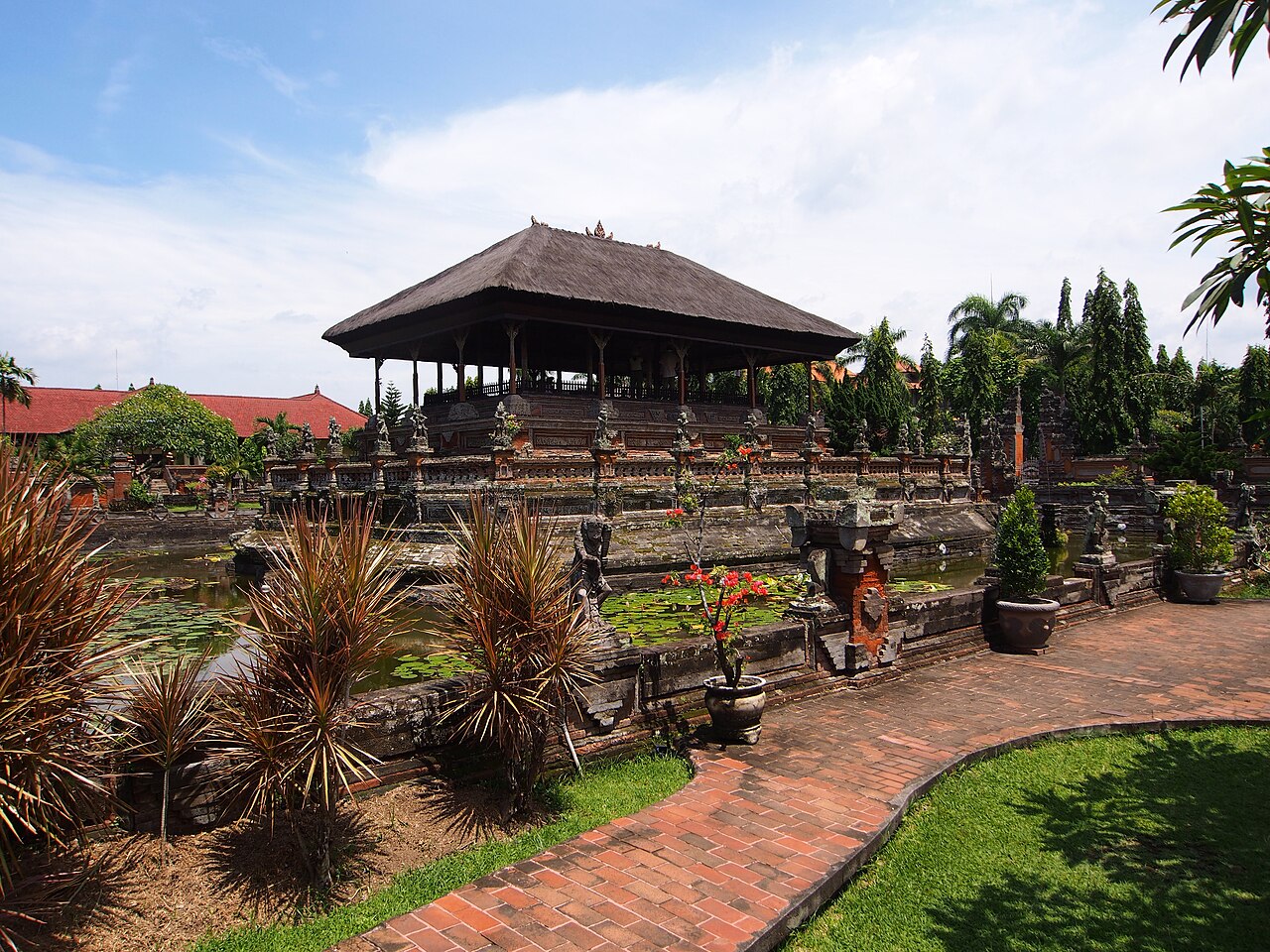
Like its neighbor, the floating pavilion carries a painted ceiling, its panels continuing the tradition of narrative art overhead. Here too the roof becomes a canvas for stories, blending beauty with meaning in the characteristic Balinese manner.
The water setting is more than decorative. In Balinese thought, such moats and gardens evoke cosmic seas and sacred order, turning the pavilion into a symbolic island of harmony, a fitting retreat for a king regarded as a link to the divine.
Pause on the bridge and take in the reflection of the pavilion in the water. It is a scene of perfect calm, and it captures the aesthetic ideal of the Balinese court, where architecture, nature and art were woven into a single harmonious whole.
The very name, the floating pavilion, captures the poetry of the conception, a building that appears to rest weightless upon the water, dissolving the boundary between architecture and reflection.
In the cool of the day, with the surface of the moat still, the pavilion and its mirror image seem to complete each other, an image of balance that lies at the heart of Balinese aesthetics.
Crossing the little bridge to reach it heightens the sense of passing into a place set apart, a serene retreat surrounded by water and crowned with story.
Together with the Hall of Justice, the floating pavilion forms the twin heart of the surviving palace, and the two structures are almost always experienced as a pair, each enriching the other.
The Water Garden of Taman Gili
The pavilions of Klungkung sit within what is known as the Taman Gili, the island garden, a designed landscape of moats and greenery that frames the structures and heightens their beauty. The whole ensemble was conceived as a unified composition of building and water.

Wandering the garden, you appreciate how carefully the elements were arranged. The moats reflect the pavilions, the greenery softens the enclosure, and the overall effect is one of tranquil balance, an earthly image of cosmic order.
Water gardens like this held deep meaning in Balinese royal culture, symbolizing the sacred seas of myth and providing a setting worthy of a king’s spiritual role. The Taman Gili was as much a religious statement as a pleasure garden.
Take time simply to sit and absorb the atmosphere. The interplay of still water, painted pavilions and quiet greenery creates a mood of contemplation that lingers, and it is easy to see why this remains such a beloved place.
The name Taman Gili, meaning island garden, perfectly describes the effect of pavilions set amid encircling water, each one an island of calm within the sacred enclosure.
Balinese garden design was never merely ornamental; it was a way of modelling the cosmos in miniature, with water standing for the primeval seas and the pavilions for the ordered world of gods and kings.
Even reduced from its original extent, the garden still works its intended magic, drawing visitors into a mood of stillness and reflection that feels worlds away from the busy streets outside.
It is a landscape meant to be felt as much as seen, and lingering here is the surest way to absorb the particular serenity that has made the site so beloved.
Photographers and painters alike have long been drawn to the scene, and it is easy to understand why: few compositions in Bali so perfectly balance architecture, water and sky.
The Great Gate and What Remains
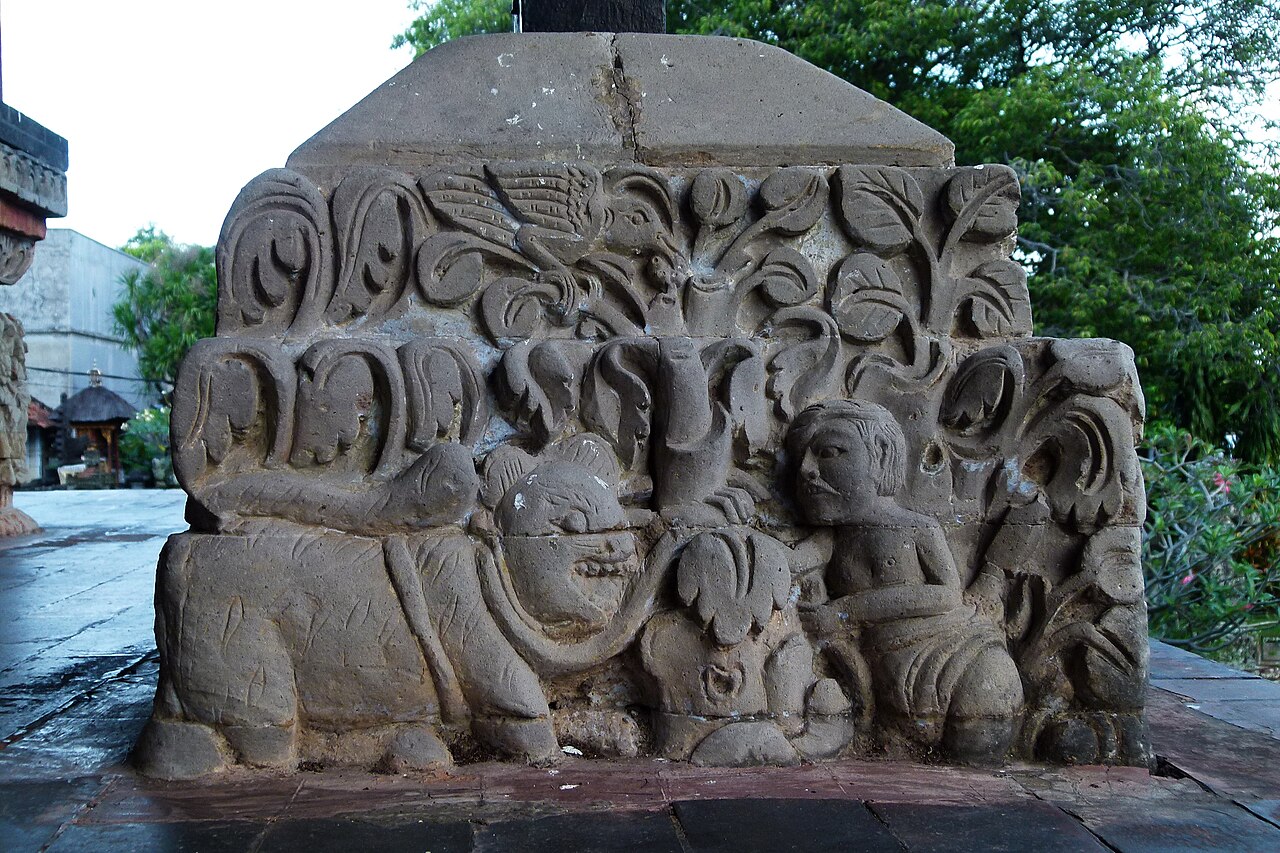
Among the most poignant survivals at Klungkung is the great gateway, the Kori Agung, a richly carved portal that once led into the heart of the royal compound. Standing today somewhat apart, it is a haunting reminder of the far larger palace that once surrounded these pavilions.

For the complex you see is only a fragment. The greater part of the royal palace was destroyed, and what remains are these few precious structures, saved from a wider devastation. The surviving gate speaks eloquently of everything that was lost.
Running your eye over the intricate carving of the portal, you glimpse the artistry that must have adorned the whole vanished palace. It is a fragment that hints at a magnificence now gone, and it lends the site a deep undercurrent of loss.
To stand before the gate is to feel the presence of absence, the sense of a great royal world reduced to a handful of survivors. That awareness gives the beauty of Klungkung a melancholy depth.
Such gateways were among the most lavishly decorated elements of any Balinese palace, marking the threshold between the ordinary world and the sacred space of kingship. The care lavished on them reflected their symbolic importance.
To pass through, or even to stand before, such a portal was to cross into a realm apart, and the surviving gate at Klungkung still communicates that sense of transition despite everything that has been lost around it.
Fragments like this are precious precisely because they let us imagine the whole. From the quality of the carving that survives, we can begin to reconstruct in our minds the splendour of the vanished compound.
In its silent, weathered grandeur, the gate has become one of the most photographed and contemplated features of the site, a symbol of both loss and endurance.
Standing quietly before it, many visitors find themselves moved by the thought of all that once lay beyond, now vanished but not forgotten.
The Tragedy of the Puputan
The story of Klungkung reaches its climax in one of the most harrowing episodes in Balinese history. When colonial forces moved against the kingdom in the early twentieth century, the court chose not surrender but a ritual fight to the death, a puputan, in which the royal household marched out to meet the guns.

This act of defiant self-sacrifice brought the kingdom to a devastating end, and with it the destruction of much of the palace. The events left a profound scar on the Balinese memory, a symbol of both the brutality of conquest and the fierce dignity of resistance.
Understanding the puputan is essential to understanding the site. The pavilions that survive stand as witnesses to a tragedy, their beauty forever shadowed by the knowledge of how the court that created them met its end.
A monument nearby commemorates these events, ensuring that the sacrifice is never forgotten. When you walk the peaceful grounds today, it is worth holding this history in mind, for it gives the tranquil beauty of the place its full and sombre meaning.
The word puputan itself speaks of an ending fought to the very finish, a refusal to live under conquest that the Balinese have long regarded with a mixture of grief and fierce pride.
The events resonate far beyond Klungkung, standing in Balinese memory as a defining moment of resistance and sacrifice, and they lend this quiet site a significance that goes to the heart of the island’s identity.
For all the tranquility of the grounds today, the memory of that final stand hovers over the site, giving its beauty a depth of feeling that few other places can match.
Remembering the puputan as you walk the peaceful grounds transforms the visit, turning simple sightseeing into an act of quiet remembrance.
A Living Heritage
Despite the destruction it suffered, Klungkung remains a living part of Balinese cultural life. The Kamasan painting tradition seen on its ceilings still flourishes in the nearby village that gave it its name, kept alive by artists who continue the centuries-old craft.

The site itself is cherished as a repository of Balinese identity, drawing visitors, students and pilgrims who come to connect with the island’s classical heritage. Far from being a dead monument, it remains woven into the ongoing story of Bali.
This continuity is deeply meaningful. The traditions embodied at Klungkung, in art, in kingship, in religion, did not vanish with the kingdom but live on in the culture of the island, of which the palace remains a treasured symbol.
For the visitor, this living dimension adds richness to every panel and pavilion. You are not simply viewing relics but engaging with a heritage that still breathes in the art and rituals of Bali today.
Ceremonies and offerings still connect the site to the religious life of the surrounding community, ensuring that it remains a place of living practice rather than mere spectacle.
The survival of the Kamasan tradition in particular offers a remarkable thread of continuity, linking the painters of today directly to those who once adorned these royal ceilings.
In this sense Klungkung is less a monument to a closed chapter than a bridge between past and present, a place where the classical heritage of Bali continues to inform and inspire.
To engage with Klungkung, then, is to participate, however briefly, in a living tradition rather than to observe a dead one, and that is a rare privilege for any traveler.
This quality of continuity, of a heritage carried forward rather than merely mourned, is perhaps the deepest lesson the site has to offer its visitors.
It is this enduring vitality, more than any single pavilion, that makes Klungkung feel less like a ruin and more like a keeper of the island’s living soul.
The Kamasan Painting Tradition
The art that makes Klungkung so unforgettable belongs to a distinctive school known as Kamasan painting, named for the village where it developed and still thrives. This classical style, with its flat, elegant figures and warm natural pigments, is among the oldest continuous painting traditions in Bali.

Kamasan artists worked within a rich visual language of conventions, depicting gods, heroes and demons according to established forms passed down through generations. Far from limiting them, these conventions gave their work a timeless, sacred quality that mere naturalism could never achieve.
The palette itself was traditionally drawn from natural materials, lending the paintings their characteristic earthy warmth. Every figure, gesture and color carried meaning, so that reading a Kamasan panel is as much an act of interpretation as of admiration.
At Klungkung this tradition reached one of its highest expressions, covering the royal ceilings with narrative cycles of remarkable ambition. To see Kamasan art here, in its royal context, is to understand why the style has been so treasured for so long.
That the tradition still lives on in the nearby village is a source of wonder in itself, a rare case of a classical art surviving into the present, its practitioners still painting scenes their ancestors would have recognized.
Visitors interested in the art can often see it being practiced in the nearby village, where workshops keep the techniques alive and pass them to new generations of painters.
The style’s influence radiated outward across Bali, shaping religious art in temples and palaces alike, so that the ceilings of Klungkung can be seen as a royal high point of a much wider artistic culture.
Because the tradition is so bound up with religious narrative, learning to read its conventions opens a door not just to the art but to the entire worldview of classical Bali.
For many travelers, discovering that the art overhead is not a frozen relic but part of a still-vital craft is one of the most moving revelations of the whole visit.
A Closer Look on Film
To appreciate the full beauty of Klungkung, from its painted ceilings to its floating pavilion, film offers a wonderful complement to a visit. The short video below helps bring the palace and its artistry to life.

Watching it, you can better sense the atmosphere of the place, the detail of the paintings and the serenity of the water garden, all of which reward a closer look. It makes an ideal companion to understanding this remarkable site.
The Palace of Klungkung Today
Today the surviving pavilions of Klungkung, set in their tranquil water garden, endure as one of the most significant historical and artistic sites in Bali. Their painted ceilings continue to astonish visitors, and their history continues to move all who learn it.
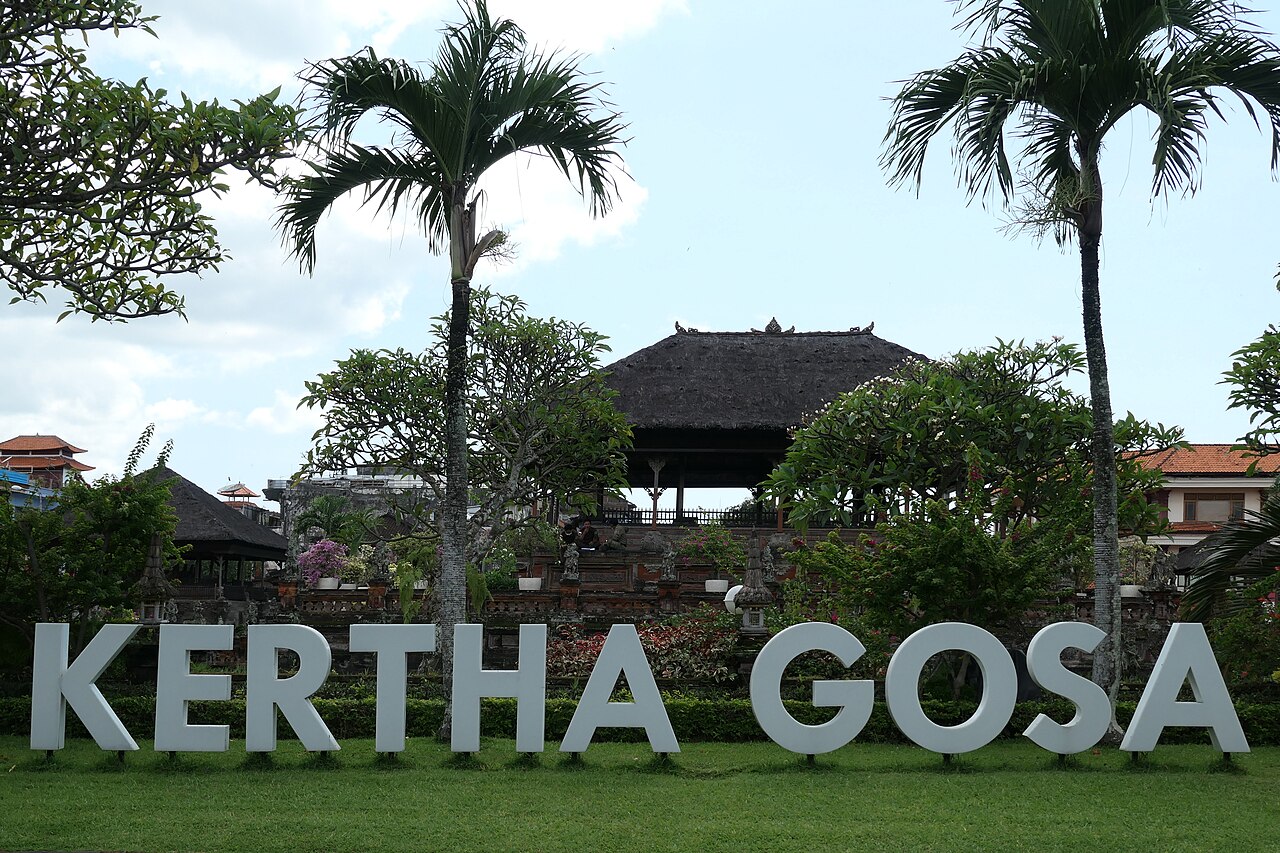
For travelers, the palace offers a rare and profound experience, a chance to encounter the classical heart of Balinese kingship and to stand beneath some of the finest traditional painting in Indonesia. It rewards those who come with curiosity and respect.
There is a lesson in the endurance of Klungkung. Though the kingdom fell and the palace was largely destroyed, its art, its meaning and its memory survived, testifying to the resilience of a culture that refused to be erased.
When you finally turn to leave, glance back at the painted pavilions reflected in their moat. You will carry with you the images of a cosmos rendered in color, the memory of a proud and tragic kingdom, and a deeper sense of the soul of Bali.
The enduring popularity of the site among both visitors and the Balinese themselves testifies to its lasting power to move and to teach, generation after generation.
Few sites in Bali so completely reward the effort to look, to learn and to reflect, and fewer still leave so lasting an impression on those who make the journey.
In its painted pavilions and quiet moats, Klungkung preserves not just the memory of a kingdom but the enduring spirit of Balinese art and belief.
It stands, in the end, as a testament to endurance, its painted ceilings still glowing above the water long after the kingdom that made them passed into history.
Long after you have left Bali, the memory of those painted heavens above the still water will return to you, a quiet reminder of a kingdom that turned its ceilings into a vision of the cosmos.
View the location on Google Maps
Palaces Nearby
If the painted pavilions of Klungkung have deepened your love of Southeast Asia’s royal courts, two more palaces of the maritime and island world make fitting companions to this one.
- the Istana Besar of Johor, the grand seaside palace of the Malay sultanate in Johor Bahru.
- the Royal Palace of Tonga, the seafront home of the last indigenous monarchy of the Pacific.
You May Like
Balla Lompoa, the Great House and Golden Crown of the Gowa Kings


One thought on “The Painted Palace of Klungkung, Where Bali’s Kings Put the Cosmos on the Ceiling”