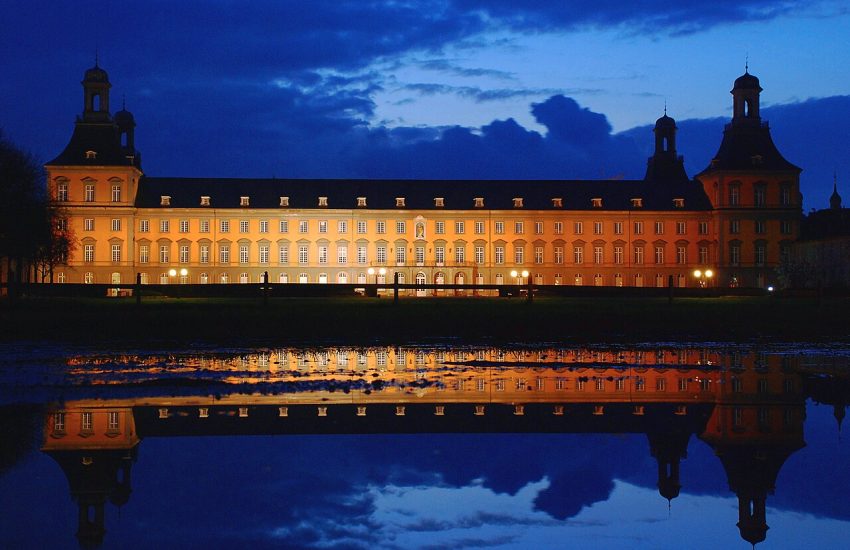
At the western edge of the old town of Munster, facing a broad square and backed by gardens, stands the last great baroque palace built in Westphalia. The Prince Bishops Palace was designed by Johann Conrad Schlaun, the master architect of the region, and its warm red brick and pale sandstone facade has become one of the symbols of the city.
Built for the prince bishops of Munster in the late eighteenth century, just before the old order collapsed, the palace is today the main building of the University of Munster, one of the largest universities in Germany. Behind it lie the palace garden and a historic botanical garden.
In this article we will explore the palace from the prince bishop who commissioned it to Schlaun’s design, its gardens and its life as a university, and we will finish with practical tips for your visit.
In This Article
- A Red Brick Palace at the Edge of the Old Town
- The Prince Bishops of Munster
- Johann Conrad Schlaun
- The Facade and Its Sculpture
- The Palace Through the Seasons
- The Forecourt and the Square
- A Symbol of Munster
- The Central Projection
- Home of the University
- War Damage and Restoration
- The Palace Garden and the Botanical Garden
- The Palace on Video
- Visiting the Palace Today
A Red Brick Palace at the Edge of the Old Town

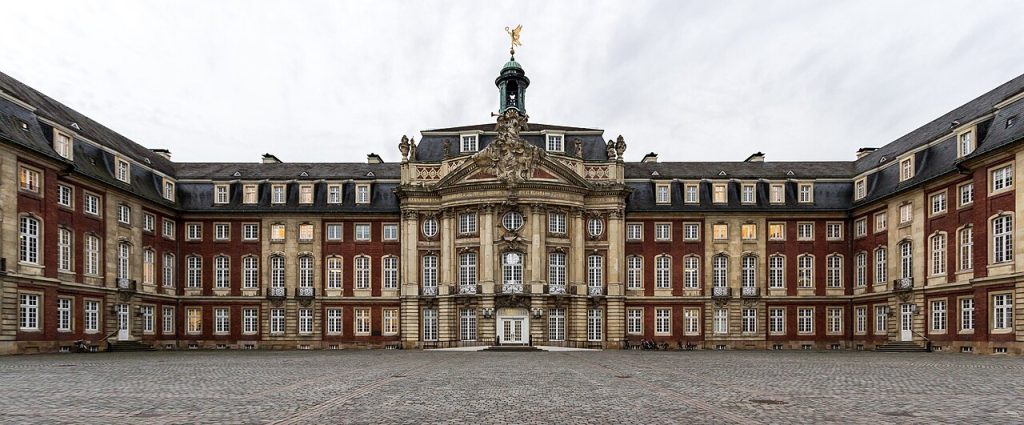
Approaching the palace across the wide square in front of it, you see a long, three winged building of red brick trimmed with pale sandstone. Its central projection, crowned with sculpture, rises above the forecourt and gives the facade a strong focal point.
The combination of red brick and light stone is typical of Westphalian baroque, and Schlaun used it with great skill to create a building that is both grand and warm.
Munster is a lively university city famous for its bicycles, its historic old town and its role in the Peace of Westphalia of 1648.
What makes the palace special is its harmony of proportion and colour, and its continuing role as a centre of learning.
The palace stands at the end of a long view from the old town, so that it appears as a natural climax to a walk through the historic streets.
Its human scale and warm colours make it feel welcoming rather than imposing, a quality that many visitors appreciate.
The Prince Bishops of Munster
For centuries Munster was the capital of a prince bishopric, a territory ruled by bishops who were also secular princes of the Holy Roman Empire.
In the eighteenth century, Prince Bishop Maximilian Friedrich von Konigsegg Rothenfels, who was also elector of Cologne, decided to build a new residence in Munster.
The site chosen had previously been occupied by the city’s citadel, and its demolition opened space for a palace and gardens on the western edge of the town.
Construction began in 1767, but the prince bishops would enjoy their new residence for only a few decades before secularisation in 1803 brought their rule to an end.
Maximilian Friedrich ruled both Cologne and Munster at the same time, a common arrangement in the eighteenth century, and he divided his time between Bonn and Munster.
Johann Conrad Schlaun
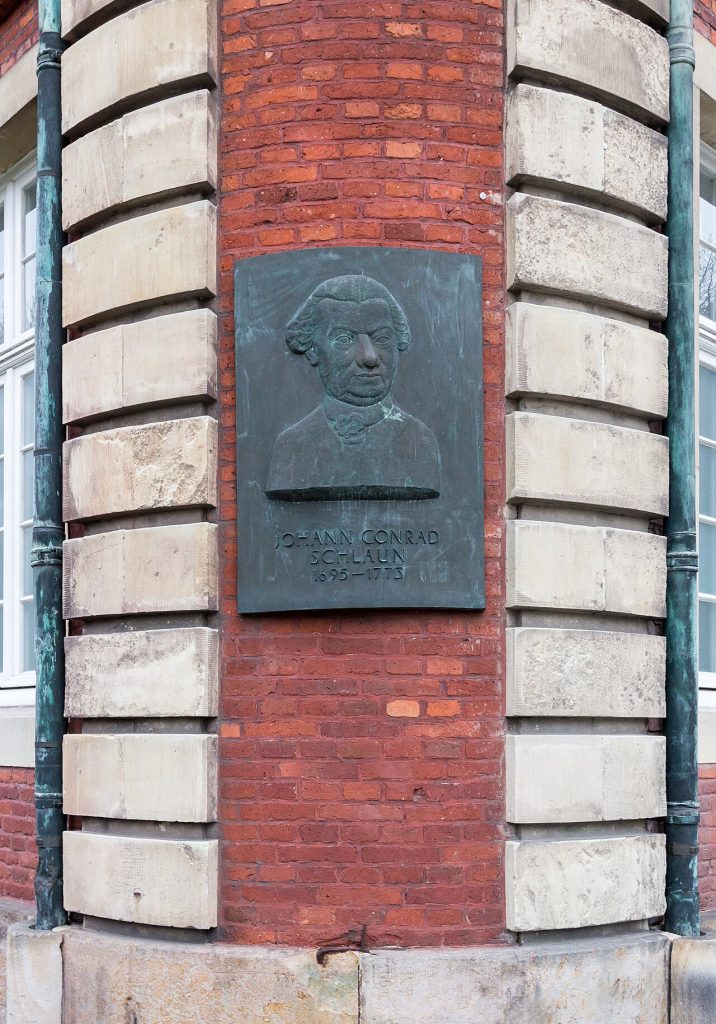
Johann Conrad Schlaun was the greatest architect of the Westphalian baroque. Born in 1695, he worked for the prince bishops and the nobility of the region for decades, designing palaces, churches and country houses.
Among his works are Clemenswerth hunting lodge, parts of Nordkirchen Palace and the Erbdrostenhof in Munster, one of the finest baroque townhouses in Germany.
The Prince Bishops Palace was his last major work. He died in 1773, before it was completed, and the building was finished by Wilhelm Ferdinand Lipper, who added some classical touches.
Schlaun’s style combines Italian and French influences with local building traditions, especially the use of red brick and sandstone.
Schlaun’s buildings can be found throughout Westphalia, and a tour of his works is a wonderful way to discover the region’s baroque heritage.
The Facade and Its Sculpture

The main facade of the palace is dominated by a central projection with columns, a balcony and a pediment crowned by sculpture. The arms of the prince bishop once adorned this central section.
On either side, the wings extend toward the square, framing the forecourt and creating a welcoming gesture toward the city.
The red brick walls are articulated by sandstone pilasters, window frames and cornices, giving the facade a lively rhythm of colour and texture.
Close up, you can see the fine carving of the sandstone details, a testament to the skill of the craftsmen who worked on the palace.
The sculptures on the pediment represent allegorical figures, chosen to express the virtues of good government.
The Palace Through the Seasons
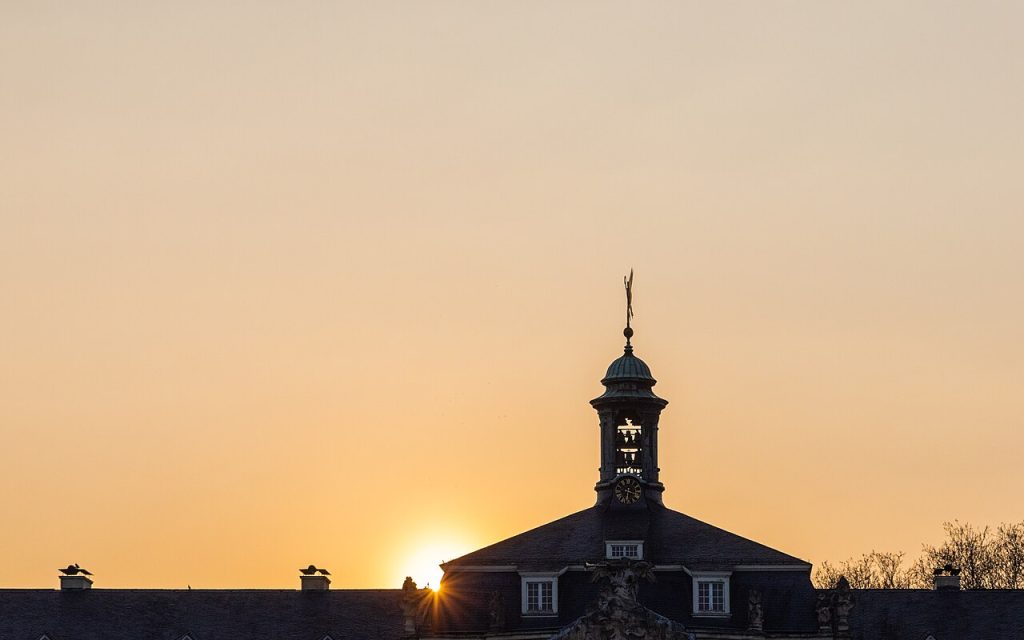
In autumn, the trees around the palace turn gold and red, matching the warm colours of the brick facade.
In winter, frost and snow give the palace a quiet, elegant beauty, and the illuminated facade glows in the early evening.
Spring brings fresh green to the square and the gardens, and summer fills the forecourt with students and visitors enjoying the sunshine.
Each season shows the palace in a different light, and photographers return again and again.
The Forecourt and the Square
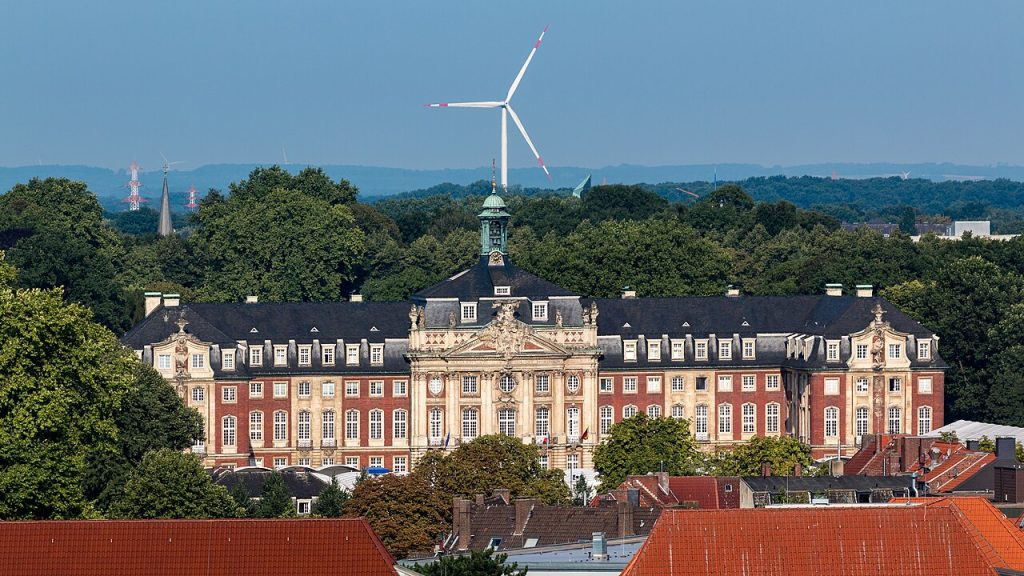
In front of the palace lies a large open square, laid out where the citadel once stood. It provides space to appreciate the full width of the facade.
The square is used for events, markets and fairs throughout the year, including the famous Send fair, one of the oldest in the region.
From the square, streets lead into the old town, with its arcaded Prinzipalmarkt, the cathedral and the historic town hall where the Peace of Westphalia was signed.
The open space also gives the palace a sense of grandeur, despite its relatively modest size compared with other princely residences.
On market days, the square fills with stalls and visitors, and the palace provides a stately backdrop to the bustle.
A Symbol of Munster
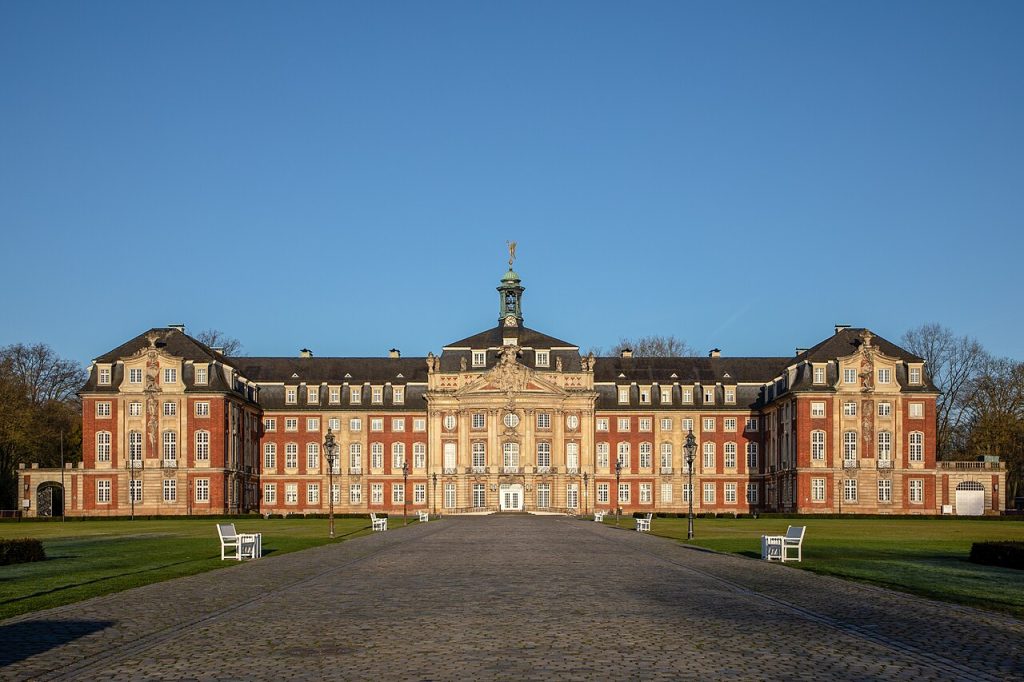
For the people of Munster, the palace is one of the city’s most beloved landmarks, appearing on postcards, logos and souvenirs.
It represents both the city’s history as a princely capital and its present as a vibrant university town.
Graduation ceremonies, concerts and celebrations held at the palace connect generations of students and citizens with this historic building.
Even visitors who come to Munster for other reasons usually find their way to the palace at some point.
The Central Projection
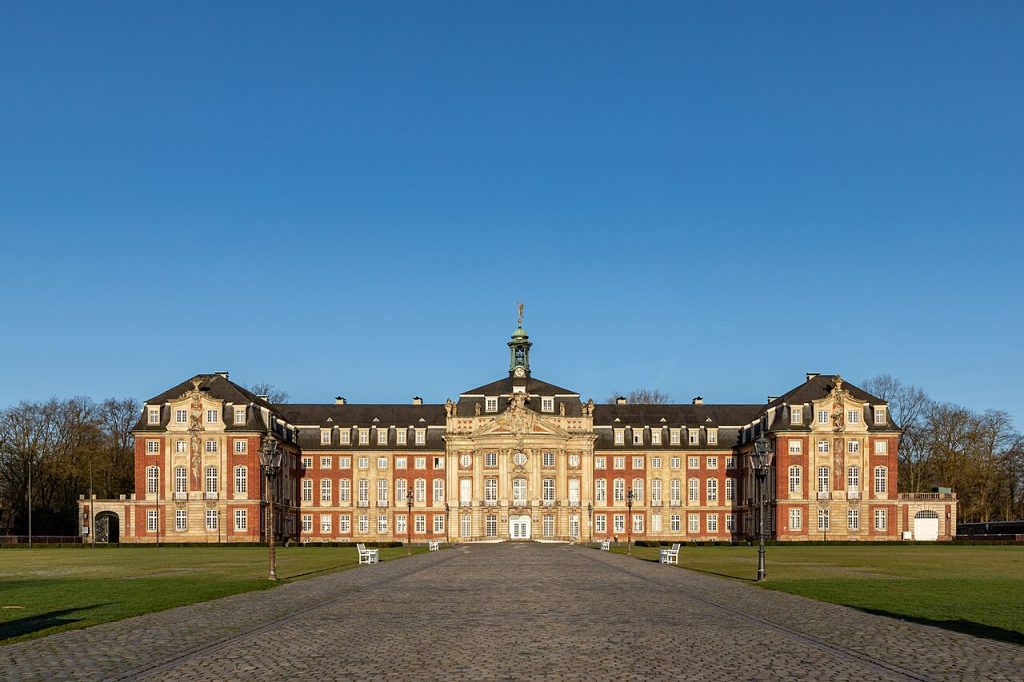
The central projection of the palace is its most elaborate part, with columns, a balcony and sculpture that emphasise the importance of the main entrance and the state rooms behind it.
Schlaun designed it to be seen from a distance, so that visitors crossing the square would be drawn toward the centre of the building.
The balance between the central projection and the long wings shows Schlaun’s mastery of proportion.
Standing in front of it, you can sense the ceremonial purpose of the palace as the seat of a ruling prince.
The balcony above the entrance was designed for the prince bishop to appear before his subjects on ceremonial occasions.
Home of the University

After secularisation, the palace served various purposes, including as the residence of Prussian officials. In 1954 it became the main building of the University of Munster.
The university, one of the largest in Germany, uses the palace for its administration and for ceremonies, and its hall hosts lectures and events.
Students from around the world pass through its doors every day, giving the palace a lively, youthful atmosphere.
The combination of baroque architecture and academic life makes the palace a fitting symbol of a city that values both tradition and learning.
Graduates of the university traditionally have their photographs taken in front of the palace, making it a place of personal memories for thousands of people.
War Damage and Restoration
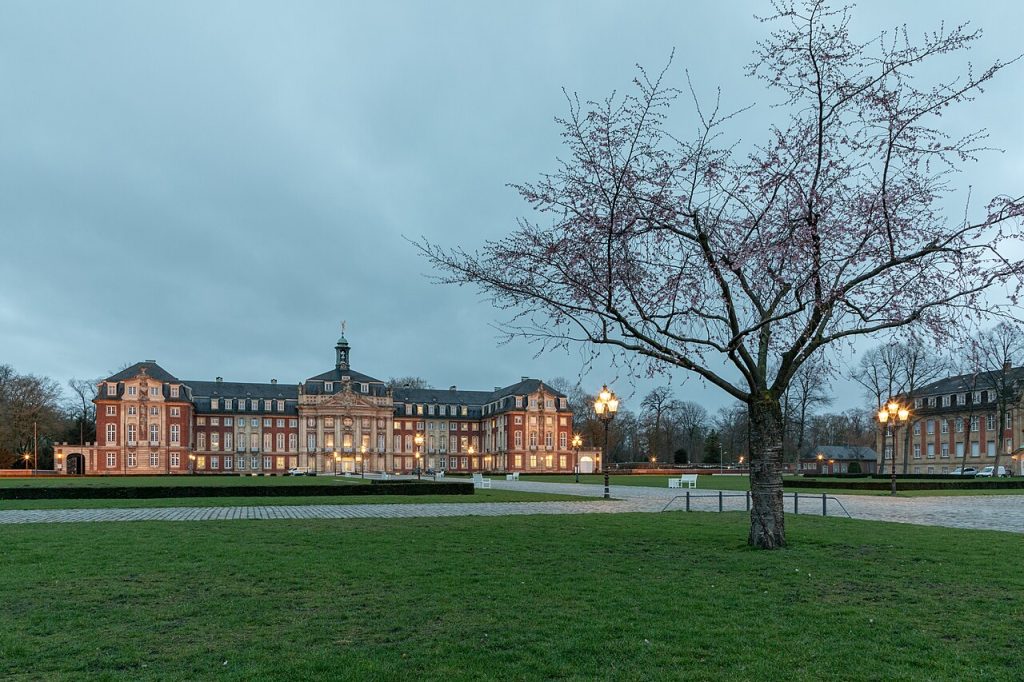
During the Second World War, Munster was heavily bombed, and the palace was largely destroyed, leaving only its outer walls.
After the war, the exterior was carefully rebuilt to Schlaun’s design, while the interior was adapted for the needs of the university.
The reconstruction restored the palace as a landmark of Munster and a reminder of the city’s baroque heritage.
Today, the restored facade looks much as it did in the eighteenth century, glowing in red brick and sandstone.
The Palace Garden and the Botanical Garden
Behind the palace lies the palace garden, a large park with lawns, trees and paths that is open to the public and popular with students and families.
Within the garden is the Botanical Garden of the University of Munster, founded in 1803, with greenhouses and thousands of plant species.
The gardens offer a peaceful retreat close to the city centre, and they are especially beautiful in spring and early summer.
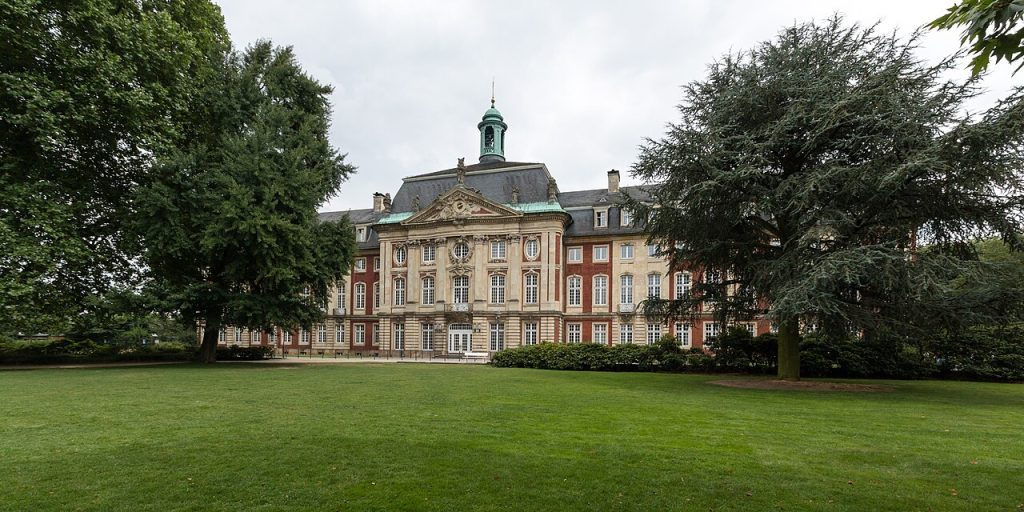
From the gardens, there are fine views of the rear facade of the palace framed by trees.
The botanical garden’s greenhouses shelter tropical plants, while the outdoor beds display plants from many regions of the world.
The Palace on Video

For a look at the palace before your visit, the video below presents the Prince Bishops Palace in Munster.
Watch for the red brick facade, the forecourt and the gardens.
If the video inspires you, read on for practical tips.
Visiting the Palace Today

As the main building of the university, the palace interior is not regularly open as a museum, but the exterior, the forecourt, the palace garden and the botanical garden are freely accessible.
The palace lies on the western edge of the old town, a short walk from the cathedral and the Prinzipalmarkt, and easy to reach by bicycle or bus.
Plan to combine your visit with a walk through the old town, a visit to the historic town hall and the LWL Museum of Art and Culture, and perhaps the Erbdrostenhof, another masterpiece by Schlaun.
Munster is also a good base for exploring the moated castles of the Munsterland, including Nordkirchen Palace, the Westphalian Versailles.
Whenever you visit, the palace offers a fine example of Westphalian baroque and a vivid sense of Munster’s blend of history and youthful energy.
View the location on Google Maps
Palaces Nearby
If you have enjoyed this palace, the Rhineland and Westphalia hold more remarkable residences. Here are two more well worth adding to your journey:
- Clemenswerth Palace – the star shaped hunting lodge of Clemens August in the Emsland.
- Nordkirchen Palace – the moated Versailles of Westphalia.
You May Like