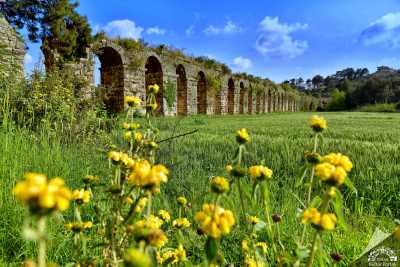
Trebenna Ancient City, located 32 kilometers west of Antalya, at the northern foot of Sivridağ, can be reached through the forest, passing through the villages of Geyikbayırı and Çağlarca. The city, built on a hill in the form of a protrusion, is surrounded by rocks. It is understood that the original name of Trebenna, which was thought to be the last defense place of the coastal cities in the West Antalya Plain, in the Luwian language was “Trebewana”, meaning “Trebe country”.
Antalya Provincial Directorate of Culture and Tourism
No evidence has been found for the existence of Trebenna in the Hellenistic and pre-Hellenistic period. However, since Termessos was under the rule of the Ptolemies in 281-280 BC, according to an inscription, it is expected that the same sovereignty would also exist in the lands where Trebenna is located. Likewise, it is possible that Trebenna lands were located among the places on the eastern side of the Taurus Mountains captured by Pergamon after the Peace of Apameia (168 BC). II. Eumenes (197–160 BC) annexed the western lands of Pamphilia to the kingdom. The 3rd century AD was a very bright period for Trebenna. Emperor III, who ascended to the Roman throne at the age of 13 and went on a trip to Asia in 242. Gordianus (AD 238–244) gave Trebenna, like many other Lycian cities, the freedom to mint coins. Although Trebenna officially remained within the political borders of the Lycian province in the Roman period, it definitely appeared as a city of Pamphylia in the Byzantine period.
Antalya Provincial Directorate of Culture and Tourism
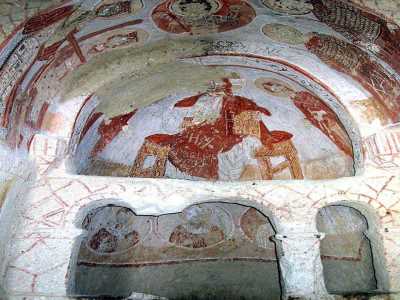
The visible parts of the city walls from the ruins in the ruins date from the Byzantine era. There are many rock chambers in the acropolis rocks. Those for residential and grave purposes can be distinguished at first glance. Some of them are first graves and then residences. The most special one is the one standing right across from the entrance to the acropolis. Roman period structures are on the plain between the acropolis and Sivritepe. The ekklesiasterion, sebasteion and stoa, with their facades facing southeast and lined up side by side, constitute the western border of the city square, where Roman period public structures are concentrated, while the bath, the last public structure on the slope of the Elmin Necropolis, determines the southern border. The entrance to the building is provided by two monumental doors that divide the facade into three approximately equal parts. The acropolis of the Roman city was the place where the settlement retreated during the Byzantine period, it was surrounded by a protection wall, and this was the main settlement of the city during the Middle Ages. The city continued its existence as a Byzantine city until the end of the 12th century AD. It is estimated that Trebenna was abandoned when Antalya and its surroundings fell into the hands of the Turks in the early 13th century AD.
Trebenna is among the “Ancient Cities of the Lycian Civilization” (2009) recommended to the UNESCO World Heritage List.
Source: “Trebenna”, Antalya From Past to Present II. Volume, Antalya Provincial Directorate of Culture and Tourism (2012)
Places to Visit in Antalya
Source: Antalya Provincial Culture and Tourism Directorate