Here is a strange kind of masterpiece: a castle so perfectly designed that architects still study it as the textbook ideal, and yet a castle that was never actually finished. Beaumaris, on the flat green island of Anglesey in North Wales, is widely regarded as the most technically perfect concentric castle ever built in the British Isles, a flawless piece of military geometry, walls within walls arranged with almost mathematical symmetry. And yet its towers never reached their intended height, its buildings were never completed, and the money simply ran out. It is a fortress frozen forever halfway to greatness.
Beaumaris was the last of the mighty iron ring of castles that Edward I built to hold down conquered Wales, and in a sense it is the purest of them all. The other Edwardian castles had to be squeezed onto awkward rocks and ridges, but Beaumaris was built on a flat, empty site by the sea, giving its brilliant architect a clean sheet on which to design the perfect castle with no compromises. What he drew is a marvel of symmetry and layered defence, admired ever since as the summit of the castle-builder’s art.
But its very perfection is shadowed by its incompleteness, and that is a large part of its charm. So let’s cross the moat into this beautiful, unfinished fortress and discover why it is at once the most perfect and the most poignant of all Edward’s great Welsh castles.
We will look at both the perfection and the incompleteness, because at Beaumaris the two are inseparable, and together they make the castle what it is. Keep the flat, open site in mind as we go, for it is the key to everything: it gave the architect his freedom, and it gives us, today, the clearest possible view of what the ideal medieval castle was meant to be.

Table of Contents
- The Last of the Iron Ring
- Geometry as a Weapon
- The Genius Behind the Design
- A Castle You Could Sail Into
- When the Money Ran Out
- The Fortress That Never Fought
- Decline and Quiet Survival
- A Perfect Plan to Walk Around
- The Town by the Strait
- Getting to Beaumaris
- Nearby Castles
- Before You Go
The Last of the Iron Ring
Beaumaris was born out of a shock. In 1294 to 1295, a major Welsh revolt under Madog ap Llywelyn caught Edward I off guard and swept across North Wales, even threatening the king himself. Once the rising was crushed, Edward was determined to plug the last gap in his chain of castles, and in 1295 he began building a new fortress on the Isle of Anglesey, at a spot called Beaumaris, meaning beautiful marsh, to command the eastern entrance to the Menai Strait and the rich, grain-growing island beyond.
This was the final link in the iron ring, the great system of castles Edward had thrown up to hold conquered Wales, joining Caernarfon, Conwy, and Harlech. And once again the man in charge was Master James of St George, the brilliant Savoyard architect who had designed the others, now at the height of his powers and experience.
For James, Beaumaris was a gift. Where his earlier castles had to be shoehorned onto difficult rocks and ridges, forcing compromises in their design, Beaumaris was to rise on flat, open, empty ground beside the sea. For once the architect had a completely clear site and could build, without constraint, exactly the castle he thought perfect. What he produced is the closest thing the Middle Ages ever came to the ideal fortress on paper made real.
There was a human cost to founding Beaumaris that is easy to overlook. To clear the site, the existing Welsh town that stood there was swept away and its inhabitants moved elsewhere, replaced by a new English settlement planted beside the castle. Like the other Edwardian foundations, Beaumaris was as much an act of colonisation as of fortification, an English town and fortress implanted on the conquered island to hold it down.
Geometry as a Weapon
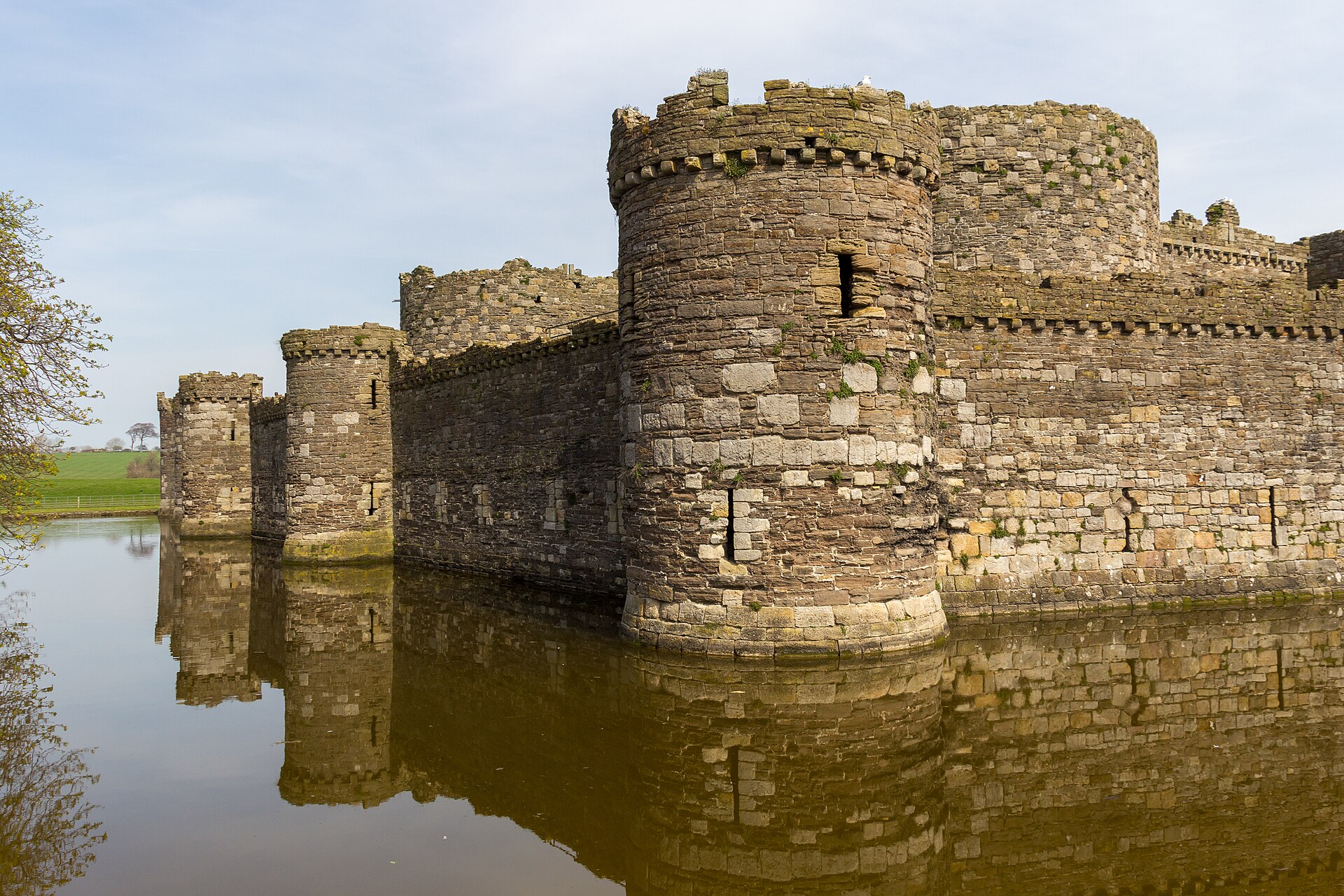
Freed from the awkward sites of his other castles, James of St George laid out Beaumaris with breathtaking symmetry. It is a concentric castle in its purest form, a square inner ward with round towers at the corners and great gatehouses on two sides, set precisely within a lower, many-sided outer wall studded with its own towers, the whole thing then ringed by a water-filled moat. Everything balances, everything answers everything else, in a design of almost mathematical clarity.
This symmetry was not just for beauty; it was a weapon. The concentric plan meant that defenders on the high inner walls could fire over the heads of those on the lower outer walls, so that an attacker faced layer upon layer of defence, every approach covered by overlapping fields of fire from many directions at once. To break in, an enemy would have to overcome ring after ring of walls and towers, each commanding the one in front, an almost hopeless task.
Beaumaris packs an extraordinary number of defensive features into its compact plan: multiple gates, drawbridges, portcullises, murder-holes, arrow loops set at cunning angles, and a complex, twisting route through the gatehouses that would turn any assault into a nightmare. For students of medieval fortification it is the perfect specimen, the concentric castle reduced to its flawless essence, and it is admired the world over as a supreme achievement of military design.
The gatehouses deserve special attention, because they were the key to the whole system. Rather than a simple gate, each was a deep, complex structure through which any attacker had to pass a gauntlet of doors, portcullises, and openings for missiles, turning the very act of entering into a death trap. At Beaumaris the plan called for two of these mighty gatehouses, and even unfinished they show how far the art of the defended entrance had advanced by the end of the thirteenth century.
The Genius Behind the Design
Beaumaris is really the crowning work of one remarkable man, Master James of St George, and it is worth remembering him here, because this castle is his purest statement. Brought from Savoy in the Alps, where he had built fortresses for its counts, James was placed in charge of Edward I’s entire Welsh castle programme, and over years of work at Caernarfon, Conwy, Harlech, and more he became perhaps the greatest military architect in Europe.
At Beaumaris, with a flat and empty site, he was finally free of the compromises that his rocky earlier sites had forced on him, and he responded with a design of textbook perfection. Everything he had learned across a lifetime of castle-building went into it, distilled into a single, flawless plan. In that sense Beaumaris is a kind of summing-up, the last and most refined expression of a genius at the height of his craft.
That the castle was never finished should not obscure the achievement. What James drew and began to build is still taught and admired as the ideal of its type, and it secures his place among the great architects of the Middle Ages. To walk Beaumaris is, in a real way, to walk inside the mind of the man who designed the finest castles of the age.

A Castle You Could Sail Into
One of the cleverest features of Beaumaris was its link to the sea. The castle was built beside the tidal water of the strait, and a channel and dock were created so that supply ships could sail right up to the castle walls and unload directly through a water gate. A vessel of considerable size could tie up at the castle’s own dock, ensuring that the garrison could always be supplied and reinforced by sea.
This was a vital feature for a fortress planted in potentially hostile territory. As at Harlech and the other coastal Edwardian castles, the sea link meant that even if the surrounding country rose in revolt and cut the castle off by land, it could still be fed and defended from the water. It was a lesson Edward’s builders had learned well, and at Beaumaris they built it into the design from the start.
You can still trace the remains of this arrangement today, the moat and the site of the dock hinting at how ships once came almost to the castle door. It is a reminder that these great castles were not isolated strongpoints but part of a system that relied on sea power, tying the conquest of Wales to England’s command of the surrounding waters.

When the Money Ran Out
For all its perfection on the drawing board, Beaumaris was never finished, and the reason was money. Edward I’s Welsh castles had cost a staggering fortune, straining the resources of the English crown to the limit, and as the king’s attention and treasure were increasingly drawn north to his wars against Scotland, the funds for Beaumaris dried up. Work slowed, stopped, restarted, and finally petered out with the castle incomplete.
The evidence is there for anyone to see. Many of the towers never reached their intended height, standing today as stumps far lower than they were meant to be. Buildings planned for the interior were never built, and some parts of the design were simply never realised. The perfect castle on paper was left as a magnificent but unfinished torso, a dream that outran the money to build it.
There is something quietly moving about this. Beaumaris shows us not a castle worn down by later centuries but one that never got the chance to be completed in the first place, its ambition visible precisely because it was never fully achieved. It stands as a monument both to the genius of its design and to the crushing cost of Edward’s conquest of Wales, a cost that even a great kingdom could not sustain forever.
The scale of the spending is almost hard to believe. In its busiest building seasons Beaumaris employed hundreds of masons, diggers, and labourers and swallowed sums that would have funded a small war, and the accounts that survive give a vivid picture of the effort involved. That even this could not finish the castle shows just how monstrously expensive Edward’s whole Welsh project had become, and why the crown’s purse finally cried enough.

The Fortress That Never Fought
Here is a final irony: this most perfect of war machines never really saw war. By the time Beaumaris was built, the great Welsh revolts were largely over, and the castle, for all its flawless defences, was never subjected to the epic sieges that battered Harlech or tested Conwy. Its towers, designed to shrug off the fiercest assault, were mostly spared the chance to prove themselves in earnest.
The castle did have a brush with conflict much later, during the English Civil War in the seventeenth century, when it was held for the king and eventually surrendered, but even then it saw nothing like the dramatic sieges of its sister castles. For the most part, Beaumaris passed its life in peaceful obscurity, a masterpiece of military architecture that was never truly put to the test.
In a way this only adds to its appeal. Beaumaris is the perfect castle preserved almost as a design study, uncomplicated by the scars and rebuildings that war brings. What you see is very close to what James of St George drew, a clean, coherent statement of how the ideal castle should be built, left largely undisturbed by the violence it was made to withstand.
In an odd way, the castle’s peaceful history is a kind of success. Edward built his iron ring precisely so that Wales would be so thoroughly cowed that these fortresses would rarely need to fight, and at Beaumaris that is more or less what happened. The very quietness of its story is testimony to how completely the conquest had done its work by the time the last castle rose. Perfection, here, was never seriously challenged.

Decline and Quiet Survival
After the Middle Ages, Beaumaris, like the other Edwardian castles, gradually lost its purpose as Wales settled into English rule, and it slipped into a long, gentle decline. Never completed, and never much fought over, it simply faded, its unfinished walls and stumpy towers standing quietly by the shore while the little town beside it went about its business.
Yet its very obscurity helped preserve it. Because it was not a great strategic prize, it escaped much of the deliberate destruction that wrecked other castles, and its low, unfinished walls survived remarkably intact. Over time it came to be appreciated not as a working fortress but as a work of art, admired by antiquarians and travellers for the beauty and clarity of its design.
Today Beaumaris is cared for as one of the great monuments of Wales, and it is jointly recognised, alongside Caernarfon, Conwy, and Harlech, as part of a World Heritage Site honouring the outstanding importance of Edward I’s castles. Small, peaceful, and perfectly proportioned, it holds an honoured place among the finest castles ever built.

A Perfect Plan to Walk Around
For the visitor, Beaumaris offers a very particular pleasure: it is one of the easiest castles anywhere to understand. Because it is flat, compact, and symmetrical, you can grasp its entire plan almost at a glance, seeing exactly how the concentric rings work, how the gatehouses defend the entrances, and how every part supports the whole. For anyone who wants to learn how a medieval castle was meant to function, there is no better classroom.
Walking around the walls and through the wards, you can trace the clever, twisting routes an attacker would have had to take, admire the neat geometry of the towers, and appreciate the sheer intelligence of the design. And because so much survives at a low, walkable level, it is a gentle and rewarding castle to explore, without the steep climbs of its mountain sisters.
The lovely little town of Beaumaris beside it, with its Georgian buildings, old gaol, and views across the strait to the mountains of Snowdonia, adds to the charm. Castle and town together make for a delightful visit, in one of the most beautiful corners of Wales.
Because so little was added or rebuilt after the Middle Ages, there is an unusual purity to what survives. At many castles you are looking at a palimpsest of centuries, medieval walls patched by Tudor windows and Victorian restoration. At Beaumaris you are looking, very largely, at a single moment, the vision of one architect around 1300, left almost undisturbed. That coherence is rare and precious, and it is a big part of what makes the castle so satisfying to study.

The Town by the Strait
The castle did not stand alone, but at the edge of a planned town that Edward founded beside it, populated with English settlers and given trading privileges, in the same pattern of fortress-and-colony seen across his Welsh castles. That town grew into the pleasant seaside place of Beaumaris we know today, one of the most attractive small towns in Wales.
Over the centuries Beaumaris gathered other historic buildings worth seeing, including a fine old courthouse and a Victorian gaol that visitors can still tour, giving a grim but fascinating picture of crime and punishment in the nineteenth century. Together with the castle, these make the town a rich destination, layering later history over its medieval origins.
The setting ties it all together. Looking out across the Menai Strait to the mountains of Snowdonia, with the water busy with boats and the mountains changing colour through the day, Beaumaris enjoys one of the loveliest positions of any castle town in Britain. The beautiful marsh that gave it its name has become a genuinely beautiful place.
Getting to Beaumaris
Beaumaris lies on the Isle of Anglesey, off the north-west coast of Wales, reached by crossing one of the famous bridges over the Menai Strait from the mainland near Bangor. It is an easy drive, and the setting, where the flat island meets the water with the mountains of Snowdonia rising beyond, is glorious. The town itself is a pleasant seaside place well worth exploring.
The castle is compact enough to see thoroughly in an hour or two, and its flat, accessible layout makes it one of the more relaxing great castles to visit. Take time to walk the walls and the wards, and to stand back and appreciate the symmetry of the whole. Combine Beaumaris with Caernarfon and Conwy across the water, and you will have completed the full circuit of Edward I’s masterpieces, ending, fittingly, with the most perfect, if unfinished, of them all.
The castle sits at roughly 53.2650, -4.0897. Punch that into Google Maps and it will take you straight to Beaumaris Castle on Anglesey.
Nearby Castles
The Perfect Castle That Was Never Finished
Beaumaris is the dream of the perfect castle, caught in the moment just before completion. Given a clean site and a free hand, the greatest castle-builder of the Middle Ages drew a fortress of flawless symmetry and layered strength, the concentric castle in its purest, most studied form. That the money ran out before it could be finished only makes it more eloquent, its ambition laid bare in its unfinished towers.
Walk its neat, balanced wards today, with the moat glinting and Snowdonia blue across the water, and you are looking at the summit of an art. Beaumaris never fought a great siege and never rose to its full height, but it did something rarer: it captured, in stone, the ideal that every castle-builder was reaching for. It is, quite simply, the most perfect castle Britain ever nearly built.
You May Like
Stirling Castle: The Fortress and Palace at the Heart of Scotland