There is an old saying that whoever holds Stirling holds Scotland, and for most of the country’s history it was simply true. Stirling Castle stands on a great crag rising abruptly from a flat plain, guarding the lowest point at which the River Forth could be bridged, the narrow waist of the country where the Lowlands meet the Highlands. Armies marching north or south had to pass this way, and so this rock became the strategic key to the whole nation, fought over in battle after battle. It has been called the brooch that holds the Highlands and Lowlands of Scotland together, and it looks every inch the part.
But Stirling is far more than a fortress. On its summit stands one of the most magnificent groups of royal buildings in Britain, a golden-walled great hall and an exquisitely carved Renaissance palace, built by the Stewart kings who made Stirling one of their favourite homes. Here Mary, Queen of Scots was crowned as a baby, kings were born and christened, and the Scottish court dazzled in an age of splendour. Stirling is both a mighty stronghold and a glittering royal residence, war and grandeur side by side.
And in the fields just below the rock, two of the most famous battles in Scottish history were fought, victories that helped win the nation’s freedom. So let’s climb the crag to the castle that guards the heart of Scotland, and explore both its warlike and its royal faces.
We will explore both of Stirling’s faces, the fortress and the palace, because they belong together, two sides of a place that was at once the key to a kingdom and the jewel of a dynasty. Keep the strategic rock and the winding river in mind as we go, for they explain why kings fought so hard to hold Stirling, and why, once they held it, they made it so magnificent.
Table of Contents
- The Key to the Kingdom
- Wallace and the Battle of Stirling Bridge
- Bannockburn and the Bruce
- Layers of Stone and Power
- A Palace Fit for the Stewarts
- The Golden Great Hall
- The Childhood Home of a Queen
- Carved Heads and Woven Unicorns
- From Royal Court to Army Barracks
- The Ghosts of the Castle
- Visiting Stirling
- Nearby Castles
- Before You Go
The Key to the Kingdom
Stirling’s importance is written in the landscape. The castle stands on a steep crag, and like Edinburgh it is a classic crag-and-tail, a hard volcanic rock with a long ramp trailing behind it, down which the old town runs. But what really made Stirling matter was the river. Here the Forth, which cuts across the middle of Scotland, could be crossed at its lowest bridging point, and the castle commanded that crossing, controlling movement between the north and south of the country.
This meant that whoever wanted to march an army through Scotland, in either direction, had to reckon with Stirling. It was a bottleneck, a gateway, and a prize, and control of it could decide the outcome of whole wars. Little wonder that it was besieged and fought over so many times, or that the greatest battles of Scotland’s struggle for independence were fought in its shadow, with the castle itself as the ultimate stake.
So Stirling was never just a local fortress but a piece on the national chessboard, a place of the first strategic importance for centuries. Its position gave it a significance out of all proportion to its size, and made it, again and again, the focus of the fiercest fighting in Scottish history.
The castle changed hands with dizzying frequency during the Wars of Independence, taken and retaken as the fortunes of war swung back and forth. One of its sieges, in the years around Bannockburn, even ended with an agreement that the garrison would surrender if not relieved by a certain date, and it was the attempt to relieve it that brought the two great armies to battle. Time and again, control of this one rock proved worth a full-scale war.
Wallace and the Battle of Stirling Bridge
In 1297, in the fields below the castle, one of the most famous victories in Scottish history was won. Scotland was under English occupation, and a rising against English rule was led, most famously, by William Wallace, the guerrilla leader later immortalised in legend and film. When an English army advanced toward Stirling, Wallace and his fellow commander caught them at a fatal disadvantage as they crossed the narrow bridge over the Forth.
As the English troops filed slowly across the bridge, the Scots fell on them, trapping the divided army with the river at its back. The result was a crushing Scottish victory, the Battle of Stirling Bridge, which shattered English control and made Wallace a hero of the resistance. The castle above watched over a triumph that showed the world Scotland would not be easily conquered.
Today the great Wallace Monument rises on a nearby hill, visible from the castle, commemorating the hero and the battle. Standing on Stirling’s ramparts and looking out toward it, you can survey the very ground where this pivotal clash took place, one of the moments that lit the long fight for Scottish freedom.

Bannockburn and the Bruce
Even more decisive was the battle fought below Stirling in 1314. The castle was then held by an English garrison, and its relief became the trigger for one of the most important battles in British history. King Robert the Bruce, leading the Scottish cause, confronted a much larger English army under King Edward II that had marched to save the besieged castle, and over two days of fighting near a stream called the Bannockburn, the Scots won an overwhelming victory.
Bannockburn was a catastrophe for the English and a triumph for the Scots, and it effectively secured Scotland’s independence for generations. The castle that had been the prize of the campaign passed firmly into Scottish hands, and Robert the Bruce, as he had at other captured fortresses, is said to have ordered its defences slighted so it could not be used against him. The battle became, and remains, a defining moment of Scottish national pride.
That two of the most celebrated battles in the whole story of Scotland, Stirling Bridge and Bannockburn, were both fought in the shadow of this one castle shows just how central Stirling was to the nation’s fate. The rock stood witness to the winning of Scottish freedom itself.

Layers of Stone and Power
Beneath and around the famous Renaissance buildings, Stirling is a fortress of many layers, its defences built and rebuilt across the centuries. Massive outer walls and gun batteries, added in the age of artillery, guard the approaches, while within lie the accumulated buildings of generations of kings, from medieval strongpoints to Renaissance palaces. Walking through the castle, you pass from one age to another.
The strong defensive front that greets visitors today, with its imposing gatehouse and gun positions, dates largely from the sixteenth century and later, designed to withstand cannon in an age when older medieval walls had become vulnerable. Behind these defences, the royal buildings could enjoy their splendour in relative safety, fortress and palace working together.
This layering is part of what makes Stirling so rewarding to explore. It is not a single-period castle but a living record of Scottish history, each generation adding its own mark, from the warlike Middle Ages through the golden age of the Stewarts to the military centuries that followed. To walk it is to walk through the whole story of the nation, written in stone.
A Palace Fit for the Stewarts
Once Scotland’s independence was secured, Stirling grew into something more than a fortress: it became a favoured home of the royal house of Stewart, and the kings of Scotland lavished money on turning it into a magnificent Renaissance palace. Over the fifteenth and sixteenth centuries, successive Stewart monarchs raised splendid new buildings on the rock, transforming the grim stronghold into a dazzling court.
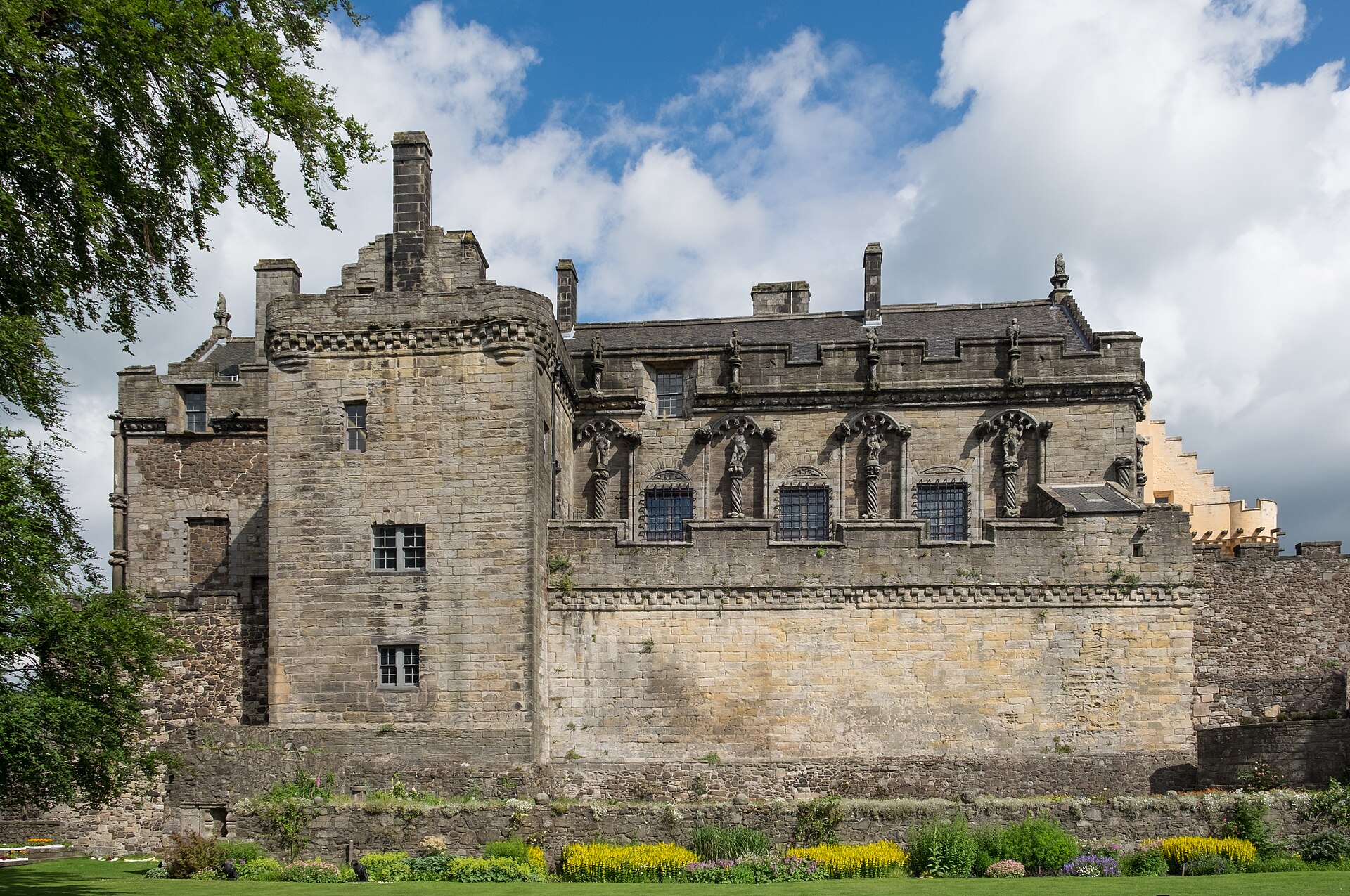
The crowning achievement was the royal palace built by King James V in the sixteenth century, one of the finest Renaissance buildings in the whole of Britain. Its outer walls are covered in an extraordinary array of carved stone figures, statues of the king, of classical and biblical characters, and of strange and lively creatures, a riot of sculpture unlike anything else in Scotland, proclaiming the sophistication and ambition of the Scottish court.
Inside, the palace has been sumptuously restored to evoke its original splendour, with brightly painted and richly furnished royal apartments, giving visitors a vivid sense of the colour and luxury of a Renaissance court. Stirling under the Stewarts was not a backwater but a centre of art, learning, and display that could hold its own with any court in Europe.
The carved figures on the palace walls repay a slow look. Among the kings and classical heroes are grotesques, mythical beasts, and lively, often humorous characters, a whole cast of stone sculpture climbing the facade. They were meant to impress visitors with the learning and sophistication of the Scottish court, showing that its king was a Renaissance prince versed in the culture of the age, and they remain one of the most remarkable displays of their kind in Britain.

The Golden Great Hall
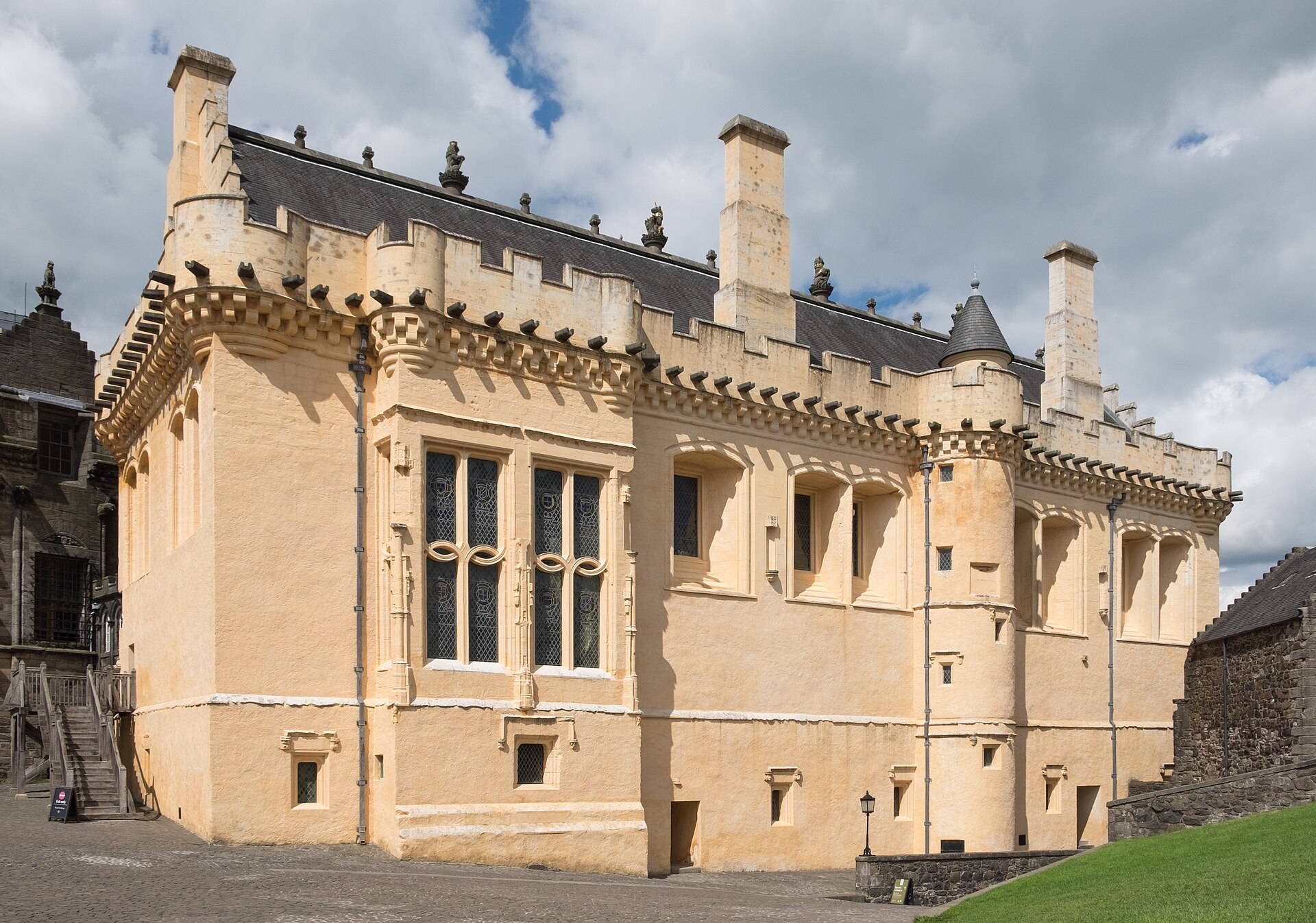
Alongside the palace stands another masterpiece of Stewart building, the Great Hall, raised by King James IV around 1500. It is the largest medieval hall ever built in Scotland, a vast space designed for feasts, ceremonies, and displays of royal power, with a magnificent hammer-beam roof and great windows. Here the court gathered for banquets and celebrations on the grandest scale.
The most striking thing about the Great Hall today is its colour. When it was restored, its exterior was given back its original coating of golden limewash, so that it glows a warm yellow-gold, exactly as it would have when new. This bold decision startles some visitors, but it is historically accurate, and it restores the hall to the eye-catching splendour its royal builders intended.
Together the golden Great Hall and the carved palace make the summit of Stirling one of the most impressive groups of royal Renaissance buildings anywhere in Britain. They show that the Stewart kings meant Stirling to be not just a stronghold but a showpiece, a stage on which to display the wealth, culture, and confidence of the Scottish monarchy.
The golden limewash caused a stir when it was first applied, because modern eyes are used to seeing old buildings as bare grey stone. But medieval and Renaissance builders loved bright colour and rich finishes, and the restoration is a valuable reminder that these places were never the sombre ruins we often imagine. In its heyday, Stirling would have blazed with colour, gilding, and painted decoration, a feast for the eye designed to overwhelm.

The Childhood Home of a Queen
Stirling is bound up with the tragic and famous story of Mary, Queen of Scots. She became queen when only a few days old, on the death of her father, and it was here at Stirling Castle that she was crowned in 1543 as a tiny child, in a ceremony held in the castle’s chapel. For safety in dangerous times, much of her early childhood was spent within these walls before she was sent to France.
The castle was thus a royal nursery as well as a fortress, a place where the future of the Scottish crown was quite literally cradled. Mary’s later life would be one of drama, danger, and ultimately execution, but it began here, on this rock, and Stirling remained closely tied to her story and to that of her son.
That son, James VI, also had his own great moment at Stirling. In 1594 he built a new Chapel Royal within the castle for the lavish baptism of his own son, Prince Henry, an event of European significance celebrated with enormous festivity. The castle where Mary was crowned as a baby thus saw, a generation later, the christening of a royal heir amid great splendour, its royal role continuing across the generations.
There is a dark family drama attached to Stirling as well. It was here, according to tradition, that an earlier Stewart king, James II, personally murdered a rival earl during a quarrel, stabbing him and having his body thrown from a window, a brutal reminder that behind the Renaissance splendour lay the same ruthless power struggles that ran through every royal court of the age. Stirling saw the Stewarts at both their most cultured and their most violent.
Carved Heads and Woven Unicorns
Among Stirling’s greatest treasures are the Stirling Heads, a remarkable series of large carved oak roundels that once decorated the ceiling of the king’s presence chamber in the palace. Each is carved with a face, a portrait of a king, queen, courtier, or classical figure, and together they form one of the finest collections of Renaissance woodcarving in Britain, a gallery of the faces of a sixteenth-century court.
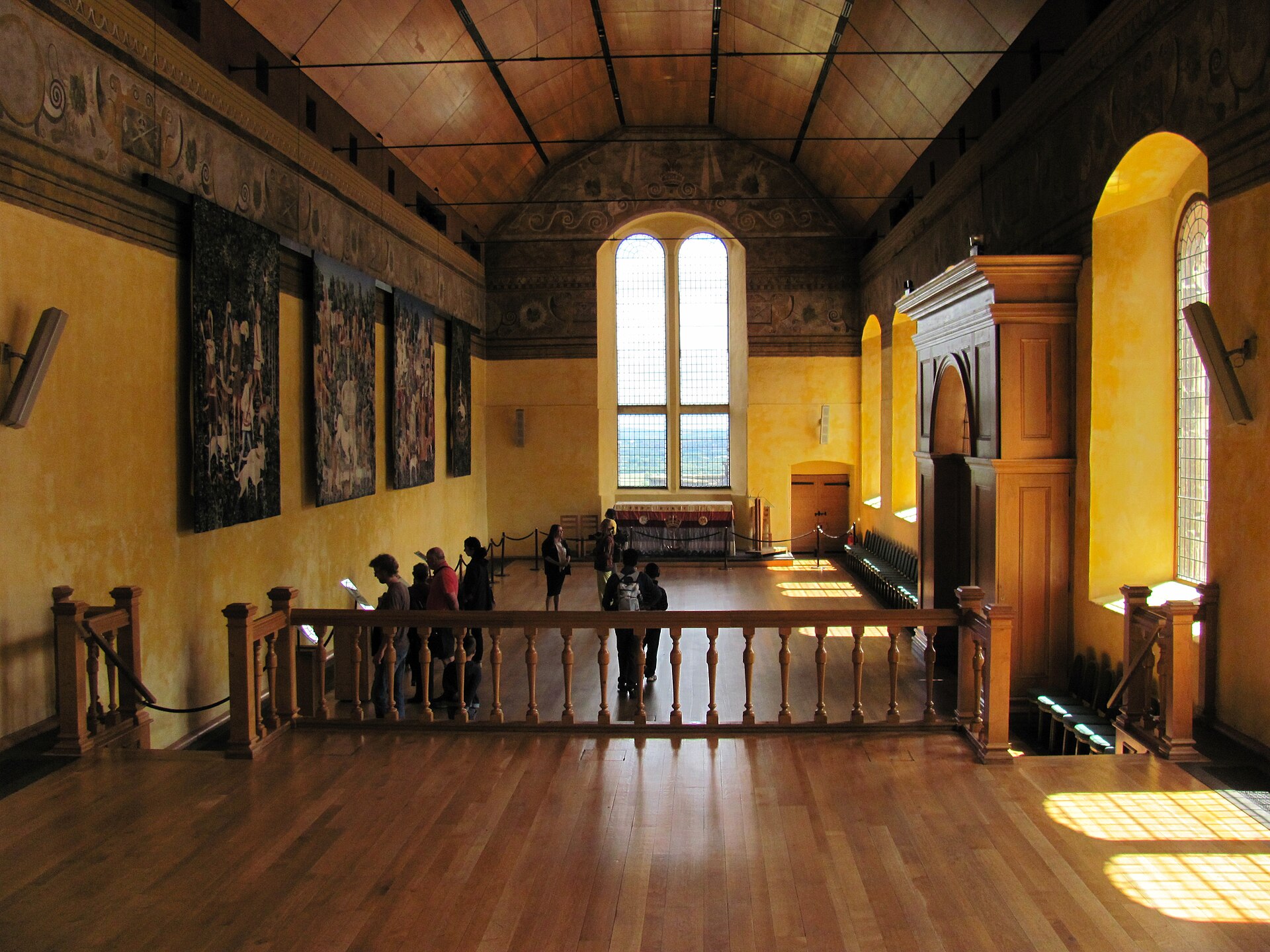
The palace is also home to a spectacular modern achievement: the recreated Unicorn tapestries. Inspired by a famous set of medieval tapestries depicting the hunt of the unicorn, a team of weavers spent years painstakingly reproducing them by hand using traditional techniques, and the results now hang in the royal apartments, glowing with colour and detail. The unicorn, Scotland’s national animal, is a fitting emblem for these extraordinary works.
Together the carved heads and the woven unicorns show how completely Stirling has been brought back to life. Rather than presenting bare stone rooms, those who care for the castle have recreated the colour, art, and richness of the Renaissance court, so that visitors can experience something close to the dazzling world the Stewart kings actually inhabited.

From Royal Court to Army Barracks
After the crowns of Scotland and England were united under James VI and I in 1603, and especially after the later union of the two kingdoms, Stirling gradually lost its role as a royal residence. The court moved south, and the castle’s glory days as a Renaissance palace faded. Over the following centuries it was turned increasingly to military use, becoming an army barracks and depot, home to Scottish regiments.
This military phase left its own mark, with buildings adapted and altered for the army’s needs, and the fine royal apartments put to humbler uses. For a long time the palace and hall were subdivided and obscured, their splendour hidden beneath layers of barracks fittings, and the castle’s royal past was easy to forget beneath its role as a working garrison.
In more recent decades, however, a major programme of restoration has stripped away the later alterations and brought the great royal buildings dramatically back to life, restoring the Great Hall’s golden walls, the palace’s painted apartments, and much more. Today Stirling once again presents its Renaissance splendour, one of the most rewarding and beautifully restored castles in the whole of Britain.
The Ghosts of the Castle
With such a long and dramatic history, Stirling has naturally gathered its share of ghosts, and it is often listed among the more haunted castles in Scotland. The most famous is the Green Lady, a spectral figure said to be linked to Mary, Queen of Scots, sometimes described as a servant who died saving the queen from a fire, and whose appearance is traditionally taken as a warning of disaster to come.
There is also a Pink Lady, a beautiful ghost in a pink gown said to wander between the castle and a nearby church, perhaps searching for a lost love killed in one of the castle’s sieges. Staff and visitors over the years have reported the usual repertoire of unexplained footsteps, cold spots, and fleeting figures, especially in the older parts of the buildings.
As always, the ghost stories are really the castle’s turbulent past refusing to lie quiet. A place that has seen coronations, murders, sieges, and the comings and goings of tragic queens seems almost bound to feel haunted, and Stirling, rich in drama, provides plenty of raw material for the imagination to work on.
Visiting Stirling
Stirling lies in central Scotland, roughly between Edinburgh and Glasgow, and it is very easy to reach by road or rail, with the castle a walk up through the historic old town from the station. Its central position makes it a natural stop on any tour of Scotland, and the views from the castle, over the plain, the winding Forth, the Wallace Monument, and the distant Highland hills, are magnificent.
Allow a good half day to do the castle justice, because there is a great deal to see: the carved Renaissance palace and its painted rooms, the golden Great Hall, the Chapel Royal, the Stirling Heads and the Unicorn tapestries, and the ramparts with their sweeping views. Nearby, the site of the Battle of Bannockburn and the Wallace Monument make natural companions to a visit, letting you follow the whole dramatic story of Scotland’s fight for freedom around the rock that held its key.
The castle sits at roughly 56.1240, -3.9490. Punch that into Google Maps and it will take you straight to Stirling Castle.
Nearby Castles
The Brooch That Holds Scotland Together
Stirling is Scotland’s story in a single castle. On its rock the nation’s freedom was fought for and won, in the shadow of Wallace’s bridge and Bruce’s field; on its summit the Stewart kings raised a Renaissance court of golden halls and carved palaces; and within its chapel a baby queen was crowned who would become one of history’s most tragic figures. Few places hold so much of a country’s past, or hold it so grandly.
Stand on the ramparts and look out over the plain, with the Forth winding away and the Highland hills blue on the horizon, and you understand at once why they said whoever holds Stirling holds Scotland. This is the brooch that pins the country together, a fortress and a palace and a battlefield all in one, guarding, as it has for a thousand years, the very heart of the nation.
You May Like
Mafra, the Palace a King Built From a Vow


One thought on “Stirling Castle: The Fortress and Palace at the Heart of Scotland”