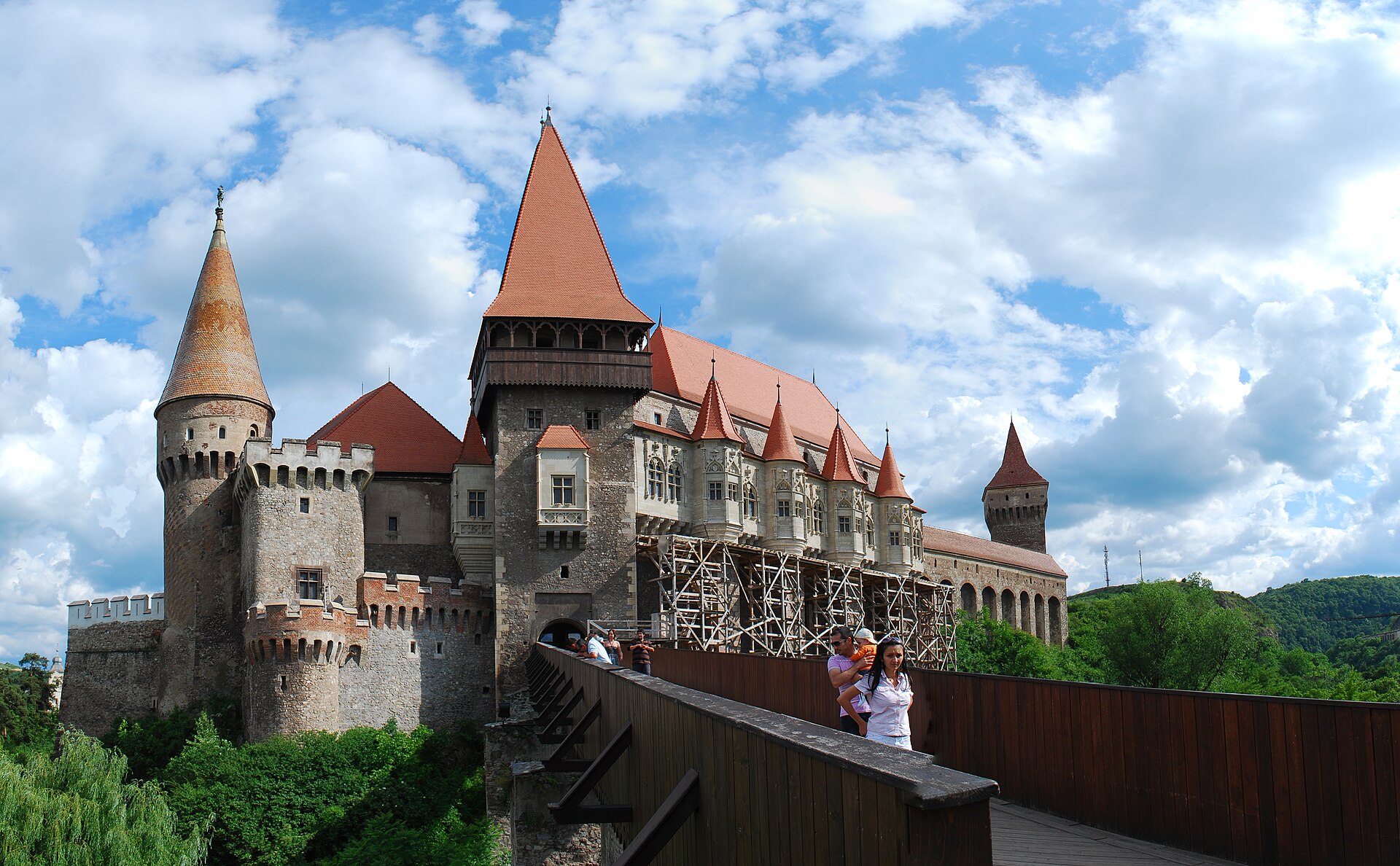
If you had to design the perfect fairy-tale castle, you might well end up with something very like Corvin. Rising above a river in the Transylvanian town of Hunedoara, with its cluster of tall towers, its steeply pitched roofs, its long dramatic bridge and its riot of pointed turrets, it looks almost too perfect to be real, the kind of castle that belongs on a film poster or the cover of a fantasy novel. And indeed it has appeared on plenty of both.
Yet Corvin, also known as Hunyadi Castle or the Castle of the Corvins, is entirely real, and it is one of the largest and most important castles in Romania, a masterpiece of Gothic and Renaissance architecture with a history reaching back to the fifteenth century and beyond. Behind its storybook appearance lies the story of one of the greatest warriors of medieval Europe, and of the family that rose from these walls to the throne of a kingdom.
So come with me across the great bridge and into the courtyards of Corvin, and let us explore both the fairy-tale castle and the formidable history behind it. We will meet the fearsome general who built it as a fortress against the Ottomans, admire the halls and towers he and his son created, ponder the dark legend of its famous well, and discover why this castle in a Romanian steel town is counted among the wonders of the country.
In This Article
- The Fairy-Tale Castle of Transylvania
- A Fortress Granted to a Rising Family
- John Hunyadi, the Hammer of the Turks
- The Long Bridge Over the Ravine
- Courtyards and Painted Galleries
- The Knights’ Hall and the Diet Hall
- Towers With Names and Stories
- The Well and Its Heartbreaking Legend
- A Chapel Within the Walls
- The Raven and the King
- Later Centuries and a Great Fire
- Restored to Its Former Glory
- A Star of the Screen
The Fairy-Tale Castle of Transylvania
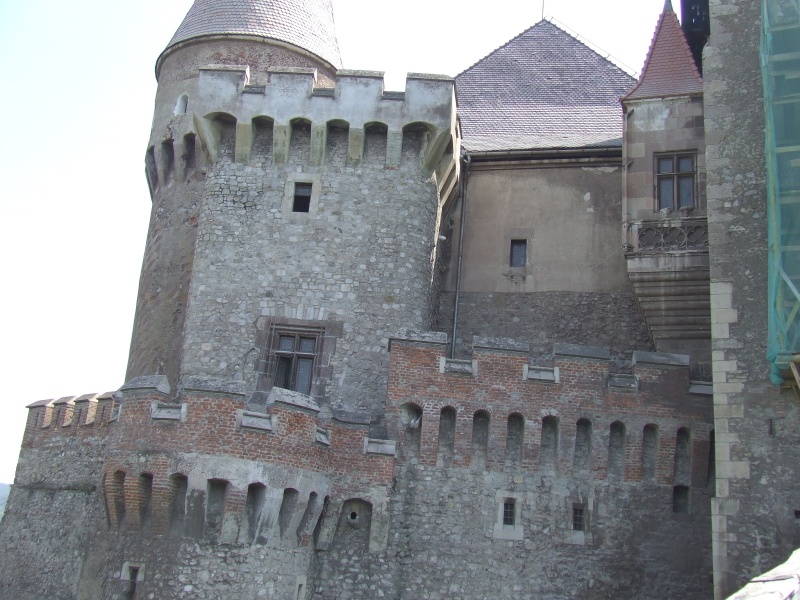
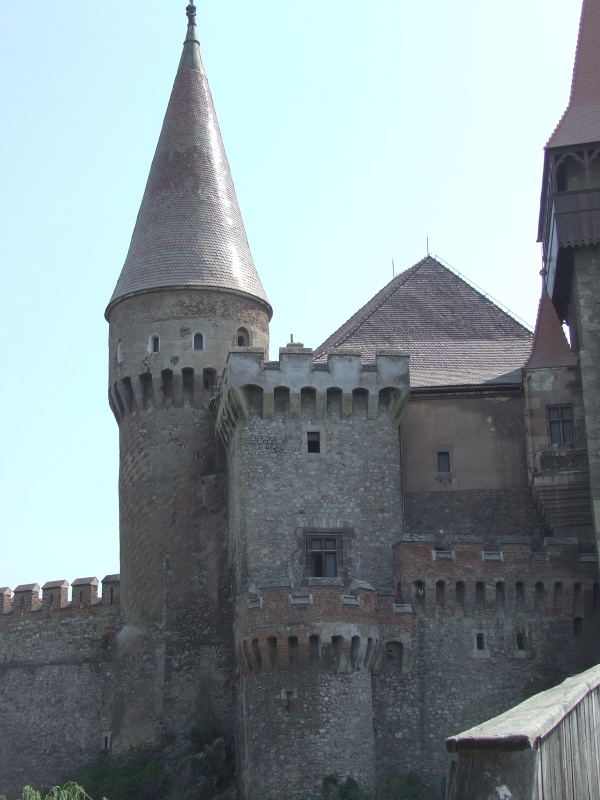
Corvin Castle is the sort of building that makes people reach for their cameras and their superlatives at the same time. Rising on a rocky outcrop above the Zlaști river in the town of Hunedoara, in the Transylvania region of western Romania, it presents a silhouette of almost operatic drama: a dense cluster of tall towers and turrets, high pitched roofs, buttressed walls and a long slender bridge reaching across a ravine to the gate. It is a castle from a story.
It is also one of the largest and most significant castles in all of Romania, and it is frequently listed among the seven wonders of the country. In an age when so many great castles survive only as ruins, Corvin stands substantially intact and richly restored, a rare chance to experience a great late-medieval fortress-palace more or less whole, with its halls, chapels, towers and courtyards all in place.
What makes Corvin so special is the way it fuses the martial and the beautiful. It was built as a serious fortress, a stronghold against the very real threat of the Ottoman Turks, and yet it was also conceived as a magnificent residence, a showcase of Gothic and Renaissance splendour worthy of one of the greatest families of the age. It is at once a war machine and a palace, and that double nature gives it its extraordinary character.
If you want to find this Transylvanian wonder before you visit, here are the coordinates for the castle above Hunedoara. It sits, a little incongruously, in a town long known for its steelworks, so that the fairy-tale towers rise against a backdrop of industry, a juxtaposition that only adds to the strange magic of the place.

The contrast with the surrounding industrial town, long dominated by ironworks and steel mills, only sharpens the castle’s dreamlike quality, as if a page from a book of legends had been set down in the middle of a working city. Few great castles occupy so unexpected a setting, and few reward the visitor who seeks them out with so complete a change of world.
A Fortress Granted to a Rising Family
The story of Corvin is inseparable from the rise of one extraordinary family, the Hunyadis. There had been a fortification on this rock earlier, but the castle’s great age began in 1409, when King Sigismund of Hungary granted the estate of Hunedoara to a nobleman named Voyk, a warrior of Wallachian origin in the royal service, whose son would become one of the most celebrated figures in European history.
That son was John Hunyadi, in Hungarian János Hunyadi, in Romanian Iancu de Hunedoara, and it was he who transformed the modest older fortress into the magnificent castle whose core survives today. From the 1440s onward he rebuilt and vastly expanded the stronghold on the rock, raising towers, halls and defences, turning his family seat into a fortress-palace fit for his soaring ambitions and his crucial military role.
The castle was built, above all, as a bulwark against the Ottoman Empire. In these decades the Turks were advancing relentlessly into the Balkans and threatening the Kingdom of Hungary itself, and Hunyadi, as the kingdom’s greatest general and the defender of its southern frontier, needed a stronghold worthy of his mission. Corvin was to be both his home and a command centre in the great struggle against the Ottoman advance.
So the fairy-tale castle we admire was born of deadly serious purpose, the fusion of a rising family’s ambition with the desperate needs of frontier defence. Hunyadi built to impress and to protect in equal measure, and every graceful turret and grand hall of Corvin sits atop a foundation of hard military necessity, raised in the shadow of the Ottoman threat that dominated his age.
The rise of the Hunyadis is all the more remarkable given the fluid, dangerous frontier world they came from, where Wallachian, Hungarian and Saxon populations mingled and where military talent could still carry a capable man to the heights. Corvin embodies that world of opportunity and danger, a self-made family’s monument raised on a contested border.
John Hunyadi, the Hammer of the Turks
To understand Corvin you must understand the man who built it, for John Hunyadi was no ordinary lord but one of the towering figures of fifteenth-century Europe. Rising through sheer military talent from relatively modest origins, he became the leading general of the Kingdom of Hungary, its regent, and the foremost Christian commander in the long war against the Ottoman Turks, feared and respected across the continent.
His greatest hour came in 1456 at the Siege of Belgrade, where his forces won a stunning victory over the army of Sultan Mehmed II, the conqueror of Constantinople, halting the Ottoman advance into Central Europe for a generation. The victory was celebrated across Christendom, and the noon bell rung in churches to this day is popularly connected to the commemoration of that triumph, a remarkable echo of Hunyadi’s fame.
Hunyadi died later that same year, of plague that swept the victorious camp, but his legacy was immense. He had saved Hungary at its moment of greatest peril, and he had raised his family to the summit of power, setting the stage for his son to achieve what even he had not. The castle at Hunedoara was the physical embodiment of that achievement, the seat from which a dynasty of warriors and kings arose.
Standing in Corvin today, it is worth remembering that this fairy-tale castle was the home of a genuine hero of European history, a man whose name still resonates in Hungary, Romania and beyond. The beauty of the place can distract from the steel behind it, but Corvin was built by and for a warrior who quite literally changed the course of history on the battlefields of the Ottoman wars.

So great was his reputation that his enemies as well as his allies spoke of him with awe, and stories of his exploits circulated across Europe in his own lifetime. For the peoples of the Balkans and Central Europe living under the shadow of Ottoman expansion, Hunyadi was a symbol of hope, the commander who proved that the seemingly unstoppable advance could, after all, be halted.
The Long Bridge Over the Ravine
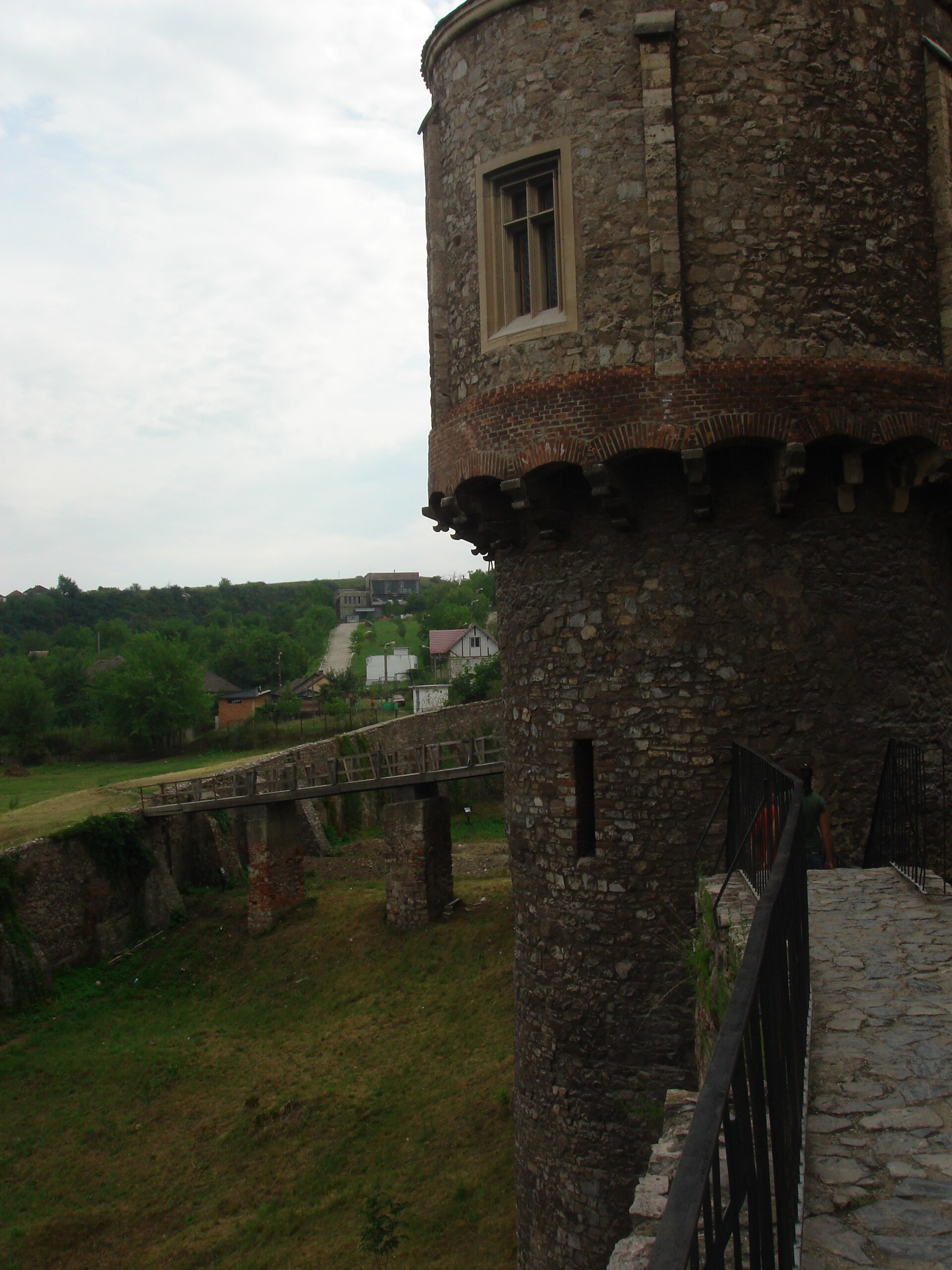
The approach to Corvin is one of its greatest theatrical effects. To reach the castle you must cross a long wooden bridge, carried on tall stone piers, that spans the ravine of the Zlaști river separating the castle rock from the town. The crossing is dramatic and slightly vertiginous, the wooden boards underfoot, the drop below, the great gate and towers looming ahead, a genuinely cinematic entrance to the fortress.
The bridge served an obvious defensive purpose. By setting the castle across a ravine and reaching it only by a bridge, the builders created a formidable obstacle for any attacker, a gap that could be defended and, in earlier forms, raised or destroyed to cut the castle off entirely. The approach forced enemies into a narrow, exposed crossing under the guns and arrows of the defenders, a classic piece of medieval military design.
But the bridge is also pure spectacle, and it is the image of Corvin that most people carry away. The sight of the long span reaching across the void toward the cluster of towers and roofs is irresistibly romantic, and it is no accident that this is the view reproduced on countless postcards and film frames. The bridge turns arrival into an event, a ceremonial passage from the ordinary world into the castle of legend.
Crossing it today, in perfect safety, you can feel both functions at once, the old defensive logic and the sheer romance. The boards creak, the ravine yawns below, the towers rise ahead, and for a moment you are stepping out of the modern town and into the fifteenth century, walking the same dramatic approach that has led visitors, honoured and hostile alike, to the gate of Corvin for centuries.
In its earlier forms the crossing would have been even more formidable, with sections that could be raised or removed, turning the bridge into a true drawbridge that sealed the castle off from the world. The present wooden structure preserves the drama of that arrangement while allowing the steady stream of modern visitors to make the crossing in safety.
Courtyards and Painted Galleries
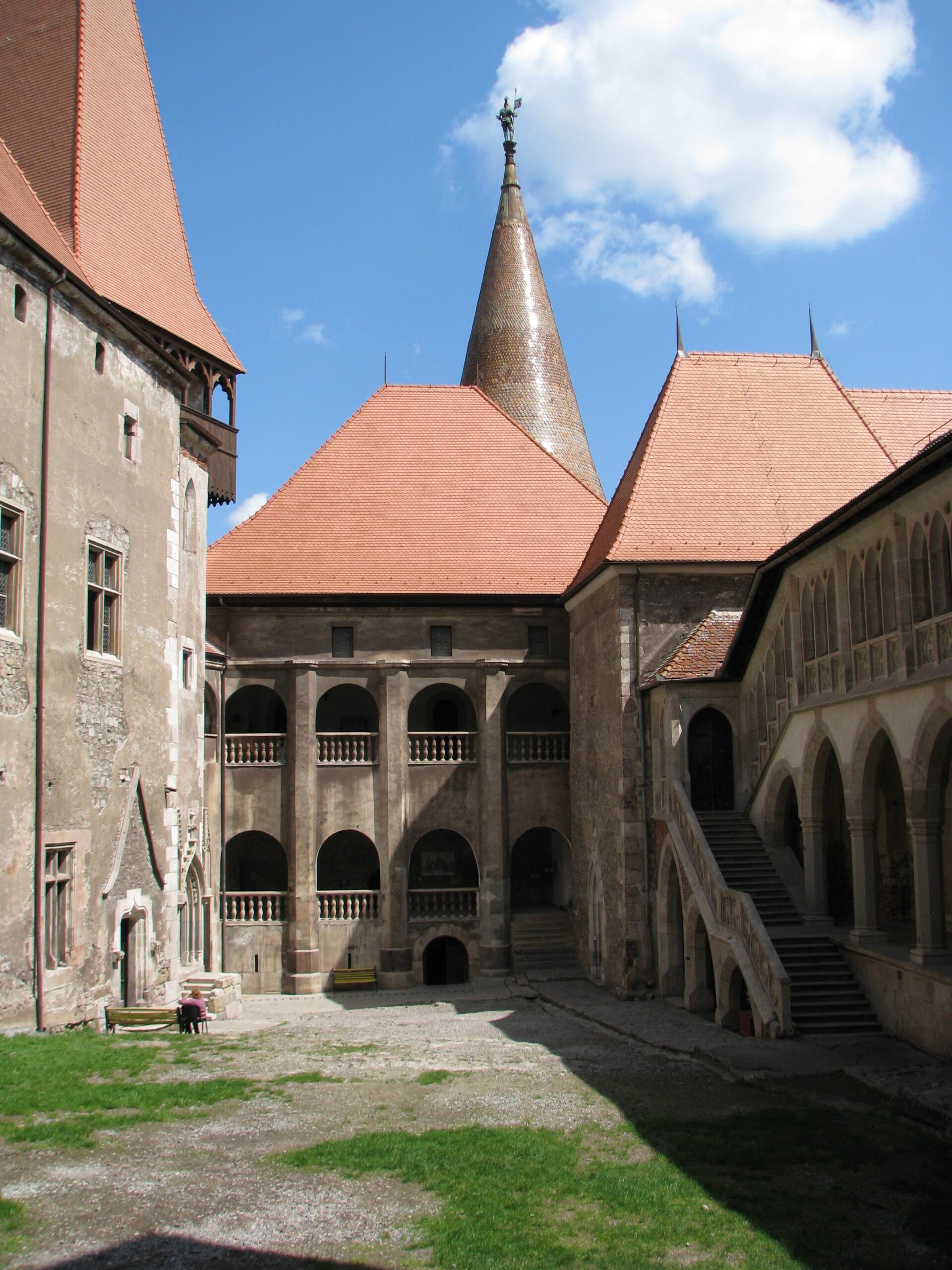
Pass through the gate and you enter the courtyards at the heart of Corvin, where the castle’s double nature as fortress and palace is most beautifully expressed. Here, enclosed by high walls and towers, are elegant galleries and loggias, arched openings and staircases, that soften the martial severity of the exterior with a real grace and refinement, the touch of the palace amid the strength of the fort.
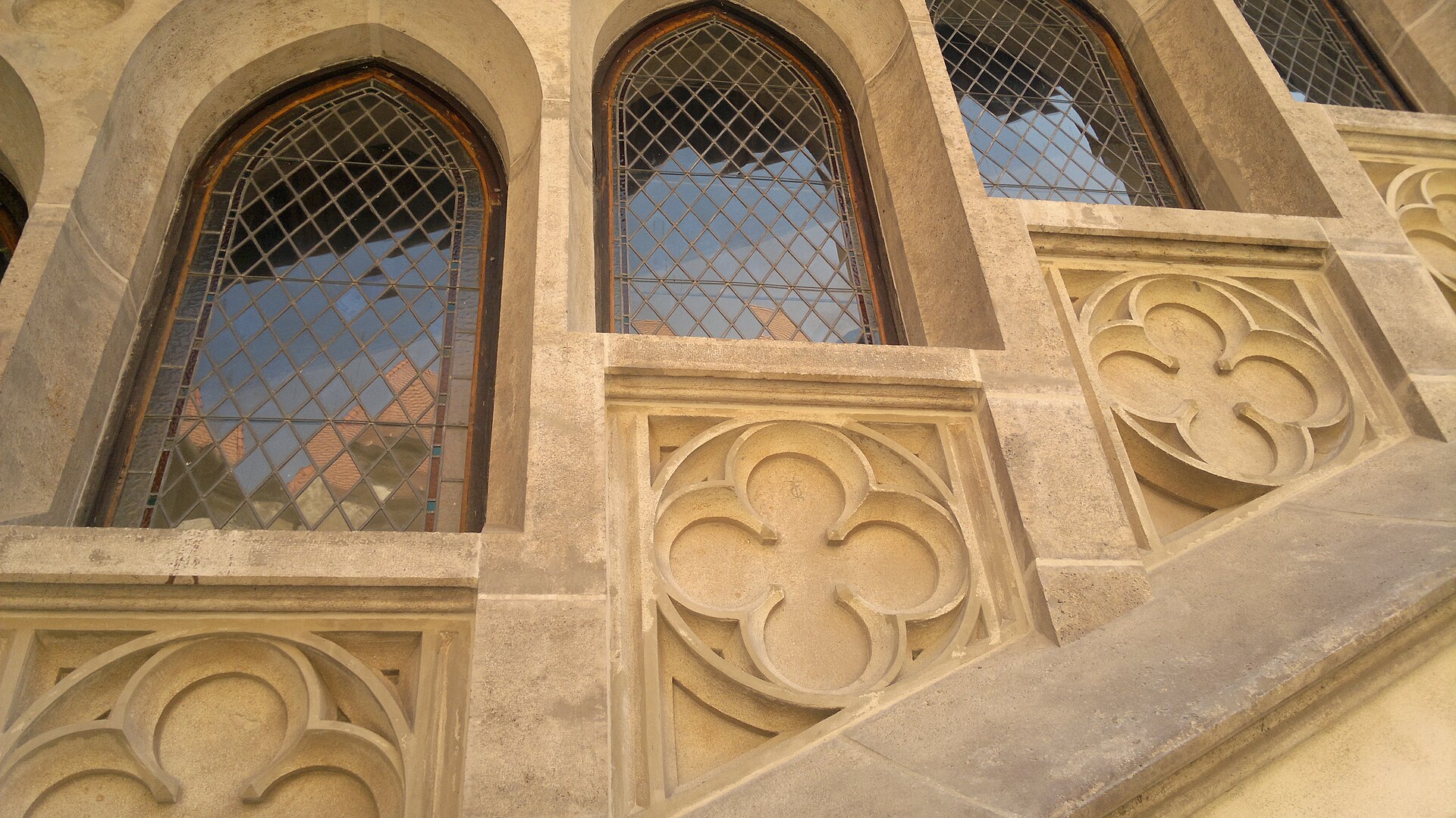
The architecture blends the Gothic and the Renaissance in a way that captures the transitional moment of the fifteenth century. The pointed arches, the ribbed vaults and the general verticality speak the late Gothic language of Hunyadi’s own age, while later additions introduced the rounder arches and classical grace of the Renaissance imported from Italy, so that a walk through the castle is a walk across the boundary between two great architectural worlds.
Traces of painted decoration survive in places, hinting at how colourful and richly adorned these spaces once were, far from the bare stone we sometimes imagine when we think of medieval castles. The Hunyadis meant to impress visitors with their wealth and taste as well as their military might, and the courtyards were a stage for that display, where guests would first sense the grandeur of the family that ruled here.
Standing in the courtyard, ringed by towers and galleries with the sky framed above, you feel the particular atmosphere of Corvin, at once enclosed and soaring, defensive and elegant. This was the daily heart of the castle, the space through which its inhabitants and visitors constantly moved, and it remains the point from which the whole complex, halls and chapel and towers, opens out around you.

The Knights’ Hall and the Diet Hall
The grandest interiors of Corvin are its two great halls, magnificent vaulted chambers that were the ceremonial heart of the castle. The Knights’ Hall, a vast space with its ribbed vaults springing from a row of marble columns, was used for feasts and grand gatherings, and it remains one of the finest Gothic secular interiors in the region, a room built to overawe and to celebrate.
Alongside it lies the Diet Hall, or Hall of the Diet, another great chamber that served for councils and assemblies, its walls once bearing painted decoration including, by tradition, images connected to the family and its story. Together these halls express the political as well as the military importance of Corvin, for this was not just a fortress but a seat of power where matters of state were debated and decided.
The scale and quality of these rooms remind us that the Hunyadis were, in effect, princes, exercising authority over vast estates and playing a central role in the affairs of the kingdom. Halls like these were where that authority was performed, in feasts that displayed wealth and generosity and in councils that shaped policy, all beneath the soaring vaults that proclaimed the family’s greatness.
To stand in the Knights’ Hall today, beneath its high vaults and beside its marble columns, is to sense the ambition of the family that built it. This was a space designed for magnificence, for the gathering of nobles and knights around a lord who had risen to the very summit of the kingdom, and even now, empty and quiet, it retains the grandeur of an age when Corvin was one of the great centres of power in Central Europe.
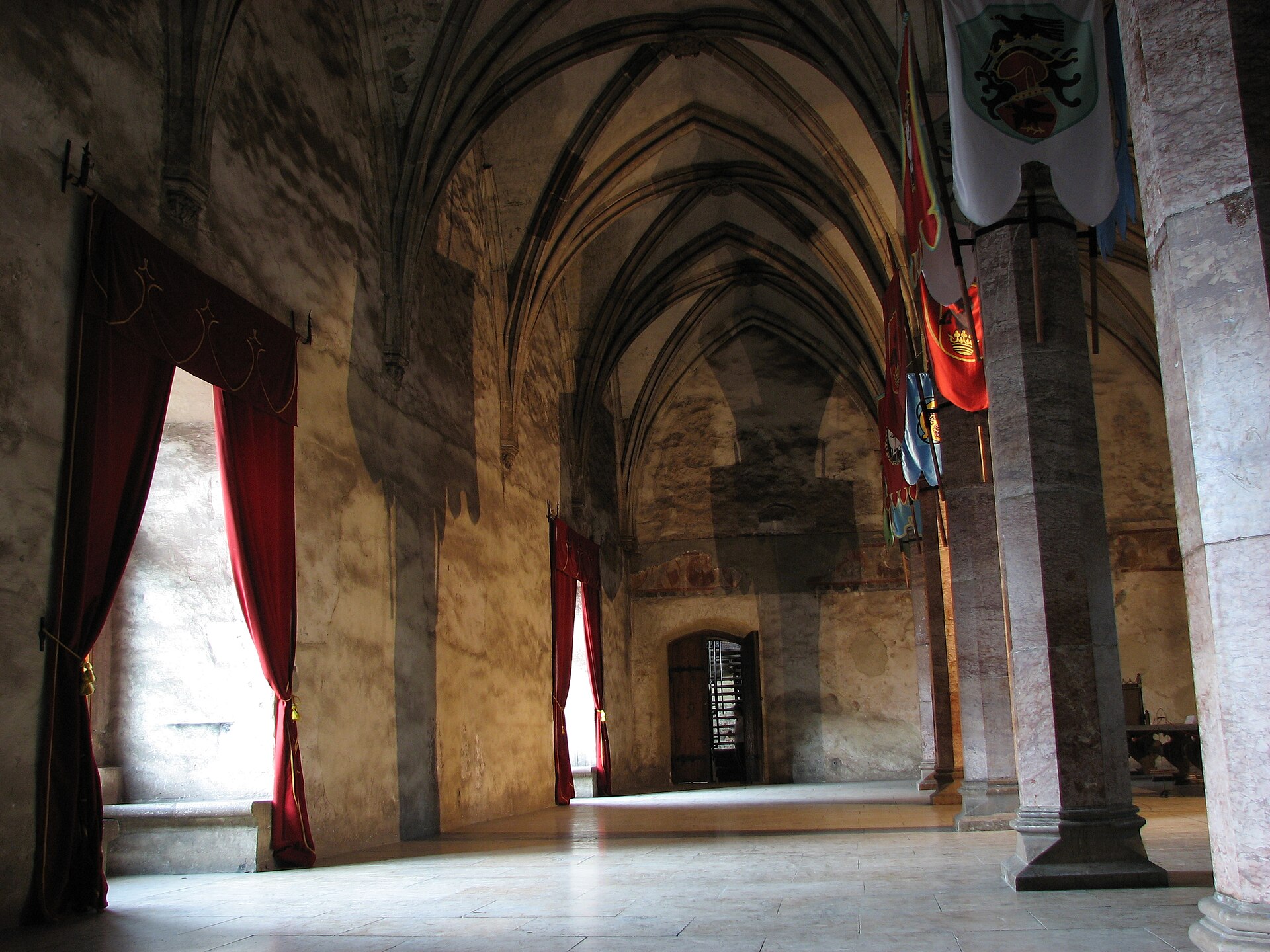
Restorers have worked to recover something of the original colour and decoration of these halls, and where the painted schemes survive or have been reconstructed, they hint at how vivid and richly adorned the interiors of a great fifteenth-century castle truly were, a world away from the bare grey stone of popular imagination.
Towers With Names and Stories
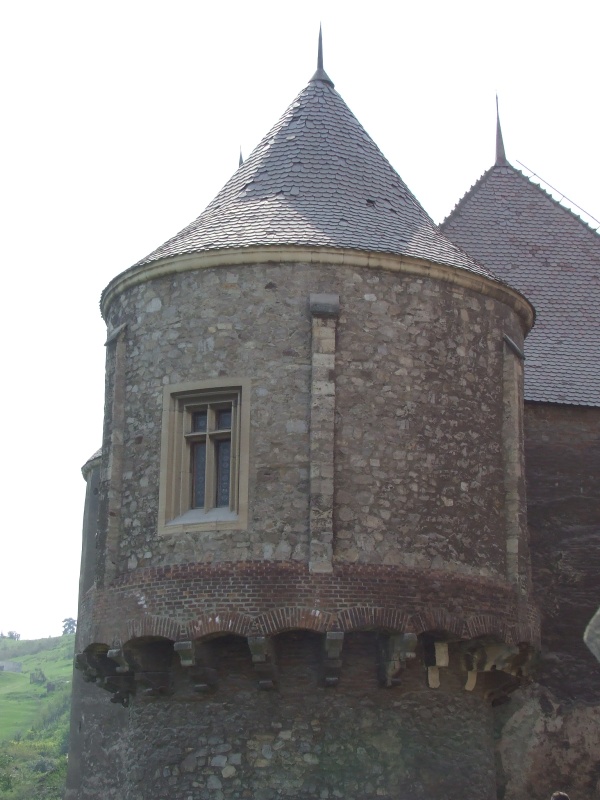
Corvin bristles with towers, and each has its own name, character and story, adding to the castle’s air of romance and mystery. Among the most famous is the Neboisa Tower, whose name is often translated as do not be afraid or fear not, a defensive tower connected to the rest of the castle by a covered walkway, designed as a strongpoint and final refuge in the event of an attack breaching the outer defences.
Other towers carry their own associations. There is a tower linked to the preacher John of Capistrano, who worked alongside Hunyadi in the crusade against the Ottomans, and various towers devoted to defence, storage and residence, each fitted into the complex according to its purpose. The variety of the towers, round and square, tall and squat, gives Corvin its wonderfully irregular, picturesque skyline.
The towers were, of course, primarily military. They provided platforms for defenders, covered the walls and approaches with fields of fire, and served as strongpoints that could be held even if other parts of the castle fell. In an age of both traditional siege warfare and the emerging power of gunpowder, a well-towered castle like Corvin was a formidable proposition for any attacker to contemplate.
Yet the towers also do something for the imagination that goes beyond their function. It is the forest of towers and turrets, more than any single feature, that gives Corvin its fairy-tale quality, its resemblance to the castle of a dream or a story. Practical strongpoints of medieval war, they have become, to the modern eye, the very emblems of romance, and they crown the castle with an unforgettable, storybook silhouette.
The Well and Its Heartbreaking Legend
In the courtyard of Corvin lies a deep well, and around it clings the castle’s most famous and most poignant legend. The story tells of three Ottoman prisoners who were promised their freedom if they could dig a well through the rock to reach water. For years, so the tale goes, the captives laboured, digging ever deeper, sustained by the promise that water would buy their liberty.
At last, after some fifteen years of toil, or so the legend claims, the prisoners struck water and completed the well, only to find that the promise would not be honoured, whether because their captor had died or simply reneged. In their bitterness and despair, the story says, one of them carved an inscription into the wall of the well, a message whose meaning has been variously interpreted but which is traditionally rendered as a lament that they had water but no soul, or no freedom.
Whether any of this is literally true is impossible to say, and the details vary in the telling, but the legend has attached itself firmly to the well and gives the spot a genuine air of tragedy. It captures something of the harshness of the age, the casual cruelty toward captives, the dashed hope of freedom, and it is one of the details that visitors remember most vividly from a tour of the castle.
There is a lesson in the way such legends grow. The well is a real and impressive feat of engineering, driven deep through solid rock to secure the castle’s water, and that alone is remarkable. But it is the human story, true or embroidered, of hope and betrayal that gives the well its hold on the imagination, a reminder that castles are remembered as much for their stories as for their stones.
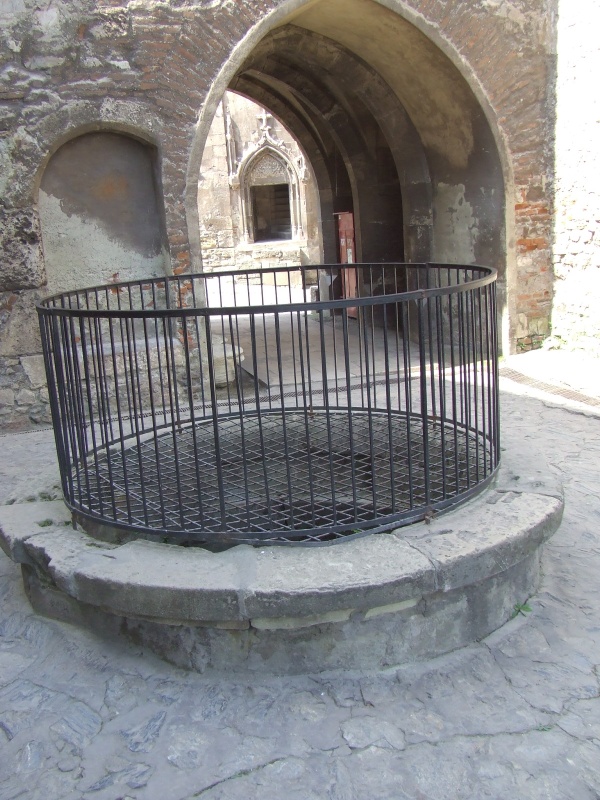
Guides at the castle still recount the tale to every group that gathers at the well-head, and the inscription, whatever its true origin, has become one of the most quoted pieces of writing associated with any Romanian castle. Its enduring power lies in its ambiguity, a cry that could be about water, or freedom, or the soul, spoken across the centuries from the bottom of a well.
A Chapel Within the Walls
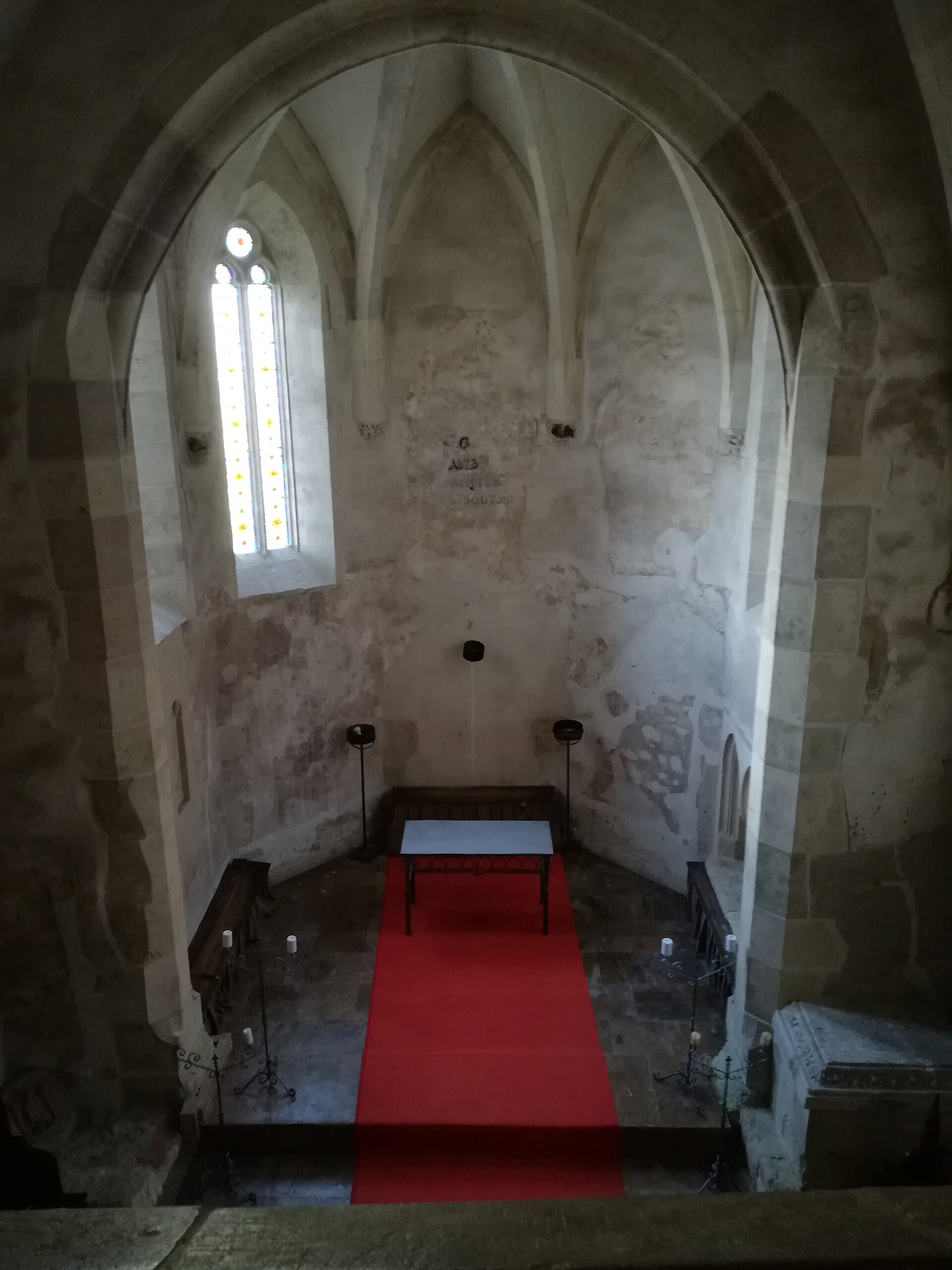
Like every great medieval castle, Corvin has its chapel, built by the Hunyadi family to serve the spiritual needs of the household and to proclaim their piety. Set within the walls, it is a graceful Gothic space, a place of quiet devotion amid the martial bustle of the fortress, and a reminder that for the people who built and lived in Corvin, faith and war were inseparable companions.
The chapel was an important statement as well as a place of prayer. For a family like the Hunyadis, rising fast and defending Christendom against the Ottomans, religious devotion was central to their identity and their claim to legitimacy. John Hunyadi in particular was celebrated as a champion of the Christian faith against Islam, and a fine chapel at the heart of his castle underscored that role.
Architecturally, the chapel shares the Gothic character of the castle’s fifteenth-century core, its pointed forms and vaulting in keeping with the halls and galleries around it. It provided a focus for the religious life of the castle, where Mass would be celebrated, where the family would worship, and where the great events of their lives, births, marriages and deaths, would be marked with appropriate solemnity.
To step into the chapel today is to find a moment of stillness within the drama of Corvin. Amid the towers and halls built for power and war, this quiet sacred space speaks of the other dimension of medieval life, the constant presence of religion, and it completes the picture of the castle as a whole world in itself, with everything its inhabitants needed for body and soul alike.
The Raven and the King
The castle’s very name, Corvin, points to the family’s greatest triumph. John Hunyadi’s son, Matthias, was elected King of Hungary in 1458, just two years after his father’s death, and reigned as Matthias Corvinus, one of the most brilliant monarchs of the age, a soldier, statesman and Renaissance patron whose court became a beacon of humanist culture. From a frontier warrior’s family had come a king.
The name Corvinus, and the raven, in Latin corvus, that became the family emblem, are tied to a legend about Matthias and a ring carried by a raven, and the black bird clutching a golden ring appears throughout the castle as the badge of the dynasty. Under Matthias, the family reached the very summit of European power, and the castle at Hunedoara basked in the reflected glory of the Corvinus king.
Matthias contributed to the castle himself, and it was in his reign that some of its Renaissance elements were added, bringing the new Italian style to the Gothic fortress his father had built. Corvin thus embodies the whole trajectory of the family, from Voyk the royal servant, through John the great general, to Matthias the Renaissance king, three generations of astonishing ascent written into its stones.
That a single family could rise, in three generations, from provincial nobility to the throne of Hungary is one of the great stories of the age, and Corvin is its monument. The raven emblem you see throughout the castle is not mere decoration but the proud badge of that ascent, a reminder that these fairy-tale towers were the cradle of a dynasty that reached, quite literally, the height of royal power.
Under Matthias Corvinus, Hungary became one of the most powerful and cultured states in Europe, its royal library, the Bibliotheca Corviniana, among the greatest collections of the age. That such splendour flowed from a family whose seat was this castle at Hunedoara only deepens the significance of Corvin as the cradle of an extraordinary dynasty.
Later Centuries and a Great Fire
After the glory of the Hunyadis and Matthias Corvinus, the castle entered a long and more turbulent period. It passed through many hands over the following centuries, held by various nobles and princes of Transylvania, including the Bethlen family and others, each of whom left some mark, adding fortifications suited to the age of gunpowder or adapting the halls to changing needs.
As the centuries wore on and the castle’s military importance faded, Corvin suffered periods of neglect. No longer the seat of a great family at the height of its power, it was used for lesser purposes and allowed, at times, to decay, its grandeur dimming as the world that had built it passed away. Like so many great castles, it faced the slow threat of abandonment and ruin.
The gravest blow came in the nineteenth century, when fires damaged the castle, most seriously a great fire in 1854 that gutted parts of the structure. Such disasters might have finished a lesser building, reducing Corvin to the picturesque ruin that was the fate of many medieval fortresses, its halls open to the sky, its towers crumbling above the river.
But Corvin was too important and too magnificent to be lost. From the later nineteenth century onward, efforts were made to restore the castle, and these interventions, though sometimes criticized for their romantic liberties, saved the building and returned it to something like its former glory. The Corvin we visit today is the fruit of that long labour of rescue and restoration, a great castle pulled back from the brink.
Restored to Its Former Glory
The restoration of Corvin, carried out over many decades from the nineteenth century into modern times, has returned the castle to a state of magnificence, and it is this restored Corvin that enchants the hundreds of thousands of visitors who come each year. The work has not been without controversy, as such reconstructions rarely are, but the result is a castle that can be experienced whole, its halls roofed, its towers standing, its bridge crossable.
Debates continue among historians and conservators about how faithful the restorations have been, and how much romantic imagination has been mixed with historical evidence. But for most visitors, the important thing is that Corvin survives as a vivid, immersive experience of a great medieval castle, rather than as a heap of evocative ruins, and the restored halls and courtyards allow the full drama of the place to be felt.
Today Corvin is one of Romania’s premier tourist attractions and a source of national pride, regularly celebrated as one of the wonders of the country. It stands as a monument not only to the Hunyadis and their age but to the long effort of later generations to preserve their heritage, a fortress twice made, once by medieval warriors and again by modern restorers.
To appreciate the full sweep of the castle, from the great bridge to the towers to the halls within, it helps to walk it in company, and this tour does exactly that, leading you across the bridge and through the courtyards and chambers. It captures the scale and atmosphere of Corvin far better than any single view, and conveys why this restored fortress remains one of the most beloved castles in Europe.
A Star of the Screen
With its dramatic silhouette and authentic medieval spaces, Corvin has become a favourite of filmmakers, and it has appeared in numerous films and television productions, often standing in for imaginary castles in historical and fantasy dramas. Some visitors recognize its towers and courtyards from the screen before they ever set foot in Romania, and this cinematic fame has spread the castle’s image around the world.
The castle’s fantastical appearance makes it perfect for such roles. Where a filmmaker needs a castle that looks like the very idea of a castle, all towers and turrets and dramatic bridges, Corvin delivers instantly, and its genuine age lends an authenticity that no set could match. Like Bran to the east, it has found a second life as a backdrop for the imagination, its real history feeding fictional ones.
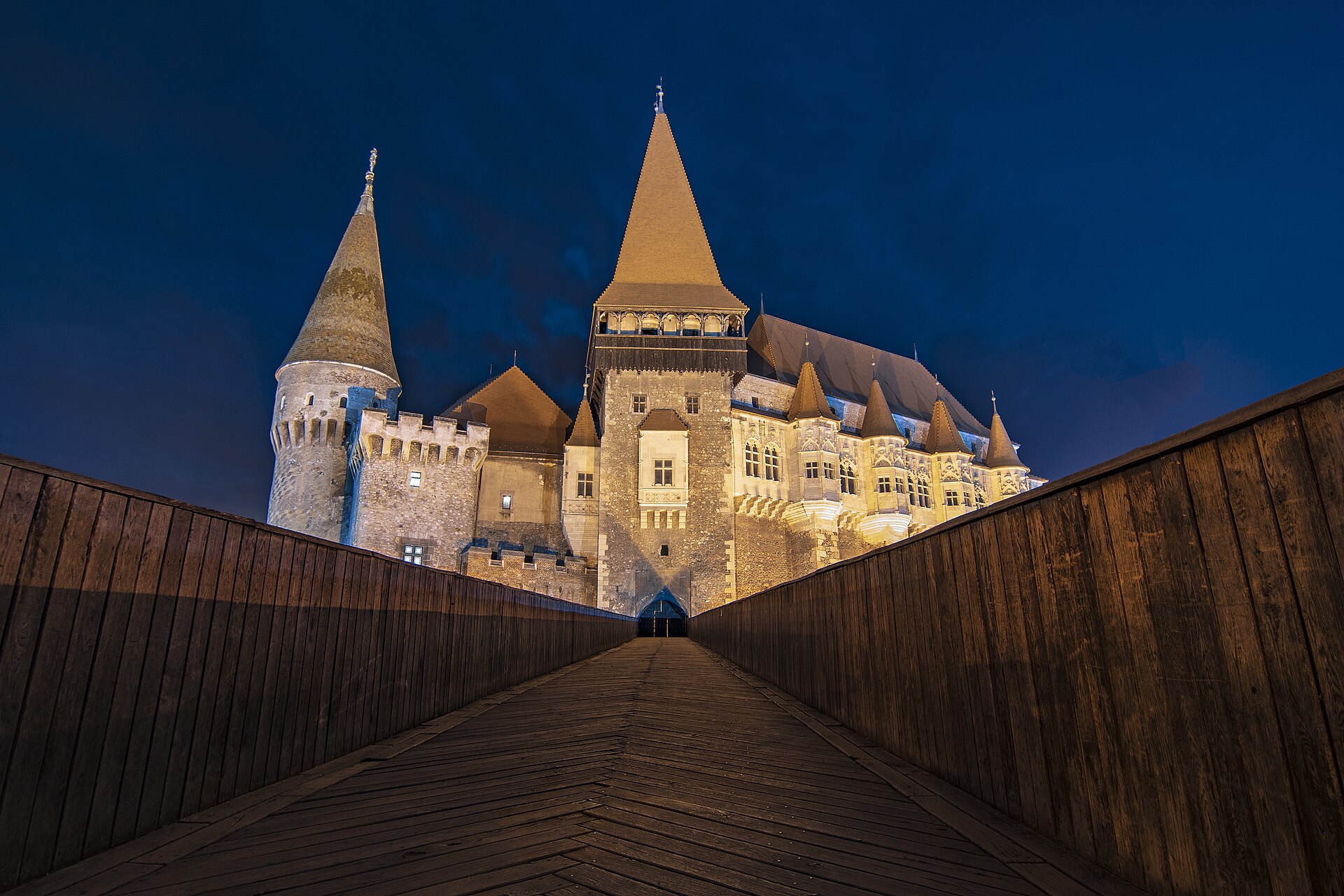
By night, floodlit against the dark, Corvin is at its most spectacular, the illumination throwing its towers and roofs into sharp relief and deepening its air of mystery. This is when the castle looks most like the dream-fortress of legend, and it is a favourite time for photographers seeking to capture its full romantic drama against the Transylvanian sky.
All of this has made Corvin one of the most visited and most photographed places in Romania, a highlight of any journey through Transylvania. It draws lovers of history, of architecture, of film and of sheer romantic spectacle, and it rewards them all, a genuine medieval masterpiece that also happens to look exactly like the castle of everyone’s imagination, standing proud above its Transylvanian town.
This modern fame, like Bran’s Dracula association, brings the practical benefit of resources for the castle’s upkeep, ensuring that the fees and attention of film crews and tourists help preserve the very fabric that makes Corvin so photogenic in the first place. Fame and preservation, here as elsewhere, go hand in hand.
Castles Nearby
- Bran Castle: The Real History Behind Dracula’s Fortress
- Bojnice Castle: The Fairy-Tale Dream a Count Built in Stone
Why Corvin Looks Like a Castle From a Dream
Corvin is that rare thing, a castle that fully lives up to its own legend. It looks like a fairy tale, and it turns out to have a history every bit as dramatic as its appearance, the story of a warrior who saved a kingdom, a family that rose to a throne, and a fortress that survived neglect and fire to stand magnificent above its Transylvanian town.
That is what sets Corvin apart from mere romantic ruins or modern fantasies. The storybook towers are real, raised by a genuine hero of European history in the deadly serious business of defending Christendom against the Ottoman advance. The beauty and the history reinforce each other, so that the more you learn of Hunyadi and his son, the more meaningful every turret and hall becomes.
So when you travel through Transylvania, do not miss the greatest castle in Romania. Cross the long bridge, stand in the Knights’ Hall, peer down the well with its tragic legend, and look up at the forest of towers against the sky. Corvin Castle is proof that history can be as romantic as any fairy tale, and that the most beautiful castles are often those with the fiercest stories behind them.
You May Like
Buda Castle: The Crown of Budapest Above the Danube


One thought on “Corvin Castle: The Fairy-Tale Fortress a Warrior Built”