We come at last to the Danube, and to one of the most magnificent castle-scapes in all of Europe. High on Castle Hill, above the great river that divides Budapest into Buda and Pest, stretches the vast palace of Buda Castle, a sweeping range of domes and wings and terraces that crowns the city and gazes across the water at the parliament on the far bank. It is one of the definitive images of Central Europe, and a fitting climax to our journey through its castles.
Buda Castle is the historic seat of the kings of Hungary, a royal palace with roots deep in the Middle Ages, and its story is the story of Hungary itself, in all its glory and its suffering. Here a Renaissance king made one of the most brilliant courts in Europe; here the Ottoman Turks ruled for a century and a half; here empires clashed and the palace was destroyed and rebuilt, again and again, rising each time from the ruins to crown the hill anew.
So come with me up onto Castle Hill, above the Danube, and let us explore the great palace of the Hungarian kings. We will trace its history from medieval fortress to Renaissance jewel to Ottoman stronghold to Habsburg palace, follow its terrible destructions and triumphant rebuildings, and discover why Buda Castle, for all its scars, remains the proud crown of Budapest and one of the great royal palaces of Europe.
In This Article
- The Palace Above the Danube
- Born After the Mongol Storm
- The Golden Age of Matthias Corvinus
- A Century and a Half Under the Crescent
- The Habsburg Palace Rises
- The Fountain of King Matthias
- Beneath the Great Dome
- Courtyards, Gates and Ornament
- The Mythical Bird of the Magyars
- The Funicular and the Castle District
- A Palace of Museums
- Destroyed Again, and Reborn
- The Enduring Crown of Budapest
The Palace Above the Danube
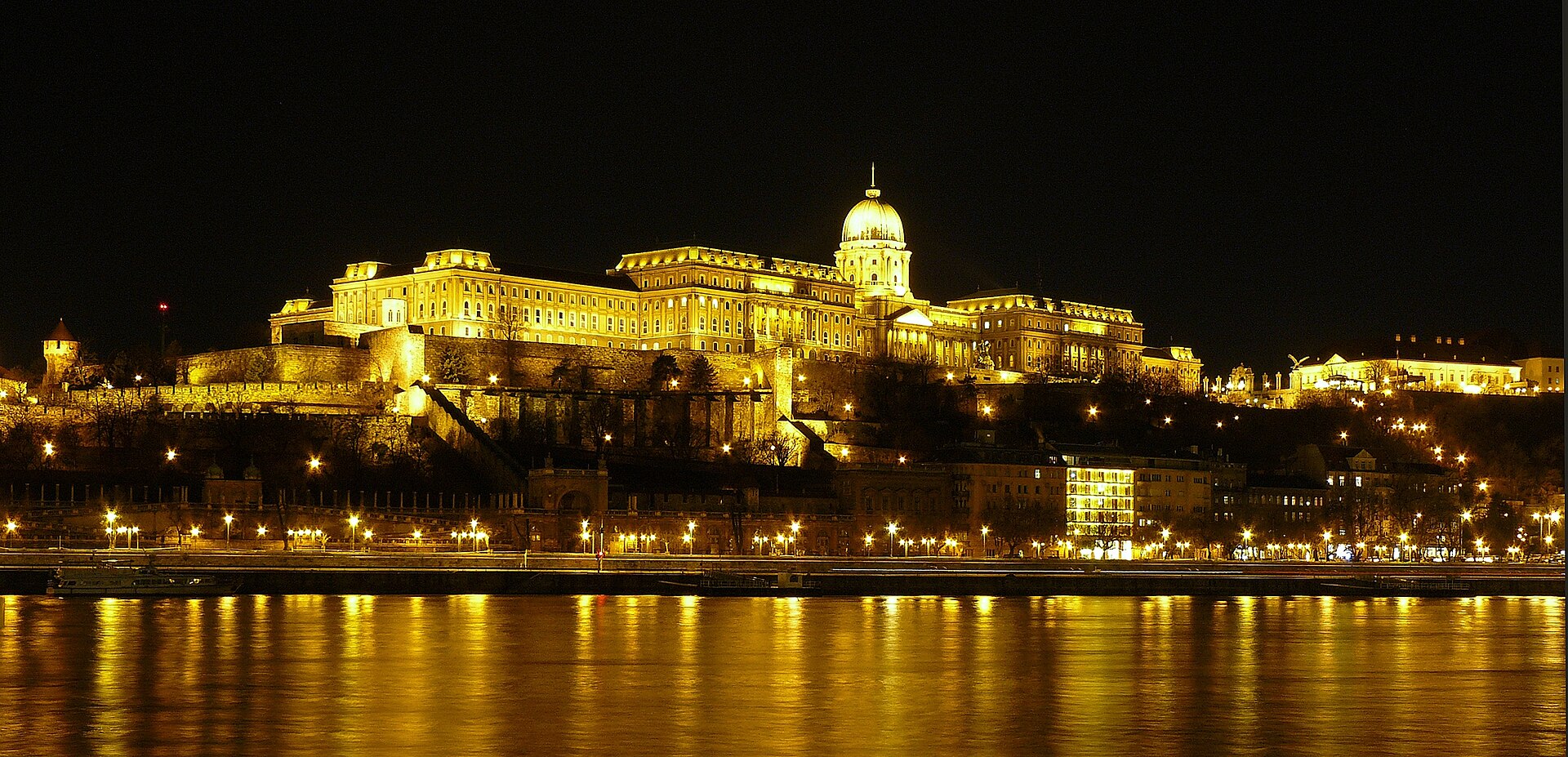
Few cityscapes in the world can rival the view of Buda Castle from across the Danube. The great palace stretches along the crest of Castle Hill, its domes and long ranges of buildings rising above the wooded slopes and the river, and at night, floodlit and reflected in the water, it is one of the most romantic sights in Europe. This is the crown of Budapest, and the historic seat of the kings of Hungary.
The setting is everything. Budapest is really two cities joined into one, hilly Buda on the west bank of the Danube and flat Pest on the east, and Castle Hill rises dramatically on the Buda side, a long limestone ridge that has been the fortified heart of the city for many centuries. From the palace terraces, the whole of Pest spreads out across the river, dominated by the great neo-Gothic parliament on the far bank.
The importance of the site was recognized long ago, and the entire Castle Hill district, together with the banks of the Danube, forms part of a UNESCO World Heritage Site, honoured as one of the world’s great urban landscapes. Buda Castle is the centrepiece of this ensemble, the royal palace around which the whole historic quarter of old Buda is arranged.
If you want to find this magnificent hill before you visit, here are the coordinates for the castle above the Danube. Zoom out and you will see how it commands the river and the city, the fortified ridge of Buda facing the sprawl of Pest across the water, the two halves of a great capital united by their bridges and crowned by the royal palace on its hill.

At night the effect is unforgettable, as the palace, the bridges and the parliament are all bathed in golden light and doubled in the dark water of the Danube, turning the whole centre of Budapest into one of the most romantic urban panoramas anywhere in the world. It is a sight that draws travellers back to the river again and again.
Born After the Mongol Storm
Like Spiš far to the north, Buda Castle owes its origins to the Mongol invasion that devastated the Kingdom of Hungary in 1241. In the aftermath of that catastrophe, King Béla IV understood that his realm needed strong stone fortresses on defensible heights, and in the following decades a royal castle rose on the naturally strong Castle Hill above the Danube, the beginning of the great palace to come.
Over the following centuries the medieval castle grew into a major royal residence, expanded by successive kings of Hungary as Buda rose to become the capital of the kingdom. Under the Angevin and later kings the palace was enlarged and embellished, and by the late Middle Ages Buda Castle was one of the important royal seats of Central Europe, the centre of a powerful and ambitious kingdom.
A particularly great builder was King Sigismund of Luxembourg, who in the early fifteenth century, as both King of Hungary and Holy Roman Emperor, undertook a huge expansion of the palace in the Gothic style, raising grand halls and towers and making Buda a residence worthy of an emperor. The medieval palace reached impressive dimensions, a fitting seat for a kingdom at the height of its medieval power.
Though little of this medieval fabric survives above ground today, having been buried, destroyed and rebuilt over the turbulent centuries that followed, its foundations and fragments have been recovered by archaeologists, and they remind us of the deep antiquity of the site. The great palace we see now stands upon a thousand years of royal building, the latest in a long succession of castles on the hill above the Danube.
The Golden Age of Matthias Corvinus
The most brilliant chapter in the history of Buda Castle came in the second half of the fifteenth century, under King Matthias Corvinus, the same great monarch whose family we met at Corvin Castle. Matthias transformed Buda into one of the most dazzling Renaissance courts in all of Europe, importing Italian humanists, artists and architects and remaking the palace in the new Renaissance style.
Matthias was a true Renaissance prince, learned, ambitious and a magnificent patron, and under him Buda became a centre of humanist culture to rival the great courts of Italy. He assembled one of the most famous libraries of the age, the Bibliotheca Corviniana, a treasury of beautifully illuminated manuscripts that was among the largest and finest collections of books in Europe, a wonder of the age.
The court of Matthias at Buda drew scholars and artists from across the continent, and the palace was filled with Renaissance splendour, its halls adorned with art, its gardens laid out in the Italian manner, its life conducted with a refinement that astonished visitors. For a few glorious decades, Buda Castle was one of the true capitals of European Renaissance culture, a beacon of learning and beauty in Central Europe.
This golden age, tragically, did not long survive Matthias, who died in 1490. The great library was later scattered and largely destroyed, and the brilliant Renaissance palace would soon face catastrophe. But the memory of the reign of Matthias Corvinus remains a high point of Hungarian history, and the ghost of his magnificent court still haunts the hill, a vision of what Buda Castle was at its most glorious.

The dispersal of the Bibliotheca Corviniana after the fall of Buda is one of the great cultural losses of European history, its priceless manuscripts scattered across the libraries of the world, where surviving Corvinian codices are treasured to this day. Their beauty gives us a tantalizing glimpse of the splendour of Matthias’s court at its height.
A Century and a Half Under the Crescent
The glory of Renaissance Buda was shattered by the rise of the Ottoman Empire. After the catastrophic Hungarian defeat at the Battle of Mohács in 1526, the kingdom collapsed, and in 1541 the Ottomans took Buda, beginning nearly a century and a half of Turkish rule over the city and much of Hungary. The royal palace of the Hungarian kings became an Ottoman provincial capital.
Under Ottoman rule, Buda changed profoundly. The great Renaissance palace fell into decline, used for military and administrative purposes rather than as a splendid royal court, and the city took on an Ottoman character, with mosques, baths and the trappings of Turkish urban life. For generations, Buda Castle flew the crescent flag, a frontier stronghold of the Ottoman Empire deep in the heart of Central Europe.
The end came in 1686, in one of the great sieges of European history. A vast Christian army of the Holy League, drawn from across Europe, besieged Ottoman Buda in a bloody and prolonged assault, and after fierce fighting the city was stormed and recaptured. The siege was devastating: much of the old palace and city was ruined in the fighting and the explosions, and the Renaissance Buda of Matthias was largely obliterated.
The recapture of Buda in 1686 was celebrated across Christian Europe as a turning point in the long struggle against the Ottomans, the beginning of the end of Turkish power in Hungary. But it left the royal hill a scene of devastation, the medieval and Renaissance palace in ruins. The Buda Castle that would rise from these ashes would be a new creation, built by the victorious Habsburgs on the rubble of the old.
During the Ottoman period Buda acquired baths and other Turkish institutions, some of which survive in Budapest to this day, so that the Ottoman centuries left a genuine mark on the city even as they interrupted its royal history. The famous thermal baths of Budapest owe part of their tradition to this era.
The Habsburg Palace Rises
With Buda in Habsburg hands after 1686, the ruined royal hill was gradually rebuilt, and over the following centuries there arose a grand new palace in the Baroque and later styles, the direct ancestor of the building we see today. The Habsburg rulers of Hungary, who were also the emperors in Vienna, reconstructed Buda Castle as a magnificent royal residence befitting their status.
A key figure in this rebuilding was the Empress Maria Theresa, who in the eighteenth century oversaw the construction of a large Baroque palace on the hill, giving Buda Castle much of its essential form as a sweeping royal residence rather than a medieval fortress. The palace grew through successive campaigns of building into the enormous complex that dominates Castle Hill.
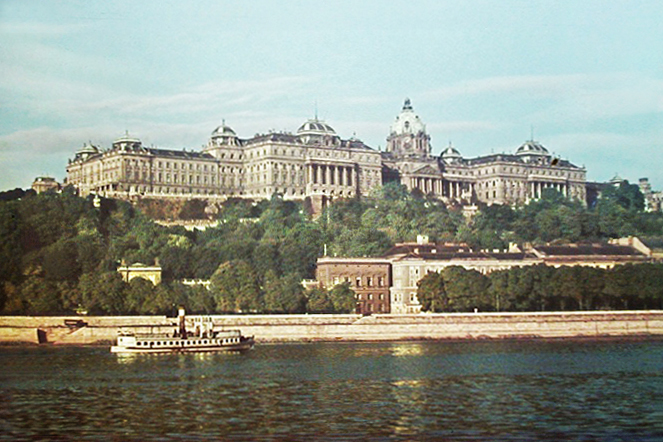
The greatest expansion came in the later nineteenth and early twentieth centuries, when architects such as Miklós Ybl and Alajos Hauszmann transformed and enlarged the palace into a vast neo-Baroque masterpiece, crowned with its great dome, one of the largest and most magnificent royal palaces in Europe. This was Buda Castle at its most grandiose, the proud seat of the Hungarian crown within the Austro-Hungarian empire.
The courtyards and wings of this Habsburg-era palace, rebuilt yet again after later disasters, are what visitors explore today. The building expresses the imperial confidence of its age, when Budapest was one of the twin capitals of a great empire and the palace on its hill was meant to rival any royal residence on the continent, a Baroque and neo-Baroque vision of monarchy in stone.

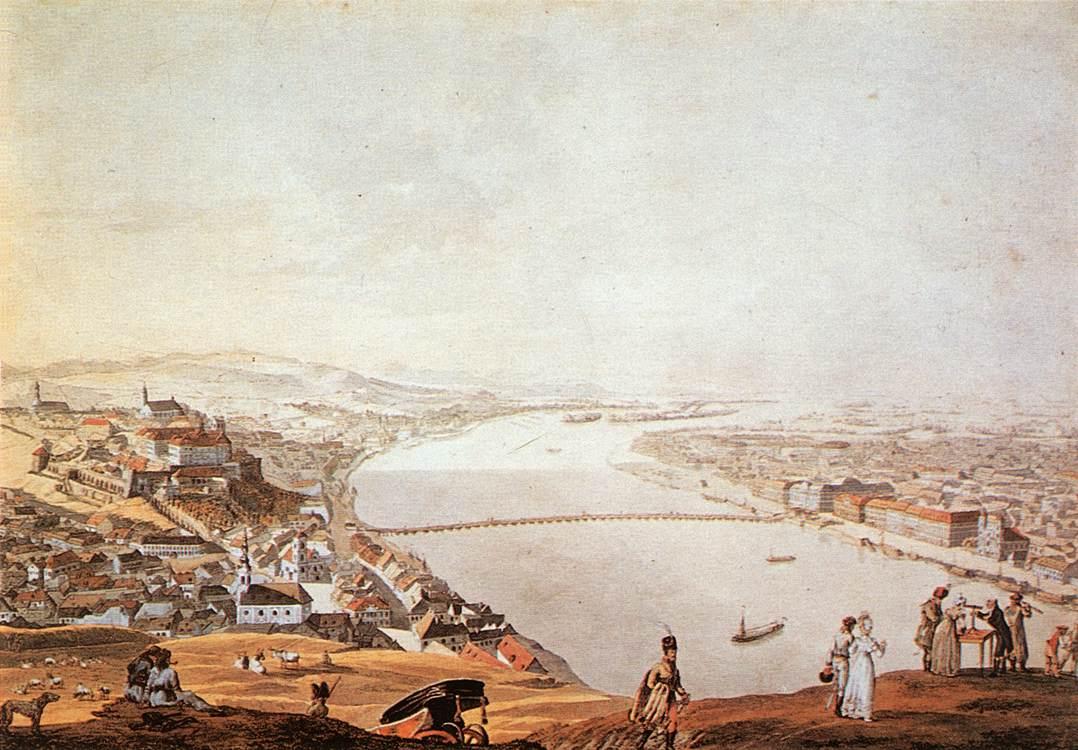
The rebuilding of Buda over the eighteenth and nineteenth centuries mirrored the revival of the city itself, which grew from a war-ruined frontier town into one of the great capitals of Europe, so that the rise of the palace and the rise of Budapest went hand in hand, each reflecting the other’s ambition.
The Fountain of King Matthias
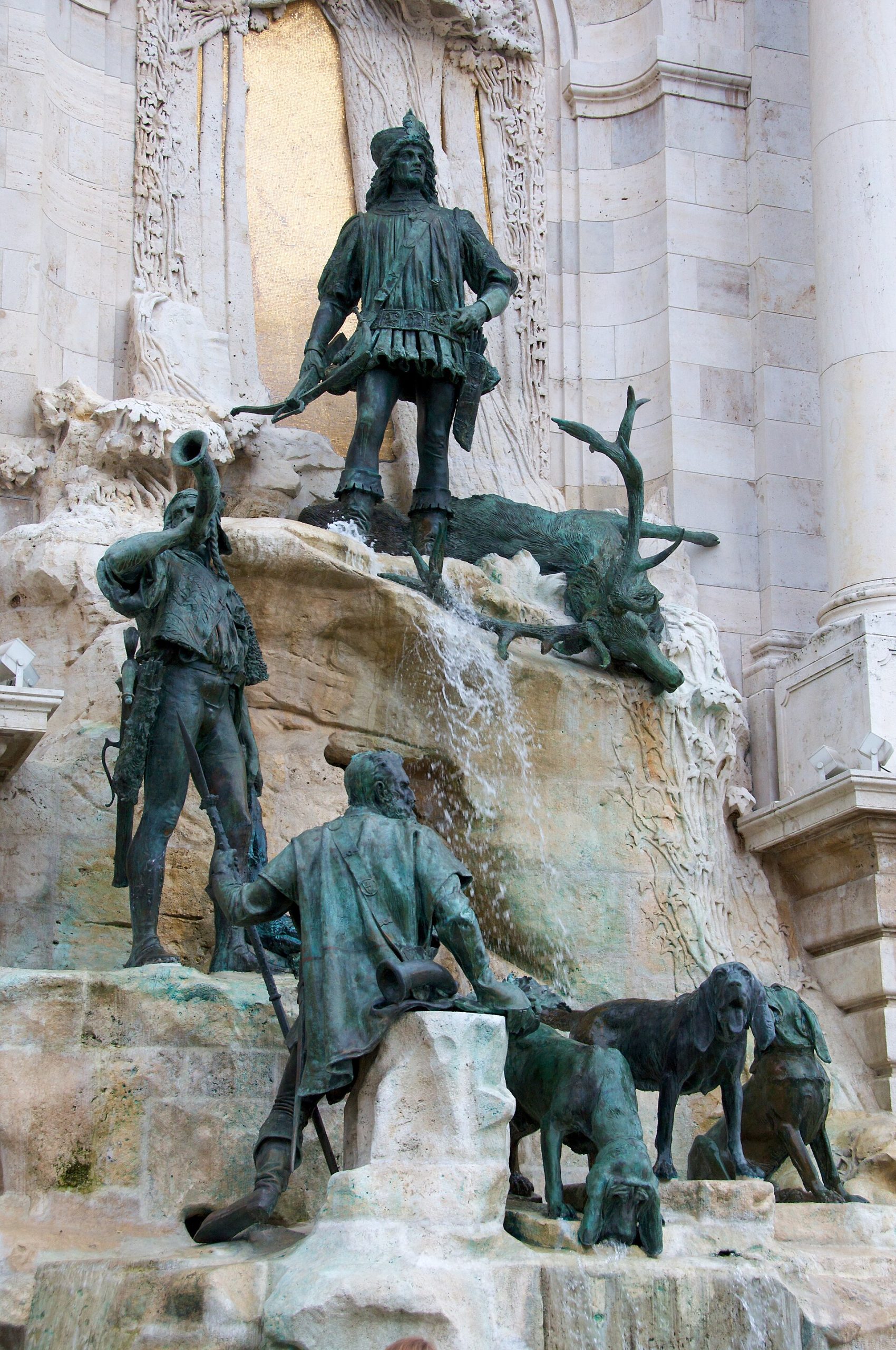
One of the most beloved features of Buda Castle is the Matthias Fountain, a magnificent bronze sculptural group set against the palace walls, one of the most photographed monuments in Budapest. It depicts King Matthias Corvinus on a hunting expedition, the king standing proud amid his hounds and companions, a romantic vision of the great Renaissance monarch in the wild.
The fountain, created in the early twentieth century, illustrates a popular romantic legend associated with Matthias, a tale of the king meeting a beautiful peasant girl, Ilonka, while hunting in disguise, a doomed love story that captured the imagination of later generations. The sculpture turns this legend into a spirited, dynamic tableau, full of movement and life, a favourite of visitors to the castle.
Monuments like the Matthias Fountain show how the memory of the golden age of Matthias Corvinus continued to inspire Hungary long after his death. Even as the actual Renaissance palace was destroyed and rebuilt, the figure of the great king remained a potent symbol of Hungarian glory, and artists returned again and again to his image, keeping his legend alive on the very hill where he once ruled.
Set against the grand walls of the palace, the fountain is a perfect meeting of history and romance, a monument that connects the modern visitor to the vanished splendour of the Renaissance court. It is one of the small delights of a visit to Buda Castle, a reminder that beneath the grandeur of the Habsburg palace lies the older, glittering memory of Matthias and his brilliant Buda.
Beneath the Great Dome
The most prominent feature of Buda Castle, visible from across the city, is its great central dome, rising above the long ranges of the palace to crown Castle Hill. The dome is the product of the great neo-Baroque expansion around the turn of the twentieth century, and it gives the palace its commanding, unmistakable silhouette, the fixed point of the Buda skyline.
The dome and the grand facades were designed to project the power and dignity of the Hungarian crown at the height of the Austro-Hungarian era, when Budapest was a booming imperial capital determined to rival Vienna. Everything about the palace of that period spoke of ambition and confidence, and the dome was its crowning statement, a symbol of monarchy raised high above the twin cities of Buda and Pest.
The palace beneath the dome was, in its imperial heyday, a place of enormous grandeur, with sumptuous state rooms, grand staircases and halls fit for the ceremonies of a great kingdom. Though these interiors were largely destroyed in later disasters and the building now serves other purposes, the external grandeur of the dome and facades still conveys the imperial magnificence for which the palace was built.
Seen from the Pest side of the river, or from one of the Danube bridges, the dome of Buda Castle riding above the wooded hill is one of the essential images of Budapest, as recognizable as the parliament building it faces across the water. It is the visual anchor of the whole royal hill, the crown upon the crown, and it announces the presence of the palace from every corner of the city.

Courtyards, Gates and Ornament
The great palace is organized around a series of courtyards and terraces, and wandering them is one of the pleasures of a visit. Among the most characterful is the Lion Court, named for the sculpted stone lions that guard its gateway, a dignified enclosed space at the heart of the complex that gives access to the various wings and their collections.
These courtyards and the ornamental gates, balustrades, statues and fountains that adorn them were part of the grand design of the imperial-era palace, meant to impress visitors with a sequence of magnificent spaces as they approached and moved through the royal residence. The sculpted lions, in particular, have become a beloved feature, keeping their watch as they have for generations.
The terraces of the palace, meanwhile, offer some of the finest views in Budapest, looking out across the Danube to Pest and the parliament, or along the river to the bridges and the hills beyond. These belvederes were designed as much for the enjoyment of the view as for grandeur, and today they are among the most popular vantage points in the whole city.
Moving through the courtyards, gates and terraces, you sense the sheer scale and ceremonial ambition of the palace, a building designed to be experienced as a grand processional sequence. Even now, with the interiors given over to museums, the outdoor architecture of Buda Castle, its courts and lions and balustraded terraces, preserves the magnificence of a great royal residence.

The Mythical Bird of the Magyars
Guarding the palace, its bronze wings spread wide, stands one of the most striking monuments of Buda Castle: the great Turul, an enormous statue of the mythical bird that lies at the very origins of Hungarian legend. Perched dramatically on the ramparts, clutching a sword in its talons, the Turul is one of the most powerful national symbols of Hungary.
The Turul is a bird of ancient Magyar mythology, a great falcon or eagle associated with the legendary origins of the Hungarian people and the founding dynasty of the kingdom. According to the old legends, the Turul played a role in the ancestry of the ruling house, and the bird became a symbol of the nation and its royal lineage, reaching back into the misty prehistory of the Magyars.
The great statue at Buda Castle, created around the turn of the twentieth century, was intended to celebrate this ancient national mythology and to link the modern Hungarian state to its legendary origins, in the age of surging national feeling within the Austro-Hungarian empire. Its dramatic form, the huge bird poised as if about to take flight, makes it one of the most memorable monuments on Castle Hill.
For Hungarians, the Turul carries a deep emotional charge as an emblem of national identity and continuity, and its presence at the royal palace binds the modern nation to the ancient legends of its founding. To stand beneath the great bronze bird, its wings spread against the sky above the Danube, is to feel the mythic dimension of Hungarian history, brooding over the palace of the kings.

The Turul remains a potent and sometimes debated symbol in modern Hungary, invoked in various ways across the political and cultural spectrum, a measure of how deeply the ancient bird is woven into the national imagination. At Buda Castle it stands simply as a guardian of the royal hill and a link to the legendary dawn of the Hungarian people.
The Funicular and the Castle District
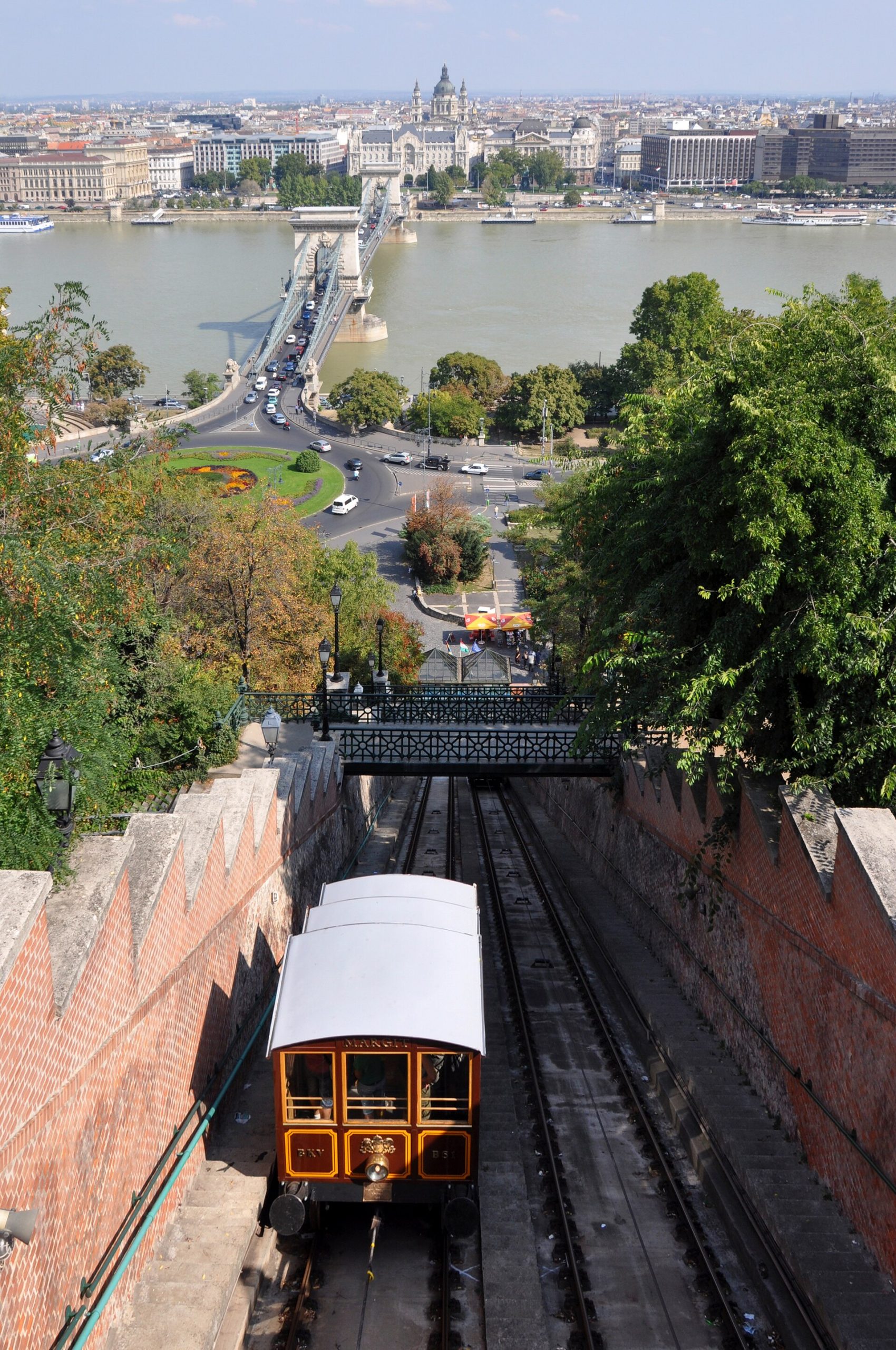
Getting up to Buda Castle is itself a small pleasure, for one of the ways to ascend Castle Hill is by the historic funicular, the Sikló, a charming little cable railway that has been climbing the steep slope from the Danube bank to the palace since the nineteenth century. Its wood-panelled cars and fine views make the short ride a delightful introduction to the castle.
The palace is only part of the wider Castle District, the old town of Buda that crowns the hill around it, a beautifully preserved quarter of cobbled streets, historic houses, churches and squares. This medieval and Baroque townscape, largely spared the worst of modern development, is one of the loveliest historic districts in Central Europe and an essential part of the Buda Castle experience.
Just a short walk from the palace stand two of Budapest’s most famous landmarks: the great Matthias Church, with its colourful tiled roof, where Hungarian kings were crowned, and the fairy-tale Fisherman’s Bastion, a romantic neo-Romanesque terrace of white turrets and arcades offering spectacular views over the Danube to Pest. Together with the palace, they make Castle Hill a treasury of monuments.
The whole district rewards slow exploration on foot, wandering its quiet lanes between the grand palace and the famous landmarks, discovering hidden courtyards and sudden views over the river and the city. Buda Castle is the great centrepiece, but it sits within a wider historic quarter of extraordinary charm, and the two together form the crowning glory of old Buda above the Danube.
In recent years an ambitious programme of reconstruction has begun to restore some of the palace’s lost historic features and interiors, part of a wider effort to return more of the castle’s former grandeur, so that the long story of building and rebuilding on Castle Hill continues even now into the twenty-first century.
A Palace of Museums
Today Buda Castle no longer serves as a royal residence, for Hungary is a republic and its kings are long gone, but the great palace has found a new and fitting purpose as a home for some of the nation’s most important cultural institutions. The vast building now houses museums and collections that make it one of the great cultural centres of Hungary.
Chief among them is the Hungarian National Gallery, which occupies a large part of the palace and displays a magnificent collection of Hungarian art from the Middle Ages to the present, tracing the artistic history of the nation through its painting and sculpture. The palace also houses the Budapest History Museum, which explores the long story of the city and the castle, including surviving remnants of the medieval royal palace.
The National Széchényi Library, one of the great libraries of Hungary, also makes its home in the palace, continuing, in a sense, the tradition of learning and scholarship that reached its height under Matthias Corvinus and his famous library. Thus the palace remains a centre of Hungarian culture, its halls filled not with a royal court but with art, history and books for the nation.
This transformation from royal residence to cultural treasure-house is a familiar fate for great palaces in the modern age, and at Buda Castle it feels especially appropriate. The building that was so often destroyed and rebuilt now safeguards the artistic and historical heritage of Hungary, its grand rooms serving the whole nation, a royal palace given over, in the end, to the people and their culture.

For visitors, this concentration of great collections means that a day at Buda Castle can be as much about art and history as about architecture, and many come as much for the National Gallery’s masterpieces as for the palace itself. The building thus serves a double role, monument and museum, history and its own container at once.
Destroyed Again, and Reborn
Buda Castle has been destroyed and rebuilt more times than almost any palace in Europe, and its most recent devastation came within living memory, in the terrible Siege of Budapest at the end of the Second World War. Over the winter of 1944 and 1945, the city became the scene of ferocious fighting between German and Soviet forces, and Castle Hill, held to the last, was reduced to smoking ruins.
The magnificent imperial-era palace was gutted, its grand interiors destroyed, its roofs and much of its structure shattered by shellfire and flame. It was one more catastrophe in the long cycle of destruction that had repeatedly befallen the royal hill, from the siege of 1686 to the bombs of 1945, and once again the great palace lay broken above the Danube.
In the decades after the war, the palace was rebuilt yet again, though in a somewhat simplified form, its exterior grandeur restored while its ruined imperial interiors were adapted for the museums that now fill it. The reconstruction, carried out under the postwar communist regime, saved the building and returned the familiar silhouette of the dome and facades to the Buda skyline.
That Buda Castle stands proud again today, after so many destructions, is a testament to the resilience of the city and the determination to preserve its heritage. The palace has risen from the rubble time after time, medieval to Renaissance to Baroque to imperial to modern, each version built on the ruins of the last, an unbreakable symbol of Budapest that no siege, however terrible, has ever been able to erase for good.

Archaeological excavation of the ruins after 1945 had one unexpected benefit: it uncovered substantial remains of the medieval royal palace of Sigismund and Matthias, long buried beneath the later building, allowing parts of the Gothic and Renaissance castle to be studied and displayed for the first time in centuries. From destruction came rediscovery.
The Enduring Crown of Budapest
Seen as a whole, from the air or from across the river, Buda Castle resolves into a single majestic ensemble crowning its hill, the long ranges of the palace, the great dome, the terraces and courtyards, the Turul and the fountains, all riding above the Danube in a composition of imperial grandeur. It is the definitive image of Budapest and one of the great palace-scapes of Europe.
The endurance of the palace, through every catastrophe of Hungarian history, has made it far more than a building. It is a symbol of the nation itself, of a people who have suffered invasion, occupation and destruction again and again, and who have rebuilt and endured every time. The palace that keeps rising from its ruins is an emblem of Hungarian resilience, a crown that cannot be permanently cast down.
Today the whole of Castle Hill, palace and district together, is one of the most visited and most beloved places in Hungary, drawing crowds from around the world to admire its architecture, enjoy its museums and views, and absorb its extraordinary history. It is the essential destination of any visit to Budapest, the summit of the city in every sense.
To take in the full sweep of the hill, it helps to walk it in company, and this tour leads you across Castle Hill, through the palace courts and the historic district around it. It conveys, as no single view can, the grandeur and the atmosphere of the place, and it makes a fitting close to any journey through the great castles of Central Europe, for Buda Castle gathers the whole drama of the region, glory and destruction and rebirth, into one magnificent palace above the Danube.

In this sense Buda Castle belongs not only to Hungary but to the whole shared story of Central Europe, a region where the same great forces, empire and faith, invasion and revival, shaped a chain of magnificent castles from the Baltic to the Danube. To stand on Castle Hill is to stand at one end of that chain, looking back across a continent of fortresses.
Castles Nearby
- Corvin Castle: The Fairy-Tale Fortress a Warrior Built
- Wawel Royal Castle: The Sacred Hill at the Heart of Poland
Why Buda Castle Endures as the Crown of Budapest
There could hardly be a better place to end a journey through the castles of Central Europe than Buda Castle, for it gathers into a single palace the whole drama of the region. Here is the medieval fortress born of the Mongol terror, the brilliant Renaissance court of Matthias Corvinus, the long shadow of the Ottoman wars, the imperial grandeur of the Habsburgs, and the terrible destructions and heroic rebuildings of the modern age, all layered on one hill above the Danube.
That is the deepest lesson of Buda Castle, and of so many of the castles we have visited: that these great buildings are not frozen monuments but living survivors, shaped and scarred and rebuilt by the turbulent history of the peoples who made them. Buda has been destroyed and reborn more times than almost any palace in Europe, and its endurance is the endurance of Hungary itself.
So stand on Castle Hill, above the great river, and look out over Budapest spread below, and let the whole history of Central Europe settle around you. From the fortresses of Bohemia to the palaces of Romania, from the ruins of Slovakia to the royal hills of Poland and Hungary, these castles tell the story of a region, and Buda Castle, crown of the Danube, is a fitting place to bring that story, at last, to a close.
You May Like
Mafra, the Palace a King Built From a Vow