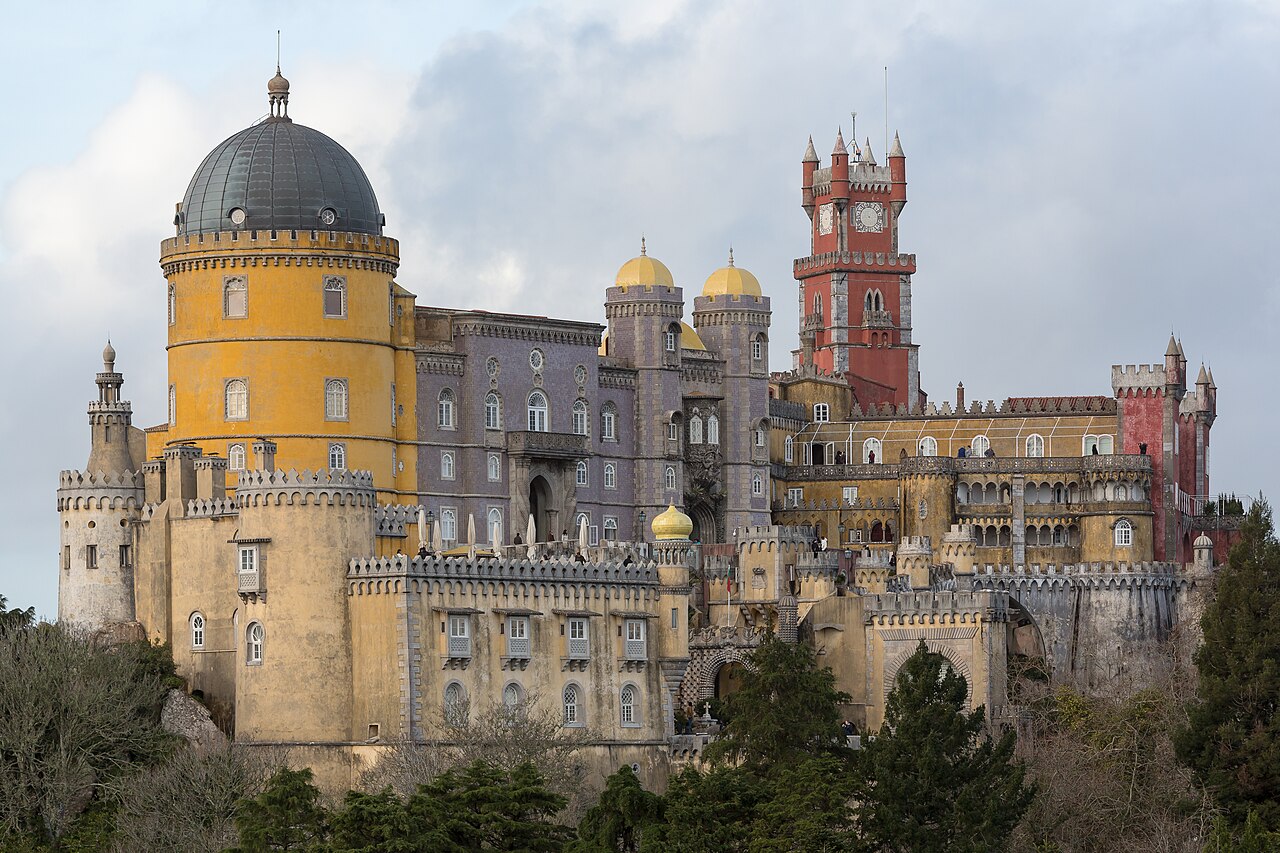
Some buildings try to blend into their surroundings. Pena does the opposite. Perched on a rocky peak high above the town of Sintra, its towers painted in vivid reds and yellows, its walls bristling with domes, battlements, and carved monsters, it looks less like a real palace than like something conjured out of a fairy tale or a dream. On a clear day you can see it for miles, a burst of colour against the green hills; on a misty morning it seems to float, half-hidden, above the clouds.
The Palacio Nacional da Pena is the most famous expression of Romanticism in Portuguese architecture, and one of the most beloved buildings in the country. Where earlier palaces sought dignity and order, Pena revels in fantasy. It piles style upon style, borrowing from Gothic, Moorish, Renaissance, and Manueline sources and fusing them into a single exuberant whole that answers to no rulebook but the imagination of its creator.
That creator was a king with the soul of an artist, and Pena is above all his personal vision made real. Built in the nineteenth century on the ruins of an old monastery, it was conceived not as a seat of power but as a summer retreat, a place of beauty and escape. In this it succeeded completely, and it has been enchanting visitors ever since, drawing crowds from around the world to its hilltop above Sintra.
In this guide you will discover how Pena came to be, from the monastery that once stood on the site to the king who transformed it, the wild mix of styles that makes it so distinctive, the strange details that reward a close look, the vast romantic park that surrounds it, and what it is like to visit today. By the end you will understand why this improbable, joyful building has become a symbol of Sintra itself.
In This Article
- A Ruined Monastery on a Misty Hill
- The Artist King Who Dreamed It Up
- Building a Fantasy in Stone
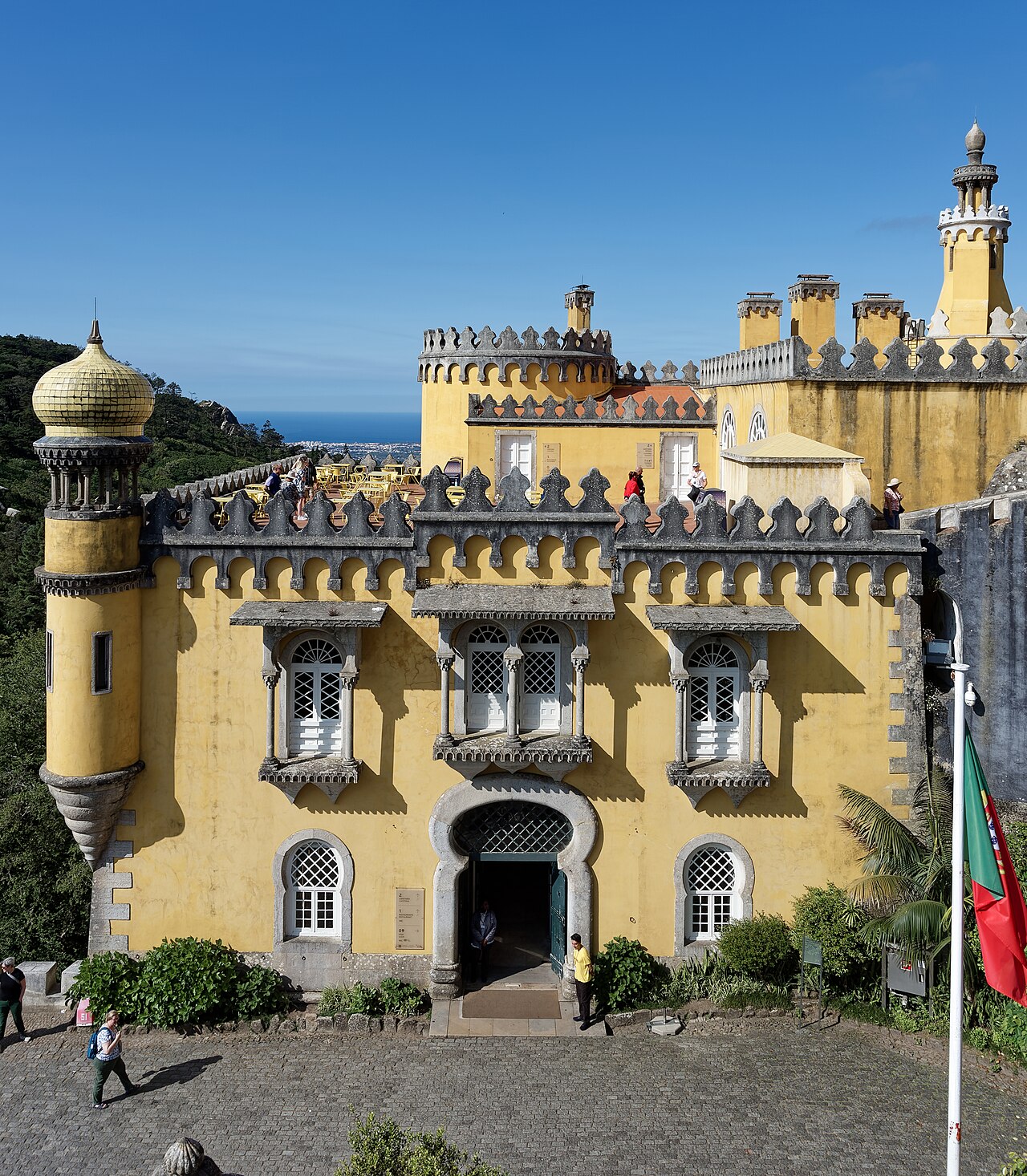
- A Riot of Styles on One Hilltop
- Why Pena Wears Such Bold Colours
- The Triton Gate and Its Strange Guardians
- Inside the Royal Rooms
- The Chapel and the Monastery Within
- The Enchanted Park Around the Palace
- Pena as a Monument of Romanticism
- From Royal Retreat to National Treasure
- Making the Most of Your Visit
- See Pena for Yourself
A Ruined Monastery on a Misty Hill
Long before it became a riot of colour, the peak where Pena stands was a place of quiet devotion. In the Middle Ages the site drew pilgrims to a chapel dedicated to Our Lady, and in the sixteenth century a monastery was established there for the Hieronymite friars, a small religious house clinging to one of the highest points above Sintra. For centuries the monks lived in this remote, cloud-wrapped spot, far from the bustle of the world below.
The monastery was never large, but its position was extraordinary. Surrounded by the wild, rocky landscape of the Sintra hills, often veiled in mist, it had an atmosphere of romance and isolation that would later prove irresistible. The friars themselves may have valued the solitude for its spiritual power; a place so close to the sky seemed fitting for a life of contemplation.
Disaster and decline eventually emptied the monastery. The great Lisbon earthquake of 1755 damaged the buildings, and though the chapel survived, the complex fell into disrepair over the following decades. When the religious orders were suppressed in Portugal in the 1830s, the monastery was abandoned altogether, left to crumble on its lonely peak, its cells silent and its walls slowly surrendering to the elements.
It was in this ruined, romantic state that the site caught the eye of the man who would transform it. To a sensibility shaped by the Romantic movement, the crumbling monastery on its misty summit was not a sad relic but an inspiration, a perfect starting point for something extraordinary. Where others might have seen only ruins, he saw the bones of a dream.
There is a poetry in the fact that Pena grew from a place of prayer. The very isolation that had made the peak suitable for monks, its height, its mist, its sense of being apart from the world, was exactly what made it irresistible to a romantic imagination. The ruins did not have to be invented; they were already there, waiting, and the palace that rose from them kept something of the monastery’s otherworldly stillness even at its most exuberant.
The Artist King Who Dreamed It Up
The visionary behind Pena was Ferdinand II, a German prince who became king of Portugal through his marriage to Queen Maria II. Cultured, artistic, and deeply influenced by the Romantic ideals sweeping Europe, Ferdinand was a painter, a collector, and a lover of nature and beauty, and he found in Portugal a landscape and a ruined monastery that spoke directly to his imagination.
Ferdinand acquired the old monastery and the surrounding lands and set about turning them into a summer palace unlike anything the country had seen. This was to be a personal project in the fullest sense, guided at every step by the king’s own taste. He worked closely with his architect, a German mining engineer with a flair for design, and together they shaped a building that expressed Ferdinand’s romantic vision rather than any official programme.
What set Ferdinand apart was that he thought like an artist rather than a bureaucrat. He cared about how the palace would look from a distance, how it would sit in its landscape, how colour and silhouette and detail would combine to create an effect. He treated the whole hilltop as a canvas, composing the palace and its park together as a single work of art on a grand scale.
Because Pena was so closely tied to Ferdinand’s personal vision, it carries his character in a way few royal buildings do. It is not the statement of a dynasty or a nation so much as the expression of one romantic imagination. That intimacy is part of its charm; to visit Pena is to step inside the daydream of a king who loved beauty above almost everything else.
Ferdinand’s German background is worth dwelling on, because it helps explain Pena’s look. He came from a world steeped in the romantic castles and forests of central Europe, and he brought that sensibility south, grafting it onto Portuguese history and landscape. The result is a building that feels at once foreign and deeply Portuguese, a meeting of two romantic traditions in the person of one king who belonged fully to neither.
Building a Fantasy in Stone
Construction of Pena got underway in the late 1830s and continued through the following decades, gradually transforming the ruined monastery into the palace we see today. Rather than sweeping the old buildings away, Ferdinand incorporated the surviving monastery, including its chapel and cloister, into the new structure, so that the historic core sits embedded within the romantic additions like a memory preserved inside a dream.
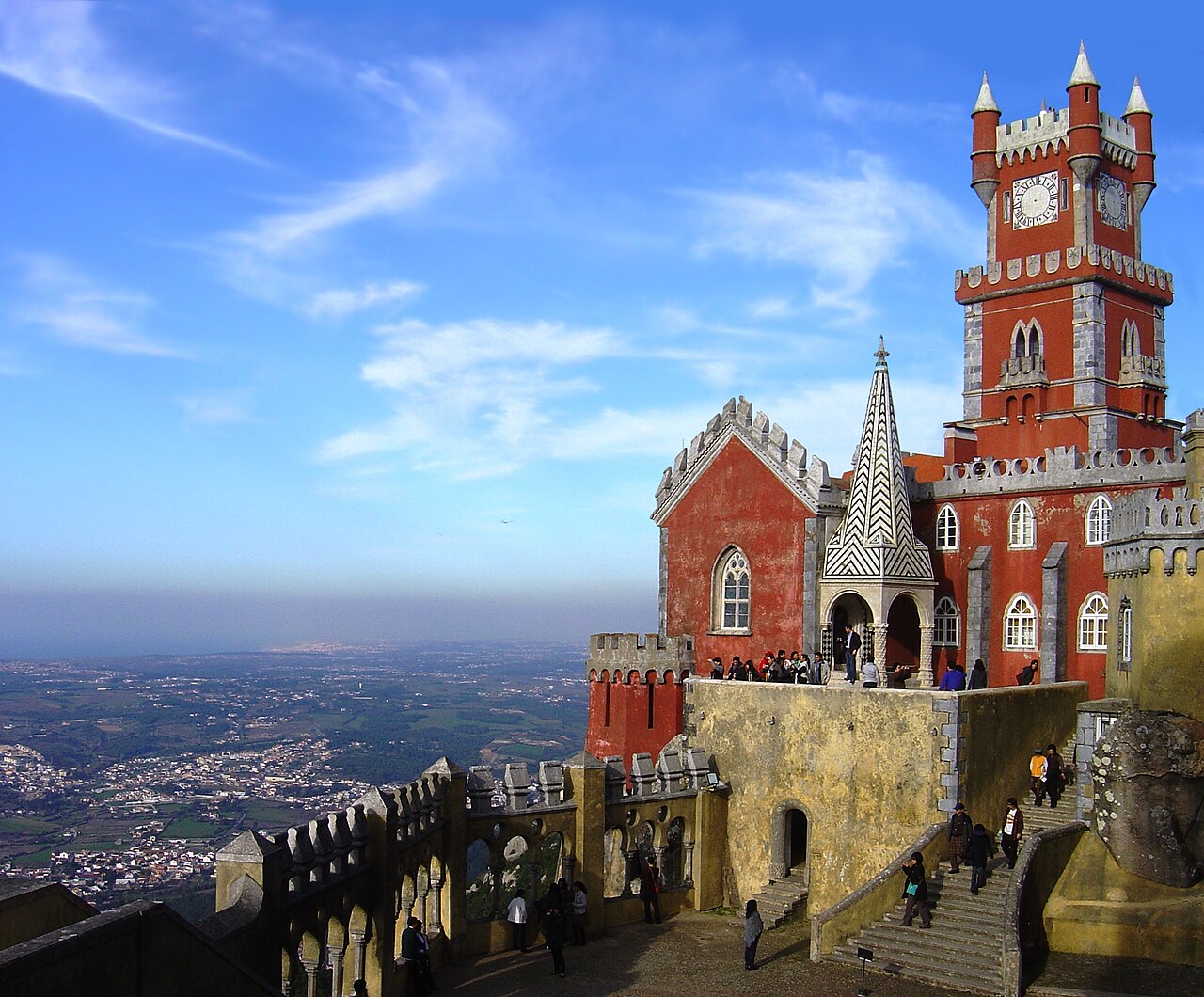
Around and above this core rose an entirely new palace of towers, terraces, gateways, and battlements, expanding the modest footprint of the monastery into a sprawling, theatrical composition. The building climbs and wraps around the rocky summit, using the natural contours of the peak to create dramatic changes of level and unexpected views at every turn. Walking through it, you are constantly rising and falling, turning corners into new surprises.
The work drew on skilled craftsmen and the materials of the region, and the construction itself was a considerable feat given the steep, exposed site. Everything had to be carried up the hill, and the builders had to contend with the wind, the mist, and the sheer rock. That the result feels so effortless and playful is a tribute to the care that went into solving these very practical problems.
By the time the main work was complete, Ferdinand had created something without real precedent in Portugal: a purpose-built romantic palace that fused old and new, sacred and secular, into a single joyful whole. It was a summer home, a work of art, and a statement of a whole way of feeling about beauty and the past, all raised on a peak that had once known only the silence of the monks.
A Riot of Styles on One Hilltop
The first thing everyone notices about Pena is that it seems to obey no single architectural style. This is entirely deliberate. Pena is a masterpiece of eclecticism, the nineteenth-century taste for freely mixing historical styles, and it draws on a remarkable range of sources. Gothic pinnacles rise beside Moorish arches; Renaissance domes sit near Manueline ornament inspired by Portugal’s own age of discovery.
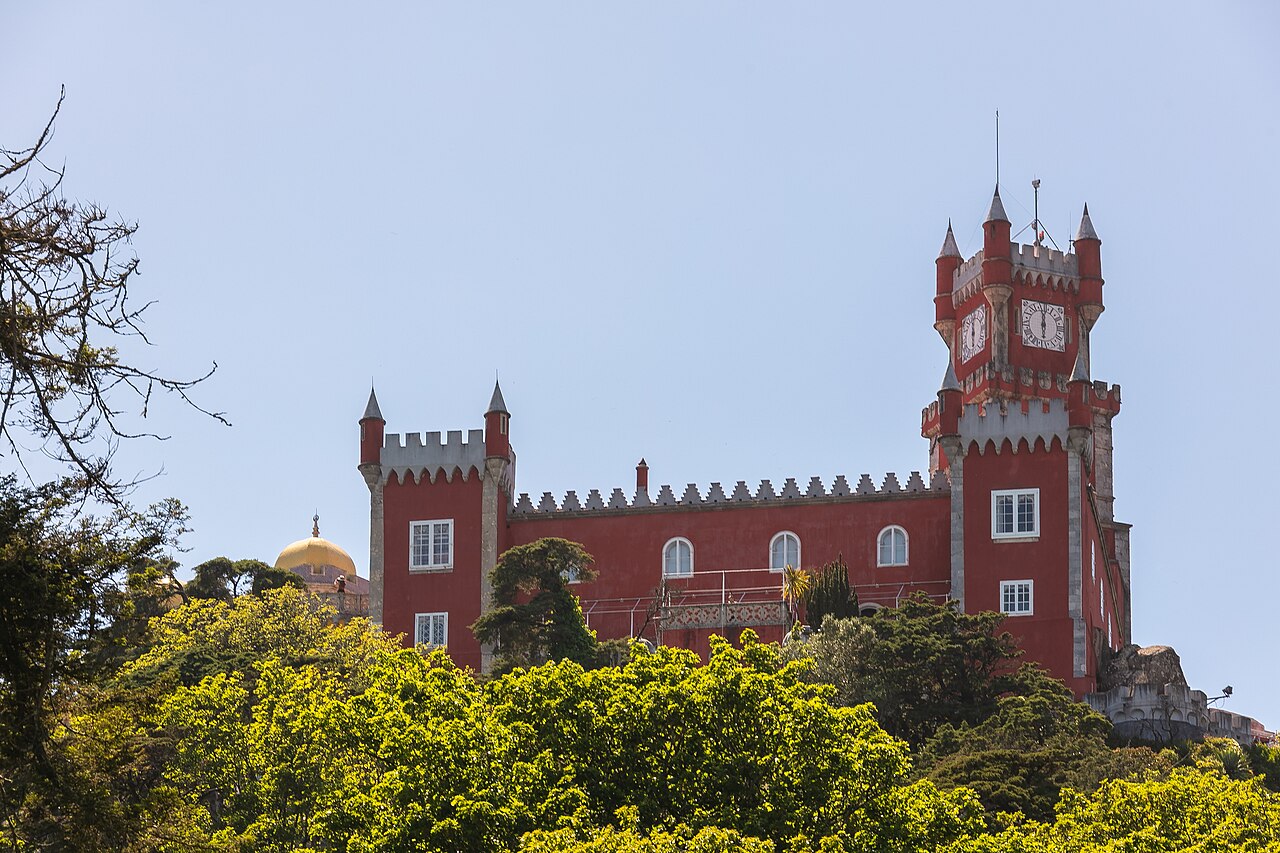
This mingling could easily have produced chaos, but at Pena it produces delight. The different elements are combined with such confidence and good humour that the whole reads as a coherent fantasy rather than a muddle. Each style contributes its own note, and together they create a building that feels like a compendium of everything romantic and picturesque in architecture, gathered on a single peak.
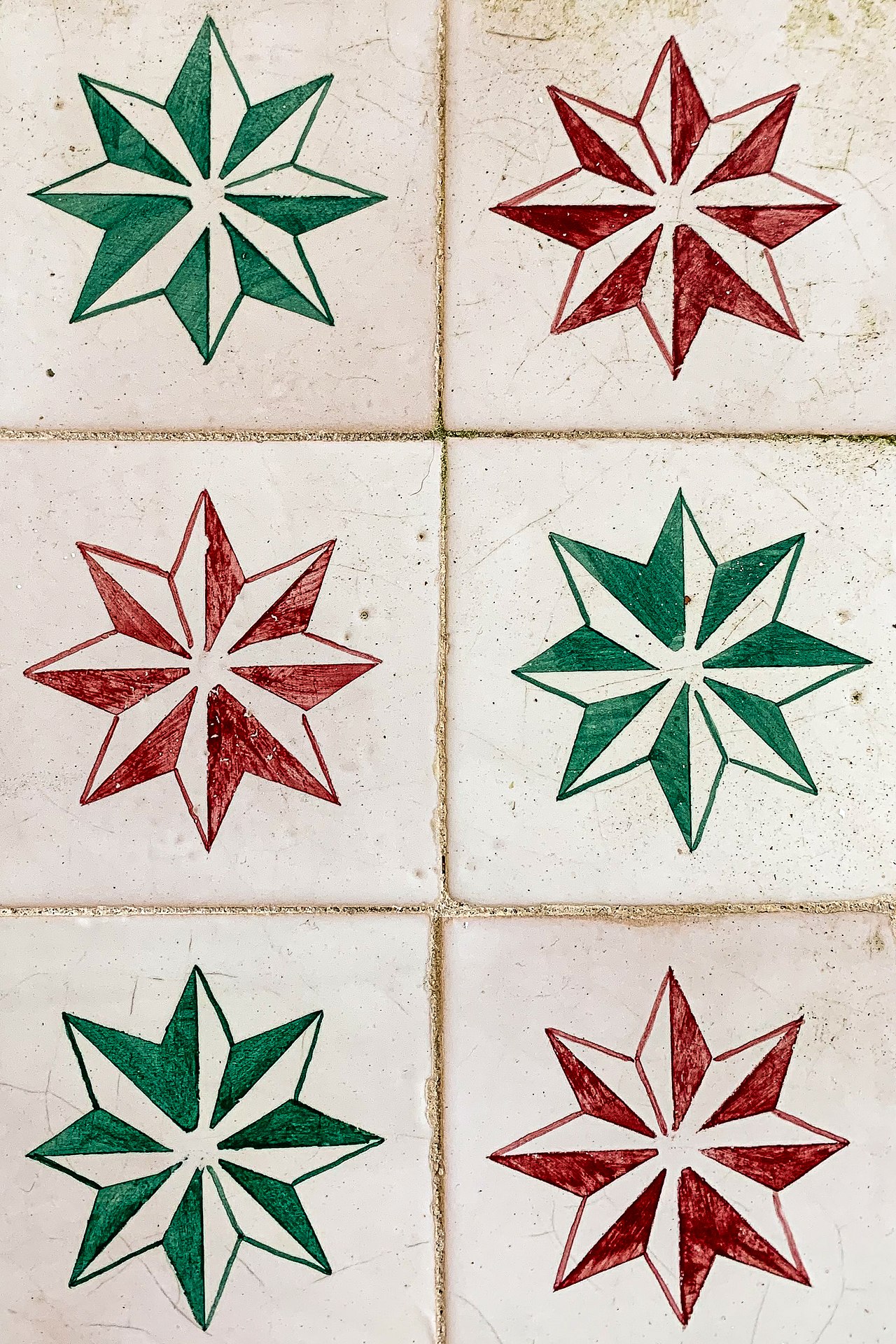
Particularly striking are the Moorish and Manueline references, which root the fantasy in Portugal’s own history. The horseshoe arches and tilework nod to the country’s Islamic past, while the elaborate carved ornament recalls the Manueline style of the great age of exploration. In this way Pena is not merely a generic romantic castle but a distinctly Portuguese one, dreaming of its own national past.
The overall effect is theatrical in the best sense. Pena was designed to be experienced as a sequence of dramatic pictures, from the sweeping silhouette seen across the hills to the intimate details revealed up close. It is architecture as storytelling, each tower and terrace and gateway a scene in a romantic narrative that unfolds as you move through and around the building.
It is worth saying that this eclecticism was not laziness or indecision but a considered aesthetic choice. The nineteenth century believed that the styles of the past were a shared treasury to be drawn upon freely, and Pena takes that belief to its most joyful extreme. Every borrowing is deliberate, chosen for its romantic associations, so that the building becomes a kind of anthology of everything its creator found beautiful in the architecture of the past.
Why Pena Wears Such Bold Colours
Perhaps the single most distinctive feature of Pena is its colour. The palace is famously painted in vivid tones, with sections in warm red and others in bright yellow, set off by grey stone ornament. In an age when so much architecture aimed at restrained dignity, this exuberant use of colour was daring, and it remains central to the palace’s fairy-tale character.
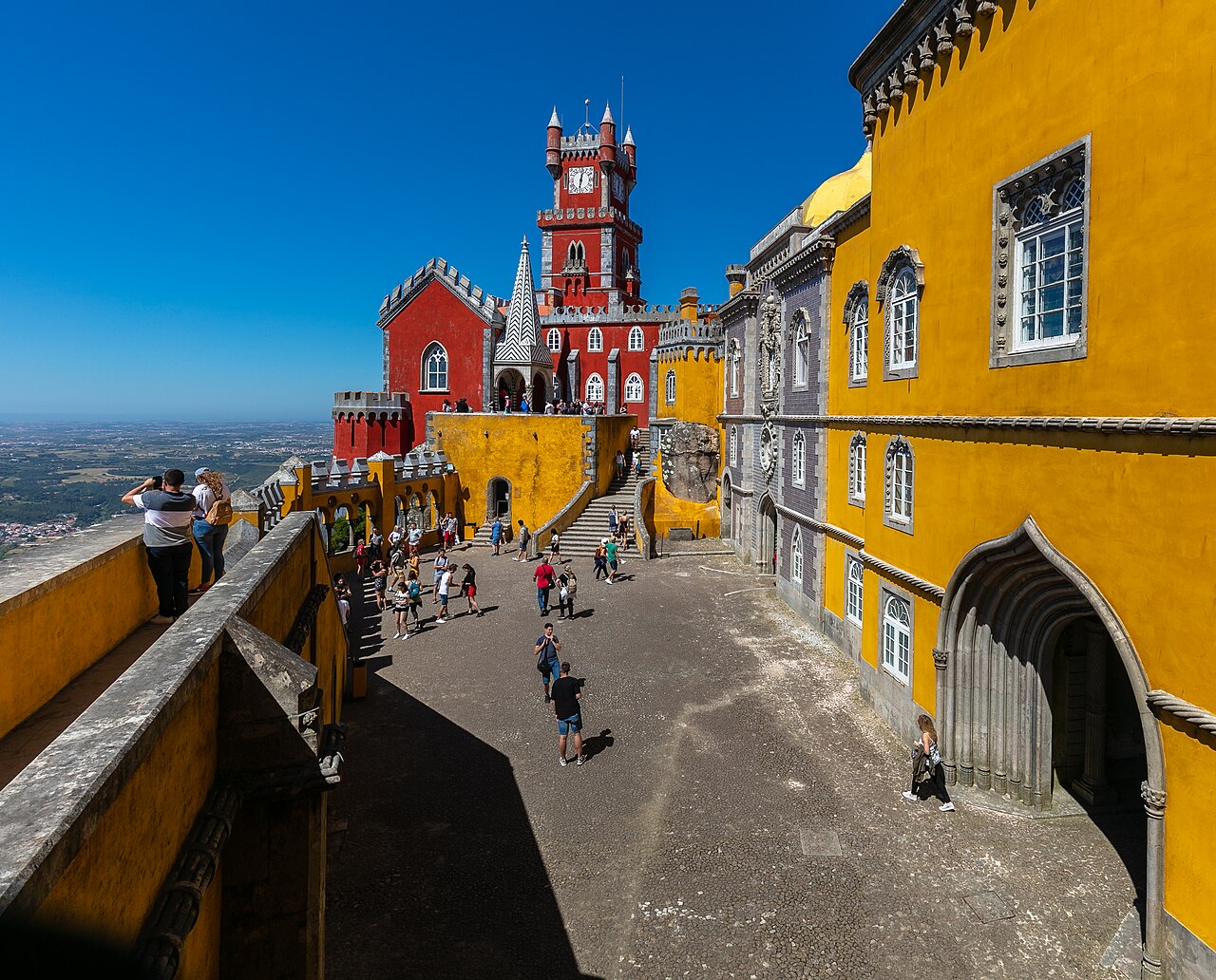
The colours were part of the original romantic conception, meant to make the building stand out against the greenery and mist of the Sintra hills and to heighten its picturesque, storybook quality. Different wings were given different colours to distinguish the parts of the palace and to enrich the overall composition, turning the whole structure into a play of hues as much as of forms.
Over the long life of the building the colours faded, and for a period Pena took on a more muted, weathered grey appearance that many visitors came to know. In time, however, restoration work returned the palace to its intended vivid palette, reviving the reds and yellows that Ferdinand had chosen. The bright Pena of today is thus both a modern restoration and a return to the founder’s original vision.
The effect of the colour is hard to overstate. It is what makes Pena instantly recognisable, what lifts it from the ranks of romantic castles into something uniquely joyful. Approaching the palace and seeing those bold walls emerge against the sky, you understand at once that this is a building meant not to intimidate but to enchant, to lift the spirits of everyone who sees it.
The restoration of the colours was itself a significant act of interpretation. For many people, the faded grey Pena had become the familiar one, and returning it to red and yellow was a decision to honour the founder’s intention over the accidents of time. The debate around such choices is part of what makes historic conservation fascinating, and at Pena the bold decision has been widely embraced as restoring the palace to its true self.
The Triton Gate and Its Strange Guardians
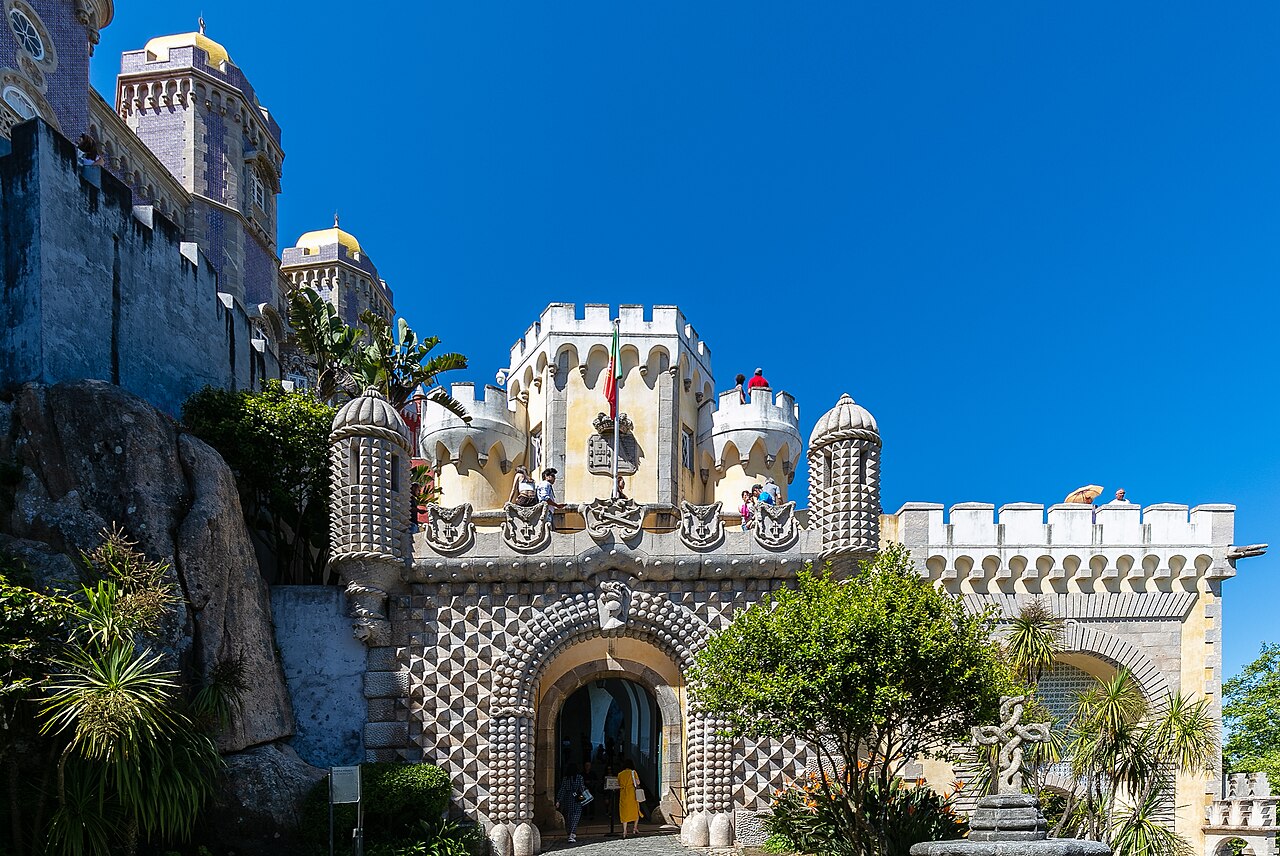
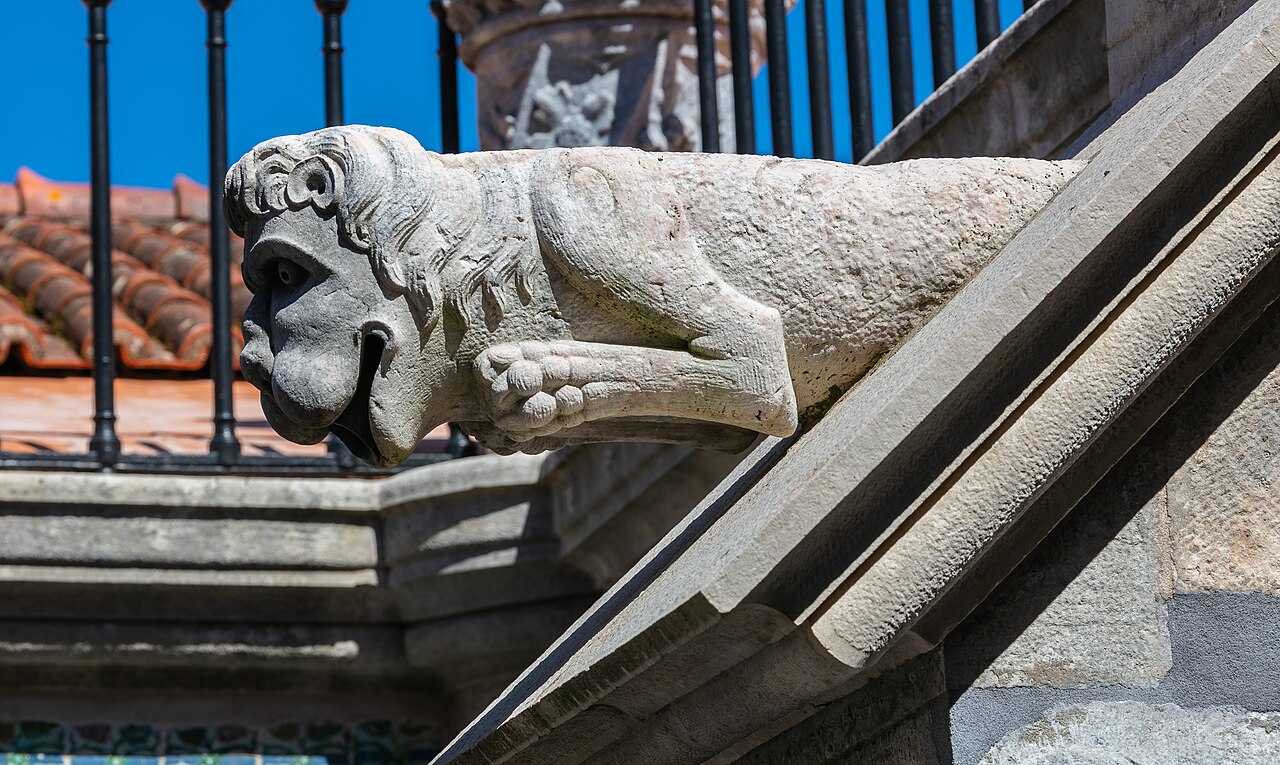
Among Pena’s many wonders, one detail draws every camera: the Triton gateway. Above one of the main entrances crouches a monstrous figure, half sea-god and half creature of nightmare, emerging from a great shell with a twisted, muscular body and a fierce expression. It is one of the most memorable pieces of sculpture in any Portuguese palace, and a perfect emblem of Pena’s romantic imagination.
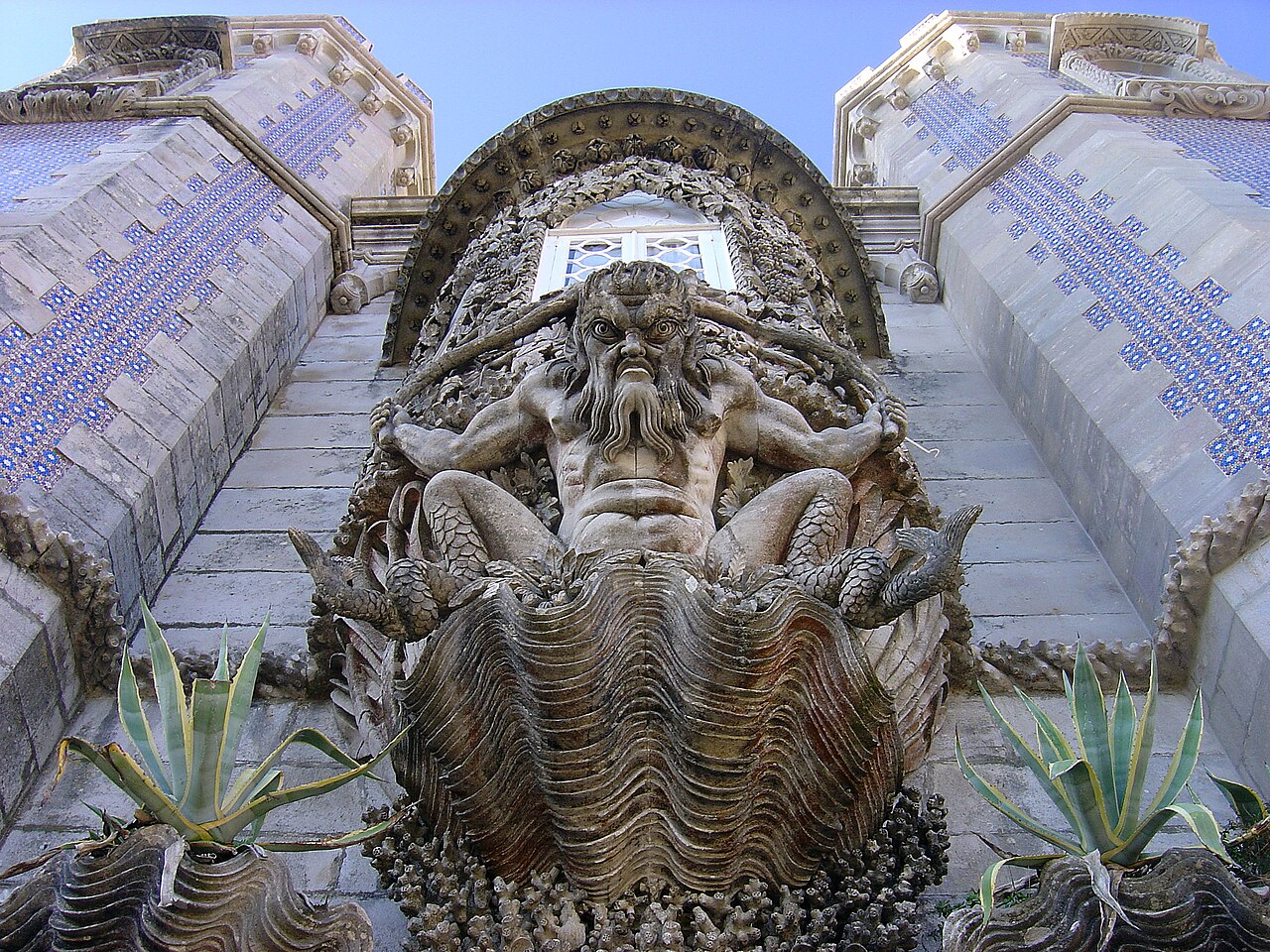
The Triton is rich in symbolism. Rising from a shell and framed by coral-like ornament, the figure is often read as an allegory of creation, a mythological guardian standing at the threshold between the outside world and the enchanted interior of the palace. Whatever its precise meaning, its effect is unforgettable, a moment of fantasy and menace worked into the very fabric of the building.
Details like the Triton are what make Pena reward slow exploration. All around the palace, carved ornament brings the walls to life with figures, foliage, and forms drawn from myth and nature. The romantic imagination that shaped the whole building is expressed just as vividly in these small touches as in the grand silhouette, and finding them is one of the pleasures of a visit.
These decorative flourishes also reflect the seriousness with which the romantic movement took ornament and symbol. Nothing at Pena is merely functional; everything is expressive, meant to stir the imagination and to weave the visitor into a story. The Triton, glowering above the gate, is the guardian of that story, welcoming you into a world where architecture and fantasy have become one.
Standing beneath the Triton and looking up, many visitors feel a small thrill of unease mingled with wonder, which is exactly the response the Romantics prized. They believed beauty and terror were closely linked, that the sublime could stir the soul in ways mere prettiness could not. The gate’s monstrous guardian is a compact lesson in that idea, proof that even a summer palace built for pleasure could reach for something deeper and stranger.
Inside the Royal Rooms
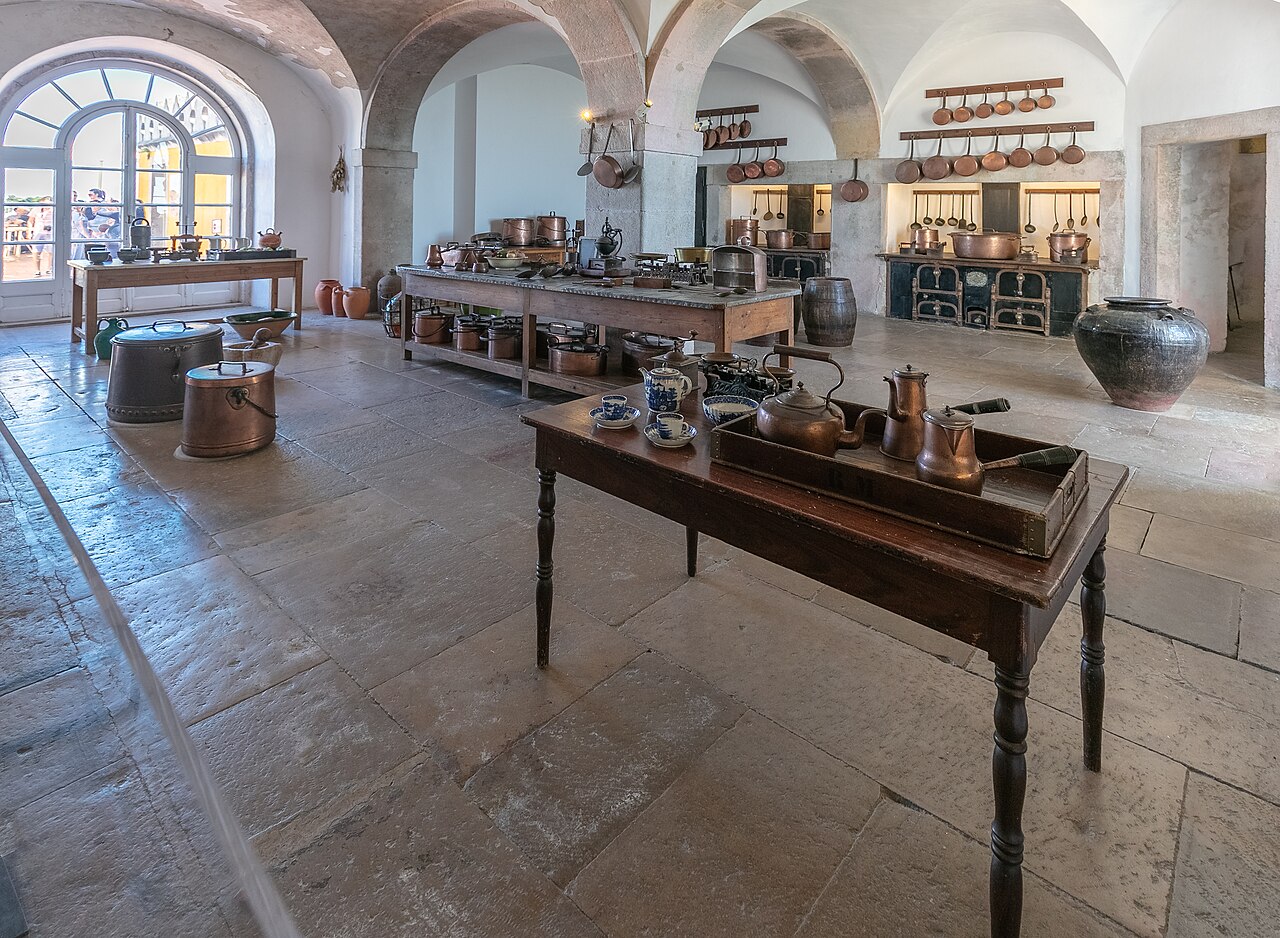
If the exterior of Pena is pure spectacle, the interior offers a more intimate surprise. Because the palace was a summer retreat rather than a seat of state, its rooms have a domestic, lived-in quality quite different from the grand ceremonial halls of other royal residences. Here you find the private world of a royal family at leisure, decorated with warmth and personality.
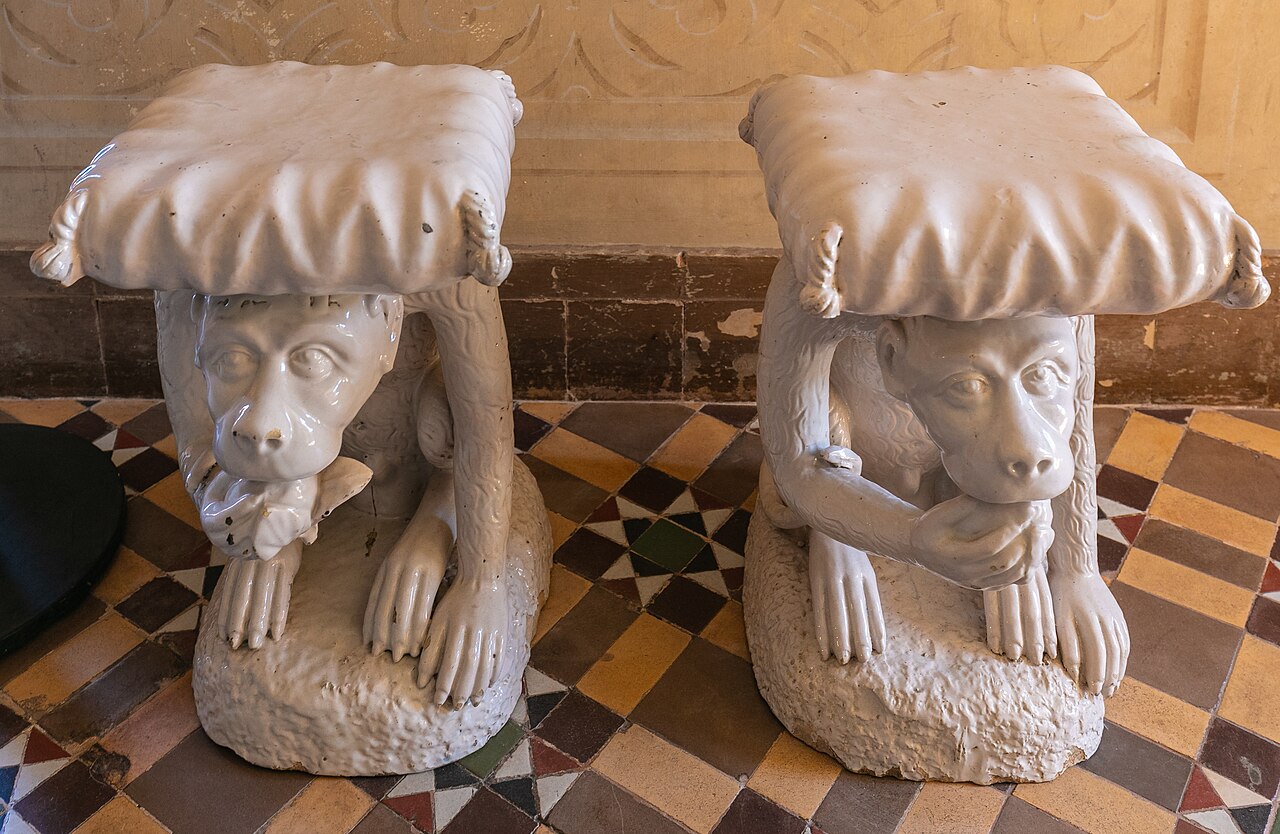
The rooms are filled with the furniture, art, and objects that the royal family gathered around them, reflecting the eclectic and cultured taste of Ferdinand and his successors. There are richly decorated chambers and more comfortable private spaces, ornamental plasterwork and painted decoration, and throughout a sense that these were rooms meant to be enjoyed rather than merely admired from a rope line.
Because the palace was preserved largely as it was left when royalty departed, the interiors give a vivid picture of how it was actually used. You can move through the sequence of rooms and imagine the family at rest, escaping the heat and formality of Lisbon for the cool, misty heights of Sintra. That sense of a real home, rather than a museum set piece, gives the interior its particular appeal.
The contrast between inside and out is part of Pena’s magic. The wildly theatrical exterior promises fantasy, and the interior delivers something gentler and more human: the private refuge of people who loved this strange and beautiful place. Together the two sides of the palace tell a fuller story than either could alone, of grandeur and intimacy joined on a single peak.
The eclecticism of the exterior carries indoors as well, in the mixture of styles and objects that fill the rooms. Ferdinand and his family collected widely, and the interiors reflect a magpie delight in beautiful things from many places and periods. This gives the rooms a personal, slightly restless character, as if each space were a cabinet of the family’s enthusiasms rather than a showcase of a single decorative programme.
The Chapel and the Monastery Within
At the heart of Pena, embedded within all the romantic additions, survives the old monastery, and with it the chapel that gave the site its original purpose. To step from the colourful new palace into these older spaces is to travel back in time, from the nineteenth-century fantasy to the quiet devotion of the sixteenth-century religious house that came before.
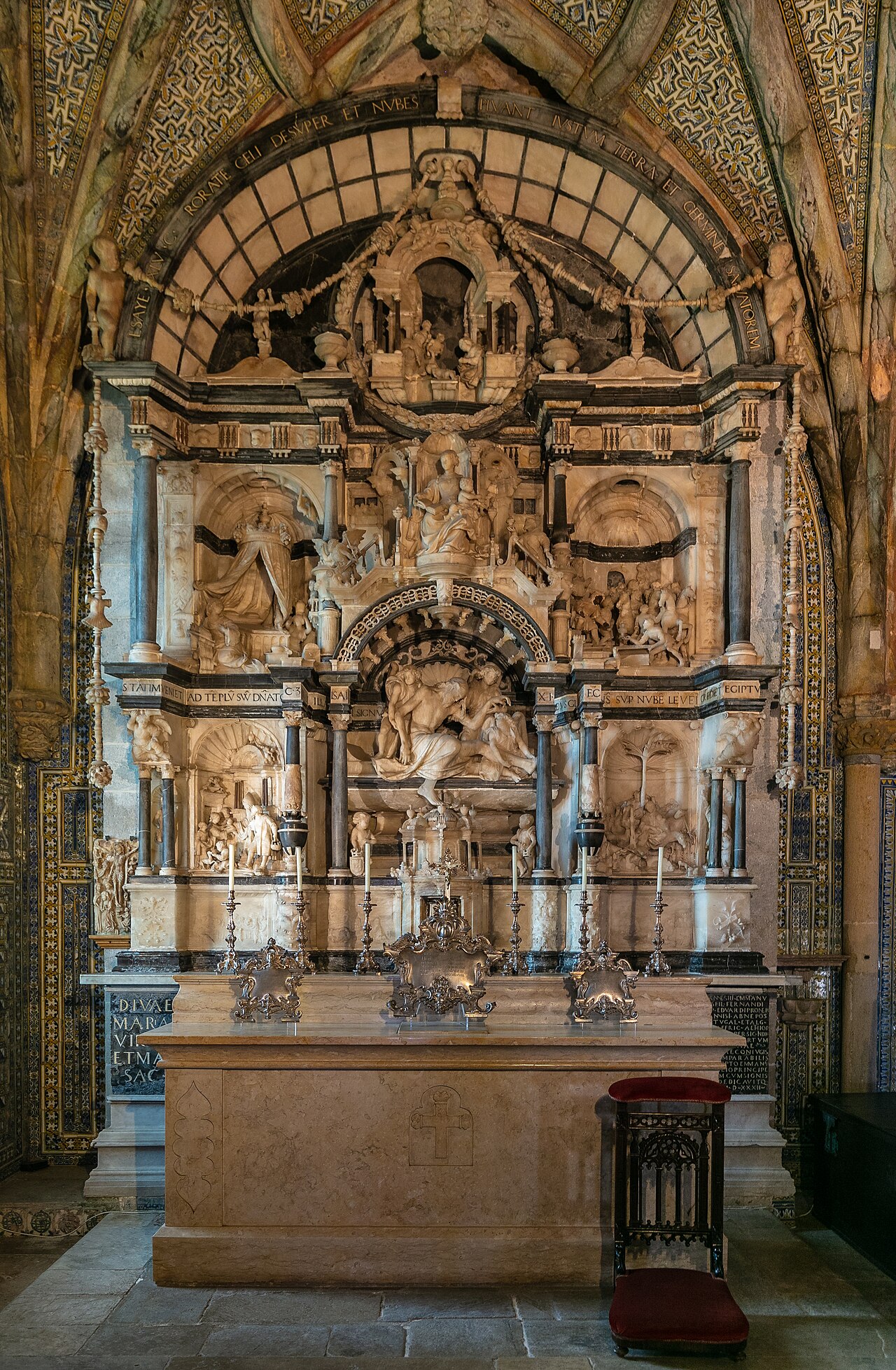
The chapel preserves treasures from the monastery’s long history, including a notable altarpiece of great artistic value, a survivor of the site’s sacred past. Ferdinand, for all his romantic imagination, took care to respect and preserve this historic core rather than sweeping it away, and its inclusion gives Pena a depth of history beneath its playful surface.
The old cloister, too, remains within the palace, its calm arcades a striking contrast to the exuberance all around. These monastic spaces are among the most atmospheric at Pena, offering a moment of stillness and reflection amid the crowds and the colour. They remind you that this joyful palace grew from a place of solitude and prayer.
This layering of eras is one of Pena’s deepest pleasures. The palace is not a single moment frozen in time but a conversation between centuries, the romantic king reaching back to the medieval monastery and weaving its memory into his dream. In the chapel and cloister, the ghost of the old monastery lives on at the centre of Ferdinand’s creation.
This respect for the old fabric also tells us something about Ferdinand as a builder. For all his willingness to invent and embellish, he understood the value of what he had inherited, and he wove the monastery’s history into his new creation rather than erasing it. The result is a palace with genuine historical depth, one whose romantic surface rests on foundations of real age and meaning.
The Enchanted Park Around the Palace
Pena is not just a palace but a landscape, for Ferdinand conceived the building and its surroundings as a single work of art. Around the palace he created a vast park, planting it with an extraordinary variety of trees and plants gathered from around the world and laying out winding paths, hidden corners, lakes, and follies across the rugged terrain of the hill.
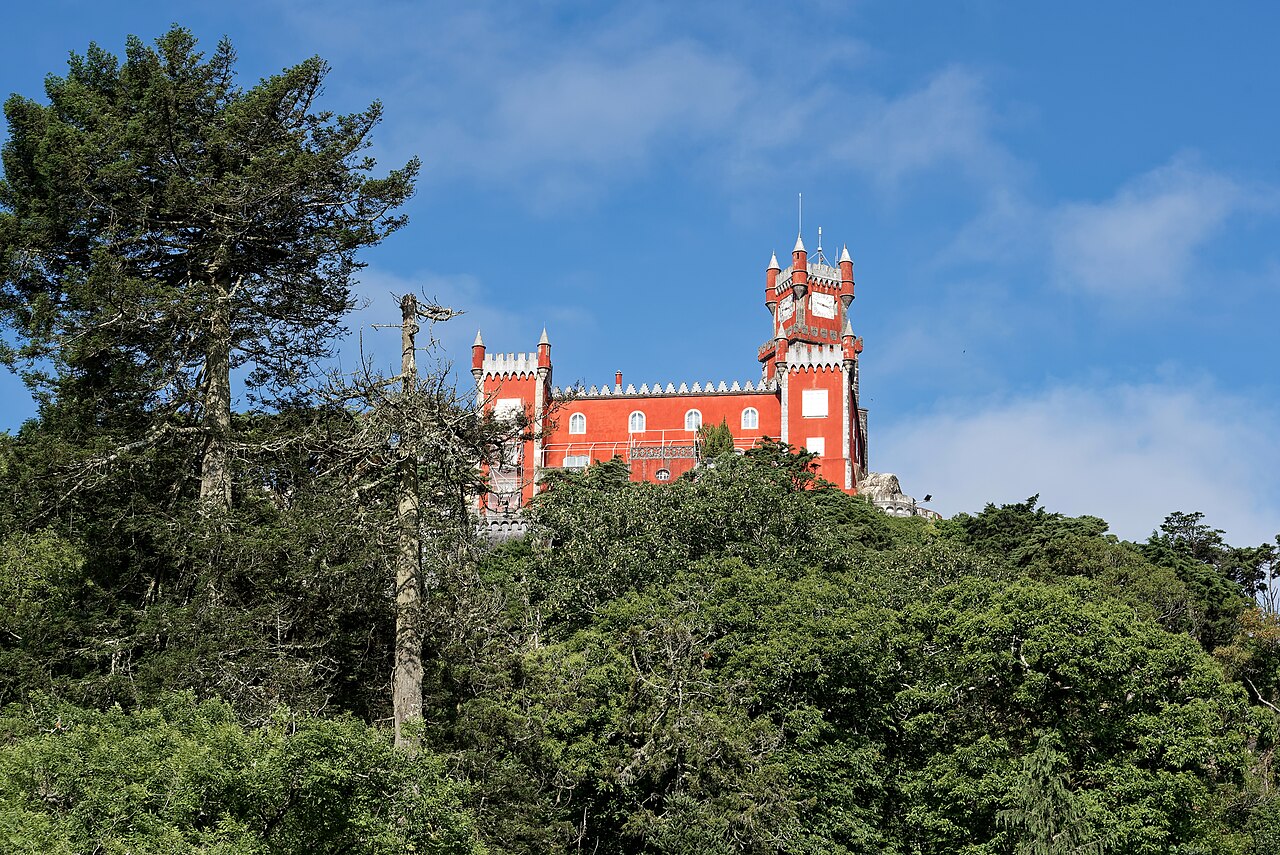
The Park of Pena is a masterpiece of romantic landscape design. Rather than imposing geometric order, Ferdinand embraced the wildness of the site, creating a lush, seemingly natural forest threaded with trails that lead to unexpected views and surprises. Exotic species from many continents thrive in the mild, misty climate, turning the park into a living collection as rich as anything inside the palace.
Wandering the park, you come upon all manner of romantic incidents: ornamental lakes with waterfowl, a chalet built as a private retreat, statues and fountains, and viewpoints that open suddenly onto sweeping panoramas of the surrounding country. The highest point offers views that on a clear day stretch all the way to the sea, a reward for the climb through the enchanted woods.
The park is essential to understanding Pena. It is the setting that completes the fantasy, framing the colourful palace in green and giving visitors space to lose themselves in the romantic mood Ferdinand wished to create. To visit the palace without walking at least a little of the park is to miss half of what makes Pena so magical.
Ferdinand’s approach to the park anticipated ideas about landscape that feel strikingly modern. He treated the whole hillside as an environment to be composed, mixing native and exotic plants, shaping views, and letting nature and design blur into one another. The park is thus not merely a setting for the palace but a work in its own right, one of the great romantic gardens of Europe, and a place that rewards unhurried exploration as much as the building itself.
Pena as a Monument of Romanticism
Pena is often described as one of the finest expressions of Romanticism in the world, and the description is well earned. The Romantic movement, which swept European art and thought in the nineteenth century, prized emotion over reason, nature over artifice, and the imagined past over the classical present. Pena embodies all of these values in built form.
In its embrace of the ruined monastery, Pena reflects the Romantic fascination with the past and with the picturesque beauty of decay. In its wild park and its dramatic hilltop setting, it reflects the Romantic love of nature and the sublime. And in its free mingling of historical styles, it reflects the Romantic imagination’s freedom to dream beyond the rules of any single tradition.
Ferdinand himself was a thoroughly Romantic figure, an artist-king who valued beauty and feeling and who poured his sensibility into this personal project. Pena is in many ways a self-portrait of that sensibility, a place where one man’s romantic imagination was given the resources to build itself into reality on a spectacular scale.
This is why Pena matters beyond its beauty. It is a key document of a whole way of seeing the world, a monument to the Romantic idea that architecture could be a form of poetry. Recognised as part of a wider cultural landscape of outstanding value, it stands among the most important romantic buildings anywhere, a peak in more senses than one.
Pena’s influence rippled outward in its own time and after. It helped inspire a wave of romantic and revivalist building, and it turned Sintra into a magnet for artists, writers, and travellers drawn by its atmosphere. The palace became a symbol of a whole cultural moment, and its fame has only grown, so that today it stands as one of the images the wider world most readily associates with Portugal itself.
From Royal Retreat to National Treasure
Pena served as a summer residence and beloved retreat for the Portuguese royal family through the second half of the nineteenth century, a place associated with leisure, culture, and the private life of the monarchy. Its remote beauty made it a refuge from the pressures of the capital, and successive royals cherished it as a personal haven.
When the monarchy fell in 1910, Pena, like the other royal palaces, passed into the hands of the new republic. Rather than let so remarkable a building fall into neglect, the state recognised its extraordinary value and moved to preserve it, classifying it as a national monument and opening it to the public as a museum. The romantic king’s private dream became a shared inheritance.
In the decades since, Pena has been cared for, studied, and restored, most visibly in the campaign that returned its walls to their original vivid colours. Together with the surrounding park, it forms part of a wider cultural landscape around Sintra that has been recognised for its outstanding universal value, drawing protection and international attention.
Today Pena is one of the most visited monuments in Portugal, welcoming enormous numbers of visitors from around the world. Its journey from ruined monastery to royal fantasy to national treasure is complete, and the palace that Ferdinand built to please his own romantic soul now delights millions. Few buildings have so thoroughly fulfilled, and then outgrown, the dream of their creator.
Making the Most of Your Visit
Pena sits high above the town of Sintra, itself an easy day trip from Lisbon, and reaching the palace is part of the adventure. Because it stands on a steep peak, visitors usually travel up through the park by shuttle or on foot, and comfortable shoes and a readiness for hills and steps are essential. The climb is rewarded at every stage by the unfolding views and the growing sense of anticipation.
View Pena Palace on Google Maps
A full visit takes in both the palace interior and the surrounding park, and it is worth allowing several hours to do justice to both. The palace can be extremely busy, especially in peak season, so arriving early in the day helps you enjoy the interiors and the famous terraces before the largest crowds arrive. The park, being vast, always offers quieter corners even on the busiest days.
Because Pena is such a popular destination, it is wise to plan ahead, checking current opening hours and ticket arrangements and considering booking in advance during busy periods. Sintra as a whole holds many other wonders nearby, so many visitors combine Pena with other sites, though the palace and its park can easily fill a memorable day on their own.
You can find the palace and plan your route using the map link below. However you arrive, be ready for the weather to change quickly on the peak, where mist and sun trade places in minutes. That very changeability is part of Pena’s romance, wrapping the colourful towers in cloud one moment and revealing them against blue sky the next, and it ensures that no two visits are ever quite the same.
It also helps to come with the right frame of mind. Pena rewards curiosity and a willingness to wander, to peer at the carved details, to follow a side path in the park, to wait for the mist to lift from a viewpoint. Visitors who rush through in search of the single perfect photograph often miss the palace’s real gift, which is the slowly unfolding sense of having stepped inside someone else’s beautiful dream.
See Pena for Yourself
Pena is a feast for the eyes, and no description can quite capture the impact of seeing its colours and silhouette in motion. The short film below takes you up to the palace and around its towers and terraces, giving a sense of the setting, the wild mix of styles, and the dramatic views that make a visit so memorable.
As you watch, keep in mind the story behind the spectacle: a ruined monastery, an artist-king, and a romantic vision that turned a lonely peak into one of the most enchanting palaces in the world. Pena is proof that architecture can be pure joy, and that a single imagination, given room to dream, can leave a gift that lasts for generations.
Palaces Nearby
If Pena has captured your imagination, two other Portuguese palaces within reach make wonderful companions, each offering a very different vision of royal life.
- Mafra, the Palace a King Built From a Vow — a colossal Baroque palace, basilica, and convent north-west of Lisbon.
- Ajuda, Lisbon’s Unfinished Royal Palace — the neoclassical last home of the Portuguese monarchy, now a rich museum.
You May Like
The Bardo, a Palace of the Beys Filled With Roman Mosaics