On the banks of a river in the valley of Thimphu, the capital of Bhutan, rises a great white fortress crowned with golden roofs. Tashichho Dzong is at once a fortress, a monastery, and a seat of government, its massive whitewashed walls enclosing courtyards, temples, and the throne room of a king. It is one of the most beautiful buildings in the Himalayas, and the living heart of the last of the world’s Buddhist kingdoms.
Bhutan is a country unlike any other, a small Vajrayana Buddhist realm in the high mountains that has famously chosen to measure its success not only in wealth but in the happiness of its people. Tashichho Dzong is the centre of that realm’s life: here the king has his throne room, here the government has its offices, and here the country’s chief abbot and central monastic body have their summer seat, so that the sacred and the secular share a single set of walls.
The dzong belongs to a distinctive Bhutanese architectural tradition, its inward-sloping walls, its central tower, and its intricate woodwork built, by custom, without nails or architectural plans, following methods passed down through generations. To stand before it is to encounter a living monument, still performing the functions for which it was built, at the heart of a kingdom that has guarded its traditions with rare devotion. In the sections that follow you will get to know the dzong, the kingdom it serves, and the extraordinary way of life it embodies.

In This Article
- A White Fortress by the River
- What a Dzong Is
- The Last Buddhist Kingdom
- Centuries of Building and Rebuilding
- Walls Without Nails
- The Seat of the King and the Government
- The Seat of the Monastic Body
- Courtyards, Temples, and Painted Walls
- The Great Festival of the Dzong
- Coronations and the Ceremonies of the Crown
- A Living Seat in a Modern Kingdom
- The Dzong on Film
- Visiting Tashichho Dzong
A White Fortress by the River
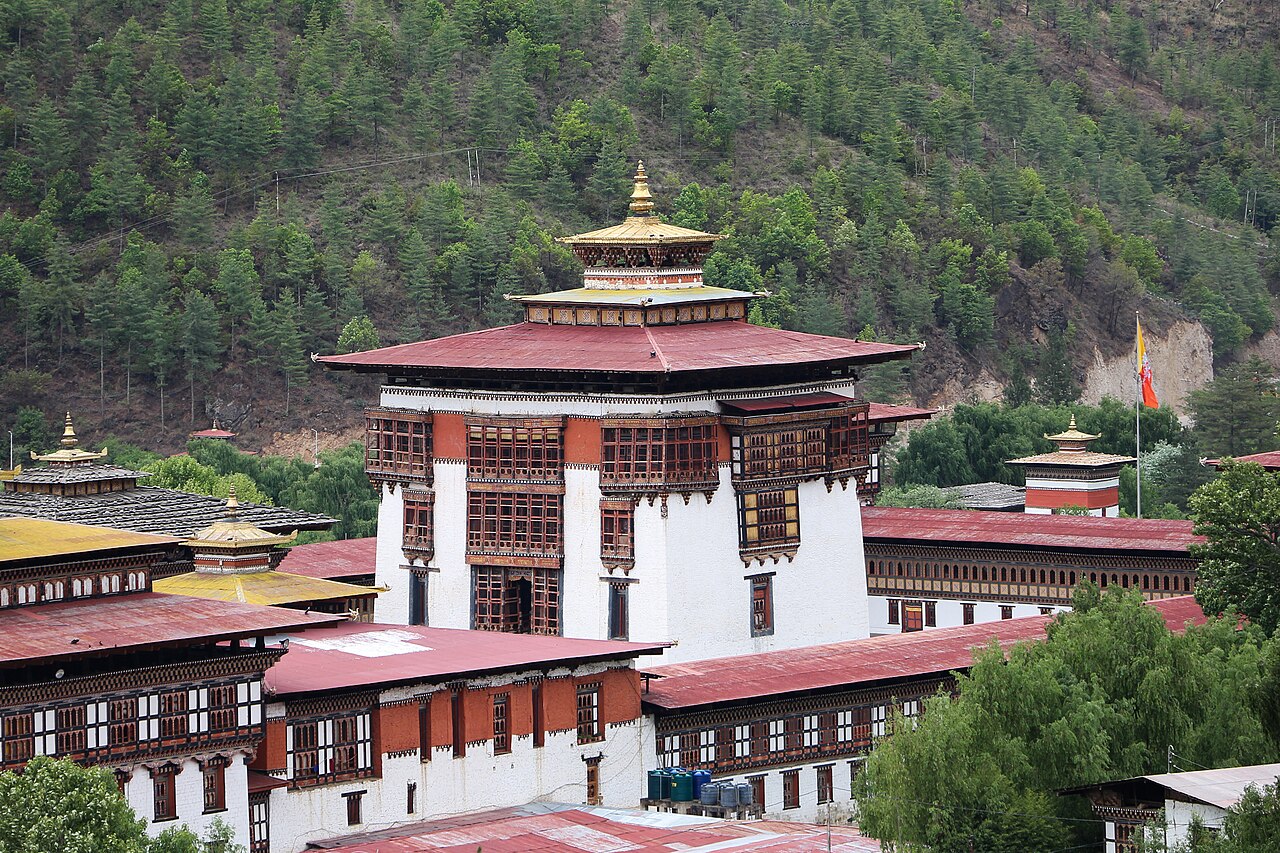
Tashichho Dzong stands in the Thimphu valley, on the bank of the river that runs through the Bhutanese capital, its great white walls and golden-roofed towers rising against a backdrop of forested hills. Approaching it, especially when it is floodlit in the evening or catching the clear mountain light by day, is one of the memorable experiences of a visit to Bhutan, for the dzong is as beautiful as it is imposing.
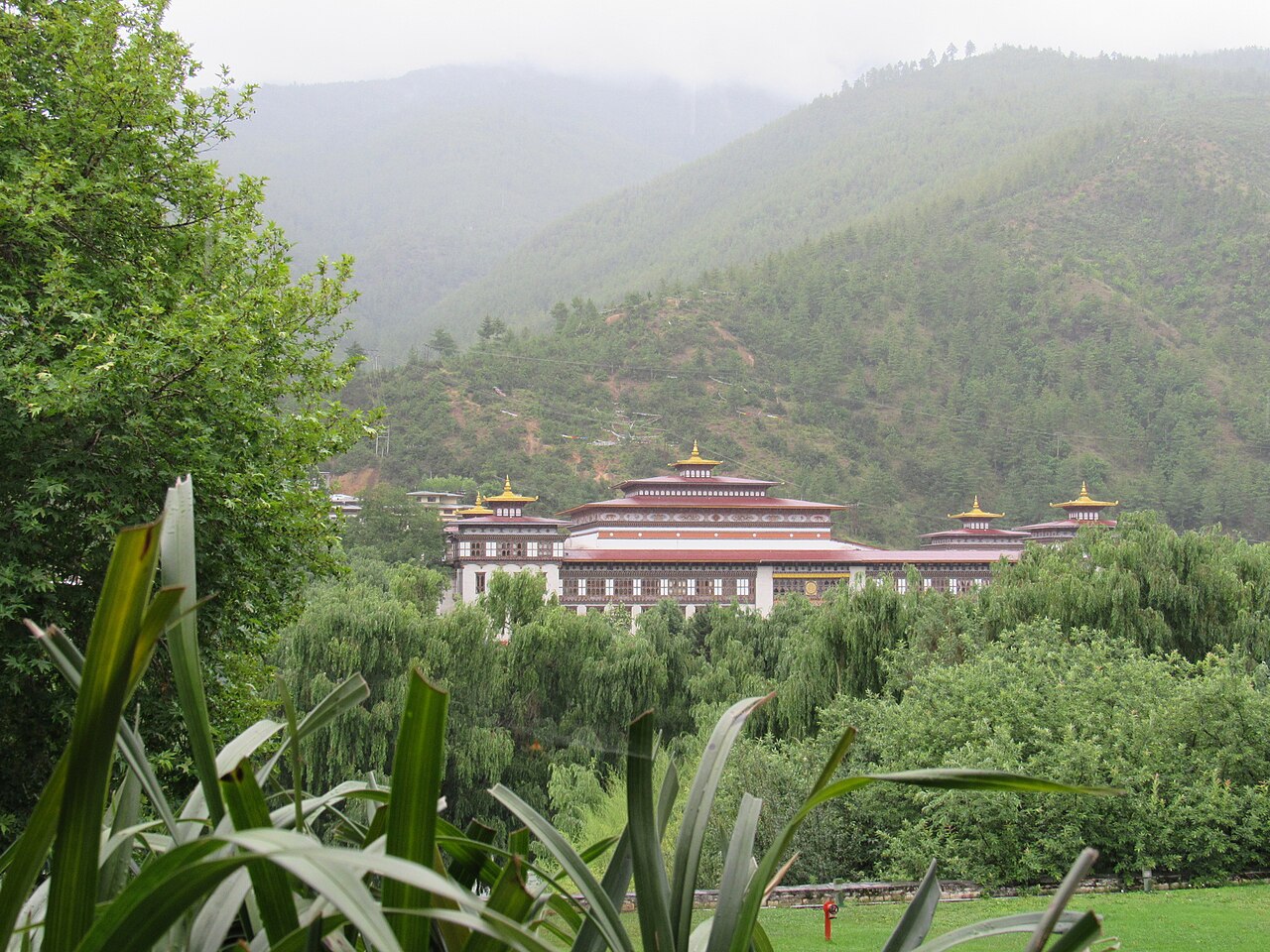
The building is large and commanding, a fortress in form, with high, thick, inward-sloping walls that convey both strength and grace. Above them rise the golden roofs of its temples and its central tower, gleaming in the sun, while the whitewashed walls below give the whole structure a luminous purity that is characteristic of Bhutanese dzong architecture.
Set amid gardens and lawns by the river, with the mountains rising behind, the dzong occupies one of the finest positions in the valley. It is the dominant monument of Thimphu, a city that is itself unusual among capitals for its small scale and its preservation of traditional architecture, and the dzong stands at its heart as the symbol and centre of the nation.
To arrive at Tashichho Dzong is thus to arrive at the very heart of Bhutan. This is not a museum or a ruin but a working seat of king, government, and religion, alive with the activity of the state and the monastic community. Its beauty is matched by its significance, and it offers the visitor a direct encounter with the living institutions of one of the world’s most distinctive nations.
Many travellers count their first sight of it, glowing white against the green hills, among the images they carry home from Bhutan.
What a Dzong Is
To understand Tashichho Dzong, one must understand the dzong itself, a form of building distinctive to Bhutan and the wider Himalayan Buddhist world. A dzong is a fortress, but far more than that: it is traditionally a combined stronghold, monastery, and centre of administration, serving the military, religious, and governmental functions of a region within a single massive complex.
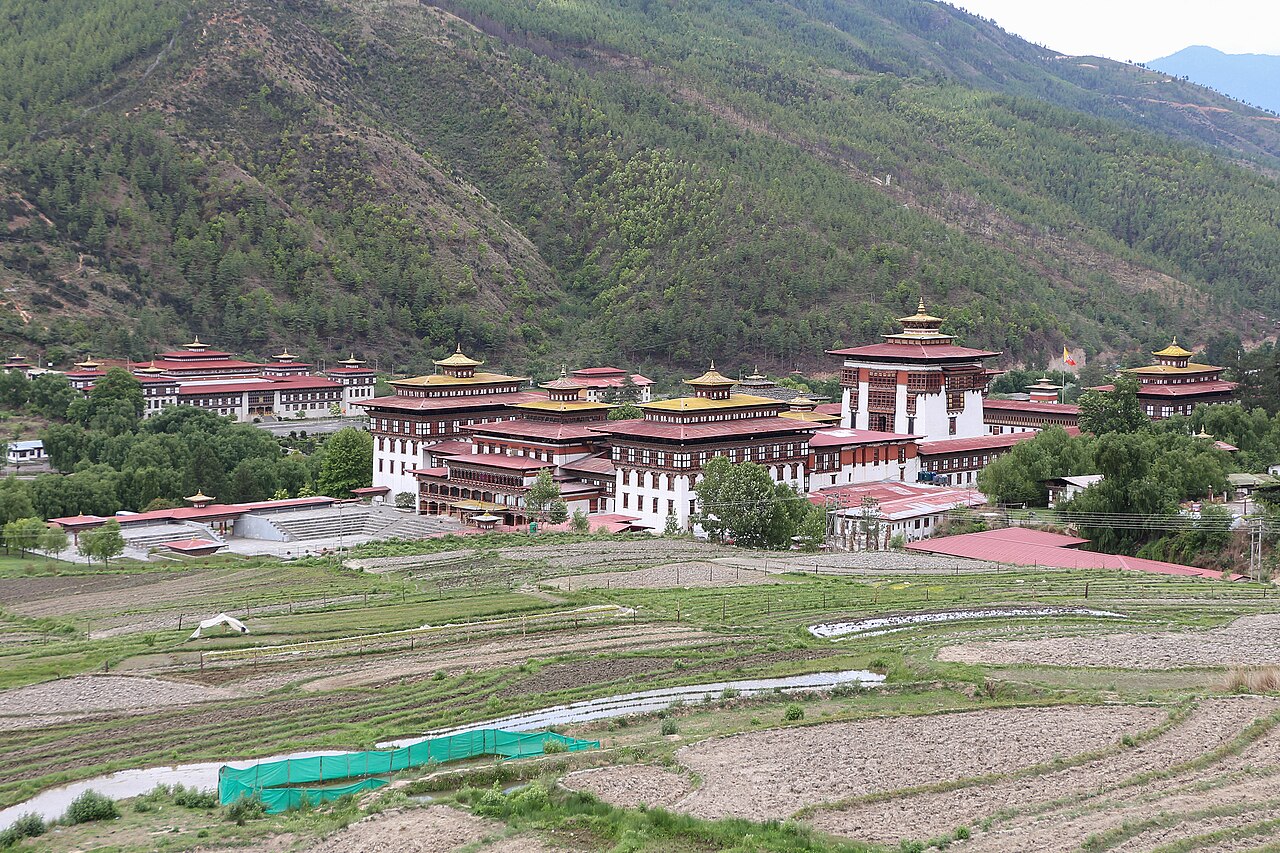
Dzongs were built across Bhutan as centres of power and faith, commanding valleys and routes, defending the country, and housing both monks and officials. Their characteristic form, with towering whitewashed walls sloping inward as they rise, central towers, and interior courtyards, made them both formidable fortresses and dignified seats of religious and civil authority.
The dual role of the dzong, sheltering both the monastic community and the administration, reflects a deep feature of Bhutanese life, in which the religious and the secular are closely intertwined. Within a dzong, monks and officials share the same walls, and the rhythms of worship and government proceed side by side, an arrangement that continues to this day in the great dzongs of the kingdom.
Tashichho Dzong is the grandest and most important of these buildings, the dzong of the capital, and it embodies the tradition in its fullest form. As the seat of the king, the government, and the central monastic body, it unites in one complex all the functions that the dzong was created to serve, a living example of a building type found nowhere else in quite this form.
The genius of the dzong lies in this union of functions. A single building could hold off an enemy, house a community of monks, and govern a province, so that in times past the dzong was the whole apparatus of authority gathered behind one set of walls. That completeness is why the dzongs became, and remain, the defining monuments of Bhutan.
The Last Buddhist Kingdom
Tashichho Dzong is the seat of the kingdom of Bhutan, a small nation in the eastern Himalayas that has become famous for its distinctive character and its careful preservation of its traditions. Bhutan is often described as the last independent Vajrayana Buddhist kingdom in the world, a realm where a particular form of Buddhism shapes the culture, the calendar, and the identity of the nation.
The country is ruled by the Wangchuck dynasty, a line of kings, known as the Druk Gyalpo or Dragon Kings, established in the early twentieth century, under whom Bhutan has been unified and guided into the modern world while preserving its heritage. The kings have overseen the country’s careful and gradual modernisation, including, in time, the introduction of democratic institutions alongside the monarchy.
Bhutan is perhaps best known internationally for its philosophy of measuring the nation’s progress not merely by economic output but by the wellbeing of its people, an idea often summed up as Gross National Happiness. This approach, emphasising the balance of material development with cultural, spiritual, and environmental values, has made Bhutan a byword for a different way of thinking about national success.
At the centre of this kingdom stands Tashichho Dzong, the seat from which the king reigns and the government works, and where the religious life of the nation is anchored. To understand the dzong is to understand Bhutan itself, a country that has chosen to guard its Buddhist heritage and its natural environment with rare devotion, and whose distinctive way of life is embodied in the great white fortress of its capital.
The image of the dragon, which gives the kings their title and appears on the national flag, runs deep in Bhutanese identity, for the country calls itself the land of the thunder dragon. The dzong, as the seat of the Dragon King, stands at the centre of that self-understanding, the earthly seat of a realm that imagines itself under the protection of the dragon of the storms.
That protection, Bhutanese would say, is not merely a legend but a way of living lightly upon the land.
Centuries of Building and Rebuilding
The history of Tashichho Dzong stretches back many centuries, to a dzong first established on or near the site in the medieval period by a religious figure of the age. Like many Himalayan buildings, it has been rebuilt and remade several times over the centuries, following the fires, earthquakes, and changes of fortune that have repeatedly damaged or transformed it.
The dzong passed through the hands of the religious and political powers that shaped Bhutan, serving as an important centre of authority through the country’s history. Its role grew as the institutions of the Bhutanese state developed, and it became bound up with the governance of the region and with the religious life centred on its temples and monastic quarters.
The dzong as it stands today owes much to a major rebuilding and expansion carried out in the twentieth century, under one of the kings of the Wangchuck dynasty, when Thimphu became the established capital of the country. This great work enlarged and renewed the dzong to serve as the seat of the modern Bhutanese state, providing space for the throne room, the government, and the monastic body.
Remarkably, this modern rebuilding was carried out in the traditional manner, following the age-old methods and forms of Bhutanese dzong architecture rather than adopting modern construction. In this way the dzong was renewed for its modern role while remaining true to the traditions that had shaped it, so that the building visitors see today is both a contemporary seat of government and a faithful continuation of a centuries-old architectural heritage.
The willingness to rebuild, again and again, after fire and earthquake is itself part of the dzong’s story, and part of Bhutan’s. Rather than let disaster erase the building, each generation raised it once more in the old form, so that the dzong is at once very old and continually renewed, an unbroken idea housed in ever-renewed walls.
Continuity, not permanence of stone, is the Bhutanese way with such buildings.
Walls Without Nails
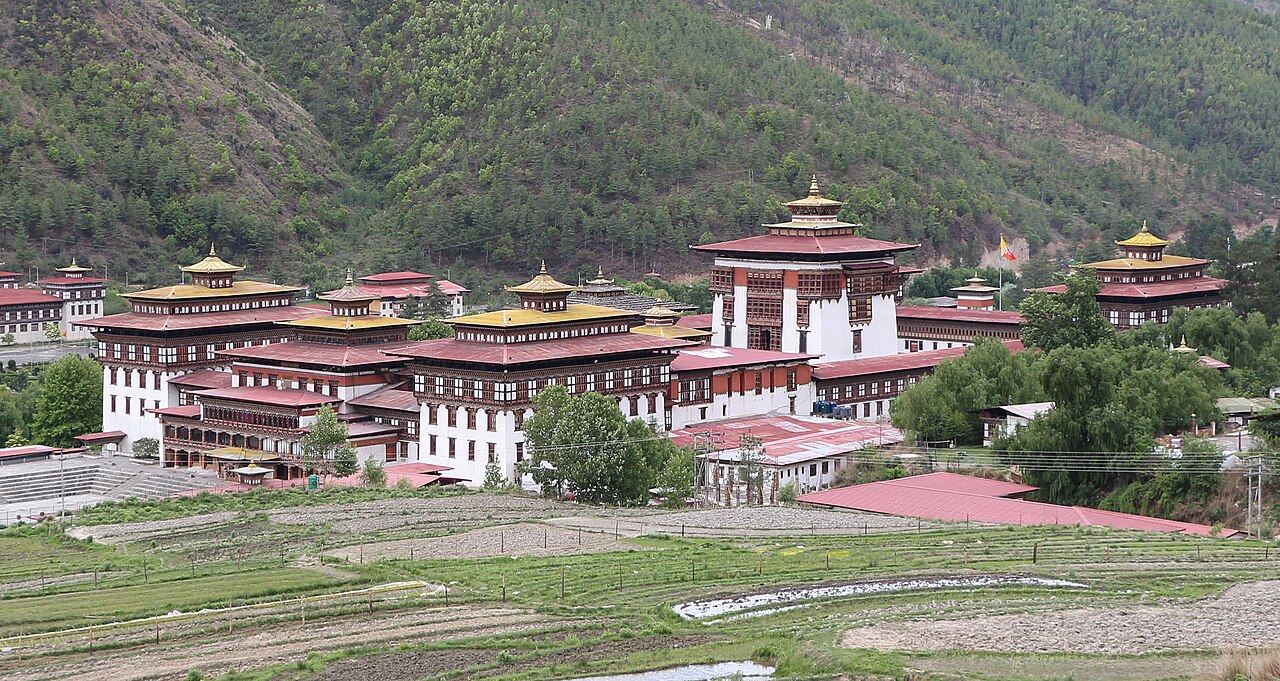
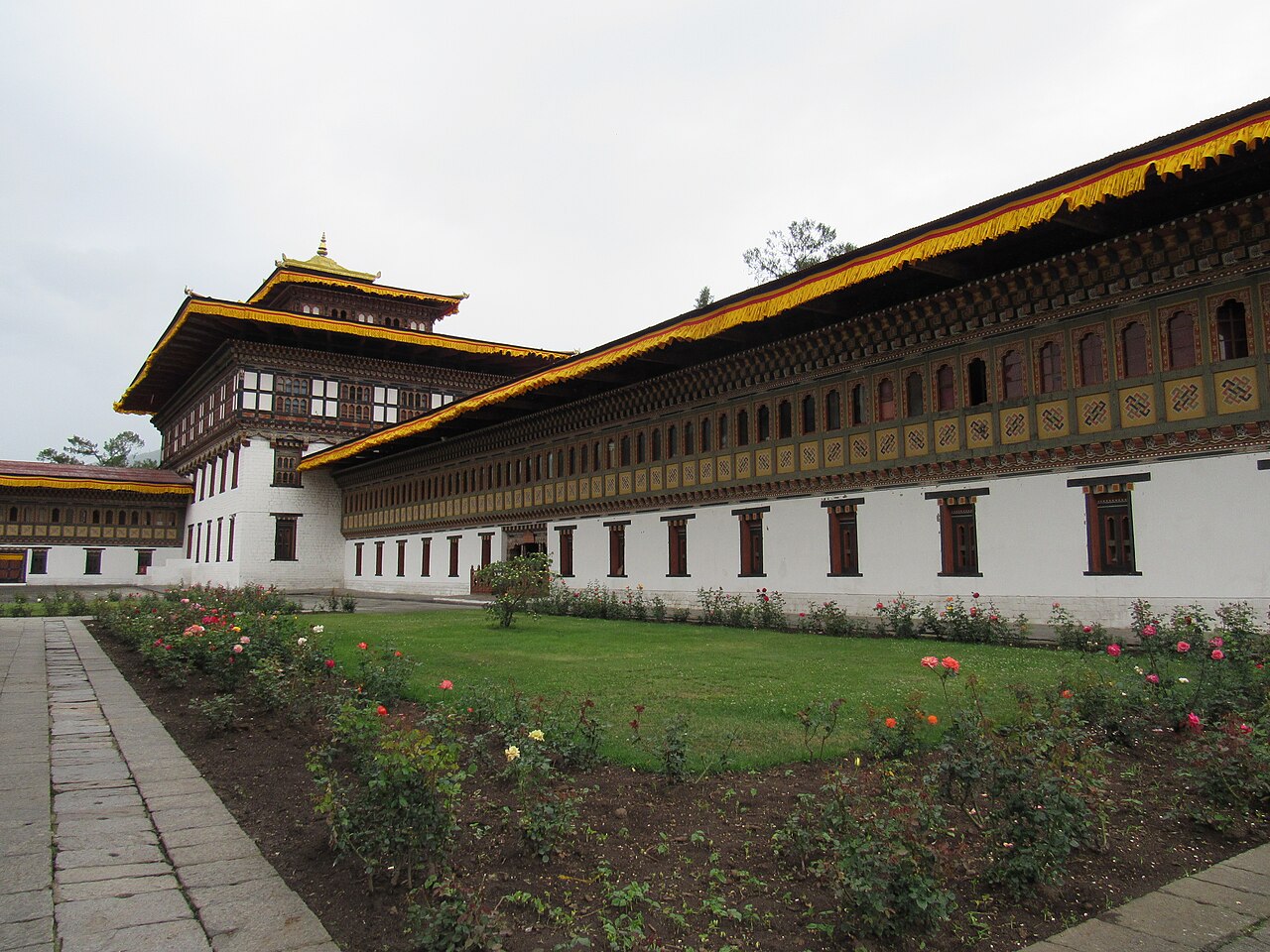
The architecture of Tashichho Dzong is a superb example of the Bhutanese dzong tradition, and its construction follows methods of remarkable ingenuity and beauty. The great walls, whitewashed and sloping inward as they rise, are built to convey strength and dignity, while the upper storeys, temples, and towers are crowned with the golden roofs that give the dzong its gleaming splendour.

By tradition, dzongs are built without the use of nails and, famously, without detailed architectural drawings, the knowledge of their construction passed down through master builders who carry the designs in memory and practice. This extraordinary tradition means that these vast and intricate buildings are raised through inherited skill and craft, a living continuation of methods reaching back through the generations.
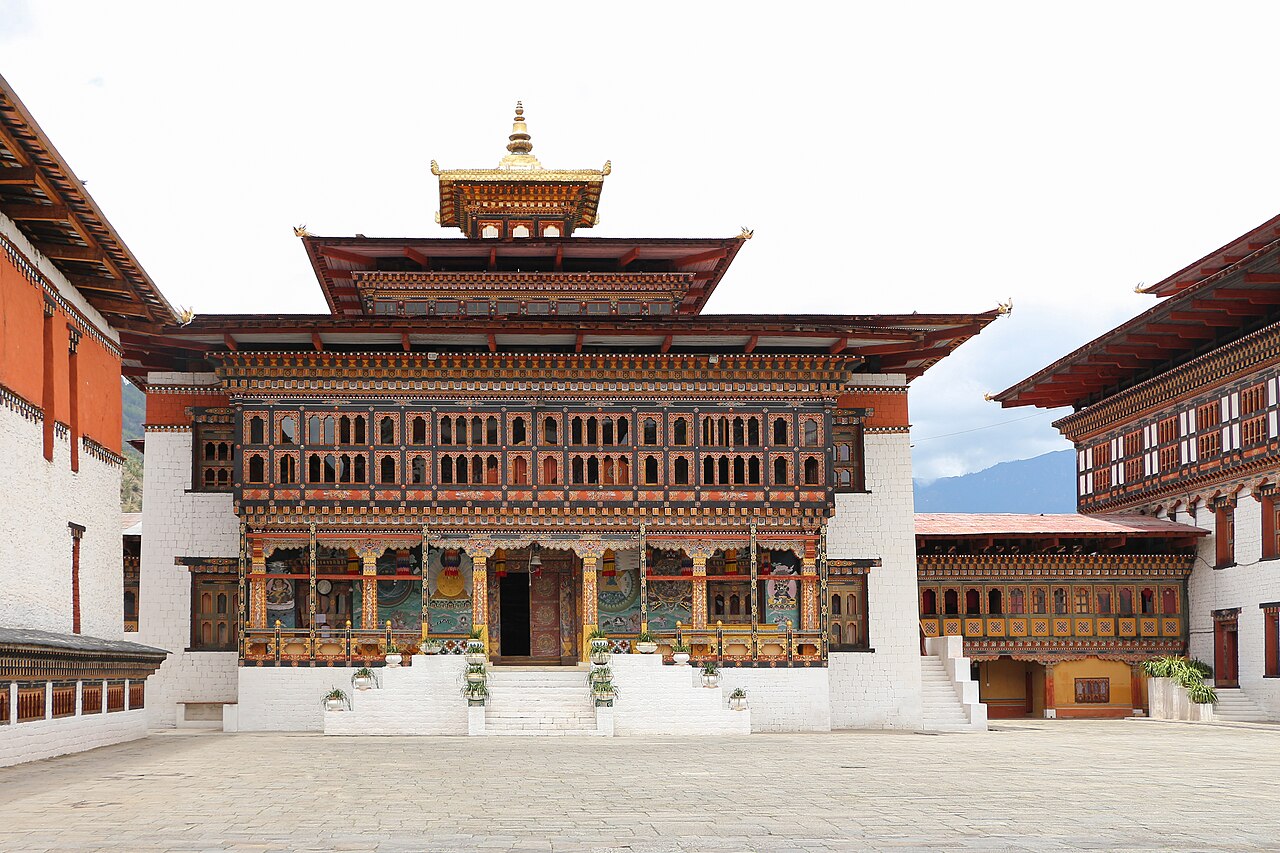
At the heart of the dzong rises the central tower, the utse, a tall structure that dominates the complex and houses important temples and shrines. Around it are arranged the courtyards, the ranges of buildings for the monastic community and the administration, and the temples with their rich decoration, all composed according to the traditional plan of the dzong.
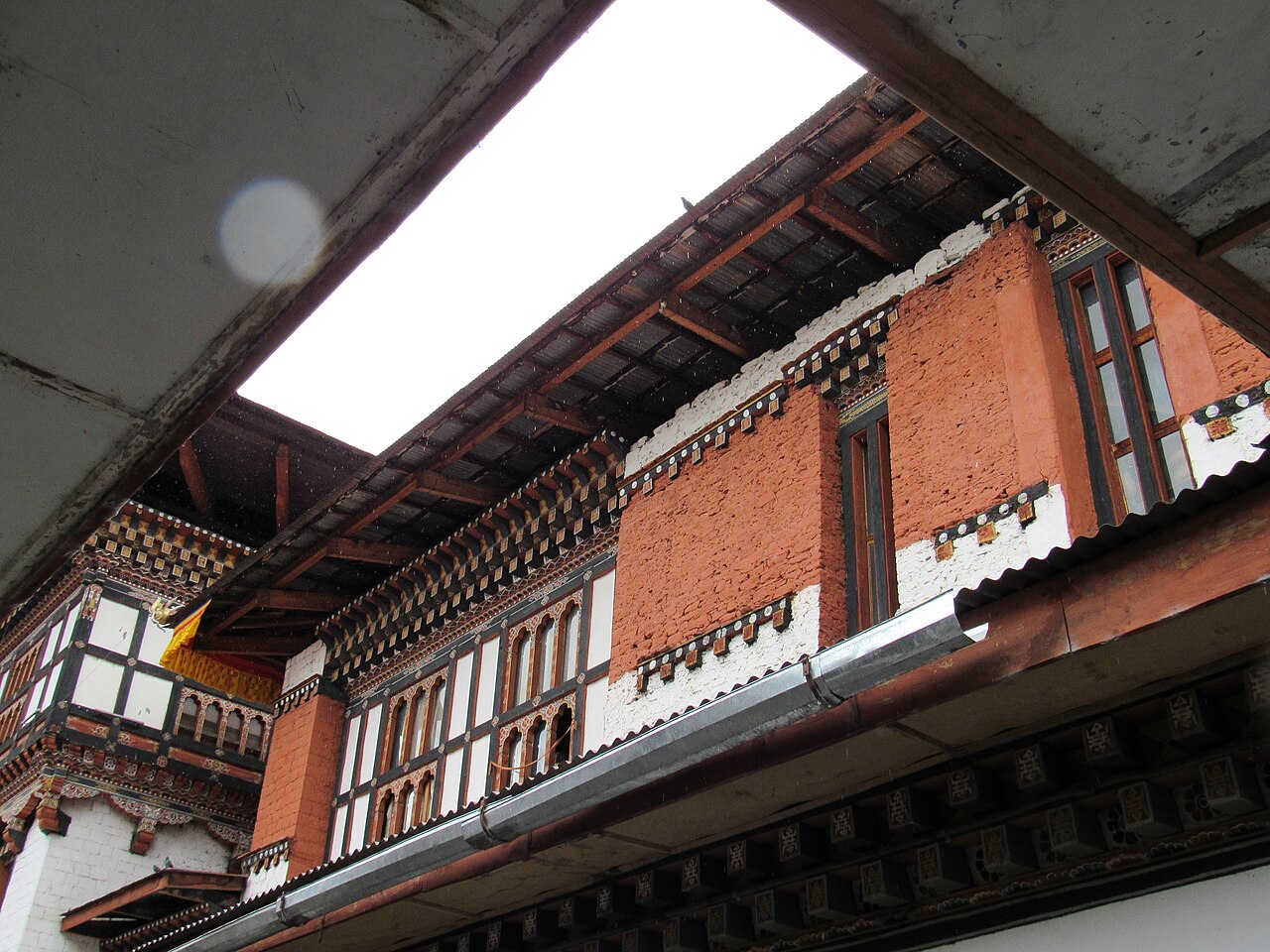
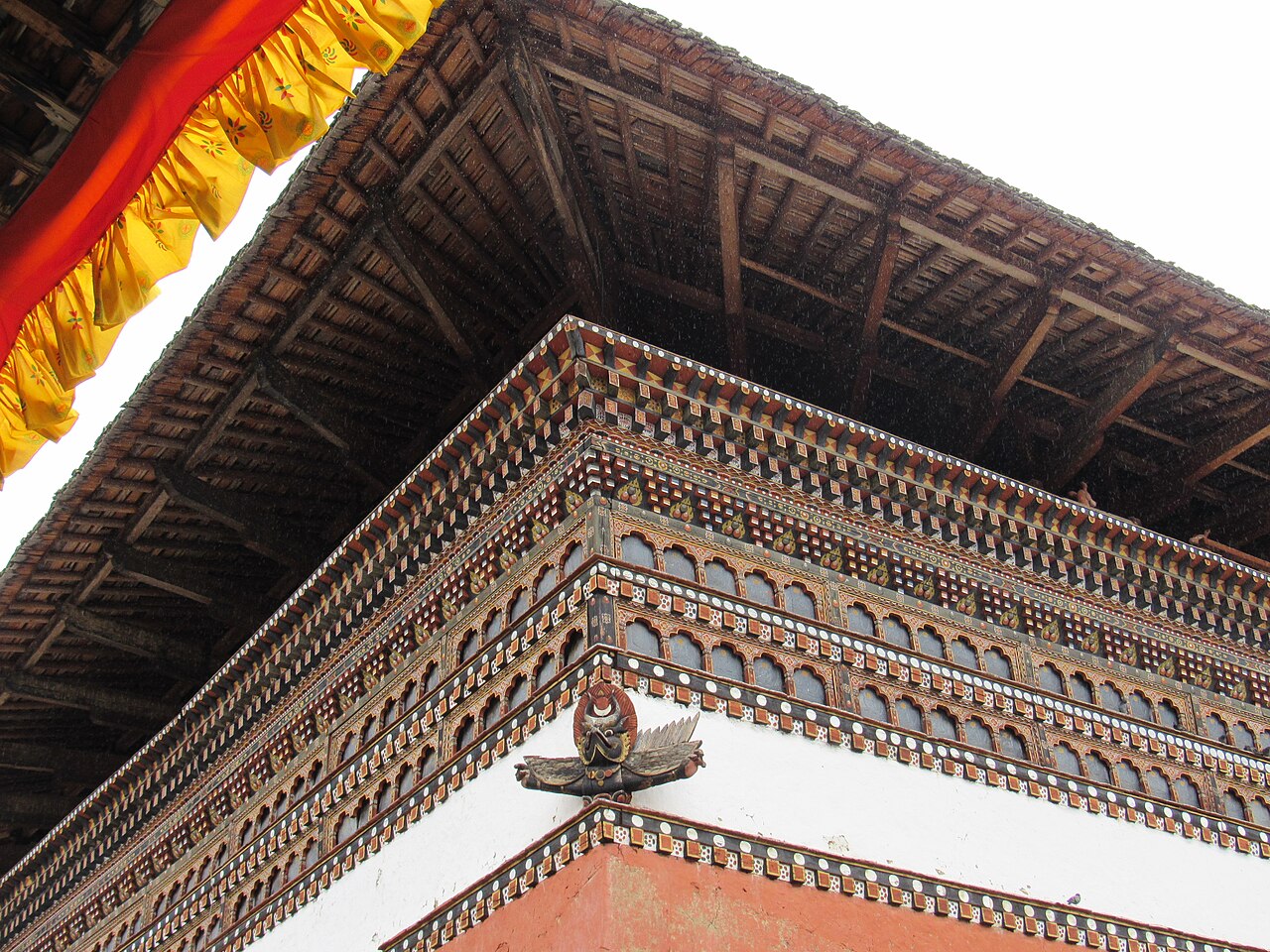
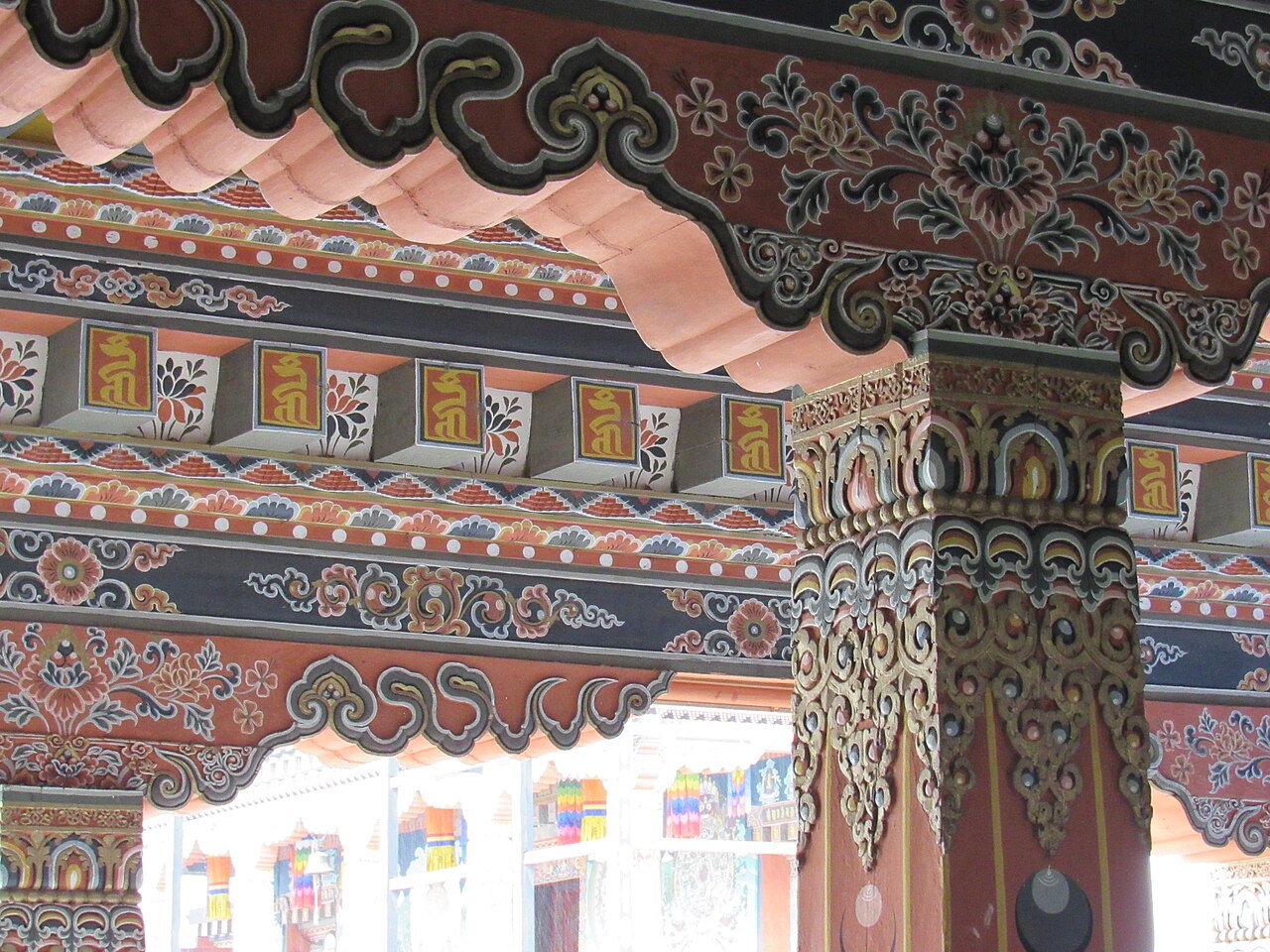
The woodwork is a glory of the building, for Bhutanese architecture makes lavish use of intricately carved and painted timber, in windows, galleries, brackets, and beams, worked with traditional motifs and brilliant colour. Combined with the pure white walls and the golden roofs, this woodwork gives the dzong its characteristic beauty, a harmony of massive form and delicate detail that is unmistakably Bhutanese.
That such immense and complex buildings could be raised without nails or written plans astonishes visitors from cultures where architecture means blueprints and steel. In Bhutan the design lives in the mind and hands of the master builder, a form of knowledge as much spiritual as technical, and the dzong is its supreme expression, proof that memory and craft can raise a fortress fit for a king.
The Seat of the King and the Government
Tashichho Dzong is, above all, the working seat of the Bhutanese state. It houses the throne room of the king, the Druk Gyalpo, and serves as the centre from which the monarch performs his official functions, so that the dzong is the ceremonial and symbolic heart of the kingdom, the place most closely associated with the crown.

The dzong also contains the offices of the government, including those of important ministries and the secretariat, making it the administrative centre of the country. Within its walls the business of governing Bhutan is carried on, so that the dzong is not a relic of past power but a living seat of the modern state, where the affairs of the nation are conducted every day.
This concentration of royal and governmental functions in the dzong reflects the traditional role of such buildings as centres of authority, now adapted to the needs of a modern kingdom. The king, the government, and the institutions of the state are all anchored here, giving the dzong a central place in the political life of the nation that few buildings anywhere can match.
For the visitor, the knowledge that the dzong is the actual seat of the king and government adds greatly to its significance. This is where Bhutan is governed and where its monarch reigns, a working centre of power housed within a traditional fortress-monastery, and to visit is to see the living institutions of the kingdom in their proper and historic setting.
There is a striking modesty of scale in all of this by the standards of great world capitals, for Bhutan is a small country and Thimphu a small capital. Yet that only sharpens the dzong’s dignity: everything the nation is, crown, government, and faith, is gathered here, in a single luminous fortress by the river, with nothing wasted and nothing merely for show.
The Seat of the Monastic Body
Alongside its royal and governmental functions, Tashichho Dzong is a great religious centre, serving as the summer seat of Bhutan’s central monastic body and its chief abbot, the Je Khenpo, the head of the country’s Buddhist establishment. The dzong thus houses not only the throne and the government but the leadership of the nation’s religious life, uniting the sacred and the secular within its walls.
The central monastic body, a large community of monks, moves between seats according to the season, and Tashichho Dzong is its home for part of the year. During this time the dzong is alive with the religious life of the community, with worship, study, and ceremony proceeding within its temples and quarters, alongside the work of the government in the same complex.
The presence of the chief abbot and the monastic body gives the dzong a spiritual authority to match its political importance. In Bhutan, the religious and the temporal are traditionally regarded as twin pillars of the state, and the dzong embodies this balance, sheltering the head of the faith and the head of the government under a single roof.
This dual character is one of the most striking things about Tashichho Dzong and about Bhutan itself. In a single building, the affairs of the kingdom and the life of the faith proceed side by side, monks and officials sharing the same courtyards, the same walls, the same sacred space. It is a vivid expression of a society in which religion and government remain deeply intertwined, and the dzong is its living centre.
The seasonal movement of the monastic body between its summer and winter seats is itself a kind of living ceremony, a procession that marks the turning of the year and reminds the nation that its faith, like its government, has a rhythm and a home. Tashichho Dzong is the grandest of those homes.
Courtyards, Temples, and Painted Walls
Within its great walls, Tashichho Dzong unfolds as a series of courtyards and buildings, containing temples, shrines, monastic quarters, and administrative offices. Moving through the dzong means passing from courtyard to courtyard, each framed by the tall buildings and galleries of the complex, in an ordered progression that is characteristic of dzong architecture.

The temples, or lhakhangs, are the spiritual heart of the dzong, housing images of the Buddha and of the deities and saints of Bhutanese Buddhism, along with the objects and decorations of worship. These temples are richly adorned, their walls covered with paintings and their interiors filled with statues, offerings, and the accumulated sacred art of the tradition.
The decoration throughout the dzong is a feast of colour and craftsmanship. Bhutanese religious art is vivid and intricate, and the temples and galleries of the dzong are adorned with murals, carvings, and painted woodwork depicting the figures and symbols of the faith. This art is not merely ornamental but devotional, part of the religious function of the building.
For the visitor, the courtyards and temples offer an encounter with the living religious culture of Bhutan. Within the dzong the sacred art, the architecture, and the presence of the monastic community combine to create an atmosphere of great beauty and spiritual seriousness, so that a visit is not only a sightseeing experience but an encounter with a faith and a way of life still fully alive.
The paintings often depict the wheel of life, the guardians of the four directions, and the great teachers of the tradition, so that the walls themselves teach, offering to those who can read them a whole cosmology in colour.
The Great Festival of the Dzong
Tashichho Dzong comes most vividly to life during the great festival known as the tshechu, one of the most important religious and cultural events of the Bhutanese calendar, held at the dzong and drawing crowds from across the country. During the festival, the courtyards of the dzong become the stage for days of ceremony, celebration, and, above all, sacred masked dance.
The masked dances, known as cham, are the heart of the tshechu, performed by monks and laymen in elaborate costumes and masks representing deities, demons, and figures from Buddhist tradition. These dances are not mere entertainment but sacred rituals, believed to bestow blessings on those who watch, and they are performed with great skill and devotion amid the colour and music of the festival.
The tshechu draws Bhutanese from far and wide, dressed in their finest traditional clothing, who gather to witness the dances, receive blessings, and take part in the communal life of the festival. For a few days the dzong is transformed into a place of joyous religious celebration, its courtyards filled with dancers, musicians, and crowds of worshippers, in one of the great spectacles of the Himalayan world.
For visitors fortunate enough to attend, the tshechu is an unforgettable experience, offering a chance to see the living religious culture of Bhutan at its most vivid and beautiful. Even for those who visit at other times, knowing that the dzong hosts such festivals adds to its significance, revealing it as not only a seat of power but a centre of the communal and spiritual life of the whole nation.
The masks and costumes, many of them treasured and old, are brought out for these days and worn by dancers who have trained long to perform the steps correctly, for a mistake in a sacred dance is no small matter. To watch is to see belief in motion, the teachings of the faith made visible in colour, movement, and sound.
Coronations and the Ceremonies of the Crown
As the ceremonial seat of the monarchy, Tashichho Dzong is bound up with the great occasions of the Bhutanese crown, including the coronations and important ceremonies of the kings. It is here, in the throne room and the halls of the dzong, that the most solemn events of the reign take place, so that the building is woven into the very fabric of the monarchy.

The coronation of a Bhutanese king is a profoundly significant event, combining royal and religious ceremony in a manner reflecting the close bond between the crown and the faith. Such occasions, held amid the temples and courtyards of the dzong, express the sacred as well as the political character of the monarchy, and mark the dzong as the stage for the defining moments of the dynasty.
The dzong is also the setting for other important national ceremonies and receptions, from the observances of the royal calendar to the reception of honoured guests. In this role it serves as the grand ceremonial centre of the kingdom, the place where the nation gathers, in the person of its king and its institutions, to mark its most significant moments.
This ceremonial role reinforces the dzong’s place at the heart of Bhutanese life. It is not only where the country is governed and where its faith is centred, but where the great rites of the monarchy are performed, so that the building embodies the continuity and dignity of the crown. In its halls the history of the Wangchuck dynasty and the modern kingdom of Bhutan continues to be made.
For a nation so small, such ceremonies carry enormous weight, binding king and people together in shared witness, and the dzong is the vessel that holds them.
A Living Seat in a Modern Kingdom
What sets Tashichho Dzong apart from so many great palaces and fortresses of the world is that it remains fully alive, performing today the functions for which it was built. In an age when so many historic royal and religious buildings have become museums, the dzong continues as the working seat of a king, a government, and a monastic community, a living institution rather than a preserved relic.
This vitality reflects the character of Bhutan itself, a country that has chosen to carry its traditions into the modern world rather than abandon them. As Bhutan has modernised and, in time, adopted democratic institutions, the dzong has continued to serve as the centre of the state, adapting to new realities while preserving its ancient forms and functions.
The dzong thus stands as a symbol of Bhutan’s distinctive path, its determination to develop and modernise while holding fast to its Buddhist heritage, its monarchy, and its traditional culture. The building embodies the balance the nation seeks, between the old and the new, the sacred and the secular, the material and the spiritual, that lies at the heart of its philosophy.
For the visitor, this living quality is what makes Tashichho Dzong so remarkable. To walk its courtyards is not to tour a monument to a vanished past but to visit the beating heart of a living kingdom, where king, government, and faith continue their work as they have for generations. Few buildings anywhere offer so vivid an encounter with a functioning traditional state, alive and at work within its ancient walls.
In this, Tashichho Dzong quietly rebukes the assumption that tradition and modernity cannot share a roof. Here they plainly do, and have done for generations, the fax machines and files of a modern ministry humming a courtyard away from the butter lamps and chanting of the monks.
It is a lesson the wider world increasingly comes to Bhutan to learn.
The Dzong on Film
The beauty and atmosphere of Tashichho Dzong, its white walls and golden roofs, its courtyards and temples, its setting by the river beneath the hills, are best appreciated in motion, and the short film below offers a tour that brings the dzong and its history to life. Watching it alongside the images in this article helps convey the grandeur and serenity of the place.
If you are planning a visit to Bhutan, a video like this is a fine way to prepare, helping you recognise the main features of the dzong and understand its role as the seat of king, government, and faith. It also conveys something of the distinctive character of Bhutan, a kingdom whose traditions and landscape are unlike anywhere else on earth.
And if a visit to Bhutan lies beyond your plans for now, the film lets you experience the great dzong of Thimphu from afar. Let it play, and picture yourself standing before its white walls and golden roofs, in the valley of the Bhutanese capital, at the living heart of the last of the world’s Buddhist kingdoms.
Visiting Tashichho Dzong
For travellers to Bhutan, Tashichho Dzong is one of the essential sights of the capital and of the whole country, a highlight of any visit to Thimphu. Because it is a working seat of government and religion, access for visitors is managed accordingly, often permitted during particular hours or seasons, so it is important to be aware of the current arrangements and to respect them.
A visit rewards attention to the dzong’s architecture and setting: the great white walls, the golden roofs, the central tower, the courtyards, and the richly decorated temples, all in their beautiful riverside setting beneath the hills. To see the dzong floodlit in the evening is especially memorable, as is the chance, for those who time their visit well, to witness the great festival held in its courtyards.
As at any sacred and official site, visitors should dress and behave respectfully, following the guidance about which areas may be entered and photographed, and remembering that this is a place of worship and government as well as a monument. In Bhutan, respect for tradition and for the institutions embodied in the dzong is deeply valued, and visitors are expected to honour it.
However you come to it, Tashichho Dzong offers a rare and beautiful experience: the chance to visit the living seat of a Buddhist kingdom, where king, government, and faith share a single set of ancient walls. To stand in its courtyards, beneath its golden roofs, is to touch the heart of Bhutan, a nation that has guarded its traditions with rare devotion, and to encounter one of the most magnificent living monuments of the Himalayan world.
Evenings, when the dzong is lit and the day’s official business is done, are often the most atmospheric time to see it from the surrounding grounds.
Palaces Nearby
If the living seat of Bhutan has drawn you in, these two other Himalayan royal seats make a natural next stop.
- Narayanhiti, the Palace Where the Kings of Nepal Reigned and Fell — the Kathmandu seat of Nepal’s vanished monarchy.
- Ujjayanta, the Lakeside Palace of Tripura’s Ancient Kings — the domed palace of the ancient Manikya dynasty.
You May Like

Vaduz Castle, the Hilltop Home of Liechtenstein’s Reigning Prince