On the banks of the Elbe, a few kilometres upstream from Dresden, a cluster of palaces with curving, Chinese inspired roofs stands among vineyards, gardens and old trees. Pillnitz was the summer residence of the kings of Saxony, and it is one of the most enchanting palace ensembles in Germany, a dream of the Far East translated into the landscape of the Saxon river valley.
Created for Augustus the Strong, the flamboyant elector of Saxony and king of Poland, Pillnitz combines baroque architecture with exotic fantasy. Its Water Palace rises directly from the river, with grand steps where gondolas once landed, while the Hill Palace faces it across a formal garden. A later New Palace closes the ensemble, and around them stretches a park famous for a camellia tree more than two centuries old.
In this article we will explore Pillnitz from its origins as a pleasure palace to its role as a royal summer seat, through its chinoiserie architecture, its interiors and its gardens, and we will finish with practical tips for your visit.
In This Article
- A Chinese Dream on the Elbe
- Augustus the Strong and His Pleasure Palace
- Poppelmann and the Indian Style
- The Water Palace and Its River Stairs
- The Hill Palace Across the Garden
- Chinoiserie Interiors and Decorative Arts
- The New Palace and the Royal Summer Court
- The Domed Hall and the Palace Chapel
- The Famous Pillnitz Camellia
- Gardens, Palm House and English Park
- Vineyards and the Elbe Valley
- Pillnitz on Video
- Visiting Pillnitz Today
A Chinese Dream on the Elbe
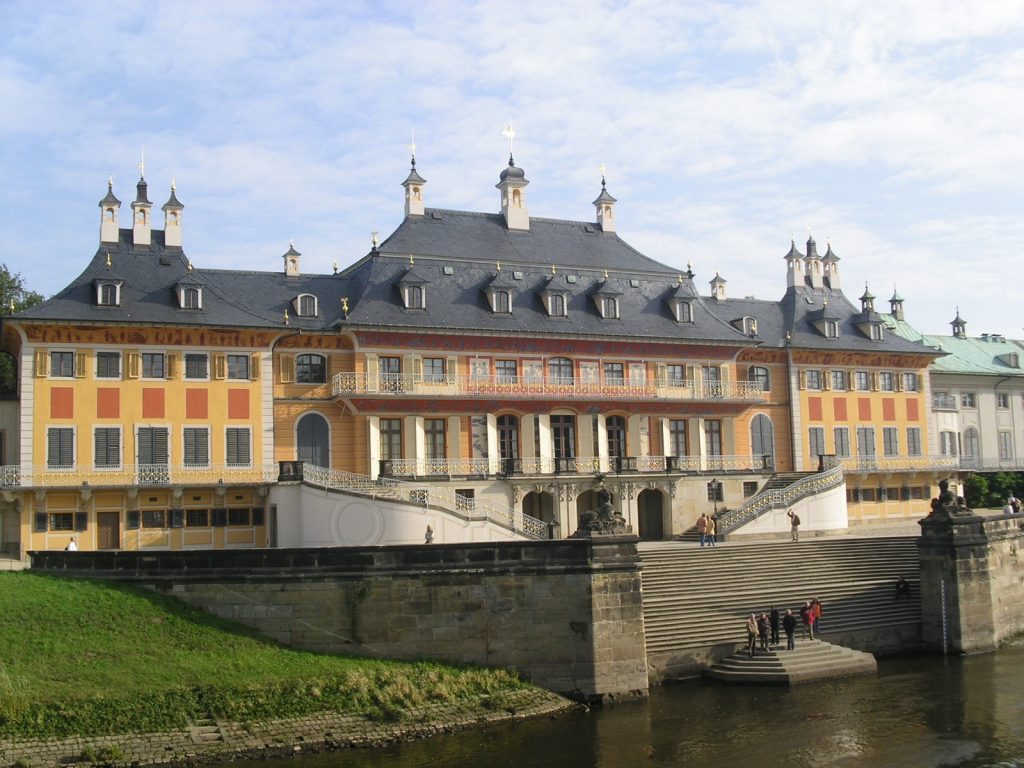
The best way to arrive at Pillnitz is by paddle steamer from Dresden, gliding up the Elbe past vineyards, villas and green hills until the palace appears on the riverbank. The Water Palace, with its sweeping roof and grand river stairs, seems to have been designed for exactly this moment of arrival.
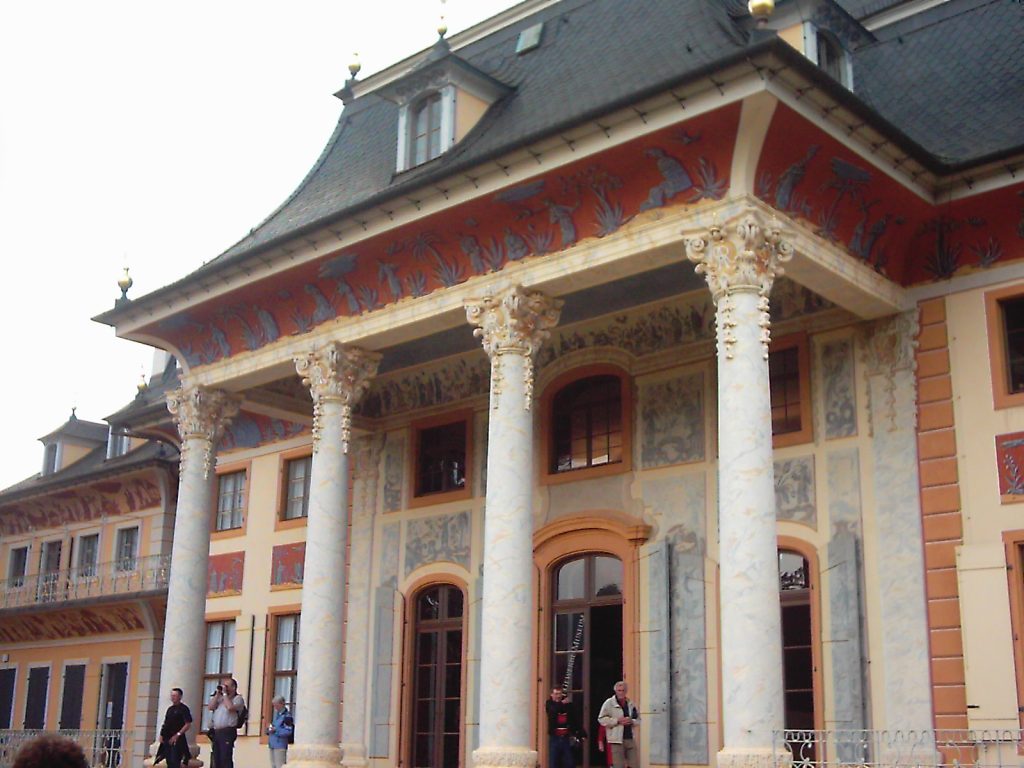
From the river, you see a long, elegant building painted in pale tones, its roof curving upward at the ends in the manner of Chinese pavilions, and its eaves decorated with painted scenes. It is a striking image, unlike any other palace in Europe.
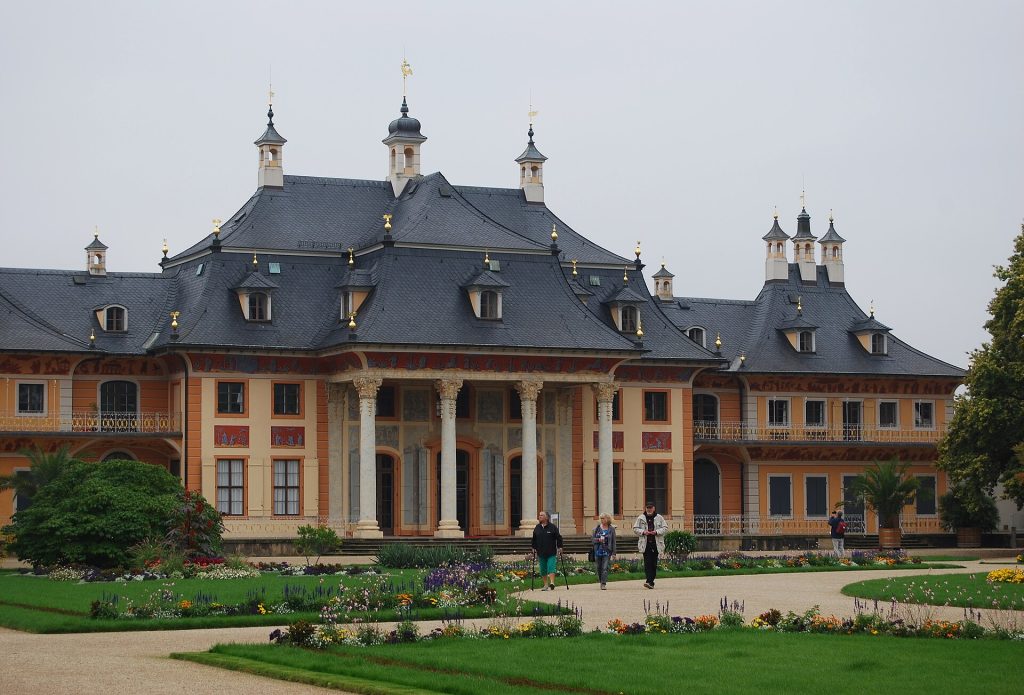
Behind the Water Palace lies a formal garden, and beyond it the Hill Palace, a mirror image building that faces the river. Between them, the New Palace closes the courtyard on the eastern side, creating a harmonious ensemble around a central garden.
Pillnitz feels light, playful and relaxed. It was built for summer pleasures, not for state ceremony, and that mood still fills the gardens and courtyards today.
Pillnitz is also a favourite place for the people of Dresden, who come here at weekends to stroll in the park, picnic by the river and enjoy the relaxed atmosphere. It is as much a local leisure spot as a historic monument.
The combination of palace architecture, river views, vineyards and gardens makes Pillnitz feel like a world of its own, a summer retreat that still lives up to its original purpose.
In spring the gardens fill with blossoms, in summer the river sparkles under long sunny days, and in autumn the vineyards turn gold. Each season gives Pillnitz a different character, and many visitors return again and again.
Arriving by steamer also lets you appreciate how the palaces were meant to be seen first from the water, a perspective that most visitors arriving by road miss entirely.
Augustus the Strong and His Pleasure Palace
The story of Pillnitz as a royal residence begins with Augustus the Strong, elector of Saxony and king of Poland, one of the most colourful rulers of the baroque age. Famous for his physical strength, his love of splendour and his many mistresses, Augustus transformed Dresden into one of the most beautiful cities in Europe.
In the early eighteenth century he acquired the estate at Pillnitz, which had an older castle, and gave it for a time to his favourite, Countess Cosel. After her fall from favour, Augustus kept Pillnitz for himself and set about creating a pleasure palace on the river.
Augustus loved festivals, masquerades and elaborate entertainments, and Pillnitz was designed as a stage for such events. Guests arrived by gondola from Dresden, landing at the river stairs, and spent the day in the gardens and pavilions enjoying music, games and feasts.
The exotic style of the buildings reflected Augustus’s passion for Asian art, especially porcelain. He was an obsessive collector and founded the Meissen porcelain manufactory, the first in Europe to produce true hard paste porcelain.
Countess Cosel, one of the most famous mistresses of Augustus, lived at Pillnitz for a time before she fell from favour and was imprisoned in the fortress of Stolpen for the rest of her long life. Her dramatic story is still told in Saxony and adds a romantic note to the history of the palace.
Augustus organised spectacular festivities at Pillnitz, including water festivals with illuminated boats, mock battles and fireworks over the river. These events were intended to dazzle visitors and demonstrate the splendour of the Saxon court.
His successors continued to use Pillnitz as a summer retreat, and over time it changed from a place of baroque festivals into a more domestic royal residence, where the family could relax away from the formalities of Dresden.
Augustus’s love of the exotic also shaped the Japanese Palace in Dresden, which he intended as a porcelain palace. Pillnitz and the Japanese Palace together show how deeply Asian art influenced his vision.
The elector also used Pillnitz to impress foreign visitors, and diplomats who attended the festivals reported on its splendour to courts across Europe, spreading the fame of Saxon taste and wealth.
In later decades the palace became associated with diplomacy too. In 1791 the Declaration of Pillnitz was issued here by the Holy Roman Emperor and the King of Prussia, warning revolutionary France, an event that helped set the stage for the wars that followed.
Poppelmann and the Indian Style
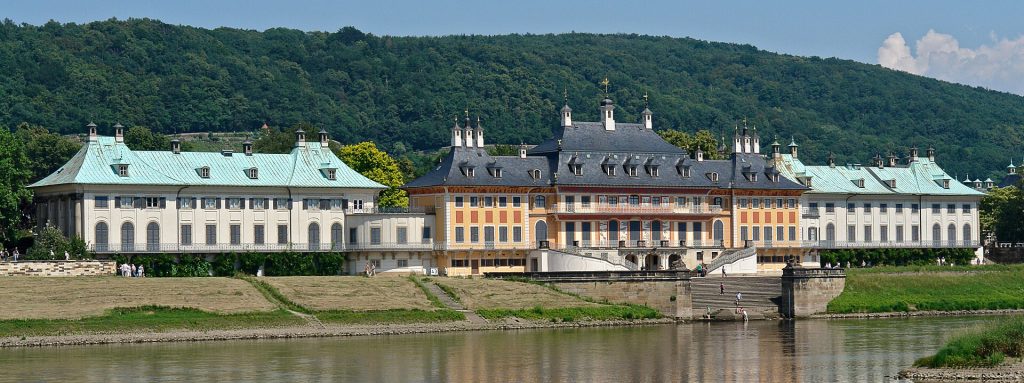
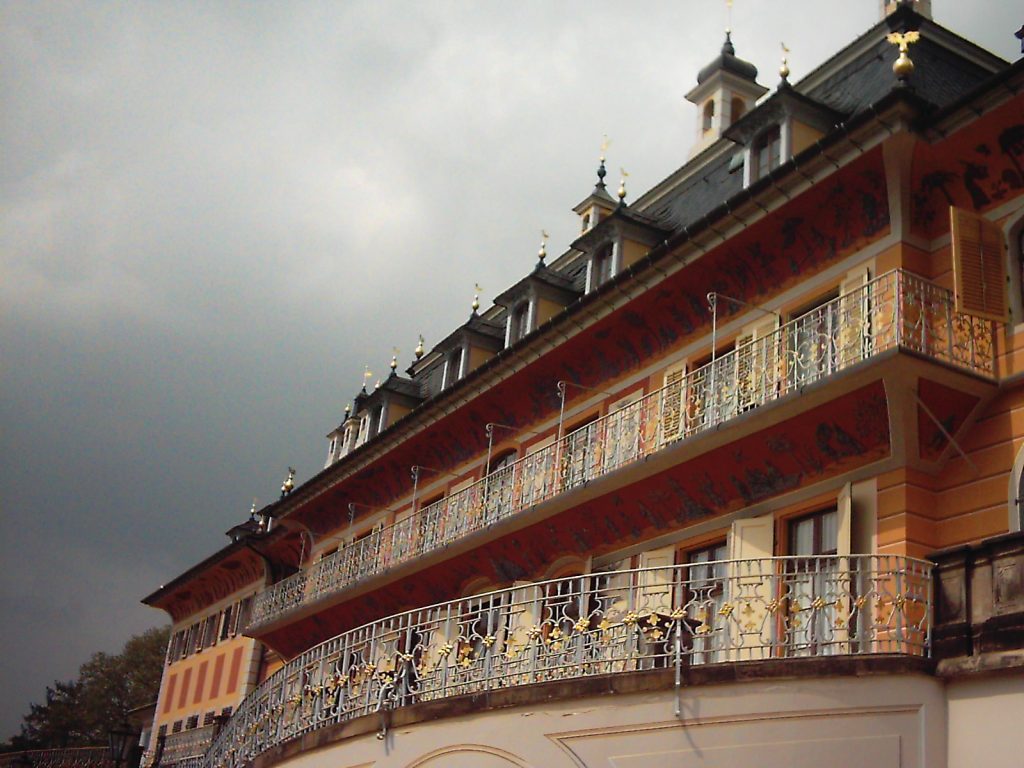
The Water Palace and the Hill Palace were built between 1720 and 1724 to designs by Matthaus Daniel Poppelmann, the architect of the famous Zwinger in Dresden, working with Zacharias Longuelune. Together they created a unique style that contemporaries called Indian, though it drew mainly on Chinese models.
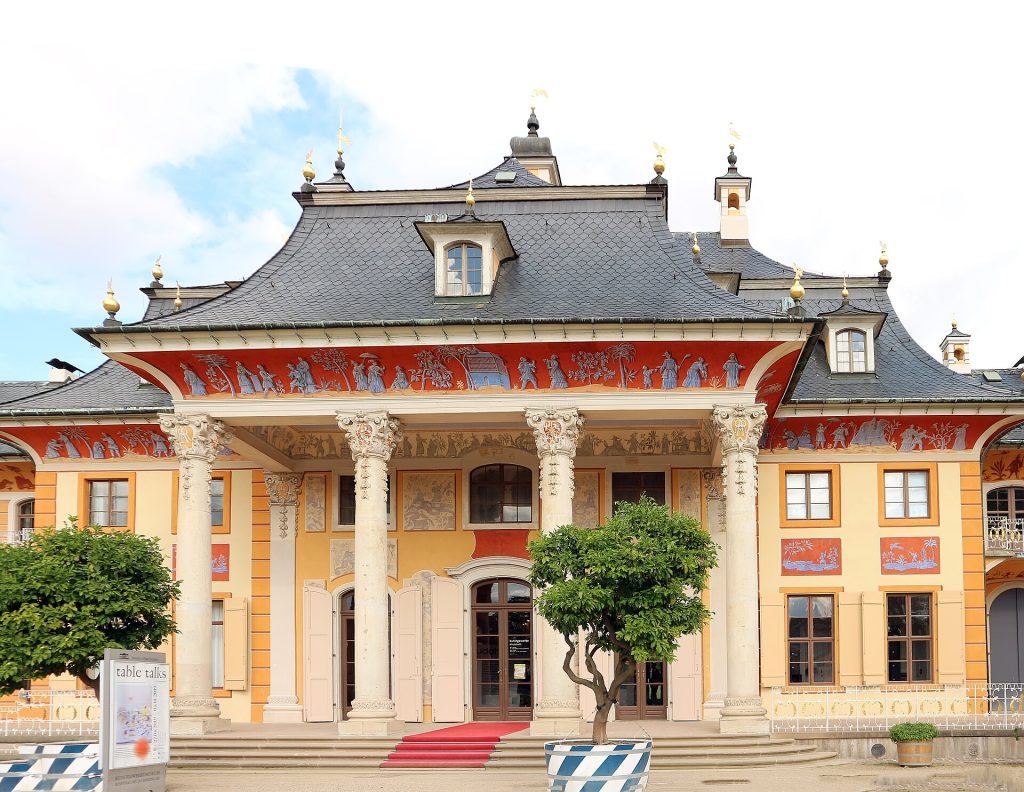
The most distinctive features are the curving roofs, the painted eaves with scenes of Asian figures, and the decorative chimneys shaped like little pagodas. These details give the buildings their exotic charm, while their underlying structure remains firmly European baroque.
Chinoiserie was fashionable across Europe in the eighteenth century, but few buildings embraced it as fully as Pillnitz. Here it is not just decoration but the defining character of the architecture.
Look closely at the painted eaves, where figures in Asian costume go about imaginary daily lives. They were painted by European artists who had never seen China, and their charm lies in this mixture of fantasy and curiosity.
Poppelmann’s work at Pillnitz shows a lighter, more playful side of his genius than the grand Zwinger. Here he could indulge in fantasy, creating buildings that are both elegant and witty.
The roofs in particular are remarkable. Their upturned edges and decorative ridges give the buildings a sense of lightness, as if they might float away over the river on a summer breeze.
Longuelune, a French trained architect, brought refinement and restraint to the design, balancing Poppelmann’s exuberance. Their collaboration produced buildings that are both exotic and harmonious.
The pagoda shaped chimneys and decorative ridge ornaments are small details that complete the illusion, and they are easy to miss unless you look up carefully.
Many visitors are surprised to learn that the buildings are not truly Chinese in construction at all, but European buildings dressed in Asian costume, exactly as a baroque masquerade would dress its guests.
The Water Palace and Its River Stairs
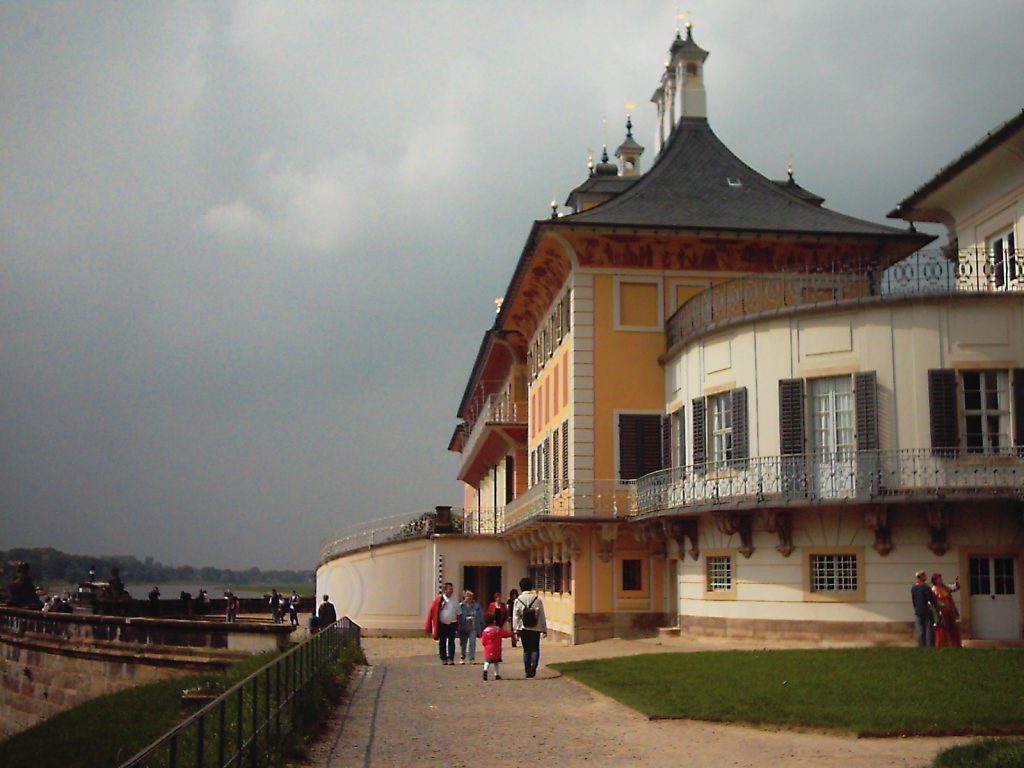
The Water Palace faces the Elbe, and its most famous feature is the grand staircase leading down to the river. Flanked by sphinxes, the steps were designed as a landing stage for gondolas, recalling the palaces of Venice.
Augustus and his guests would arrive from Dresden in elaborate boats, step onto the stairs and ascend into a world of gardens and pleasure. Even today, standing at the top of the stairs and looking across the river, you can sense the theatrical spirit of these arrivals.
Inside, the Water Palace houses part of the collections of the Museum of Decorative Arts, part of the Dresden State Art Collections. Its rooms display furniture, ceramics, textiles and design objects from many centuries.
On sunny days the river reflects light onto the facade, and the whole building seems to shimmer. It is one of the most photographed views in the Dresden area.
The sphinxes guarding the river stairs are a favourite subject for photographers, and they give the landing a mysterious, slightly exotic air that matches the Chinese style of the palace.
High water on the Elbe occasionally reaches the stairs and even the gardens, a reminder of the power of the river. Marks on the walls record the levels of historic floods.
Behind the Water Palace, the formal garden opens up, with lawns, flower beds and fountains, creating a green courtyard between the palaces that is the heart of the ensemble.
Inside, some rooms keep their original ceiling paintings and wall decoration, and the views from the windows over the river are among the finest at Pillnitz.
The Hill Palace Across the Garden
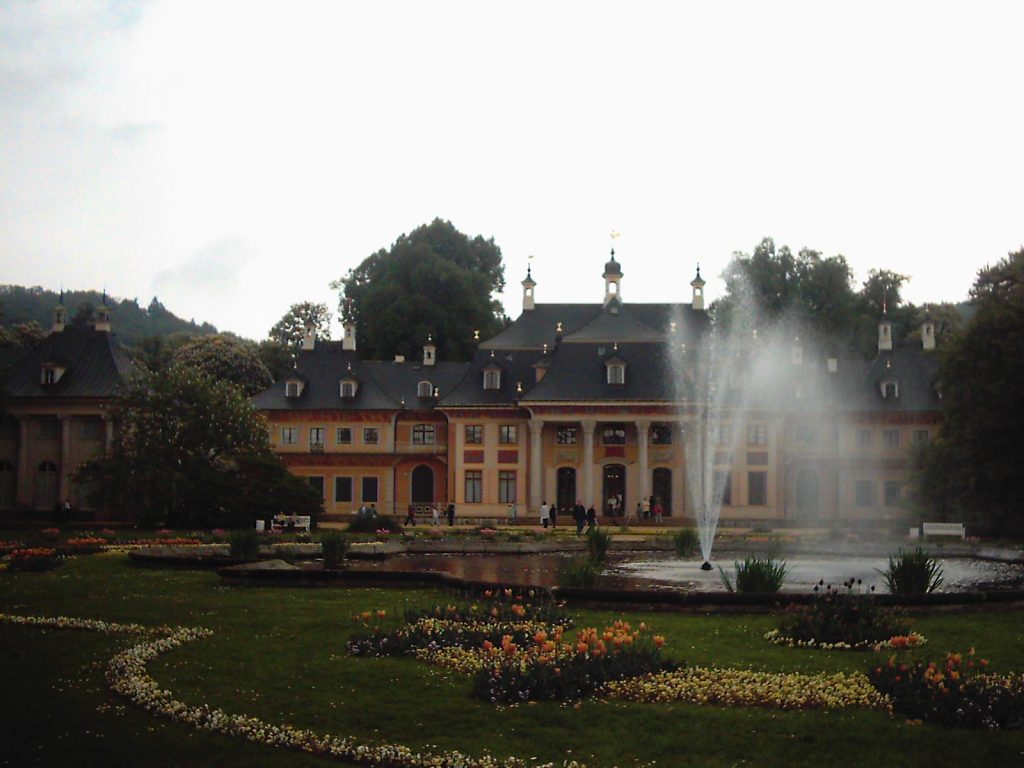
Facing the Water Palace across the formal garden stands the Hill Palace, built at the same time and in the same style. Its name comes from its position at the foot of the vine covered slopes that rise behind Pillnitz.
Like its twin, the Hill Palace has a curving roof, painted eaves and an elegant facade, and together the two buildings frame the garden in a perfect symmetry.
The Hill Palace also houses part of the Museum of Decorative Arts, and its rooms preserve some of the original painted decoration in the Chinese style.
Walking between the two palaces through the garden, you experience the ensemble as Augustus intended, a stage set for summer festivities.
From the Hill Palace you can look across the garden to the Water Palace and the river beyond, a view that shows the careful axial planning of the whole ensemble.
The vineyards behind the Hill Palace once supplied wine to the royal table, and some of them are still cultivated today, keeping alive a centuries old tradition.
The Hill Palace was badly damaged at various times but has been carefully restored, and its painted eaves and roofline once again look as they did in the eighteenth century.
Inside, visitors can see collections of furniture and decorative arts arranged by period and theme, as well as rooms that preserve their historic decoration.
Chinoiserie Interiors and Decorative Arts
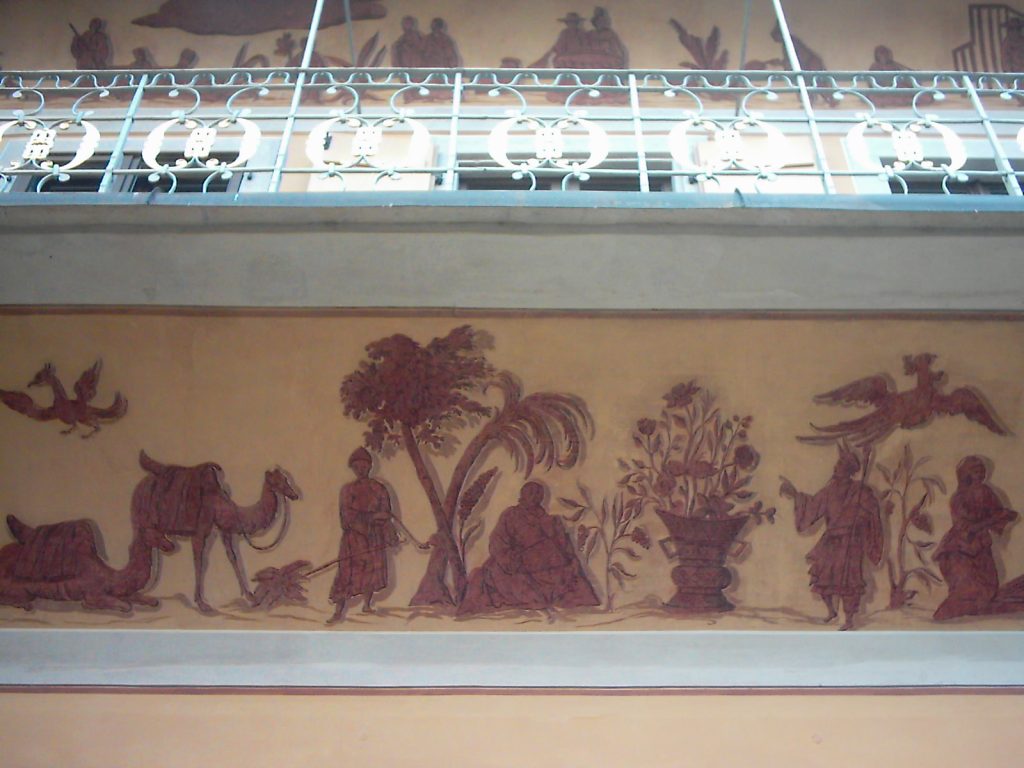
Inside the palaces you will find some of the finest chinoiserie interiors in Germany. Painted walls, lacquered panels and ceramics evoke an imagined East, full of pagodas, birds, flowers and figures in silk robes.
These rooms reflect the fascination of the Saxon court with Asian art, which was collected on a grand scale. Augustus himself amassed thousands of pieces of Chinese and Japanese porcelain, many of which are now in Dresden.
The Museum of Decorative Arts displays a wide range of objects, from baroque furniture and Meissen porcelain to modern design, so a visit offers a journey through centuries of craftsmanship.
Look out for the chairs, cabinets and tables designed in the Chinese manner, as well as the fine textiles and painted papers that once decorated the walls.
Some of the rooms preserve original wall paintings with Chinese motifs, carefully restored after centuries of wear. They give a rare glimpse of how these summer interiors looked in the eighteenth century.
The Meissen manufactory, founded by Augustus, produced porcelain in Chinese and Japanese styles, and examples of these early wares can be seen in the collections, linking the decoration of Pillnitz with the industrial and artistic achievements of Saxony.
The museum also hosts temporary exhibitions on design and craftsmanship, so there is often something new to discover alongside the permanent collections.
The juxtaposition of baroque chinoiserie and modern design pieces in the museum creates a lively dialogue between past and present, showing how ideas about style and craft have evolved.
Even the door handles, stoves and window fittings were sometimes designed to match the exotic style, showing how thoroughly the Chinese theme was carried through.
The New Palace and the Royal Summer Court
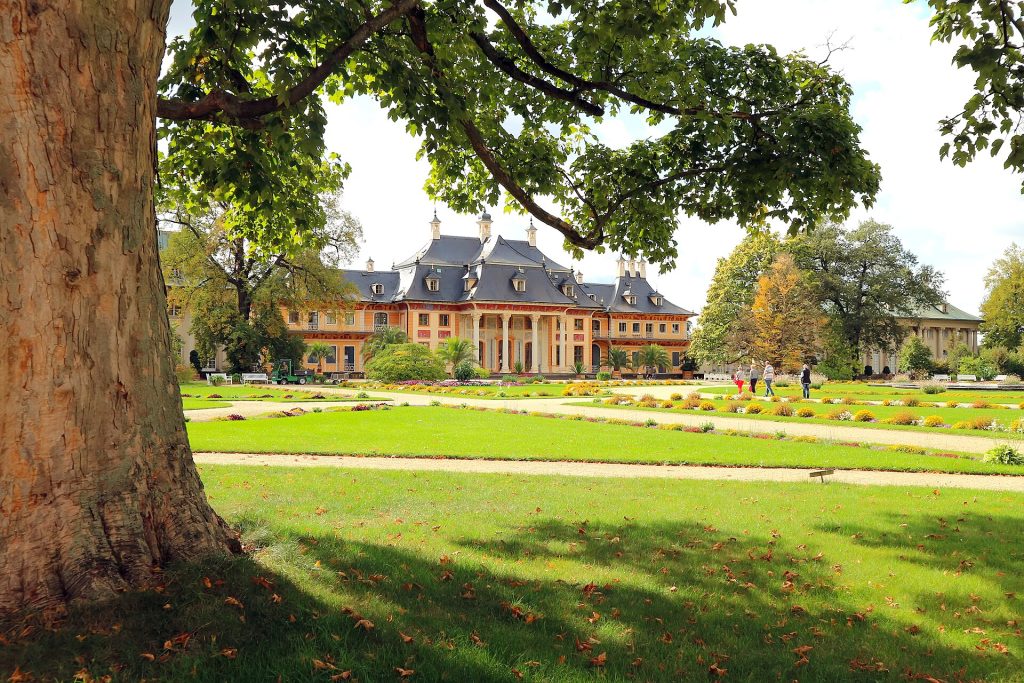
In 1818 a fire destroyed the old Renaissance castle that had stood between the two palaces. In its place, the architect Christian Friedrich Schuricht built the New Palace between 1818 and 1826, closing the courtyard on the east side and completing the ensemble.
The New Palace was designed in a classical style but harmonised with the older buildings through its roofline and proportions. It contained the royal kitchens, apartments and a Catholic chapel, and its central domed hall became a focal point for court life.
By this time, Saxony had become a kingdom, and Pillnitz served as the official summer residence of the Saxon kings until 1918. Each summer the court moved here from Dresden, bringing with it ministers, courtiers and servants.
Today the New Palace houses the palace museum, where you can learn about the history of Pillnitz and see restored rooms that recall the life of the royal family.
The architect Schuricht took care to repeat the curving roof line of the older palaces, so that the new building would fit naturally into the ensemble rather than stand out as a foreign element.
The royal kitchens in the New Palace have been restored and can be visited, showing the scale of the work needed to feed the court during the summer months.
During the summer months the royal family lived a comparatively informal life at Pillnitz, taking walks in the park, boating on the river and receiving guests in a relaxed setting.
The museum displays include portraits of the Saxon kings and queens, furniture, porcelain and personal objects that help bring the royal summers at Pillnitz to life.
Interactive exhibits and models explain how the ensemble developed over time, from the early castle through the baroque pleasure palace to the royal summer seat.
The New Palace also served as a backdrop for royal family celebrations, including birthdays and anniversaries, which were marked with music and festivities in the gardens.
The Domed Hall and the Palace Chapel
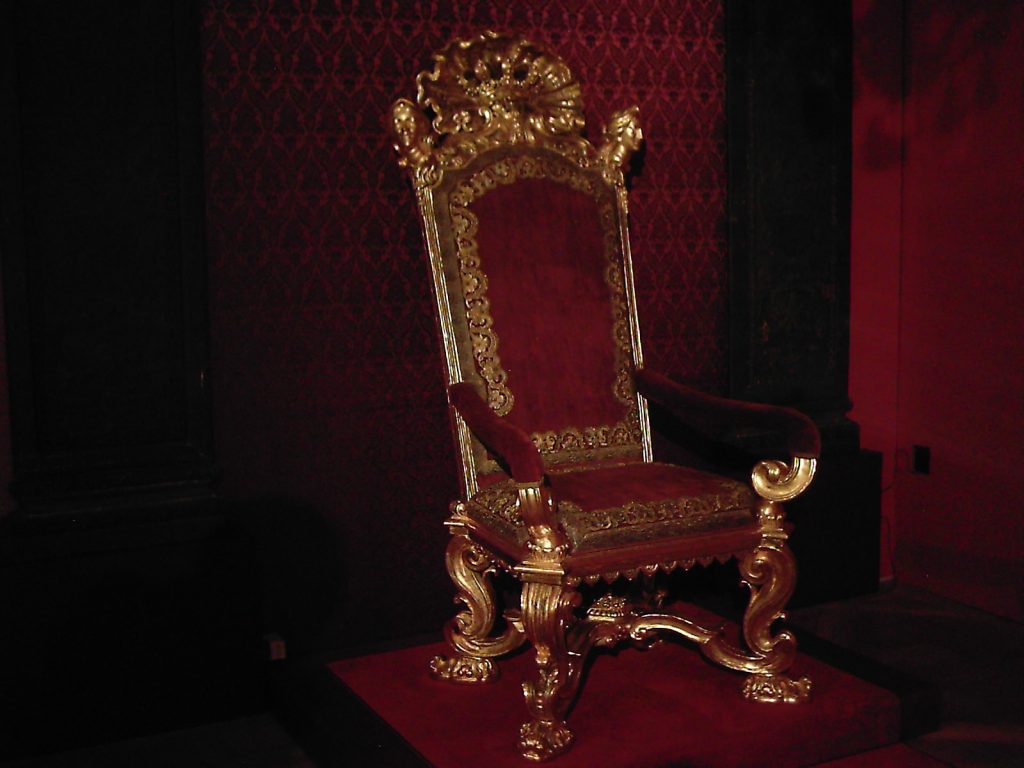
At the heart of the New Palace lies the domed hall, a grand circular room used for receptions, banquets and celebrations. Its elegant classical decoration and soaring dome make it one of the most impressive interiors at Pillnitz.
Next to it is the Catholic chapel, decorated with paintings and fine furnishings. The Saxon royal family was Catholic, while most of their subjects were Protestant, and the chapel reflects this unusual religious situation.
The chapel features paintings by Carl Christian Vogel von Vogelstein, a leading artist of the Saxon court, and its calm atmosphere contrasts with the festive spirit of the gardens.
Both spaces are part of the palace museum route and give a vivid sense of the ceremonial life of the court in the nineteenth century.
The domed hall is sometimes used for concerts and events, and its acoustics and elegant setting make it a wonderful place to hear music.
The decoration of the domed hall reflects the neoclassical taste of the early nineteenth century, with columns, coffered surfaces and restrained ornament that create a dignified atmosphere.
The chapel continued to serve the royal family until the end of the monarchy in 1918, when the last king of Saxony abdicated.
Standing beneath the dome, look up at the light entering from above, which gives the room a serene, almost spiritual quality despite its secular purpose.
The Famous Pillnitz Camellia
One of the most beloved sights at Pillnitz is not a building but a tree. The Pillnitz camellia, brought from Japan in the late eighteenth century, is one of the oldest camellias in Europe. It has grown into a huge shrub nearly nine metres tall.
In winter the camellia is protected by a movable glass house, which can be rolled over it to keep out the cold and then rolled away in summer. Between February and April it blooms with tens of thousands of red flowers, a spectacular sight that draws visitors from far and wide.
The camellia reflects the long tradition of botanical collecting at Pillnitz, where the gardens were enriched with exotic plants from around the world.
If you visit in early spring, do not miss the chance to see the camellia in flower. It is one of the great natural treasures of Saxony.
According to tradition, the camellia arrived at Pillnitz around 1801 and was planted in the garden, where it has thrived ever since despite the harsh Saxon winters, thanks to the careful protection of generations of gardeners.
The glass house that protects it is a technical marvel in its own right, with a heating system and climate control that keep the plant at just the right conditions throughout the winter.
Visitors often describe seeing the camellia in full bloom as a magical experience, with the dark green leaves almost hidden beneath a mass of deep red flowers.
Gardeners from around the world come to study the tree and its care, and cuttings from it have been grown elsewhere, spreading the legacy of the Pillnitz camellia far beyond Saxony.
A small exhibition near the camellia explains its history and the techniques used to protect it, making the visit both beautiful and informative.
Gardens, Palm House and English Park
The palace gardens at Pillnitz combine several styles. Around the palaces lies a formal baroque pleasure garden, while beyond it stretches an English landscape garden with winding paths, ponds and groups of trees, as well as a Chinese garden with a pavilion.
The palm house, built in the nineteenth century, is one of the largest of its kind in Germany and shelters plants from warm climates. Its glass and iron structure is a fine example of nineteenth century engineering.
Other features include an orangery, a conifer garden and a long avenue of trees, making the park a delightful place to explore at any time of year.
The gardens are also home to the famous Elbe meadows, where you can relax by the river and enjoy views of the vineyards on the slopes.
The Chinese pavilion in the park, built in the early nineteenth century, continues the Asian theme of the palaces and is one of the prettiest corners of the garden.
Throughout the year the gardeners plant seasonal displays, so there is always something in flower, from spring bulbs to summer roses and autumn colour.
Benches placed throughout the park invite you to sit and enjoy the views, and the paths are well maintained and easy to walk, making the gardens accessible to visitors of all ages.
The palm house shelters plants from South Africa, Australia and other warm regions, and in winter it is a welcome refuge of green warmth amid the cold Saxon weather.
The English garden’s ponds and lawns are especially lovely in early summer, when the trees are in full leaf and wildflowers bloom along the paths.
Statues and small architectural features are scattered throughout, rewarding those who take time to explore every corner of the park.
Vineyards and the Elbe Valley
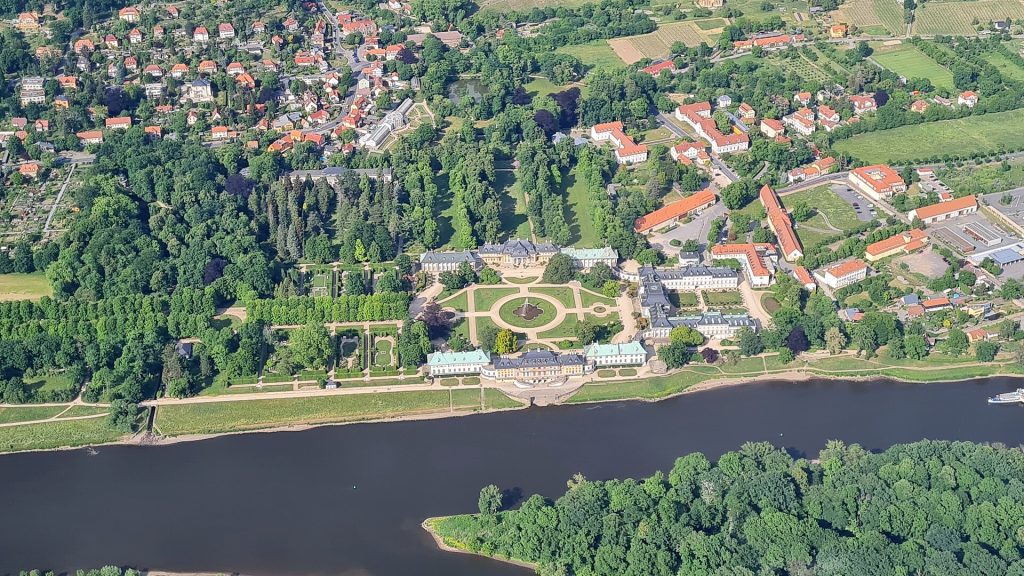
Pillnitz lies in one of the most beautiful stretches of the Elbe valley, where vineyards climb the slopes and villas dot the riverbanks. Saxony is one of the northernmost wine regions in Europe, and the vineyards around Pillnitz have been cultivated for centuries.
Above the palace rises a hill with a small church and vineyards, and a walk up the slopes rewards you with views over the palace, the river and the countryside. Some paths lead to a romantic ruin built as a garden folly and to viewpoints over the valley.
The river itself has always been central to Pillnitz. It provided the route for royal arrivals, and today paddle steamers of the Saxon fleet still stop here, linking the palace with Dresden and the Saxon Switzerland further upstream.
On a summer evening, with the sun setting over the river and the palaces glowing in warm light, Pillnitz feels like one of the most peaceful places in Germany.
The Saxon wine route passes nearby, and local wineries offer tastings of Riesling, Muller Thurgau and other varieties grown on the steep slopes above the Elbe.
For walkers, the Elbe cycle path and riverside trails offer pleasant routes to and from Pillnitz, and many people combine a visit with a walk or bike ride along the river.
The nearby Blue Wonder bridge, a famous steel bridge across the Elbe, makes a good stop on the way between Dresden and Pillnitz.
The village of Pillnitz itself is small and charming, with old houses, a church and inviting places to eat, adding to the relaxed atmosphere of a visit.
Pillnitz on Video
To get a feel for the palace and park, the video below takes you through Pillnitz, from the river stairs and palaces to the gardens and the famous camellia.
Watch for the curving roofs, the painted eaves and the formal garden between the palaces.
The video also captures the river views and the atmosphere of the park, which are hard to convey in still photographs.
If the video inspires you, the final section covers practical tips for your visit.
Visiting Pillnitz Today

Pillnitz lies about fifteen kilometres southeast of the centre of Dresden. You can reach it by bus or tram combined with a short walk, or, most memorably, by paddle steamer from the Terrassenufer in Dresden. The river trip takes a little over an hour and offers lovely views along the way.
The park is open all year, while the palace museum and the Museum of Decorative Arts are usually open from spring to autumn. The camellia house is open during the flowering season. Check current opening times before you go.
Plan at least half a day to see the palaces, the museums and the park, and longer if you want to walk in the vineyards or combine your visit with other sights along the Elbe.
Pillnitz is part of the Palaces, Castles and Gardens of Saxony, and it makes a perfect pairing with Dresden’s Zwinger and Residence Palace or with Moritzburg Castle a short drive north of the city.
There are cafes and restaurants in the village and on the palace grounds, where you can enjoy Saxon specialities and a glass of local wine after your visit.
Whatever the season, Pillnitz offers a rare combination of palace architecture, exotic fantasy and natural beauty, and it remains one of the most charming royal residences in Germany.
If you have more time, consider staying overnight in the area to enjoy the palace gardens in the quiet of early morning or evening, when the day visitors have gone.
Combined tickets often cover the palace museum, the Museum of Decorative Arts and the palm house, offering good value if you plan to see several parts of the estate.
View the location on Google Maps
Palaces Nearby
If Pillnitz has charmed you, Saxony and central Germany hold more remarkable residences. Here are two more well worth adding to your journey:
- Moritzburg Castle – the baroque hunting palace of Augustus the Strong set on an island north of Dresden.
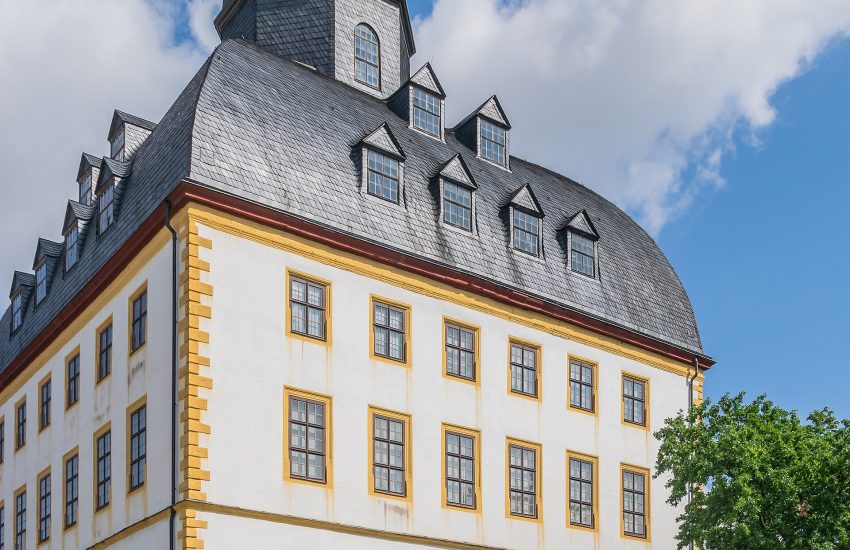
- Friedenstein Palace – the vast early baroque palace above Gotha, home of the Ekhof Theatre and its working stage machinery.
You May Like
Friedenstein Palace in Gotha and Its Living Baroque Theatre