Picture a golden baroque palace rising straight out of a lake, its four round towers reflected in the still water, approached across a long stone causeway that seems to lead you into a fairy tale. This is Moritzburg Castle, one of the most romantic and photogenic palaces in all of Germany, and the moment you catch your first glimpse of it floating on its island you understand why it has captured imaginations for centuries.
Set in the gentle countryside of Saxony a short distance from Dresden, Moritzburg was built as a pleasure palace and hunting retreat for one of the most flamboyant rulers in European history. Everything about it is designed for delight, from its sunny yellow walls to the great lake that surrounds it, and it remains one of the loveliest places to spend a day anywhere in eastern Germany.
In this article we are going to wander through the whole story of Moritzburg, from its origins as a modest hunting lodge to its transformation into the baroque jewel you see today. You will meet the extravagant king who shaped it, discover its most astonishing rooms, learn about its surprising starring role in a beloved film, and find out everything you need to plan your own visit. Come along, because few palaces reward the journey quite like this one.
In This Article
- From Hunting Lodge to Palace
- The King Who Loved Splendour
- A Baroque Transformation
- The Palace on the Water
- A Temple to the Hunt
- Rooms of Wonder
- The Palace Chapel
- Lake, Park, and Pheasant Castle
- A Fairy Tale Come to Life
- Through the Centuries
- Treasures and Curiosities
- See Moritzburg in Motion
- Visiting Moritzburg Today
From Hunting Lodge to Palace
Moritzburg did not begin as the grand baroque palace we admire today. Its origins lie in the middle of the sixteenth century, when a duke of Saxony named Moritz built a hunting lodge here in the game-rich forests outside Dresden. It was from this early ruler that the place took its name, and for a long time it served simply as a convenient base for the aristocratic sport of the hunt.
That original lodge was a Renaissance building, practical and handsome but far more restrained than what would follow. The surrounding countryside, with its woods and its abundant game, made it an ideal retreat for the rulers of Saxony, who came here to hunt, to relax, and to escape the formalities of the court in the city.
For well over a century the lodge served this modest purpose. But the location, with its forests and its potential for a dramatic watery setting, held possibilities that a later and far more ambitious ruler would seize upon. The transformation of Moritzburg from a simple hunting seat into one of the great baroque palaces of Germany was still to come, and it would be spectacular.
The choice of this particular spot was no accident. The forests here teemed with game, and the gently rolling, well-watered landscape offered everything a hunting court could wish for. Generations of Saxon rulers prized the area for its sport, and that long association with the hunt would shape the character of the palace that eventually rose here in all its baroque glory.
The King Who Loved Splendour
The man who turned Moritzburg into a wonder was Augustus the Strong, Elector of Saxony and King of Poland, one of the most extraordinary figures of his age. Famous for his legendary physical strength, his vast appetites, and his boundless love of luxury, Augustus was a ruler who did nothing by halves, and he poured his energy and his resources into making Saxony a showcase of baroque magnificence.
Augustus had grand ambitions for his lands, and Dresden became under his rule one of the most beautiful cities in Europe. Moritzburg was part of this vision, a country palace where the splendour of his court could be displayed in a setting of rural pleasure. He wanted a residence that would dazzle guests and provide a magnificent stage for hunting parties and courtly festivities.
His personality is written all over the palace. This is a building created by a man who loved to impress, who collected beautiful things on a colossal scale, and who understood the power of spectacle. To understand Moritzburg is to understand Augustus the Strong, a ruler for whom enough was never quite enough, and whose taste for the magnificent gave Saxony some of its greatest treasures.
Augustus earned his famous nickname through feats of strength that became the stuff of legend, from bending horseshoes with his bare hands to other displays of raw power that delighted his contemporaries. But he was far more than a strongman. He was a shrewd and ambitious ruler who understood that magnificence was a form of politics, a way of asserting the prestige of Saxony on the European stage.
His reign marked a golden age for Saxony, during which Dresden and its surroundings were enriched with buildings, collections, and artistic treasures that still draw visitors from around the world today. Moritzburg was one bright jewel in this crown, a country palace that embodied the exuberance and ambition of a ruler determined to leave a lasting mark on his lands.
A Baroque Transformation
To realise his vision, Augustus turned to the brilliant architect Matthaus Daniel Poppelmann, the same gifted designer responsible for some of Dresden’s most celebrated buildings. Poppelmann took the old Renaissance lodge and reimagined it completely, transforming it into the unified baroque palace that stands today, with its four distinctive round towers and its warm, glowing facade.
The genius of the redesign lay in its setting. Poppelmann placed the palace on an island in a specially created lake, so that the building appears to rise directly from the water, approached by causeways that heighten the sense of arrival. This dramatic use of water is what gives Moritzburg its unique and unforgettable character, setting it apart from almost every other palace of its kind.
The result is a masterpiece of baroque planning, where architecture and landscape work together as a single composition. The symmetry of the building, the mirror of the lake, and the careful framing of views all combine to create a scene of calculated beauty. It is a palace designed to be seen and admired from every angle, and it succeeds triumphantly.
Poppelmann was one of the defining architects of the Saxon baroque, and his work gave Dresden and its region an architectural character admired across Europe. At Moritzburg he showed his mastery of the grand gesture, taking an existing structure and lifting it into something far greater, a transformation so complete that the finished palace feels entirely of a single, confident vision.
The Palace on the Water
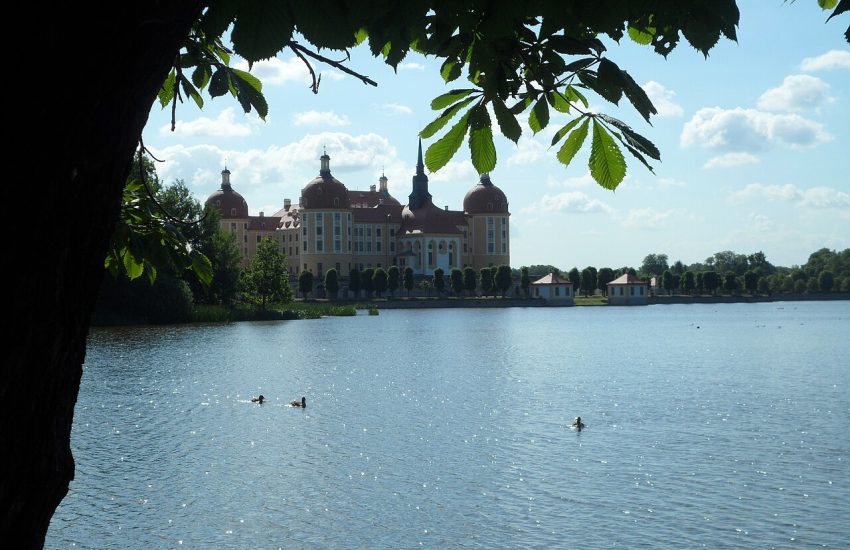
The exterior of Moritzburg is one of the great sights of Saxony. The main building, painted in a cheerful shade of yellow with contrasting detailing, sits foursquare on its island, anchored at each corner by a massive round tower. The effect is both powerful and graceful, a building that feels solid and imposing yet also light and welcoming, thanks to its colour and its watery surroundings.
Approaching across the causeway is part of the magic. As you walk toward the palace, it grows before you, its reflection shimmering in the lake, until you arrive at the broad terrace that surrounds the building. From here the views back across the water to the surrounding parkland are superb, and you begin to appreciate the full cleverness of the island setting.
Few palaces are so perfectly married to their landscape. The lake does not merely surround Moritzburg, it completes it, doubling the architecture in reflection and lending the whole scene a dreamlike quality. Whether seen in bright summer sunshine, autumn mist, or winter frost, the palace on the water never fails to make a strong impression.
The four round towers are the signature feature of the design, giving the palace its distinctive and instantly recognisable silhouette. Rising at each corner and capped with curving roofs, they lend the building a sense of solidity and balance, their forms echoed in the calm surface of the lake below. It is a composition of beautiful simplicity and great power.
The warm yellow of the walls plays a crucial role in the palace’s charm. Against the blue of the water and the green of the surrounding park, the colour glows invitingly, giving Moritzburg a sunny, welcoming character that softens its considerable size. Even on a grey day the facade seems to hold a little warmth, a touch of baroque cheerfulness in the Saxon countryside.
Photographers and painters have long been drawn to Moritzburg precisely because of how completely it rewards the eye from every direction. There is no bad angle here, no awkward rear elevation to hide. The palace was conceived as a free-standing object in the landscape, meant to be circled and admired, and that generosity of design is part of what makes it so deeply satisfying to visit.
A Temple to the Hunt
At its heart, Moritzburg was a hunting palace, and the passion for the chase that gave rise to it is reflected everywhere inside. Hunting was far more than a sport for the rulers of Saxony. It was a central ritual of court life, a display of prowess and status, and a source of endless entertainment, and Moritzburg was designed to celebrate it in the grandest possible style.
The most famous expression of this is the palace’s extraordinary collection of hunting trophies, above all its display of red deer antlers. Among these are some truly remarkable specimens, including deformed and oversized antlers of astonishing size that were prized as curiosities and mounted for all to marvel at. These trophies turn whole rooms into galleries of the hunt.
To walk through these spaces is to step into the mindset of a vanished aristocratic world, one in which the pursuit of game was woven into the very fabric of power and pleasure. The scale of the collection speaks of countless hunts across the Saxon forests, and of a court for which the chase was one of the supreme expressions of princely life.
The great hall that houses the most impressive of the antler trophies is a sight that stays with every visitor. Row upon row of mounted antlers climb the walls, some of them of truly record-breaking proportions, creating an atmosphere that is part gallery, part temple to the aristocratic obsession with the chase. It is unlike almost anything else you will see in a European palace.
These trophies were not merely decoration but a record of status and achievement, each set of antlers a memento of a particular hunt and a particular triumph. For the rulers who assembled them, the collection was a source of enormous pride, a visible testament to the richness of their forests and the grandeur of the sporting life they led at Moritzburg.
Rooms of Wonder
Inside, Moritzburg is a treasure house of baroque decoration, its rooms filled with fine furnishings, paintings, and objects gathered by Augustus the Strong and his successors. The interiors were designed to impress, with richly decorated walls, elaborate ceilings, and a sense of luxury appropriate to a king who delighted in the finer things.
Among the most celebrated spaces is a room associated with a legendary bed, lavishly decorated with vast quantities of feathers in an astonishing feat of decorative craftsmanship. This kind of extravagant, almost fantastical luxury is entirely in keeping with the spirit of Augustus, a ruler for whom no indulgence was too great if it would dazzle his guests.
The rooms also display the king’s love of collecting, from fine leather wall hangings to porcelain and precious objects. Each space tells part of the story of a court devoted to magnificence, and together they create an experience of baroque splendour that is both overwhelming and delightful. Moritzburg is a palace where every room holds a surprise.
The decoration of the interiors was carefully conceived to create a sense of mounting splendour as visitors passed from room to room. Colours, fabrics, and furnishings were chosen to harmonise and to dazzle, so that the experience of moving through the palace was itself a kind of performance, each space building on the impression created by the last.
What makes these rooms so compelling is the way they preserve the atmosphere of a particular world, the world of an eighteenth-century princely court at play. This was a palace for pleasure rather than government, and the interiors breathe that spirit of leisure and display, of a ruling class that had the means and the confidence to surround itself with beauty on a lavish scale.
The Palace Chapel
One of the glories of Moritzburg is its baroque chapel, a richly decorated space that provided for the spiritual needs of the court amid all the worldly splendour. In the baroque age, faith and display went hand in hand, and a palace chapel was expected to be as beautiful and impressive as any of the state rooms, a fitting setting for worship by a royal household.
The chapel at Moritzburg is a jewel of decoration, its interior adorned with ornate detailing, fine craftsmanship, and the characteristic exuberance of the baroque style. It stands as a reminder that this pleasure palace was also, in its way, a complete princely residence, equipped with everything the court required, including a place to pray in suitably magnificent surroundings.
Set within the wider splendour of the palace, the chapel offers a moment of a different kind of beauty, one directed heavenward rather than toward the pleasures of the hunt and the court. It completes the picture of Moritzburg as a self-contained world, a place designed to serve every aspect of aristocratic life in the grandest of styles.
The chapel also served as a setting for important ceremonies in the life of the court, its beauty lending appropriate dignity to the great occasions it hosted. In a building otherwise devoted to pleasure and display, it provided a space apart, where the solemn and the sacred could be given their due amid surroundings of the finest baroque artistry.
Lake, Park, and Pheasant Castle
The setting of Moritzburg extends far beyond the palace island itself. The surrounding park and landscape were shaped to complement the building, with the great lake as its centrepiece and further lakes, avenues, and woodland extending the composition out into the countryside. This is a palace to be experienced in its landscape, not just as a building.
Hidden within the grounds is one of Moritzburg’s most charming features, a small and exquisite later addition known as the pheasant castle, a miniature pleasure palace built for the amusement of the court. Delicately decorated and set in its own picturesque surroundings, it offers an intimate counterpoint to the grandeur of the main palace, a little jewel tucked into the parkland.
Walking or cycling through the park is one of the great pleasures of a visit. The paths lead you between the lakes and through the woods, offering ever-changing views of the palace and its reflection, and connecting the various features of this carefully designed landscape. It is a place made for leisurely exploration, exactly as its creators intended.
The lakes around Moritzburg were not only beautiful but practical, part of a managed landscape that supplied the court and enhanced the setting. Over the generations the park was shaped and reshaped according to changing fashions, yet it never lost its essential character as a green and watery stage for the golden palace at its heart.
A Fairy Tale Come to Life
Moritzburg holds a special place in the hearts of many across central Europe thanks to its starring role in a beloved fairy tale film. The palace and its wintry surroundings served as a key location for a much-loved cinematic version of the Cinderella story, a film that has become a treasured part of the Christmas season for generations of viewers in Germany, the Czech lands, and beyond.
Thanks to this connection, the palace has taken on an almost magical status for countless fans, who come to see the real setting of a story they have loved since childhood. In the colder months Moritzburg even hosts special exhibitions celebrating the film, allowing visitors to step directly into the world of the fairy tale and relive its most enchanting moments.
It is a wonderful example of how a historic building can gather new layers of meaning over time. For many visitors Moritzburg is not only a baroque palace of great beauty but also the castle from a cherished story, a place where history and imagination meet, and where the line between the real and the fairy tale grows delightfully thin.
The film in question has become an enduring seasonal classic, broadcast every year and watched by millions who return to it as a cherished holiday tradition. Its blend of romance, humour, and wintry beauty has given it a devoted following across several countries, and Moritzburg, as its castle, has become inseparable from the magic of the story in the minds of its many fans.
Visiting the palace in winter, when snow lies on the park and the lake, is to see it transformed into the very image of a fairy tale, exactly as it appears on screen. It is no wonder that so many visitors make a special pilgrimage at this time of year, eager to experience the enchantment of the story in the real and beautiful setting where so much of it was brought to life.
Through the Centuries
After the glory days of Augustus the Strong, Moritzburg continued to serve the rulers of Saxony as a hunting palace and country retreat for generations. It remained in the hands of the royal house through many changes in the fortunes of Saxony, a constant and beloved presence in a region that saw more than its share of upheaval over the centuries.
Like so much of this part of Germany, the palace passed through turbulent times, including the great political transformations of the twentieth century that swept away the old order. Through it all, Moritzburg survived, eventually becoming a museum open to the public, so that the splendour once reserved for kings and their guests could be enjoyed by everyone.
Today the palace is cared for as one of Saxony’s most treasured historic sites, its collections preserved and its rooms maintained for the enjoyment of visitors. The long continuity of its life, from ducal lodge to royal palace to public museum, gives Moritzburg a rich sense of history layered within its beautiful walls.
The survival of Moritzburg and its collections through the upheavals of modern history is a quiet triumph in itself. Where so much was lost elsewhere, this palace endured, and the decision to open it to the public ensured that its treasures would be shared rather than scattered, preserving for future generations a vivid window into the splendour of the Saxon court.
Treasures and Curiosities
Beyond its hunting trophies, Moritzburg is a storehouse of remarkable objects that reflect the collecting passions of the Saxon court. Augustus the Strong was a voracious collector, acquiring art, furnishings, and precious rarities on an enormous scale, and his successors added to the riches, filling the palace with things designed to delight, astonish, and impress visitors.
Among the treasures are superb examples of decorative craftsmanship, including magnificent gilded leather wall hangings whose intricate patterns shimmer in the light. These rare and costly furnishings were among the most prized luxuries of their day, and the collection at Moritzburg is one of the finest of its kind, a reminder of the extraordinary resources the Saxon rulers could command.
The palace also reflects the baroque love of the curious and the extraordinary, the taste for objects that provoked wonder and conversation. From striking natural specimens to exquisite works of craft, the collections at Moritzburg capture a world in which rulers delighted in surrounding themselves with the rare, the beautiful, and the marvellous, turning their palace into a cabinet of wonders.
Taken together, the collections make a visit to Moritzburg far more than an architectural experience. They are a window into the mind of a dynasty, into what its rulers valued, admired, and wished to display. In their richness and variety they tell the story of a court that reached out to the wider world in pursuit of beauty and wonder, and brought its finest prizes home to this palace on the water.
See Moritzburg in Motion
The beauty of Moritzburg is something that really comes alive in movement, in the way the palace reveals itself as you approach across the water and the way its reflection shifts with the changing light. To get a true sense of this watery wonder before you visit, it helps to see it captured on film in its full setting.
The video below carries you to the palace and its lake, giving you a feel for the scale of the building, the drama of its island setting, and the beauty of the surrounding landscape that no single photograph can quite convey. Watch for those four round towers and the shimmering reflection that makes Moritzburg so unmistakable.
Think of it as a preview of the enchantment that awaits. Nothing can quite match the feeling of walking across the causeway toward that golden facade for the first time, but a few minutes of film will give you a taste of why this palace on the water has delighted visitors for so long.
Visiting Moritzburg Today
Moritzburg today is one of the most popular day trips from Dresden, and it is easy to see why. The palace lies a short distance north of the city in the pretty countryside of Saxony, reachable by road and by public transport, which makes it a simple and rewarding addition to any trip to this beautiful region of eastern Germany. You will find its exact location on the map below.
Inside, you can explore the baroque state rooms, marvel at the famous hunting trophies, and admire the luxurious decoration that Augustus the Strong and his successors gathered here. The palace operates as a museum, with its rooms open for visitors to wander through, and there are often special exhibitions, including the hugely popular winter displays celebrating the fairy tale film.
Be sure to leave plenty of time for the grounds as well as the building. A walk around the lake, out to the pheasant castle, and through the surrounding park is an essential part of the experience, offering the finest views of the palace and a chance to enjoy its remarkable setting. Comfortable shoes and an unhurried pace are the keys to a perfect visit.
When you stand on the causeway at last, with the golden palace rising from the water before you and its reflection trembling in the lake, you will understand why Moritzburg is so beloved. It is a place of pure enchantment, a baroque dream made real, and one of those rare destinations that lives up to every expectation and then quietly exceeds it.
The journey out from Dresden is a pleasure in itself, taking you from the city into the gentle, lake-dotted countryside of this part of Saxony. Whether you come by car, by bus, or by one of the charming regional transport options, the approach builds a sense of anticipation that is amply rewarded when the palace finally appears on its island ahead of you.
However you plan your day, try not to rush. Moritzburg rewards those who take their time, who linger over the views, explore the park, and let the peaceful atmosphere of the place work on them. This is somewhere to savour rather than to tick off a list, a palace whose beauty reveals itself most fully to the unhurried visitor.
View the location on Google Maps
Palaces Nearby
If Moritzburg has worked its magic on you, there is more splendour to discover in this corner of Germany. Here are two more remarkable palaces well worth adding to your travels:
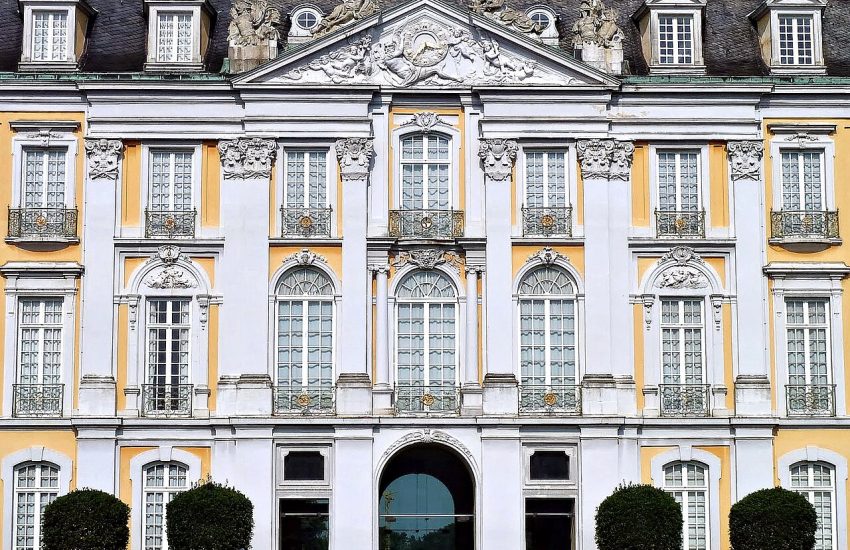
- Augustusburg Palace – a dazzling rococo masterpiece of the Cologne prince-electors with a breathtaking staircase near Bonn.
- Mannheim Palace – one of the largest baroque palaces in Europe, with a colossal facade and a splendid palace church.
You May Like
Konopiste the Bohemian Castle of a Doomed Archduke


One thought on “Moritzburg Castle the Golden Baroque Palace on a Lake”