Some palaces whisper and some palaces shout, and Mannheim Palace very definitely belongs in the second group. Stretching its enormous baroque facade across the heart of a busy German city, this is one of the largest palace complexes ever built in Europe, a building so vast that walking from one end to the other feels like a small expedition. It was designed to overwhelm, and more than three centuries later it still does exactly that.
The sheer ambition of the place tells you a great deal about the people who built it. The Palatine electors who raised Mannheim Palace were not content to keep pace with their rivals. They wanted to outdo them, to create a residence that would rank among the grandest in the German lands and announce their arrival at the very top table of European princes. The result is a monument to confidence on an almost intimidating scale.
In this article we are going to explore the whole remarkable story of Mannheim Palace, from the bold decision to move an entire court here to the devastating damage of the twentieth century and the extraordinary rebirth that followed. You will discover its glittering interiors, its famous palace church, its surprising second life as a university, and everything you need to know to visit. Settle in, because a palace this big has a story to match.
In This Article
- A Capital Moves
- Built on a Giant Scale
- The Minds Behind the Design
- Splendour Within
- The Palace Church
- A Cabinet of Learning
- The Sound of a Golden Age
- A Palace Reborn as a University
- Destruction and Loss
- Rising from the Ashes
- The Great Court of Honour
- See the Palace for Yourself
- Visiting Mannheim Palace Today
A Capital Moves
The story of Mannheim Palace begins with a dramatic decision. In the early eighteenth century the ruler of the Palatinate, Elector Carl Philipp, fell out badly with the Protestant citizens of his old capital, Heidelberg, over religious disputes. Rather than endure the friction, he made a bold move that would change the course of a city. He decided to abandon Heidelberg and build an entirely new residence from scratch in Mannheim.
It was an extraordinary act of will. Heidelberg, with its famous castle on the hill, was one of the most storied seats in Germany, and leaving it behind was no small thing. But Carl Philipp was determined, and in Mannheim he saw the chance to create something modern, something that would reflect the taste and ambitions of his age without the inconvenient baggage of the past.
Construction of the new palace began in the second decade of the eighteenth century, and the plan was audacious from the start. This was not to be a modest replacement but a statement of the very first order, a residence intended to rival the greatest courts of Europe. The decision to build here transformed Mannheim from a fortress town into a princely capital almost overnight.
The religious quarrel that drove Carl Philipp from Heidelberg was no trivial matter. He was a Catholic ruler governing a population with a strong Protestant presence, and the disputes over churches and worship had grown bitter. Moving the capital was, among other things, a way of starting fresh on ground where he could shape the religious and cultural life of his court on his own terms.
Mannheim itself was well suited to such a transformation. Laid out in a distinctive grid pattern that still defines the city centre today, it had the orderly, planned quality that appealed to an eighteenth-century prince with grand ideas. Building a colossal new palace at the edge of this geometric city was the perfect expression of a ruler determined to impose order and magnificence on his domain.
Built on a Giant Scale
It is impossible to talk about Mannheim Palace without talking about its size. This is one of the largest baroque palaces in the world, with a facade that runs for hundreds of metres and a layout containing a staggering number of rooms. It is often described as the second-largest baroque palace complex in Europe, surpassed only by Versailles itself, and standing before it you can well believe the claim.
The scale was entirely deliberate. In the competitive world of eighteenth-century princes, the size and splendour of your residence was a direct expression of your power and prestige. By building on such an enormous scale, the Palatine electors were sending an unmistakable message to their rivals about their wealth, their ambition, and their place in the hierarchy of European rulers.
Walking the length of the main facade gives you a visceral sense of this ambition. The building seems to go on and on, wing after wing, its rhythm of windows and pilasters marching across your field of vision until the whole thing reads less like a house and more like a small city under one unifying architectural idea. Few buildings anywhere manage to feel quite so commanding.
Numbers only tell part of the story, but they are striking all the same. The complex contains several hundred rooms spread across its many wings, and the main facade extends to a length that dwarfs almost every other palace of its era. To maintain and staff such a building required a small army of servants and officials, a whole community devoted to the running of the princely household.
There is a practical consequence to all this size that is easy to forget. A palace this vast was staggeringly expensive to build and to keep, and the resources poured into it represented an enormous commitment of the state’s wealth. The building is, in a sense, a monument not just to taste but to the sheer financial muscle of the Palatine electors at the height of their power.
The Minds Behind the Design
A project of this magnitude required the talents of many architects working across several decades, and the design of Mannheim Palace passed through a number of distinguished hands. The ambition to create a residence worthy of comparison with the finest in Europe meant drawing on the best ideas and the best builders available, and the palace reflects the evolving tastes of its long construction.
Among the figures associated with the building were architects trained in the grand traditions of baroque design, men who understood how to orchestrate vast spaces, create impressive sightlines, and balance overwhelming size with harmony and proportion. The challenge was not simply to build big but to build beautifully at a scale that could easily have become monotonous.
The influence of French court architecture, above all the model of Versailles, hangs over the whole conception. The idea of a sprawling residence organised around courtyards, with a central block flanked by long wings, comes directly from that tradition. Yet Mannheim is no mere copy. Its architects adapted the model to their own needs and their own site, creating something distinctly German in its monumentality.
Coordinating a building campaign that lasted for decades was a formidable task in itself. Tastes shifted over the long years of construction, from the heavier forms of the early baroque toward the lighter touch of the rococo, and the palace absorbed these changes without losing its overall unity. That it holds together so well across such a span is a quiet testament to the strength of the original conception.
Splendour Within
Behind that endless facade lay interiors of matching magnificence. The state rooms of Mannheim Palace were decorated in the full baroque and later rococo manner, with frescoed ceilings, gilded ornament, rich stucco, and the finest furnishings the court could acquire. These were spaces built for ceremony, for the elaborate rituals of princely life in which every reception and every banquet was a carefully staged performance.
The grandest of these interiors was the great hall, a soaring ceremonial space designed to take the breath away. Reached through a sequence of ever more impressive rooms, it served as the climax of the whole interior progression, the place where the full power and glory of the Palatine court was put on display for important guests and visiting dignitaries.
The decoration throughout drew on the talents of leading painters and craftsmen, who filled the ceilings with allegorical and mythological scenes celebrating the virtues and ambitions of the rulers. To move through these rooms was to be told a story in paint and gold, a story in which the electors of the Palatinate took their place among the heroes and gods of the ancient world.
Sadly, much of what you can read about these original interiors describes things that no longer survive in their first form, for reasons we will come to. Yet enough has been recovered and documented to give a clear picture of the overwhelming richness that once filled these rooms, a density of decoration that left visitors in no doubt about the status of their hosts.
Every element was coordinated toward a single effect. The colours of the walls, the patterns of the floors, the subjects of the ceiling paintings, and the placement of mirrors and furniture all worked together to produce rooms that were, in effect, immersive works of art. You did not simply stand in a Mannheim state room. You were enveloped by it.
The Palace Church
One of the jewels of the complex is the palace church, a magnificent baroque chapel built into the fabric of the residence. In an age when faith and princely power were deeply intertwined, a great palace needed a great church, a place where the ruler could worship in appropriate splendour and where the religious ceremonies of the court could be staged with full solemnity.
The church is a dazzling space, its interior rich with baroque decoration, a painted ceiling, an ornate altar, and an atmosphere of serene grandeur. It was designed to lift the spirit and to impress, blending devotion with display in a way that was entirely characteristic of its time. Light, colour, and ornament all combine to create a powerful sense of sacred theatre.
For the Catholic electors who built it, the palace church was also a statement in itself, a visible assertion of their faith at a time of real religious tension in the region. It stands as a reminder that this was not only a seat of worldly power but also a centre of court religion, where the spiritual and the political were woven tightly together.
The palace church also served the wider community in certain respects, binding the ruling house to the religious life of the capital. Its bells, its ceremonies, and its music were part of the rhythm of the city, and its grandeur reflected not only the piety of the electors but their determination that even their worship should take place in surroundings worthy of their rank.
A Cabinet of Learning
Among the many treasures of the palace was its library and the cultivated world of learning that the court fostered. The electors of the Palatinate styled themselves as patrons of knowledge as well as of the arts, and the palace housed spaces devoted to books, collections, and scholarship, their ceilings painted with suitably elevated themes celebrating wisdom and the sciences.
These rooms reflected an ideal of the enlightened prince, the ruler who was not merely powerful but also cultured, surrounded by learning and devoted to the advancement of the arts and sciences. In the eighteenth century this was a fashionable and serious ambition, and the great courts competed to attract scholars, artists, and musicians to their service.
That atmosphere of cultivation would leave a lasting mark on the palace and the city. The tradition of learning nurtured here helped lay the groundwork for the institution that occupies much of the building today, giving the old rooms a continuity of purpose that few palaces can claim across such a span of centuries.
The pursuit of learning at the Palatine court was part of a wider European movement in which rulers sought to surround themselves with the brightest minds of the age. Scholars, scientists, and artists found patronage here, and the intellectual life nurtured within these walls gave the palace a reputation that extended well beyond its role as a seat of government.
The Sound of a Golden Age
Under the electors, and especially during the reign of Carl Theodor, Mannheim became one of the most important musical centres in all of Europe. The court assembled an orchestra of extraordinary quality, and the composers and performers gathered here developed new ways of playing and writing that influenced the entire future of Western music. This flowering is remembered as the Mannheim School.
The innovations were real and lasting. The Mannheim orchestra became famous for its precision, its dramatic swells of volume, and its new expressive effects, techniques that amazed listeners across the continent and shaped the symphonic style that composers like Mozart would later inherit. Mozart himself visited Mannheim and was deeply impressed by what he heard here.
To imagine the palace in its heyday, then, you have to fill it with sound. These enormous rooms were not silent museums but living spaces alive with music, where a brilliant court orchestra set new standards and a golden age of German musical life unfolded. That invisible legacy is as much a part of Mannheim Palace as its stones.
The Mannheim court orchestra was, in its day, quite possibly the finest in Europe, and musicians and composers flocked here to be part of it. Its reputation rested on a discipline and unity of playing that was genuinely new, the whole ensemble moving as one in a way that astonished audiences used to looser standards. Contemporaries spoke of it with something close to awe.
This was more than a local curiosity. The techniques pioneered here, the dramatic crescendos, the carefully shaded dynamics, the crisp ensemble playing, spread outward and helped to shape the classical style that came to dominate European music. When you remember that the young Mozart came away inspired by what he encountered in Mannheim, you begin to grasp how important this court really was to the history of music.
A Palace Reborn as a University
Here is one of the most surprising things about Mannheim Palace today. It is not primarily a museum but a working university. The University of Mannheim occupies a large part of the vast complex, and on any given day the historic wings hum with the energy of students hurrying to lectures, studying in grand halls, and bringing new life to rooms that once echoed with courtly ceremony.
There is something wonderful about this arrangement. Rather than freezing the palace as a relic, it keeps the building alive and in constant use, giving it a genuine purpose in the modern world. The electors who built it as a centre of learning and culture would surely recognise the spirit of the place, even if the particulars have changed beyond their imagining.
For visitors, this dual identity is part of the charm. You can tour the restored state rooms and the palace church to experience the historic splendour, and at the same time you get to see a great monument fulfilling a living role. Few palaces manage to be both a treasure of the past and a thriving institution of the present quite so gracefully.
The transformation into a university was not instantaneous, but it has proved remarkably successful. Today the institution is one of the most respected in Germany, particularly known for certain fields of study, and its presence fills the old palace with a youthful energy that a purely museum building could never possess. The corridors that once carried courtiers now carry students.
This living use also helps to justify the enormous cost of maintaining such a building. A palace that earns its keep as a functioning institution is far easier to preserve than one that stands empty as a monument. In that sense the marriage of ancient palace and modern university is not just charming but genuinely practical, securing the future of the building by giving it a real job to do.
Destruction and Loss
The twentieth century dealt Mannheim Palace a terrible blow. During the air raids of the Second World War, the city of Mannheim was heavily bombed, and the palace suffered catastrophic damage. Great sections of the building were gutted, roofs collapsed, and priceless interiors, with their frescoes, stucco, and furnishings, were reduced to ruins or destroyed entirely.
The loss was immense and, in many cases, irreversible. Centuries of accumulated art and craftsmanship vanished in the fires, and what remained was often a shell of blackened walls open to the sky. For a time it must have seemed that one of Germany’s greatest baroque monuments had been lost for good, another casualty of a brutal conflict.
It is sobering to stand in the palace today and remember that so much of what you see is not the untouched original but the fruit of a long and painstaking recovery. The scars of that destruction are part of the building’s story, a reminder of how fragile even the greatest works of art can be, and of how much was swept away in a few terrible years.
Historians who have studied the destruction describe it as one of the most severe losses suffered by any German palace in the war. The combination of high explosive and fire was merciless to the delicate interiors, and the recovery of even a fraction of the original decoration required decades of determined effort in the years that followed.
Rising from the Ashes
What happened next is a genuine triumph. In the decades after the war, Mannheim Palace was painstakingly reconstructed, its damaged wings rebuilt and its great interiors carefully restored. This was an enormous undertaking, requiring skill, patience, and a deep commitment to recovering what had been lost, and it unfolded over many years.
The restorers faced difficult choices. Some spaces were returned as closely as possible to their original baroque splendour, with frescoes and decoration recreated from old records and surviving fragments, while others were adapted for new uses, above all the needs of the university. The result is a thoughtful blend of faithful restoration and practical renewal.
The showpiece state rooms and the palace church today give a vivid impression of the palace in its glory, their decoration lovingly brought back to life. To visit is to witness not only the achievement of the eighteenth century but also the determination of a later age to reclaim its heritage from the rubble. The rebirth of Mannheim Palace is, in its own way, as impressive as its original construction.
It is worth reflecting on what this recovery represents. To rebuild a palace of this scale after such devastation was an act of faith in the value of the past, a decision that the heritage embodied here was worth the immense effort and expense of restoration. Not every damaged monument was so fortunate, and Mannheim’s survival is a reminder of what determined stewardship can achieve.
The Great Court of Honour
No palace of this scale could open directly onto the street, and Mannheim is approached through a vast ceremonial forecourt known as the court of honour. This enormous open space, framed by the sweeping wings of the palace, was designed to prepare arriving visitors for the magnificence within, slowing their approach and building a sense of anticipation as the full breadth of the facade revealed itself.
The court of honour was a stage in its own right. Carriages would sweep across it, guards would be drawn up in formation, and the whole theatre of princely arrival would play out against the backdrop of that immense building. Even today, standing in the middle of this great space, you feel the deliberate drama of the design, the way the architecture reaches out to embrace and impress you.
Beyond the main block the palace once opened onto formal gardens that extended its geometry out into the landscape, a green continuation of the ordered world within. Though the city has grown up around the palace over the centuries, the sense of a grand processional approach survives, and the court of honour remains one of the most impressive urban spaces of its kind anywhere in Germany.
At night, when the facade is illuminated, the court of honour takes on a particularly magical quality, the long rows of windows glowing against the dark and the vast building seeming to float above its own shadow. It is one of the finest sights in the city, and a reminder that great architecture can move us as much by atmosphere as by detail.
See the Palace for Yourself
The scale of Mannheim Palace is one of those things that really has to be seen to be believed. Still photographs, hemmed in by the frame, struggle to convey just how far that facade stretches or how the great interiors open up around you. To get a proper sense of the place, it helps to see it in motion before you plan your visit.
The video below takes you along the building and into its restored rooms, giving you a feel for the enormous dimensions and the richness of the decoration that no single image can capture. Watch how the facade rolls on and on, and notice the grandeur of the ceremonial spaces as the camera moves through them.
Consider it a taste of what awaits. There is no real substitute for standing in the vast courtyard and craning your neck at the endless rows of windows, but a few minutes of film will prepare you for the scale and help you appreciate just what the Palatine electors managed to create here on the banks of the Rhine.
Visiting Mannheim Palace Today
Visiting Mannheim Palace is wonderfully easy, because it sits right in the centre of the city, within comfortable reach of the main station and the bustling downtown. This is not a remote country retreat but an urban palace, woven into the fabric of a lively modern German city, which makes it a natural stop on any trip through this corner of the Rhine valley. You can pinpoint the exact spot on the map below.
The historic highlights open to visitors include the restored state rooms, often shown as a museum, and the splendid palace church, which can be admired for its baroque beauty. Walking through these spaces, you get a powerful impression of the former glory of the Palatine court, while all around you the life of the university carries on, a fascinating contrast between past and present.
Give yourself time to appreciate both sides of the palace. Tour the grand interiors to soak up the history, then step back into the courtyard or the surrounding grounds to take in the staggering scale of the whole complex. Check current opening hours and tour arrangements before you go, as access to the historic rooms may be limited to certain times.
When you finally stand before that immense facade, stretching further than the eye can comfortably take in, you will understand why Mannheim Palace has impressed visitors for three centuries. It is a monument to ambition on the grandest scale, battered by history yet gloriously restored, and still every bit as commanding as its proud builders intended it to be.
Because the palace is right in the city centre, a visit combines easily with exploring Mannheim itself, from its distinctive grid of streets to its lively squares and cultural attractions. You can turn a trip to the palace into a full day of discovery, with the great baroque monument as the centrepiece of a broader wander through this underrated German city.
It is also worth timing your visit to make the most of the historic interiors, since these are the real highlights and may not be open at all hours. A little planning ensures you get to see the restored state rooms and the palace church at their best, rather than arriving to find the doors to the grandest spaces closed for the day.
View the location on Google Maps
Palaces Nearby
If the grandeur of Mannheim has left you hungry for more, this part of Germany will not disappoint. Here are two more magnificent palaces well worth a detour:
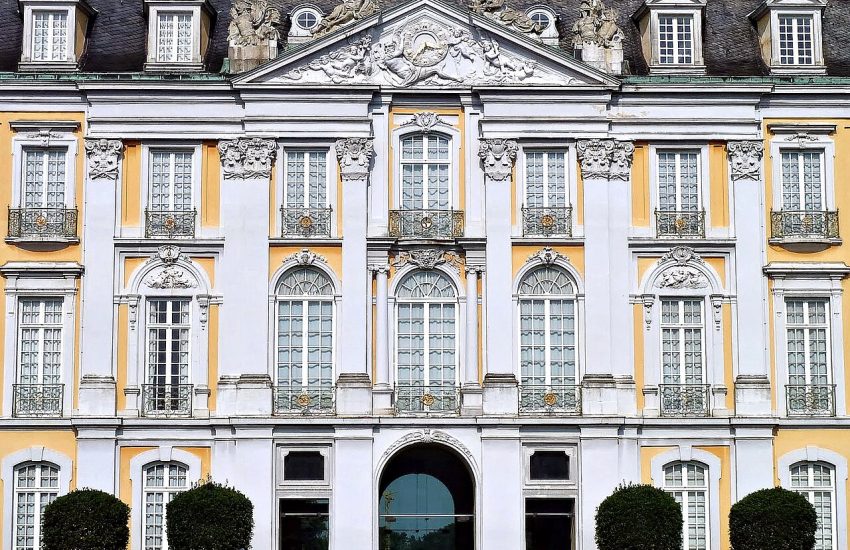
- Augustusburg Palace – a dazzling rococo masterpiece of the Cologne prince-electors with a breathtaking staircase near Bonn.
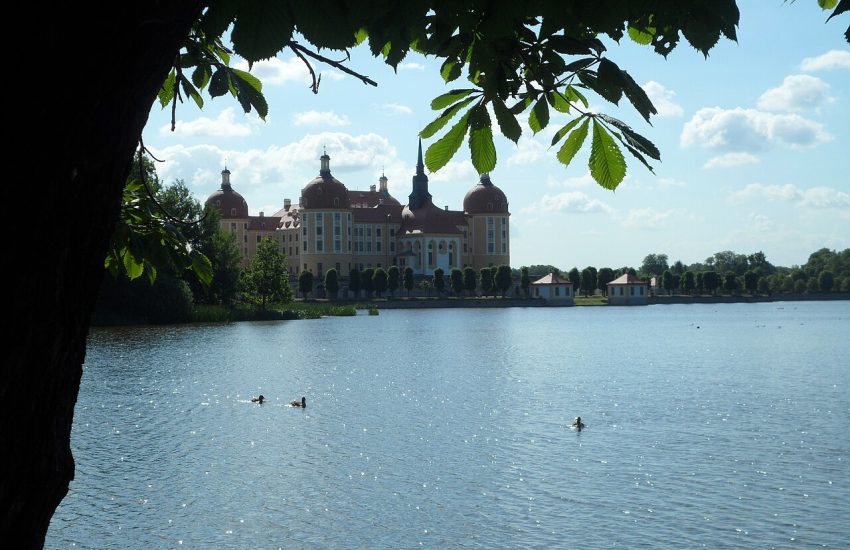
- Moritzburg Castle – a golden baroque palace rising straight out of a lake, built for Augustus the Strong in Saxony.
You May Like
Konopiste the Bohemian Castle of a Doomed Archduke


One thought on “Mannheim Palace the Colossal Baroque Wonder on the Rhine”