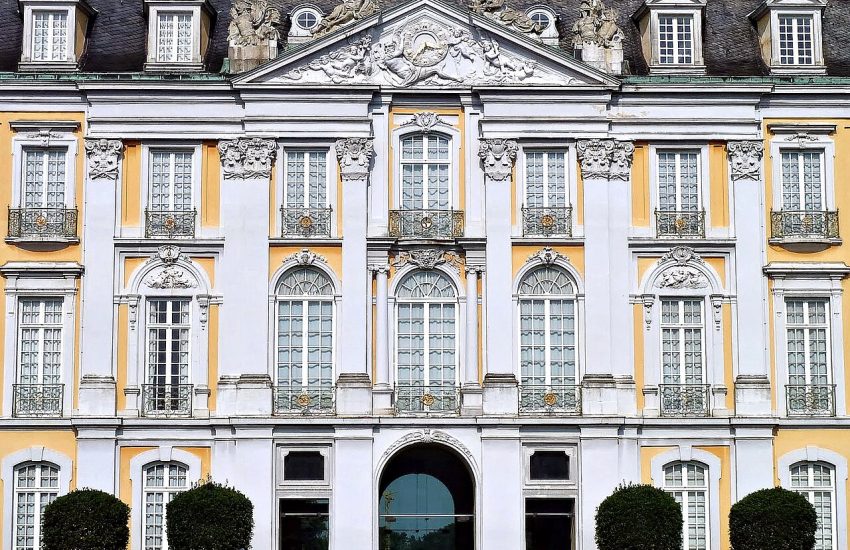
Imagine stepping off a quiet street in a small Rhineland town and walking straight into one of the most dazzling rococo interiors in all of Europe. That is the strange and wonderful surprise of Augustusburg Palace in Bruhl, a place where a prince-elector of Cologne decided he wanted beauty poured over every surface until the walls themselves seemed to sing. You are not looking at a fortress here, and you are not looking at some grim seat of power. You are looking at pure pleasure made solid, a building designed from the ground up to delight the eye and flatter the senses.
What makes Augustusburg so special is the way it refuses to be modest. The man behind it, Clemens August of Bavaria, had the money, the taste, and the ambition to hire the finest talents of his age, and he let them run. The result is a palace that feels less like a residence and more like a performance, a theatrical sequence of rooms that builds toward a staircase so breathtaking that visitors still stop dead at the bottom of it. You will understand why the moment you see it.
Over the next few thousand words you are going to walk through the whole story with me, from the ruined castle that stood here first to the UNESCO recognition that protects the palace today. You will meet the architects, the painters, and the plasterers who gave their best years to this project, and you will discover the hidden hunting lodge tucked into the woods nearby that completes the picture. By the end you will know exactly why Augustusburg deserves a place on your travel list, and how to make the most of a visit when you go.
In This Article
- Where It All Began
- The Prince Who Loved Beauty
- Building a Masterpiece
- The Staircase That Stops You Cold
- Rooms Dressed in Rococo
- Ceilings Full of Sky
- The Art of the Plasterers
- Gardens in the French Style
- The Hidden Hunting Lodge
- A Treasure for the World
- Saving the Splendour
- See It in Motion
- Visiting Augustusburg Today
Where It All Began

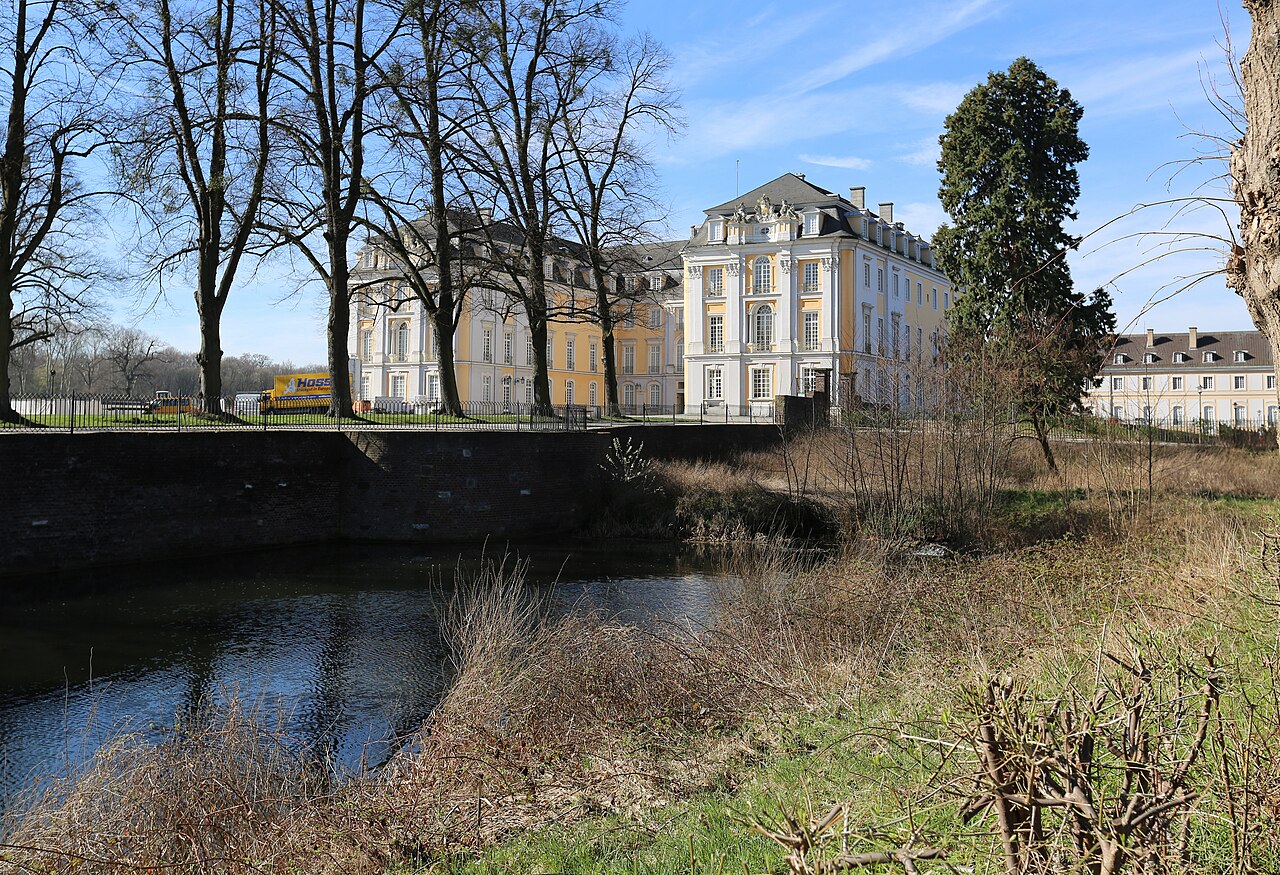
Long before the rococo gleam arrived, this spot carried a far heavier history. A medieval moated castle stood here from the fourteenth century, a defensive stronghold belonging to the archbishops of Cologne who ruled this corner of the Rhineland as powerful prince-electors of the Holy Roman Empire. That older building was a serious thing, built for protection rather than pleasure, surrounded by water and designed to keep enemies out.
War eventually caught up with it. During the conflicts of the seventeenth century the old castle was badly damaged, and by the time Clemens August inherited his position the site was little more than a romantic ruin. For many rulers that would have been the end of the story, a sad pile of stones left to crumble quietly into the landscape.
But Clemens August saw something different. He saw a canvas. The ruined walls and the surrounding land gave him the chance to build exactly the kind of palace he dreamed of, a modern residence that would announce his wealth and taste to the whole of Europe. Rather than fully demolish the past, his architects worked parts of the old structure into the new design, so that beneath all the later glamour there are still echoes of the fortress that came before.
It is worth pausing on that layering of history, because it gives Augustusburg a depth that a purely eighteenth-century building would lack. The prince-electors of Cologne were not minor figures. They sat among the seven electors who chose the Holy Roman Emperor, which made this moated castle in a quiet town a seat of genuine political weight long before any rococo ceiling was painted.
When you walk the grounds today, that older layer is easy to overlook beneath all the elegance, but it is part of what makes the place so compelling. A palace built on the bones of a fortress carries a certain tension, the memory of hard power softened and transformed into pure display. Clemens August inherited both the land and its meaning, and he chose to turn a symbol of defence into a symbol of splendour.
The Prince Who Loved Beauty

To understand Augustusburg you have to understand the remarkable man who created it. Clemens August of Bavaria was born into the Wittelsbach dynasty, one of the great ruling families of Germany, and he collected titles the way other men collect stamps. He was not only the Archbishop and Elector of Cologne but also held bishoprics in several other cities, which earned him the nickname of the lord of five churches.
He was, by every account, a man of enormous appetites and refined tastes. He loved hunting, music, and art, and he spent lavishly on all three. Where some churchmen of his era lived in sober simplicity, Clemens August threw himself into the pleasures of baroque court life with obvious joy. He wanted to be surrounded by beauty, and he had the resources to make it happen on a grand scale.
That personality is stamped all over Augustusburg. This is not a cold official building raised for duty. It is the home of a man who genuinely delighted in splendour, and every room reflects his desire to impress visitors and to live surrounded by the finest craftsmanship money could buy. When you walk through the palace you are, in a real sense, walking through his imagination.
His religious offices, it should be said, were as much about politics and family strategy as about faith. In the system of the Holy Roman Empire these great church positions carried enormous temporal power, lands, revenues, and a voice in the affairs of the empire. For a younger son of a ruling dynasty, a career in the church was a path to real authority, and Clemens August walked it with evident relish.
Yet it would be unfair to paint him only as a worldly collector of titles. He was a serious patron whose spending, however extravagant, left behind works of lasting beauty that we still travel to see. The line between vanity and genuine cultural achievement is often blurry, and at Augustusburg the balance tips firmly toward achievement.
Building a Masterpiece

Construction began in the early eighteenth century, and the project would occupy some of the greatest artistic talents of the age for decades. Clemens August did not want a provincial palace. He wanted something that could stand comparison with the courts of France and the great residences of the empire, and he was prepared to wait and pay for perfection.
The initial designs came from the architect Johann Conrad Schlaun, who began the building in a sober baroque style. But the elector soon wanted something lighter and more fashionable, and he brought in the French-trained architect Francois de Cuvillies, a brilliant designer who had made his name at the Bavarian court. Cuvillies transformed the project, pushing it toward the elegant, playful rococo style that defines the palace today.
The work stretched across many years, and the sheer ambition of it is hard to overstate. Craftsmen were brought in from across Europe, materials were sourced at great expense, and no detail was considered too small to deserve attention. The patience paid off. What emerged was not just a building but a complete artistic environment, one of the most coherent and dazzling expressions of its style anywhere.
The collaboration of so many hands over such a long span could easily have produced a muddle, a palace pulling in different stylistic directions. That it did not is a tribute to the strong guiding vision behind the project. Clemens August knew what he wanted, and the architects who shaped the building managed to fold the earlier baroque bones and the later rococo flourishes into a single, coherent statement.
It is also a reminder of how international the art world of the eighteenth century really was. French training, Italian craftsmanship, German architectural genius, and Dutch tilework all met here in one building, carried across borders by travelling masters who followed the money and the great commissions. Augustusburg is, in that sense, a thoroughly European creation, a meeting point of the finest talents the continent could offer.
The Staircase That Stops You Cold

If Augustusburg has one moment that defines it, it is the grand staircase, and it is the work of a genius. Clemens August brought in Balthasar Neumann, the greatest architect of staircases the baroque world ever produced, and Neumann gave him something close to a miracle. You enter at the bottom into a relatively contained space, and then the room opens upward in a sweep of marble, stucco, and light that feels almost impossible.
Neumann understood that a staircase could be theatre. As you climb, the perspective shifts, the decoration unfolds, and the ceiling fresco overhead reveals itself gradually until you arrive at the top transformed, ready to be received in the state rooms beyond. It was designed as a sequence of experiences, a slow reveal meant to put visitors in exactly the right frame of mind before they met the elector.
The craftsmanship is extraordinary. Artificial marble in soft colours climbs the walls, delicate stucco figures seem to float, and the whole composition is bathed in daylight from large windows. People who have seen the finest staircases of Europe routinely name this one among the very best. Stand at the bottom, look up, and you will feel the full force of what eighteenth-century artists could achieve when given freedom and funds.
It helps to know a little about Neumann to appreciate what he pulled off here. He was the master of the baroque staircase, and across the German lands he created a handful of these spaces that are considered the finest of their kind anywhere. He thought in three dimensions and in motion, designing not a static object but an experience that changes with every step you take.
At Augustusburg he was brought in to rework an earlier staircase design, and what he produced elevated the entire palace. The genius lies in the way the space expands as you rise, the balustrades sweeping in confident curves, the light pouring in to model every surface. It is architecture as choreography, and it remains the single most memorable thing most visitors carry away.
Rooms Dressed in Rococo
Beyond the staircase the palace unfolds into a series of state rooms, each one a small universe of decoration. Rococo is a style built on movement, asymmetry, and delicacy, all curling shell forms and flowing lines, and Augustusburg is one of its purest expressions. Walls shimmer with gilding, ceilings open into painted skies, and mirrors multiply the light until the rooms seem to dissolve into pure brightness.
The colour palettes are soft and sophisticated, full of pale blues, warm whites, delicate greens, and touches of gold that catch the light without overwhelming it. The effect is not heavy or oppressive the way some baroque interiors can feel. Instead it is airy and almost musical, as if the rooms themselves were composed rather than merely decorated.
Every surface rewards close attention. Door frames twist into elegant curves, overdoors carry painted scenes, and the stucco work ripples across the ceilings with astonishing finesse. These rooms were designed for receptions, banquets, and the elaborate rituals of court life, and they still carry the atmosphere of a world where appearance and ceremony were everything.
Spend time in these rooms and you start to notice how cleverly they are arranged to build toward a climax. The sequence of spaces leads the visitor onward, each room a little richer than the last, so that arriving in the grandest of them feels like a reward earned by the journey. This was the choreography of court life, where even the order in which you passed through rooms carried meaning about your status and your welcome.
The furnishings and fittings, where they survive or have been carefully reconstructed, complete the effect. Console tables, mirrors, clocks, and chandeliers were all chosen or made to harmonise with the decoration, so that nothing jars and everything contributes to the overall impression of effortless, dazzling luxury. It is a total work of art in the fullest sense.
Ceilings Full of Sky

Look up anywhere in Augustusburg and you are likely to find a painted ceiling pulling your gaze into illusionary depths. The great fresco over the staircase is the showpiece, a swirling composition that seems to open the roof to the heavens, but painted ceilings appear throughout the palace, each one adding to the sense that the building is lighter than air.
These frescoes were not simply pretty decoration. They carried meaning, celebrating the virtues, the lineage, and the ambitions of Clemens August through allegory and mythological scenes. Gods and goddesses, personifications of the arts and sciences, and symbolic figures all played their part in a visual language that educated visitors would have read like a book.
The skill involved in these paintings is remarkable. Working on curved and sloping surfaces high above the floor, the artists had to manage perspective so that the images would read correctly from below, a challenge that defeated lesser talents. At Augustusburg the illusions hold beautifully, and the ceilings still perform their old magic of making solid architecture seem to float.
The Art of the Plasterers
One of the quiet glories of Augustusburg is its stucco work, the moulded plaster decoration that covers so much of the interior. This was a specialised craft practised by travelling masters, many of them from the lake regions of northern Italy and the Alps, who could shape wet plaster into flowers, shells, figures, and endless flowing ornament with breathtaking speed and confidence.
At Augustusburg these artists had the freedom to show off. The stucco frames the frescoes, climbs the walls, and decorates the ceilings with a lightness that makes heavy plaster seem to dance. Look closely and you will see tiny details, a curl of leaf here, a playful figure there, all executed with a precision that rewards patient looking.
This kind of decoration was expensive and time-consuming, and the fact that it covers so much of the palace tells you everything about the resources Clemens August poured into the project. The stucco is not an afterthought laid over the architecture. It is woven into the whole design, binding the painted ceilings, the gilded panels, and the marble together into a single harmonious whole.
Gardens in the French Style

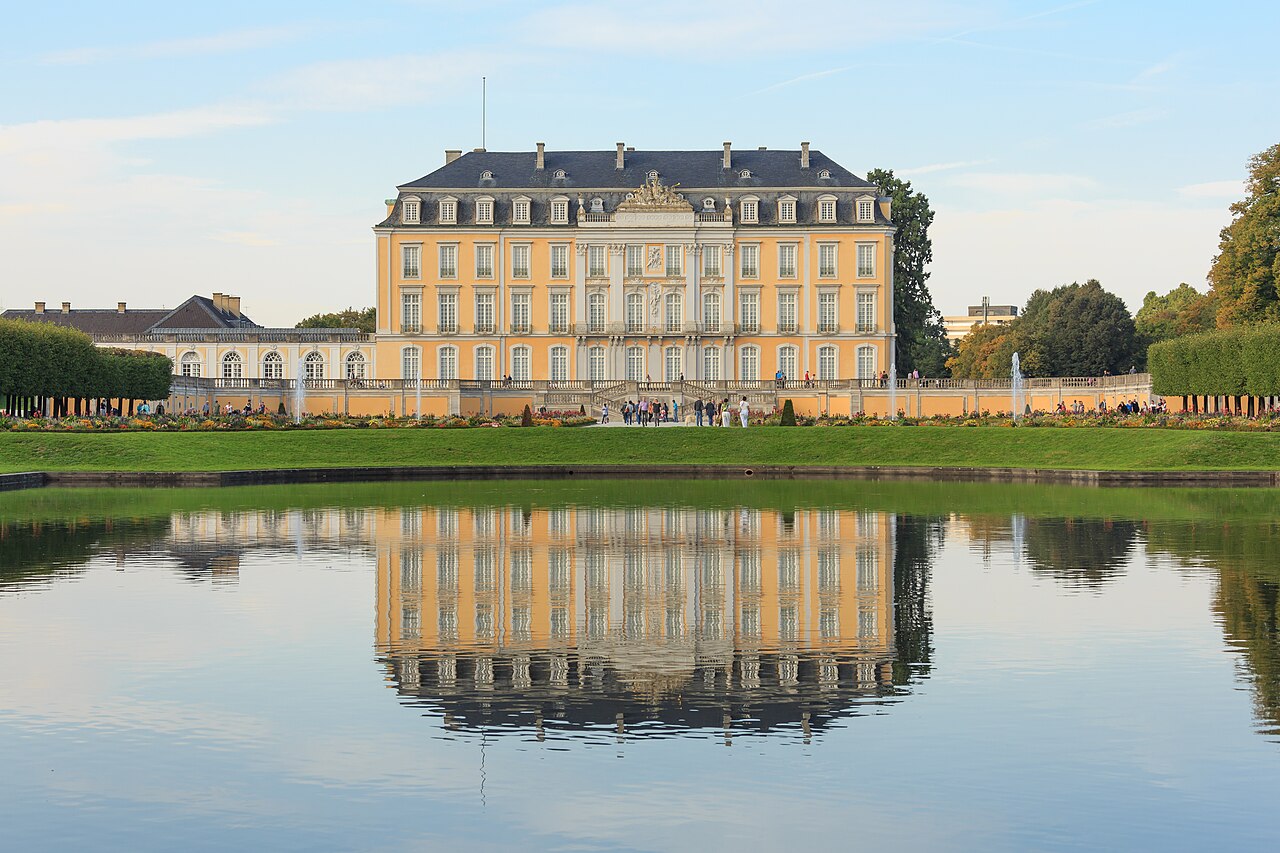
A palace of this ambition needed gardens to match, and Augustusburg has them. The grounds were laid out in the formal French style by Dominique Girard, a designer trained in the tradition of the great gardens of Versailles. The result is a landscape of geometric precision, with clipped hedges, symmetrical flower beds, ornamental water, and long sightlines that extend the architecture out into nature.
Walking in these gardens is part of the full experience of the palace. The formal parterre directly behind the building is a living pattern, best appreciated from the upper windows where the whole design reveals itself as a kind of embroidery laid out on the ground. Beyond the formal section the grounds open into more relaxed parkland, with tree-lined avenues perfect for a slow stroll.
The gardens were never just decoration. They were an extension of the court, a stage for strolling, conversation, and display, and they linked the main palace to the hunting lodge hidden in the woods beyond. To experience Augustusburg as its creator intended, you need to step outside and let the gardens draw you into the wider landscape he shaped.
The French formal garden was never meant to look natural. It was meant to show mastery, the triumph of order and human design over the unruliness of nature, and at Augustusburg that philosophy is on full display. Every hedge is a line in a vast drawing, every basin of water a mirror placed exactly where it will catch the eye and extend the view.
Seasonal planting keeps the parterre alive through the year, and the best time to see it at its most dazzling is in the warmer months when the beds are full. But even in quieter seasons the structure holds, the clipped greenery tracing its patterns across the ground, a reminder that a great garden is really a work of architecture made from living things.
The Hidden Hunting Lodge

Deep in the woods a short walk from the main palace stands one of the most charming parts of the whole estate, the hunting lodge called Falkenlust. Clemens August was passionate about falconry, the aristocratic sport of hunting with trained birds of prey, and he built this intimate retreat specifically to indulge that love. Its name means something like the joy of falconry.
Falkenlust is small compared to the main palace, but it is no less exquisite. Designed by Cuvillies, it is a jewel box of rococo decoration, with rooms lined in rare porcelain tiles, delicate paintings, and intimate spaces designed for pleasure rather than ceremony. There is even a small chapel decorated with shells and minerals in a wonderfully strange grotto style.
The lodge and the main palace were conceived as two parts of a single composition, linked by a long avenue cut through the trees so that the elector could move between them in style. Visiting both is essential if you want the full story. Falkenlust shows you the private, playful side of Clemens August, the man who loved his birds and his quiet pleasures as much as he loved grand display.
The porcelain-tiled rooms deserve a special mention. Clemens August was mad for the fashionable blue and white ceramic tiles imported from the Netherlands, and at Falkenlust he lined whole cabinets with them, creating cool, shimmering interiors unlike anything in the main palace. It is an intimate luxury, the kind of indulgence a man creates for his own private delight rather than for show.
The grotto chapel is stranger still, a small devotional space encrusted with shells, crystals, and minerals in a deliberately wild, rocky style that was hugely fashionable in its day. Coming upon it in the quiet of the woods feels like discovering a secret, and it reveals a playful, almost theatrical side of eighteenth-century taste that the grander rooms only hint at.
A Treasure for the World
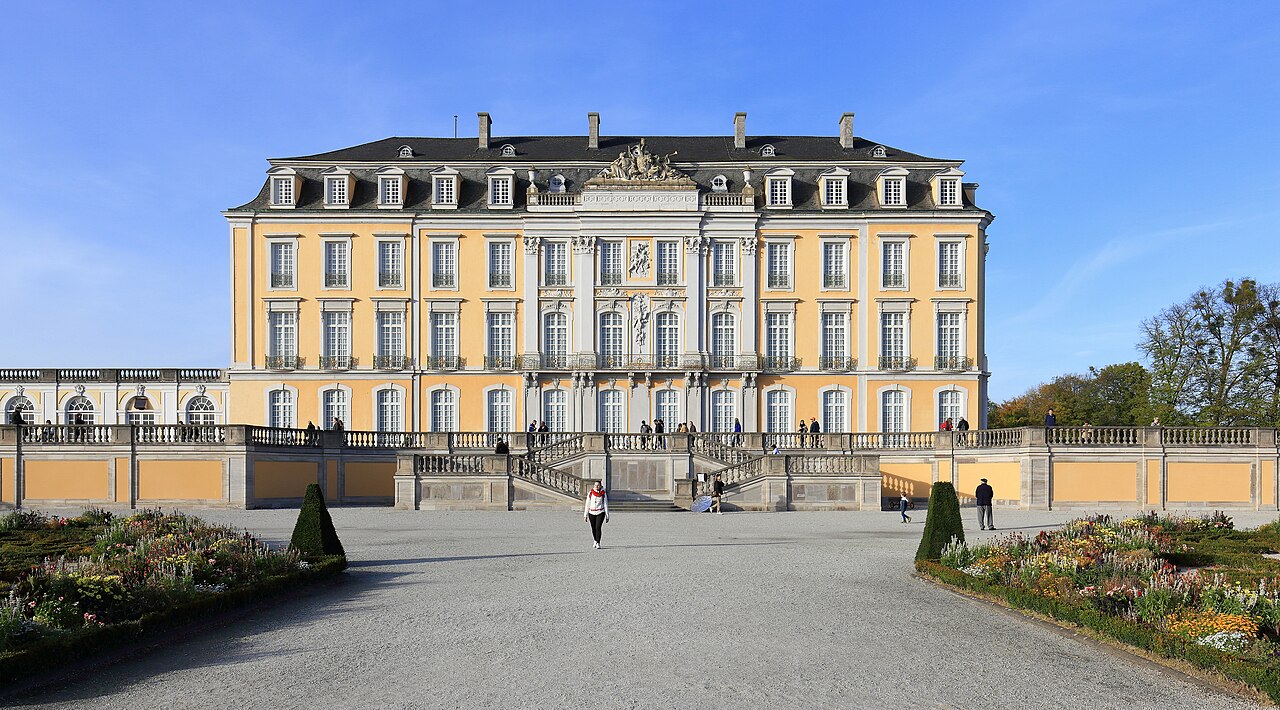
The value of Augustusburg and Falkenlust is not just a matter of local pride. In recognition of their outstanding importance, both palaces together with their gardens were inscribed on the UNESCO World Heritage List, placing them among the cultural treasures that belong, in a sense, to all of humanity. It is a status reserved for sites of truly exceptional significance.
The recognition acknowledges what makes the ensemble so special. These buildings are among the earliest and finest examples of rococo architecture in Germany, and they survive in remarkable completeness, with their interiors, gardens, and the relationship between the main palace and the lodge all intact. That wholeness is rare and precious, and it makes Augustusburg a key document in the history of European art.
World Heritage status also carries responsibility. It commits the site to careful conservation so that future generations can experience these rooms as we do. When you visit you are seeing a place that has been studied, protected, and cared for with international attention, a monument held in trust across the centuries.
Being part of that select list also places Augustusburg in remarkable company, among cathedrals, ancient cities, and natural wonders celebrated across the globe. For a palace in a modest Rhineland town, it is a striking distinction, and it confirms what visitors feel instinctively the moment they step inside, that this is a place of the very first rank.
Saving the Splendour

Augustusburg has not sailed serenely through the centuries untouched. Like so much of this region, it suffered during the great conflicts of the twentieth century, and parts of the palace were damaged and required extensive repair. The survival of such delicate decoration through those years was far from guaranteed, and its recovery is a story in itself.
Dedicated conservators have devoted enormous effort to restoring the interiors to their full glory. Working from old records, photographs, and surviving fragments, they have repaired frescoes, renewed gilding, and stabilised the fragile stucco, always with the aim of preserving as much original material as possible rather than simply replacing it.
After the war the palace even took on a new ceremonial role, serving for a time as a setting for official state receptions. It is a fitting afterlife for a building designed to impress important guests, and it kept the great rooms alive and in use rather than frozen as a museum. Today the ongoing work of care continues quietly behind the scenes, ensuring that the splendour you see is as close as possible to what Clemens August knew.
See It in Motion

Photographs can only take you so far with a place like this. The real magic of Augustusburg lies in movement, in the way the staircase unfolds as you climb it and the way light shifts across the gilded surfaces as you walk from room to room. To get a sense of that living quality, it helps to watch the palace in motion before you plan a visit.
The short film below carries you through the building and gardens, giving you a feel for the scale, the colour, and the atmosphere that still images struggle to capture. Watch how the spaces flow into one another, and keep an eye on that extraordinary staircase, which is the kind of thing you really have to see moving to believe.
Think of it as a preview rather than a substitute. No screen can replace the feeling of standing beneath those painted skies in person, but a few minutes of footage will sharpen your appetite and help you understand what all the fuss is about before you arrive at the gates.
Visiting Augustusburg Today

Augustusburg today is one of the Rhineland’s great cultural destinations, welcoming visitors who come to marvel at its rooms and wander its gardens. The palace sits in the town of Bruhl, conveniently placed between Cologne and Bonn, which makes it an easy addition to any trip through this part of western Germany. You will find the exact location on the map below.
The main palace is explored on guided tours, which is the only way to protect the delicate interiors while still letting people experience them. The tours walk you through the state rooms and, of course, up that famous staircase, with knowledgeable guides bringing the history and the artistry to life. The gardens, by contrast, are open for you to roam freely, so you can take your time among the hedges and flower beds.
Do not make the mistake of skipping Falkenlust. The hunting lodge is a short and pleasant walk from the main palace through the park, and seeing both completes the picture in a way that visiting only one cannot. Give yourself a generous half day at least, bring comfortable shoes for the grounds, and check the opening arrangements before you go, as the palace closes seasonally in the colder months.
When you finally stand at the foot of Neumann’s staircase and look up into that swirling painted sky, all the planning will feel worth it. Augustusburg is one of those rare places that lives up to every superlative, a complete and joyful vision of a vanished world, still shining as brightly as the day its proud creator first showed it off.
Getting there is refreshingly easy, which adds to the appeal. Bruhl sits on the rail line between Cologne and Bonn, and the palace is only a short walk from the station, so you can visit without a car if you prefer. That accessibility means Augustusburg makes a perfect day trip from either city, a dose of eighteenth-century splendour within easy reach of the modern Rhineland.
Photography rules inside the palace tend to be restrictive in order to protect the interiors, so be prepared to put the camera away and simply look while you are on the tour. In a way that is a gift. Freed from the urge to capture everything, you can let the rooms work on you directly, which is exactly how their creator intended them to be experienced.
View the location on Google Maps
Palaces Nearby
If Augustusburg has whetted your appetite for grand residences, you are in luck, because this region is rich with them. Here are two more remarkable palaces worth adding to your journey:
- Mannheim Palace – one of the largest baroque palaces in Europe, with a colossal facade and a splendid palace church.
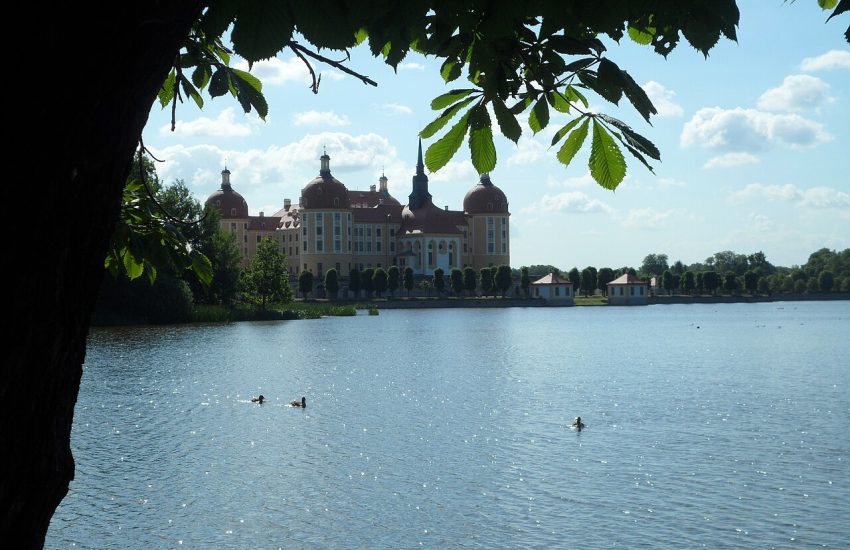
- Moritzburg Castle – a golden baroque palace rising straight out of a lake, built for Augustus the Strong in Saxony.
You May Like
Konopiste the Bohemian Castle of a Doomed Archduke