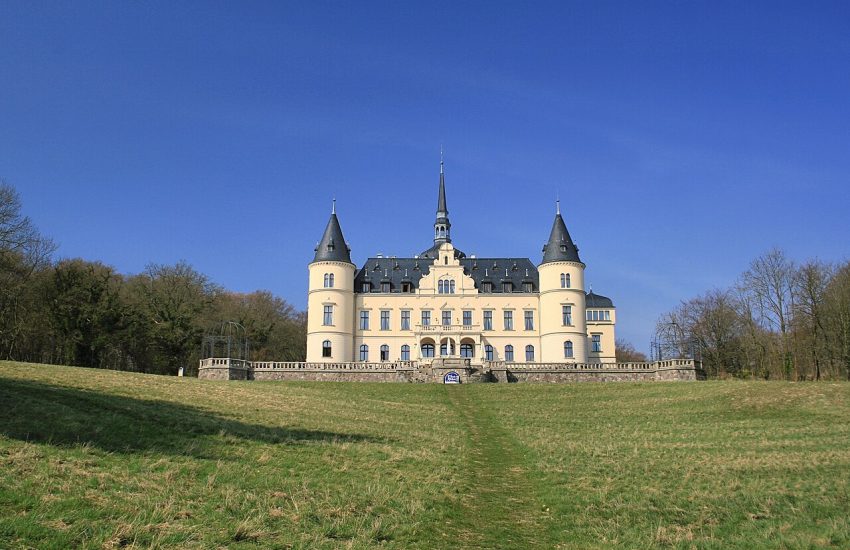
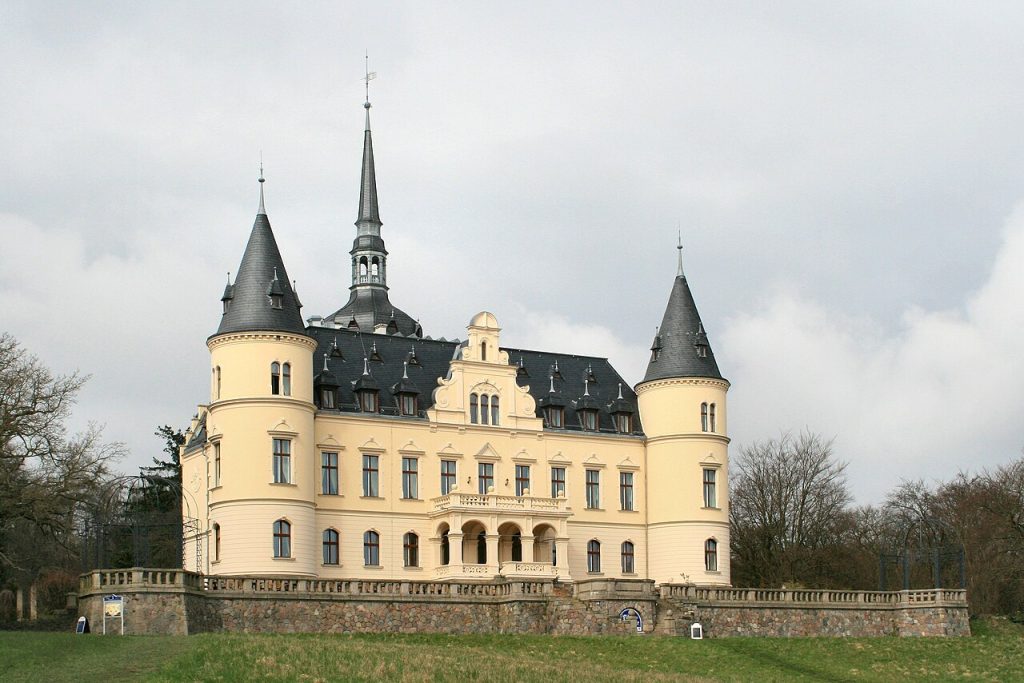
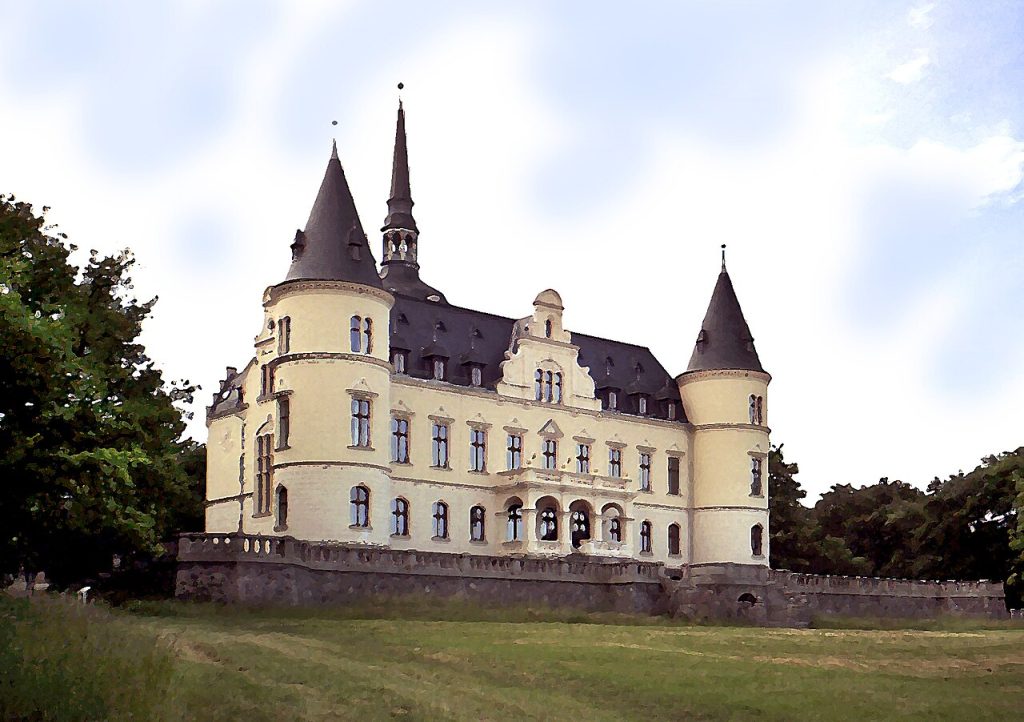
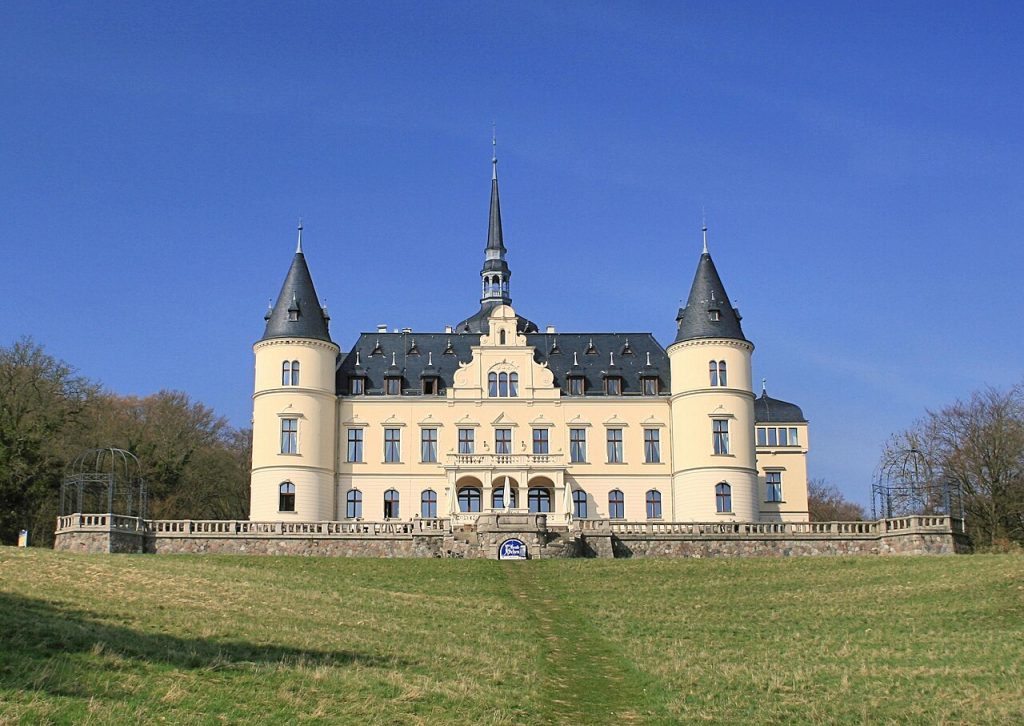
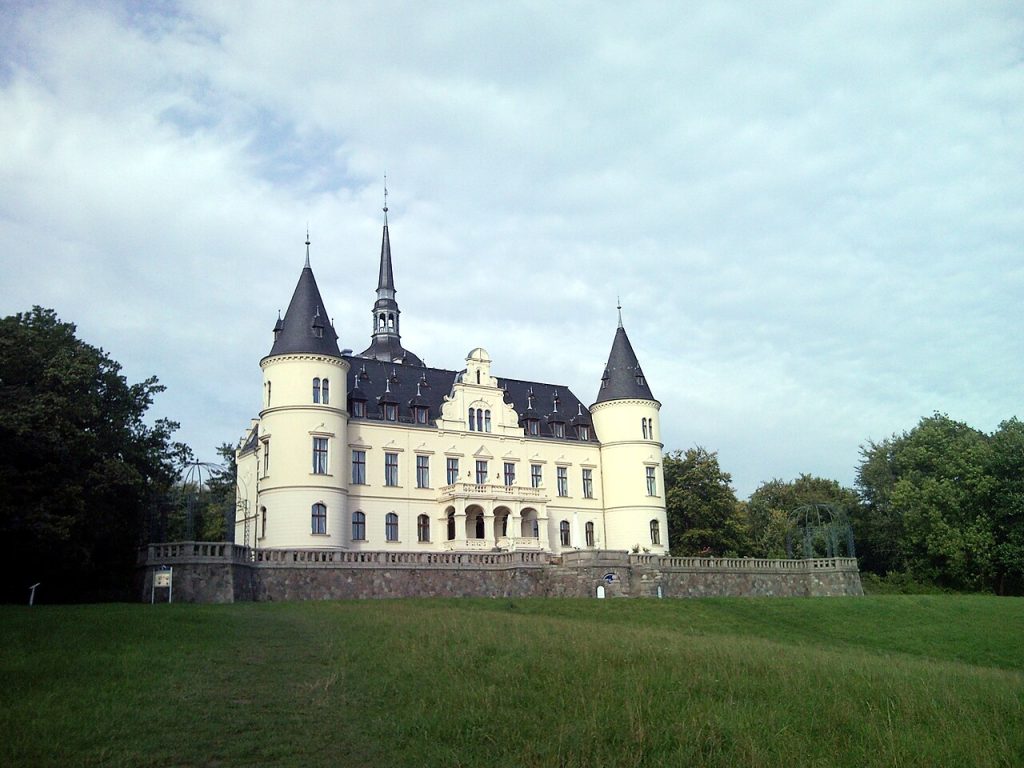
Stand on the shore of the Great Jasmund Bodden in the evening, when the water turns the colour of pewter, and look up the slope. Four slender towers rise above the trees, white walls catch the last light, and for a moment you could swear you had wandered off the Baltic island of Rügen and onto the banks of the Loire. That is exactly the effect the man who built this house wanted. Ralswiek Castle is a French Renaissance fantasy planted on a Slavic trading site, paid for with potash money by a Prussian count of Scottish blood, and today it rents you a room with a view of the pirate theatre below. Few palaces in Germany have a stranger biography.
I have walked this park in every season, and I still catch myself stopping on the terrace to work out how a building this theatrical ended up in a fishing village of a few hundred souls. The answer runs through chemistry, railways, the Kaiser’s court, the collapse of two German states and a mediaeval pirate called Klaus Störtebeker. Pull up a chair on the terrace, order a coffee, and let me walk you through it.
This is a long story, so I have broken it into stops. Use the contents below to jump around if you only have an hour before the Störtebeker show starts. Otherwise, follow me from the gatehouse to the water.
In This Article
- The Bodden, the Hill and the Village
- Silver Under the Lawn: Ralswiek Before the Castle
- A Scottish Name in a Prussian Uniform
- Potash, Chemistry and a Fortune From Salt
- Why the Loire Came to Rügen
- Four Towers and a Facade That Lies
- Inside: Oak, Hunting Trophies and the Great Staircase
- Petzold’s Park, the Last Work of Pückler’s Pupil
- The Church of Grace and the Art Nouveau Surprise
- Guests, Gossip and the Kaiser’s Shadow
- 1945: From Counts to Refugees
- Pensioners in the Ballroom: The GDR Years
- Störtebeker Loses His Head Every Night
- Ralswiek on Video
- Visiting Ralswiek Castle Today
- Palaces Nearby
The Bodden, the Hill and the Village
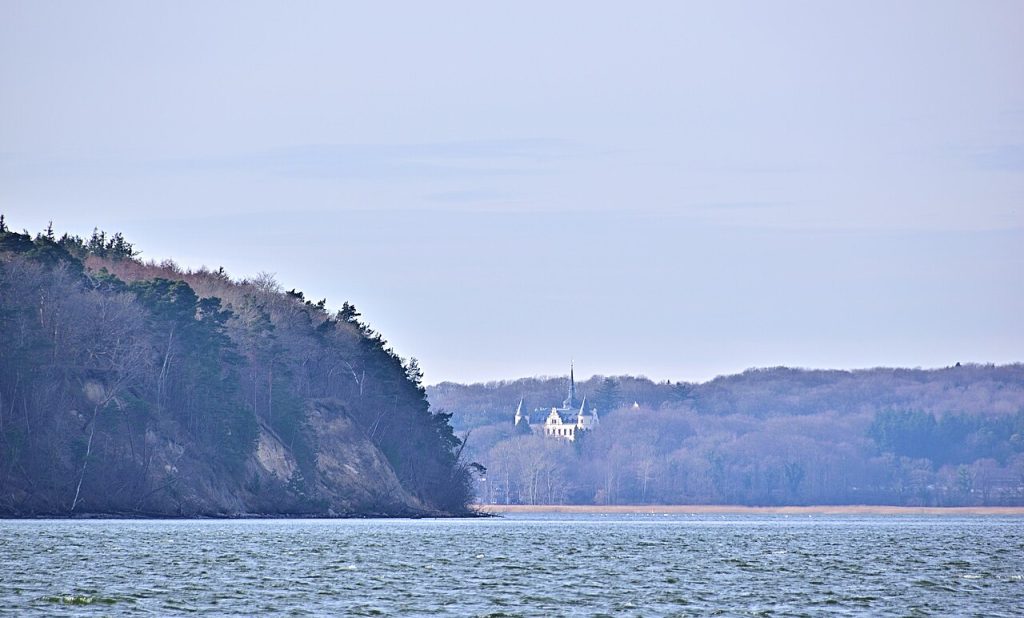
First, get your bearings. Rügen is Germany’s largest island, and its middle is hollowed out by boddens, shallow brackish lagoons that the Baltic pushes in between the headlands. The Great Jasmund Bodden is the biggest of them, and Ralswiek sits on its western shore, roughly between the island capital Bergen and the chalk cliffs of Jasmund. The village is tiny. There is a church, a handful of farmhouses, a harbour for small boats, and the hill. Everything that matters here happens on that hill or at its foot.
Now, stop here and look at the slope itself. It is not natural in its present form. The terraces, the sweeping drive, the way the lawn rolls down to the reed beds, all of that was engineered in the 1890s. Before the earthmovers came, this was a wooded bluff with a far older secret buried under the turf. We will dig that up in a moment. For now, notice how the castle is placed so that the water is always in view from the main rooms. On Rügen, where the sea is never far, that was a deliberate luxury.
Silver Under the Lawn: Ralswiek Before the Castle
Long before any count dreamed of towers, Ralswiek was one of the most important trading settlements on the southern Baltic. From the eighth to the tenth century a Slavic community, the Rani, ran a harbour here that connected the island to Scandinavia, Frisia and the river routes deep into eastern Europe. East German archaeologists, led by Joachim Herrmann, excavated the site through the 1970s and 1980s and found the remains of houses, workshops, a cult site and several clinker-built boats pulled up on the former shoreline.
The find that made headlines was a hoard of more than two thousand Arab silver dirhams, the youngest of them minted around the year 842. Somebody buried a small fortune in Islamic coins on a Baltic island and never came back for it. Think about that when you walk the lawn below the castle. Beneath your feet lie the footprints of merchants who traded with Baghdad by way of the Volga. The Douglas family, when they built here, were not the first to think Ralswiek was a good address.
A Scottish Name in a Prussian Uniform
The man who put the castle on the hill was Hugo Sholto Douglas, born in 1837 in Aschersleben in Prussian Saxony. The name is not an affectation. His family descended from a branch of the Scottish Douglases that had drifted to the continent generations earlier, and he carried the Scottish forenames proudly. He trained as a chemist, which in the middle of the nineteenth century was about the most modern thing a young man could do, and he had the rare talent of turning laboratory knowledge into industrial money.
By the 1880s Douglas was a member of the Prussian House of Lords and the Reichstag, a confidant of the court and a serious player in the salt and potash business. In 1888 he was raised to the rank of count. Men like that needed a seat to match the title, and the fashion of the day said that seat should look like a castle. Douglas looked north, to the island where he enjoyed hunting and sailing, and bought the Ralswiek estate.
Potash, Chemistry and a Fortune From Salt
Here is the part most visitors skip, and it is the key to the whole place. Potash, a group of potassium salts found in thick seams around Stassfurt and Aschersleven, is the raw material of fertiliser, glass and soap. When German mines began exploiting it in the 1860s, agriculture across Europe changed overnight, and the people who controlled the seams became as rich as any railway baron. Douglas was one of them. His family firm processed and traded the salts, and he sat on the boards that fixed prices.
So when you look at the carved stone window surrounds or the copper roofs on the towers, remember that this is fertiliser money. It is a thoroughly modern fortune dressed in old clothes. The nobility of Rügen, who had been living in brick manor houses for three hundred years, were not entirely sure what to make of the chemist count and his French castle, but they came to his dinners anyway.
Why the Loire Came to Rügen
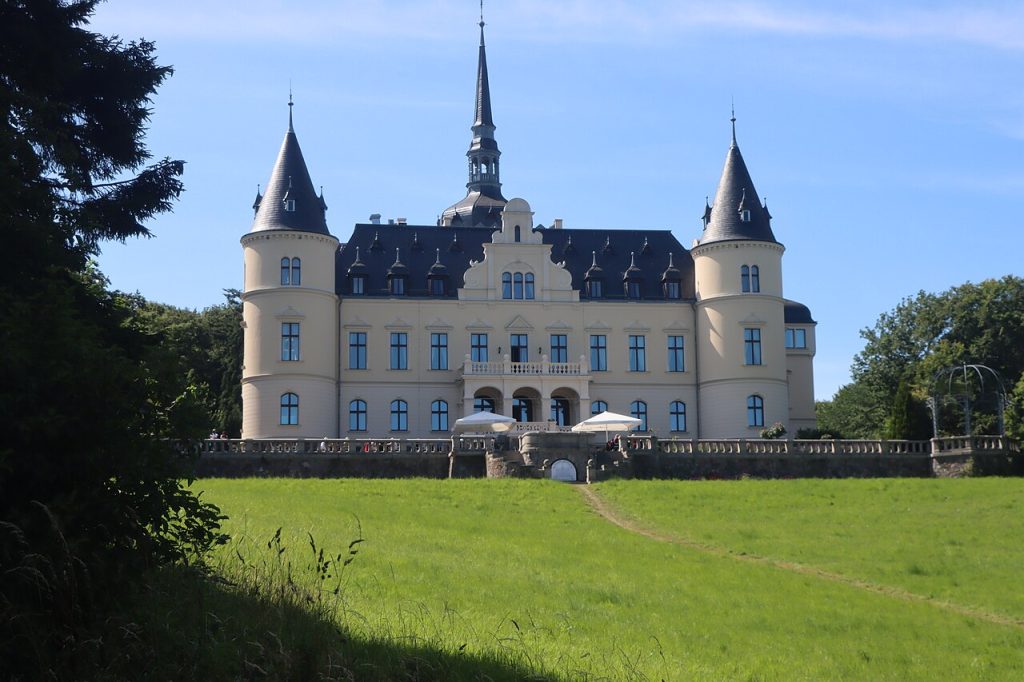
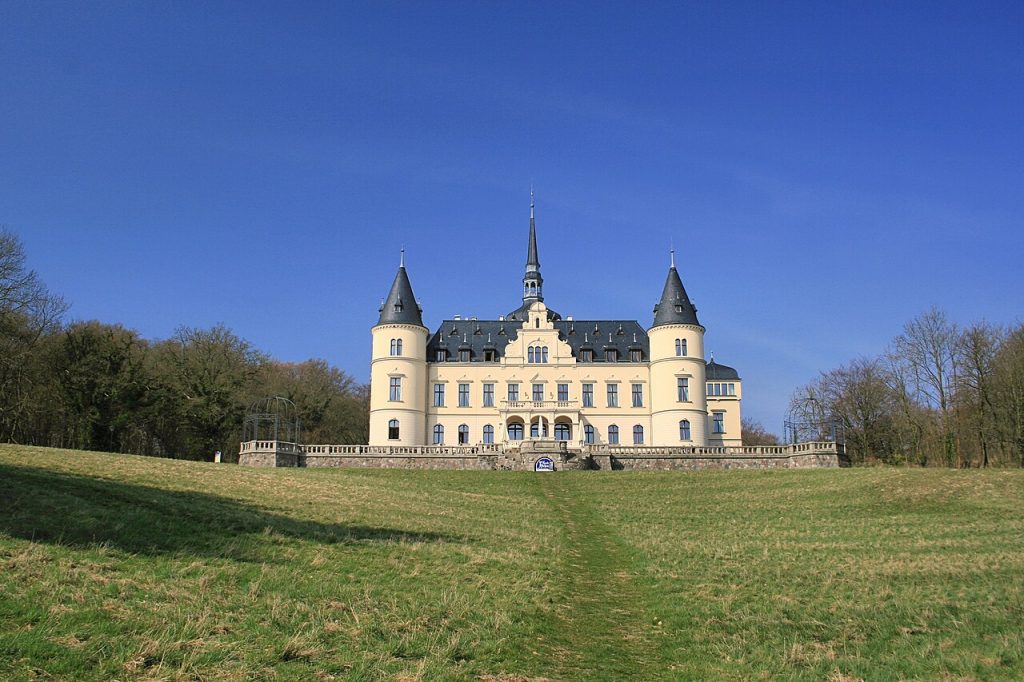
Douglas commissioned the Berlin architect Gustav Steinmetz, and the brief was unmistakable. The house would be built between 1893 and 1896 in the manner of the French Renaissance, the style of Chambord and Azay-le-Rideau. That was a bold choice in the German Empire of the 1890s, when most new money built in a heavy neo-Gothic or neo-Baroque to prove it was German. Douglas, a well-travelled man who had spent time in France, wanted lightness and elegance instead.
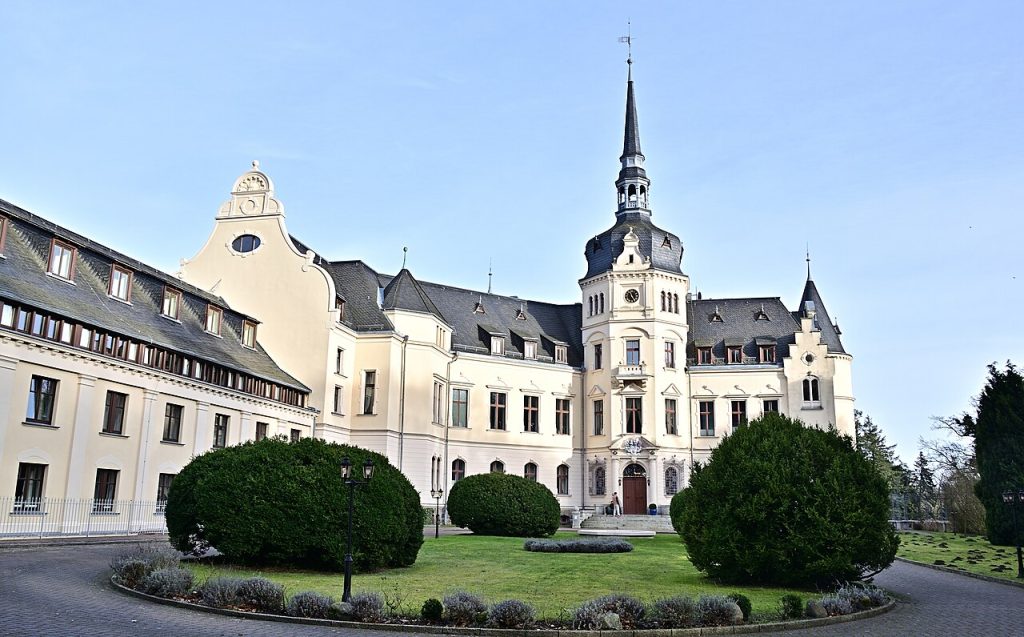
Now, stop here and look up at the roofline. The steep slate roofs, the tall chimneys, the dormers with their carved pediments, the round towers with conical caps, all of this is straight out of the Loire valley. On a grey Baltic afternoon it can look wonderfully out of place, like a visitor who dressed for a different party. On a bright summer evening, with the lagoon below, it is one of the most romantic silhouettes in northern Germany.
Four Towers and a Facade That Lies
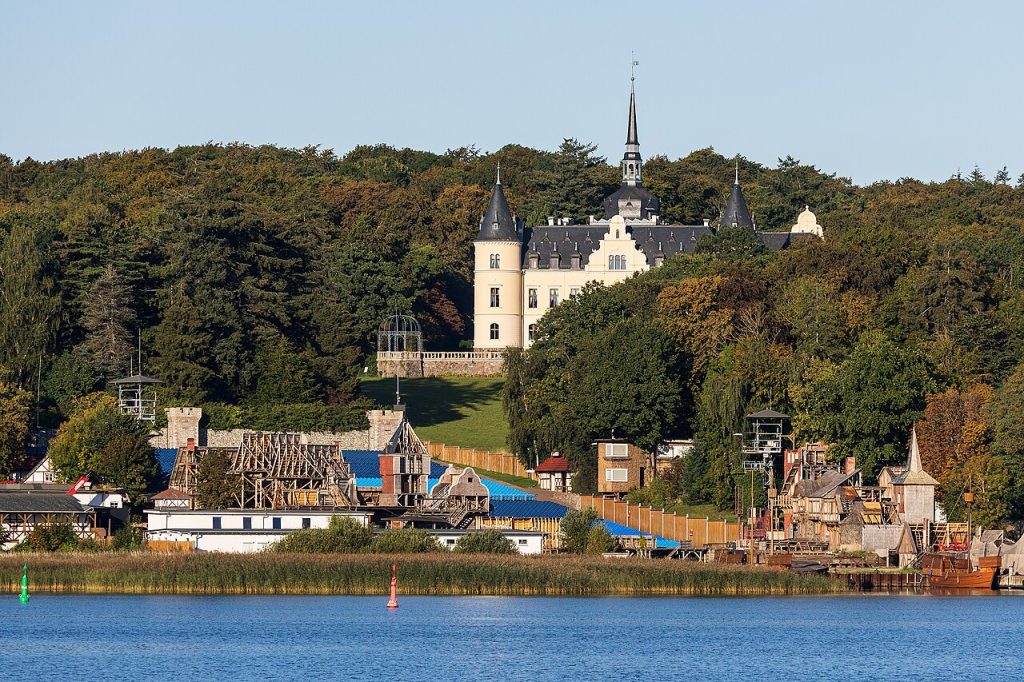
The building is roughly rectangular with a round tower at each corner, and the trick is in the material. The chateaux Douglas admired were cut from creamy tuffeau limestone. Rügen has chalk and clay but no building stone of that kind, so the castle was built in brick and then rendered and painted to imitate stone. Run your hand along the wall near the entrance and you will feel the difference. The facade, in other words, is a very elegant lie, and it has fooled photographers for more than a century.
The four towers are not just decoration. Each contains a spiral stair that allowed servants to move between floors without crossing the family’s rooms, and the upper tower rooms were favourite retreats with views over the water. A low terrace runs along the lake side, and from here the whole arrangement makes sense: the house presents its most ornate face not to the road but to the Bodden, where guests arriving by boat would see it first.
Inside: Oak, Hunting Trophies and the Great Staircase
Step inside, if the hotel staff allow it, and the French mood changes to something more Wilhelmine. The entrance hall is panelled in dark oak, with a broad staircase rising under a timber ceiling. This is the taste of the 1890s German upper class: serious, masculine, comfortable. Antlers and hunting trophies once covered the walls, for Douglas and his guests shot deer and wild boar in the island woods, and a hunting room with a tiled stove served as the gentlemen’s refuge after dinner.
Several rooms keep their original parquet floors, stucco ceilings and carved fireplaces, and the hotel has furnished the public salons in a style that at least nods to the period. Look for the ceiling paintings in the former dining room and for the stained glass in the stair windows, which carries heraldic motifs. Much was lost in the twentieth century, as we will see, but the bones of a very fine late-nineteenth-century country house are still here.
Petzold’s Park, the Last Work of Pückler’s Pupil
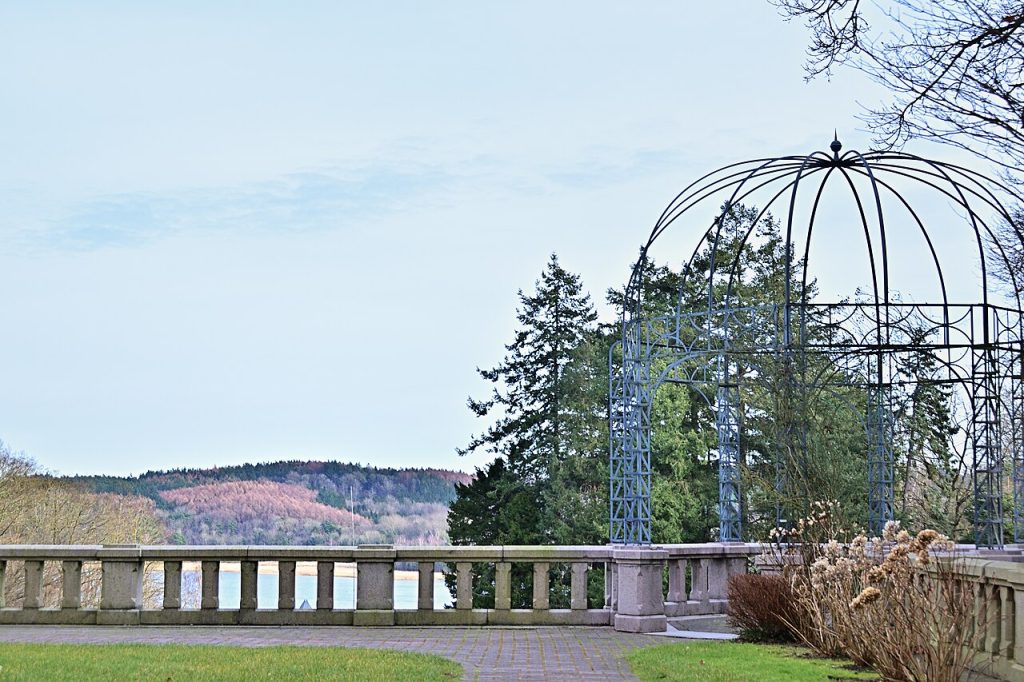
Now walk out onto the terrace and look down. The park is the work of Carl Eduard Petzold, one of the great German landscape gardeners of the nineteenth century, and Ralswiek is usually counted among his very last designs. Petzold had trained under Prince Hermann von Pückler-Muskau, the eccentric genius of Muskau and Branitz, and he carried Pückler’s ideas about sweeping lawns, carefully framed views and groups of specimen trees into dozens of estates across Europe.
At Ralswiek he had a steep site and a lake, and he used both. Terraces step down from the house, planted with roses and clipped shrubs in the formal manner, then the slope opens into an English landscape park with oaks, beeches, copper beeches and conifers arranged to frame the water. Walk the paths in October when the leaves turn and you will understand why Petzold’s clients paid so much. If you have visited Branitz, you will recognise the family resemblance immediately.
The Church of Grace and the Art Nouveau Surprise
Before you leave the hill, walk a few minutes to the village church. The Gnadenkirche, the Church of Grace, was built in 1907 at the expense of the Douglas family as a place of worship for the estate and the village, and it is a small treasure. The outside is a restrained mixture of neo-Romanesque and regional brick, but step inside and you are in the world of Jugendstil, the German Art Nouveau: flowing ornament, painted vaults, and glass that catches the lagoon light.
The church is the Douglas family’s real memorial. The count died in 1912, and members of the family lie in the vault here. In a region where most churches are mediaeval brick barns, a complete Art Nouveau interior is rare, and it tells you something about the family’s taste: forward-looking in decoration even while they built a historicist castle up the road.
Guests, Gossip and the Kaiser’s Shadow
A castle like this was built to be seen and to entertain. Douglas moved in circles close to Kaiser Wilhelm II, and the island of Rügen was fashionable with the Berlin elite in the summer months. Stories survive, as they always do, of imperial guests sailing across the Bodden to dine under the painted ceilings. How many of them are true is impossible to say, but there is no doubt that the house saw politicians, industrialists and officers on its guest lists, and that the hunting season filled the bedrooms.
The count’s son, Hugo Sholto Georg von Douglas, inherited in 1912 and kept the estate through the First World War and the troubled 1920s. The potash business, however, was never as golden again. Reparations, inflation and the nationalisation of the salt cartel chipped away at the fortune that had paid for the towers, and by the 1930s Ralswiek was a grand house kept up with increasing difficulty.
1945: From Counts to Refugees
In the spring of 1945 the Red Army reached Rügen, and the Douglas era ended within weeks. Under the Soviet land reform every estate above a hundred hectares was expropriated without compensation, and the family lost house, park and farmland. The castle itself was pressed into immediate service as a shelter for refugees who were streaming westward from East Prussia and Pomerania, often with nothing but a handcart.
Imagine the rooms in that winter: families sleeping in the ballroom, stoves improvised in the salons, the oak panelling scarred by furniture. Much of the original fitting out vanished in those years, sold, burned for heat or simply broken. Yet the building survived intact, which is more than can be said of many Pomeranian manor houses that were blown up or left to collapse under the new regime.
Pensioners in the Ballroom: The GDR Years
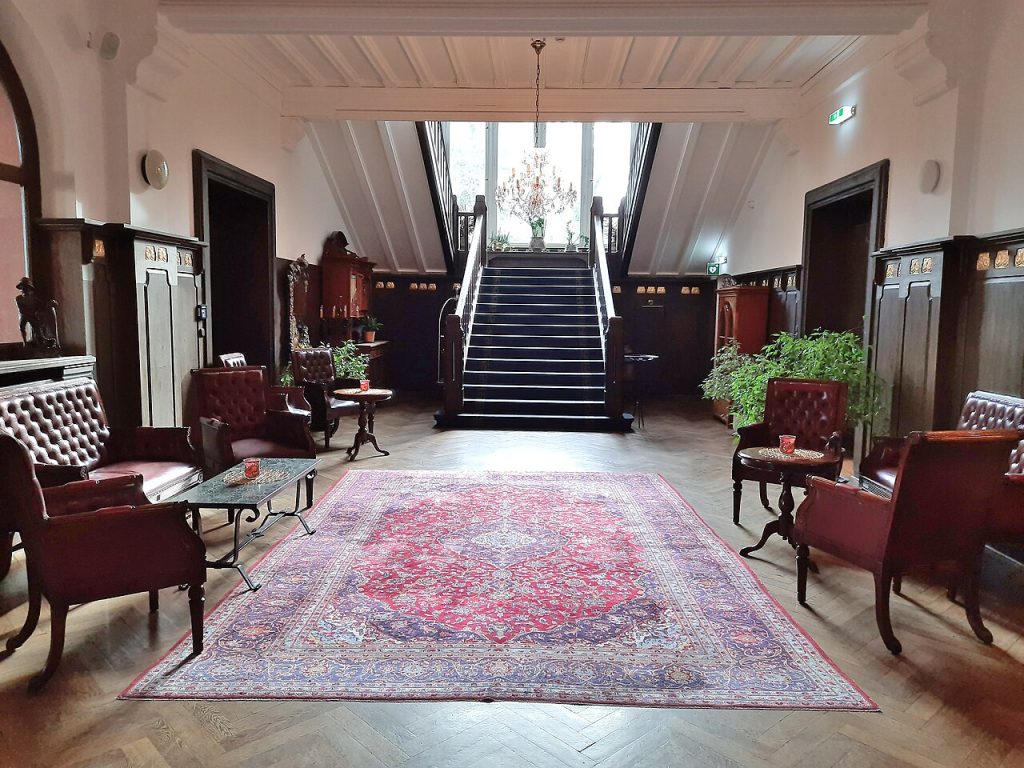
From the early 1950s the GDR authorities turned Ralswiek into a Feierabendheim, a state home for the elderly. Pensioners lived in the tower rooms, ate in the former dining room and sat on the terrace where the count had once watched his guests arrive by yacht. It was an unglamorous use, but it kept the roof tight and the heating on, and that is why the castle still stands. Dozens of similar houses used as grain stores or pigsties did not survive.
The park, meanwhile, grew wild. Petzold’s carefully composed views disappeared behind self-sown trees, and the terraces crumbled. After reunification the home closed, the building stood empty for a while and the municipality looked for a buyer. Only in the early 2000s did private investors restore the castle and reopen it in 2003 as a hotel. The park was gradually thinned and the terraces rebuilt, so that today you can once again see what Petzold intended.
Störtebeker Loses His Head Every Night
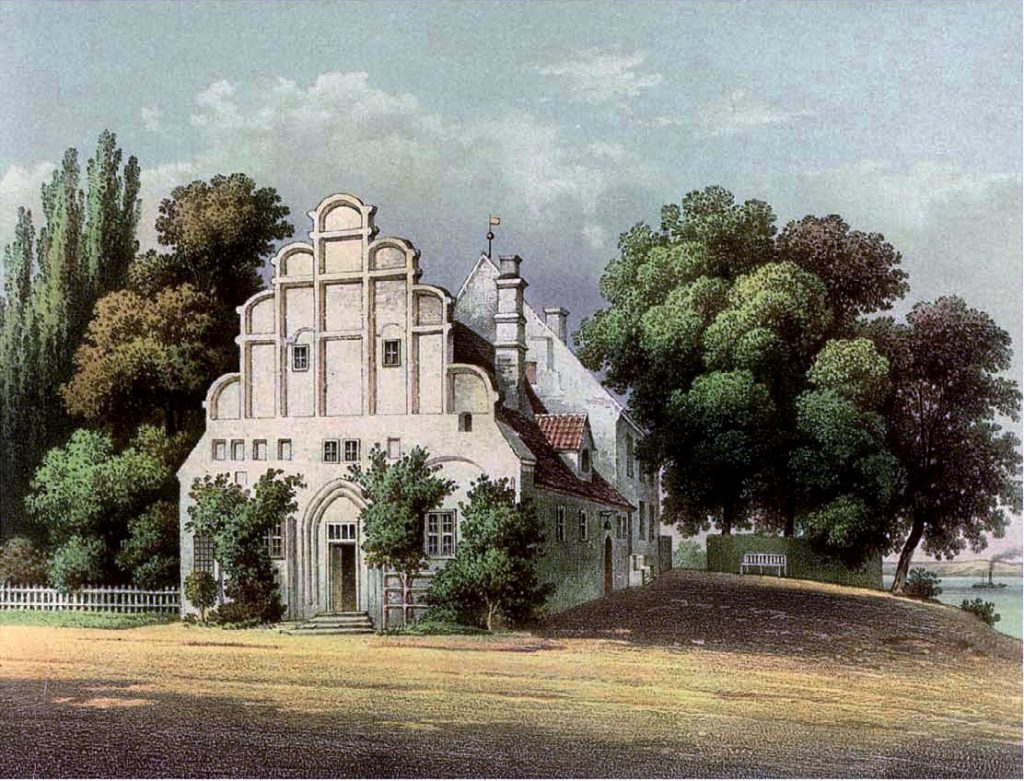
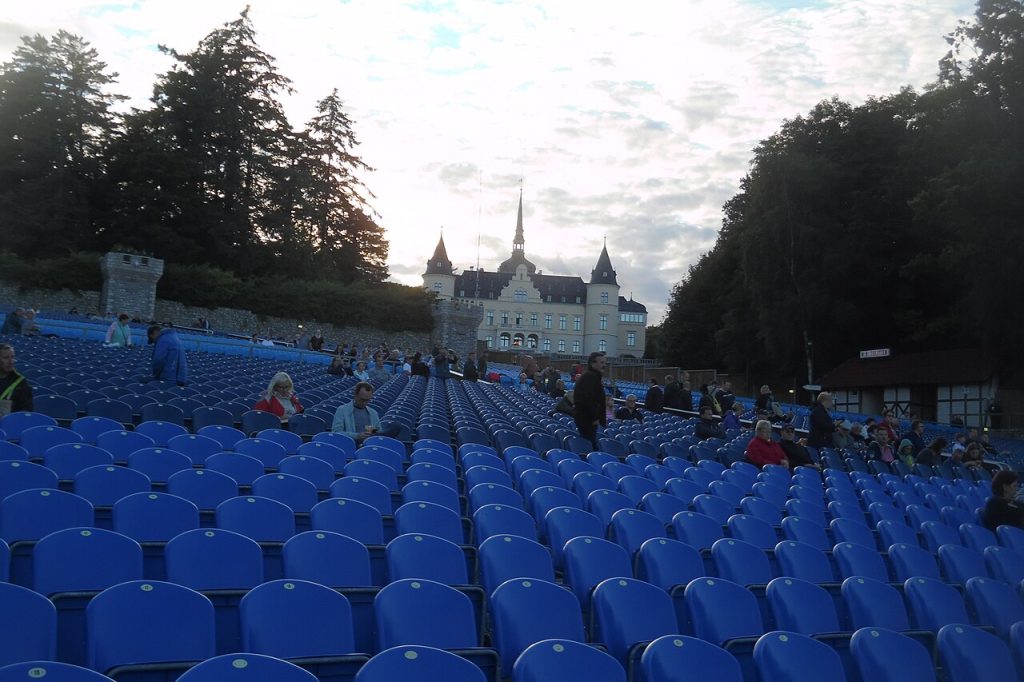
Now walk down the slope to the water, because the modern fame of Ralswiek has nothing to do with counts. Since 1993 the natural stage on the shore below the castle has hosted the Störtebeker Festspiele, a summer spectacle devoted to the legendary pirate Klaus Störtebeker and his Victual Brothers, who terrorised the Baltic around 1400 before being captured and beheaded in Hamburg in 1401. The show involves ships on the real lagoon, horses, fireworks, sword fights and a cast of hundreds, and it draws well over a hundred thousand spectators every season.
The legend says that Störtebeker, after his execution, walked headless past eleven of his men, who were to be spared in return. Here on the Bodden the pirate dies and rises again several nights a week from late June to early September, with the illuminated castle as his backdrop. It is unashamedly popular entertainment, and it has made a tiny village one of the most visited places on the island. Count Douglas would have been baffled, but I suspect he would have sold tickets.
Ralswiek on Video
Before you plan your trip, take a few minutes to see Ralswiek Castle in motion. The video below gives a good sense of the setting, the scale of the buildings and the atmosphere of the grounds.
Visiting Ralswiek Castle Today
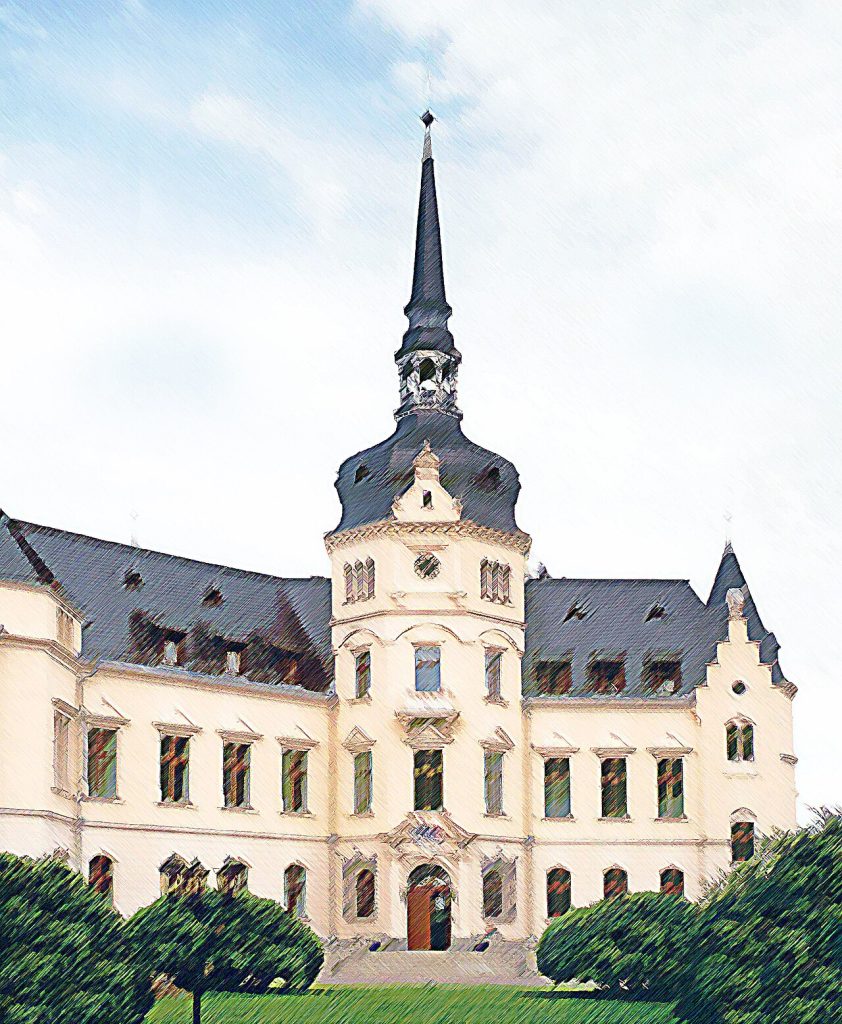
Ralswiek Castle is a hotel today, which means you cannot tour it like a museum, but the park is freely accessible and the public rooms and terrace are open to anyone willing to order a coffee or a meal. The best plan is to come in the late afternoon, walk Petzold’s terraces down to the lake, look at the reconstructed Slavic boats near the shore, visit the Church of Grace, and then watch the sunset from the terrace. If you are here between late June and early September, book a ticket for the Störtebeker Festival in advance; the stage is a short walk below the castle and the evening show starts around eight.
Ralswiek lies about eight kilometres north of Bergen auf Rügen on the road toward Sassnitz. Buses from Bergen stop in the village, and there is a large car park for the festival. Combine your visit with Spyker Castle to the north and the Granitz Hunting Lodge to the south-east for a full day of Rügen’s aristocratic history. Here is the exact spot: Ralswiek Castle on Google Maps.
Palaces Nearby
If you have enjoyed this palace, the region holds more remarkable residences. Here are two more well worth adding to your journey:
You May Like
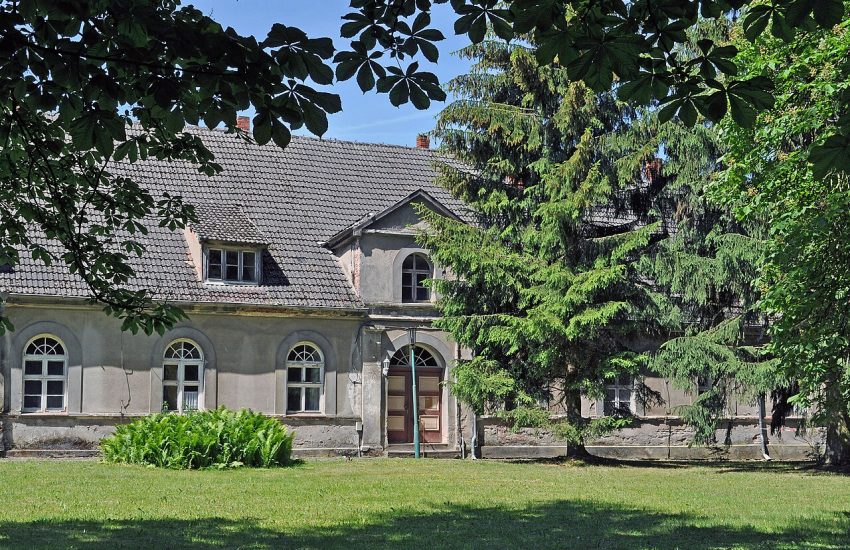
Griebenow Palace and the Swedish Field Marshal Who Lost at Poltava