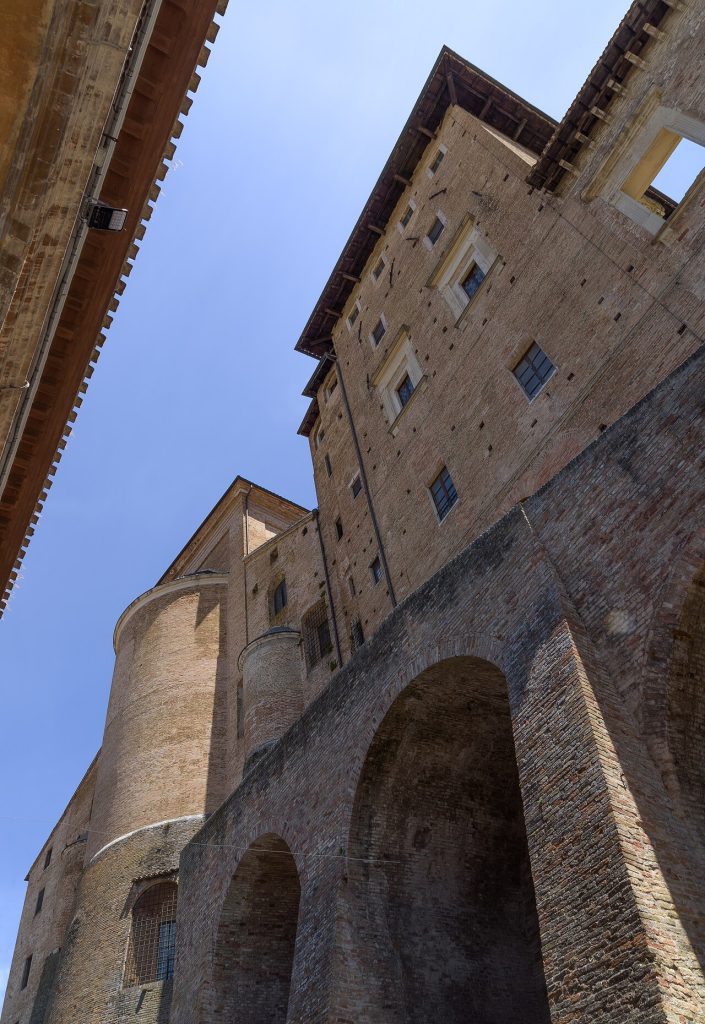
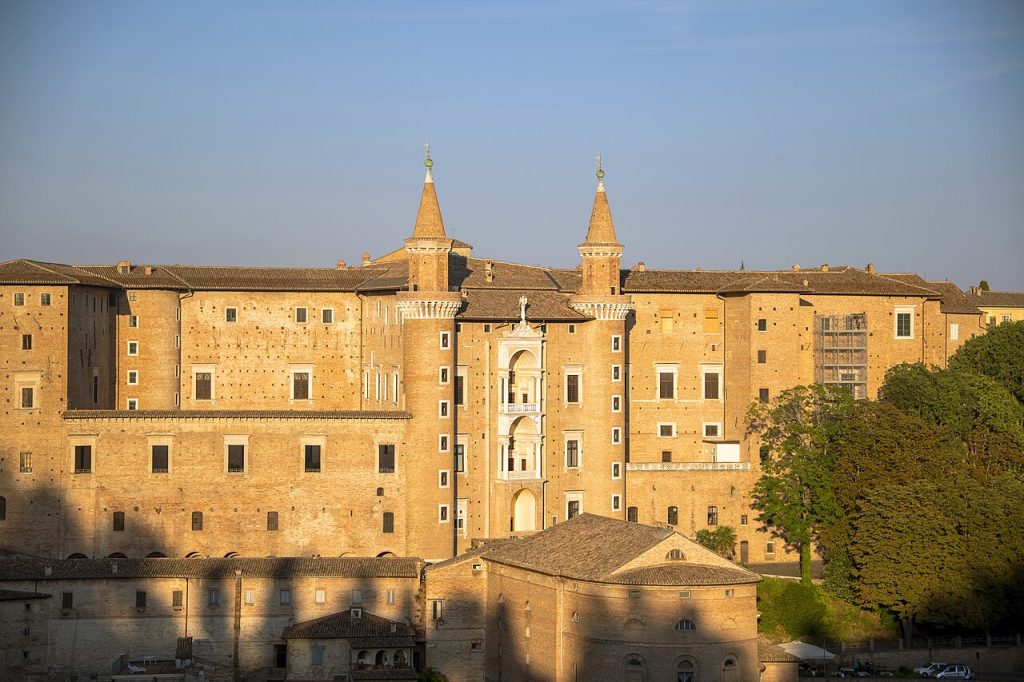
Urbino sits on two hills in the Marche, between the Apennines and the Adriatic, a small brick city of steep streets and Renaissance palaces that has not grown since the sixteenth century, and on the edge of its western hill, facing the valley and the road from Rome, stands the facade that every student of the Renaissance knows: two slender round towers with conical spires framing three storeys of loggias, one above the other, like the stern of a ship moored over the countryside. It is the Palazzo Ducale, the palace of Federico da Montefeltro, Duke of Urbino from 1444 to 1482, the mercenary general who spent his earnings on the most civilised court in Italy and built, as Baldassare Castiglione wrote, a palace that seemed not a palace but a city in the form of a palace.
Federico’s palace was designed by Luciano Laurana, a Dalmatian, and completed by Francesco di Giorgio of Siena, with the courtyard that is the model of Renaissance proportion, the studiolo whose walls are an illusion in inlaid wood, the library that held the finest manuscripts in Italy, the apartments where Piero della Francesca, Raphael’s father and the young Raphael himself worked, and the rooms where, a generation later, Castiglione set the conversations of The Book of the Courtier, the manual of the Renaissance gentleman. The palace has been the National Gallery of the Marche since 1912, with Piero’s Flagellation and Raphael’s Mute Woman among its pictures, and it is the last of the three Italian houses in this series.
Climb with me from the valley to the facade of the towers, through the courtyard to the studiolo, the library and the apartments, with Federico, his architects, his painters and his court in order. The contents are below.
In This Article
- A City on Two Hills
- Federico, the Mercenary Who Read Latin
- 1465: Laurana and the Palace in the Form of a City
- The Facade of the Towers
- The Courtyard of Honour
- The Studiolo and the Illusion in Wood
- The Library That Was the Finest in Italy
- Piero della Francesca and the Painters of the Court
- Battista Sforza and the Duchess’s Apartment
- Guidobaldo, Elisabetta and the Courtier
- The della Rovere and the End of the Duchy
- 1912: The National Gallery of the Marche
- Raphael’s City and the Palace Today
- Urbino on Video
- Visiting the Ducal Palace of Urbino Today
- Palaces Nearby
A City on Two Hills
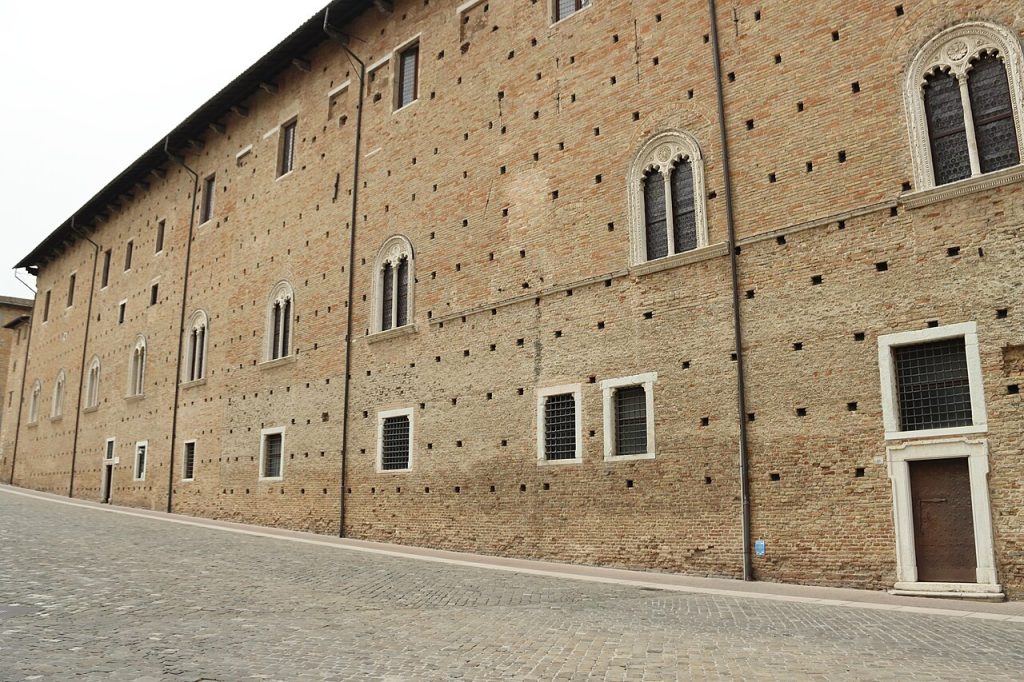
Urbino lies in the hills of the northern Marche, forty kilometres inland from Pesaro and the Adriatic, on a saddle between two hilltops that the city’s walls enclose, with the cathedral and the palace on the western hill and the university, which Federico’s successors founded in 1506, filling most of the rest. The city has about fifteen thousand people and as many students, no industry and almost no building after 1600, and it is the most complete Renaissance town in Italy because its dukes made it a capital for a century and then left it to the Church, which let it sleep. The palace occupies the western edge of the hill, its towers rising over the valley of the Metauro and the road to Rome.
Now, stop here on the road below the city and look up at the facade of the towers. The palace was built to be seen from here, by travellers arriving from Rome, and its loggias were the duke’s balconies over his state.
Federico, the Mercenary Who Read Latin
Federico da Montefeltro was born in 1422, the illegitimate son of the Count of Urbino, raised at the court of Mantua in the school of Vittorino da Feltre with the Gonzaga children, and made count in 1444 when his half-brother Oddantonio was murdered in a conspiracy that Federico may have arranged. He was a condottiere, a mercenary general who sold his army to Milan, Naples, Florence and the pope in turn and never lost a battle, earning the enormous sums, up to sixty thousand ducats a year, that paid for his palace; he lost his right eye and the bridge of his nose in a tournament in 1450 and had the nose cut away so that he could see to the right, which is why Piero painted him in left profile. He was also a Latinist who read Livy at meals, a collector of manuscripts and the patron of Alberti, Piero, Laurana and Francesco di Giorgio.
Pope Sixtus IV made him Duke of Urbino in 1474, and he died in 1482 of fever on campaign at Ferrara, leaving a ten-year-old son and a palace almost finished.
1465: Laurana and the Palace in the Form of a City
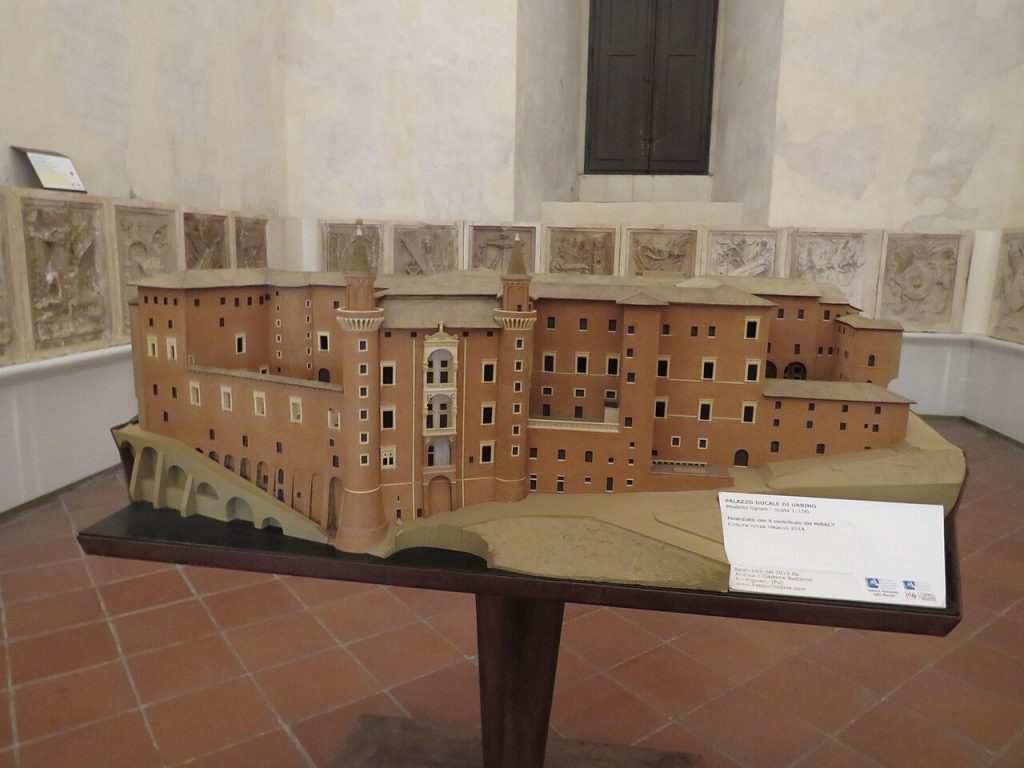
Federico began enlarging the old Montefeltro castle in the 1450s with local builders, and in 1465 he hired Luciano Laurana, a Dalmatian architect from Zara who had worked at Mantua and Naples, as his master of works with a patent that is the first document to call architecture a liberal art. Laurana worked at Urbino until 1472 and gave the palace its plan and its heart: the courtyard of honour, the grand staircase, the facade of the towers on the valley side, the arrangement of the apartments around the courtyard and the sequence of great halls, with the whole built into the hillside so that it rises three storeys on the valley and two on the town. After Laurana left, Francesco di Giorgio Martini of Siena completed the palace through the 1470s and 1480s, adding the decoration, the studiolo’s design and the hanging garden.
Castiglione’s phrase, a city in the form of a palace, describes the result: a complex of courtyards, halls, apartments, library, chapel, stables, gardens and offices for a court of five hundred, on the scale of a town and with a town’s variety.
The Facade of the Towers
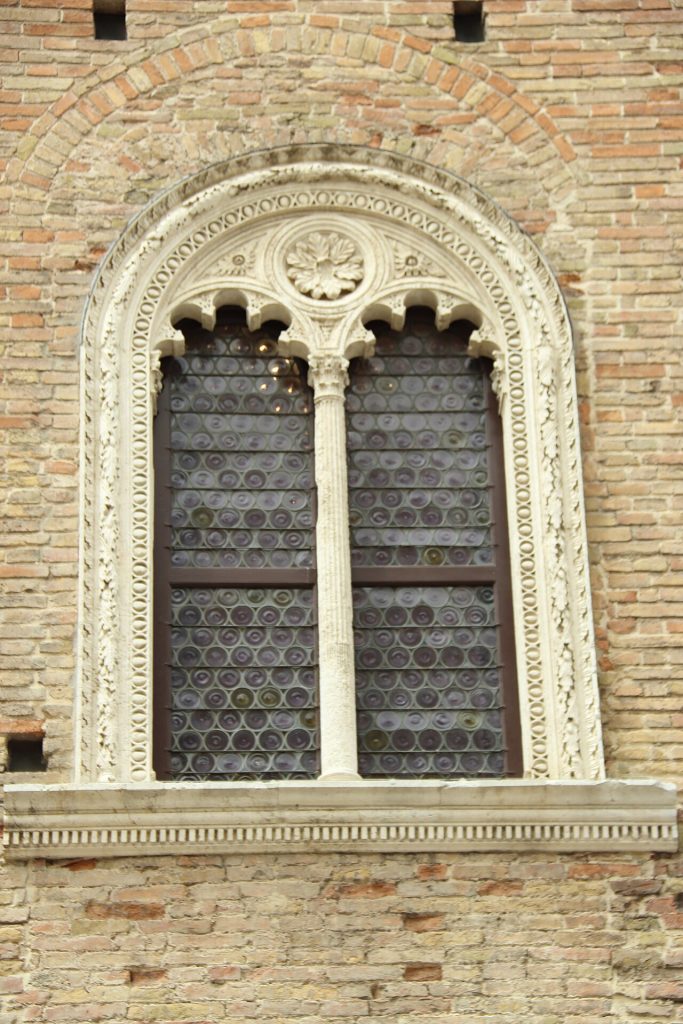
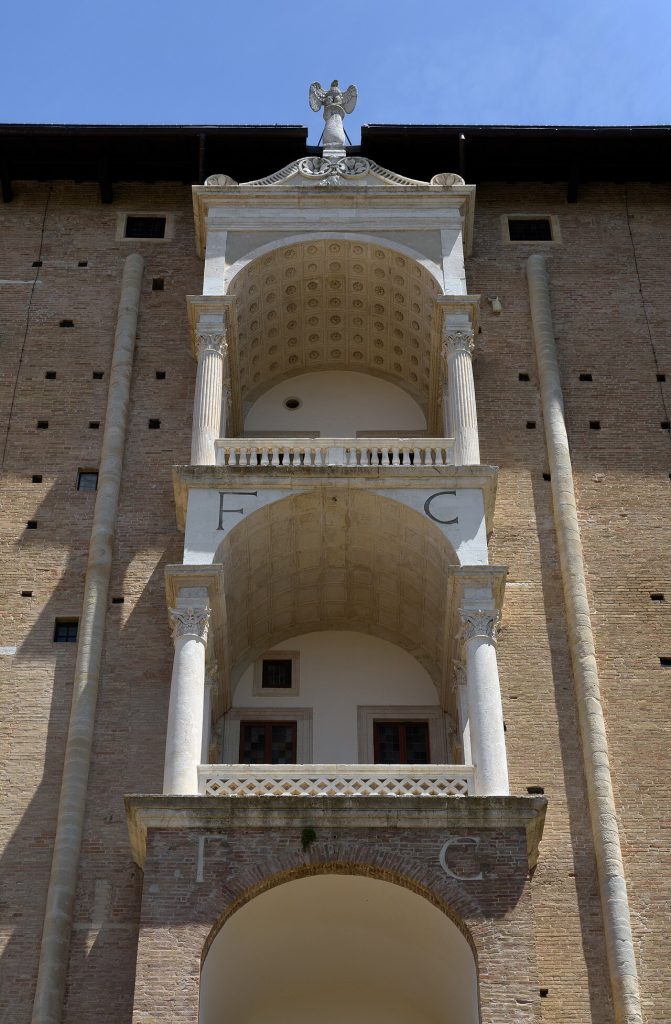
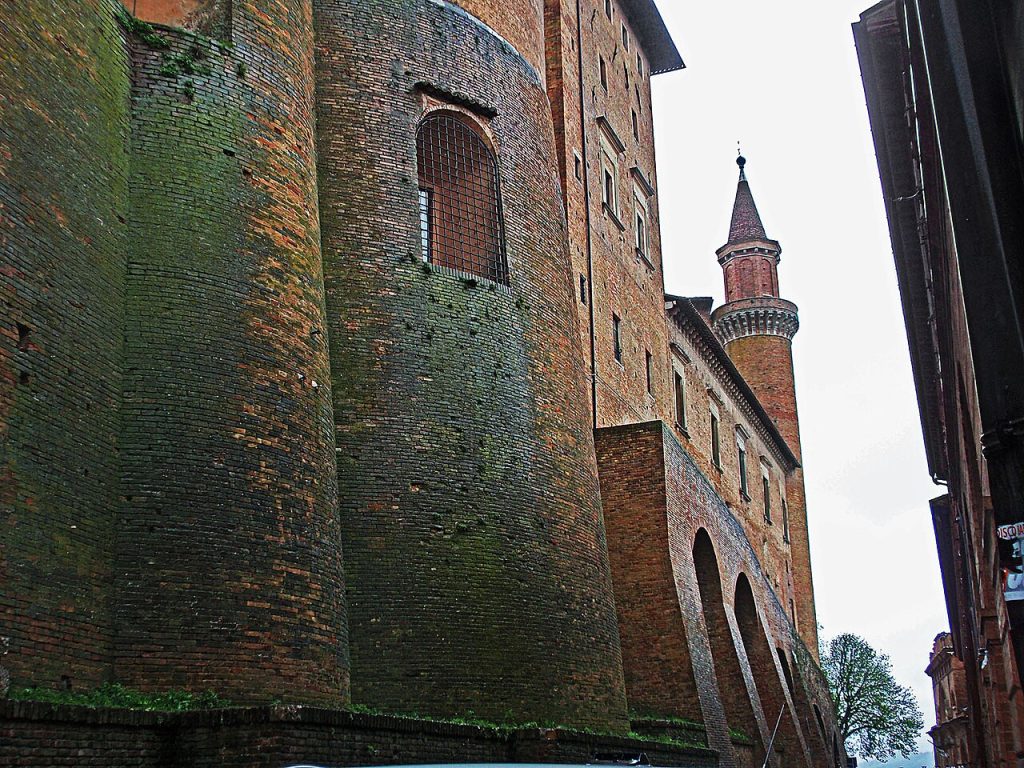
The Facciata dei Torricini, the facade of the little towers, on the valley side is the palace’s signature and one of the most original compositions of the fifteenth century: two round towers of brick, slender and tall with conical stone spires, framing a narrow central section of three loggias one above the other, with round arches on the lowest and the duke’s balconies above, from which Federico could look over his duchy toward Rome. The loggias open from the duke’s apartment, the towers hold spiral stairs and the whole was built on the edge of the cliff so that the palace seems to rise from the hill. The design is Laurana’s, and its model may be the Castel Nuovo at Naples, where he had worked, or the castles of his Dalmatian coast.
Now, stop here on the terrace of the Mercatale below and look up at the loggias. The duke stood there to receive the homage of his subjects and to watch the road, and the facade is the palace’s face to the world, which is why it is on the Italian two-euro coin’s design of Urbino.
The Courtyard of Honour
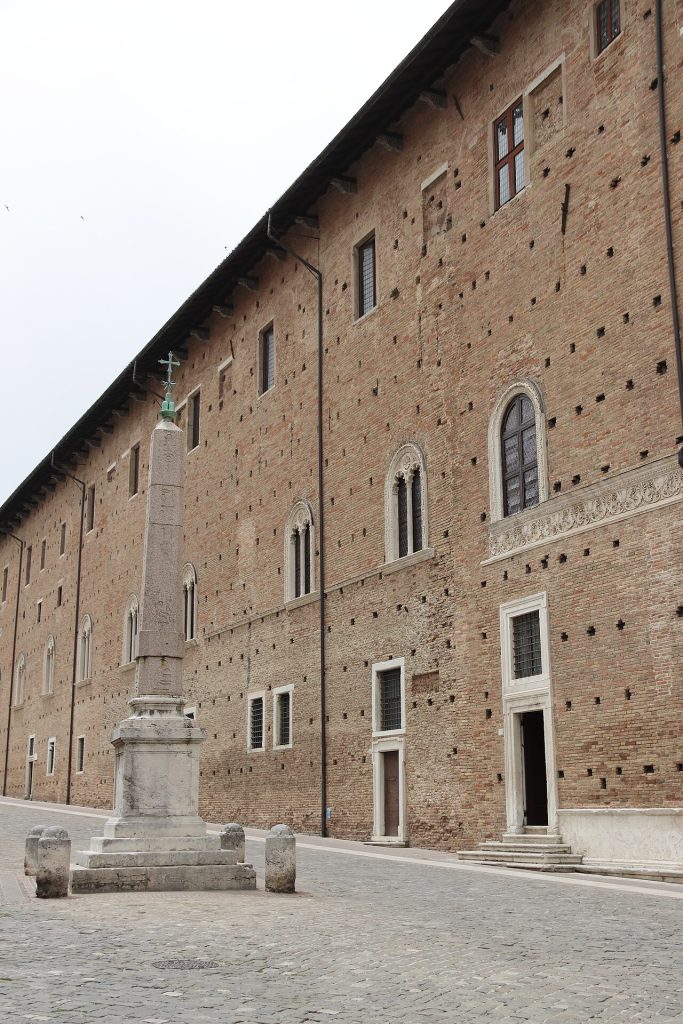
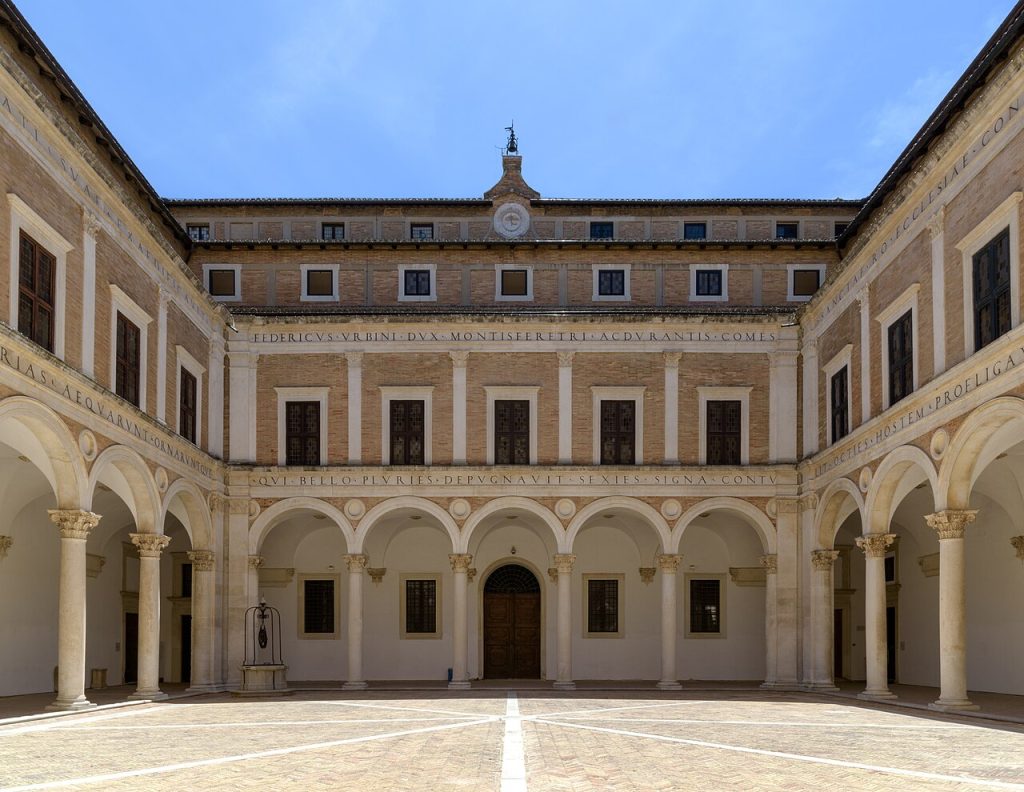
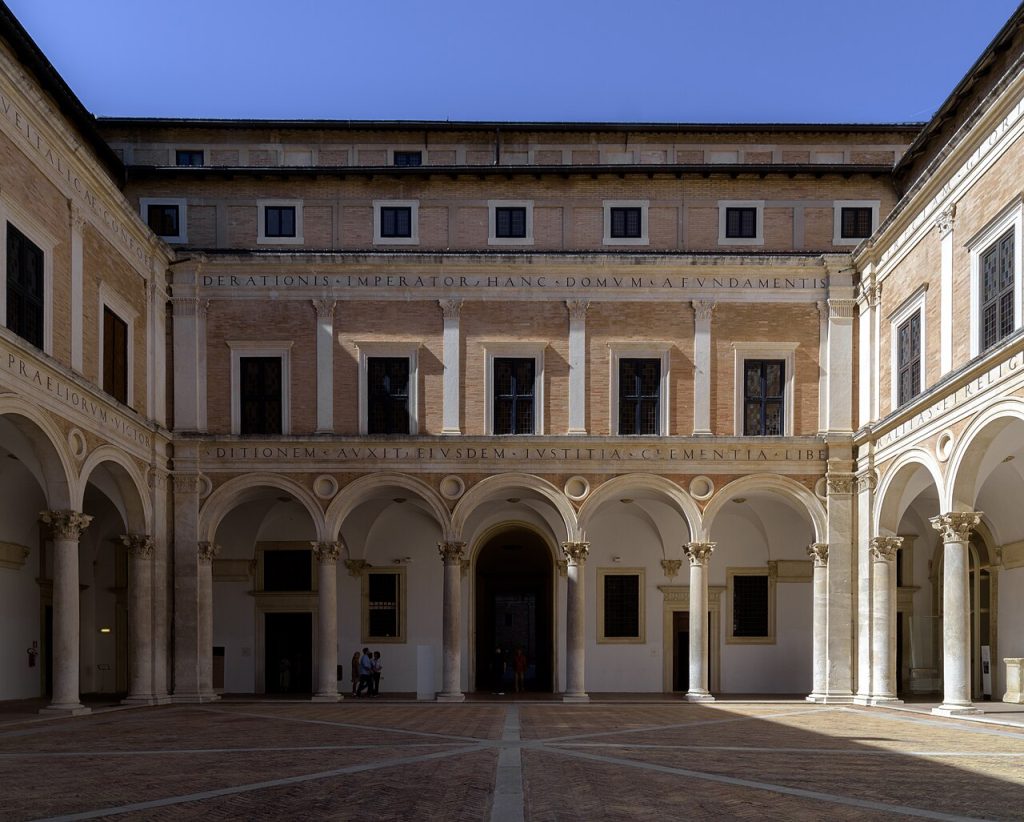
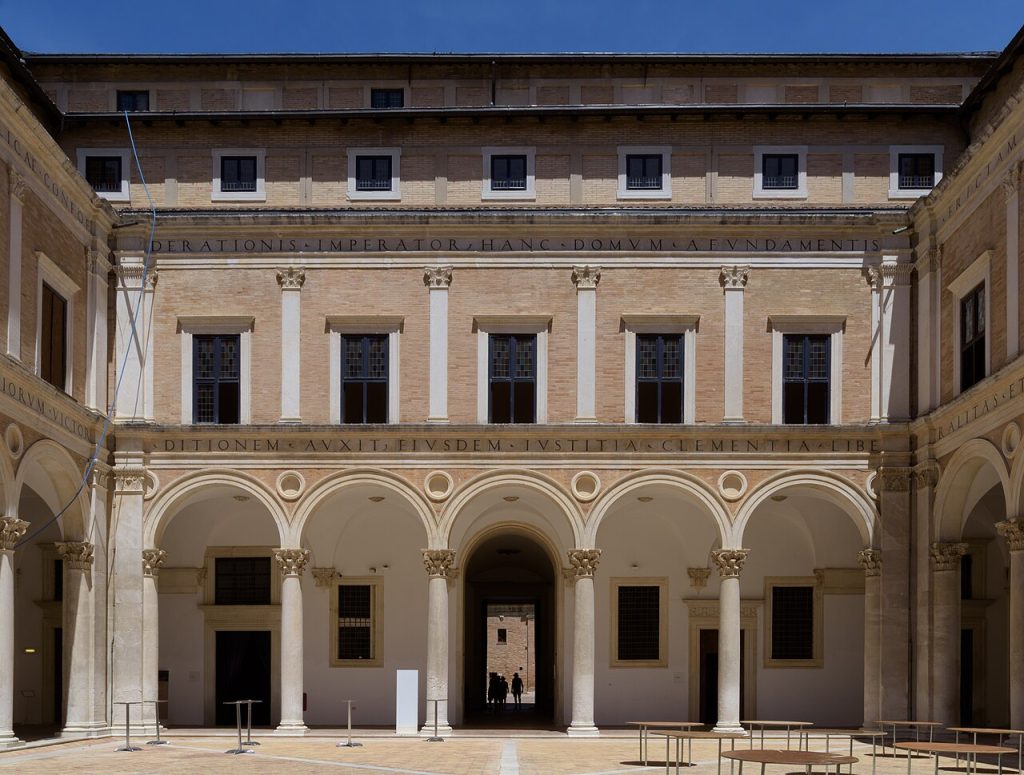
The Cortile d’Onore, the courtyard of honour, is Laurana’s masterpiece and the finest courtyard of the early Renaissance: an arcade of Corinthian columns of pale stone carrying round arches on all four sides, with pilasters above framing the windows of the first floor, a frieze with a Latin inscription in Roman capitals praising Federico’s victories and virtues running around the whole, and brick walls between the stone members, so that the court is a lesson in proportion and in the classical orders twenty years before Bramante. The grand staircase rises from one corner to the first floor, broad and shallow for the duke’s horses, and the courtyard was where the court assembled, ambassadors were received and tournaments were held.
Look at the corners, where Laurana solved the problem of the meeting arcades with L-shaped piers, and read the inscription, which calls Federico the equal of the ancients; the courtyard was built to prove it.
The Studiolo and the Illusion in Wood
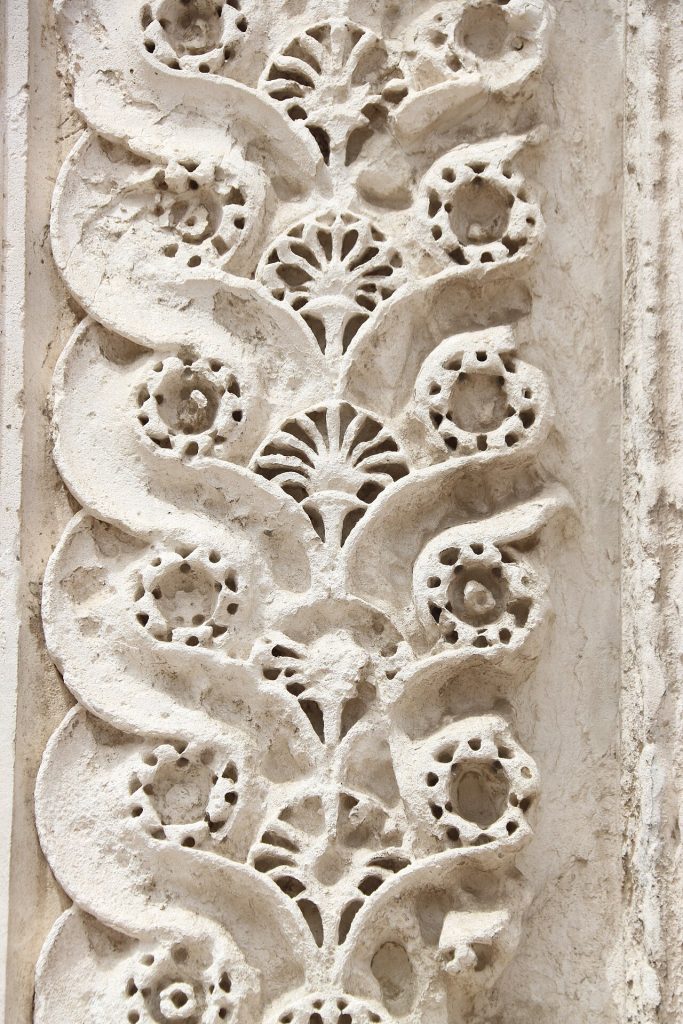
The studiolo is a room of less than four metres square between the duke’s apartment and the loggia, lined from floor to the height of a man with intarsia, inlaid wood of different colours that creates, in perfect perspective, an illusion of cupboards with their doors ajar showing books, musical instruments, armour, scientific instruments, a squirrel, a parrot, a basket of fruit and the duke’s own armour and badges, with benches and a bookcase that seem real and are flat. The panels were made in Florence about 1476, probably in the workshop of Giuliano da Maiano to designs by Botticelli and Francesco di Giorgio, and above them hung twenty-eight portraits of famous men, Plato, Aristotle, Moses, Dante, Petrarch, Sixtus IV, by Justus of Ghent and Pedro Berruguete, half now in the Louvre and half returned to the room.
Now, stop here in the doorway, since the room holds three people, and look at the cupboard with the book half open and the hourglass. It is wood, and it has fooled visitors for five hundred and fifty years; the duke sat here to read, with the Latin inscription above him and his own ideal library painted around him.
The Library That Was the Finest in Italy
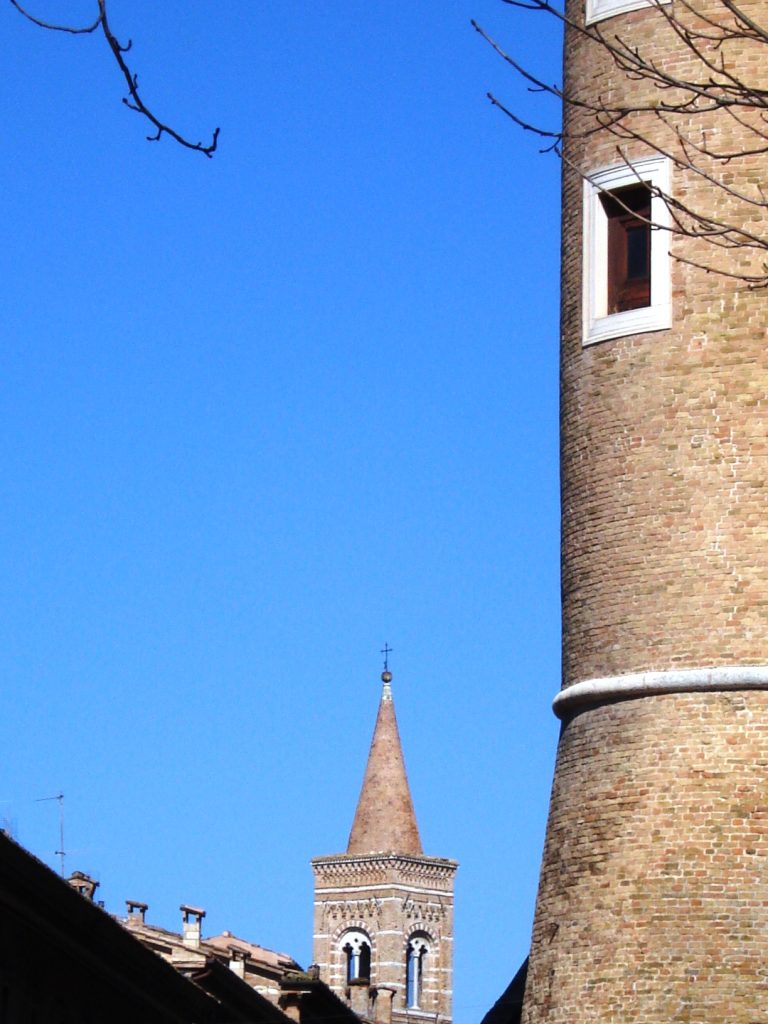
Federico’s library, in a vaulted room on the ground floor beside the courtyard, was the finest in Italy after the Vatican’s, assembled over thirty years by scribes and illuminators working for him in Urbino and Florence and by agents buying across Europe: more than a thousand manuscripts in Latin, Greek and Hebrew, all on parchment, since the duke despised printed books, bound in crimson velvet with silver clasps, with the Bible of Urbino, the finest illuminated Bible of the Renaissance, among them. The library was open to scholars and was the palace’s intellectual heart. In 1657 Pope Alexander VII took the whole collection to the Vatican Library, where it remains as the Fondo Urbinate, and the room in Urbino is empty but for its vault and its inscription.
Vespasiano da Bisticci, the Florentine bookseller who supplied the duke, said that no library in Italy was so complete or so beautiful; the room is the one place in the palace where the loss shows.
Piero della Francesca and the Painters of the Court
Federico’s court drew the painters of the age: Piero della Francesca, who painted the duke and duchess’s portraits now in the Uffizi, the Brera altarpiece with Federico kneeling in armour and, for the palace, the Flagellation of Christ and the Madonna of Senigallia, both now in the gallery, the Flagellation being the most discussed small painting in Western art; Justus of Ghent, who painted the famous men and the Communion of the Apostles; Pedro Berruguete from Spain, who painted Federico reading to his son; Paolo Uccello, who painted the predella of the profaned host; and Francesco di Giorgio, who drew the war machines and the palace’s fittings. Giovanni Santi, a court painter of the second rank, had a son in 1483 whom he named Raphael.
The gallery’s rooms hold these works in the apartments they were painted for, and the Flagellation hangs in a small room off the duke’s apartment where its light and its mystery are undisturbed.
Battista Sforza and the Duchess’s Apartment
Federico married Battista Sforza, the fourteen-year-old daughter of the lord of Pesaro, in 1460, and she became the partner of his rule, governing the state while he was at war, corresponding with the humanists in Latin and bearing him eight daughters and, in January 1472, the son he needed, Guidobaldo; she died six months later at twenty-six, and Federico, who never remarried, had Piero paint her posthumous portrait as the pendant of his own and built the duchess’s apartment in her memory. The apartment, on the first floor beside the duke’s, has the Sala degli Angeli with its fireplace of dancing putti by Domenico Rosselli, the duchess’s bedroom and the small chapel, and it is the most finely carved part of the palace, with Francesco di Giorgio’s doorways and fireplaces.
Now, stop here in the Sala degli Angeli and look at the fireplace. The putti dance under the Montefeltro eagle, and the room was finished after the woman it was for had died.
Guidobaldo, Elisabetta and the Courtier
Federico’s son Guidobaldo, duke from 1482 to 1508, was a scholar and a soldier crippled by gout, driven from Urbino by Cesare Borgia in 1502 and restored a year later, and his wife Elisabetta Gonzaga, sister of the Marquis of Mantua, presided over a court of poets, humanists and gentlemen that Baldassare Castiglione, a courtier of Urbino from 1504, made immortal in The Book of the Courtier, published in 1528: four evenings of conversation in the duchess’s rooms in March 1507, with Bembo, Bibbiena, Giuliano de’ Medici and the rest debating the qualities of the perfect courtier and the perfect lady, with wit, grace and sprezzatura, the art of making the difficult look easy. The book was the manual of European manners for three centuries, and its setting is the palace.
The rooms where the conversations were set, the duchess’s apartment and the Sala delle Veglie, survive, and the book’s opening describes the palace as the finest in Italy, which the Urbinati still quote.
The della Rovere and the End of the Duchy
Guidobaldo died childless in 1508 and the duchy passed to his adopted nephew Francesco Maria della Rovere, the pope’s nephew, a soldier painted by Titian in armour, whose family ruled Urbino for a century from a new court at Pesaro, keeping the Urbino palace as a secondary residence, enlarging it with the second floor and Girolamo Genga’s decorations and letting its collections and its library stand. The last duke, Francesco Maria II, old, childless and devout, ceded the duchy to the Church in 1626 and died in 1631; the Papal States took Urbino, the court dispersed, the pictures went to Florence with the della Rovere heiress Vittoria, who married a Medici, and the library to Rome. The palace became the seat of the papal legate and a barracks, and the city went to sleep.
The sleep preserved it: Urbino had no reason to rebuild, and the palace, stripped, survived intact.
1912: The National Gallery of the Marche
After Italian unification the palace was restored and in 1912 became the Galleria Nazionale delle Marche, the regional gallery, which has assembled in the ducal rooms the paintings of the Marche from the fourteenth to the seventeenth century: Piero’s Flagellation and Madonna of Senigallia, Raphael’s Portrait of a Lady called La Muta, Titian’s Resurrection and Last Supper, Uccello’s predella, Justus of Ghent’s Communion, the Ideal City panel attributed to Laurana or Francesco di Giorgio that is the Renaissance’s image of itself, Barocci, the Urbino painter of the Counter-Reformation, and the ceramics of the duchy’s potteries. The gallery was reorganised in the 2010s with the rooms restored and the paintings rehung in the apartments they were made for.
The gallery is one of the best in Italy and one of the least crowded, and the combination of the rooms and the pictures that belong to them is rare anywhere.
Raphael’s City and the Palace Today
Urbino has been a World Heritage site since 1998, as the city that Federico made the Renaissance’s model of a princely capital and that has kept its form, and the palace is its heart, with the cathedral beside it, the house where Raphael was born in 1483 a few streets away, the oratories with their frescoes, the fortress of Albornoz on the opposite hill with the famous view of the palace’s towers and the university filling the Renaissance houses. The city is a day trip from the Adriatic coast and a stop on the road from Rome to Rimini, and it has kept the quiet that its position, off the railways and the motorways, has given it for four hundred years.
Now, stop here on the loggia of the towers at the end of the visit and look out over the hills toward Rome. Federico stood here as the most admired prince of his age; his son’s courtiers stood here and invented good manners; and the palace, which was a city in the form of a palace, is still the largest thing in a city that stopped growing when they left.
Urbino on Video
Visiting the Ducal Palace of Urbino Today
The Ducal Palace and the National Gallery of the Marche are open Tuesday to Sunday, with a ticket covering the courtyard, the ducal apartments, the studiolo, the library room, the gallery’s collections on two floors and the basements with the kitchens and the stables; audio guides in English are available. Allow three hours, see the studiolo at opening when it is empty, and end with the loggias of the towers. Combine the palace with the cathedral and its museum next door, Raphael’s birthplace in Via Raffaello, the oratory of San Giovanni with the Salimbeni frescoes and the walk to the Albornoz fortress for the classic view of the palace at sunset.
Urbino has no railway; it is reached by bus from Pesaro in an hour, from Rimini in ninety minutes or by car from Rome in three hours and from Florence in two and a half. Naples and Palermo are a long way south, a day’s journey by train and ferry. Here is the exact spot: Ducal Palace of Urbino on Google Maps.
Palaces Nearby
You May Like
The Palace of Versailles and the Court That Invented Etiquette