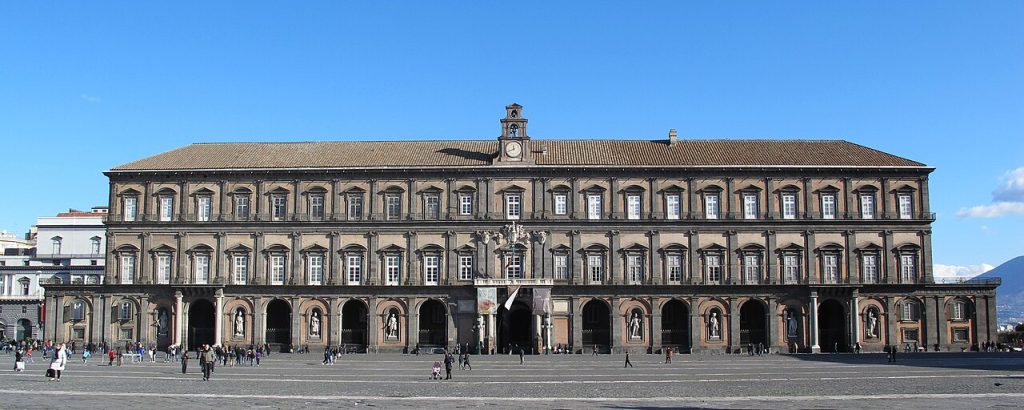
On the east side of Piazza del Plebiscito, the great curved square at the heart of Naples that faces the colonnade of San Francesco di Paola, stands a long palace of red stucco and grey piperno stone, three storeys high and a hundred and seventy metres long, with a ground floor of arches, two rows of regular windows and, in the niches of the arcade, eight marble statues of kings. It is the Palazzo Reale, the Royal Palace of Naples, begun in 1600 by the Spanish viceroy for a visit of King Philip III that never happened, the seat of the Spanish and Austrian viceroys for a century and a half and of the Bourbon kings of Naples and the Two Sicilies from 1734 to 1860, and of the Savoy kings of Italy after that.
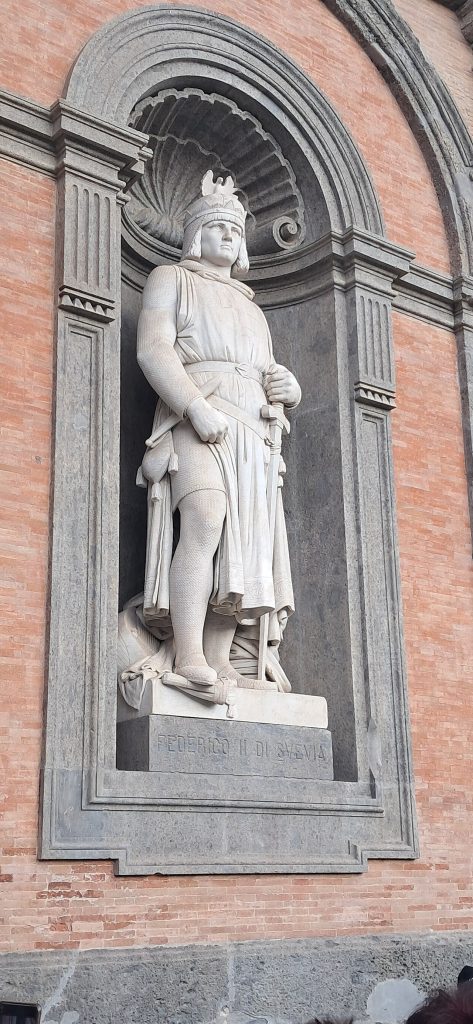
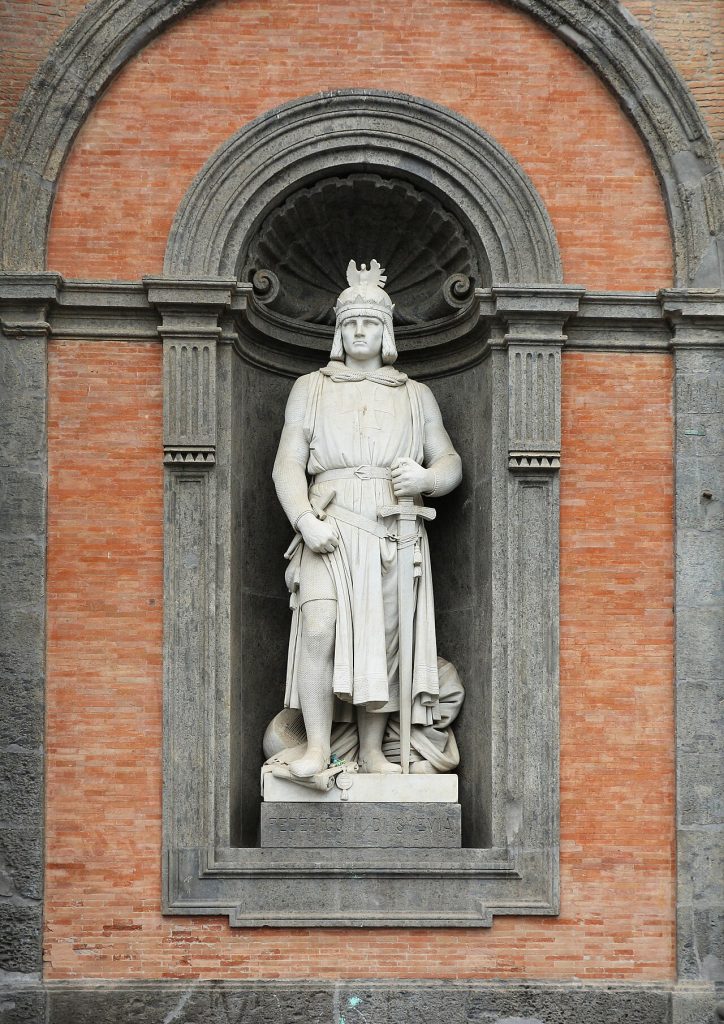
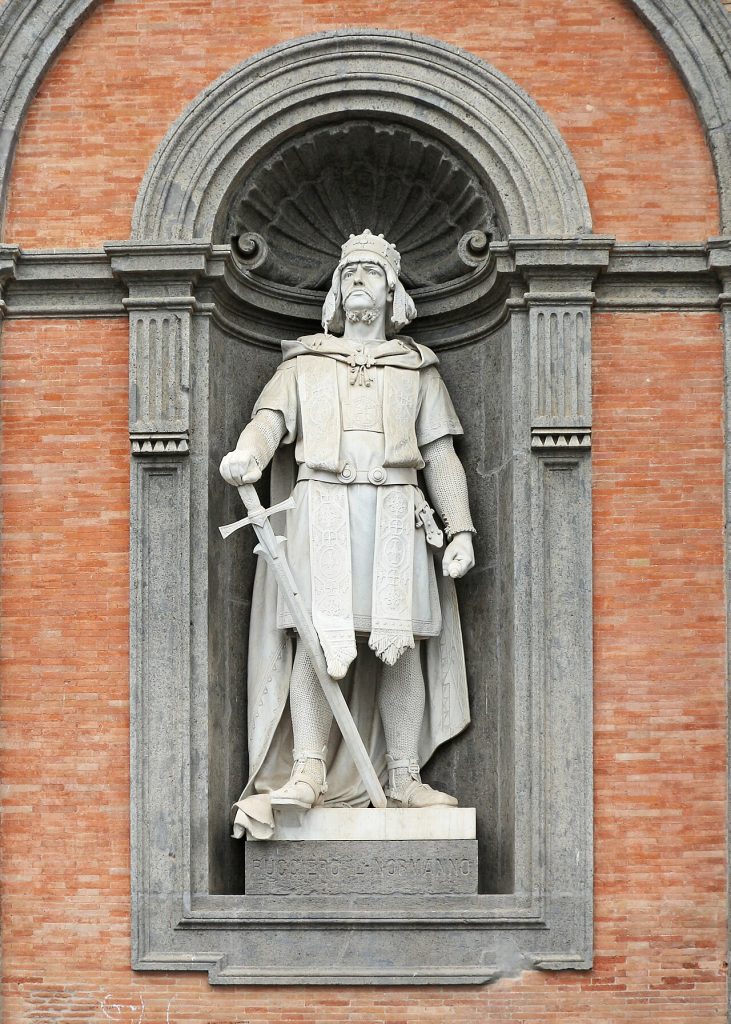
The eight statues, put up in 1888 by Umberto I of Savoy, are the dynasties that ruled Naples in order: Roger the Norman, Frederick II of Hohenstaufen, Charles of Anjou, Alfonso of Aragon, Charles V of Habsburg, Charles III of Bourbon, Joachim Murat and Victor Emmanuel II, a history of southern Italy in eight men, seven of them foreigners. Inside are the grand staircase of 1651, one of the finest in Europe, the court theatre, the throne room, the royal apartments with their Bourbon furniture and paintings, the chapel and, in the east wing, the National Library with the papyri of Herculaneum. The palace is the first of the three Italian houses in this series, with the Palazzo dei Normanni in Palermo and the Ducal Palace of Urbino to follow.
Cross the square with me from the colonnade to the arcade, up the great staircase and through the apartments to the theatre and the library, with the viceroys, the Bourbons, Murat and the Savoy in order. The contents are below.
In This Article
- Piazza del Plebiscito and the Eight Kings
- 1600: A Palace for a King Who Never Came
- Domenico Fontana’s Design
- The Great Staircase of 1651
- 1734: Charles of Bourbon Arrives
- The Court Theatre and the San Carlo
- Ferdinand IV, Maria Carolina and Nelson
- Murat, the French and the Empire Rooms
- The Royal Apartments and the Throne Room
- The Palatine Chapel and the Nativity
- 1860: Garibaldi, the Savoy and the Statues
- The National Library and the Herculaneum Papyri
- Bombs, Restoration and the Square Today
- Naples on Video
- Visiting the Royal Palace of Naples Today
- Palaces Nearby
Piazza del Plebiscito and the Eight Kings
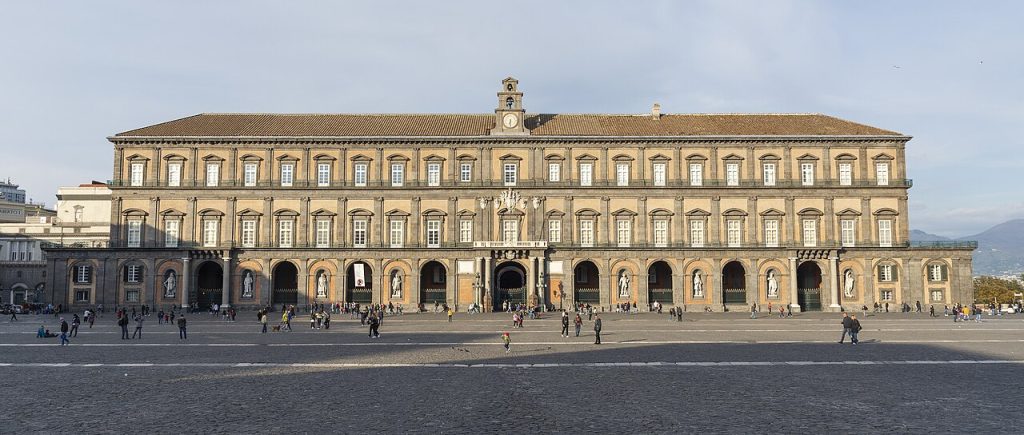
Piazza del Plebiscito is the largest square in Naples, a semicircle enclosed by the Doric colonnade of the church of San Francesco di Paola, built by Ferdinand I in thanks for his restoration in 1815 in imitation of the Pantheon, and closed on its straight side by the palace’s facade, with the equestrian statues of Charles III and Ferdinand I by Canova and Calì in the middle. The square was the palace’s forecourt and parade ground, used for the Bourbons’ military reviews and the Savoy’s plebiscite of 1860 that gave it its name, and it was a car park until 1994, when it was cleared and paved for the G7 summit and became the city’s stage for concerts and New Year.
Now, stop here in the middle of the square and read the facade from left to right: Roger II the Norman, Frederick II, Charles of Anjou, Alfonso of Aragon, Charles V, Charles of Bourbon, Murat and Victor Emmanuel II. The Neapolitans say that each is making a gesture about the one before, and that the last is checking whether he still has his wallet.
1600: A Palace for a King Who Never Came
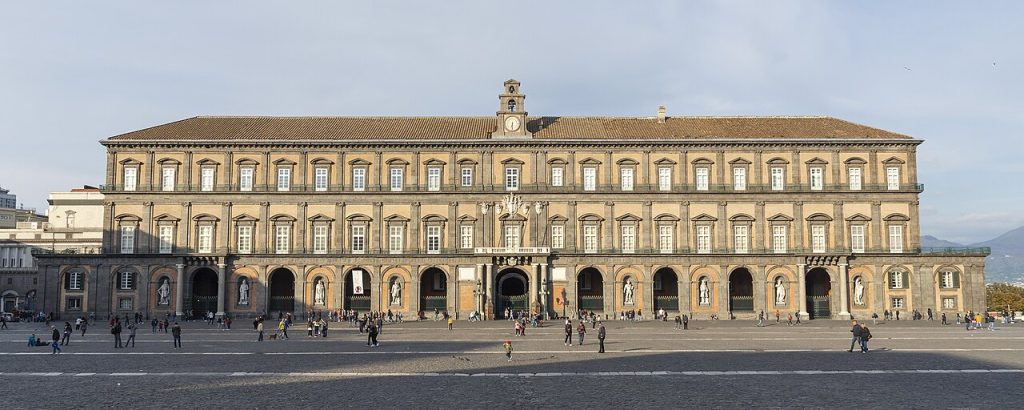
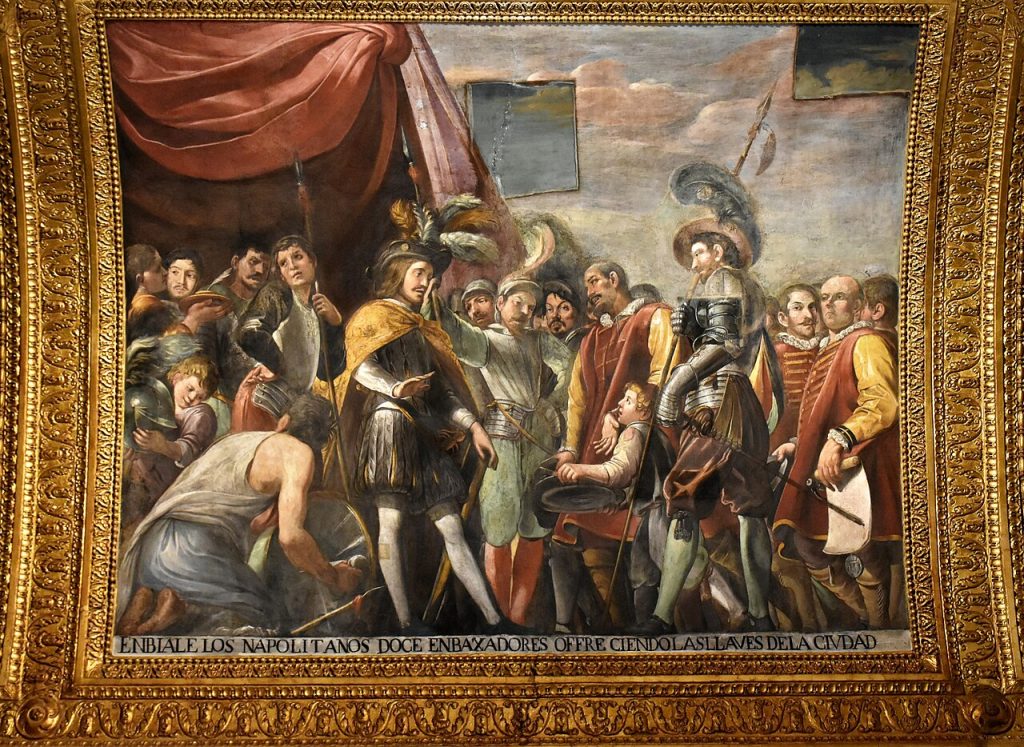
Naples had been ruled from Spain since 1503, by a viceroy who represented the Habsburg king and governed the kingdom of Naples, the largest and richest in Italy, from the old viceregal palace beside the Castel Nuovo. In 1600 the viceroy Fernando Ruiz de Castro, Count of Lemos, learned that King Philip III intended to visit his Italian kingdoms and commissioned a new palace worthy of the sovereign on the hill above the harbour, beside the old one; the king never came, no Spanish king ever visited Naples, and the palace that was built for him became the viceroys’ own, finished in its first form by 1620 and enlarged by every viceroy after.
The viceroys governed Naples for a century and a half from the palace, through revolts, plagues and the great eruption of Vesuvius of 1631, and the city grew around them into the largest in Europe after Paris.
Domenico Fontana’s Design
The architect was Domenico Fontana, who had built Sixtus V’s Rome, moved the Vatican obelisk and, falling from favour after the pope’s death, come to Naples as royal engineer in 1592. He designed the palace as a long rectangular block around a courtyard with a facade on the square of three storeys, the ground floor an open arcade of twenty-one arches in grey piperno stone, the upper floors with pilasters and windows in red stucco, severe, regular and Roman, with none of the Baroque exuberance that Naples would develop. The arcade was partly walled up in the eighteenth century by Vanvitelli, who feared for the structure, and the resulting niches received the statues in 1888.
Fontana died in Naples in 1607 and his son Giulio Cesare completed the first palace; the viceroys added the second courtyard, the great staircase and the royal apartments through the seventeenth century.
The Great Staircase of 1651
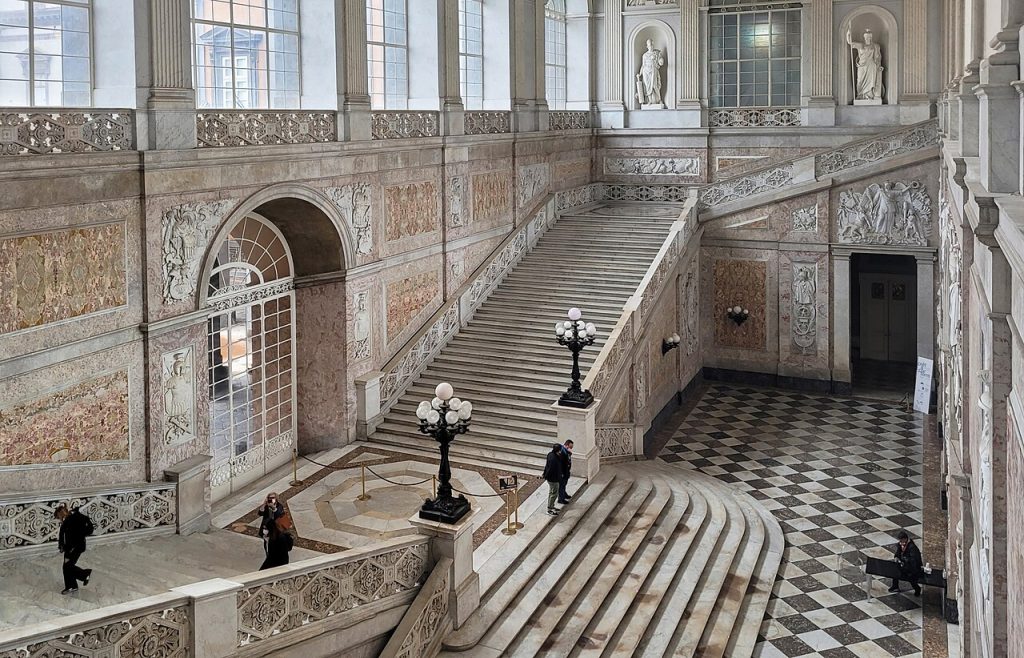
The palace’s entrance from the courtyard is the Scalone d’Onore, the grand staircase, built in 1651 by Francesco Antonio Picchiatti for the viceroy Count of Oñate as a double stair rising in a vast hall to the first floor, lit from above, which Montesquieu called the most beautiful staircase in Europe; it was rebuilt in white and grey marble after a fire in 1837 by Gaetano Genovese, who gave it its present Neoclassical dress with the bas-reliefs of the kingdom’s virtues and the statues of the Bourbon’s provinces. The stair is the palace’s grandest space and the start of the visit, and it was designed so that a carriage could draw up in the courtyard and its passengers climb to the state rooms without touching the street.
Now, stop here at the foot of the stair and look up at the two flights meeting on the landing. Eight dynasties climbed this stair, and the marble is cold enough to make the point.
1734: Charles of Bourbon Arrives
In 1734, in the War of the Polish Succession, the eighteen-year-old Charles of Bourbon, son of Philip V of Spain and Elisabeth Farnese, led a Spanish army into Naples, expelled the Austrians who had held the kingdom since 1707 and was proclaimed King of Naples and Sicily, the first king to live in the city for two centuries. Charles was a builder on a vast scale: he enlarged and redecorated the palace, built the San Carlo opera house beside it, began Capodimonte, the Albergo dei Poveri and, at Caserta, the largest palace in Europe, excavated Herculaneum and Pompeii and founded the porcelain factory and the Naples school of painting. In 1759 he left to become Charles III of Spain, handing Naples to his eight-year-old son Ferdinand.
The palace in Charles’s reign became a royal court for the first time, with the apartments refitted by Giovanni Antonio Medrano and the royal collections installed, and Naples became one of the capitals of the European Enlightenment.
The Court Theatre and the San Carlo
The visit to the apartments begins in the Teatrino di Corte, the court theatre, built in 1768 by Ferdinando Fuga for the wedding of Ferdinand IV and Maria Carolina of Austria, a small hall of white and gold with a stage, boxes and twelve statues of Apollo and the Muses in papier-mâché by Angelo Viva, where the court heard operas and concerts in private. Next door, linked to the palace by a passage, is the Teatro di San Carlo, built by Charles of Bourbon in 1737 as the largest opera house in the world and rebuilt after a fire in 1816, where the kings had their box and the city its music; it is the oldest working opera house in Europe and the palace’s grandest annex.
The court theatre was damaged by Allied bombs in 1943 and restored; the Muses survived, and the room is used for concerts.
Ferdinand IV, Maria Carolina and Nelson
Ferdinand IV reigned for sixty-five years, from 1759 to 1825, under three names and through two revolutions. A big, coarse, good-natured man who spoke Neapolitan dialect, hunted every day and sold fish in the market for fun, the lazzarone king, he was married in 1768 to Maria Carolina, the daughter of Maria Theresa and sister of Marie Antoinette, who ran the kingdom and the palace with Habsburg energy and, after her sister’s execution in 1793, Habsburg hatred of France. In 1798 the French approached, the court fled to Palermo on Nelson’s flagship with the treasury and Emma Hamilton, the French set up the Parthenopean Republic in the palace for five months, and the Bourbons returned in 1799 to hang the republicans in the square.
In 1806 Napoleon’s army came again, the court fled again to Sicily, and the palace received a French king who was the only one of the eight on the facade to be a commoner.
Murat, the French and the Empire Rooms
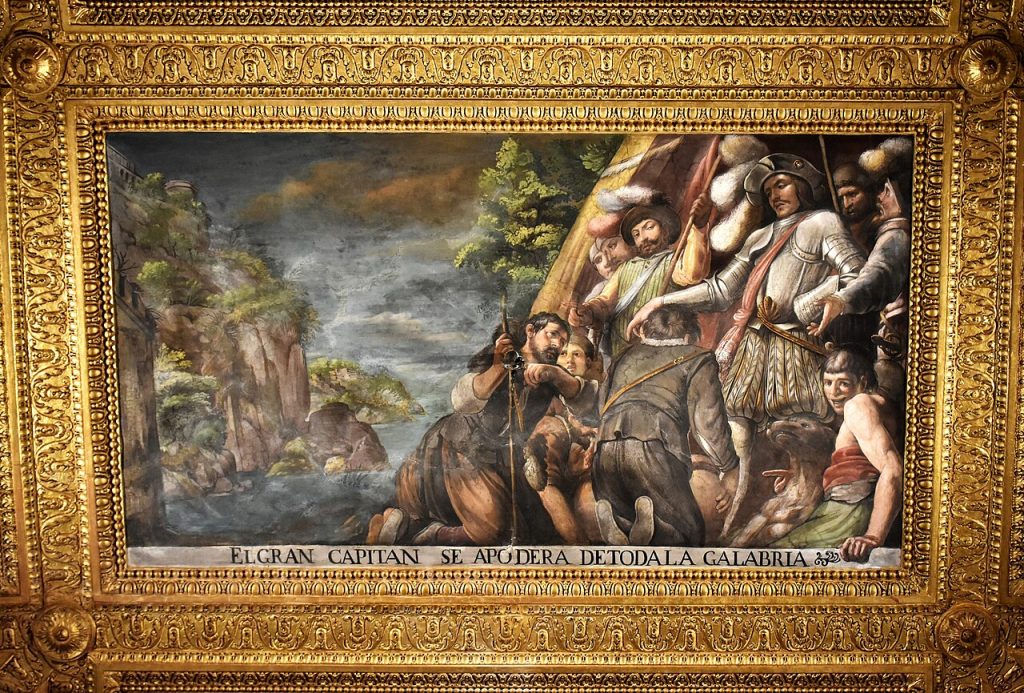
Napoleon gave Naples first to his brother Joseph, in 1806, and then in 1808 to his brother-in-law Joachim Murat, the innkeeper’s son from Gascony who had become the finest cavalry commander in Europe and the husband of Caroline Bonaparte. Murat and Caroline reigned for seven years, modernised the kingdom’s laws and administration, redecorated the palace in the Empire style with French furniture and the Neoclassical rooms that survive in the apartments, laid out the gardens and planned the square. In 1815, after Napoleon’s fall, Murat tried to regain his kingdom with a handful of men, landed in Calabria, was captured and shot, and Ferdinand returned to the palace as Ferdinand I of the Two Sicilies.
Murat’s statue on the facade, put up by the Savoy in 1888, was a deliberate insult to the Bourbons: the only non-royal king in the row, and the one who had governed best.
The Royal Apartments and the Throne Room
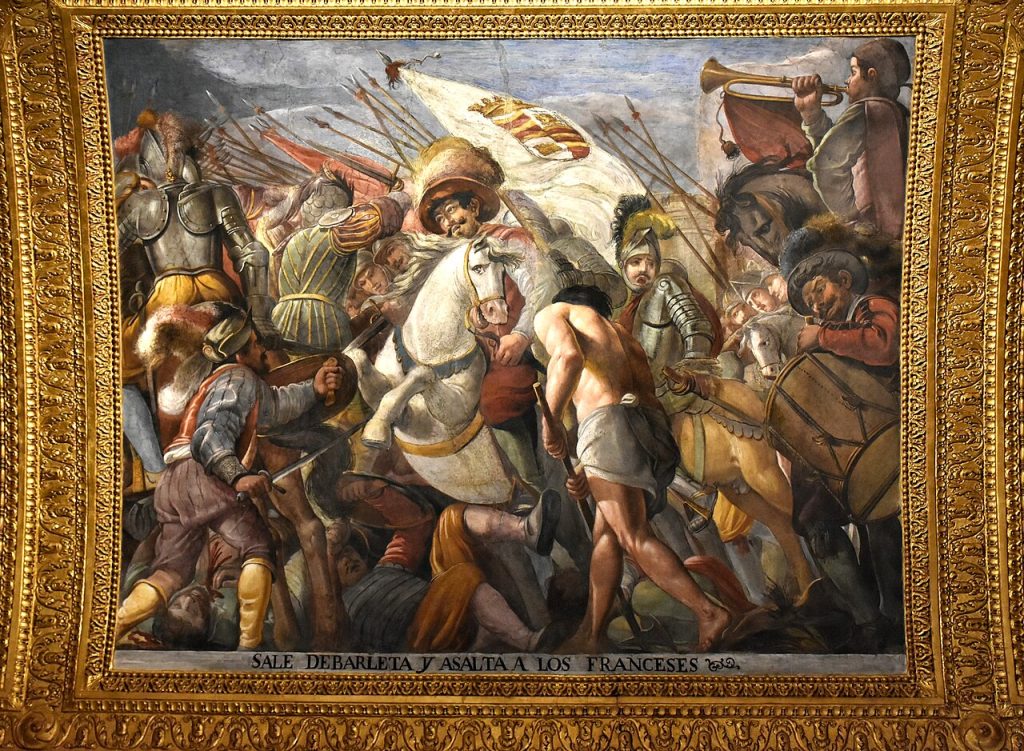
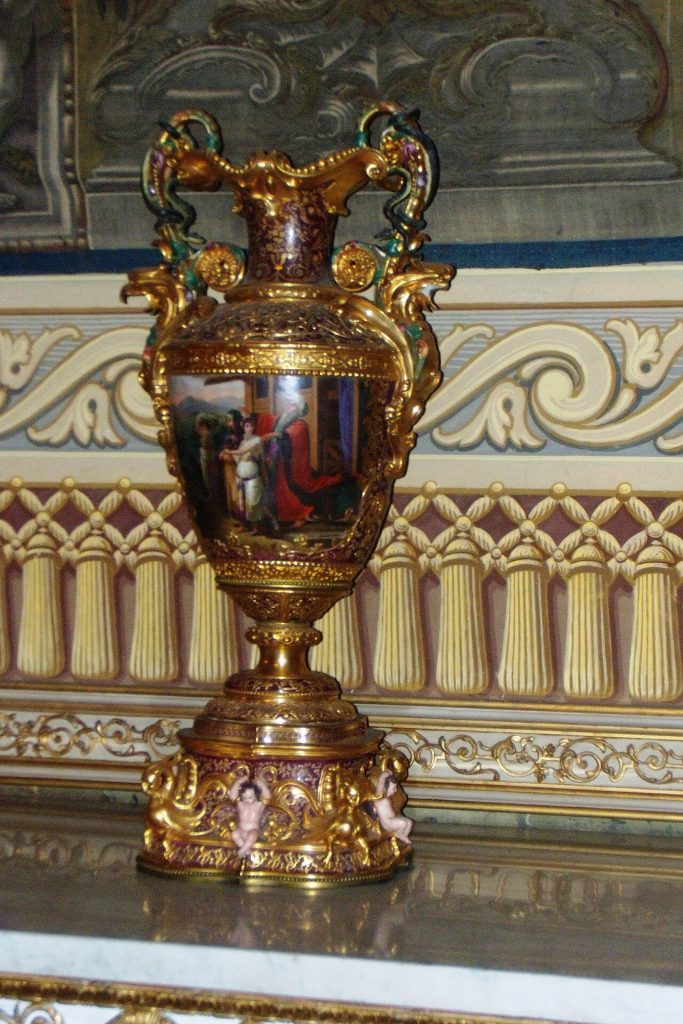
The historic apartment on the first floor runs through some thirty rooms along the facade and the courtyards: the hall of the ambassadors, the throne room with its gilded throne of 1850 under a canopy and a frieze of the kingdom’s provinces, the hall of Hercules with its Gobelins tapestries, the king’s and queen’s apartments with Bourbon and Empire furniture, Sèvres and Capodimonte porcelain, paintings by Titian, Guercino, Luca Giordano and the Neapolitan school, the private chapel and the queen’s study. The rooms were redecorated by Genovese for Ferdinand II in the 1830s and 1840s and refurnished in the twentieth century from the Bourbon’s other palaces, and they are the best surviving Bourbon interiors in Naples.
Look for the throne room’s frieze, for the tapestries in the hall of Hercules and for the Flemish and Neapolitan paintings in the queen’s rooms, and for the view from the windows over the square and the bay.
The Palatine Chapel and the Nativity
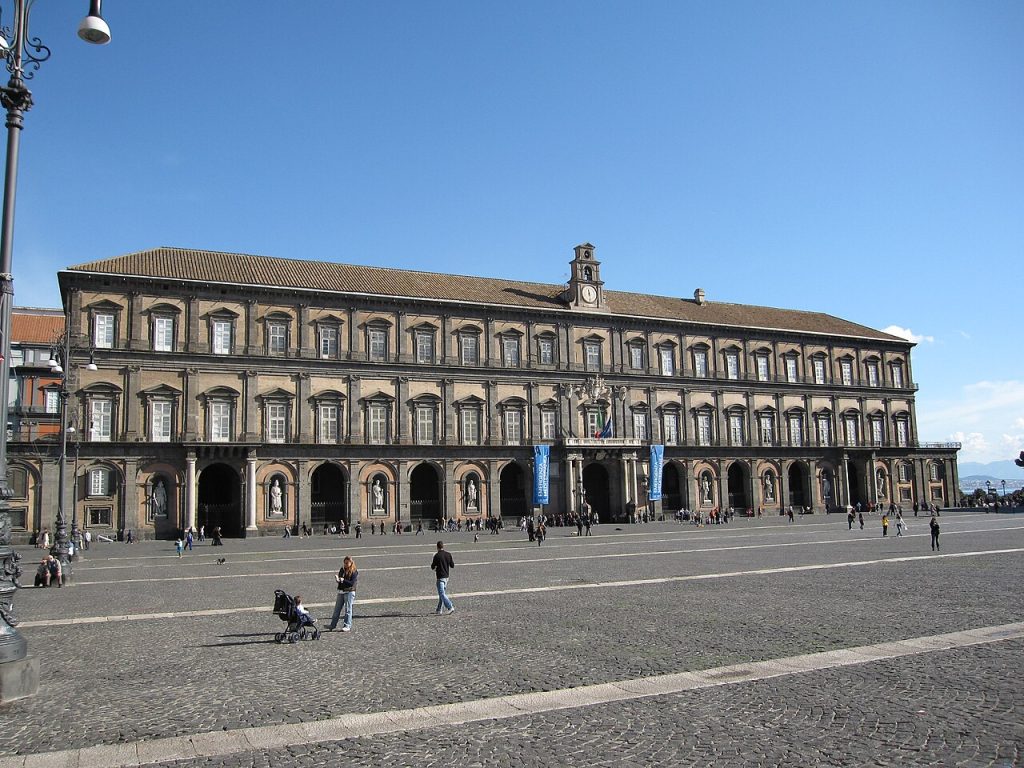
The Palatine Chapel, the royal chapel, built in 1646 by Cosimo Fanzago and redecorated in the nineteenth century, has a Baroque high altar of coloured marbles and gilt bronze brought from the church of Santa Teresa in 1808, Murat’s gift, and holds the palace’s most Neapolitan treasure: the royal presepe, the Nativity scene of the Bourbons, a crowd of several hundred eighteenth-century figures in terracotta and silk, shepherds, kings, Neapolitan street vendors, musicians and animals around the manger, the finest surviving example of the art that Naples made its own. The chapel was damaged in 1943 and restored, and the Nativity was reassembled from the royal collections.
Now, stop here before the presepe and find the Neapolitan details: the macaroni seller, the tavern, the Turks in turbans, the ruins of a Roman temple. The Bourbons’ Christmas was the city’s, and the kings themselves arranged the figures.
1860: Garibaldi, the Savoy and the Statues
On 7 September 1860 Garibaldi entered Naples by train, King Francis II having left for Gaeta the day before, and in October a plebiscite in the square voted the kingdom into united Italy; Victor Emmanuel II arrived in November and the Bourbons of Naples, after a hundred and twenty-six years, were gone. The palace became a residence of the Savoy, used by Victor Emmanuel and Umberto I for visits to the south, and in 1888 Umberto had the arcade’s niches filled with the eight statues of the dynasties, ending with his father, a monument to a unity that Naples had voted for and would resent. The Savoy gave the east wing to the National Library in 1922, and the apartments became a museum in the same decade.
The palace was the Savoy’s statement that they were the heirs of all of Naples’ kings; the Neapolitans, who still argue about the Bourbons, have never quite agreed.
The National Library and the Herculaneum Papyri
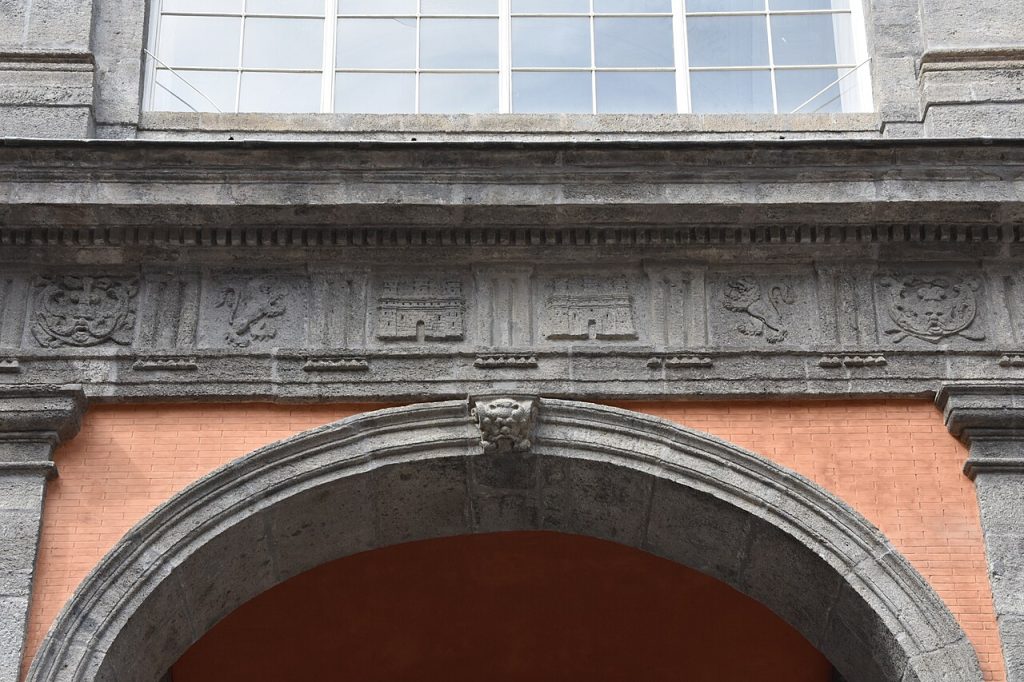
The Biblioteca Nazionale Vittorio Emanuele III, the National Library of Naples, occupies the east wing and the upper floors of the palace, with two million volumes, the Bourbon royal library, the Farnese manuscripts that Charles brought from Parma and, in a special room, the Herculaneum papyri, some eighteen hundred carbonised scrolls found in 1752 in the Villa of the Papyri at Herculaneum, the only library of the ancient world to survive, unrolled with a machine invented by a Neapolitan priest and still being read with imaging technology. The library’s reading rooms, in the Bourbon apartments with their frescoed ceilings, are open to readers, and the papyri can be seen on guided tours.
The library also holds the manuscripts of Leopardi and the Bourbon archives, and its gardens, the hanging garden over the harbour, are among the palace’s secrets.
Bombs, Restoration and the Square Today
Allied bombs in 1943 destroyed part of the palace’s roof, the court theatre and the chapel, and the Germans, retreating, burned the archives in the courtyard; the restoration took a decade, and the museum reopened in the 1950s. Since 2014 the palace has been an autonomous museum of the Ministry of Culture, which has restored the apartments, the staircase and the facade, reopened the hanging garden and the chapel and made the palace, with the Castel Nuovo and the San Carlo beside it, the centre of a monumental quarter that the pedestrianised square has given back to the city.
Now, stop here on the balcony of the throne room and look over the square to the colonnade and the bay beyond. Eight dynasties ruled Naples from this building and seven of them came from somewhere else; the square below belongs to the Neapolitans, who have outlasted all of them.
Naples on Video
Visiting the Royal Palace of Naples Today
The Royal Palace of Naples is open daily except Wednesday, with a ticket covering the grand staircase, the court theatre, the historic apartment of thirty rooms, the Palatine Chapel with the Nativity and the hanging garden; audio guides in English are available. Allow two hours, and book separately for the National Library’s guided tours of the Herculaneum papyri and the Bourbon reading rooms, which run on set days. Combine the palace with the Castel Nuovo across the street, the San Carlo opera house next door, which has daily tours, and the Galleria Umberto, and come back to the square at sunset.
The palace is on Piazza del Plebiscito in the centre of Naples, five minutes from the Municipio metro station and the port; Naples is seventy minutes from Rome by high-speed train. Palermo is reached by overnight ferry or a one-hour flight, Urbino by train to Pesaro and bus. Here is the exact spot: Royal Palace of Naples on Google Maps.
Palaces Nearby
You May Like
The Ducal Palace of Urbino and the Court of Federico da Montefeltro


One thought on “The Royal Palace of Naples and the Eight Kings on the Facade”