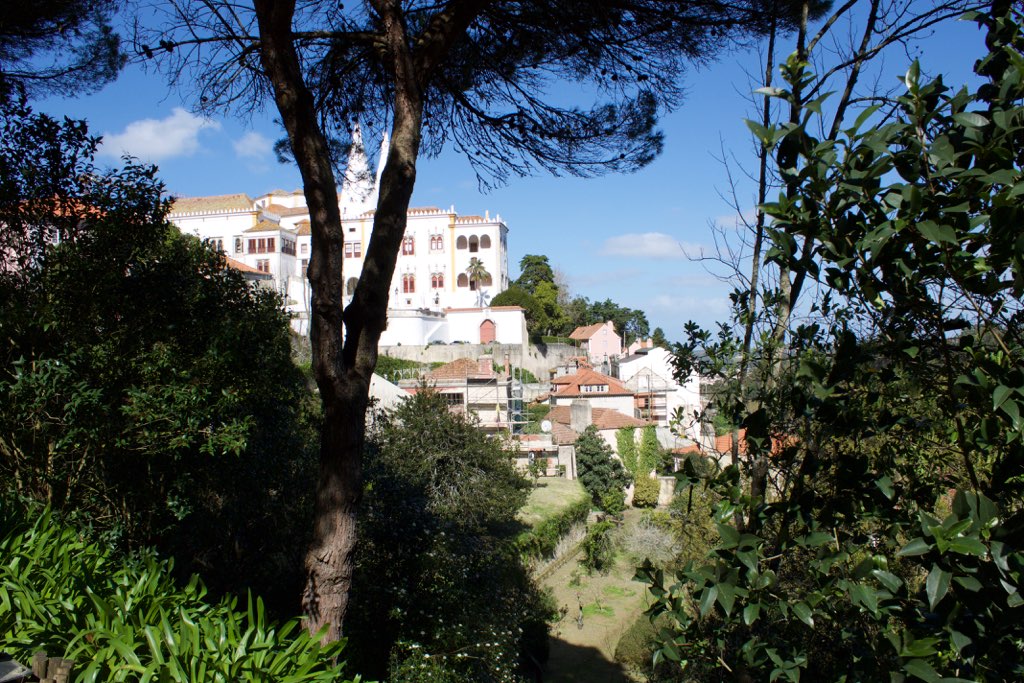
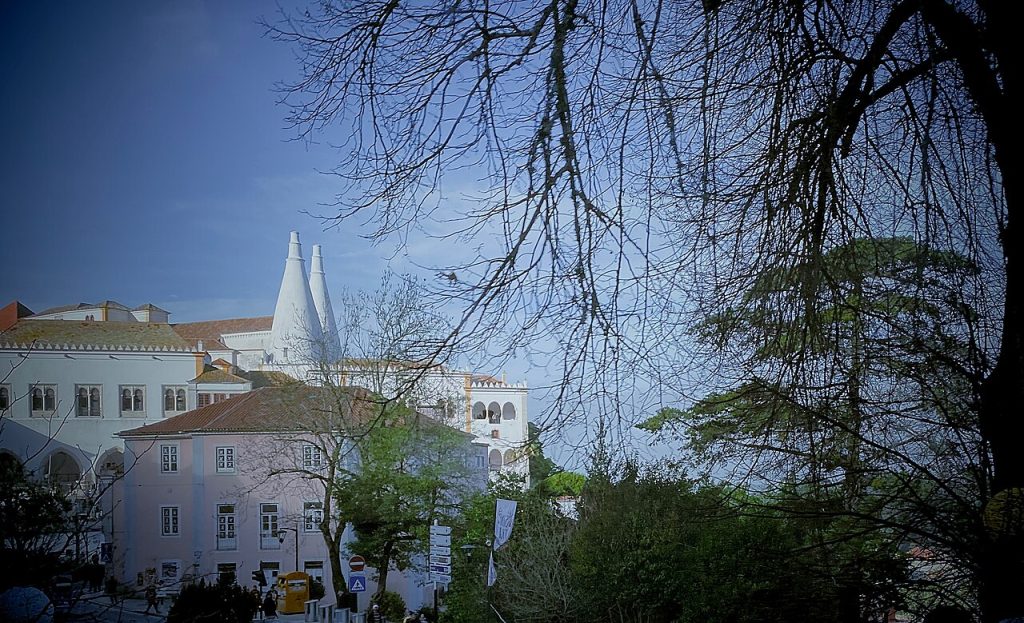
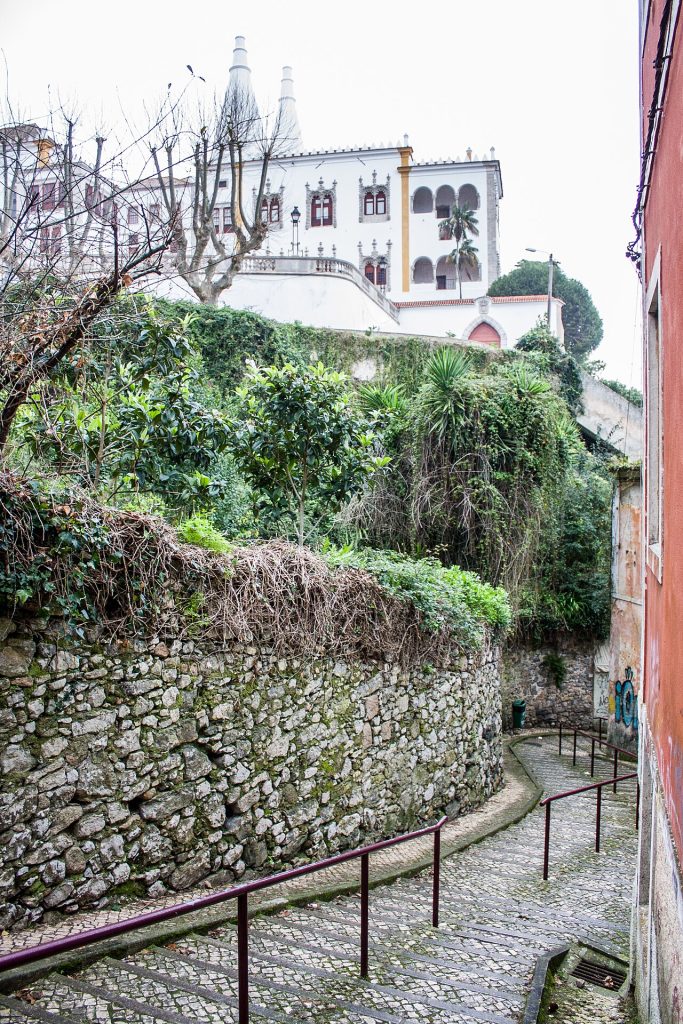
Half an hour west of Lisbon, where the Serra de Sintra lifts a ridge of green granite between the capital and the Atlantic, a small town of mansions and camellias gathers around a white palace whose roofline is unlike any other in Europe: two colossal conical chimneys, thirty-three metres high, rising side by side like kilns above Gothic facades, Moorish windows and walled patios. It is the Palácio Nacional de Sintra, the town palace of the Portuguese kings for nearly eight centuries, the best preserved medieval royal residence in the country and the heart of the cool, wooded, half-magical landscape that Lord Byron called glorious Eden and UNESCO lists whole as the Cultural Landscape of Sintra.
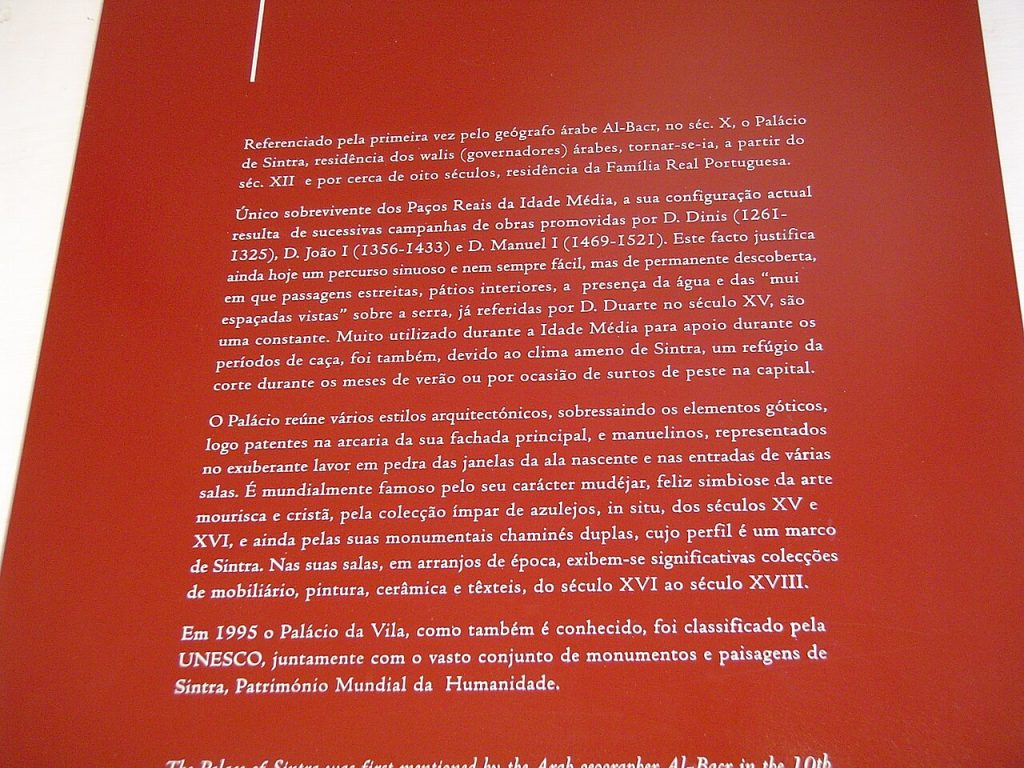
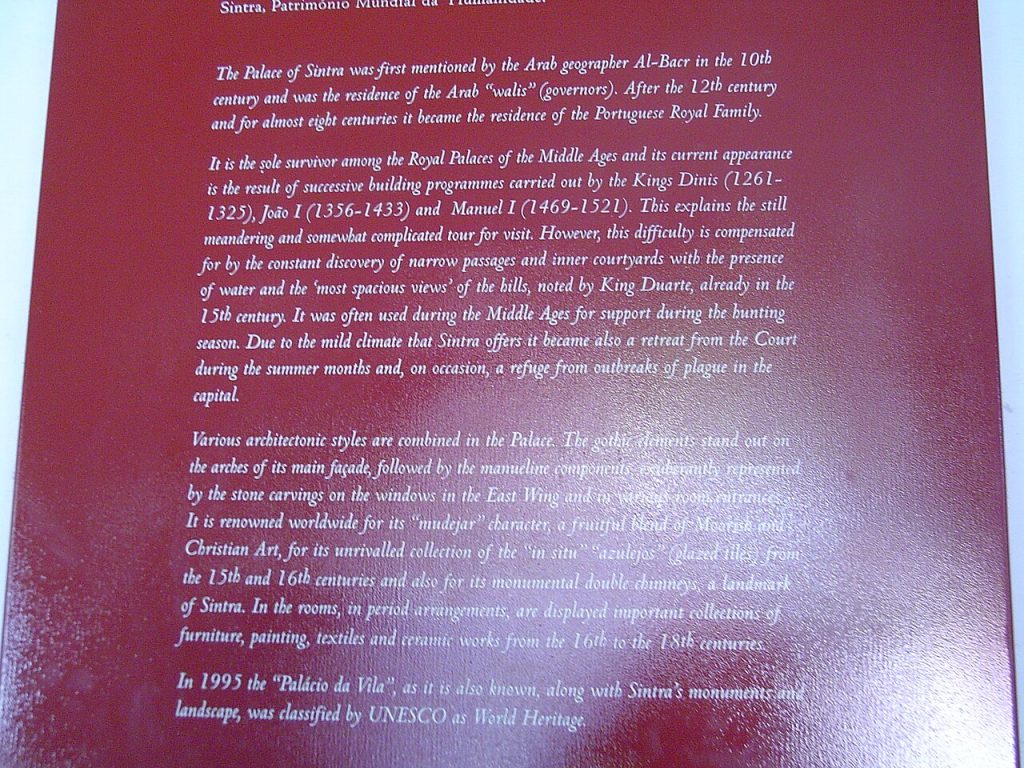
The palace is a Moorish building wearing Portuguese history. The residence of the Islamic walis of Sintra passed to the Portuguese crown at the conquest of Lisbon in 1147, and every great dynasty rebuilt without demolishing: Dinis and his successors kept the Moorish core and its waters, John I of Avis raised the great halls of the Swans and the Magpies and the kitchen of the two chimneys around 1400, and Manuel I, flush with the first pepper fleets from India, added a wing in his ocean-going Manueline style and crowned the palace with the heraldic dome of the Sala dos Brasões, the proudest painted room in Portugal. Here courts summered, treaties ripened, a poisoned king heard swans, a mad one was confined for nine years, and the last queen passed on her way to exile. It is the fifth stop of the Iberian chapter, and the first of its three Sintra palaces.
Walk with me up from the town square through the Swan Hall and the Magpie Hall, under the gilded dome of the coats of arms, into the chapel, the mad king’s room and the great kitchen beneath the chimneys, with Moors, Avis kings, spice fleets and azulejos in order. The contents are below.
In This Article
- The Serra and the Town
- The Palace of the Walis
- 1147: The Conquest and the Medieval Kings
- John I and the Avis Rebuilding
- The Hall of the Swans
- The Hall of the Magpies
- Manuel I and the Pepper King’s Wing
- The Sala dos Brasões
- The Azulejos and the Waters
- The Kitchen of the Two Chimneys
- The Prison of Afonso VI
- Councils, Autos and the Last Queen
- The National Palace Today
- Sintra on Video
- Visiting the Sintra National Palace Today
- Palaces Nearby
The Serra and the Town
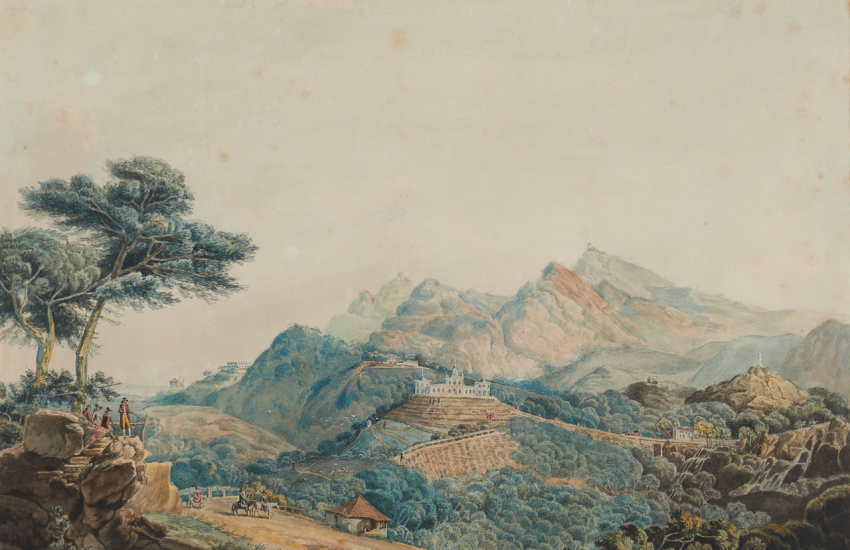
The Serra de Sintra is a ten-kilometre ridge of granite thrown up between the Tagus plain and the ocean, catching the Atlantic mists so that its slopes stay green and dripping when Lisbon bakes; the Romans called it Mons Lunae, the Mountain of the Moon, and every ruler of Lisbon has kept a summer refuge here for the cool air alone. The town climbs the ridge’s northern foot in terraces of quintas, fountains and tree ferns, with the palace filling its central square, the Moorish castle’s walls riding the crest above, and Pena’s domes, a later story in this series, crowning the highest peak; the micro-climate grows camellias, magnolias and giant sequoias in what is nominally the latitude of Sicily.
Now, stop here in the Praça da República with the palace’s white mass and twin cones above you: the town has no other centre and needs none, for the building was the town’s reason, employer and calendar for seven hundred years.
The Palace of the Walis
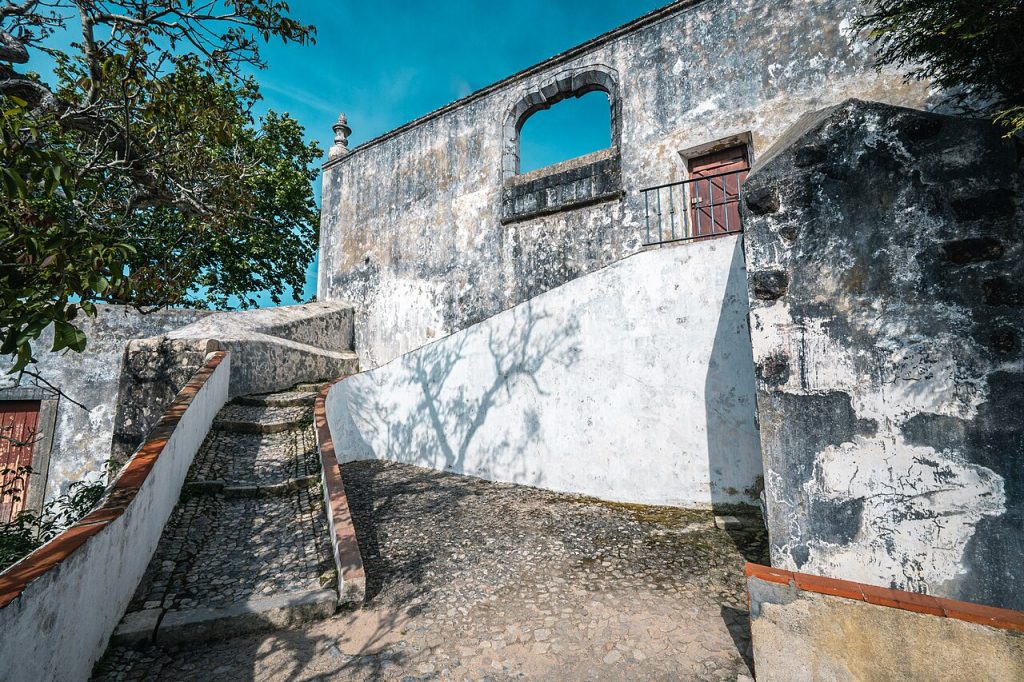
Under Islam, Sintra was a dependency of Lisbon with two castles: the military one on the crest, whose restored walls visitors climb today, and the residence of the walis in the town below, praised by the geographer Al-Bakri in the eleventh century, a palace of courtyards, water and orchards in the Andalusi manner. That lower palace is the building’s seed: its patios, cisterns, channels and some walls survive within the later fabric, its taste for courtyards with running water never left the house, and the horseshoe-arched windows and glazed tiles that later kings commissioned were conscious continuations, so that the palace remained, in its bones and manners, the most Moorish royal house in Christian Europe.
Sintra surrendered to Afonso Henriques, first king of Portugal, in 1147 in the wake of Lisbon’s fall; the walis’ palace became the king’s, and has never since belonged to anyone else.
1147: The Conquest and the Medieval Kings
The first Portuguese centuries used the palace as they found it, with repairs and small works: Dinis, the farmer-poet king who planted the pine forests of Leiria and founded the university, kept Sintra for his queen, Saint Isabel, and ordered its waters maintained; the palace’s charter tradition says its Mouraria, the quarter of Muslim craftsmen retained after the conquest, supplied the plasterers and tilers who kept the Andalusi crafts alive in royal service. Fernando I, the last of the Burgundian line, bought out the local lordship in 1383 and made the palace fully the crown’s; his death that year brought the succession crisis and revolution from which the house of Avis rose.
Thus when the great rebuilding came, it came on a living Moorish house in working order, which is why Sintra never got a clean-slate Gothic palace and why it is unique.
John I and the Avis Rebuilding
John I, the bastard Master of Avis raised to the throne by the revolution of 1385 and the victory of Aljubarrota, rebuilt Sintra around 1400 as the favoured seat of his new dynasty: the great entrance facade with its Gothic portal and paired Moorish-arched windows, the central patio, the Swan and Magpie halls, and the kitchen with its two chimneys are his, built by Portuguese masters with Mudéjar craftsmen, and paid for by a kingdom secure at last from Castile. Here John and his English queen Philippa of Lancaster, granddaughter of Edward III, raised the Illustrious Generation, Duarte the philosopher-king, Pedro the traveller, Henry the Navigator, whose African schemes were argued in these rooms before Ceuta’s conquest in 1415 launched the age of discoveries.
Sintra under John was the family house of the dynasty that invented Atlantic Portugal; the ships left from Lisbon, but the decisions summered here.
The Hall of the Swans
The Sala dos Cisnes, the Hall of the Swans, is the palace’s great hall and the largest medieval royal hall in Portugal, lit by rows of arched windows onto the patio and roofed by a panelled ceiling painted with twenty-seven swans, each in a different pose with a gold collar; tradition ties them to the wedding of John’s daughter Isabel to Philip the Good of Burgundy in 1430, whose gift of swans, or whose Burgundian emblem, the painters repeated overhead. Here the court banqueted, ambassadors from Castile, England and Rome were received, and the autos of Gil Vicente, the father of Portuguese theatre, were staged before the king; the hall still hosts state dinners and concerts, seven centuries into its service.
Now, stop here mid-hall and count swans: twenty-seven, one, the guides say, for each year of Isabel’s age at her wedding, and if the arithmetic of the legend is shaky, the ceiling’s serene procession is not.
The Hall of the Magpies
The adjoining Sala das Pegas, the Hall of the Magpies, carries the palace’s best story on its ceiling: a hundred and thirty-six magpies, each holding in its beak a scroll with the king’s motto Por Bem, for good, and in its claw a rose of Lancaster. The tale, told since the sixteenth century, says Queen Philippa caught John kissing a lady-in-waiting; the king protested it was done por bem, innocently, and, stung by the court’s chatter, had a magpie painted for every gossiping lady, chattering birds pinned forever under his motto. Historians shrug, the rose and motto are real royal emblems, and the room, where the king gave audience, wears the joke magnificently.
True or not, it is the oldest piece of palace gossip in Europe still doing its job on the original ceiling; look up and the birds are still talking.
Manuel I and the Pepper King’s Wing
Manuel I, the Fortunate, in whose reign Vasco da Gama reached India and Cabral touched Brazil, poured pepper money into Sintra from 1497: a new eastern wing with the great heraldic room above, windows in the Manueline style, that uniquely Portuguese flowering of late Gothic twisted with ropes, coral and armillary spheres, Mudéjar tile revetments ordered from Seville by the shipload, and the patio’s grotto of baths refreshed. It was at Sintra, chroniclers tell, that Manuel received word of Gama’s return in 1499, and the palace’s azulejos and gilded ceilings are the domestic face of the empire that followed; his motto and armillary sphere stud the walls he touched.
Manuel’s works completed the palace you see, and after him the kings changed little but furnishings: Sintra was finished, and Portugal’s builders moved on to grander follies elsewhere, some of them up this very hill.
The Sala dos Brasões
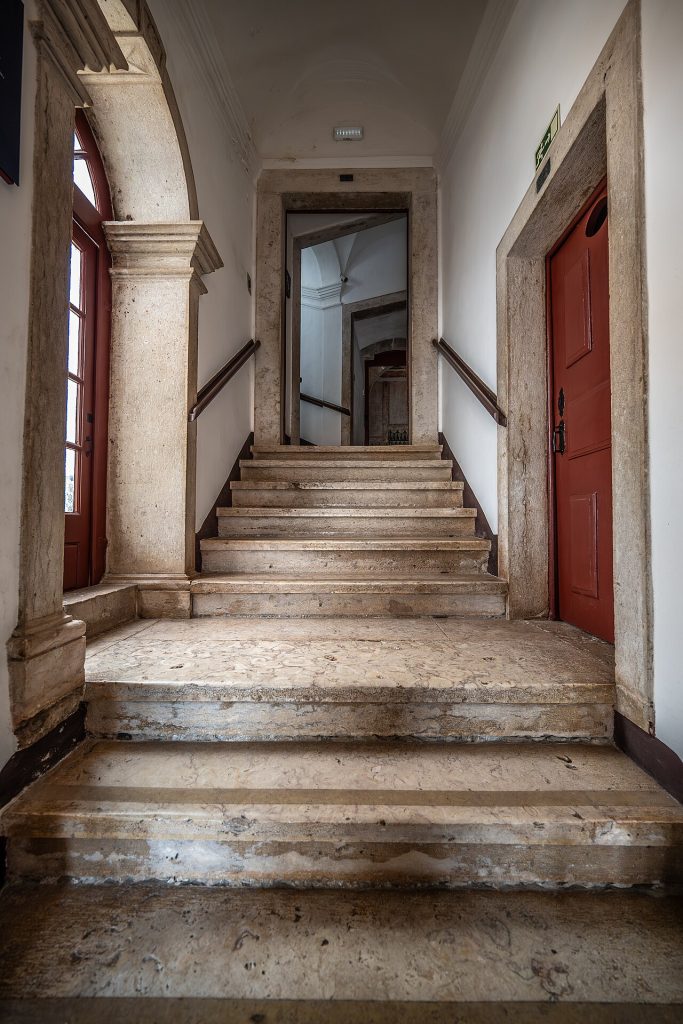
The Sala dos Brasões, the Hall of Coats of Arms, finished between 1515 and 1520 at the top of Manuel’s wing, is the proudest heraldic room in Europe: an octagonal gilded dome carrying, at its crown, the royal arms of Portugal, around them the shields of Manuel’s eight children, and below, held by seventy-two golden stags, the arms of the seventy-two leading noble houses of the kingdom, the whole governing class painted into one ceiling; the walls beneath were lined in the eighteenth century with blue-and-white azulejo hunting scenes, and the windows look over the town to the sea. One shield is blank: the Távoras, erased in 1759 when the family was destroyed for alleged regicide, their absence the room’s grimmest footnote.
Now, stop here under the dome and turn slowly: it is the Portuguese state as a planetarium, king at the zenith, princes orbiting, nobility fixed in golden order, and every visitor from 1520 to this morning has left with a bent neck.
The Azulejos and the Waters
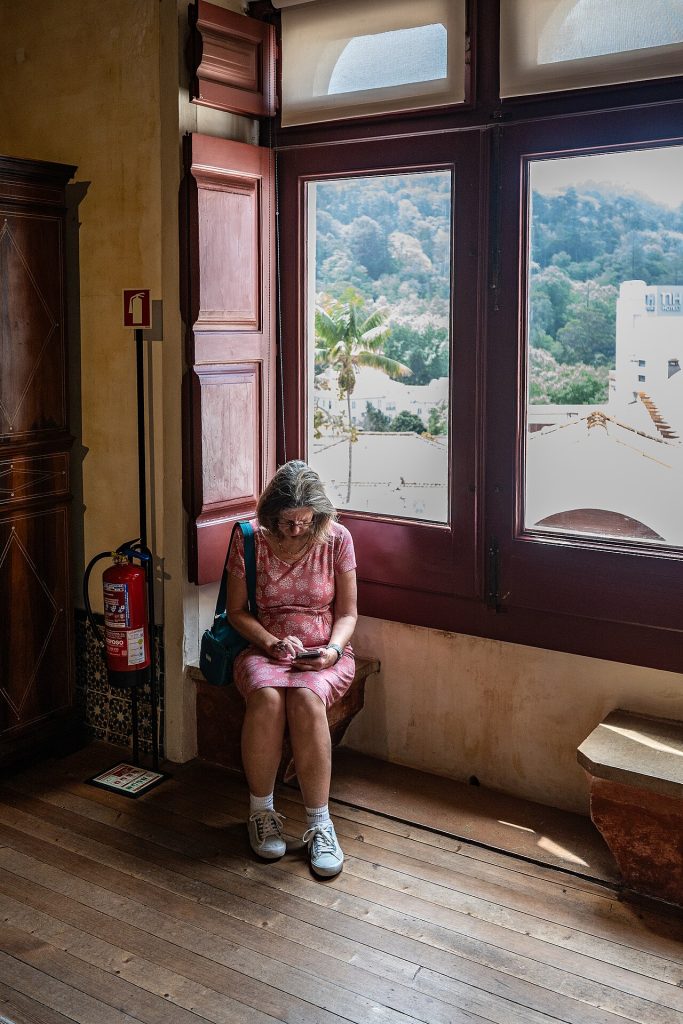
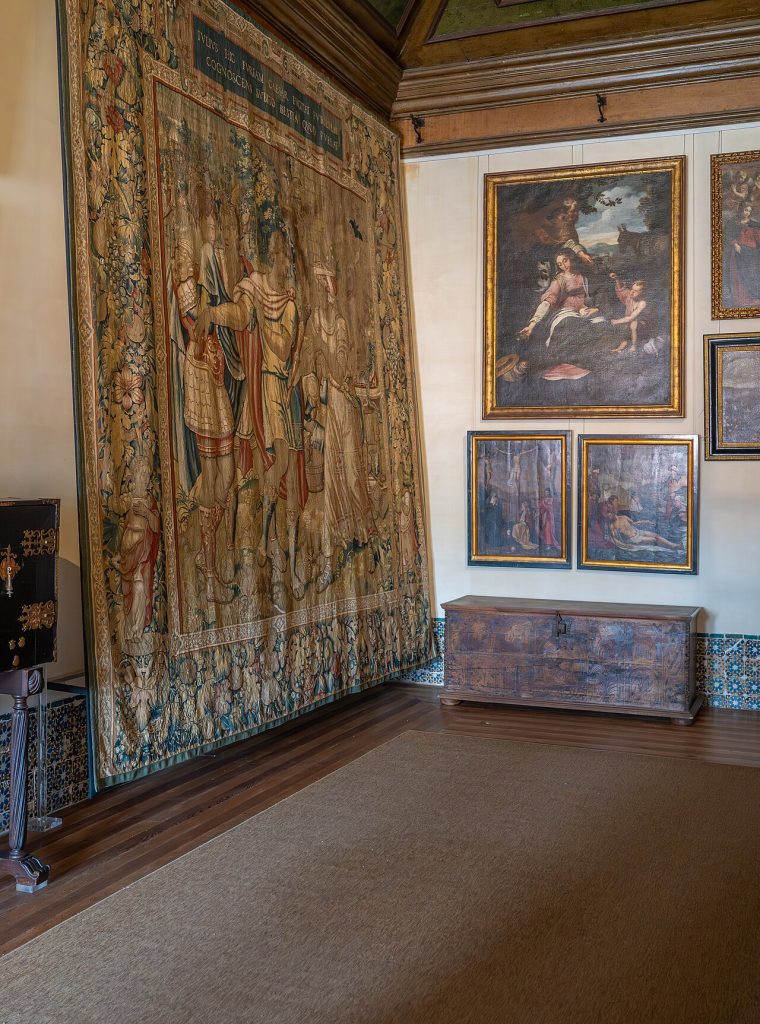
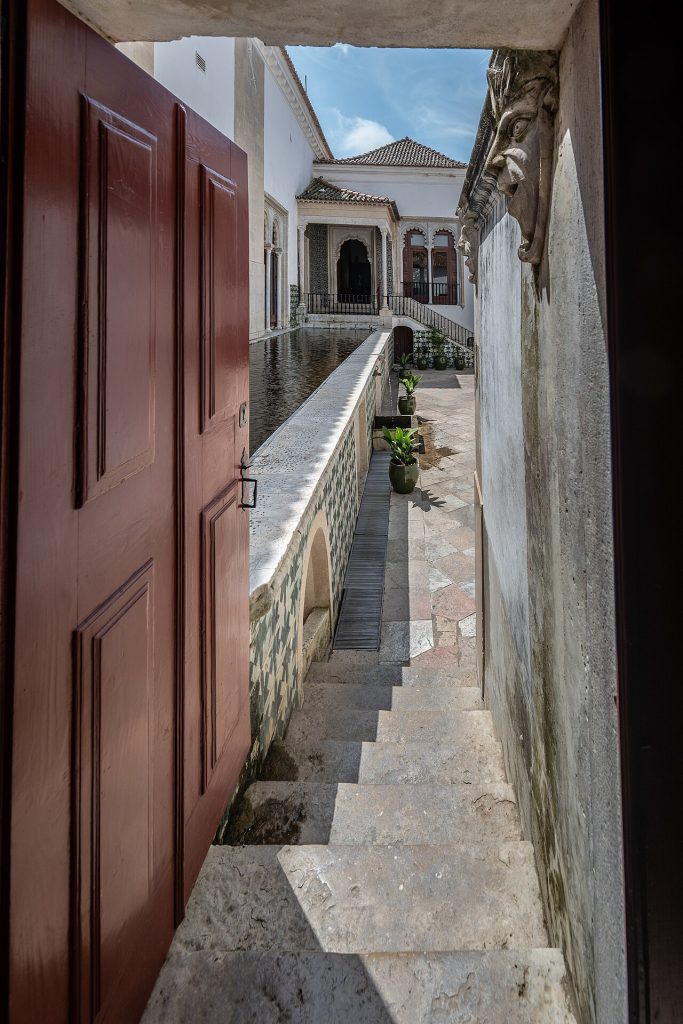
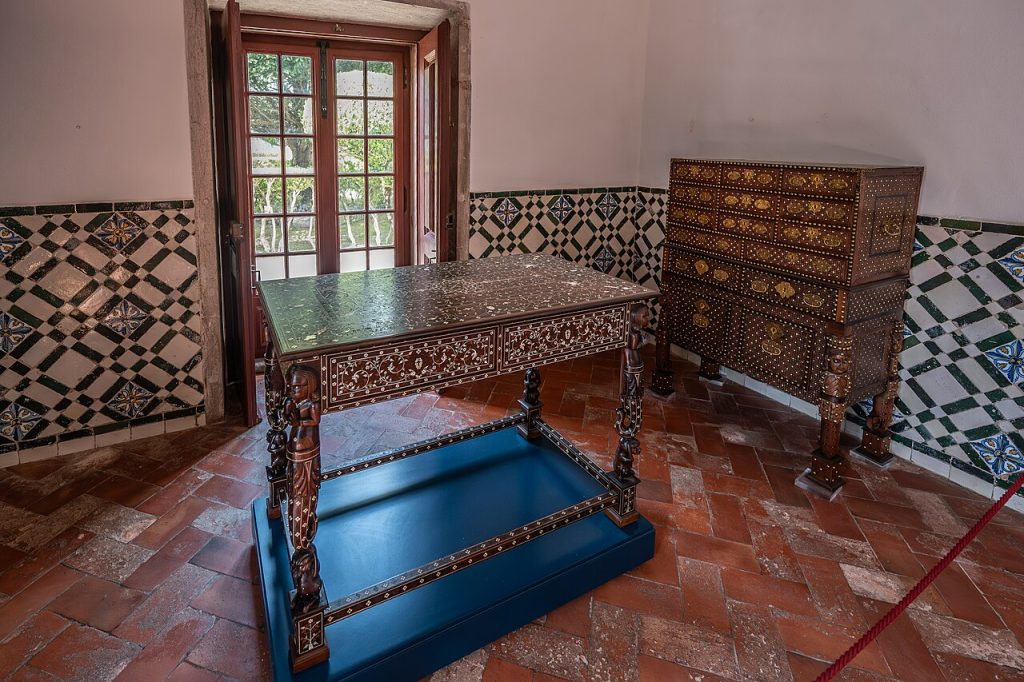
The palace is the best single collection of azulejos in Portugal, read room by room like a tile museum that happens to be a palace: green-and-white chequers and Mudéjar cuerda seca and arista tiles from Seville in the oldest rooms, the corn-flower panels of the central patio, Manueline armillary spheres, vine leaves in relief climbing the chapel stair, and the great blue-and-white figurative walls of the eighteenth century in the Brasões and elsewhere, five centuries of the art on original walls. Among them run the waters: the central patio’s channel and basin, the grotto of the baths with its jets and tiled Negress fountain, cisterns fed from the serra, the Moorish palace’s hydraulics never abandoned.
Walk the patios listening: the sound of thin water on tile is the palace’s oldest furnishing, older than any king in the paintings, and the serra still supplies it for free.
The Kitchen of the Two Chimneys
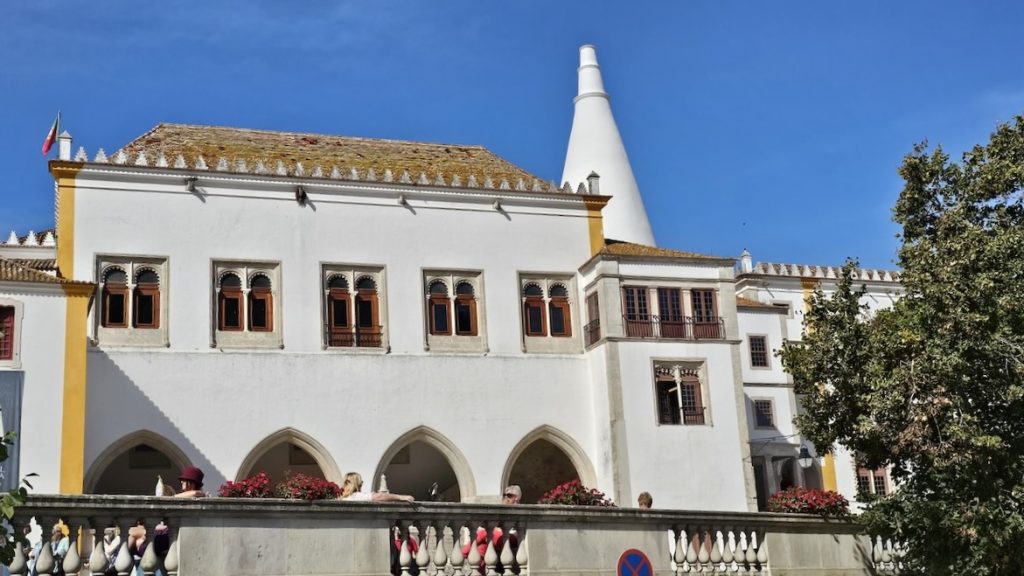
The kitchen behind the Swan Hall is a single great room beneath the two conical chimneys, each open overhead in a white funnel narrowing thirty-three metres to the sky, built for John I’s household to roast oxen whole for hall feasts, with tiled walls, iron spits and ovens that stayed in use into the twentieth century, catering its last royal banquet for Queen Elizabeth II’s state visit in 1957. The cones, whitewashed outside and visible from everywhere in town, became Sintra’s emblem, on its arms, its pastry boxes, for the town’s queijadas and travesseiros are the required dessert after the palace, and its souvenirs; no one knows another kitchen like it anywhere.
Now, stop here under one of the cones and look straight up at the circle of sky: you are standing in the fireplace of a medieval state banquet, inside the logo of a town.
The Prison of Afonso VI
The palace’s darkest room is a plain chamber off the central patio where Afonso VI, the Victorious, under whose reign Portugal’s independence from Spain was finally won in battle, but who was himself lamed and unstable from childhood illness, was confined by his brother Pedro, who had taken his throne, his liberty and his queen, the marriage annulled and the lady promptly married to Pedro. Deposed in 1668 and held first in the Azores, Afonso was moved in 1674 to Sintra and kept nine years in this room, where the guides show a track worn in the tile floor, by tradition the path of his pacing, until his death at the palace in 1683; he heard mass through a grille into the chapel next door.
The chapel itself, with its Mudéjar ceiling of interlaced stars and painted walls of doves, is the palace’s oldest devotional room; the prisoner-king’s grille is its saddest fitting.
Councils, Autos and the Last Queen
For five centuries the palace framed the kingdom’s turning points: here the boy-king Sebastian held councils before launching the Moroccan crusade that killed him and sixty years of independence at Alcácer Quibir in 1578; here, under Spanish rule, the captive kingdom’s nobles came to swear Philip II; here John IV’s restored dynasty summered, and the eighteenth-century court kept its autumns until Mafra and Queluz, newer toys, drew it away, leaving Sintra to dowagers and the mad king’s ghost. The last royal act came in the monarchy’s last month: Queen Amélia stayed in the palace in the autumn of 1910, and from Sintra was driven to Ericeira on 5 October to the yacht that took the family to exile when the Republic was proclaimed.
Eight centuries of continuous crown ownership ended that week; no other European palace served one unbroken national monarchy so long.
The National Palace Today
The Republic declared the palace a national monument in 1910, opened it as a museum, and restorations through the twentieth century, not without the era’s heavy hand, recovered halls and ceilings; since 1995 it anchors the UNESCO Cultural Landscape of Sintra, the first such landscape listing in Europe, and since 2012 it is managed by Parques de Sintra with the serra’s other monuments, hosting concerts in the Swan Hall, scholarly tile conservation and nearly a million visitors a year who nonetheless thin out here by mid-afternoon, when the day-trippers climb to Pena and leave the Moorish patios almost quiet. The town around it lives its double life, heritage stage set by day, small serra town by night.
Now, stop here a last time in the central patio at closing, with the water running and the swifts circling the chimneys. Walis, navigators, poisoned and mad and exiled kings all kept this one cool house on the Mountain of the Moon, and it has outlasted every Portugal that owned it while never once standing empty; the water channel you hear has been playing, give or take a siege, for a thousand years.
Sintra on Video
Visiting the Sintra National Palace Today
The Palácio Nacional de Sintra is open daily, with timed tickets online from Parques de Sintra cheaper than the door and a route covering the Swan and Magpie halls, the Brasões dome, the chapel, Afonso VI’s chamber, the patios and the kitchen; allow ninety minutes, and come at opening or after three, when the tour groups are on the hill. Pair it with a queijada and a bica in the square, the Moorish castle and Pena above, reached by bus 434 from the palace’s door, and Monserrate and Quinta da Regaleira along the Seteais road; Sintra deserves two days, but if you have one, this palace first, Pena after, is the right order.
Sintra is forty minutes from Lisbon by train from Rossio or Oriente, and the palace five minutes’ walk from the station through the old town; by car the A37 takes half an hour outside rush hour, but parking is scarce, so the train wins. Here is the exact spot: Sintra National Palace on Google Maps.
Palaces Nearby
You May Like
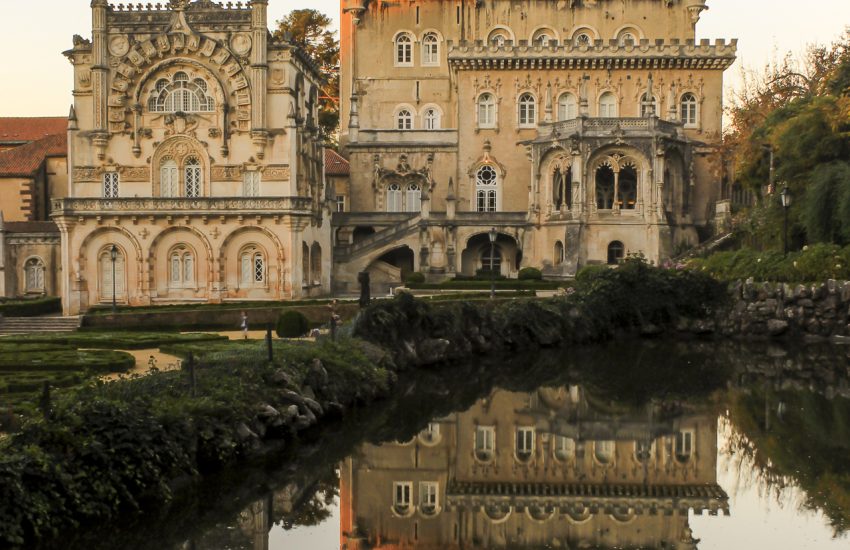
Bussaco Palace and the Hunting Lodge That Became a Hotel