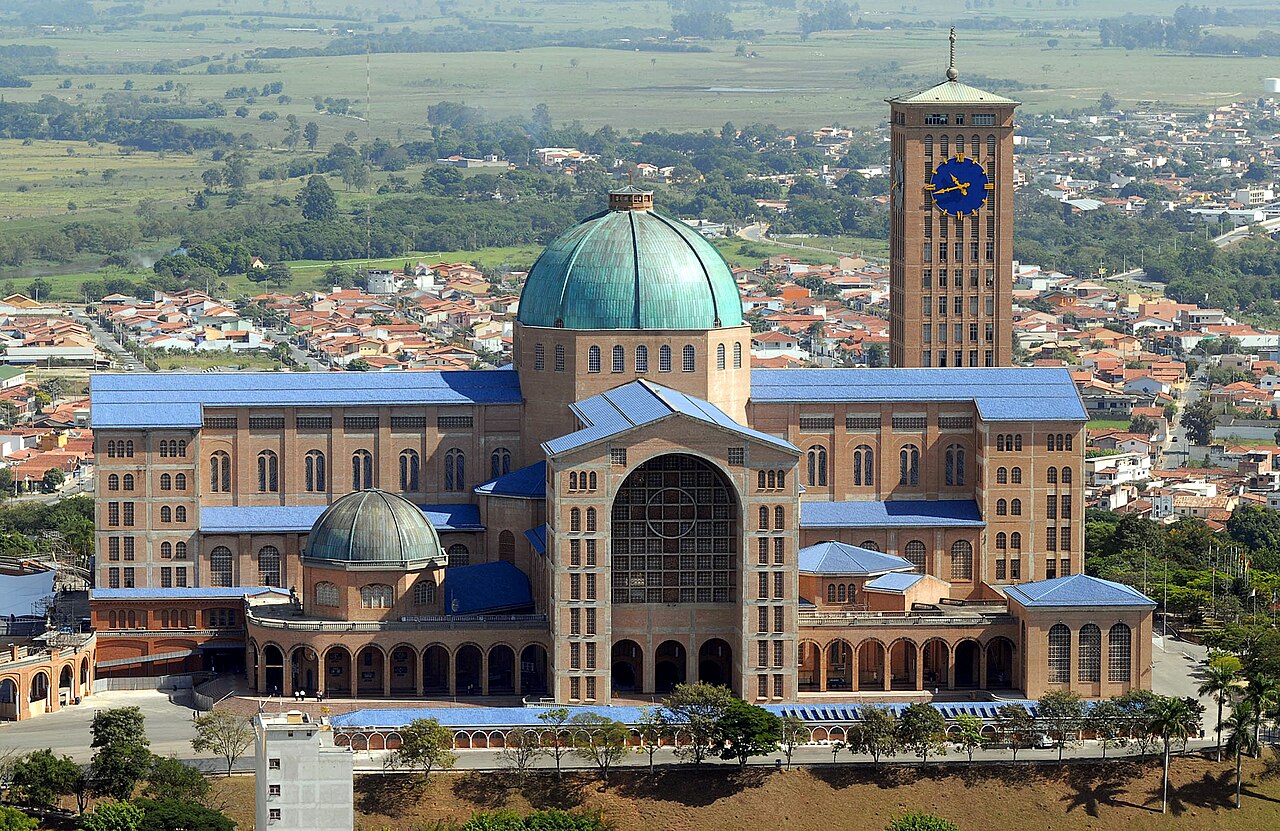
Some holy places overwhelm you with their grandeur. Aparecida does that too, since it is one of the largest churches on earth, big enough to hold tens of thousands of worshippers under its great dome. But the thing that actually draws the crowds is tiny: a small, dark statue of the Virgin Mary, barely the height of a forearm, that a few poor fishermen pulled out of a Brazilian river almost three centuries ago. The contrast between the enormous basilica and the little figure at its heart says almost everything about this place, and about the warm, popular Catholicism of Brazil that surrounds it.
To understand why an entire nation built so vast a shrine around so small an object, you have to go back to a single unlucky day of fishing on the Paraiba River.
The little statue from the river
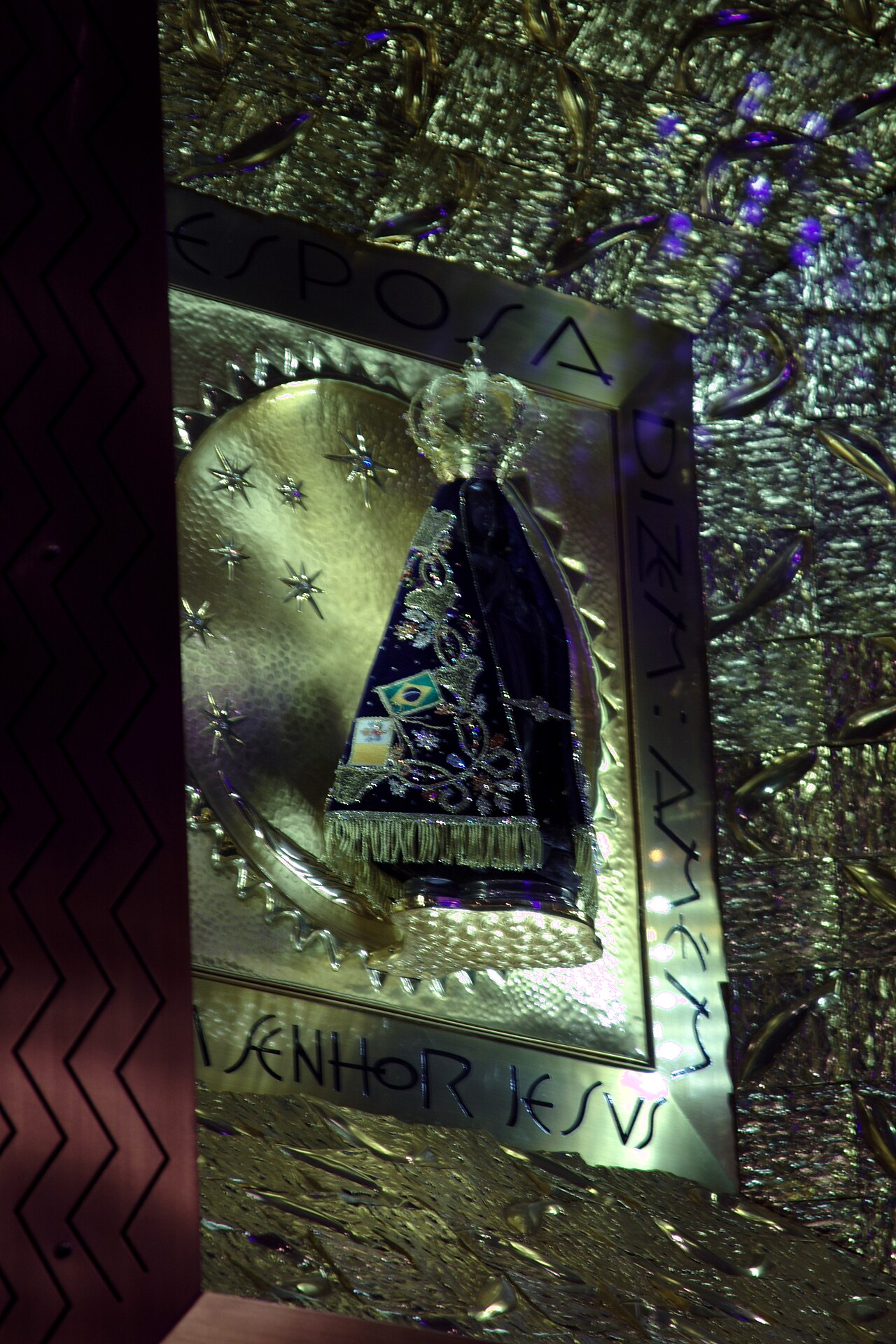
The story, cherished and retold across Brazil, takes place in the early eighteenth century. Three fishermen, struggling to catch anything on the Paraiba River, cast their nets again and again with no luck. Then, instead of fish, they pulled up the body of a small terracotta statue of the Virgin Mary, dark in colour, and on the next cast they found its head. After they brought the little figure into their boat, the tradition says, their nets suddenly filled with fish. The image came to be known as Our Lady who Appeared, Nossa Senhora Aparecida, and word of the miraculous catch spread quickly among the ordinary people of the region.
What makes this story so beloved in Brazil is precisely its humbleness. There were no kings or bishops in it, only poor working men on a river, and a Virgin whose dark colouring resembled the mixed and African-descended people who would come to love her most. A simple chapel was built to house the statue, then a larger church as the pilgrims multiplied, and over the centuries the devotion grew into something national. The dark little Virgin became, for millions of Brazilians, a mother who belonged to the poor and the overlooked rather than to the powerful.
How a chapel became a basilica for a continent
As the centuries passed and the number of pilgrims swelled into the millions, the modest churches that had sheltered the statue were no longer enough. In the twentieth century, work began on the enormous basilica that stands today, a building conceived on a scale to match the devotion of an entire nation. It is one of the largest Catholic churches in the world, an immense structure in the shape of a cross with a soaring central dome, capable of receiving the vast crowds that converge on the town, especially around the feast day of Our Lady of Aparecida, which is a national holiday in Brazil.

The sheer numbers are hard to grasp. Aparecida receives many millions of visitors every year, making it one of the most visited Marian shrines anywhere in the world, rivalling the great pilgrimage sites of Europe. On the busiest days the town fills with the faithful arriving by bus, on foot, and sometimes on their knees in acts of devotion, a river of ordinary people flowing toward the small dark image at the centre of it all. The basilica was raised to the highest rank the Catholic Church gives to such a shrine and has welcomed popes, but it remains, at heart, a place of the common people.
What it means in the Catholic world
Aparecida belongs to the Roman Catholic Church, and it sits at the very centre of Brazilian Catholic identity, since Our Lady of Aparecida is the official patroness of Brazil. This places it in a quite different part of the Christian family from the Orthodox monasteries of the East. Here there is a pope, a worldwide church, and the particular Catholic devotion to the Virgin Mary, who is honoured not as a goddess but as the mother of Christ and a powerful intercessor, someone the faithful ask to pray on their behalf.
This Marian devotion is one of the features that most distinguishes Catholic and Orthodox Christianity from most Protestant traditions, which generally emphasise a direct relationship with God and give Mary a far smaller role, without shrines, pilgrimages, or veneration of her images. At Aparecida, that Catholic devotion takes on a distinctly Brazilian warmth and colour, blending official Church practice with the heartfelt, expressive popular faith of Latin America. To watch the crowds here, weeping, singing, lifting their children toward the image, is to see a form of Christianity that is intensely emotional, communal, and bound up with the everyday hopes and sorrows of ordinary families.
Inside the great shrine
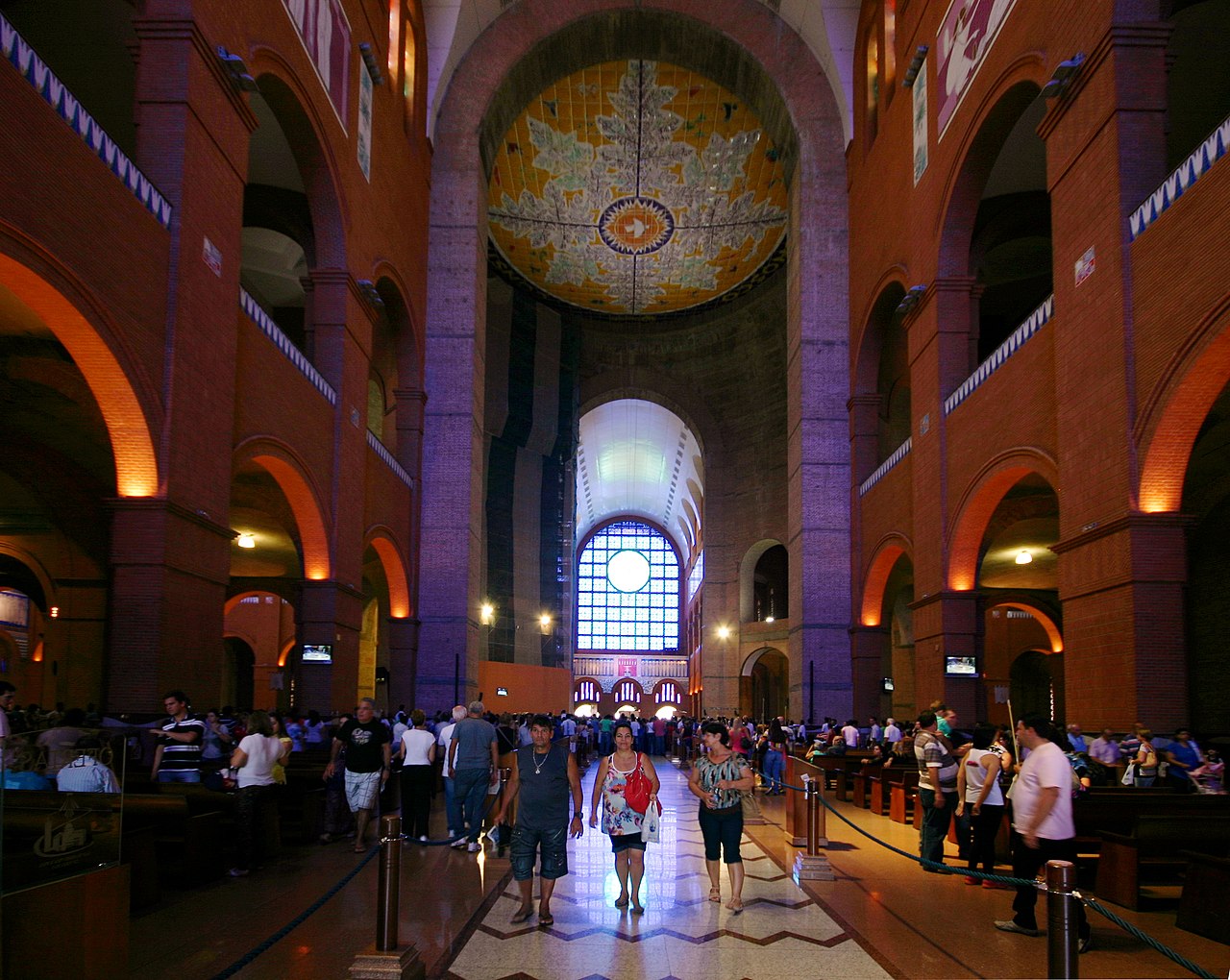
Stepping into the basilica, the first impression is simply of scale, of a space so wide and high that people seem small within it, gathered in their thousands yet leaving room to spare. Light pours down from the great dome, and the four arms of the cross-shaped building stretch out to hold the crowds. Unlike the bare stone austerity of an Eastern monastery, this is a bright, modern, expansive Catholic interior, designed above all to bring enormous numbers of people close to the object of their devotion.

The statue itself, after a long journey and even a period when it was broken and lovingly restored, is displayed where the faithful can come before it, often encased and richly adorned, the small dark figure at the focus of all that vast architecture. Around the shrine spreads a whole landscape of devotion: chapels, a hall where pilgrims leave offerings in thanks for answered prayers, walkways for the crowds, and all the bustle of a town that has organised its life around receiving the faithful. There is nothing hushed or remote about it; it is loud, crowded, and full of life, which is exactly how the people who come here want it.
Going to Aparecida
The town sits roughly midway between the great cities of Sao Paulo and Rio de Janeiro, which is part of why it became so accessible to so many, and most visitors arrive as part of an organised pilgrimage or a family trip rather than as tourists in the usual sense. If you go expecting the quiet contemplation of a remote monastery you may be surprised, because Aparecida is at its most characteristic when it is full, alive with the noise and warmth of a people who treat the Virgin as one of the family.
For an outsider, the most rewarding thing is simply to watch and to feel the depth of devotion on display, the way a small statue rescued from a river by three poor fishermen came to gather a nation around it. There is a lesson in that smallness. In a country marked by great inequality, the patroness of Brazil is a dark-skinned Virgin who first showed herself to the poorest of workers, and the millions who come to her each year seem to find in that story a promise that they, too, are seen and held. The basilica may be vast, but it is that intimate promise, carried in a little dark figure, that fills it.


