Georgians have a saying that you have not really seen their country until you have stood in Mtskheta, and they do not mean it lightly. This small town where two rivers meet, just half an hour north of the modern capital Tbilisi, was the heart of the Georgian kingdom for centuries, and it remains the spiritual centre of the nation to this day. At its core stands Svetitskhoveli, a cathedral whose name means the Living Pillar, and whose story reaches back to the very moment a whole people decided to become Christian. For Georgians, this is not simply an old and beautiful church. It is the place where their nation, in a sense, was baptised.
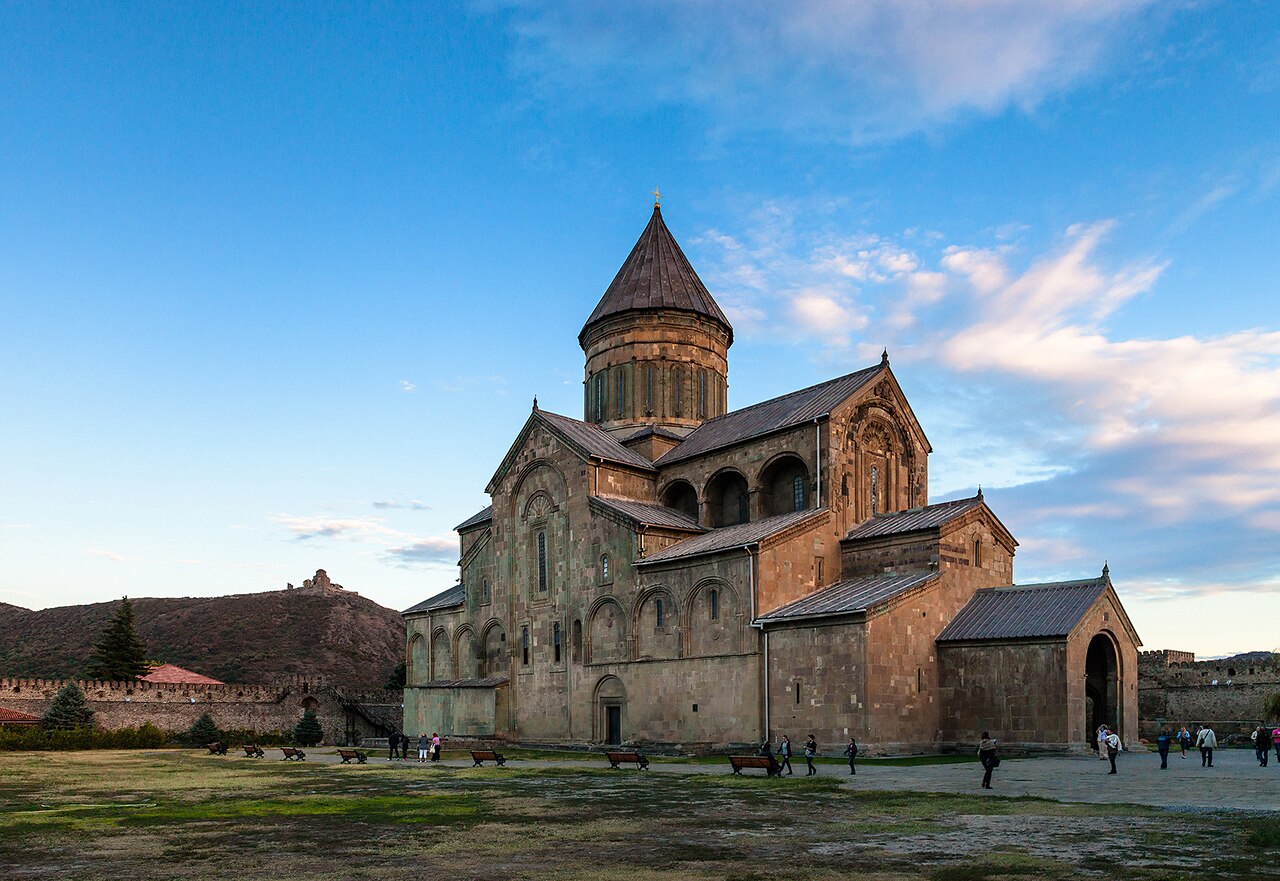
To walk into Svetitskhoveli is to walk into the founding legend of Georgian Christianity, a story that braids together a seamless robe, a holy woman, and a column that would not stay on the ground.
A robe, a pillar, and the birth of a Christian nation
The legend begins, remarkably, in Jerusalem. According to Georgian tradition, a Jewish man from Mtskheta was present at the crucifixion of Jesus and brought home with him the seamless robe of Christ. When his sister took the robe in her arms, the story says, she died on the spot, overwhelmed, and was buried still holding it. From her grave grew a great cedar tree. Centuries later, when Georgia was being converted to Christianity, that tree was cut to make a column for the country first church, and the column miraculously rose into the air and would not be set in place until prayer brought it down. From it, the tradition holds, flowed a sacred liquid that healed the sick, and so the church was named for the Living, life-giving Pillar.
Whatever one makes of the legend, the history beneath it is genuinely momentous. In the early fourth century, through the preaching of a woman remembered as Saint Nino, the kingdom of Iberia, as eastern Georgia was then known, adopted Christianity as its state religion. This made Georgia one of the very first nations on earth to do so, alongside neighbouring Armenia, long before most of Europe. Mtskheta was the royal capital where that decision was made, and the church on this spot has marked the place ever since. To stand here is to stand at the origin point of one of the oldest continuous Christian cultures in the world.
The church the centuries kept rebuilding
The cathedral you see today is not the original wooden church but a grand stone structure built in the eleventh century, the work of a master architect whose name is carved into its north wall, an unusual and touching survival from an age when builders rarely signed their work. Over the following thousand years it was damaged by invaders, earthquakes, and the simple passage of time, and repeatedly repaired and reinforced, so that the building is in a sense a layered record of Georgian history, each crisis and recovery written into its stones.
For long stretches of that history, Georgia was a small Christian kingdom caught between far larger empires, repeatedly invaded and fought over. Through all of it, Svetitskhoveli remained the coronation church and the burial place of Georgian kings, the fixed point around which national life turned. When you understand that this one building witnessed the crownings and the funerals of rulers across the better part of a millennium, its hold on the Georgian imagination starts to make sense. It is less a monument to any single moment than a companion that has accompanied the nation through nearly all of its existence.

Where it stands in the Christian world
Svetitskhoveli belongs to the Georgian Orthodox Church, one of the ancient autocephalous, or self-governing, churches of Eastern Orthodox Christianity. Like the Bulgarian, Russian, Greek, and other national Orthodox churches, it shares the same faith, sacraments, and ancient liturgy as the wider Orthodox communion while governing its own affairs. For an Orthodox Georgian, this cathedral is the mother church of the entire national faith, the seat from which Christianity spread through the land, and a place where the connection between God, nation, and history feels especially close.
It is worth pausing on how old this tradition is, because it sets Georgian Christianity apart even within Orthodoxy. This is a church that traces its conversion to the fourth century and has maintained its own ancient alphabet, its own chant, and its own distinctive religious art across seventeen centuries of near-constant pressure from outside. For visitors more familiar with Roman Catholic or Protestant Christianity, the differences are immediately visible: there are no pews, no organ, and no statues, but instead icons, candlelight, sung prayer, and worshippers who stand, cross themselves, and venerate images and relics in a manner that has changed remarkably little since the early centuries of the faith. Svetitskhoveli is one of the great living expressions of that unbroken Eastern Christian world.
Inside the Living Pillar
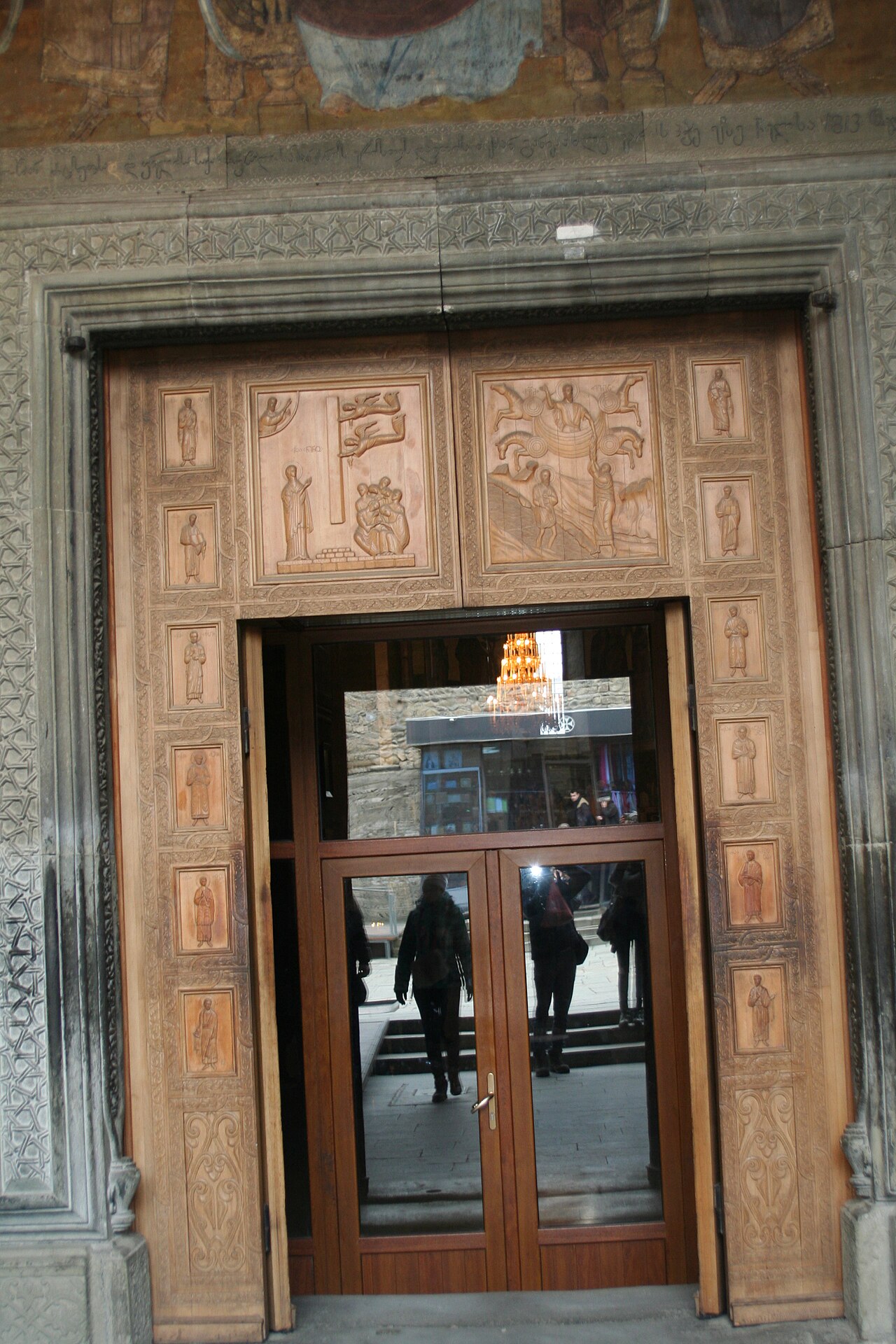
Step through the doors and the interior opens upward into a vast, austere space, far plainer than a Western cathedral of comparable importance, and all the more powerful for it. The stone is bare and honey-coloured, the light falls in long shafts from high windows, and the eye is drawn naturally toward the spot where the legendary pillar is said to have stood, marked and venerated within the church. Fragments of old frescoes survive on the walls, including scenes that have faded to ghostly outlines, and the worn flagstones underfoot have been polished by centuries of pilgrims feet.

Scattered across the floor and walls are the tombs of Georgian kings, simple slabs that once covered the most powerful figures in the land, now quietly underfoot as visitors pass. There is something deeply moving about that ordinariness, the way the great and the humble share the same cool, candlelit space. Around the cathedral runs a stout defensive wall, a reminder that in this part of the world a holy place also had to be a stronghold, able to shelter the town and its treasures when armies came through, as they so often did.
Coming to Mtskheta
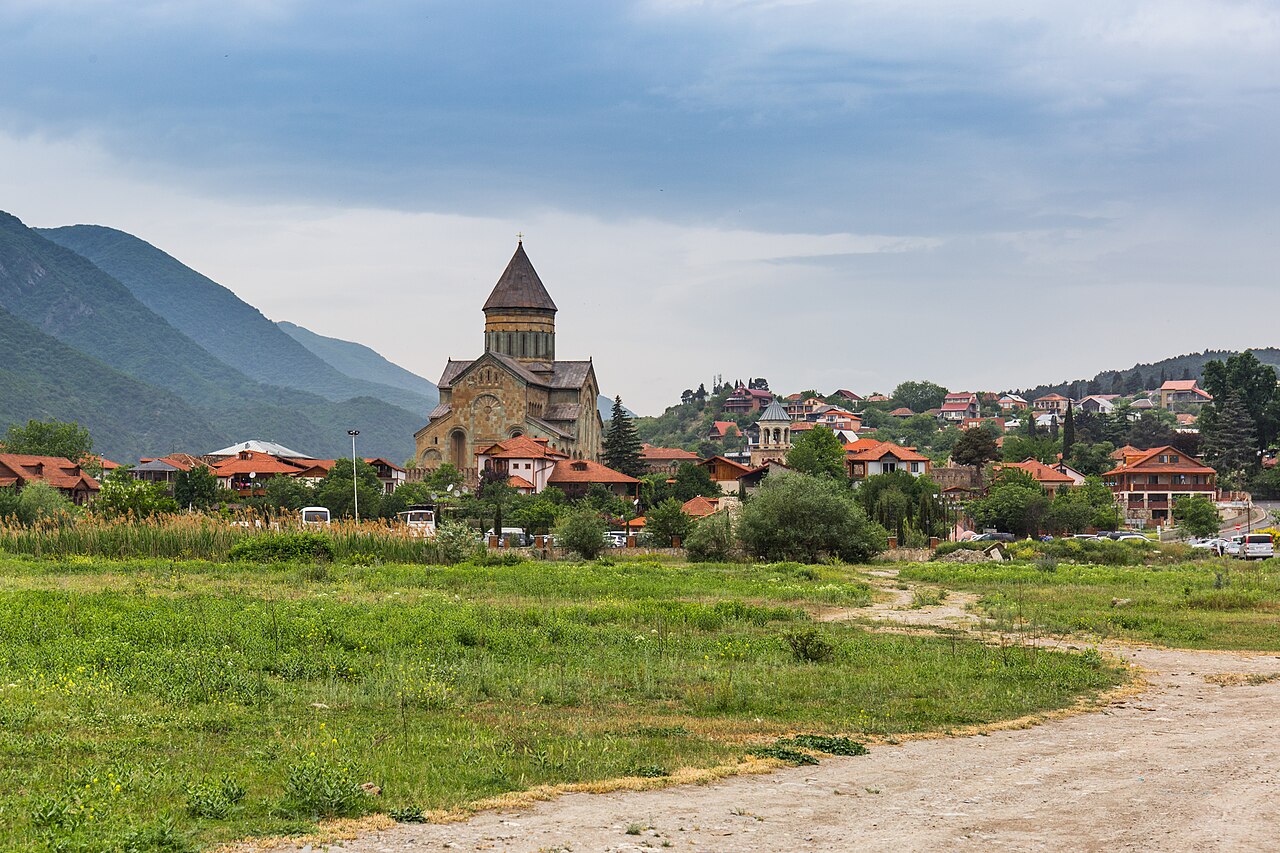
Because it lies so close to Tbilisi, Mtskheta is an easy and very popular trip, and on summer weekends the little town can fill with visitors. Yet it absorbs them well, and even on a busy day the cathedral itself retains its gravity. The town around it is worth lingering in, with its old houses, its riverside setting, and other ancient churches scattered through and above it, including a hilltop monastery across the valley that looks down on Svetitskhoveli and frames the whole sacred landscape. Together they form a place so dense with history that the area as a whole is recognised as a treasure of world heritage.
If you come, try to give yourself enough time to let the place settle on you rather than ticking it off in twenty minutes. Stand for a while in the great quiet interior, watch an elderly Georgian woman light a candle and bow before an icon as her ancestors have done for seventeen hundred years, and you begin to feel the thing that words struggle to carry: that this is not a relic of a faith that has passed, but the still-beating heart of one that never stopped. For Georgians, the Living Pillar is exactly that, and a visit here is the surest way to understand who they believe themselves to be.


