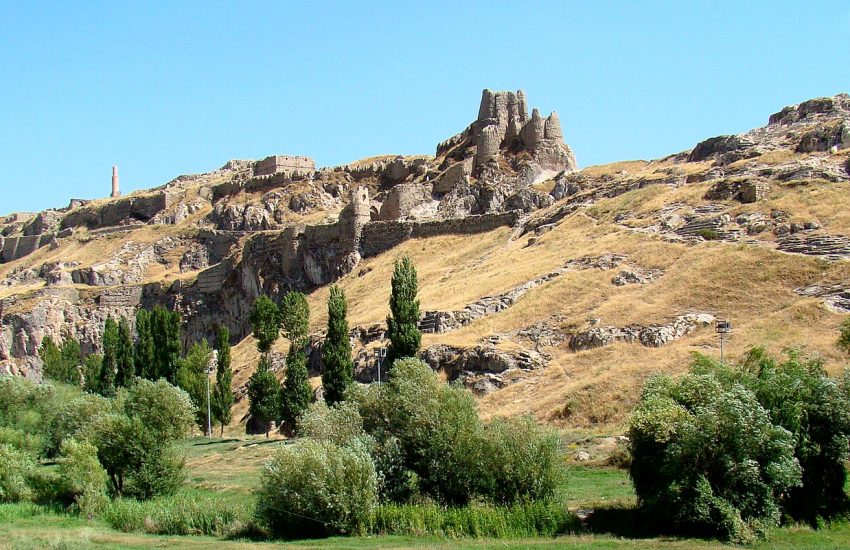
High on the edge of the great plateau of Moab, east of the Dead Sea, there stands one of the largest and most famous of all the castles the Crusaders ever raised in the Holy Land. Kerak Castle, the mighty stronghold of the Lordship of Oultrejordain, dominates the ancient King’s Highway that has carried caravans and pilgrims and armies between Damascus and Egypt and Mecca since the beginning of recorded time. To stand upon its walls and look out over the tawny hills of Jordan is to survey a landscape soaked in the history of the Crusades.
In this article you are invited to explore the long and dramatic story of this great fortress, from its founding by a Frankish nobleman in the twelfth century, through the notorious career of the robber baron Raynald of Châtillon and the chivalrous sieges of the great Saladin, down through the Ayyubid and Mamluk centuries and into the present day. Kerak is a castle of vaulted galleries and deep dungeons, of glittering glacis and grim towers, and few places bring the age of the Crusades so vividly to life.
In This Article
- A Castle Built on a Spur
- Pagan the Butler and the Lords of Oultrejordain
- The Great Vaulted Galleries
- The Glacis and the Ditches
- Raynald of Châtillon, the Robber Baron
- The Wedding Siege of 1183
- The Fall to Saladin
- The Ayyubid Treasury and the Red Paper
- Baybars and the Mamluk Tower
- The Underground City
- The Town of Al-Karak
- Ottoman Sieges and Later Years
- The Largest of the Crusader Castles of Jordan
- Castles Nearby
- Exploring Kerak Today
A Castle Built on a Spur
The strength of Kerak begins, as with so many great castles, in its position. It is a classic example of what is called a spur castle, a fortress built upon a tongue of high ground that juts out from a larger plateau and is defended on three of its four sides by the steep valleys that fall away around it. This natural strength meant that the builders had to fortify heavily only the one side where the spur joined the main plateau, and there they concentrated their most formidable defences.
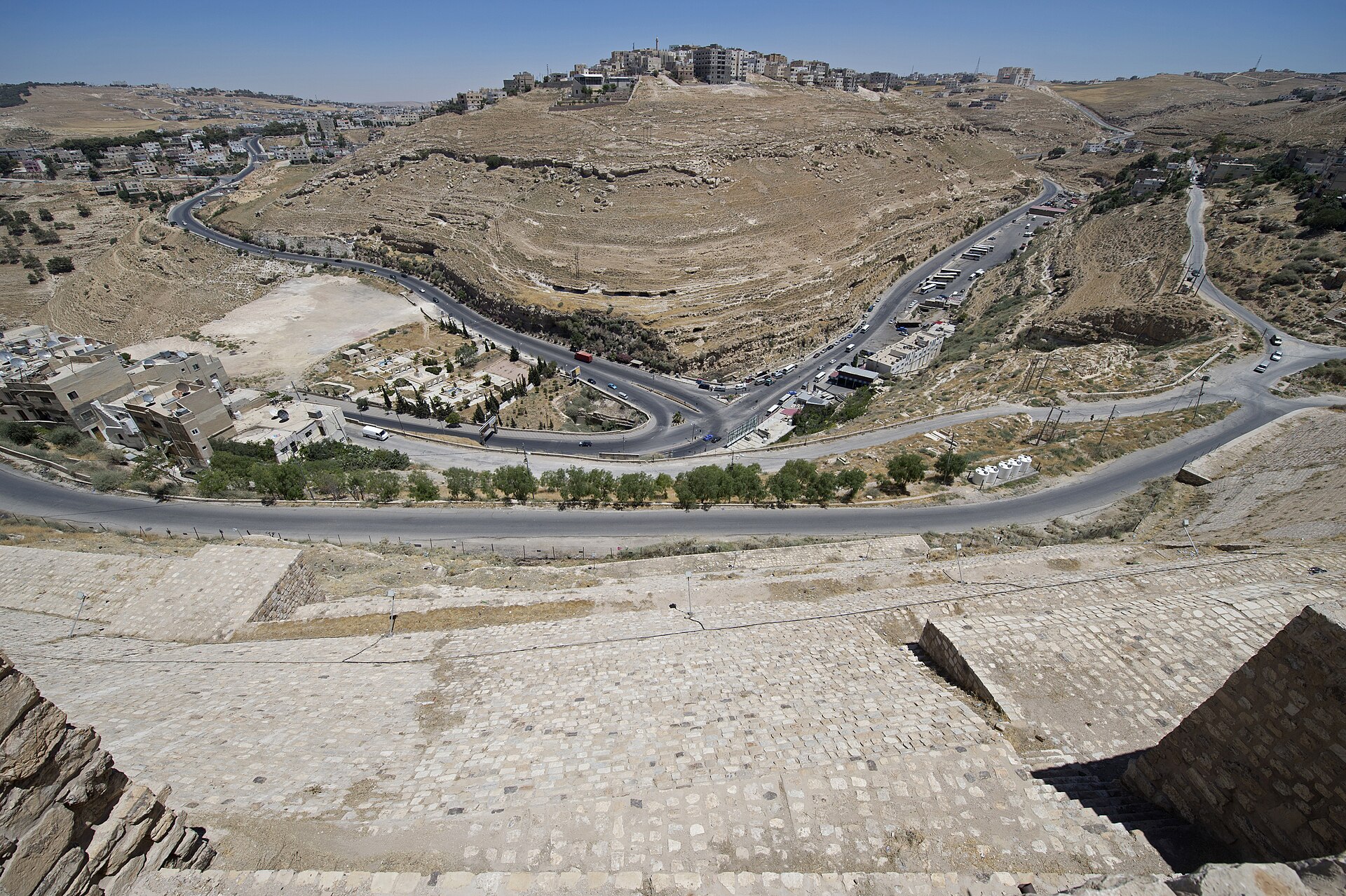
From its lofty perch the castle commands a tremendous sweep of country, and in clear weather the view reaches all the way to the shimmering line of the Dead Sea far below to the west. Its position on the southern end of the plateau of Moab placed it astride the great trade and pilgrimage routes of the region, and whoever held Kerak held the key to the movement of men and goods across a vast and vital stretch of the medieval world.
The choice of a spur for the site of the castle reflects the deep practical wisdom of medieval military engineers, who understood that the surest defence was the one that nature herself provided. By building where the land already fell away in steep cliffs on three sides, the builders of Kerak spared themselves an enormous labor and gained a strength that no amount of masonry could equal. All their effort could then be poured into the single vulnerable neck of the spur, where ditch and wall and tower were piled up in a concentrated mass of defence that few armies would ever dare to assault directly.
The plateau of Moab on which Kerak stands is itself a place of deep history, mentioned again and again in the ancient records of the region and fought over since time immemorial. To build a castle here was to plant a fortress upon ground already old in war, and the Crusaders who chose the site were only the latest in a very long line of peoples who had recognized its strategic worth. The land around Kerak is dotted with the traces of earlier ages, and the castle sits within a landscape as rich in the past as any on earth.
Pagan the Butler and the Lords of Oultrejordain
The castle was founded in the year 1142 by a Frankish nobleman with the memorable name of Pagan the Butler, who served as an officer at the court of King Fulk of Jerusalem. Pagan chose this commanding spur as the new capital of the Lordship of Oultrejordain, the Crusader domain that stretched across the lands beyond the River Jordan, replacing the older and weaker fortress of Montreal to the south. From Kerak the lords of Oultrejordain could dominate the bedouin tribes and, more importantly, the rich trade routes running between Damascus, Egypt, and the holy city of Mecca.
Pagan’s successors, the lords Maurice and Philip of Milly, strengthened the castle further, cutting two deep ditches into the living rock on the north and south sides to isolate the spur still more completely from the surrounding plateau. Under their care Kerak grew into one of the most important strongholds of the entire Crusader kingdom, a great administrative and military center controlling a strategic frontier region that was as vital as it was exposed.
The Lordship of Oultrejordain that Kerak governed was one of the largest and most valuable fiefs of the entire Kingdom of Jerusalem, embracing a vast territory beyond the Jordan and controlling the desert routes that were the lifeblood of the medieval Near East. To hold Kerak was to hold enormous power and enormous wealth, for the tolls levied upon the passing caravans could make a lord rich beyond measure. It was this very wealth and power, and the temptation to abuse it, that would in time draw the castle and its lords into the fatal quarrel with Saladin that destroyed them.

The Great Vaulted Galleries
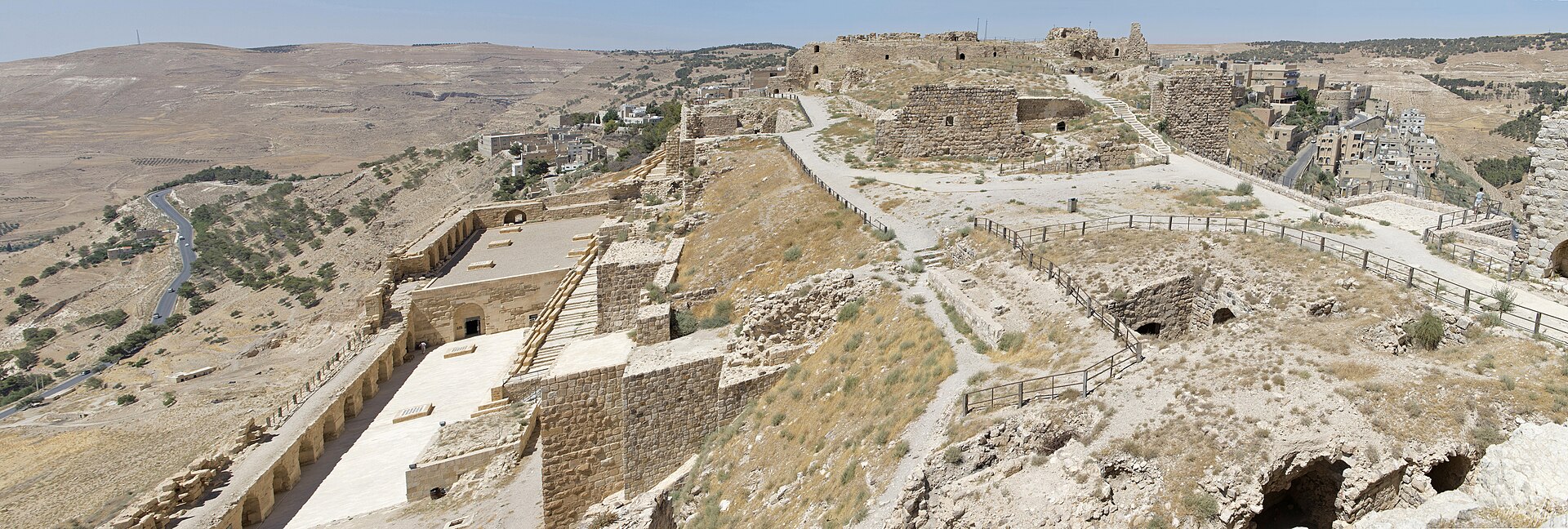
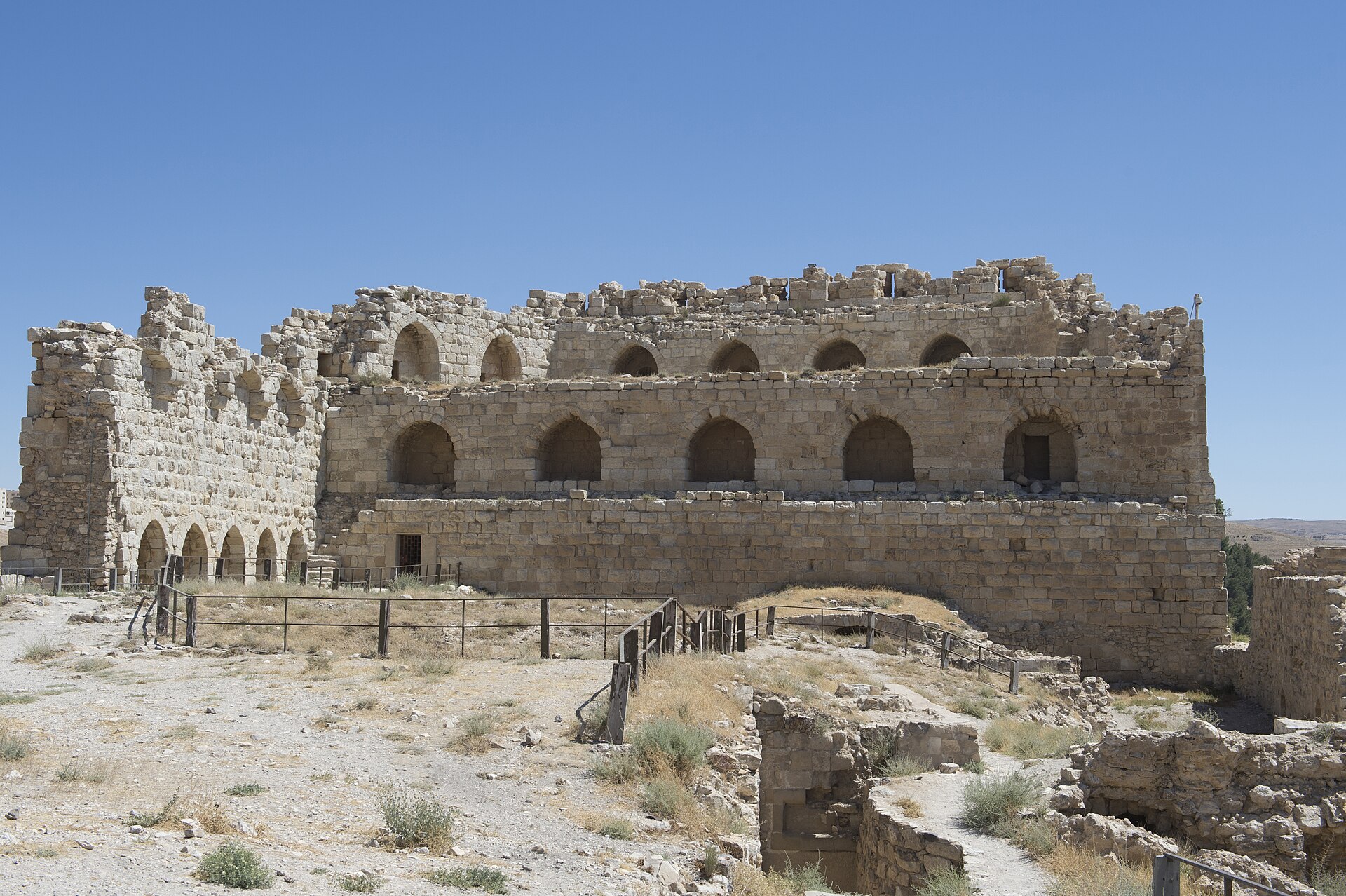
One of the most impressive features of Kerak, and one that never fails to astonish the visitor, is the series of immense vaulted galleries that run beneath and within its walls. Along the north wall in particular, great arched halls rise on two levels, vast tunnels of stone that once served as living quarters, as stables for the horses of the garrison, and as sheltered fighting galleries from which the defenders could shoot down upon any enemy approaching the castle.
These galleries are among the finest surviving examples of Crusader vaulting anywhere, and to walk through them today, in the cool shadow beneath their soaring arches, is one of the great pleasures of a visit to Kerak. They speak of the confidence and the resources of the men who built them, for such construction was expensive and laborious, and their sheer scale gives some sense of the many hundreds of soldiers, servants, and animals that this great fortress was built to house.
Standing within these great galleries, you cannot help but be struck by the skill of the masons who raised them. The stone was cut and fitted with real care, the arches spring true and strong, and the whole has endured for the better part of nine centuries with scarcely a fault. In their cool, dim length, with the desert sun blazing unseen outside, these halls preserve the very feel of the Crusader age more powerfully than any other part of the castle. They are the bones of the fortress, the great skeleton of stone upon which all the rest was built, and they remain magnificent to this day.
It is thought that these two-tiered galleries served a dual purpose, providing both accommodation and defence in a single ingenious structure. The lower level, dark and sheltered, offered stabling and storage, while the upper level, pierced with arrow slits, formed a covered fighting platform from which the garrison could dominate the approach to the castle in perfect safety. This economy of design, in which every part of the building served more than one purpose, is characteristic of the best Crusader architecture, and Kerak displays it on a truly grand scale.

The Glacis and the Ditches
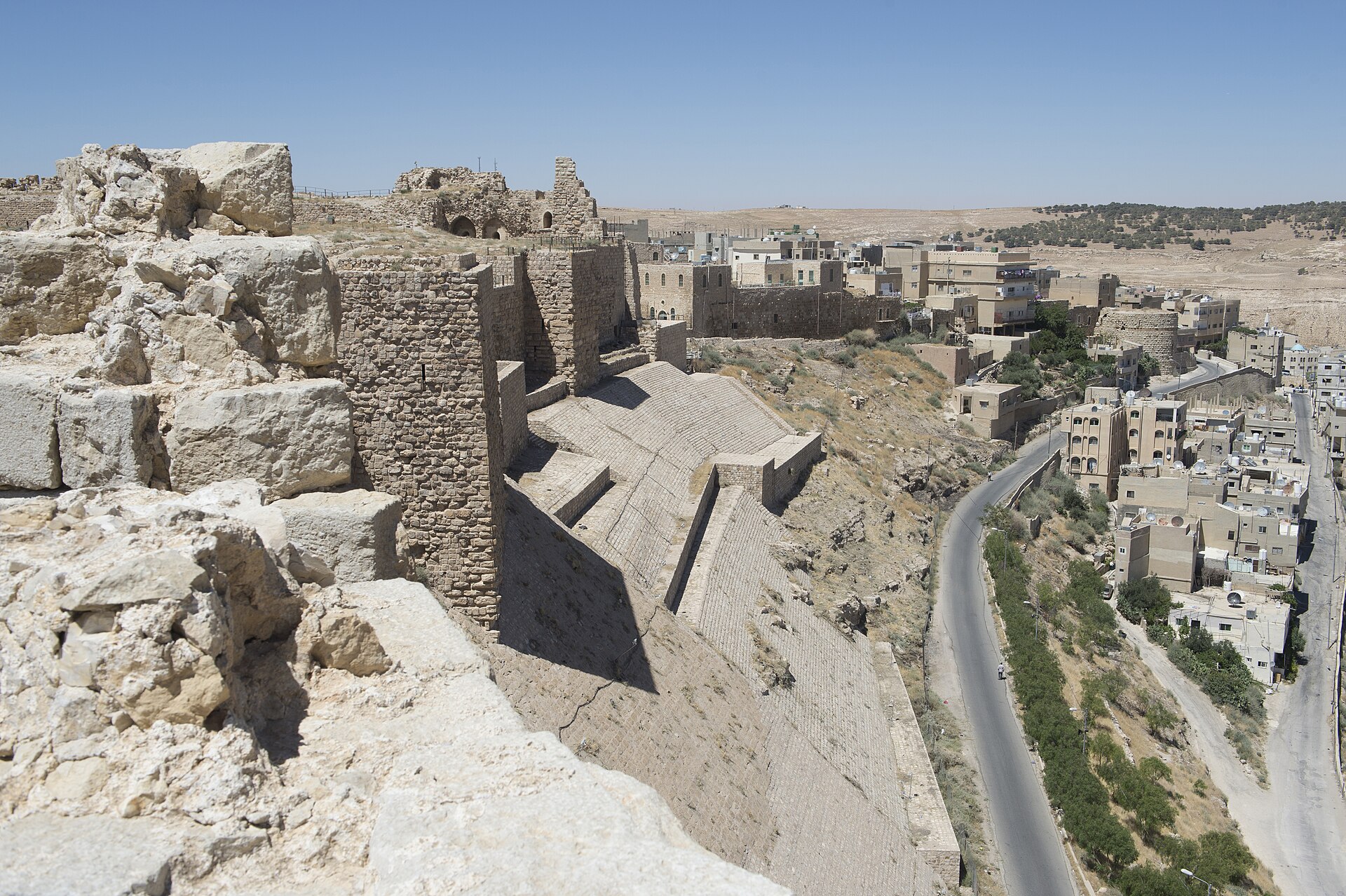
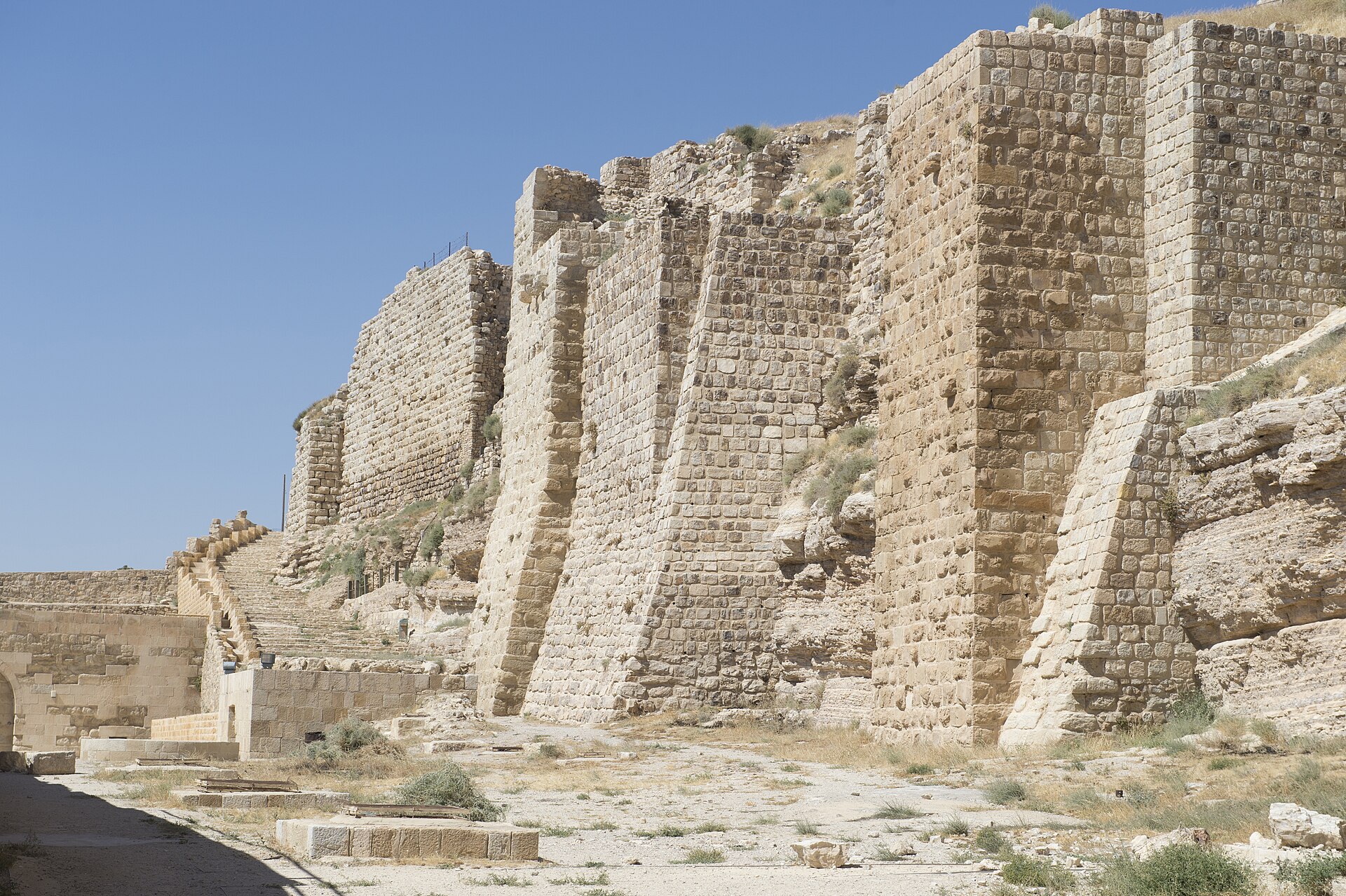
Like the other great castles of the Crusader East, Kerak was protected by a glacis, a great sloping skirt of steep and slippery masonry laid against the base of its walls. This artificial slope made it all but impossible for an attacker to bring siege towers or scaling ladders against the walls, or indeed to climb them at all, for anyone who tried would slide helplessly back down into the killing ground below, exposed all the while to the missiles of the defenders above.
Combined with the deep ditches cut into the rock on the vulnerable landward sides, the glacis made Kerak an extraordinarily difficult place to assault. An attacking army would first have to cross the ditch, then contend with the glacis, and only then reach the foot of the walls themselves, all under a constant rain of arrows and stones. It is little wonder that the castle withstood so many sieges, or that its capture, when it finally came, owed more to hunger than to force of arms.
The engineering of the glacis reveals much about the nature of medieval siege warfare, which was less a matter of sudden storm than of patient, grinding attrition. Every obstacle that could slow an attacker, expose him to fire, or force him to labor under the walls bought precious time for the defenders and cost the besiegers dearly in blood. The smooth, steep slope of the glacis was one of the most effective of all such devices, and its presence at Kerak, as at the other great castles of the region, shows how thoroughly the Crusaders had mastered the science of fortification during their long struggle for the Holy Land.
Raynald of Châtillon, the Robber Baron
In the year 1176 the lordship of Kerak passed by marriage to one of the most notorious figures of the entire Crusader age, Raynald of Châtillon. Raynald was a bold, ruthless, and utterly unscrupulous adventurer, and from his stronghold at Kerak he embarked upon a career of plunder that would ultimately bring ruin upon the whole Kingdom of Jerusalem. He preyed upon the rich caravans that passed along the King’s Highway below his walls, seizing their goods and their people in flagrant violation of the truces sworn between the Crusaders and the Muslims.
Worst of all, in the eyes of the Muslim world, Raynald launched a daring raid down the Red Sea that threatened the holy cities of Mecca and Medina themselves, an outrage that Saladin never forgave. By his reckless aggression Raynald made himself the personal enemy of the greatest Muslim leader of the age, and he drew down upon Kerak, and upon the whole Crusader kingdom, the full and terrible wrath of Saladin. The robber baron of Kerak had lit a fire that would consume the Latin East.
History has not been kind to the memory of Raynald of Châtillon, and with good reason, for even by the rough standards of his age he was regarded as a man of exceptional treachery and cruelty. Yet there is no denying his boldness, and from the eagle’s nest of Kerak he made himself a terror to the whole Muslim world for more than a decade. His raids struck at the very heart of Islam, and his contempt for the truces that bound his fellow Christians brought him into conflict even with his own king. In Raynald, the castle of Kerak found a lord as formidable and as dangerous as the fortress itself.
It is worth pausing over the sheer audacity of Raynald’s Red Sea expedition, for it was an enterprise almost without precedent. He had ships built in pieces, carried overland to the coast, and launched upon the waters of the Red Sea, where his raiders fell upon the pilgrim traffic and threatened the very approaches to the holy cities. Nothing could have been better calculated to enrage the entire Muslim world, and Saladin’s response, when it came, was correspondingly implacable. The road from Raynald’s raid to his execution after Hattin runs straight, and Kerak stood at its very beginning.

The Wedding Siege of 1183
The most famous episode in the whole history of Kerak took place in the year 1183, and it is a tale that has come down to us as one of the great stories of medieval chivalry. Saladin brought his army against the castle and laid siege to it at the very moment when a great wedding was being celebrated within its walls, the marriage of the young Humphrey of Toron to the princess Isabella of Jerusalem. Even as the siege engines battered the walls, the wedding feast went on inside.
The mother of the bridegroom, it is said, sent out dishes of food from the wedding banquet to Saladin himself, reminding him that he had once, long ago, been a captive who had held the boy in his arms. Moved by the gesture, Saladin is said to have asked in which tower the young couple were lodged, and to have given orders that his siege engines should not be aimed at that part of the castle, so that the newlyweds might be spared amid the fury of the assault. It is a story that reveals the extraordinary character of the great Saladin, a warrior capable of magnanimity even toward his enemies.
The story of the wedding siege has been retold countless times over the centuries, and it has come to stand as a kind of emblem of the whole strange world of the Crusades, in which bitter enemies could yet share a code of honor that transcended the divisions of faith and war. That Saladin, in the very act of storming the castle, could pause to spare a pair of newlyweds from his siege engines is a detail that has captured the imagination of every generation that has heard it. It reminds us that even in the midst of the most savage of conflicts, humanity and courtesy could still find a place.
The relief of the 1183 siege by King Baldwin the Fourth, the young leper king of Jerusalem, is itself a stirring tale, for the ailing monarch had himself carried on a litter at the head of his army to rescue the castle. That so sick a man, wasting away from his terrible disease, could still rouse himself to lead his knights across the desert to the relief of Kerak speaks volumes for the desperate courage of the Crusader kingdom in its final years. Twice in successive years the castle was saved in this way, before the catastrophe of Hattin at last left it to its fate.

The Fall to Saladin
The sieges of the 1180s were relieved each time by the arrival of a Crusader army, but the days of Kerak were numbered. In the year 1187 the whole military strength of the Kingdom of Jerusalem was annihilated by Saladin at the catastrophic Battle of Hattin, and Raynald of Châtillon, the lord of Kerak, was taken prisoner and beheaded by Saladin’s own hand in revenge for his many crimes. With the field army destroyed and its lord dead, the great castle was left isolated and without hope of rescue.
Even so, Kerak did not fall easily. The garrison held out through a long and bitter siege, enduring terrible privations, and it is said that the defenders were reduced to selling their own wives and children for food before the end. At last, in the year 1188, starved into submission after the disaster at Hattin had sealed their fate, the defenders surrendered the castle to the forces of Saladin. The greatest stronghold of Oultrejordain had passed into Muslim hands, never to return to the Crusaders.
The fall of Kerak in 1188 marked the effective end of the Crusader presence in the lands beyond the Jordan, and it was part of the great collapse that followed the disaster at Hattin. One by one the castles and cities of the Latin East surrendered to Saladin in those years, and the kingdom that had stood for nearly a century was reduced almost to nothing. That Kerak held out as long as it did, even after all hope was gone, is a testament both to the strength of its walls and to the desperate courage of its defenders, who endured horrors beyond imagining before they at last laid down their arms.
The execution of Raynald of Châtillon after the battle of Hattin has become one of the most famous scenes of the whole Crusader epic. Saladin, it is said, offered a cup of iced water to the captured King Guy of Jerusalem, but pointedly refused it to Raynald, and when the robber baron drank from it anyway, Saladin declared that he had not given him leave and struck him down with his own hand. Thus perished the lord of Kerak, and with him the aggressive spirit that had brought his castle and his kingdom to ruin. The fortress he had held so fiercely fell within the year.
The Ayyubid Treasury and the Red Paper
Under the rule of Saladin’s Ayyubid dynasty, Kerak lost none of its importance. Far from it, for the castle now became the administrative center for the whole of the region of Jordan, and one of the treasuries of Saladin’s brother al-Adil was housed within its strong walls. So great was the prestige attached to the governorship of Kerak that its holders were granted the rare privilege of writing their official correspondence upon red paper, a mark of the very highest rank in the bureaucracy of the age.
The Ayyubid rulers strengthened the defences of the castle still further, carrying out major works of expansion and improvement in the years around 1244 and 1245 under the prince an-Nasir Dawud. Kerak became a place of refuge and a seat of power in the turbulent politics of the Ayyubid princes, who fought among themselves for control of Saladin’s great inheritance. The castle that the Crusaders had built to hold the Muslims at bay had become one of the strongholds of the Muslim world itself.
The transformation of Kerak from a Crusader stronghold into an Ayyubid seat of power illustrates one of the great themes of the castle’s history, its remarkable ability to serve whoever held it, generation after generation, regardless of their faith or origin. The Franks built it, the Ayyubids inherited and improved it, and each in turn found it indispensable. This continuity of use, running unbroken across the great divides of religion and dynasty, is one of the things that makes Kerak so fascinating, for its stones have sheltered Christian knight and Muslim prince alike.
Baybars and the Mamluk Tower
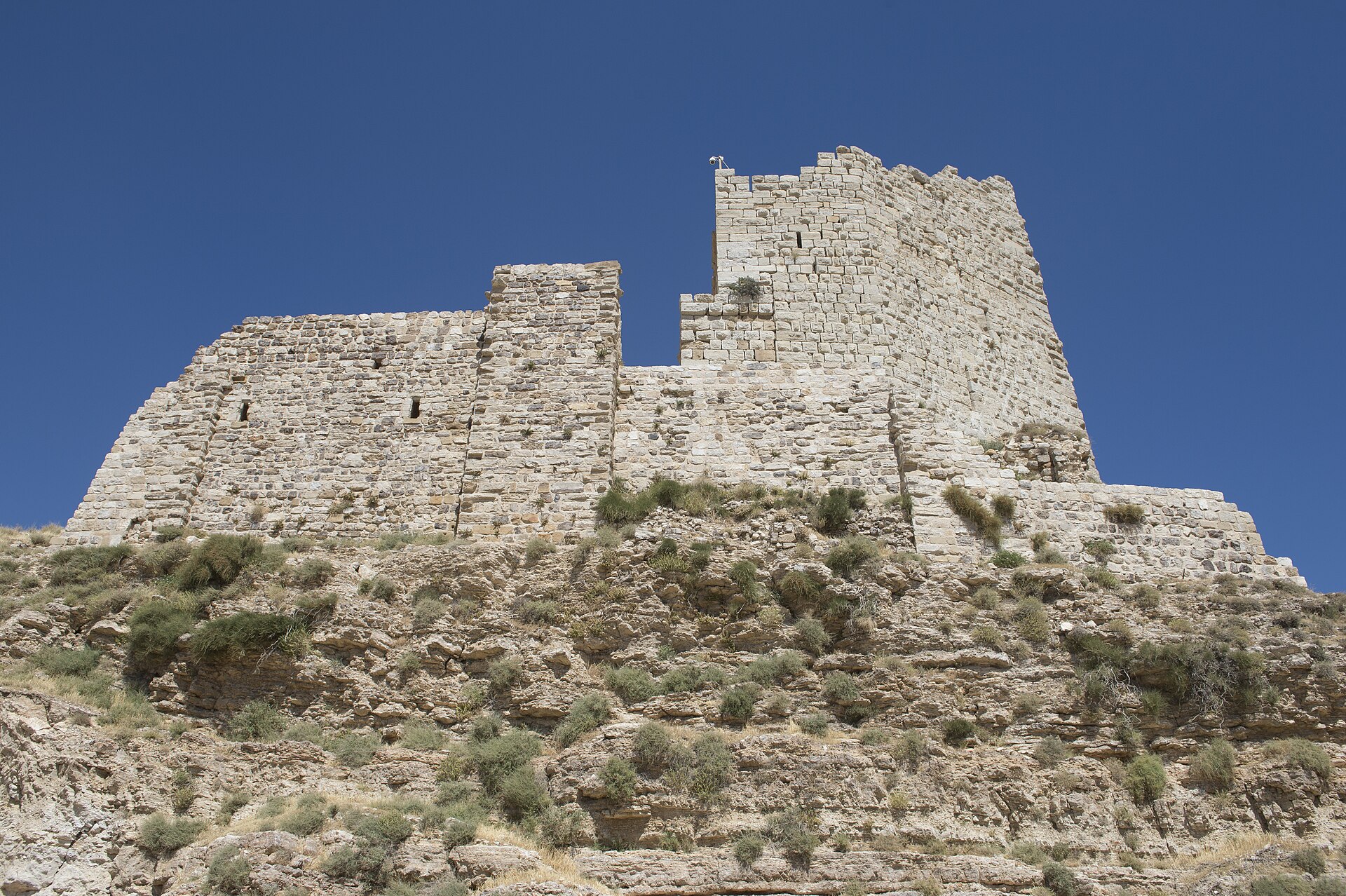
When the Mamluk sultans succeeded the Ayyubids as masters of Egypt and Syria, Kerak entered upon a new age of importance. In the year 1263 the great sultan Baybars, the most formidable soldier of his day and the scourge of the remaining Crusader states, enlarged the castle and built a massive new tower upon its northwest corner, a grim block of Mamluk masonry that still stands today as one of the most striking features of the fortress.
Under the Mamluks, Kerak became the seat of no fewer than four ministries, those of the army, of finance, of the region itself, and of the chancery, and it maintained a substantial garrison of horsemen. The castle served the Mamluk state as a fortress, a prison, and a place of refuge in times of trouble, and more than one sultan sought shelter behind its walls when the fortunes of politics turned against him. The Mamluk stones of Kerak, distinguishable from the rougher Crusader work by their finer limestone, are a lasting monument to this later chapter of the castle’s long life.
The great tower of Baybars is a fitting symbol of the Mamluk age at Kerak, for the Mamluks were, above all, soldiers, and their architecture has a stark and uncompromising strength that mirrors their character. Where the Crusaders had sometimes indulged in a certain grace, the Mamluks built for war pure and simple, and their massive tower dominates the southern end of the castle with a brooding, martial power. It stands as a reminder that Kerak remained a working fortress, garrisoned and ready for battle, long after the Crusaders who first raised it had passed into history.
The Mamluk period also saw Kerak serve repeatedly as a place of political refuge and even as a royal prison, for its strength and its remoteness made it ideal for both purposes. More than one sultan, driven from the throne of Egypt by the endless intrigues of the Mamluk court, fled to Kerak to gather his strength before attempting to recover his power, and more than one dangerous rival was shut away behind its walls. The castle thus played a part in the high politics of the Mamluk state out of all proportion to its distance from the great cities of Cairo and Damascus.

The Underground City
Perhaps the most atmospheric part of any visit to Kerak is the descent into its underground world. Beneath the courts and towers of the castle lies a veritable labyrinth of vaulted corridors, storerooms, cisterns, and passages, some hewn directly into the rock of the spur and others built up in stone. In the dim light that filters down through occasional openings, these shadowy tunnels seem to breathe out the very atmosphere of the Middle Ages.
Here were stored the vast quantities of food, water, and materiel that a garrison needed to withstand a long siege, and here too, in all likelihood, were the dungeons in which the castle’s prisoners were held. It was into such grim places that Raynald of Châtillon is said to have hurled his captives, some of them, according to a chilling tale, cast down from the walls with wooden boxes fixed about their heads so that they should remain conscious to the very end. The underground city of Kerak is a place of wonder and of dread in equal measure.
The descent into these underground chambers is, for many visitors, the most memorable part of the whole experience of Kerak, for it engages the imagination as nothing else can. Down here, away from the light and the modern world above, it is easy to feel the presence of the past pressing close, to picture the crowded storerooms and the wretched prisoners, the flicker of torchlight on the vaulted stone. The underground world of Kerak is the castle’s secret heart, and it holds the memory of both the ordinary business of the garrison and the darker deeds that its history records.
Modern visitors descend into these passages with electric torches and the comfortable knowledge that they may climb back up into the sunlight whenever they wish, but it requires only a little imagination to feel how different the experience must have been for those who lived and suffered here in centuries past. The garrison who sheltered here during the long siege, the prisoners who languished in the darkness, the servants who toiled among the stores, all knew these tunnels as a part of daily life. To walk here now is to share, however faintly, in that vanished world.

The Town of Al-Karak
Kerak was never merely a castle standing alone, for around it grew up the walled town of al-Karak, which shared in the fortress’s defences and its history. The town occupied the northern part of the same spur, separated from the castle by one of the great rock-cut ditches, and it was itself protected by walls and towers, so that an enemy had to take the town before he could even come at the castle proper. Town and castle together formed a single great fortified complex, one of the strongest in all the region.
The town has been inhabited continuously from the days of the Crusaders down to the present, and today al-Karak is a thriving place of well over a hundred thousand people, the capital of its governorate and an important center of southern Jordan. The friendly bustle of the modern town about the walls of the ancient castle is a reminder that Kerak has never been a dead ruin but a living place, woven into the life of its region for the better part of a thousand years.
The close relationship between castle and town at Kerak is characteristic of the way medieval fortresses actually functioned, for a great castle was never an isolated thing but the strong center of a whole community. The townsfolk provided the labor, the trade, and the supplies that kept the garrison alive, and in times of danger they took refuge behind the same walls that protected the soldiers. The survival of al-Karak as a living town to the present day, gathered still about the walls of its ancient castle, is a rare and precious thing, and it gives the visitor a vivid sense of continuity with the distant past.
Anyone who visits Kerak today will be struck by how naturally the ancient and the modern coexist there, the great medieval walls rising directly out of the busy streets of a living town. Children play and merchants trade in the shadow of stones that were laid down in the age of the Crusades, and the castle, far from being a lifeless museum, remains woven into the daily rhythm of the community that surrounds it. This living continuity is part of what gives Kerak its special charm, and it distinguishes the castle from so many other medieval fortresses that stand abandoned and alone.
Ottoman Sieges and Later Years
The importance of Kerak did not end with the Middle Ages. Through the long centuries of Ottoman rule the castle retained its strategic value, guarding the pilgrimage road to Mecca and dominating the tribes of the surrounding country. In the year 1834 it was the scene of a dramatic episode when Ibrahim Pasha, the son of the ruler of Egypt, besieged the castle during a great revolt of the local peasantry, and in the course of that siege much of the old fortifications was destroyed.
Later in the nineteenth century the Ottomans reestablished their firm control over the region, stationing a substantial garrison at Kerak that included both infantry and cavalry. The castle thus remained a working fortress and a seat of government into relatively modern times, a remarkable span of active life for a building first raised in the twelfth century. Few castles anywhere can boast so long and so continuous a military history as this great stronghold on the plateau of Moab.
The long Ottoman chapter of Kerak’s history is often overlooked by those who come to see it purely as a Crusader castle, yet it is an important part of the whole. For the fortress did not simply fall silent after the Middle Ages, but went on serving as a strongpoint and a seat of government for centuries more, right up to the threshold of the modern age. The scars of the 1834 siege, and the additions of the later Ottoman garrison, are part of the rich texture of the castle as we find it today, layer upon layer of history written into its weathered stones.

The Largest of the Crusader Castles of Jordan
For all the sieges and destructions it has suffered across the centuries, Kerak remains one of the largest and most impressive of all the Crusader castles that survive in the Near East. Its great galleries and towers, its glacis and ditches, its underground passages and vaulted halls, together form one of the most complete pictures we possess of what a major Crusader fortress was really like. Though its construction is somewhat rougher than the sublime perfection of Krak des Chevaliers to the north, Kerak more than makes up for it in the sheer drama of its history.
The castle stands as a monument to an extraordinary age, when knights from the far west of Europe carved out kingdoms in the deserts of the east, and when great leaders like Saladin rose to drive them out again. Every stone of Kerak has a tale to tell, of ambition and greed, of courage and cruelty, of chivalry and war.
When you finally stand upon the summit of Kerak and look out across the vast and silent landscape of Moab, with the Dead Sea glinting far below and the desert stretching away to the horizon, you understand at last why men fought so hard and so long to hold this place. It is a position of tremendous natural grandeur as well as tremendous strategic value, and the castle that crowns it is worthy of its setting. Kerak is a fortress that rewards the traveler who makes the effort to reach it with an experience that lingers long in the memory, a true window into the great and terrible age of the Crusades.
If you would like to see exactly where this great fortress stands upon the map, you can find it here:
View on Google Maps: 31.1808, 35.7014
From that lonely spur above the King’s Highway, Kerak has watched over the crossroads of the Near East for the better part of nine hundred years, and it watches over them still.

Castles Nearby
If Kerak has drawn you into the world of the Crusades, you may enjoy these other great fortresses of the medieval Near East:
- Krak des Chevaliers: The Finest Castle of the Crusaders
- The Citadel of Aleppo: Four Thousand Years on a Single Hill
Exploring Kerak Today
Kerak Castle stands today as one of the great monuments of the Crusader age, its vast halls and galleries and towers drawing travelers from all over the world to the King’s Highway of Jordan. To wander through its shadowy passages and climb its ancient walls is to step directly into the world of the twelfth century, into an age of faith and violence, of knights and sultans, that has left few marks upon the earth so eloquent as this.
If you should ever find yourself in Jordan, do not fail to make the journey up onto the plateau of Moab to see this remarkable fortress for yourself. The town of al-Karak that clusters about its walls is a friendly and welcoming place, and the castle at its heart is one of the finest surviving examples of Crusader military architecture anywhere in the world. Kerak has outlasted the kingdom that built it by more than eight hundred years, and it stands yet, proud and grim, upon its lonely spur above the desert.
Whether you come for the history, for the architecture, or simply for the astonishing views from its ramparts, Kerak Castle will not disappoint you, and you will carry away the memory of this great fortress on its lonely spur above the desert for the rest of your days.
You May Like
Erbil Citadel: The Oldest Living City on Earth