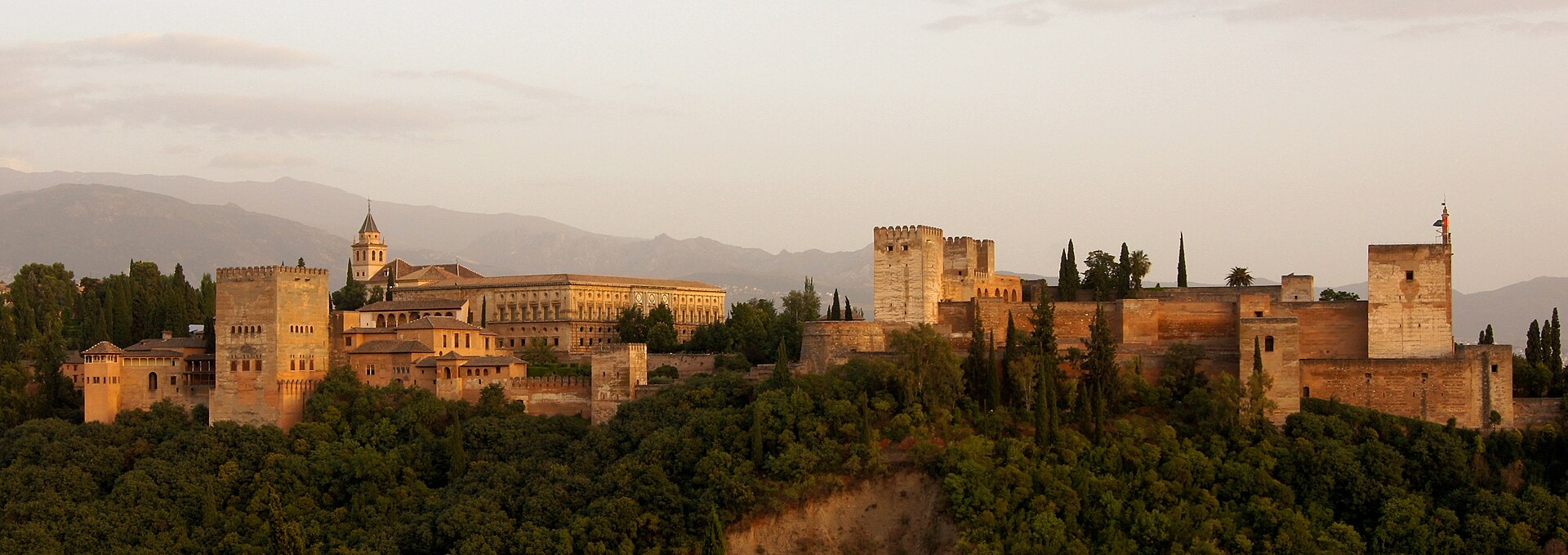
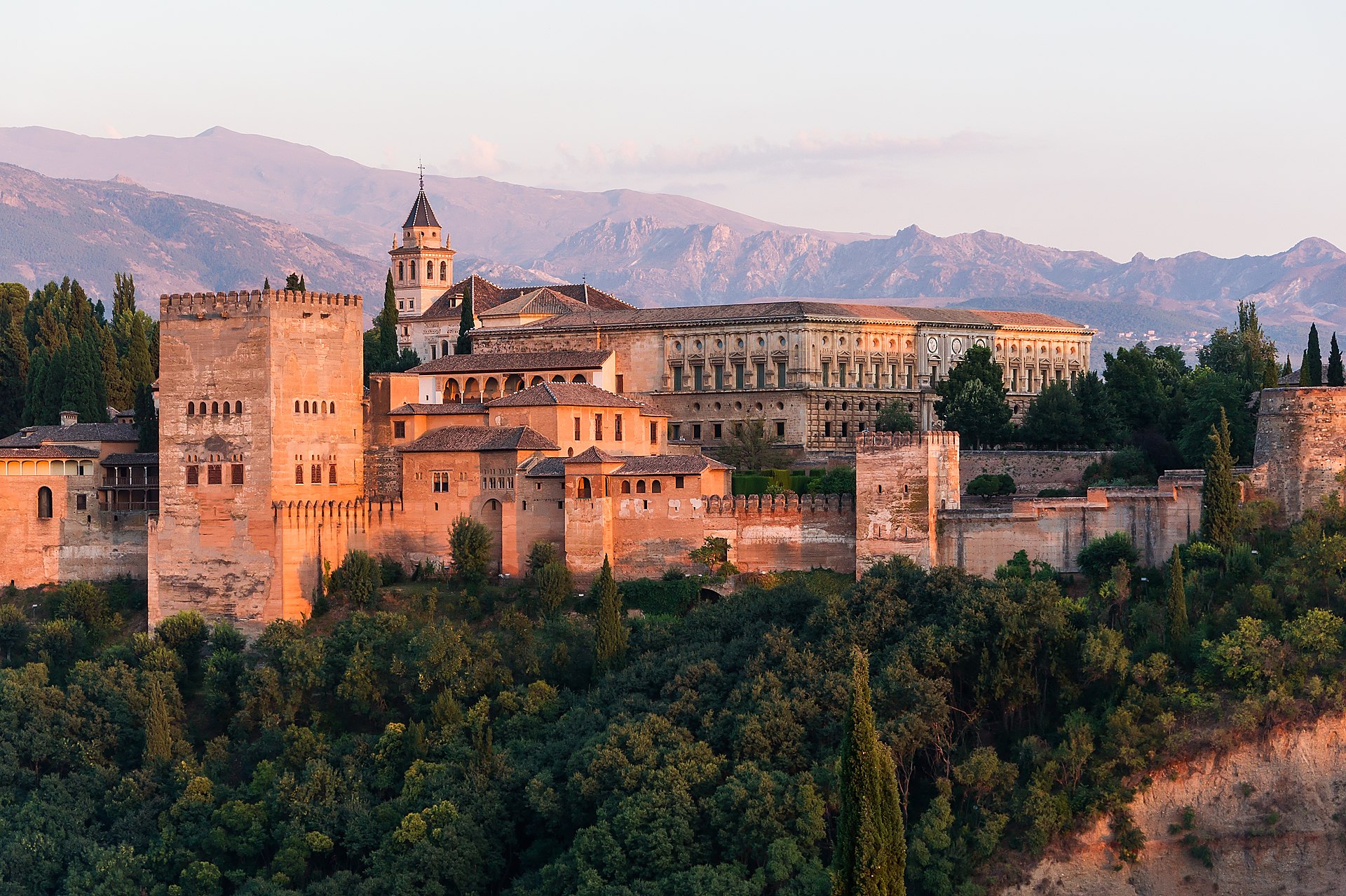
On a long red-walled hill above the city of Granada, with the snow-capped peaks of the Sierra Nevada rising behind, stands the most beautiful palace of the Islamic world in Europe. The Alhambra, whose name comes from the Arabic for the red one, is a fortress-palace of the Nasrid kings, the last Muslim rulers of Spain, and within its plain outer walls lies a hidden world of courtyards, fountains, and halls whose walls dissolve into lacework of carved stucco, colored tile, and flowing Arabic calligraphy. It is one of the supreme achievements of world architecture, and one of the most visited monuments on earth.
The Alhambra is not a single palace but a walled city on the hill, containing a fortress, several royal palaces, gardens, and the dwellings of a whole court. Its great glory is the Nasrid palaces, a sequence of courtyards and halls, above all the Court of the Myrtles and the Court of the Lions, where the art of al-Andalus reached its final and most exquisite flowering before the fall of Muslim Spain.
The palace was the seat of the Nasrid dynasty, who ruled the Emirate of Granada, the last Muslim state in the Iberian Peninsula, for two and a half centuries after the rest of al-Andalus had fallen to the Christian kingdoms. In their mountain stronghold the Nasrids preserved and perfected the civilization of Islamic Spain, and the Alhambra is its crowning monument, built in the very twilight of Muslim rule.
This is the opening palace of a group of great Islamic royal residences of the western Mediterranean in this series, the world of al-Andalus and the Maghreb. To pass from the plain red walls of the Alhambra into the Court of the Lions, with its forest of slender columns and its fountain borne on the backs of stone lions, is to enter a vision of paradise made by the last kings of Muslim Spain, a beauty that has enchanted the world for centuries.
In This Article
- The Red Fortress on the Hill
- The Nasrid Kingdom of Granada
- The Alcazaba, the Fortress
- The Comares Palace and the Court of the Myrtles
- The Court of the Lions
- The Art of Stucco, Tile, and Word
- Life at the Nasrid Court
- Water and the Paradise Garden
- The Generalife, the Summer Garden
- The Renaissance Palace of Charles V
- The Fall of Granada
- Ruin, Romance, and Rediscovery
- The Alhambra Today
The Red Fortress on the Hill
The Alhambra is a walled complex occupying a long, narrow hill above Granada, its red outer walls and towers enclosing a whole royal city. Within these fortifications lie the Alcazaba, the military citadel at the western point; the Nasrid palaces, the royal residence; the gardens; and, from a later age, the Renaissance palace of the Emperor Charles V.
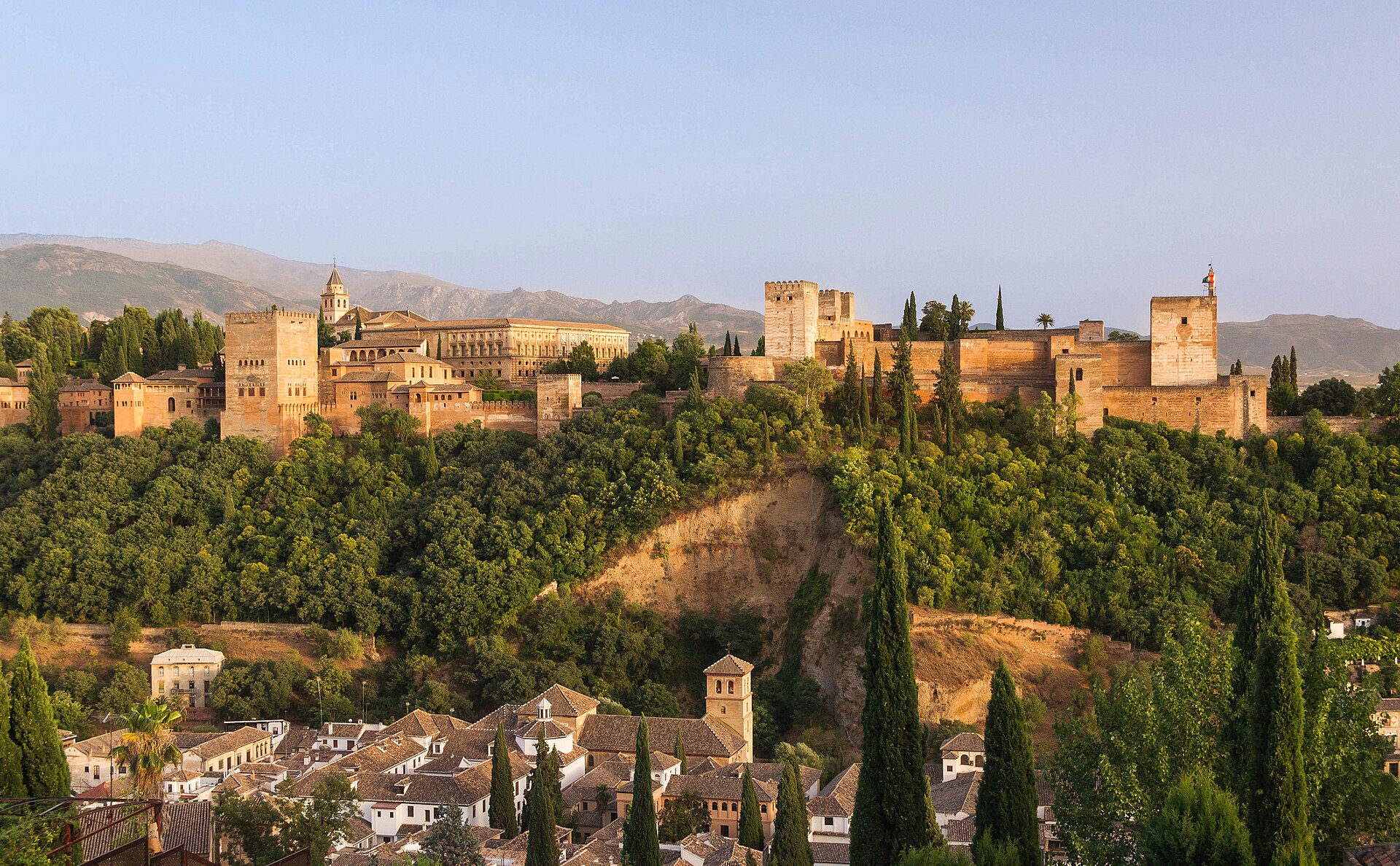
The name Alhambra, the red one, refers to the color of the walls, built of rammed earth and brick that glow red in the sun, especially at dawn and dusk. From the city below and from the hills opposite, the long line of red walls and towers along the ridge is one of the most famous silhouettes in the world.
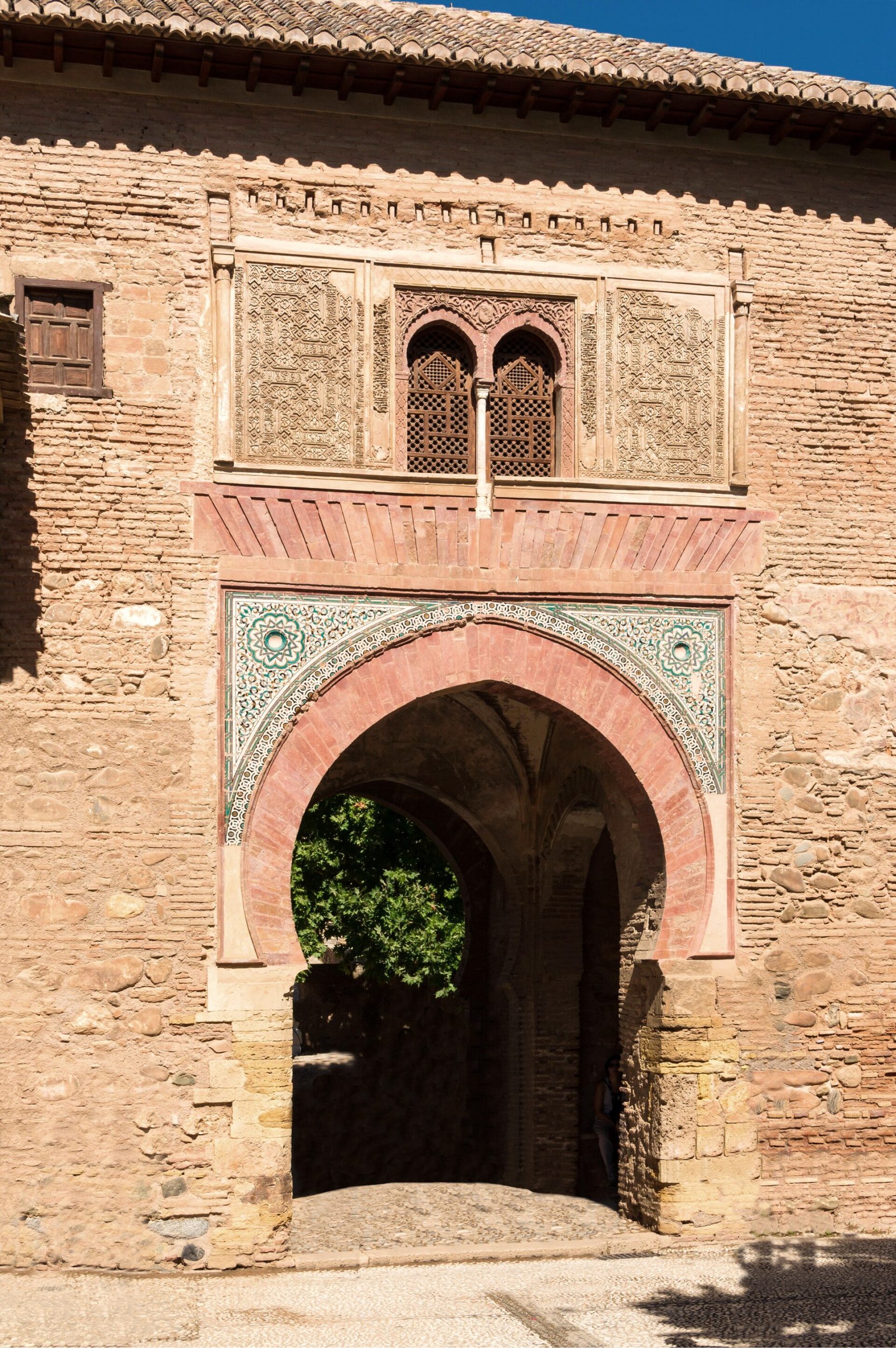
The plain, even austere, exterior of the palace conceals the extraordinary richness within, a deliberate contrast characteristic of Islamic architecture, in which beauty is turned inward, toward private courtyards, rather than displayed on the outer face. The visitor passing from the fortress walls into the Nasrid palaces experiences this contrast as a revelation.
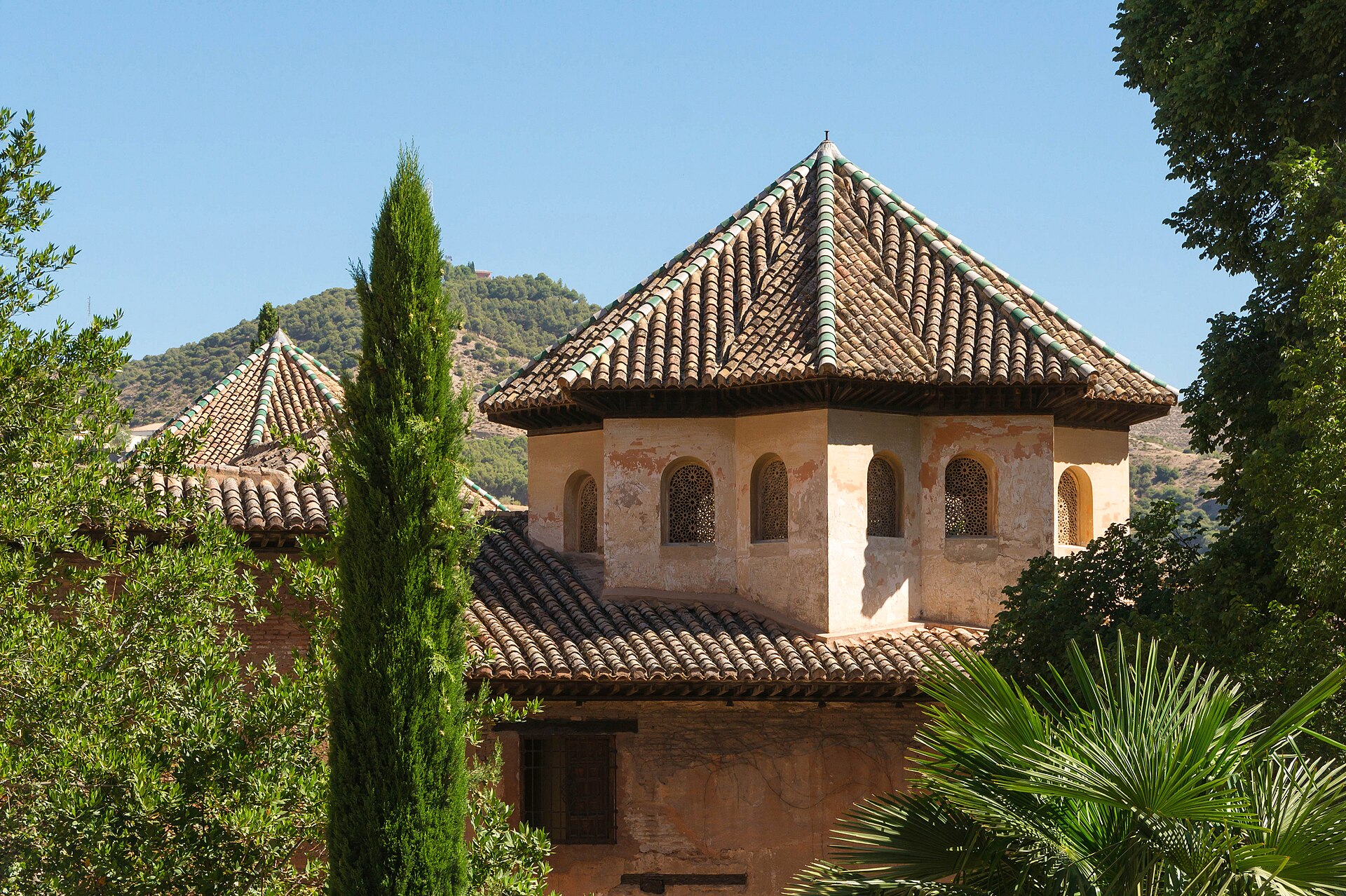
Within, the palaces are organized around courtyards, each with its pool or fountain, surrounded by halls whose walls are covered from floor to ceiling with carved stucco, colored tile, and inscriptions. Water, light, and ornament combine in these spaces to create an atmosphere of serene and otherworldly beauty.
The whole complex, fortress, palace, and garden together, represents the fullest surviving expression of the art and architecture of al-Andalus, the Muslim civilization of medieval Spain. The Alhambra is its masterpiece and its memorial, the place where the culture of Islamic Spain achieved its final and most perfect form.
The Alhambra opens a new chapter in this series, for it belongs to a world quite distinct from the East and South Asian courts explored in recent regions. Here we are in the Islamic Mediterranean, the world of al-Andalus and the Maghreb, whose art shares a common vocabulary of geometry, calligraphy, and the paradise garden. The Alhambra is the supreme monument of this civilization in Europe, and it sets the theme for the great Moorish palaces that will follow.
The Nasrid Kingdom of Granada
The Alhambra was the seat of the Nasrid dynasty, who ruled the Emirate of Granada, the last independent Muslim state in the Iberian Peninsula. As the Christian kingdoms of the north advanced through the medieval centuries, conquering the great cities of al-Andalus one by one, Granada survived as the final refuge of Muslim Spain.
The Nasrids came to power in the thirteenth century, at a time when the Muslim position in Iberia was collapsing, and through a combination of diplomacy, tribute, and the natural strength of their mountainous territory they preserved their kingdom for two and a half centuries. Granada became the last home of the civilization of al-Andalus.
Under the Nasrids, and especially in the fourteenth century, the kingdom enjoyed a golden age of art and culture even as its political situation remained precarious. The great palaces of the Alhambra were built in this period, a final flowering of Andalusi art produced by a kingdom living always in the shadow of its powerful Christian neighbors.
The Nasrid state was a sophisticated civilization, a center of learning, craftsmanship, and trade, preserving the traditions of al-Andalus and maintaining connections across the Islamic world and the Mediterranean. Its wealth and refinement are written in the exquisite ornament of the Alhambra, the work of the finest craftsmen of the age.
That so much beauty was created in the last age of a doomed kingdom gives the Alhambra its poignant character. The Nasrids built their paradise on the hill even as the world of al-Andalus was ending, and their palace stands as the magnificent final achievement of Muslim Spain, completed only a few decades before the kingdom fell.
There is a particular irony worth dwelling on in the Nasrid achievement. The dynasty survived for two and a half centuries largely by accepting a subordinate position, paying tribute to the Christian kingdom of Castile and playing the shifting politics of a frontier with great skill. Out of this precarious, compromised independence came one of the most sublime artistic flowerings in history, as if the very fragility of the kingdom concentrated its energies into the making of beauty that would outlast its fall.
The Alcazaba, the Fortress
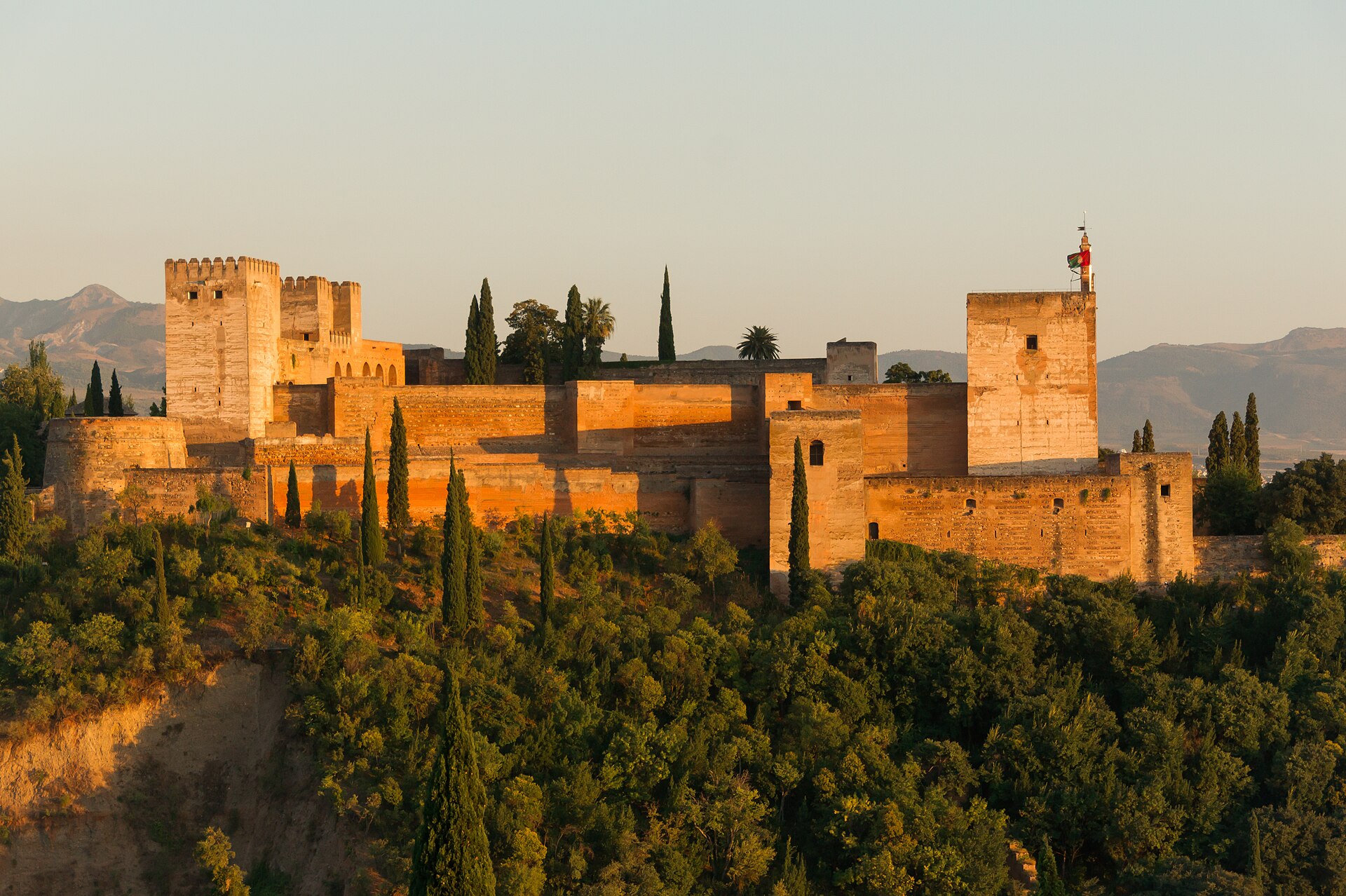
At the western tip of the hill stands the Alcazaba, the military citadel of the Alhambra and its oldest part, a fortress of towers and ramparts that guarded the whole complex. From its heights, above the plunging walls, the defenders commanded the city of Granada and the plain and mountains beyond.
The Alcazaba is a genuine fortress, built for war, with massive towers, thick walls, and a keep, quite distinct in character from the delicate palaces it protected. It housed the garrison that defended the royal city, and its watchtowers guarded against attack in a kingdom that lived under constant threat.
The greatest of its towers offers, from its summit, one of the finest views in Spain, over the red roofs of the old Muslim quarter of Granada, across to the caves and hills opposite, and away to the snow-capped Sierra Nevada. This commanding position was the reason the hill was fortified in the first place.
The contrast between the stern Alcazaba and the exquisite Nasrid palaces expresses the double nature of the Alhambra, at once a fortress and a paradise, a stronghold of a threatened kingdom and a place of surpassing beauty. The fortress made the palaces possible, guarding the royal city on its hill.
For the visitor, the Alcazaba provides both a sense of the military reality of the Nasrid kingdom and a magnificent vantage point over Granada and its setting. Its towers and ramparts remind us that the beauty of the Alhambra was created behind the walls of a fortress, in a kingdom always prepared to defend itself.
The Comares Palace and the Court of the Myrtles
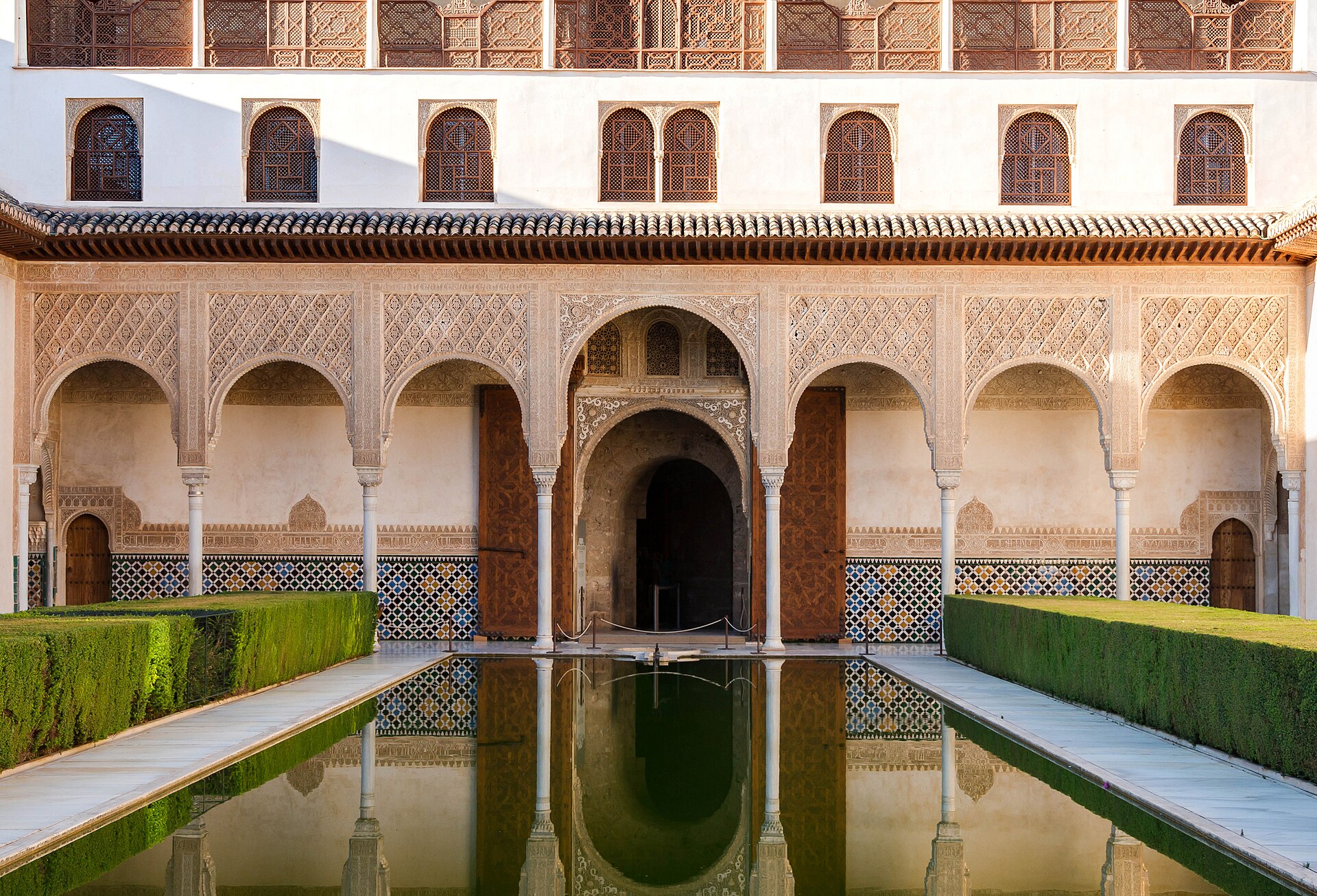
The first of the great royal palaces is the Comares Palace, built around the Court of the Myrtles, one of the most serene and beautiful spaces in the Alhambra. A long rectangular pool, flanked by hedges of myrtle, reflects the arcades at either end and the great tower that rises above it, a composition of water, light, and architecture of perfect balance.
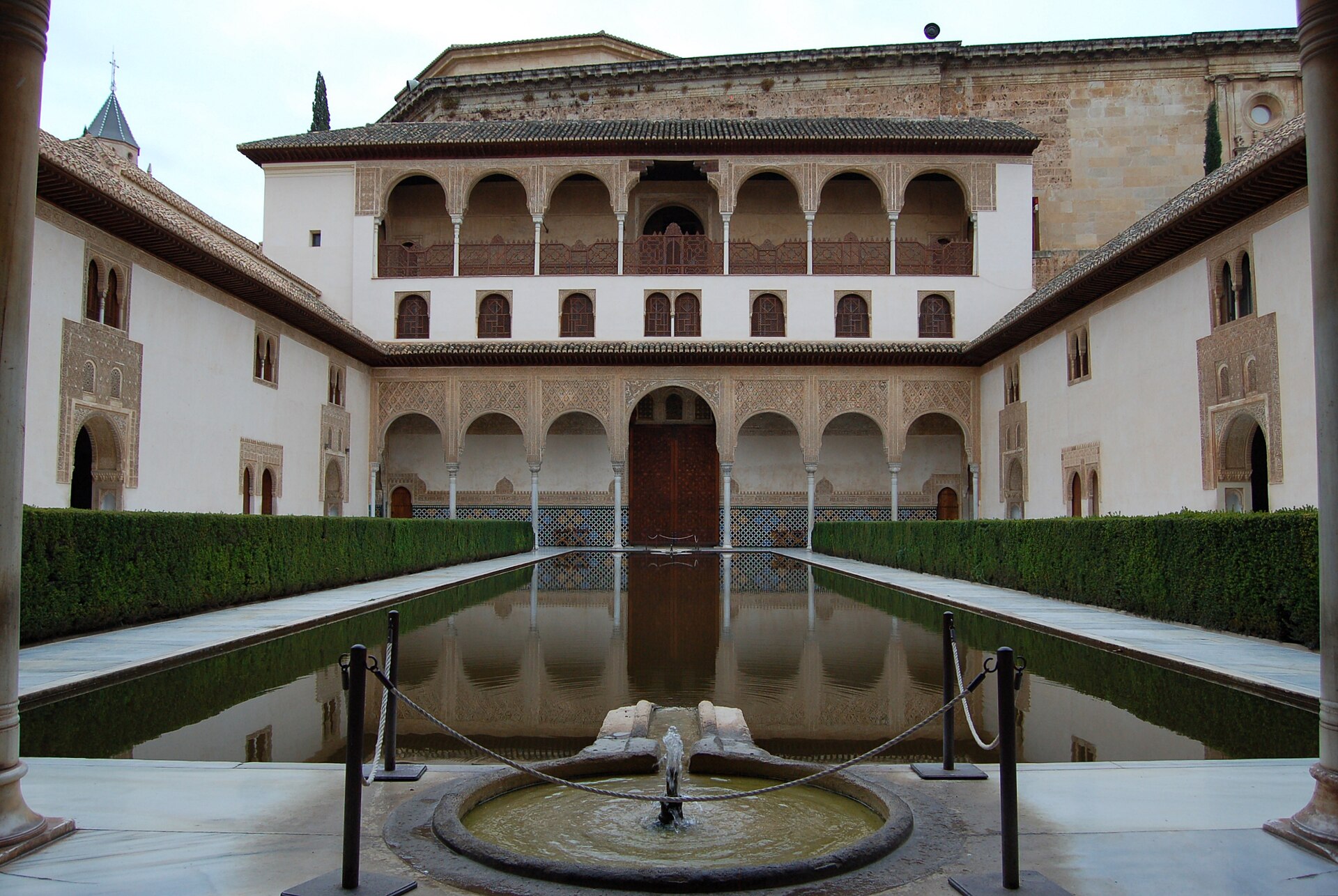
The pool of the Court of the Myrtles is the heart of the composition, its still surface doubling the surrounding architecture in reflection and bringing light and coolness into the palace. The use of water as a mirror, multiplying the beauty of the buildings, is one of the great themes of Alhambra architecture.
At the northern end of the court rises the Comares Tower, containing the Hall of the Ambassadors, the grandest room in the Alhambra and the throne room of the Nasrid kings. Here the sultan received envoys and conducted the highest affairs of state, seated beneath a magnificent domed ceiling.
The Hall of the Ambassadors is a masterpiece, its walls covered with carved stucco and inscriptions, and its ceiling an intricate wooden dome representing the seven heavens of Islamic cosmology, so that the enthroned sultan sat, symbolically, beneath the vault of the heavens. It was the ceremonial center of the kingdom.
The Comares Palace, with its court and its throne room, was the public and official heart of the Nasrid residence, the setting for the ceremonies of state and the reception of the great. Its serene court and its majestic hall together form one of the supreme achievements of the architecture of al-Andalus.
The symbolism of the Hall of the Ambassadors repays a moment’s thought. The great wooden dome above the throne, with its thousands of pieces arranged to represent the heavens, placed the enthroned sultan quite deliberately at the center of a model of the cosmos. To approach him was to approach, in the language of the architecture, the axis of creation itself, and the whole room was designed to impress upon envoys and subjects the sacred majesty of the Nasrid crown.
The Court of the Lions
The most famous space in the Alhambra, and one of the most celebrated courtyards in the world, is the Court of the Lions, the heart of the Palace of the Lions, the private residence of the sultan. Surrounded by a gallery of slender columns and centered on a fountain borne on the backs of twelve stone lions, it is a vision of paradise made in stone and water.
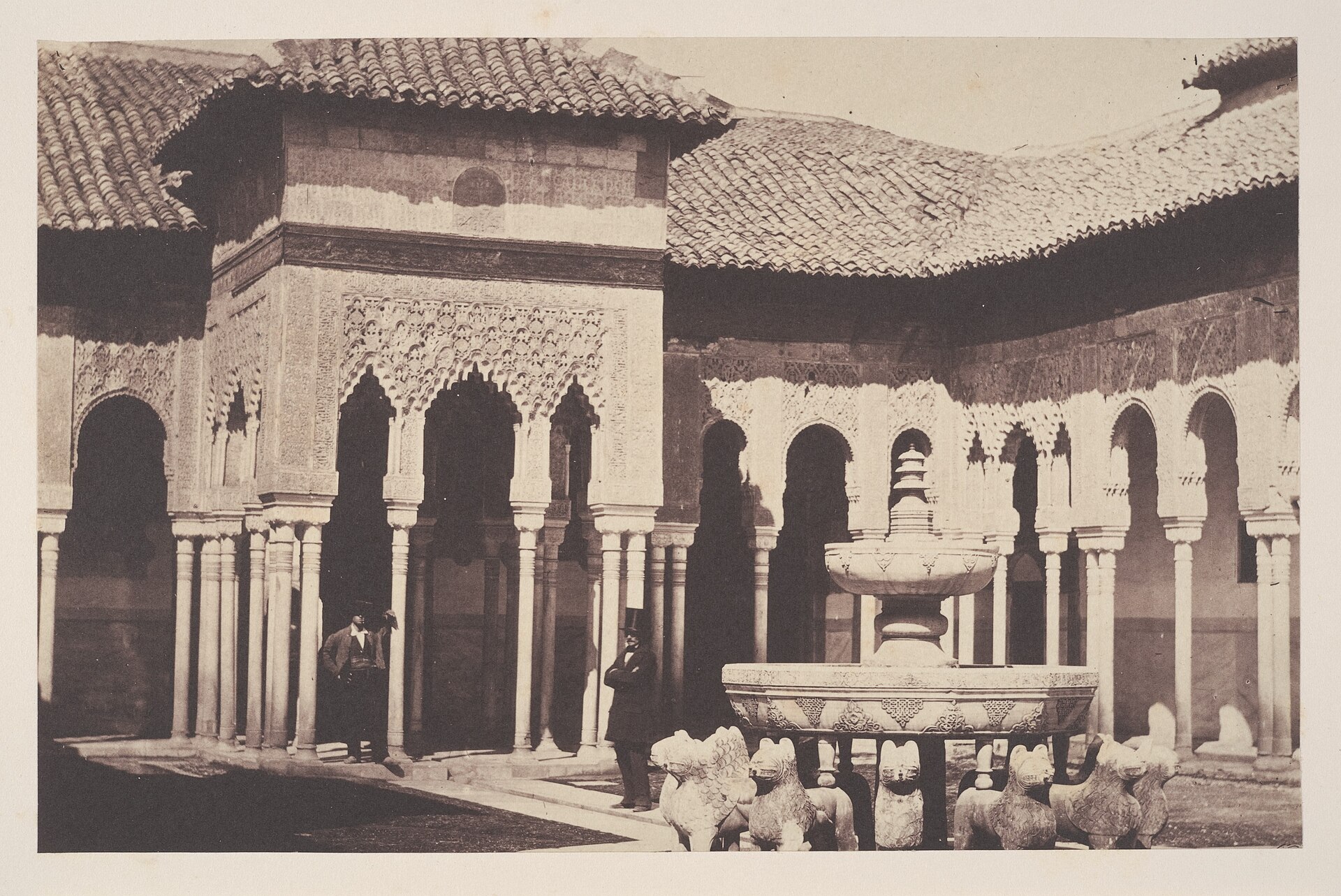
The court is surrounded by an arcade of one hundred and twenty-four white marble columns, arranged singly and in groups, supporting arches of carved stucco so fine they seem to hang in the air. This forest of columns, light and rhythmic, gives the court an airy, almost weightless beauty unlike anything else in architecture.
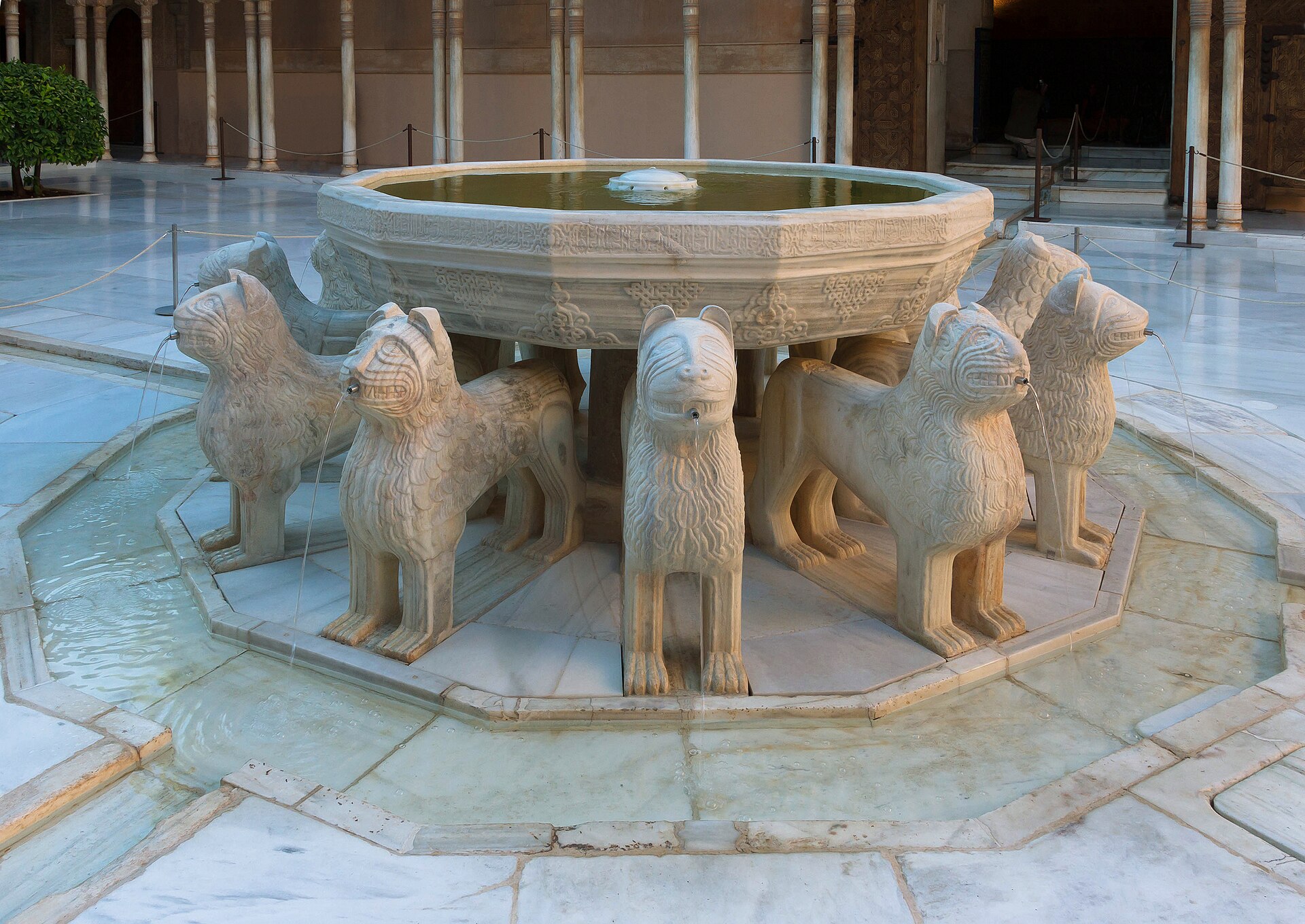
At the center stands the famous fountain, a great basin resting on the backs of twelve stone lions, from which channels of water run out along the four axes of the court, dividing it into quarters in the manner of the Islamic paradise garden. The lions and their fountain are among the most beloved images of the Alhambra.
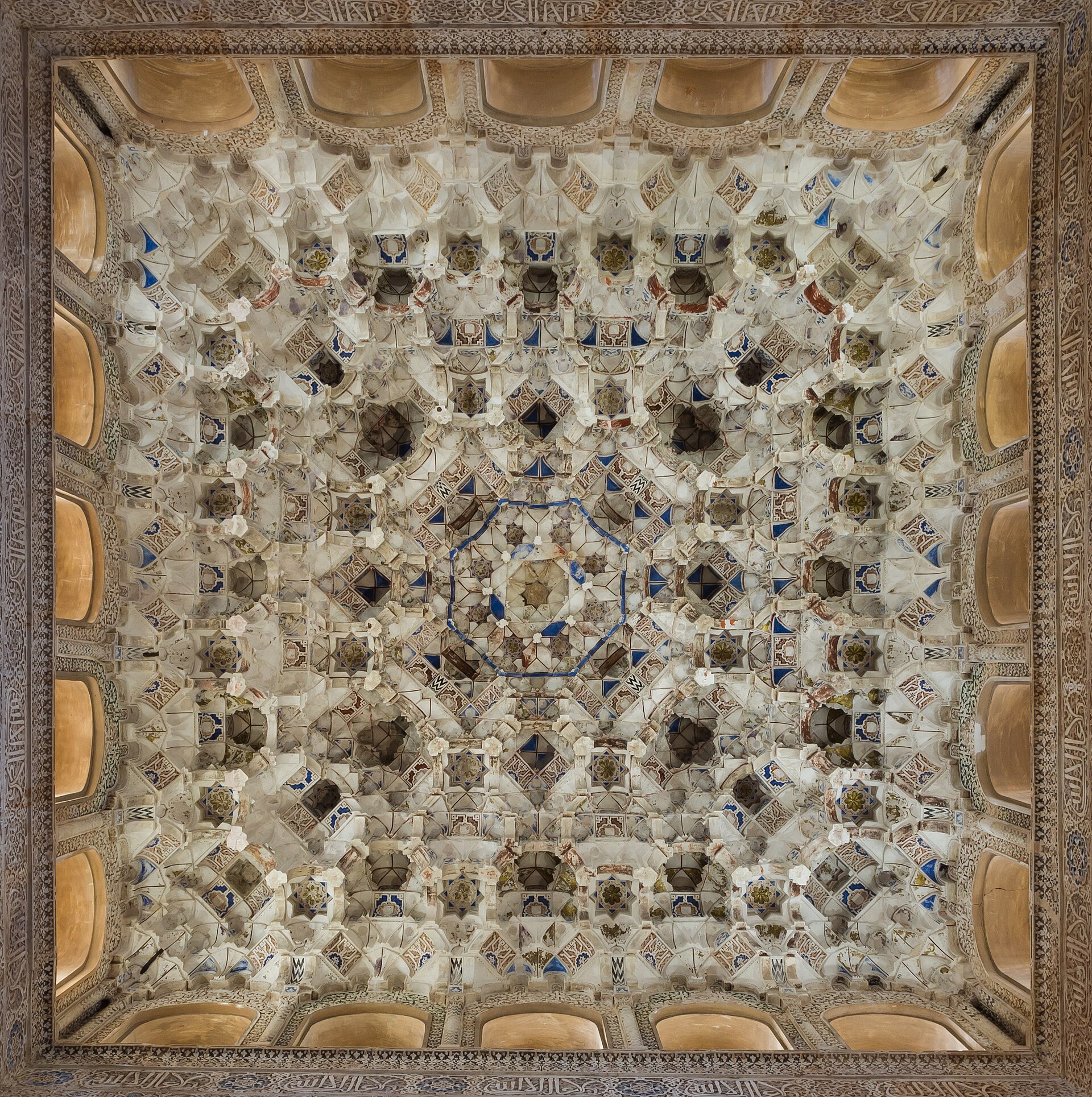
Around the court open some of the most beautiful halls of the palace, including chambers whose ceilings are filled with muqarnas, the honeycomb vaulting of Islamic architecture, cascading in thousands of tiny cells that catch and scatter the light. These rooms are among the supreme achievements of Andalusi decoration.
The Court of the Lions represents the art of the Alhambra at its most perfect, a private paradise of water, light, and ornament created for the pleasure of the sultan. In its columns, its fountain, and its muqarnas ceilings, the civilization of al-Andalus reached the very summit of its architectural achievement.
There is a reason the Court of the Lions has become, for so many, the very image of Islamic art. In its combination of mathematical order and sheer sensuous beauty, of structural lightness and decorative richness, it achieves something that feels almost impossible in stone, an architecture that seems woven rather than built. Standing among its columns as the light shifts and the fountain plays, one understands why generations of visitors have reached for the language of dreams and paradise to describe it.
The Art of Stucco, Tile, and Word
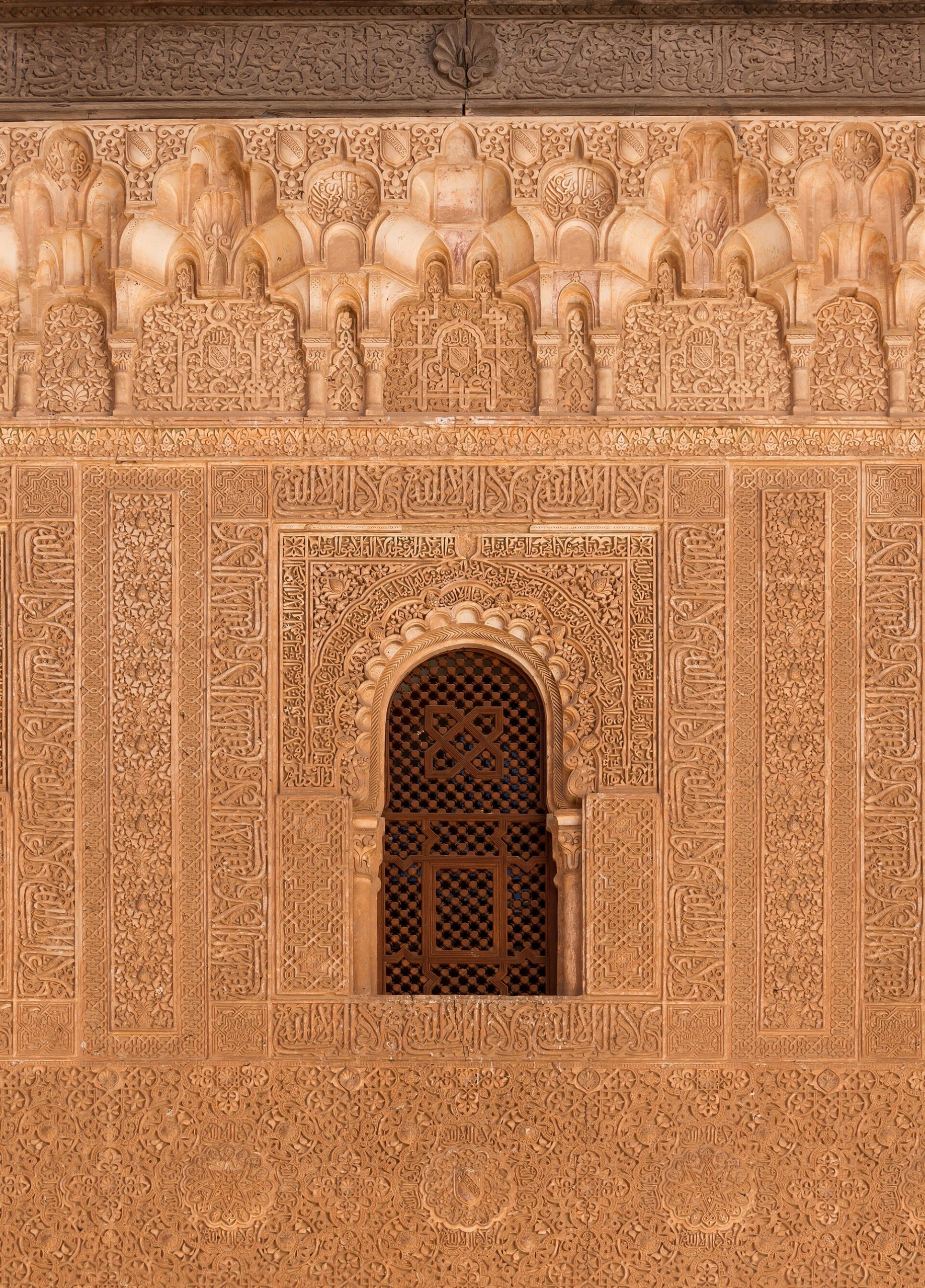
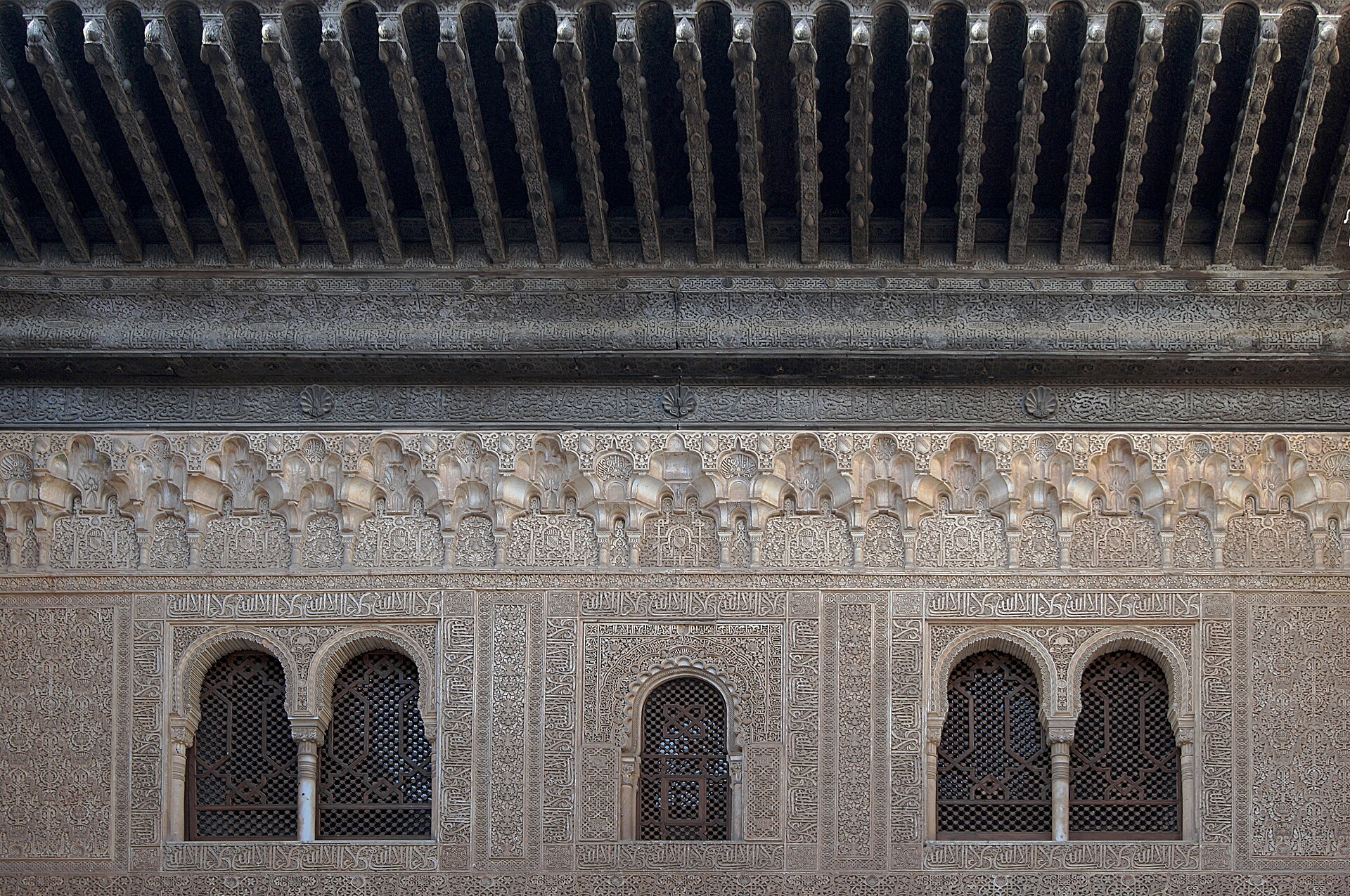
The glory of the Alhambra is its decoration, the covering of nearly every surface with ornament of astonishing intricacy and beauty. Carved stucco, colored ceramic tile, and Arabic inscriptions combine to transform the walls of the palace into fields of pattern that seem to dissolve the solid architecture into lace and light.
The carved stucco is worked into intricate patterns of geometry, stylized vegetation, and interlace, covering the upper walls and arches in a delicate white tracery. This plasterwork, carved with extraordinary fineness, is one of the signature arts of the Alhambra, giving its halls their characteristic shimmering, weightless quality.
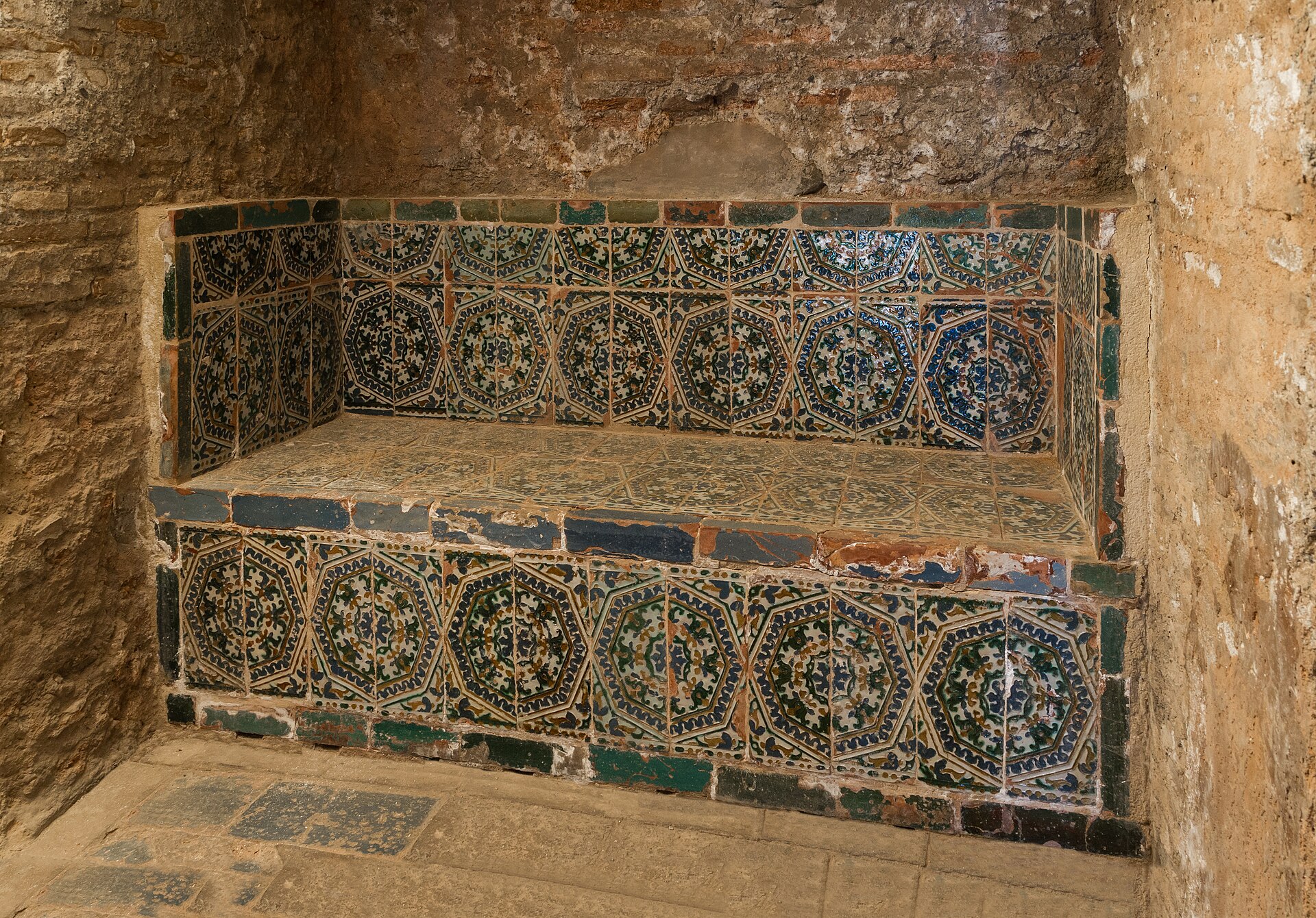
The lower walls are covered with colored tile, arranged in complex geometric patterns of great mathematical sophistication. The tilework of the Alhambra is famous among mathematicians and artists alike for its geometric ingenuity, embodying principles of pattern and symmetry explored by the craftsmen of al-Andalus.
Woven through the decoration are inscriptions in Arabic, verses of poetry, praises of the rulers, and above all the repeated Nasrid motto, there is no victor but God. These inscriptions turn the walls into a text as well as an image, and the poetry inscribed in the palace describes and celebrates the very rooms it adorns.
In keeping with Islamic tradition, the decoration contains no images of living beings but achieves its overwhelming richness through geometry, vegetation, and the written word. This union of pattern, color, and calligraphy represents one of the supreme decorative traditions of world art, and it reaches its highest expression in the halls of the Alhambra.
The tilework in particular has fascinated mathematicians, for the craftsmen of the Alhambra, working purely by geometric intuition and inherited tradition, produced patterns that modern mathematics recognizes as embodying deep principles of symmetry. That an art created for beauty and devotion should also anticipate abstract mathematical discovery is one of the wonders of the palace, a meeting of the aesthetic and the intellectual that few buildings can match.
Life at the Nasrid Court
Behind the beauty of the Alhambra lay the life of a sophisticated court, the center of a kingdom that was a hub of learning, poetry, craftsmanship, and trade. The Nasrid sultans presided over a cultivated society that preserved and developed the intellectual and artistic traditions of al-Andalus in its final refuge.
The court was a place of poetry, and the very walls of the palace are inscribed with verse, some of it composed by court poets to describe and praise the rooms it adorns. This union of architecture and poetry, in which the building speaks of itself in the words carved upon it, is unique to the Alhambra.
Learning flourished in Nasrid Granada, which maintained the scholarly traditions of al-Andalus in mathematics, astronomy, medicine, and philosophy, and the geometric sophistication of the palace’s decoration reflects the mathematical culture of the kingdom. The Alhambra is, among other things, a monument to the science of its makers.
The court also depended on the labor of many, the craftsmen who carved the stucco and set the tile, the gardeners who tended the paradise gardens, the engineers who managed the water, and the servants and soldiers who sustained the royal city. The palace was a working establishment as well as a work of art.
This courtly civilization, refined and precarious, produced in the Alhambra its supreme monument even as its world was ending. To understand the palace is to remember the society that made it, a last brilliant flowering of the culture of al-Andalus, preserved in the ornament and the poetry of the halls on the hill of Granada.
Water and the Paradise Garden
Water is the soul of the Alhambra, present everywhere in pools, channels, fountains, and cascades, and its use is one of the palace’s greatest achievements. In the dry heat of southern Spain, the abundance and mastery of water was both a practical marvel and a profound symbol, evoking the paradise gardens promised in the Islamic tradition.
The engineers of the Alhambra brought water to the hill through channels from the mountains, and distributed it throughout the palace to feed the pools and fountains and to cool the air. This command of water, in a hilltop fortress in an arid land, was a triumph of engineering as well as of art.
Water served many purposes at once, cooling the halls, delighting the eye and ear, mirroring the architecture, and carrying deep symbolic meaning. The still pools reflected the buildings and the sky, the running channels divided the courts into the quarters of the paradise garden, and the fountains filled the air with sound and coolness.
The Islamic conception of paradise as a garden of flowing water and abundant greenery shaped the whole design of the Alhambra, in which architecture, water, and planting combine to create an image of heaven on earth. The courts and gardens were meant to evoke the paradise described in the Quran, a foretaste of the reward of the faithful.
This mastery of water gives the Alhambra its unique atmosphere, cool and serene amid the heat, alive with the sound and movement of fountains and channels. It is one of the great achievements of the palace, and one of the reasons that visitors, then as now, have felt on entering it that they had come to a place of otherworldly beauty.
The Generalife, the Summer Garden
On the hillside beside the Alhambra lies the Generalife, the summer palace and gardens of the Nasrid kings, a place of retreat and pleasure amid terraces of flowers, fountains, and greenery. Its name is thought to mean the garden of the architect or of paradise, and it is one of the most beautiful gardens in the world.
The Generalife was designed as a place of escape from the ceremony of the main palace, a rural retreat where the sultan could relax amid gardens and water. Terraced into the hillside, it commands lovely views over the Alhambra, the city, and the surrounding country, set among orchards and cultivated land.
Its most famous space is a long court with a central channel of water lined by fountains that arc over the pool, surrounded by flower beds and greenery. This Court of the Water Channel is one of the enduring images of the Generalife, a perfect marriage of water, planting, and architecture.
The gardens combine the Islamic tradition of the paradise garden with the practical cultivation of fruit and flowers, terraced into the slope and fed by the same channels of mountain water that served the palace. They represent the horticultural art of al-Andalus at its finest, a green paradise beside the red walls of the Alhambra.
Though much altered over the centuries, the Generalife preserves the spirit of the Nasrid pleasure garden, and it remains one of the great delights of a visit to the Alhambra. Its terraces of flowers and its fountains offer a vision of the earthly paradise that the kings of Granada created on their hillside.
The contrast between the Generalife and the main palace is part of its charm, for where the Alhambra is architecture with gardens, the Generalife is a garden with architecture, greenery and water taking the leading role. It reminds us that for the people of al-Andalus the garden was not mere decoration but a serious art and a foretaste of paradise, and that the cultivation of flowers, fruit, and flowing water ranked among the highest achievements of their civilization.
The Renaissance Palace of Charles V
Amid the Islamic palaces of the Alhambra stands a great Renaissance building of a wholly different character, the palace of the Emperor Charles V, built after the Christian conquest of Granada. A massive square block enclosing a circular courtyard, it is a masterpiece of Renaissance architecture set incongruously among the Nasrid halls.
After the fall of Granada, the Alhambra passed to the Spanish crown, and in the sixteenth century the Emperor Charles V ordered the construction of a new palace within its walls, in the classical style of the Italian Renaissance. Its severe, monumental exterior and its perfect circular inner court are of great architectural distinction.
The building is a striking example of Renaissance design, and in any other setting it would be admired without reservation. Within the Alhambra, however, its heavy classical mass stands in dramatic contrast to the delicate Islamic palaces around it, a juxtaposition of two utterly different worlds of architecture.
The construction of the palace involved the demolition of part of the Nasrid buildings, and its presence has been debated ever since, seen by some as an intrusion and by others as a monument in its own right. It embodies the meeting, and the collision, of the two civilizations whose histories converged at the Alhambra.
Today the palace of Charles V houses museums, including collections of the art of the Alhambra and of Spanish painting, and its circular courtyard is admired as an architectural achievement. It stands as a permanent reminder of the passing of the Alhambra from Muslim to Christian hands, two great cultures side by side on the hill.
The Fall of Granada
The Alhambra witnessed one of the decisive events of European history, the fall of Granada in 1492, when the last Muslim kingdom in the Iberian Peninsula surrendered to the Catholic Monarchs, Ferdinand and Isabella, completing the centuries-long Christian reconquest of Spain. The keys of the city were handed over, and the Nasrid kingdom came to an end.
The last Nasrid sultan, Boabdil, surrendered the Alhambra and went into exile, and tradition holds that he wept as he looked back for the last time on the palace and the city he had lost. The end of Granada closed the history of al-Andalus, nearly eight centuries of Muslim presence in the Iberian Peninsula.
The year 1492 was momentous in many ways, for the same monarchs who took Granada also sponsored the voyage of Columbus and ordered the expulsion of the Jews from Spain. The fall of the Alhambra was part of a great turning point, the emergence of a unified Christian Spain and the beginning of a new age.
For the Muslim world, the loss of Granada was the end of al-Andalus, the brilliant civilization that had flourished in the peninsula for centuries. The Alhambra, completed only decades before, became the monument of that vanished world, the last and greatest achievement of Muslim Spain.
The surrender of the Alhambra thus marks one of the great endings of history, the close of Islamic rule in Western Europe. The palace passed to the victors, but it endured as a memorial to the civilization that built it, and its beauty has ensured that the memory of al-Andalus has never faded from the world.
The image of Boabdil looking back and weeping at the sight of the lost Alhambra, whether literally true or a later legend, has become one of the enduring symbols of the fall of al-Andalus, a moment of personal grief standing for the end of a whole world. Even the victors, it is said, were moved by the beauty of what they had won, and the survival of the palace they might have destroyed is itself a kind of tribute to the civilization that made it.
Ruin, Romance, and Rediscovery
After the fall of Granada the Alhambra gradually declined, and over the following centuries it suffered neglect, alteration, and damage, its halls falling into disrepair and its gardens running wild. For a time the palace of the Nasrid kings was inhabited by squatters and threatened with ruin.
The palace was rediscovered by the wider world in the nineteenth century, above all through the Romantic movement, which was captivated by its beauty and its air of vanished glory. Travelers, artists, and writers came to Granada drawn by the legend of the Moorish palace, and their accounts spread its fame across Europe and America.
The most influential of these was the American writer Washington Irving, who lived for a time in the palace and whose Tales of the Alhambra, published in the 1830s, enchanted readers around the world with its blend of history, legend, and description. His book did much to make the Alhambra one of the most famous buildings in the world.
The Romantic rediscovery led in time to efforts to preserve and restore the palace, rescuing it from ruin and beginning the long work of conservation that continues to this day. The Alhambra was recognized as a treasure not only of Spain but of world civilization, and steps were taken to protect it.
The story of the Alhambra’s rediscovery is part of its romance, the tale of a vanished paradise brought back to the world’s attention and saved from ruin. The palace that had been the last refuge of al-Andalus became, in the modern age, a beloved monument of world heritage, its beauty admired by all humanity.
The Alhambra Today
Today the Alhambra is one of the most visited monuments in the world, drawing millions of visitors each year to marvel at its palaces, gardens, and views. So great is the demand that admission is limited and timed, to protect the fragile fabric of the palace from the pressure of the crowds who come to see it.
In 1984 the Alhambra, together with the Generalife and the old Muslim quarter of Granada, was inscribed on the UNESCO World Heritage List, recognized as a masterpiece of Islamic art and architecture and one of the supreme monuments of world civilization. The listing set a seal on its universal importance.
Conservation of the palace is an ongoing and delicate task, for the carved stucco, tile, and woodwork are fragile and vulnerable to the effects of time, weather, and mass tourism. The work of preserving the Alhambra for future generations is among the great responsibilities of Spanish and world heritage.
For Spain, the Alhambra is a monument of profound significance, a reminder of the country’s Islamic past and of the rich, complex history of al-Andalus, in which Muslim, Christian, and Jewish cultures met and mingled. It stands as a symbol of a lost civilization and of the enduring beauty it created.
To pass through the Court of the Lions or to stand by the pool of the Court of the Myrtles, with the red walls around and the mountains beyond, is to enter one of the most beautiful places ever made by human hands. The Nasrid kingdom fell more than five centuries ago, but the paradise it built on the hill of Granada endures, enchanting the world as it has for generations.
Book well ahead if you hope to see it, for entry to the Nasrid palaces is strictly timed and tickets sell out far in advance, a measure of both the Alhambra’s fame and its fragility. And if you can, come in the early morning or the late evening light, when the red walls glow and the crowds thin, for it is then that the palace most fully recovers the serene, otherworldly atmosphere its builders intended, a paradise on the hill above Granada.
Palaces Nearby
The Alhambra opens a new group of great Islamic royal residences of the western Mediterranean, the world of al-Andalus and the Maghreb. More Moorish palaces, from Andalusia and Morocco, will join it soon, to trace the varied splendor of this brilliant civilization.
You May Like

Qasr Al Hosn: The White Fort Where Abu Dhabi Began


2 thoughts on “The Alhambra: The Paradise Palace of the Last Moorish Kings”