In the heart of Seville, beside its great cathedral, lies a palace that is one of the most extraordinary buildings in Europe, a Christian royal residence built in the style of Islamic art. The Royal Alcazar of Seville, behind its plain crenellated walls, opens into a world of horseshoe arches, carved plaster, glazed tile, and tranquil courtyards that could belong to the Alhambra, yet it was built by a Christian king. It is the finest example of Mudejar architecture in Spain and the oldest royal palace still in use in Europe.
The Alcazar is a layered palace, built and rebuilt over more than a thousand years on a site that has been a seat of power since Roman and Islamic times. Its heart is the palace of the Christian king Pedro the First, raised in the fourteenth century by Muslim craftsmen in the style of al-Andalus, and around it are gathered Gothic halls, Renaissance additions, and some of the most beautiful gardens in Spain.
The palace tells the complex story of medieval Spain, where Muslim and Christian civilizations met, fought, and profoundly influenced one another. That a Christian monarch should build his palace in the Islamic style, employing Muslim artisans and covering his walls with Arabic inscriptions, speaks of a cultural interweaving unique to the Iberian Peninsula, and the Alcazar is its supreme monument.
This is the second palace of a group of great Islamic and Moorish-influenced royal residences of the western Mediterranean in this series, following the Alhambra of Granada. Where the Alhambra was the last palace of Muslim Spain, the Alcazar of Seville is the masterpiece of the shared culture that followed, a Christian palace of Islamic beauty that remains, to this day, a residence of the Spanish crown.
In This Article
- A Palace of Many Ages
- The Islamic Origins
- King Pedro and the Mudejar Palace
- The Mudejar Style
- The Courtyard of the Maidens
- The Art of the Azulejo
- The Hall of the Ambassadors
- The Courtyard of the Dolls
- The Gothic Palace and the Catholic Monarchs
- The Alcazar and the New World
- The Gardens of the Alcazar
- A Living Royal Palace
- The Alcazar Today
A Palace of Many Ages
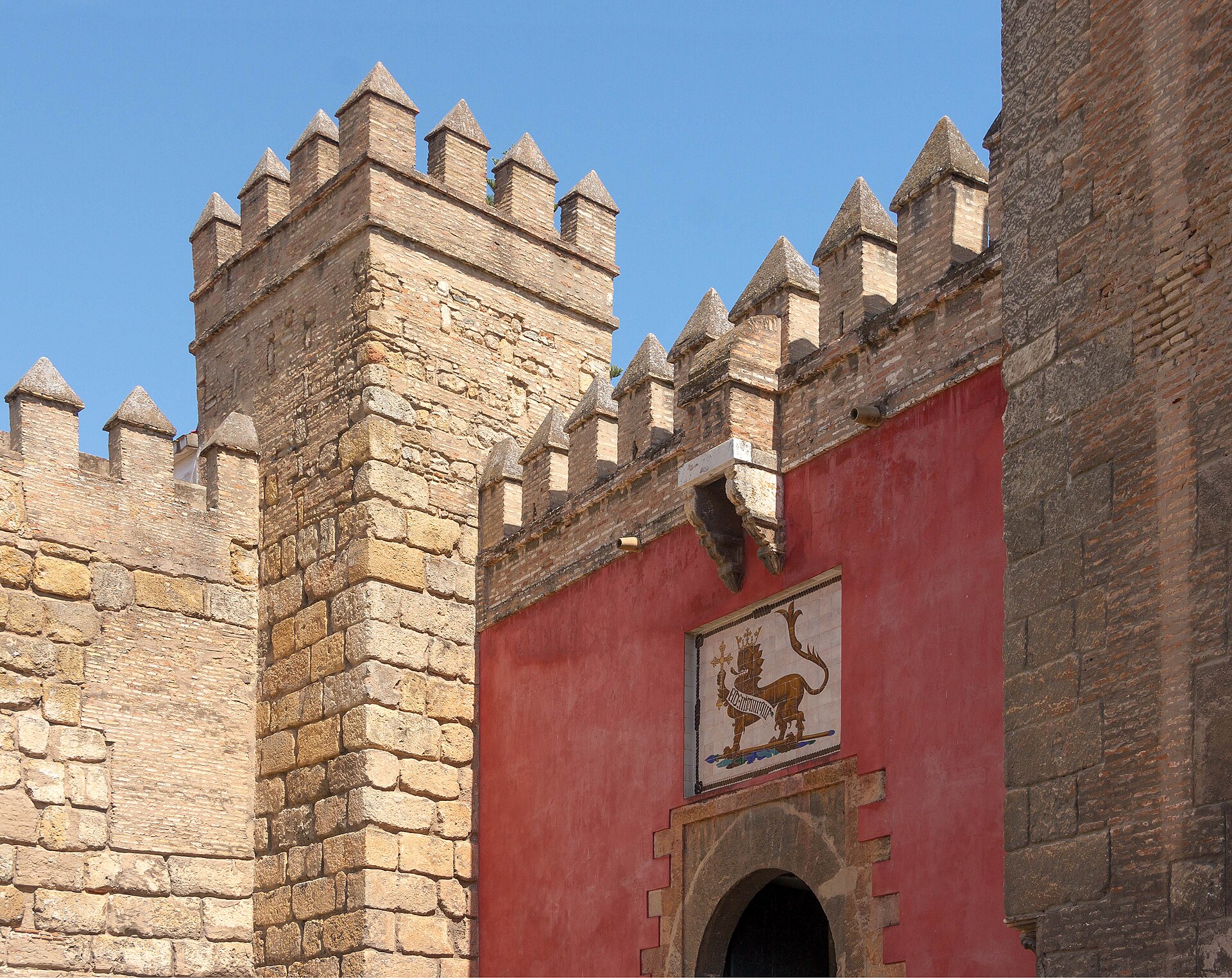
The Royal Alcazar of Seville is not a single building but a complex of palaces, halls, and gardens built up over more than a millennium on the same site. Behind its fortified outer walls lie structures from many periods, from the traces of its Islamic origins to the fourteenth-century Mudejar palace at its heart and the Gothic and Renaissance additions around it.

The name Alcazar comes from the Arabic word for a fortified palace, and the site has been a seat of power since the early Middle Ages, when the Muslim rulers of Seville built their fortress-palace here. Successive rulers, Muslim and then Christian, rebuilt and expanded the complex, each leaving their mark.
The heart of the palace is the residence built by the Christian king Pedro the First in the fourteenth century, a masterpiece of the Mudejar style that imitates the Islamic architecture of al-Andalus. Around it stand the earlier Gothic palace of Alfonso the Tenth and later additions, so that the complex spans the whole history of medieval and early modern Spain.
Beyond the buildings lie the extensive gardens, laid out over the centuries in styles from the Islamic to the Renaissance and beyond, a green paradise of terraces, fountains, and pavilions. Together the palaces and gardens make the Alcazar one of the richest and most beautiful royal complexes in Europe.
For the visitor, the Alcazar offers a journey through the layered history of Spain, from its Islamic past through the Christian Middle Ages to the age of the Renaissance and beyond. Its blend of styles, above all its incomparable Mudejar heart, makes it one of the most fascinating and beautiful palaces in the world.
The Alcazar makes a fascinating companion to the Alhambra, the palace that opened this Moorish group. Where the Alhambra was built by Muslim kings as the last redoubt of al-Andalus, the Alcazar was built by a Christian king in the Islamic style, employing the same traditions of craftsmanship. Seen together, the two palaces reveal how the art of al-Andalus outlived the political power that created it, passing into the service of the Christian kingdoms that conquered Muslim Spain.
The Islamic Origins
The site of the Alcazar has been a seat of power since the early Middle Ages, when Seville was a great city of al-Andalus, Muslim Spain. The rulers of the city built a fortified palace here, and under successive Muslim dynasties, culminating in the Almohads who ruled in the twelfth century, it became a splendid royal residence.
Under Muslim rule Seville was one of the greatest cities of the western Islamic world, a center of art, learning, and trade, and its rulers adorned it with fine buildings, of which the palace was the chief. Elements of these Islamic structures survive within the later Alcazar, traces of its origins as a palace of al-Andalus.
The Islamic palace established the pattern that would shape the Alcazar for centuries, the arrangement around courtyards with pools and gardens, the use of water and greenery, and the traditions of decoration in carved plaster and tile. Even after the Christian conquest, these Islamic principles continued to govern the building.
When Seville fell to the Christian kingdom of Castile in the thirteenth century, the Muslim palace passed to the new rulers, who at first occupied and adapted the existing buildings. The transition from Muslim to Christian rule did not erase the Islamic character of the palace but set the stage for its remarkable continuation.
The Islamic origins of the Alcazar are fundamental to understanding it, for the palace that the Christian kings later built was a continuation and imitation of the Andalusi tradition they inherited. The Alcazar is thus rooted in the civilization of Muslim Spain, whose art it preserved and perpetuated long after the Christian conquest.
It is worth remembering how great a city Muslim Seville was, for at its height under the Almohads it rivalled the major capitals of the Islamic world, and its great minaret, now the bell tower of the cathedral known as the Giralda, still dominates the city. The Alcazar was the palace of the rulers of this brilliant metropolis, and though little of the original Islamic fabric survives intact, the whole later palace grew from that Andalusi root, inheriting its forms, its gardens, and its relationship to water.
King Pedro and the Mudejar Palace
The glory of the Alcazar is the palace built in the fourteenth century by King Pedro the First of Castile, known as Pedro the Cruel or Pedro the Just according to one’s view of him. He raised, at the heart of the complex, a residence of surpassing beauty in the Mudejar style, imitating the Islamic architecture of al-Andalus.
Pedro employed Muslim craftsmen, and craftsmen from the still-independent Nasrid kingdom of Granada are said to have worked on his palace, so that its decoration is closely related to that of the Alhambra itself. The result is a Christian palace that is, in its art, a masterpiece of Islamic design.
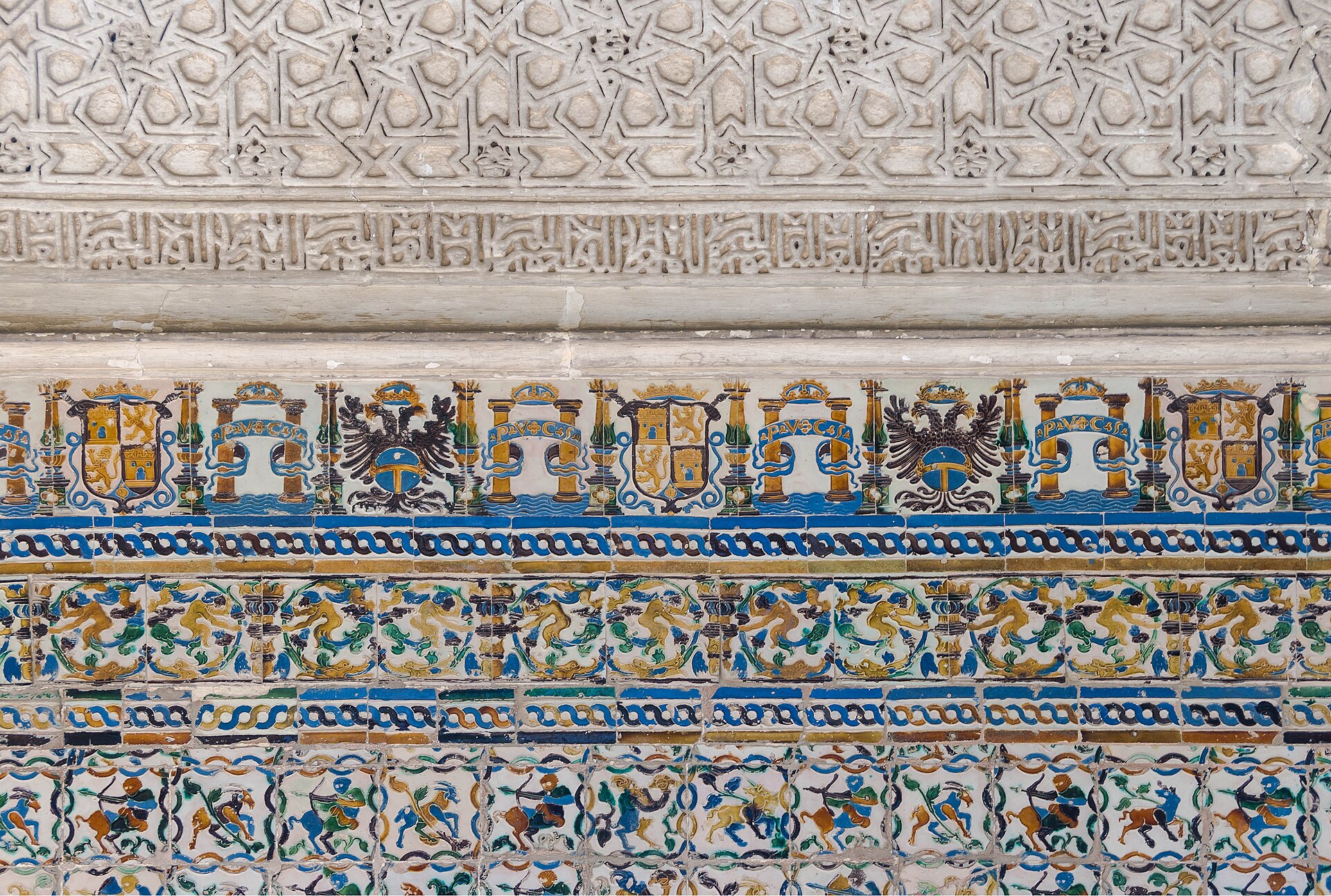
The palace is covered with the carved plaster, glazed tile, and Arabic inscriptions characteristic of Andalusi architecture, and its courtyards and halls follow the Islamic pattern. Yet it was built for a Christian king, and its inscriptions mingle praises in Arabic with Castilian heraldry, a striking emblem of the cultural fusion of medieval Spain.
Pedro’s relationship with the Muslim rulers of Granada, and his taste for the art of al-Andalus, made his palace possible. It reflects a moment when the boundary between the Christian and Islamic worlds in Spain was porous, and when a Christian monarch could find in Islamic art the highest expression of royal splendor.
The palace of Pedro the First is the heart and the masterpiece of the Alcazar, the finest surviving example of Mudejar architecture and one of the most beautiful royal residences in Europe. It stands as a monument to the shared culture of medieval Spain, a Christian palace clothed in the beauty of al-Andalus.
The nickname of Pedro the First, remembered by his enemies as the Cruel and by his supporters as the Just, hints at the turbulent and violent reign behind this serene palace. His was an age of civil war and bitter dynastic struggle, and the beauty of his Alcazar was created amid political ferocity. As so often in this series, the tranquil courts and glittering halls were the product of a hard and dangerous world, and the contrast between the peace of the palace and the violence of its history is part of its fascination.
The Mudejar Style
The style of Pedro’s palace is called Mudejar, a term for the art produced by Muslim craftsmen, or in the Islamic tradition, under Christian rule in Spain. It represents the continuation of the artistic traditions of al-Andalus in the service of Christian patrons, and the Alcazar is its supreme achievement.
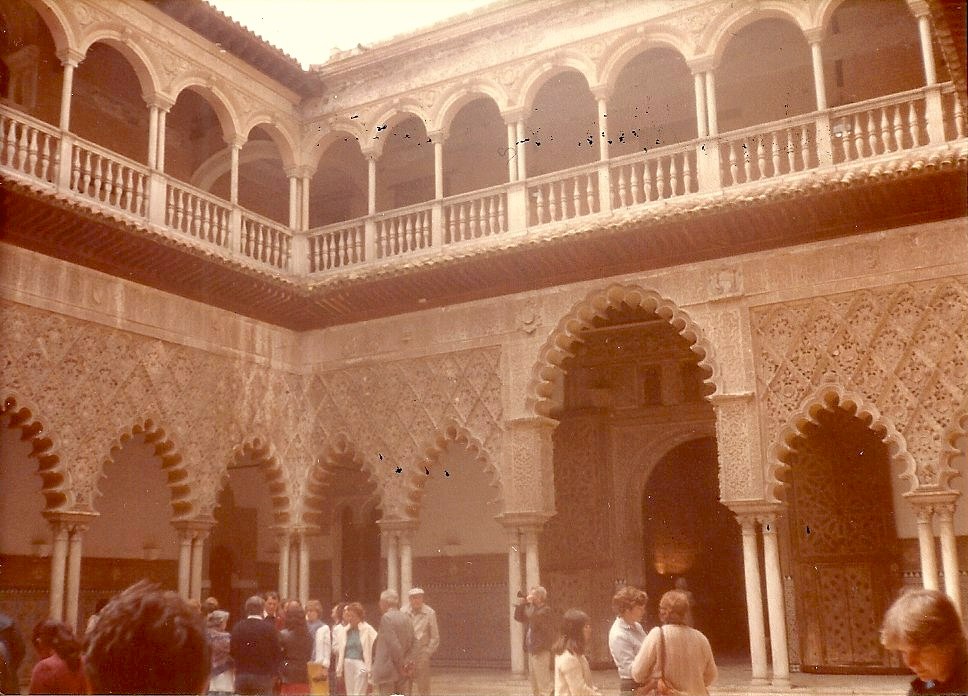
Mudejar architecture uses the vocabulary of Islamic art, horseshoe and multi-lobed arches, carved plaster worked into geometric and vegetal patterns, glazed tile in intricate designs, and wooden ceilings of great complexity. In the Alcazar, these elements combine to create interiors of dazzling richness in the Andalusi manner.
What distinguishes the Mudejar from purely Islamic art is the context and sometimes the content, for the same craftsmen who carved Arabic praises might also incorporate Christian heraldry and Castilian mottoes. The Alcazar’s decoration thus mingles the two worlds, an artistic expression of the complex society that produced it.
The style flourished across Spain in the later Middle Ages, in palaces, churches, and homes, as the artistic traditions of al-Andalus persisted long after the Christian conquest of most of the peninsula. The Alcazar of Seville is the grandest and most complete example, the royal masterpiece of the tradition.
For the visitor, the Mudejar style is the great wonder of the Alcazar, an Islamic beauty created for and by a Christian kingdom. Its carved plaster, its tile, and its ceilings preserve the art of al-Andalus in one of its most magnificent settings, a testament to the enduring influence of Muslim Spain on the culture of the peninsula.
The very existence of the Mudejar style raises fascinating questions about the society that produced it, for it shows Christian and Muslim Spain bound together in a shared artistic culture even as they were divided by religion and war. The craftsmen who built these palaces carried the traditions of al-Andalus into the service of new masters, and their work is a reminder that the history of medieval Spain was one of exchange and influence as much as of conflict, a convivencia written in plaster and tile.
The Courtyard of the Maidens
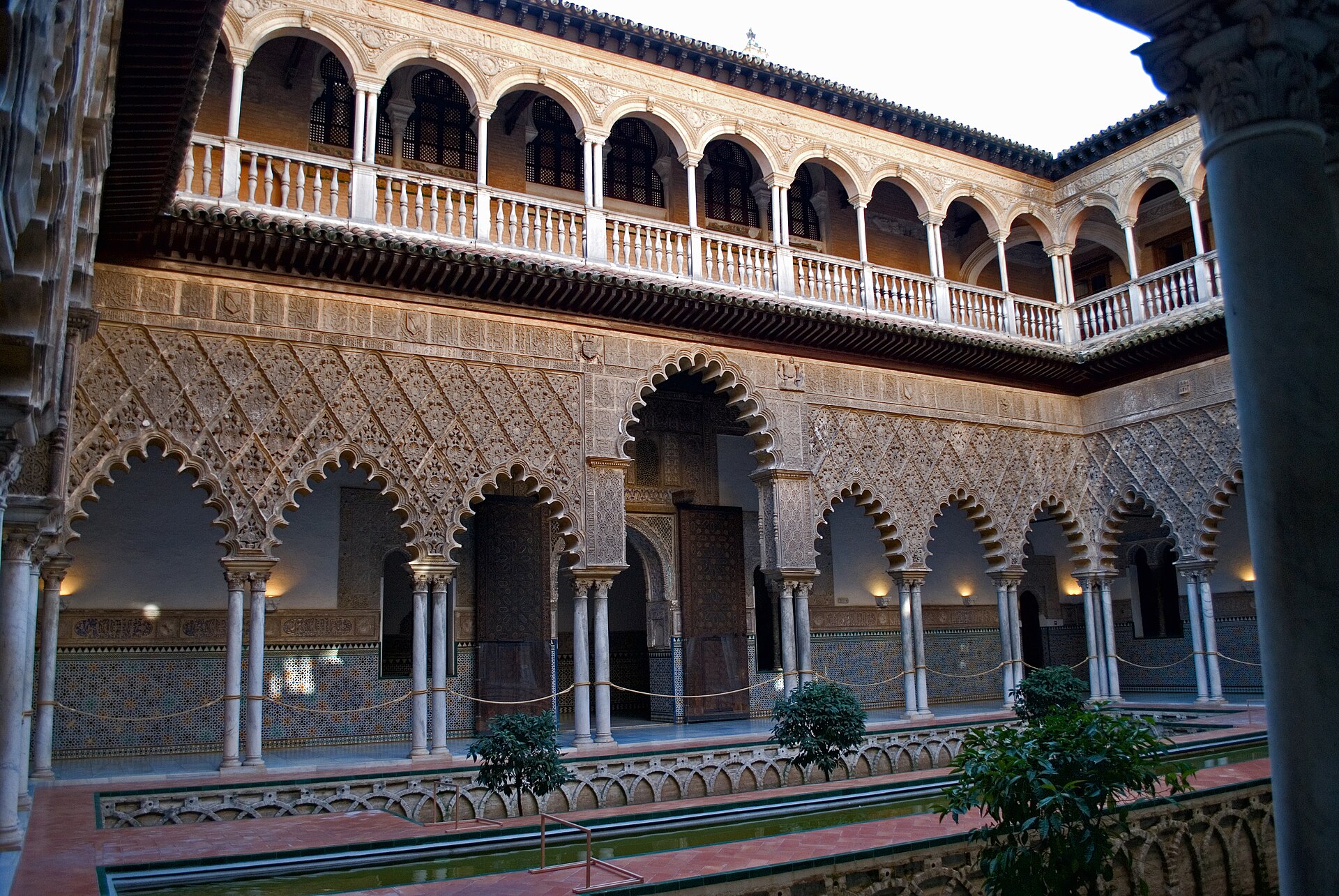
The heart of Pedro’s palace is the Patio de las Doncellas, the Courtyard of the Maidens, one of the most beautiful courtyards in Spain. A long rectangular court centered on a sunken garden and a reflecting pool, it is surrounded by arcades of multi-lobed arches on slender marble columns, their surfaces covered with carved plaster.
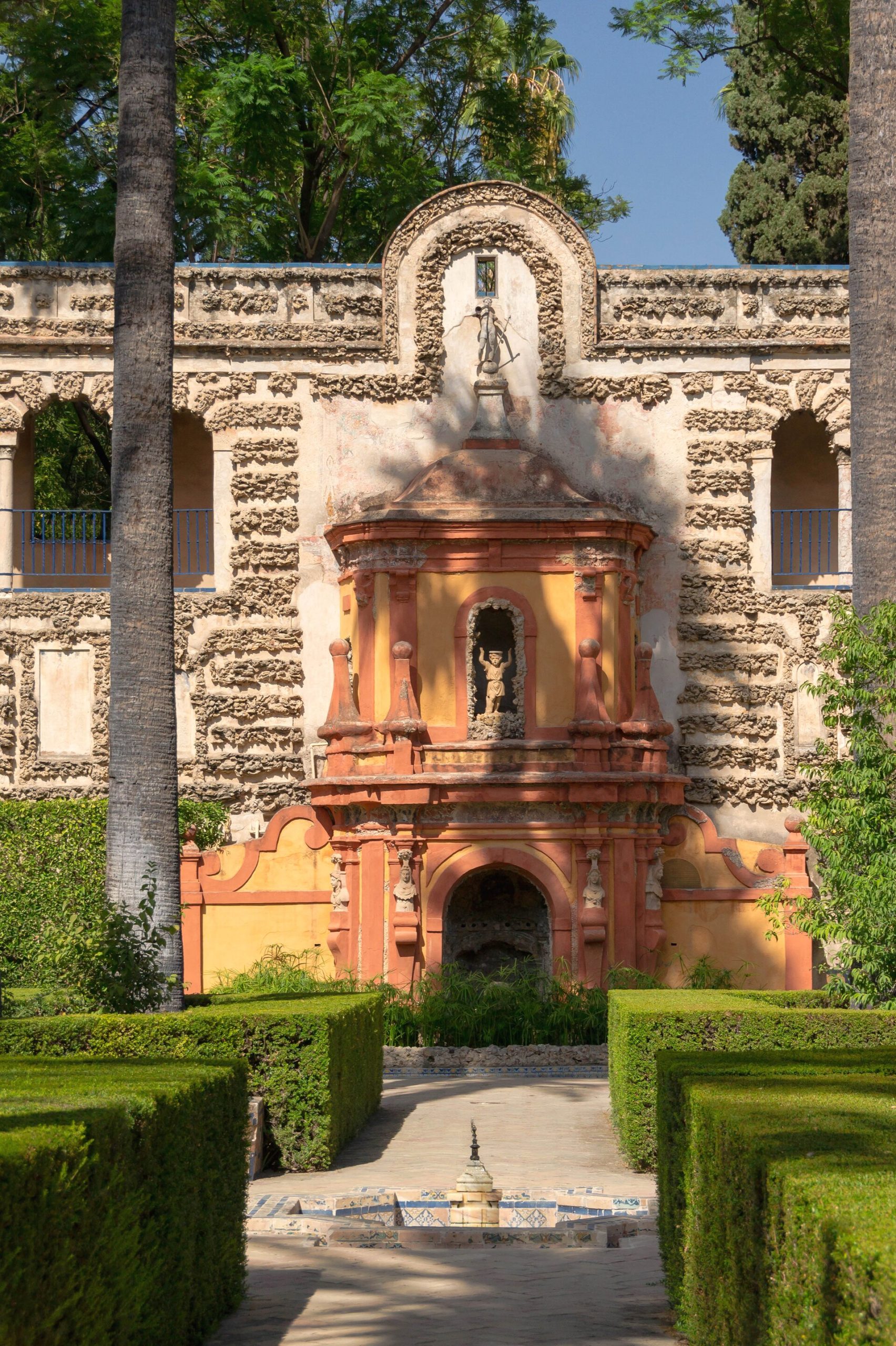
The courtyard takes its name from a legend concerning a tribute of maidens, and it served as the ceremonial center of the palace. Its arcades, with their intricately carved arches and the tilework of the lower walls, are among the finest achievements of Mudejar art, echoing the courtyards of the Alhambra.
At the center of the court lies a sunken garden with a long reflecting pool, restored to its original form after being paved over in a later age. The pool brings water and light into the courtyard in the Islamic manner, mirroring the arcades and cooling the air, the heart of the composition.
The decoration of the courtyard combines the carved plaster and tile of the Andalusi tradition with the heraldry and inscriptions of the Castilian crown, embodying the fusion of cultures that defines the palace. Every surface is worked with ornament, transforming the court into a masterpiece of Mudejar design.
The Courtyard of the Maidens is the supreme space of the Alcazar, the ceremonial and artistic heart of Pedro’s palace. In its arcades, its pool, and its ornament, it achieves a beauty comparable to the great courts of the Alhambra, a Christian court built in the perfected style of al-Andalus.
The Art of the Azulejo
Among the glories of the Alcazar is its tilework, the glazed ceramic tiles known in Spain as azulejos that cover the lower walls of the palace in brilliant geometric patterns. This art, inherited from al-Andalus and developed over the centuries, is one of the defining features of the Mudejar palace.
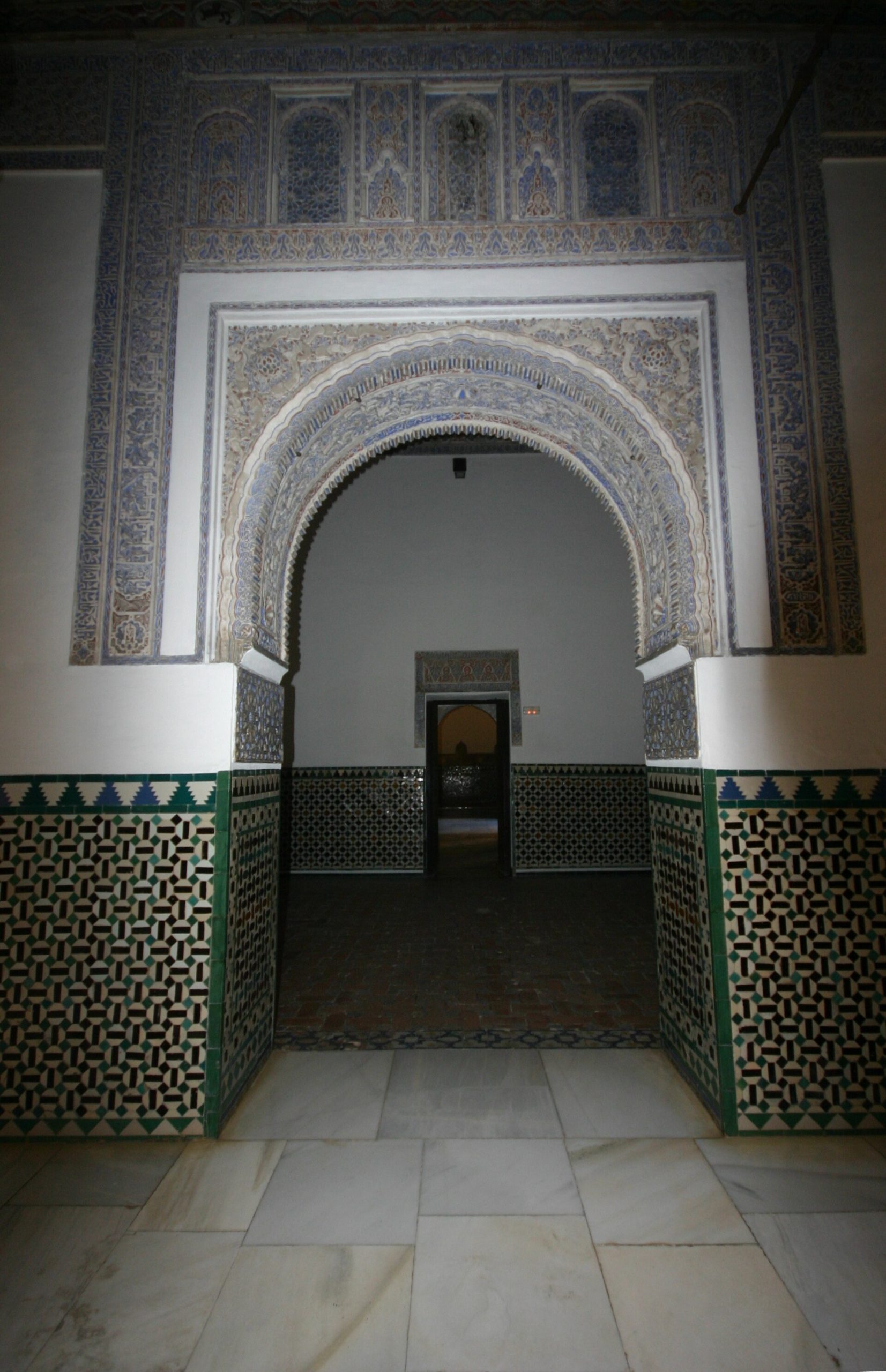
The tiles are arranged in intricate geometric designs of great mathematical sophistication, their interlocking patterns covering the walls in fields of color. The craftsmen of Seville were masters of the art, and the Alcazar preserves some of the finest tilework in Spain, from the medieval Mudejar to later periods.
The word azulejo itself reflects the Islamic origins of the art, and the technique and designs derive from the ceramic traditions of al-Andalus. Over the centuries Seville became a great center of tile production, and the art flourished long after the medieval period, adorning palaces, churches, and homes across the region.
In the Alcazar, the tilework combines with the carved plaster above it to cover the walls with ornament, the colorful geometric tiles below and the white carved plaster above creating a characteristic contrast. Together they transform the interiors into masterpieces of decorative art.
The azulejos of the Alcazar are among the treasures of the palace, a living tradition of ceramic art that connects the building to its Islamic origins and to the wider culture of Andalusia. Their brilliant patterns are inseparable from the beauty of the Mudejar palace and its courts.
The Hall of the Ambassadors
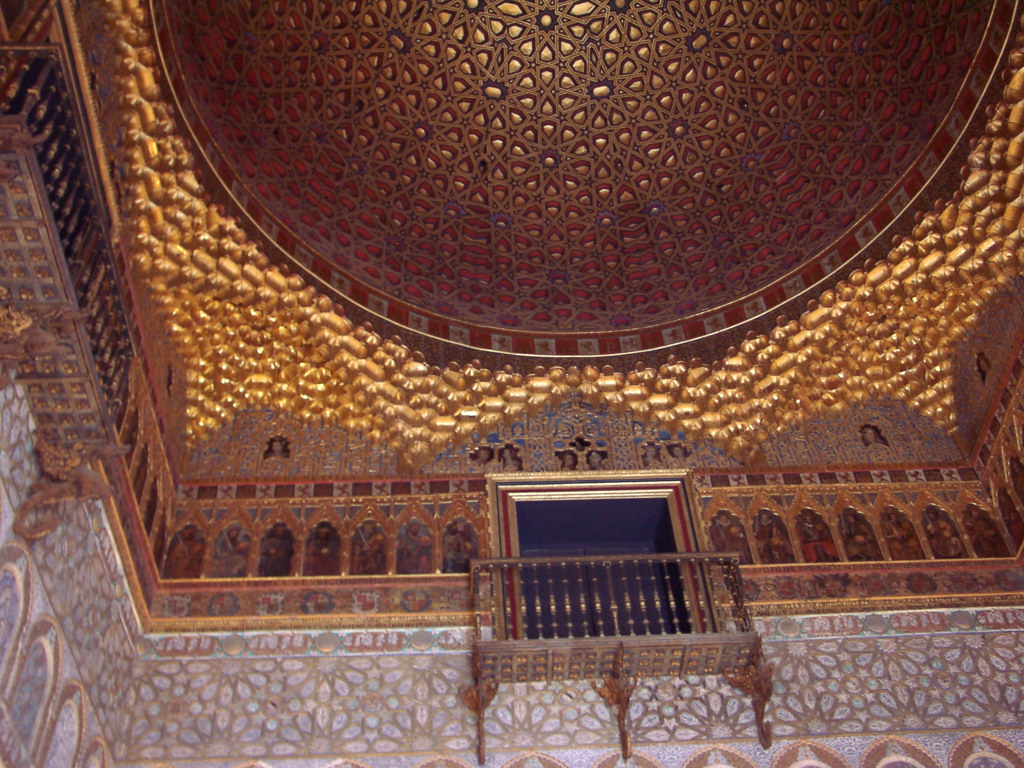
The grandest room of the palace is the Salon de Embajadores, the Hall of the Ambassadors, the throne room of Pedro the First and the most splendid interior of the Alcazar. Square in plan and crowned with a magnificent wooden dome, it is a masterpiece of Mudejar art and the ceremonial heart of the palace.
The hall is famous above all for its dome, a great half-orange of carved and gilded wood, intricately worked and glittering with color, representing the heavens above the enthroned king. This ceiling is one of the supreme achievements of Mudejar craftsmanship, filling the room with a sense of soaring splendor.
The walls of the hall are covered with carved plaster, glazed tile, and inscriptions, and pierced by horseshoe arches leading to adjoining rooms. Every surface is worked with ornament in the Andalusi manner, creating an interior of overwhelming richness fit for the ceremonies of a king.
Here Pedro received ambassadors and conducted the highest affairs of state, seated in majesty beneath the golden dome. The hall was designed to impress upon visitors the power and splendor of the Castilian crown, expressed in the perfected language of Islamic art.
The Hall of the Ambassadors remains the most magnificent space in the Alcazar, its golden dome and its carved walls preserving the splendor of Pedro’s court. It stands as the crowning achievement of the Mudejar palace, a throne room of Islamic beauty at the heart of a Christian kingdom.
There is a deep irony worth pausing on in the Hall of the Ambassadors, for here a Christian king received his court beneath Arabic inscriptions praising God, in a room built by Muslim craftsmen in the style of a civilization his kingdom was steadily conquering. The Alcazar embodies this paradox throughout, a monument to the way medieval Spain absorbed and perpetuated the culture of al-Andalus even as it displaced it politically, so that the art of the vanquished became the splendor of the victors.
The Courtyard of the Dolls
Alongside the ceremonial Courtyard of the Maidens lies a smaller and more intimate court, the Patio de las Munecas, the Courtyard of the Dolls, which served the private life of the palace. Delicate and richly decorated, it was the heart of the private royal apartments.
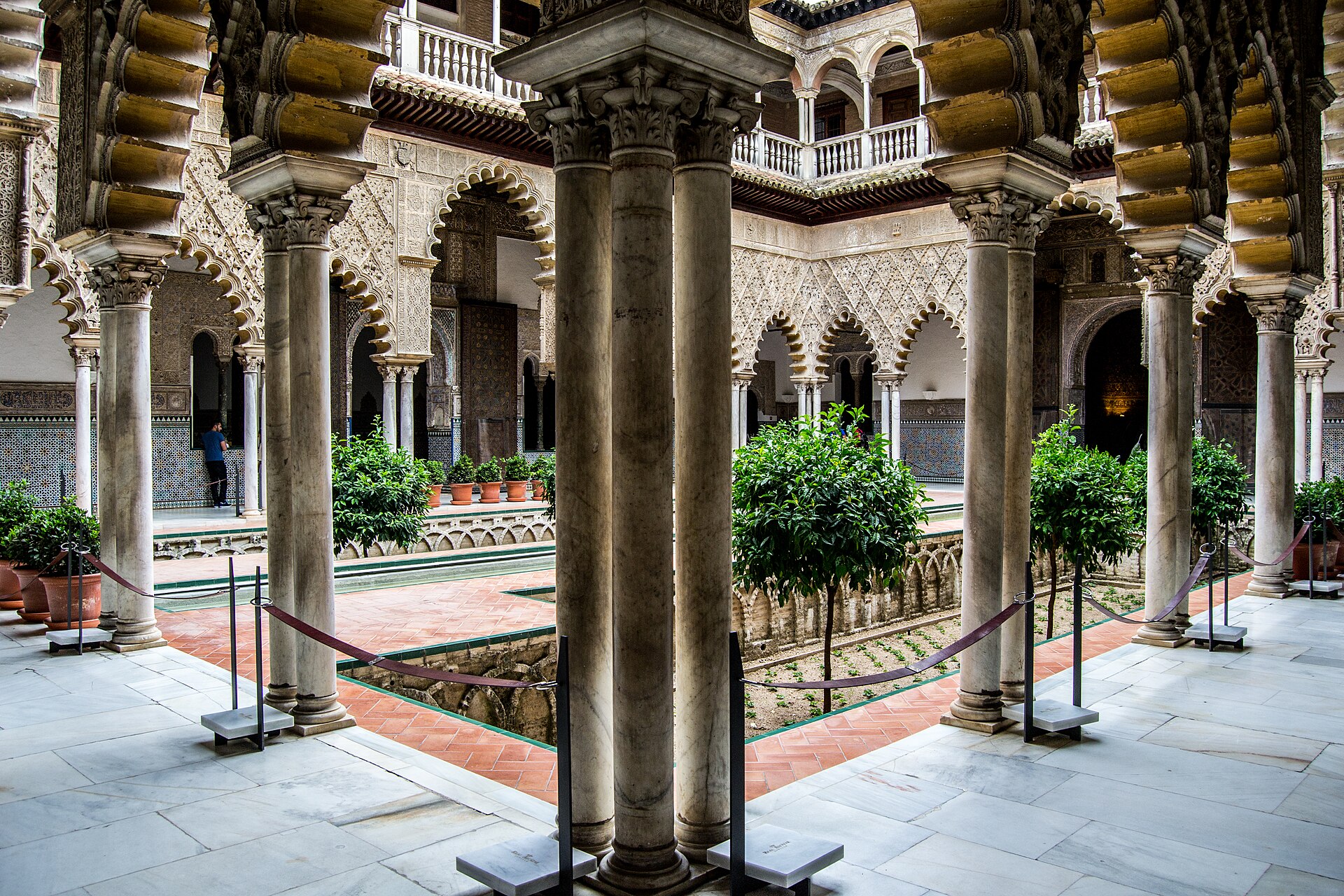
The courtyard takes its curious name from tiny faces carved among the ornament of its arches, small details that have given the court its popular name over the centuries. Intimate in scale, it contrasts with the grand ceremonial court, expressing the private rather than the public life of the palace.
Surrounded by slender columns and delicate arches covered with carved plaster, the Courtyard of the Dolls is a jewel of Mudejar decoration on a small scale. Its intimacy and its fine ornament made it a fitting setting for the private life of the royal family.
The private apartments around the court were where the king and his household lived away from the ceremony of the great halls, and their decoration, though more intimate, is no less exquisite than that of the public spaces. The court reveals the domestic side of Pedro’s palace.
The Courtyard of the Dolls completes the palace of Pedro, providing the private counterpart to the ceremonial Courtyard of the Maidens. Together the two courts, the grand and the intimate, express the full range of life in the Mudejar palace, from the majesty of state to the privacy of the royal household.
The tiny carved faces that give the Courtyard of the Dolls its name are the kind of small, human detail that makes a great palace memorable, a touch of playfulness amid the grandeur. Generations of visitors have searched the ornament to find them, and their presence reminds us that these buildings were not only monuments of state but homes, made by craftsmen who could allow themselves a moment of whimsy even in a royal palace.
The Gothic Palace and the Catholic Monarchs
Beside the Mudejar palace of Pedro stands an older Gothic palace, built in the thirteenth century by King Alfonso the Tenth after the Christian conquest of Seville, and later much altered. Its vaulted halls, in the European Gothic style, stand in contrast to the Islamic beauty of Pedro’s palace nearby.
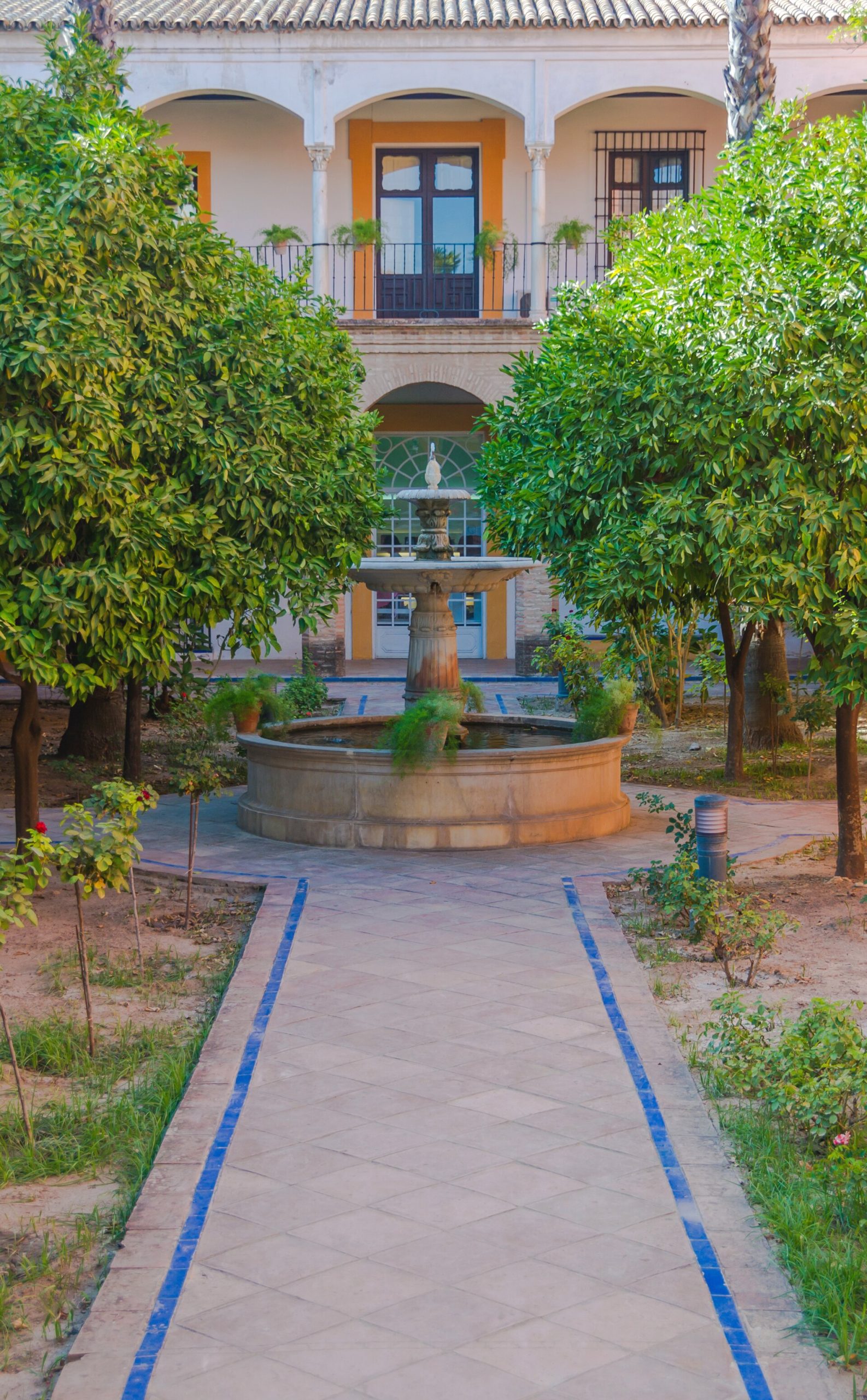
The Gothic palace represents the other architectural tradition of the Alcazar, the European style brought by the Christian conquerors, and it reminds us that the complex was always a meeting of two worlds. Its halls were used for ceremony and, over the centuries, were adapted and decorated in changing styles.
The Alcazar was closely associated with the Catholic Monarchs, Ferdinand and Isabella, who used it as a residence and from whose reign date important additions and events. It was a favored royal seat during the momentous age when Spain was united and its overseas empire begun.
One of the halls of the palace housed an institution of world-historical importance, for it was here, in the age of the Catholic Monarchs, that the affairs of the newly discovered Americas were administered. The Alcazar thus stood at the center of the events that opened a new age in world history.
The Gothic palace and the associations with the Catholic Monarchs add further layers to the history of the Alcazar, tying it to the great events of Spanish and world history. Alongside the Mudejar palace, they make the complex a monument not only of art but of the momentous history of Spain.
The juxtaposition of the Gothic palace and the Mudejar palace within a single complex is one of the most instructive things about the Alcazar, for it lets the visitor see, side by side, the two architectural worlds that met in medieval Spain. To pass from the pointed vaults of the Gothic halls into the horseshoe arches and carved plaster of Pedro’s palace is to cross, in a few steps, between two civilizations, and to feel how remarkable it was that a single kingdom should embrace them both.
The Alcazar and the New World
The Alcazar played a part in one of the great turning points of history, the European encounter with the Americas, for Seville became the center of Spain’s overseas empire and the Alcazar was closely bound up with that enterprise. Christopher Columbus is associated with the palace, received here on his return from the New World.
In the palace was established the institution that administered the affairs of the Americas, controlling the trade and shipping between Spain and its new overseas territories. For a time the Alcazar stood at the very center of the Spanish empire, the point from which a new world was governed.
Seville held a monopoly on trade with the Americas, and the city grew immensely rich as the gateway to the New World, its port crowded with the ships of empire. The Alcazar, at the heart of this wealthy and powerful city, shared in its importance as the administrative center of the imperial enterprise.
The palace thus witnessed the beginning of the age of European overseas empire, an age of exploration, conquest, and exchange that would transform the world. The wealth of the Americas flowed through Seville, and the Alcazar was among the places where the new global order was administered.
This association with the New World adds a dimension of world history to the Alcazar, tying the beautiful Mudejar palace to the momentous events of the age of exploration. The palace of Islamic beauty stood at the center of the Spanish empire, a meeting point of the medieval and the modern worlds.
Standing in the palace that administered the early Spanish empire, one feels the vertigo of world history, for it was from this beautiful and ancient seat that a new and world-changing age was in part directed. The same Seville that had been a jewel of al-Andalus became the gateway to the Americas, and the Alcazar bridges those two epochs, a palace of the medieval Mediterranean that found itself, briefly, at the center of the emerging modern world.
The Gardens of the Alcazar
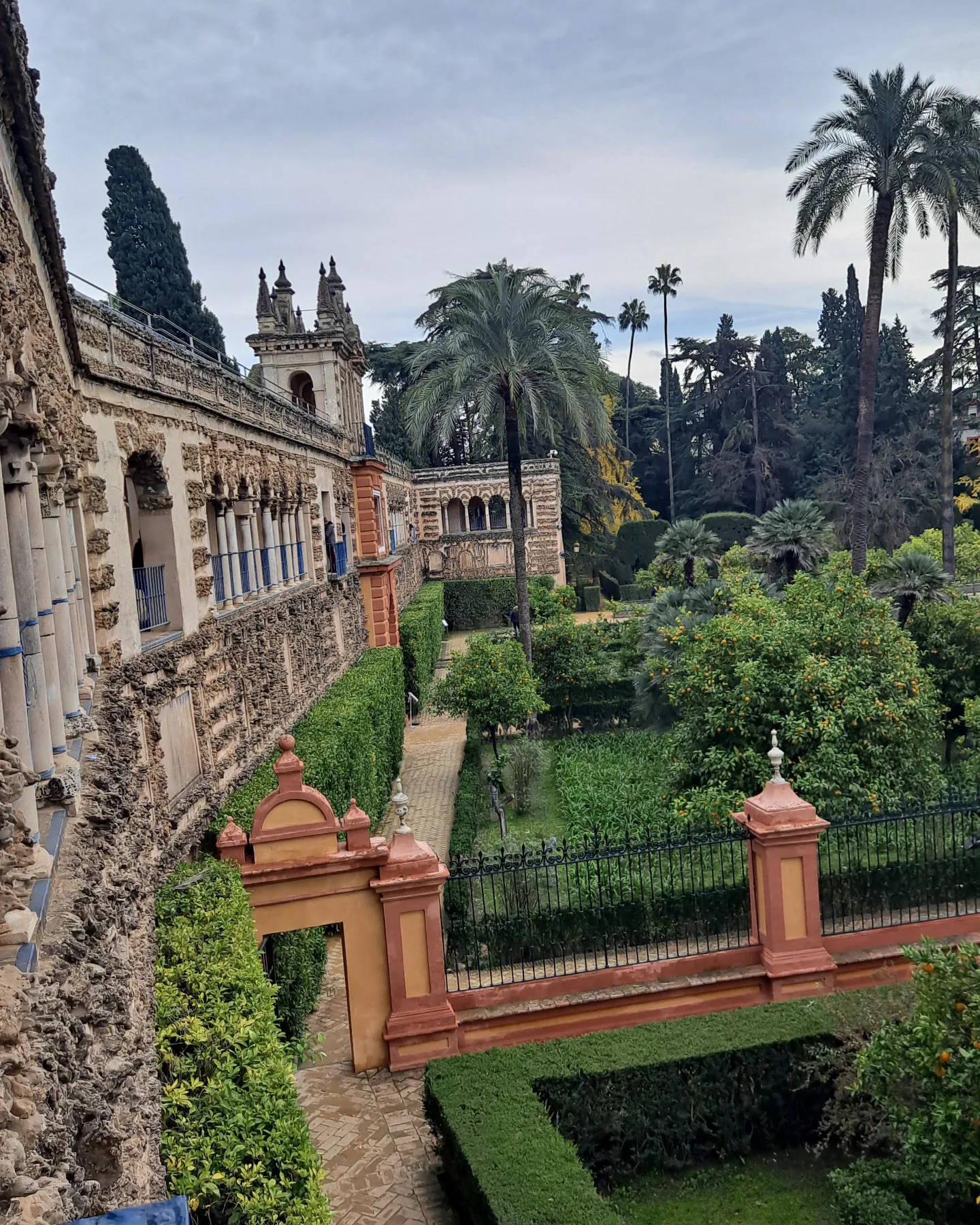
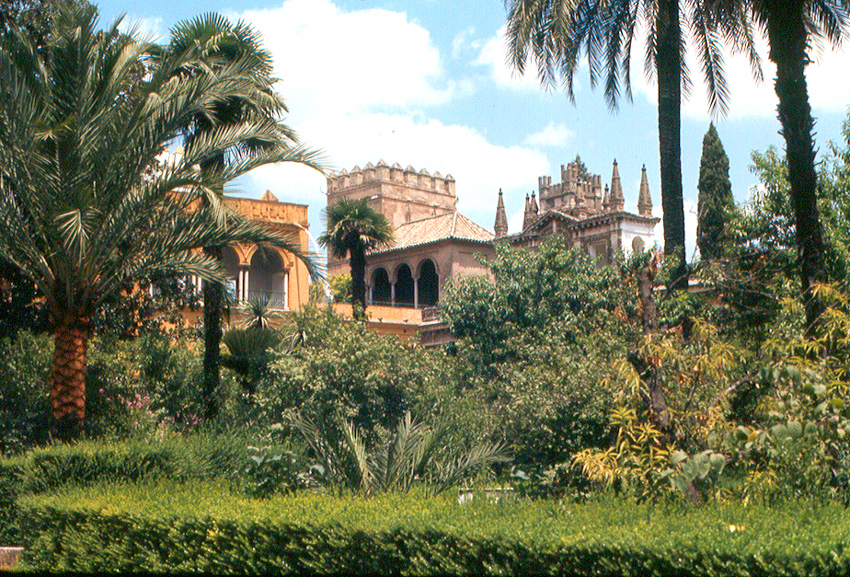
Beyond the palaces lie the extensive gardens of the Alcazar, among the most beautiful and historic in Spain, laid out over the centuries in a succession of styles from the Islamic to the Renaissance and beyond. Terraces, pools, fountains, pavilions, and shaded walks make them a green paradise beside the palace.
The gardens preserve the Islamic tradition of the paradise garden, with their use of water, greenery, and geometric order, alongside later additions in the Renaissance and Baroque styles. The result is a rich and varied landscape reflecting the many ages of the palace.
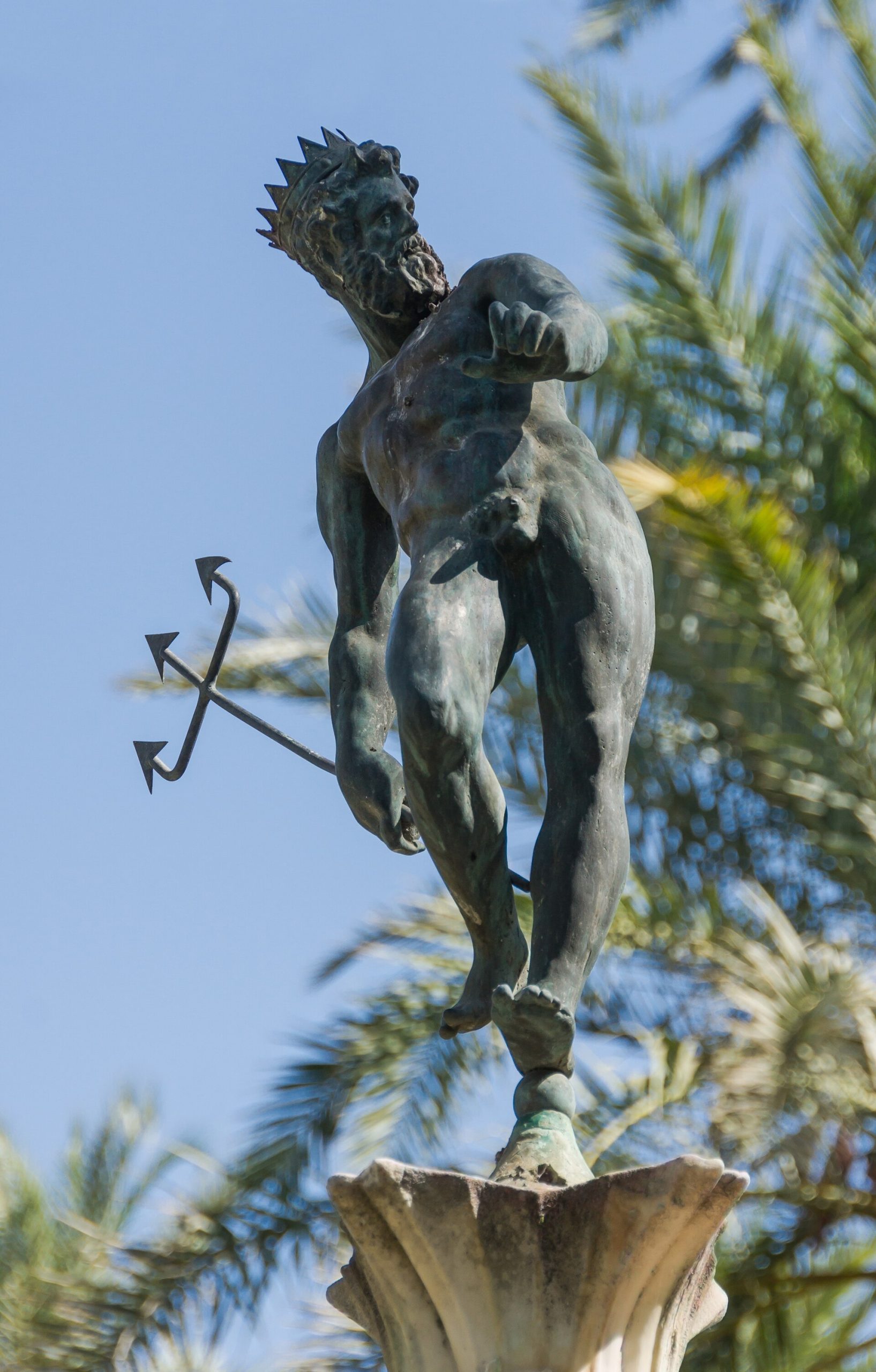
Among the features of the gardens are ornamental pools, including one with a bronze fountain, terraces planted with orange trees and palms, and pavilions such as the elegant garden house associated with the Emperor Charles the Fifth. Fountains and channels of water bring coolness and delight throughout.
The gardens were an essential part of the life of the palace, a place of retreat, pleasure, and repose in the hot climate of Seville. Their combination of water, greenery, and architecture continues the tradition of the Islamic garden that shaped the Alcazar from its beginnings.
For the visitor, the gardens are among the great delights of the Alcazar, a place to stroll among fountains and orange trees after the splendor of the palace interiors. They complete the palace as a paradise of art and nature, one of the loveliest royal landscapes in Spain.
A Living Royal Palace
The Alcazar of Seville holds a distinction rare among the palaces in this series, for it remains in use by the Spanish royal family, who occupy the upper floor when they visit the city. This makes it the oldest royal palace still in use in Europe, a living residence with a history of more than a thousand years.
The continuing royal use gives the Alcazar a special status, for it is not merely a museum but an active royal residence, maintained and used by the reigning house of Spain. When the royal family is present, the upper apartments serve as their home, continuing the palace’s ancient function.
This living continuity connects the modern Spanish monarchy to the long history of the palace, from its Islamic origins through the medieval Christian kings to the present day. The Alcazar is a thread of continuity running through the whole history of Spain, still serving the purpose for which it was built.
The public areas of the palace, the Mudejar and Gothic halls and the gardens, are open to visitors, while the royal apartments above remain private. This combination of public monument and living residence is part of what makes the Alcazar unique among the historic palaces of Europe.
That the Alcazar remains a royal residence after so many centuries is a remarkable testament to its enduring role, a palace that has served as a seat of power without interruption for more than a millennium. It is a living monument, its ancient beauty still in the service of the Spanish crown.
The Alcazar Today
Today the Royal Alcazar of Seville is one of the most visited monuments in Spain, drawing great numbers of visitors to marvel at its Mudejar palace, its Gothic halls, and its beautiful gardens. It is among the treasures of Andalusia and a highlight of any visit to Seville.

In 1987 the Alcazar, together with the cathedral and the historic archive of Seville, was inscribed on the UNESCO World Heritage List, recognized for its outstanding value as a masterpiece of Mudejar art and a monument of the history of Spain. The listing set a seal on its universal importance.
In recent times the Alcazar has gained new fame as a filming location, its exotic beauty serving as the backdrop for films and television series that have introduced its courtyards and gardens to audiences around the world. This modern celebrity has brought a new generation of visitors to the palace.
For Spain, the Alcazar is a monument of profound significance, embodying the complex history of the country, the meeting of Islamic and Christian civilizations, and the shared culture that produced the Mudejar style. It stands as a symbol of the rich and layered heritage of Andalusia.
To stand in the Courtyard of the Maidens or beneath the golden dome of the Hall of the Ambassadors, in a Christian palace built in the beauty of al-Andalus, is to encounter one of the most fascinating buildings in the world. The Alcazar endures, a living palace of a thousand years, where the arts of two civilizations meet in enduring splendor.
If you visit, book ahead and go early, for the Alcazar is among the most popular sites in Spain and its courts can grow crowded. Give yourself time for the gardens as well as the palace, for the two together make the full experience, the glittering Mudejar halls and the green paradise of orange trees and fountains beyond. Few palaces in Europe offer so rich an encounter with the layered history of a nation, or so beautiful a meeting of two great civilizations.
Palaces Nearby
The Alcazar of Seville belongs with the other great Moorish and Islamic-influenced palaces of the western Mediterranean gathered here. Travel to the last palace of Muslim Spain in Granada, and watch this space for another palace of the region to join them soon.
You May Like
Changgyeonggung: The Gentle Garden Palace of Seoul