In the very centre of modern Seoul, ringed by glass towers and the rush of a capital city, sits a palace unlike any other in Korea. Deoksugung is a compound where curved tile roofs and painted wooden halls stand a few paces from grand columned buildings that would not look out of place in a European capital. Nowhere else does the Korean royal story collide so vividly with the wider world, and nowhere else can you walk in a few minutes from a traditional throne hall to a neoclassical stone palace built for an emperor.
That mixture is not an accident of taste. It is the record of a desperate and fascinating moment in Korean history, when a small kingdom, squeezed between rising empires, tried to reinvent itself as a modern nation and declared its ruler an emperor to match those of China, Japan, and the West. Deoksugung was the stage on which that drama played out, and its buildings still carry the hopes and the heartbreak of those years.
For most of its long life the site was not even a main palace. It began as a princely residence, was pressed into royal service in an emergency, and only late in its history became the beating heart of a court. Yet it is precisely this improvised, layered quality that makes it so rich. To walk its grounds is to move through several centuries and several worlds at once, from Confucian ritual to gas lamps and telegraph wires.
In this article you will get to know Deoksugung in full: how it began, why it rose to prominence, the halls and gardens that fill it, the emperor who staked everything on modern reform, and the way the palace lives on today as one of the most beloved and photographed places in Seoul. It is a story of survival, ambition, and quiet endurance, told in wood, stone, and stone once more.

In This Article
- Where Two Worlds Meet
- A Prince’s House Becomes a Palace
- The Court Returns in a Time of Crisis
- The Birth of the Korean Empire
- An Emperor’s Programme of Reform
- Junghwajeon, the Throne Hall
- Seokjojeon, the Stone Palace
- Halls, Pavilions, and Quiet Corners
- A Pavilion for a Cup of Coffee
- The Changing of the Royal Guard
- Loss, Diminishment, and Survival
- The Stone-Wall Road and the Gardens
- Deoksugung in the Life of Modern Seoul
Where Two Worlds Meet
The first thing to understand about Deoksugung is that it refuses to fit into a single category. Approach it from the busy plaza at its main gate and you see a classic Korean palace entrance, a broad wooden gatehouse with a sweeping tiled roof. Step inside and you find the expected sequence of courtyards and painted halls. But keep walking and the scene changes utterly, and you come upon a massive grey building of columns and pediments, all stone and symmetry, that seems to have wandered in from another continent.
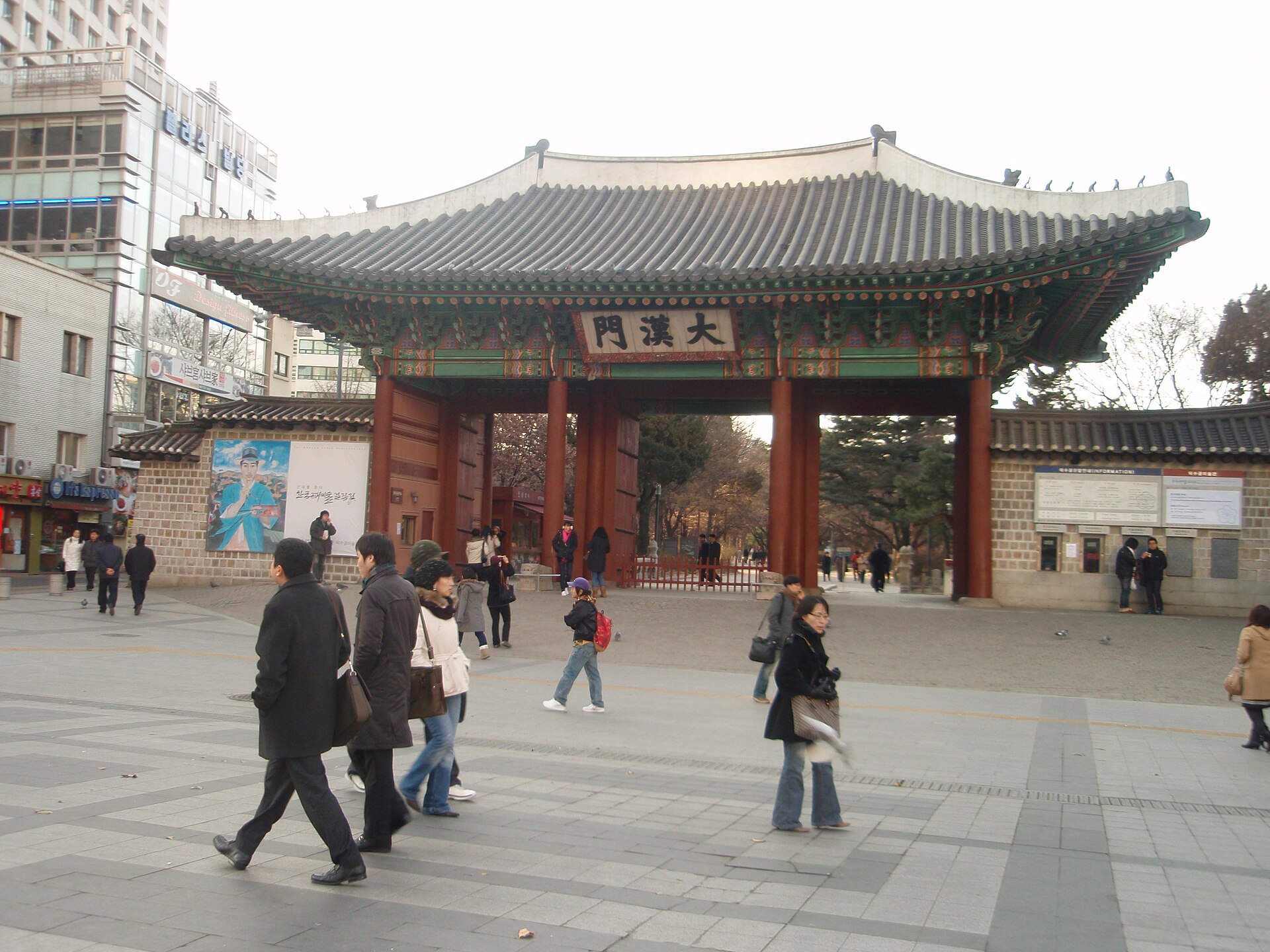
This coexistence is the essence of the place. Deoksugung is the only Korean palace that holds within its walls both the traditional architecture of the Joseon kingdom and the Western-style buildings of the short-lived Korean Empire. The contrast can be jarring at first, but spend a little time and it begins to feel like a conversation, an argument in architecture about what Korea should be at the turn of the twentieth century.
Because it sits at the centre of the city, the palace also has an intimacy that the larger Seoul palaces lack. It is smaller, more compressed, and its most famous feature may be the stone-wall road that runs alongside it, a tree-lined lane beloved of couples and photographers. To visit Deoksugung is to feel the pulse of the modern city and the hush of the old court at the very same moment.
Part of what makes this fusion so poignant is how deliberate it was. The emperor and his advisers did not stumble into mixing East and West; they chose it, believing that survival meant mastering the forms of the powers pressing in on them while holding fast to their own identity. Every mismatched roofline in the compound is therefore a decision, a small act of hope that Korea could be both modern and itself, and that belief gives the palace an emotional charge its grander rivals lack.
The compactness of the site works to its advantage here. Because everything is close together, the leaps between styles and centuries happen within a few steps, making the palace’s central theme impossible to miss. You do not have to imagine the collision of old and new; you simply turn a corner and there it is, wood giving way to stone, the Joseon world meeting the age of empire in a single sweep of the eye.
A Prince’s House Becomes a Palace
The site did not start life as a royal palace at all. In its earliest incarnation it was the residence of a prince, a grand private house in the heart of the capital. Its transformation came out of catastrophe. In the late sixteenth century, during the great invasions that devastated Korea, the main royal palaces of the capital were burned to the ground, leaving the returning king without a home worthy of the throne.

In that emergency the prince’s mansion was pressed into service as a temporary royal residence. What was meant to be a stopgap ended up housing the court for years while the kingdom slowly recovered. For a time this modest compound, never designed for the ceremonies of kingship, carried the full weight of the Korean state.
Eventually the court moved on to rebuilt palaces elsewhere in the city, and the site slipped back into a quieter role, remembered as a place that had once sheltered the crown. It might have remained a historical footnote. Instead, centuries later, history would return to this spot and thrust it once more into the very centre of national life, this time at an even more fateful turning point.
There is something fitting in the fact that the palace began as a home rather than a monument. Its origins as a private residence left it without the rigid grandeur of a purpose-built royal seat, and that flexibility is exactly what allowed it, again and again, to be adapted to new needs. A palace born of improvisation was well suited to an age that would demand constant reinvention of the Korean state.
The Court Returns in a Time of Crisis
The palace’s second and greatest moment came at the close of the nineteenth century, a period when Korea was caught in a vice between powerful neighbours. The kingdom’s independence was under threat, court politics had turned deadly, and the king found himself in genuine danger within his own capital. In this atmosphere of fear and intrigue, the ruler sought safety, at one point taking refuge in a foreign legation nearby.

When he emerged, he chose to establish his court at this old site, close to the foreign legations whose presence offered a measure of protection. The compound, so long a secondary residence, now became the principal palace of the Korean crown. Buildings were raised, the grounds expanded, and the quiet site was suddenly alive with the business of a nation fighting for its survival.
It was a deliberate choice with a clear logic. By placing his court among the embassies of the Western powers, the ruler hoped to shield himself and to signal that Korea was joining the modern world of nations. The palace became both a fortress of last resort and a showcase for a new vision of the country, and the two purposes would shape everything that followed.
The decision to shelter beneath the gaze of the foreign legations reveals just how precarious the throne had become. A ruler who must site his palace for protection rather than prestige is a ruler already fighting for his life, and the choice tells us more about the desperation of the moment than any chronicle could. Yet it was also shrewd, buying the court time and space in which to attempt its great experiment in modernisation.
The Birth of the Korean Empire
It was here, at this palace, that one of the boldest gestures in Korean history took place. In 1897 the king proclaimed the founding of a new state, the Korean Empire, and took for himself the title of emperor. At a stroke he raised Korea, at least on paper, to equal standing with the great empires of China and Japan, casting off the old status of a kingdom that owed deference to its larger neighbour.
The declaration was far more than a change of title. It was a claim to full sovereignty and a statement that Korea intended to modernise on its own terms. New rituals were devised, a new altar for imperial ceremonies was built nearby, and the palace became the ceremonial centre of an empire that its founder hoped would command respect abroad and unity at home.
Behind the grandeur, however, lay desperate vulnerability. The new empire was proclaimed precisely because Korea was so weak, hemmed in by rival powers each seeking to dominate the peninsula. The imperial title was armour made of ambition, and the palace where it was proclaimed would witness both the highest hopes of the reform movement and, before long, its tragic collapse.
The proclamation of the empire was staged with immense care, for symbolism was one of the few weapons a weak state still possessed. Ceremonies were designed to echo those of the great imperial courts, and every ritual detail was calculated to assert that Korea now stood on equal footing with its neighbours. In a world where recognition could mean survival, the performance of sovereignty was itself a form of defence.
The altar built nearby for the new imperial rites deserves a mention of its own, for it completed the ceremonial world of the empire. Kingship in Korea had always been bound up with ritual, and by creating the proper altars and observances the new regime signalled that its imperial claim rested on sacred as well as political foundations. The palace and its ritual surroundings together formed the stage on which a nation tried to remake itself.
An Emperor’s Programme of Reform
The emperor who reigned from this palace pursued a sweeping programme of modernisation, remembered by the reign name he adopted. Under his direction the capital acquired the trappings of a modern city with startling speed. Electric lighting came to the palace and the streets, streetcars began to run, waterworks and telegraph lines were laid, and new schools and institutions were founded to train a modern citizenry.
The palace itself became a laboratory for this vision. Western-style buildings rose among the traditional halls, foreign advisers moved through its courtyards, and the emperor received diplomats amid a deliberate blend of Korean and European ceremony. The message was clear: Korea would not be a passive victim of the age but an active participant in it, adopting new technologies and forms while asserting its own independence.
Yet reform from above could not outrun the pressures from outside. Even as the emperor built and modernised, the grip of a rising neighbouring empire tightened. The very foreign presence that offered protection also brought interference, and the emperor’s efforts to play the powers against one another grew ever more difficult. The palace stood at the centre of a contest that its owner was slowly, painfully, losing.
It is easy, knowing how the story ends, to see these reforms as futile, but that would be unfair to the people who pursued them. They were building schools, laying rails, and lighting streets in a genuine race against time, trying to compress into a few years the transformation that other nations had taken generations to achieve. That the race was ultimately lost does not erase the courage and imagination of the attempt.
Junghwajeon, the Throne Hall
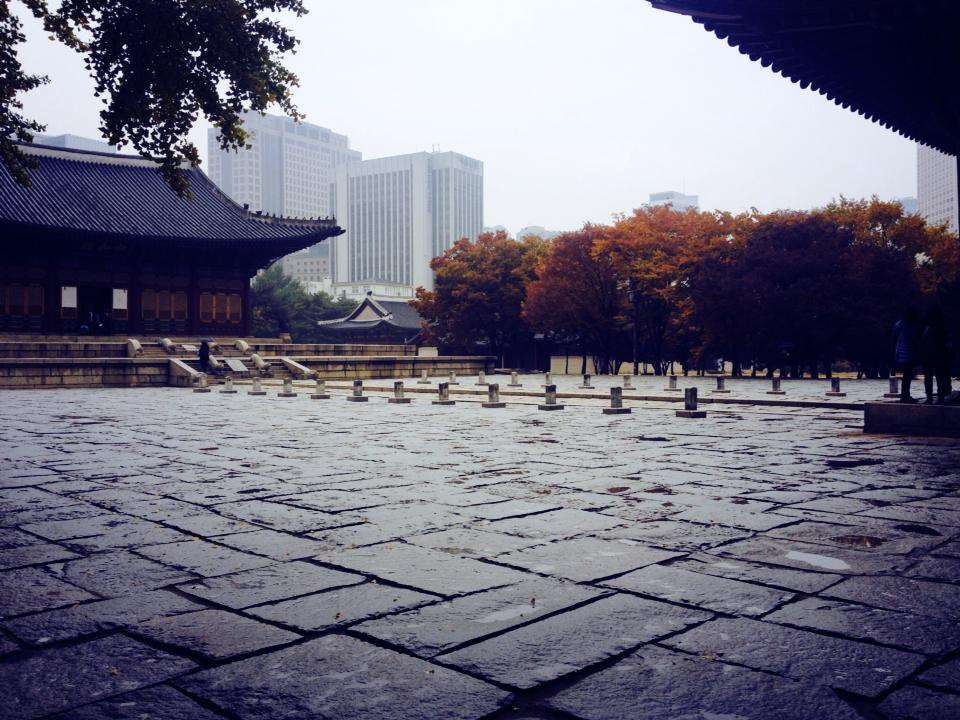
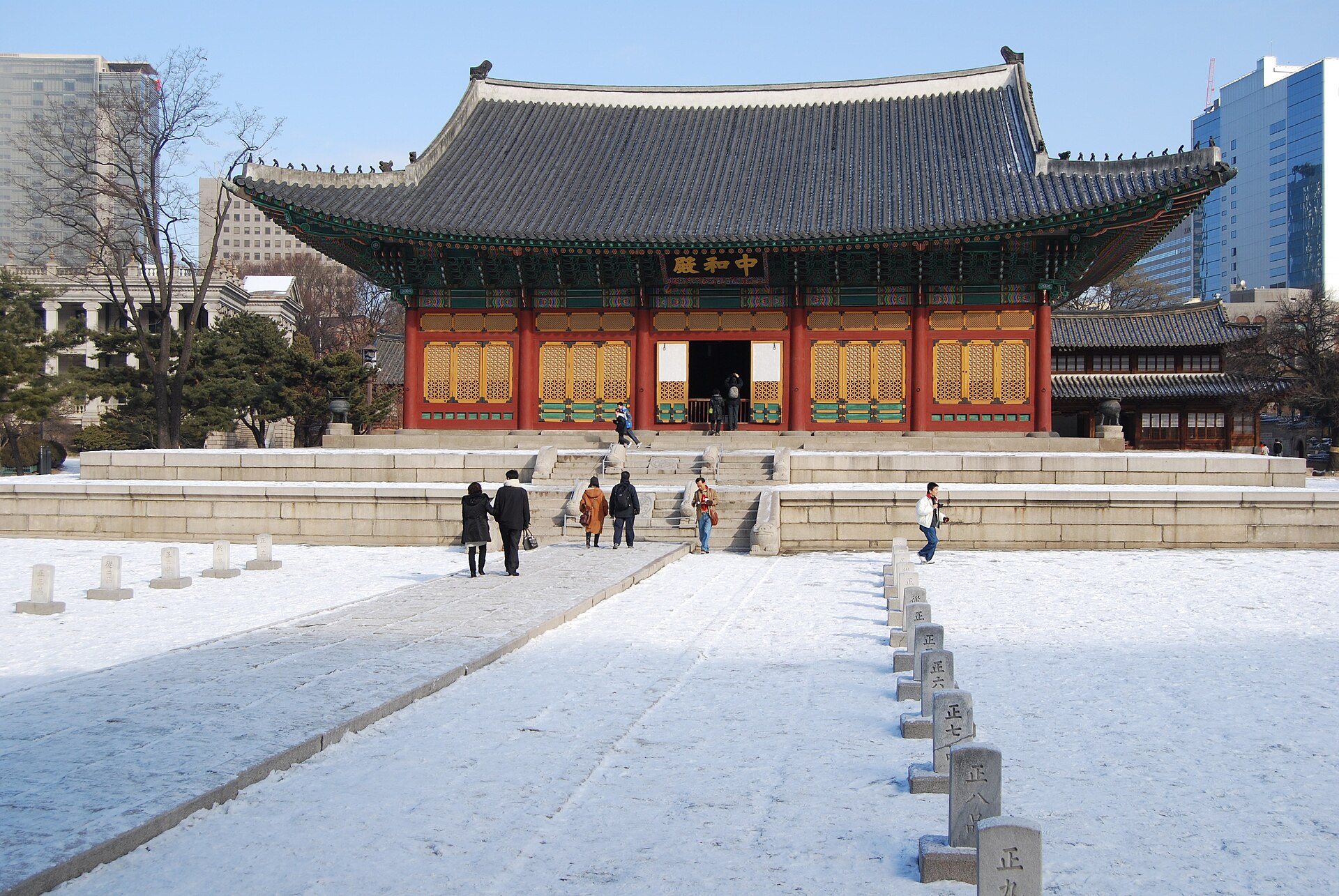
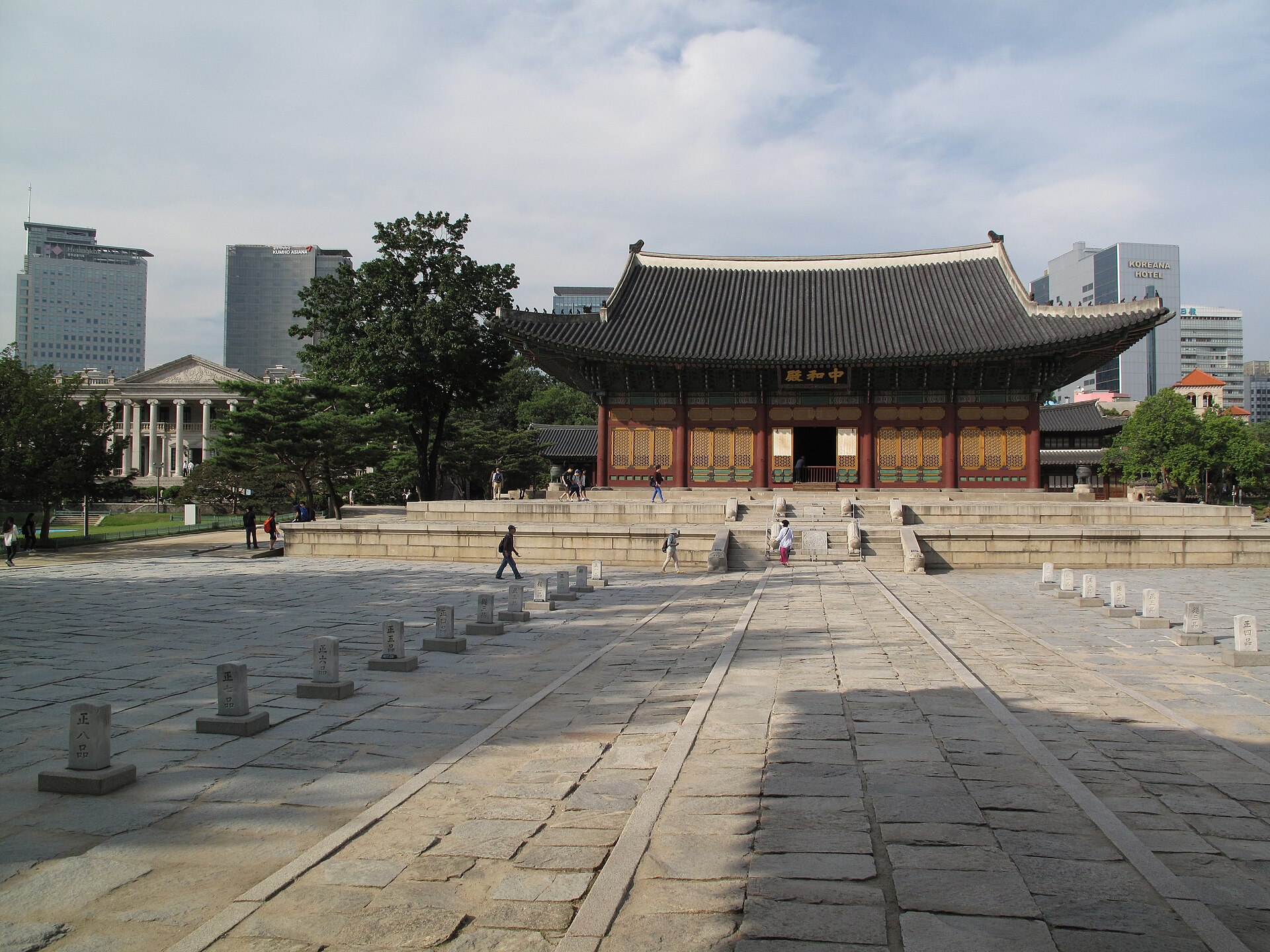
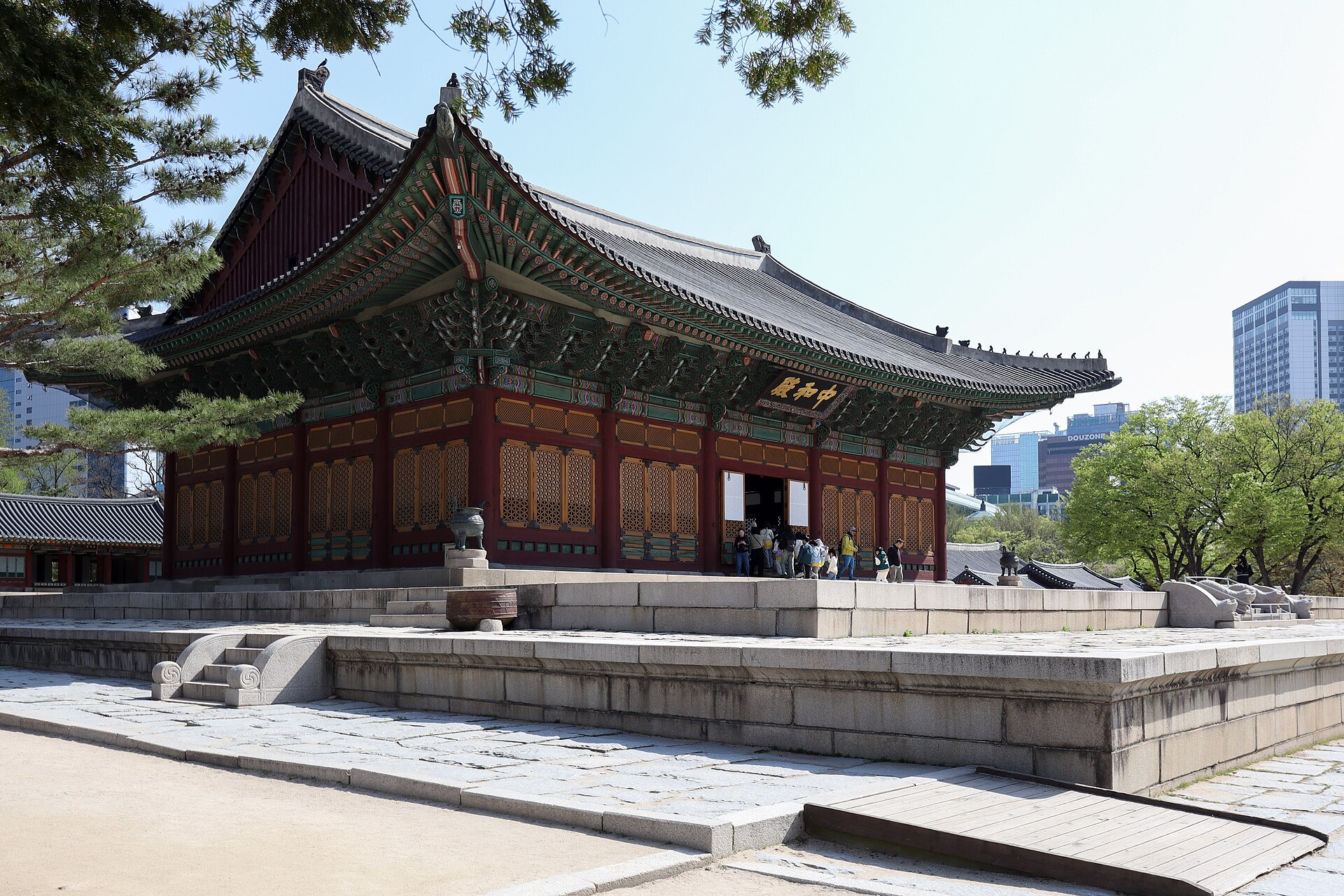
At the ceremonial core of the palace stands Junghwajeon, the main throne hall, where the emperor received officials and conducted the great rituals of state. Raised on a broad stone terrace and approached across a courtyard lined with rank stones that marked where each official was to stand, it follows the classic pattern of a Korean royal audience hall, its authority expressed through careful proportion and placement rather than sheer size.
Inside, beneath a richly painted ceiling, stands the throne, backed by the folding screen depicting the sun, moon, and five peaks that was the emblem of Korean kingship. Every element of the hall was arranged to express the cosmic role of the ruler as the point of balance between heaven and the human world, a Confucian vision of ordered harmony rendered in timber and paint.
The hall visitors see today reflects rebuilding after fire damage in the palace’s turbulent later years, and it is more modest than the grandest halls of the larger Seoul palaces. But that modesty suits its history. This was a throne hall for an empire under siege, dignified and correct, holding to the old forms even as the world that gave them meaning was slipping away.
Standing in the courtyard before the throne hall, it helps to picture it filled with ranked officials in their robes, the emperor seated within, the whole scene charged with the solemnity of state ritual. The rank stones underfoot are not mere decoration but the fixed grammar of court hierarchy, each marking a precise place in an order that was believed to mirror the harmony of the cosmos itself.
Seokjojeon, the Stone Palace
The building that most astonishes first-time visitors is Seokjojeon, a huge neoclassical structure of grey stone with a colonnade of tall columns and the balanced symmetry of a European palace. Designed by a Western architect and years in the building, it was intended as a modern residence and audience hall for the emperor, a statement in stone that Korea belonged among the modern nations of the world.
Its interior was fitted out in Western style, with reception rooms, furniture, and fittings imported to match the palaces of Europe. Here the emperor could receive foreign guests in surroundings they would recognise, a diplomatic strategy expressed through architecture. The very name means stone building, a plain description of something that was, for Korea, utterly novel.
Seokjojeon carries a heavy freight of history. Completed only as the independence it was meant to symbolise was being extinguished, it later served other, sadder purposes under foreign rule. Today, restored and opened as a museum of the imperial era, it stands as the most eloquent monument to Korea’s brief, brave attempt to modernise on its own terms, a dream frozen in colonnades and cornices.
The contrast between Seokjojeon and the wooden halls a short walk away could hardly be sharper, and that is precisely the point. To an official of the old school the stone palace must have seemed almost shocking, a deliberate break with everything a Korean palace was supposed to be. Yet to the reformers it represented the future, proof that Korea could build in the idiom of the modern age and claim a place among its powers.
Restoring the stone palace and opening it as a museum of the imperial era was a significant act of historical reclamation. Inside, reconstructed reception rooms and displays let visitors sense how the emperor and his court hoped to present themselves to the world, all polished floors and formal grandeur. It is a rare chance to step inside an ambition, to inhabit for a moment the modern Korea that its makers so nearly brought into being.
Halls, Pavilions, and Quiet Corners
Beyond the two great set pieces, the palace is filled with smaller halls and pavilions, each with its own character and use. Some served as living quarters and offices, others as spaces for study, audience, or rest. A number of them show the same fascinating blend of styles that defines the whole compound, with Korean structures adapted to new functions and Western touches appearing in unexpected places.
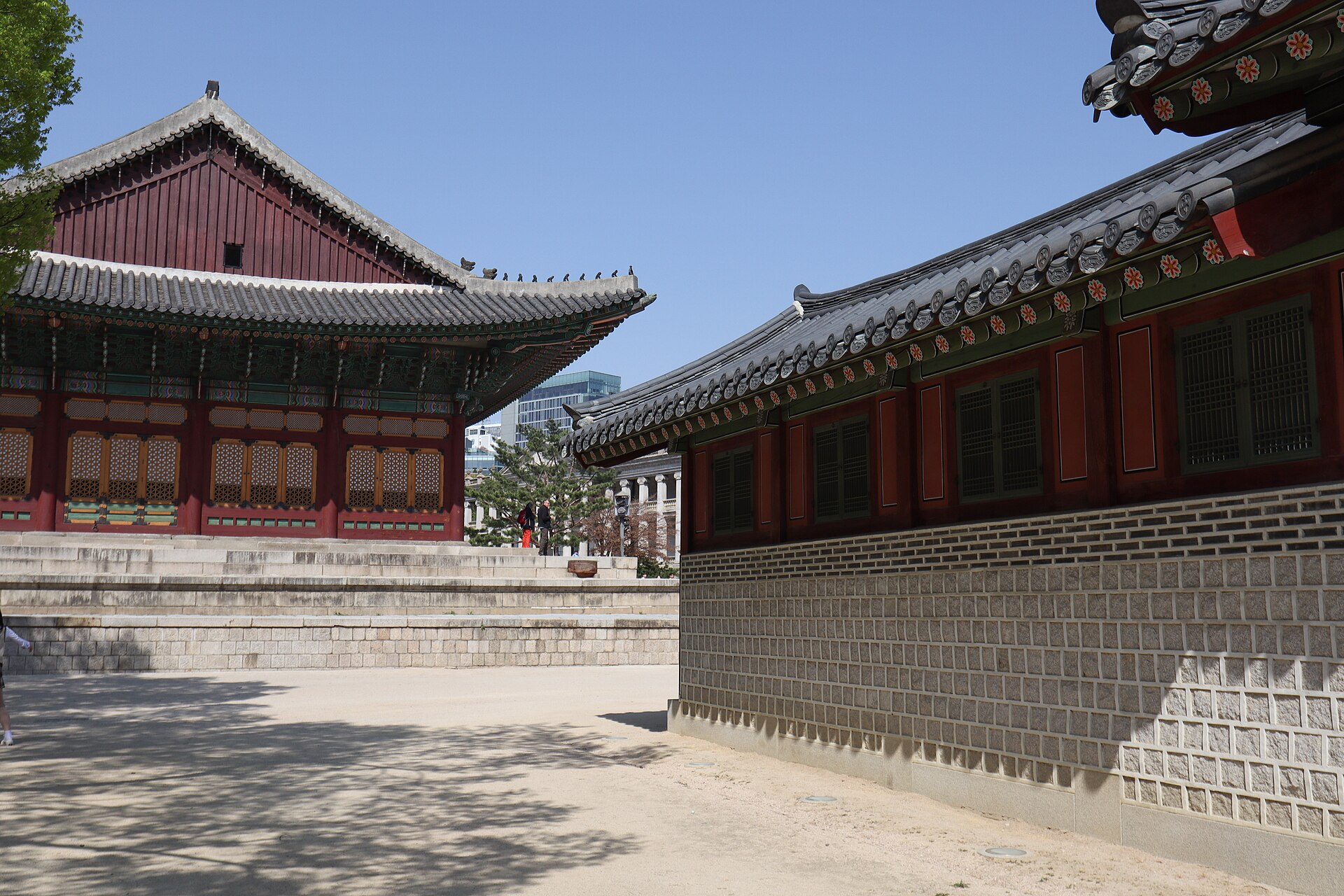
One striking building combines a traditional Korean form with a raised walkway and colonial-era detailing, a hybrid that captures the improvised spirit of the imperial court. Others are more purely traditional, preserving the intimate scale and warm woodwork of Joseon domestic architecture. Together they fill in the texture of daily life at the palace, away from the grand ceremonies of the throne hall.
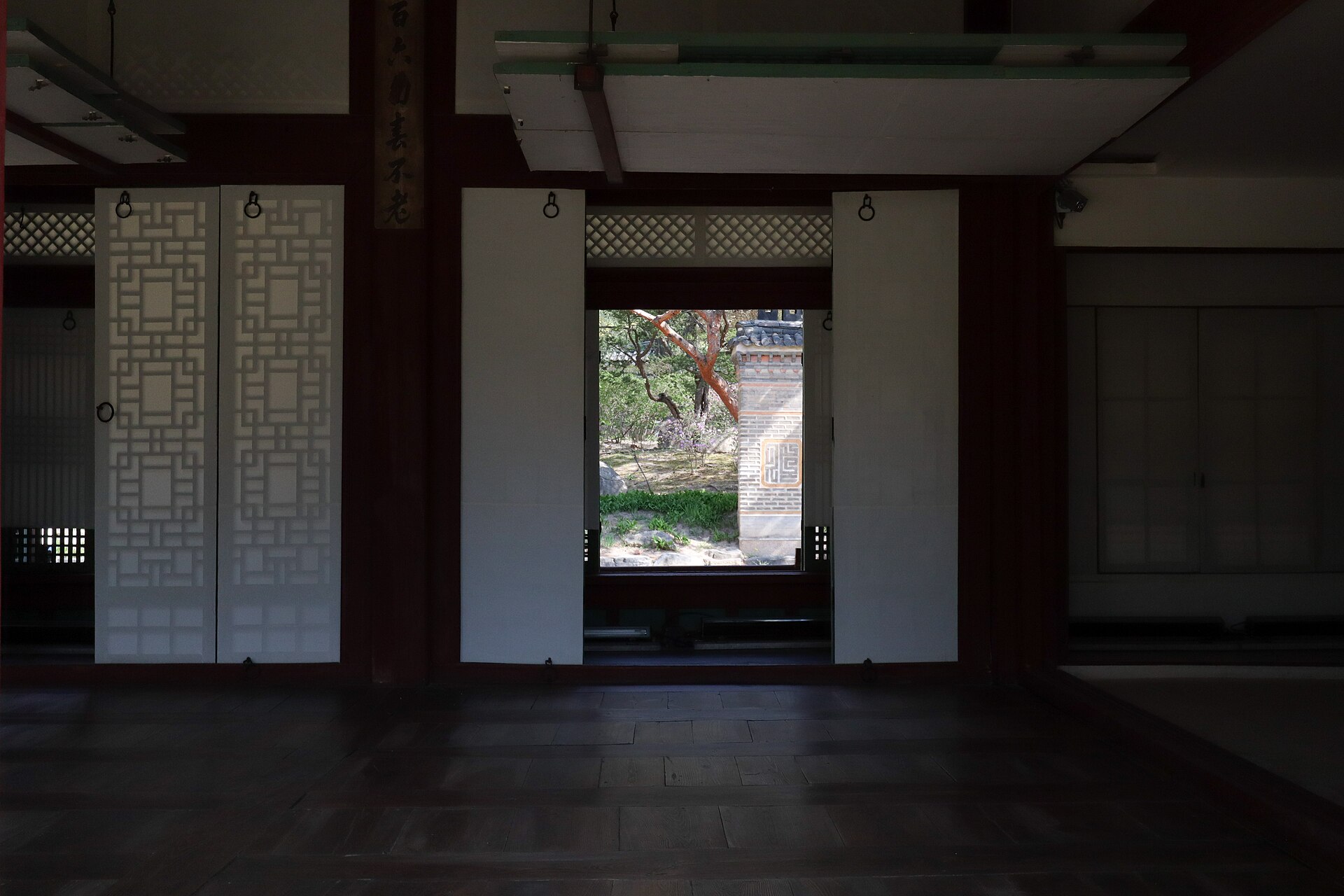
Wandering among these lesser buildings is one of the pleasures of a visit. Freed from the pressure of the great monuments, you can notice the small things: the patterns of a lattice window, the curve of a roof bracket, the way a courtyard frames a view of the city towers beyond. It is here, in the quieter corners, that the palace feels most like a place where people actually lived.
The hybrid buildings of the palace are, in miniature, the whole story of the Korean Empire. In them you can read the attempt to graft the new onto the old, to keep the warmth and beauty of Korean tradition while embracing the technologies and forms of a wider world. Sometimes the graft is graceful, sometimes awkward, but it is always sincere, and that sincerity is what gives these buildings their lasting appeal.
A Pavilion for a Cup of Coffee
Among the most charming buildings in the palace is a graceful pavilion built as a place where the emperor could relax, take in the grounds, and, famously, enjoy a cup of coffee. Coffee was one of the many novelties the emperor embraced, and the story of a Korean sovereign sipping it in a Western-influenced pavilion has become one of the best-loved anecdotes of the period.
The pavilion mixes Korean and Western decorative elements in a light, playful way, with delicate ironwork and ornament that speak of leisure rather than ceremony. It was a private space, a retreat from the pressures of an increasingly desperate reign, and it hints at the human being behind the imperial titles, a man drawn to the new and the foreign, seeking small pleasures in hard times.
Details like this rescue the palace from being merely a monument to politics. They remind us that history happened to individuals with tastes and habits, that the emperor who proclaimed a nation also liked his coffee, and that the sweep of great events was lived, day by day, in rooms and gardens by people not so different from ourselves.
The image of an emperor enjoying coffee in a garden pavilion has endured because it humanises a figure otherwise wrapped in the tragedy of his reign. It suggests curiosity, openness, and a certain quiet defiance, a determination to find and enjoy the good things of a changing world even as that world closed in. Small, personal details like these often outlast the grand political narratives around them.
The Changing of the Royal Guard
One of the most popular sights at Deoksugung today is the ceremonial changing of the royal guard, a colourful reenactment staged at the main gate. Performers in the bright costumes of the old palace guard, carrying flags, weapons, and instruments, march and take up their posts to the beat of drums, recreating a ritual that once marked the daily rhythm of the court.
The ceremony is carefully researched and staged, drawing on historical records of court costume and protocol to bring the vanished world of the palace guard back to life. For visitors it offers a vivid, accessible glimpse of royal pageantry, a splash of colour and sound against the grey backdrop of the modern city, and one of the most photographed spectacles in Seoul.
More than mere entertainment, the reenactment is part of a wider effort to keep Korea’s royal heritage present and alive in the capital. By staging these ceremonies at the palace gate, in full public view, the custodians of Deoksugung weave the memory of the court into the daily life of the city, so that even hurried passers-by are reminded of the history at the centre of their metropolis.
Watching the guards march at the gate, it is worth remembering that such ceremonies once served real functions, marking time, securing the palace, and displaying the power of the crown. The reenactment turns that vanished routine into shared public memory, letting each new generation of city-dwellers and visitors witness, however briefly, the vanished pageantry that once ordered the days of the Korean court.
Timing a visit to catch the guard ceremony is well worth the small effort, for it transforms the mood of the whole palace. The drums and the massed colour of the costumes draw a crowd, and for a few minutes the ordinary bustle of the plaza gives way to something older and more theatrical. It is one of those moments when heritage stops being a matter of buildings and becomes, briefly, a living performance.
Loss, Diminishment, and Survival
The bright hopes of the Korean Empire were not to last. Within little more than a decade of its founding, Korea lost its independence and fell under the rule of a neighbouring empire. The emperor was pressured to give up his throne, and the palace that had been the centre of a sovereign state was diminished, its grounds reduced and its buildings repurposed.
Under the ensuing decades of foreign rule and the later upheavals of war and division, Deoksugung suffered badly. Large parts of the original compound were lost, buildings were demolished or altered, and the palace that survives today is only a fragment of what once stood on the site. The stone palace and other buildings were pressed into uses far removed from their imperial purpose.
That the palace survives at all is itself a kind of triumph. Through occupation, war, and rapid modernisation, this island of history held on in the heart of a transforming city. The story of its diminishment is painful, but so is the story of its endurance, and both are essential to understanding what Deoksugung means to Koreans today.
The reuse of imperial buildings for foreign purposes during the years of occupation was its own kind of wound, a symbolic as well as physical diminishment of the palace and what it stood for. That later generations chose to restore rather than forget these buildings speaks to a determination to reclaim the story, to face the painful chapters honestly and to insist that this history belongs to Korea and to no one else.
The Stone-Wall Road and the Gardens
Running alongside the palace is one of the most famous streets in Seoul, the stone-wall road that follows the long outer wall of Deoksugung. Lined with trees that turn gold and crimson in autumn, it is a place for slow walks and quiet conversation, and it has woven itself deep into the romance and folklore of the city, celebrated in songs and stories.

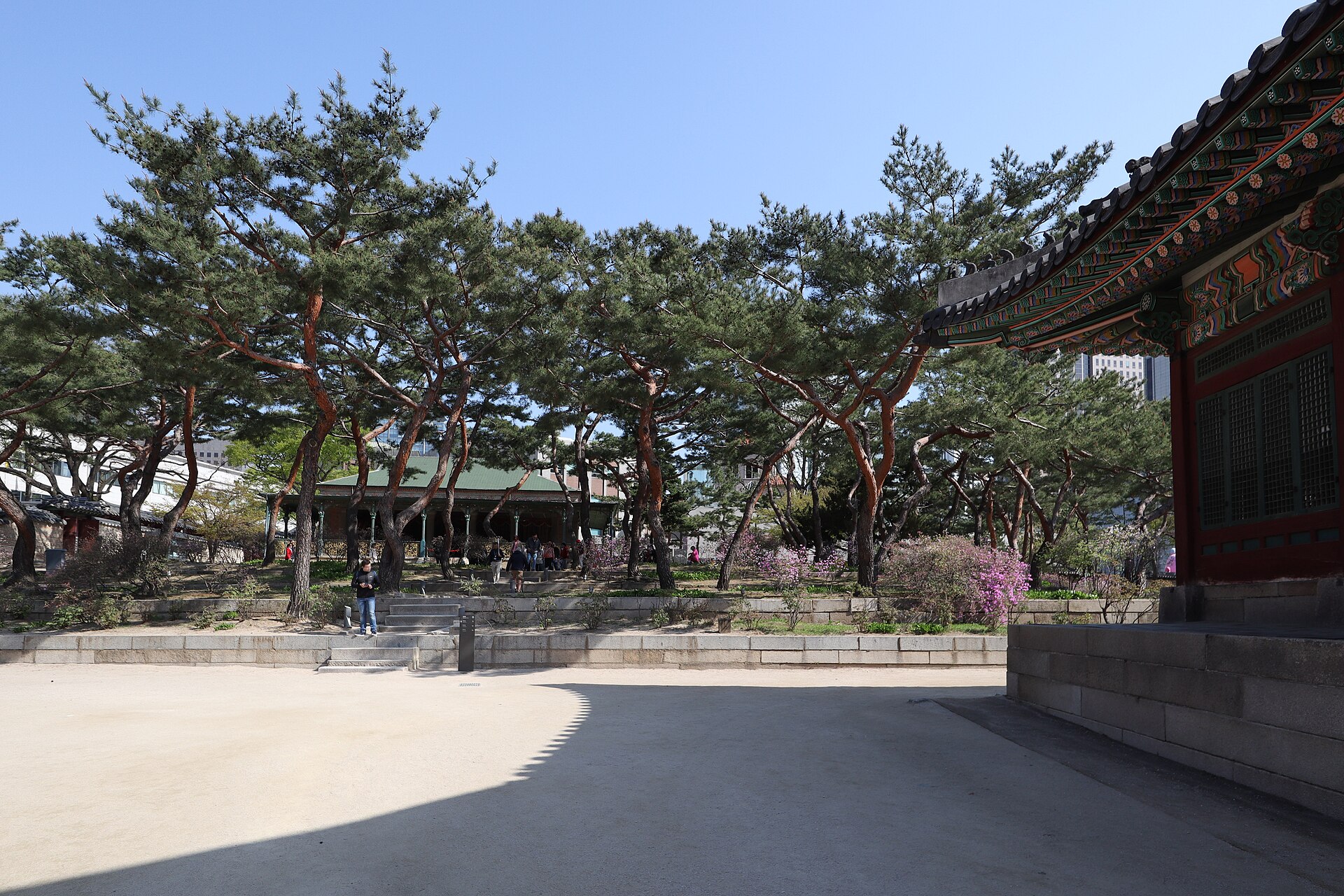
Within the walls, the palace grounds offer their own gentler pleasures. Gardens, lawns, and old trees soften the compound, and the juxtaposition of traditional halls with the neoclassical stone palace, seen across an open green, is one of the signature views of Seoul. In every season the palace takes on a different mood, from spring blossom to winter snow on the tiled roofs.
These outdoor spaces are a large part of why Deoksugung is so beloved. It is not just a set of buildings to be inspected but a place to spend time, to sit, to stroll, to watch the light change on stone and wood. In a dense and fast-moving city, the palace and its famous road provide a rare pocket of calm and beauty, open to all.
The affection Koreans feel for the stone-wall road shows how a place can become woven into the emotional life of a city. It is not grand or monumental, just a tree-lined lane beside an old wall, yet it carries a weight of memory and feeling out of all proportion to its size. In that quiet street the history of the palace passes from the textbooks into the everyday experience of ordinary people.
Seasonal change is part of the pleasure. In autumn the road blazes with colour, in spring it softens with blossom, and in winter a fall of snow on the palace roofs turns the whole scene monochrome and still. Regulars return again and again to see the same familiar view transformed, and this rhythm of the seasons binds the palace ever more tightly into the affections of the city.
Deoksugung in the Life of Modern Seoul
Today Deoksugung is one of the most visited and cherished sites in Seoul, a place where history, city life, and leisure meet. Its central location makes it easy to reach, and its combination of Korean and Western architecture, ceremonial reenactments, and beautiful grounds gives it an appeal quite different from the other palaces of the capital. It has become, in a sense, the city’s palace, folded into daily life rather than set apart from it.

The restored stone palace now houses a museum devoted to the imperial era, allowing visitors to step inside the dream of a modern Korea and see how its rulers hoped to remake the nation. Around it, the traditional halls preserve the older world of the Joseon court, so that a single visit spans centuries of Korean history and the dramatic collision between them.
For all it has suffered and lost, Deoksugung endures as a symbol of resilience. It speaks of a small nation’s determination to shape its own destiny, of ambitions that outran the times, and of the quiet persistence of beauty and memory in the heart of a great city. To stand in its grounds, with the towers of Seoul rising all around, is to feel the long, unbroken thread that ties modern Korea to its royal past.
In the end, what makes Deoksugung so moving is the way it holds contradiction without resolving it. Old and new, triumph and loss, Korean and foreign all stand side by side within its walls, refusing to be tidied into a single story. That refusal is honest, for the history it records was itself unresolved, and it is exactly what allows the palace to keep speaking, with such feeling, to everyone who walks its paths today.
For the visitor with limited time in Seoul, Deoksugung offers an unusually rich reward for a short walk. Few places let you traverse so much history, and such a dramatic historical turning point, in so compact a space. Whether you come for the architecture, the ceremony, the gardens, or simply a quiet hour in the middle of the city, the palace gives back more than its modest size would ever lead you to expect.
Palaces Nearby
Deoksugung is one of several royal palaces at the heart of Seoul, and it rewards those who go on to explore its neighbours. Two more of the capital’s palaces, each with its own distinct story, sit within easy reach and deepen the picture of Korea’s royal past.
- More Seoul palaces coming soon
You May Like
Changgyeonggung: The Gentle Garden Palace of Seoul


One thought on “Deoksugung: The Palace Where Old Korea Met the Modern World”