On the north coast of West Java, in the old port city of Cirebon, stands the oldest royal palace in the region, a place where the cultures of half of Asia meet. The Kraton Kasepuhan is the senior court of the sultanate of Cirebon, and its buildings and treasures blend Javanese, Sundanese, Chinese, Islamic, and European elements into a whole found nowhere else. Its walls are studded with blue and white porcelain, its courtyards guarded by statues of white tigers, and in its museum sits a fantastical royal carriage in the form of a winged, trunked, and clawed mythical beast.
The Kraton Kasepuhan is a palace of the coast, and its eclectic character reflects the role of Cirebon as a great trading port where the peoples and cultures of the archipelago and beyond came together. Founded in the fifteenth century, it is deeply associated with the coming of Islam to Java, and with one of the revered saints who spread the faith, giving the palace a sacred as well as a royal significance.
The palace is the seat of the sultans of Cirebon, and though the sultanate lost its political power long ago, the court endures as the guardian of a rich and unique culture. Its architecture, its treasures, its batik, and its ceremonies preserve the distinctive heritage of Cirebon, a meeting point of the great civilizations of Asia on the coast of Java.
This is the third palace of a group of Javanese and Indonesian royal courts in this series, joining the courts of Solo, and it completes a portrait of the classical culture of Java and its meeting with the wider world. To enter the Kraton Kasepuhan, with its porcelain walls and its white tigers and its winged carriage, is to encounter the extraordinary blended culture of the coast, where Java met Asia and the world.

In This Article
- The Palace of Blended Cultures
- Cirebon, the Meeting of Cultures
- Sunan Gunung Jati and the Coming of Islam
- The Founding of the Court
- The Courts of Cirebon
- An Eclectic Architecture
- The Siti Hinggil
- Walls of Porcelain
- The Great Mosque of Sang Cipta Rasa
- The Singa Barong Carriage
- The Batik of Cirebon
- The Treasures of the Court
- The Kraton Kasepuhan Today
The Palace of Blended Cultures
The Kraton Kasepuhan is the oldest and most senior of the royal palaces of Cirebon, a walled compound of courtyards, pavilions, and buildings in the heart of the old city. Its architecture and its treasures blend the traditions of Java, the Sundanese lands of West Java, China, Islam, and Europe into a unique and eclectic whole.
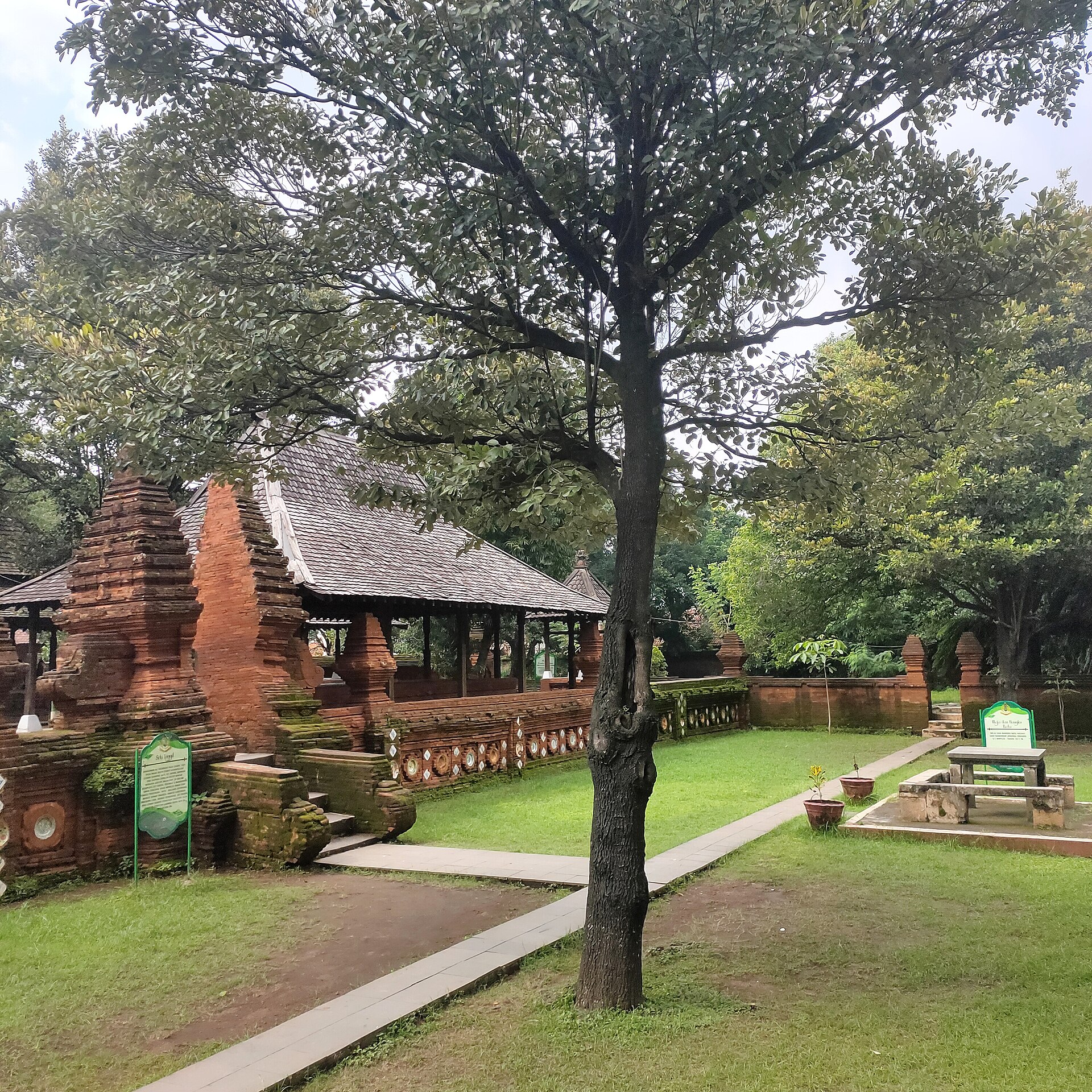
The palace is arranged around a sequence of courtyards and gates, in the manner of the Javanese court, but with its own distinctive character reflecting the culture of the coast. Its buildings combine the open pavilions of Java with elements drawn from the many cultures that met in the trading port of Cirebon.
The eclectic character of the palace is visible everywhere, in the blue and white porcelain tiles set into its walls, in the Chinese and European decorative elements, in the Islamic and Javanese forms, and in the statues that guard its courts. The palace is a museum of the meeting of cultures on the coast of Java.
Among the treasures of the palace is its famous royal carriage, a fantastical creation in the form of a mythical beast combining features of several animals, and its museums preserve the heirlooms and history of the court. The palace also contains one of the great mosques of Cirebon, reflecting its sacred significance.
For the visitor, the Kraton Kasepuhan offers an encounter with the unique culture of Cirebon, a blend of the traditions of half of Asia. As the oldest and senior court of the city, it preserves the heritage of a great trading port and a center of the coming of Islam to Java, a meeting point of civilizations.
Among the Javanese courts gathered in this series, the Kraton Kasepuhan stands out for the sheer variety of the cultures it draws together, for where the courts of Solo cultivated a refined and inward Javanese classicism, the palace of Cirebon flung its doors open to the world. Chinese porcelain, Dutch tiles, Indian and Middle Eastern symbolism, Islamic faith, and Javanese and Sundanese tradition all meet in its courts, making it perhaps the most cosmopolitan of all the royal palaces of Java.
Cirebon, the Meeting of Cultures
To understand the palace is to understand Cirebon, a port city on the north coast of Java at the meeting point of the Javanese and Sundanese cultural worlds, and a great center of trade. Its position made it a crossroads where the peoples and cultures of the archipelago and the wider world came together.
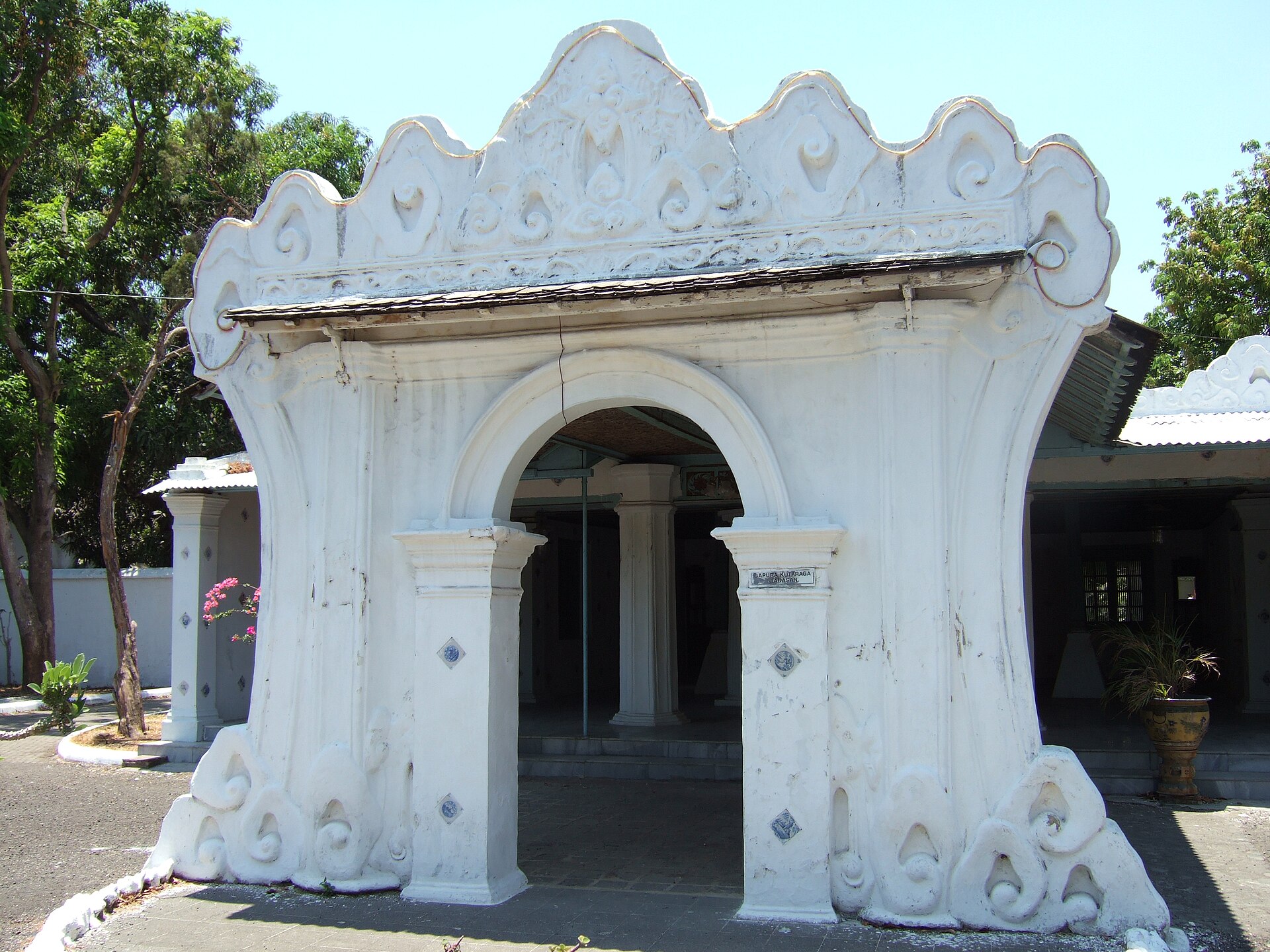
Cirebon was a significant trading port, drawing merchants and ideas from across the region and beyond, from the Javanese heartland, from the Sundanese lands of West Java, from China, from the Islamic world, and, in time, from Europe. This confluence of cultures shaped the distinctive character of the city and its court.
The city stood at the boundary between the Javanese and Sundanese worlds, and its culture blended elements of both, along with the influences that came through trade. This position gave Cirebon a distinctive identity, neither wholly Javanese nor wholly Sundanese, but a unique meeting of the two and of the wider world.
As a trading port and a meeting of cultures, Cirebon became a center for the spread of Islam in Java, its position on the trade routes bringing it into contact with the Muslim merchants and teachers who carried the faith. The city played a key role in the Islamization of Java.
The Kraton Kasepuhan reflects this world of Cirebon, its eclectic culture drawn from the many peoples who met in the port. The palace is the crown of a city that was a crossroads of Asia, and its blended character is the character of Cirebon itself, a meeting point of civilizations on the coast of Java.
The position of Cirebon at the meeting point of the Javanese and Sundanese worlds is worth dwelling on, for it made the city a cultural frontier as well as a trading port. Here two of the great peoples of Java met and mingled, and to them were added the merchants and ideas that came by sea from China, India, Arabia, and eventually Europe. The Kraton Kasepuhan is the crown of this meeting, and its blended culture could have arisen nowhere but in such a crossroads.
Sunan Gunung Jati and the Coming of Islam
The Kraton Kasepuhan is deeply associated with the coming of Islam to Java, and above all with Sunan Gunung Jati, one of the revered saints known as the Wali Songo, the nine holy men credited with spreading the faith across the island. Cirebon was one of the centers of this great religious transformation.

The Wali Songo, the nine saints, are honored in Javanese tradition as the men who brought Islam to the island and established it among its people, and Sunan Gunung Jati was among the most important of them. He is associated with Cirebon and with the founding of its sultanate, giving the court a sacred significance.
Sunan Gunung Jati is revered as both a religious teacher and a ruler, a saint who helped to establish Islam in West Java and who was connected to the ruling house of Cirebon. His tomb near the city is a major place of pilgrimage, and his memory is central to the identity of the Kraton and the sultanate.
The association of the palace with the coming of Islam gives it a religious dimension beyond its role as a royal seat, for Cirebon was a center from which the faith spread across Java. The Kraton Kasepuhan is thus a monument to a great turning point in the history of the island, the establishment of Islam.
The memory of Sunan Gunung Jati and the Wali Songo remains central to the culture of the Kraton Kasepuhan, connecting the court to the sacred history of the coming of Islam to Java. The palace is not only a royal residence but a monument to the religious transformation of the island, a place of deep spiritual significance.
The role of Cirebon in the coming of Islam to Java gives the Kraton Kasepuhan a significance that goes far beyond its walls, for the peaceful spread of the faith across the island, carried by saints and traders rather than conquering armies, is one of the great stories of Southeast Asian history. That Islam was adapted so thoroughly to Javanese culture, as the tiered roofs of the great mosque show, is part of what makes the religious heritage of Cirebon so distinctive and so fascinating.
The Founding of the Court
The Kraton Kasepuhan traces its origins to the fifteenth century, making it the oldest of the royal palaces of Cirebon and one of the oldest in Java. It was founded by a prince of the ruling house, and it grew over the centuries into the senior court of the sultanate of Cirebon.

The founding of the palace is connected to the early rulers of Cirebon and to the establishment of the sultanate as an independent Islamic state on the coast. The court became the seat of the sultans and the center of the political and cultural life of the city.
Over the centuries the palace was expanded and enriched, and its buildings and treasures accumulated the eclectic character that reflects the culture of Cirebon. Successive sultans added to the court, and it developed into the complex of courtyards, pavilions, and treasures that survives today.
The name Kasepuhan means, roughly, the elder or senior, reflecting the palace’s status as the oldest and most senior of the royal courts of Cirebon. In later centuries the sultanate divided, creating several royal courts in the city, but the Kasepuhan remained the senior among them.
The founding and growth of the Kraton Kasepuhan over the centuries made it the great monument of the sultanate of Cirebon, the senior court of a city that was a crossroads of Asia. Its long history, reaching back to the fifteenth century, gives it a special place among the royal palaces of Java.
What makes the founding story compelling is how deliberately it wove together spiritual authority and worldly power. The early rulers of Cirebon were not simply kings; they presented themselves as guardians of a faith that was still taking root along the northern coast, and the palace they raised was meant to embody that dual role. You can sense it in the way later generations retold the tale, folding miracles and pilgrimages into a narrative that justified the dynasty’s place at the meeting point of trade routes, religious currents, and older Sundanese tradition.
The Courts of Cirebon
The sultanate of Cirebon, like the kingdom of Mataram in central Java, divided over the centuries into several royal houses, each with its own palace, so that the city came to have more than one kraton. The Kraton Kasepuhan is the oldest and most senior of these, the elder among the courts of Cirebon.

The division of the sultanate created the several royal courts of the city, including the Kasepuhan, the senior court, and others such as the Kanoman and further houses. Each maintained its own palace and its own traditions, so that Cirebon, like Solo, became a city of multiple royal courts.
The multiplication of courts reflected the divisions within the ruling house and the settlements that resolved them, a pattern common in the history of the Javanese monarchies. Yet the courts of Cirebon shared the common heritage of the sultanate and the distinctive culture of the city.
Among these courts, the Kraton Kasepuhan held the senior position as the oldest, the original seat of the sultanate from which the others descended. Its status as the elder court gave it a special place in the ceremonial and cultural life of the city.
The courts of Cirebon together preserve the unique heritage of the city, its eclectic culture and its role as a center of the coming of Islam. The Kraton Kasepuhan, as the senior among them, is the great monument of this heritage, the elder court of a city that was a crossroads of Asia.
The split that eventually divided Cirebon’s court into separate keratons was not a sign of collapse so much as a reflection of how inheritance worked among ruling families whose legitimacy rested on descent. When you walk the grounds today it helps to remember that Kasepuhan claimed seniority, styling itself the elder house, and that this claim shaped everything from ceremonial precedence to the way heirlooms were divided. The rivalry was real, yet the shared ancestry meant the courts remained bound to one another by blood and ritual even as they governed distinct establishments.
An Eclectic Architecture
The architecture of the Kraton Kasepuhan is one of its great fascinations, an eclectic blend of the many traditions that met in Cirebon. Javanese, Sundanese, Chinese, Islamic, and European elements combine in the buildings and decoration of the palace, creating a whole found nowhere else.
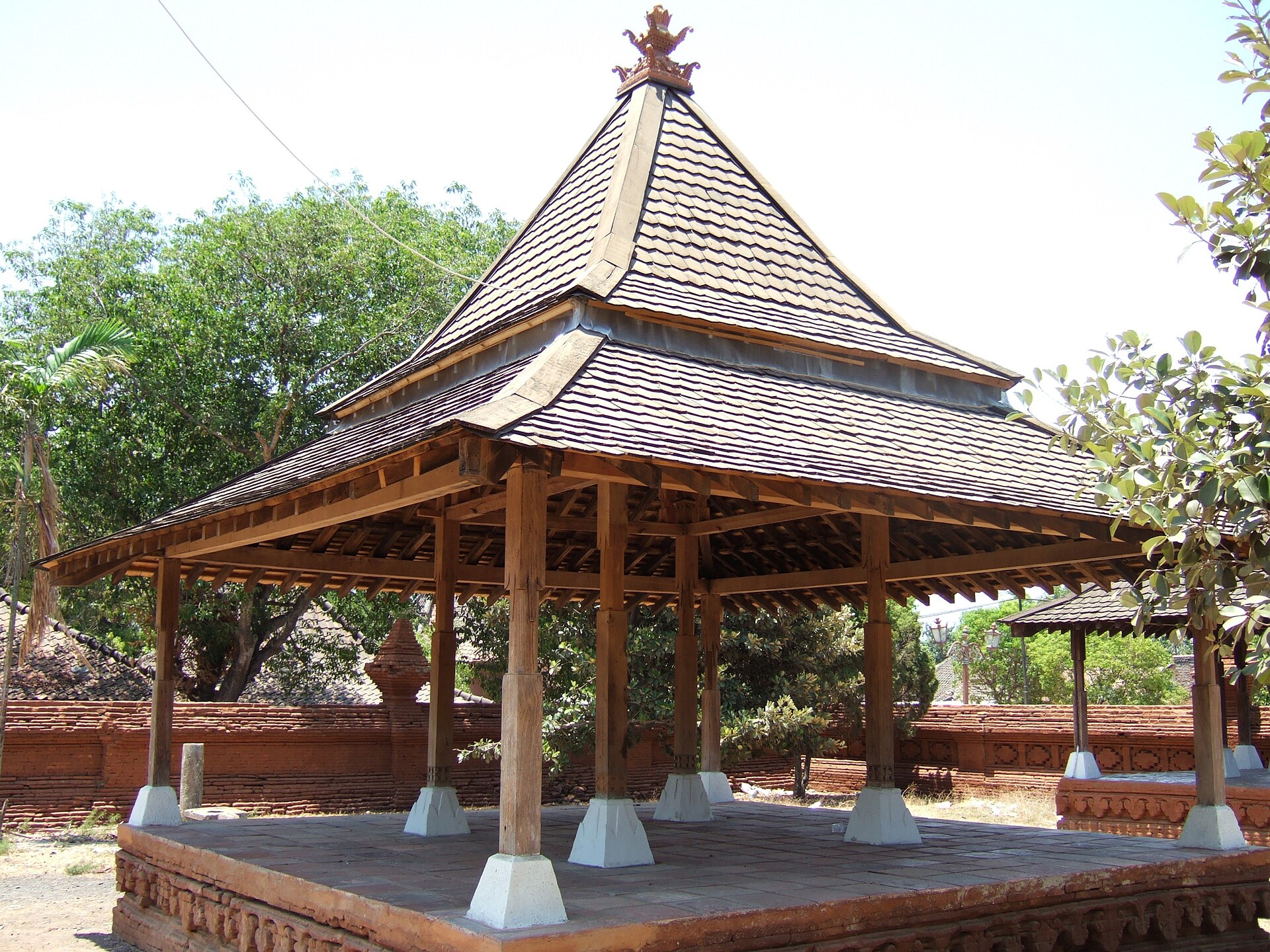
The palace combines the open pavilions of the Javanese court with red brick construction, carved ornament, and decorative elements drawn from many sources. The layout follows the Javanese pattern of courtyards and gates, but the details reflect the eclectic culture of the coast.
Among the most striking decorative elements are the blue and white porcelain tiles set into the walls of the palace, some of them Chinese and some European, including Dutch tiles depicting biblical and other scenes. These tiles, embedded in the brick, are a vivid emblem of the meeting of cultures in Cirebon.
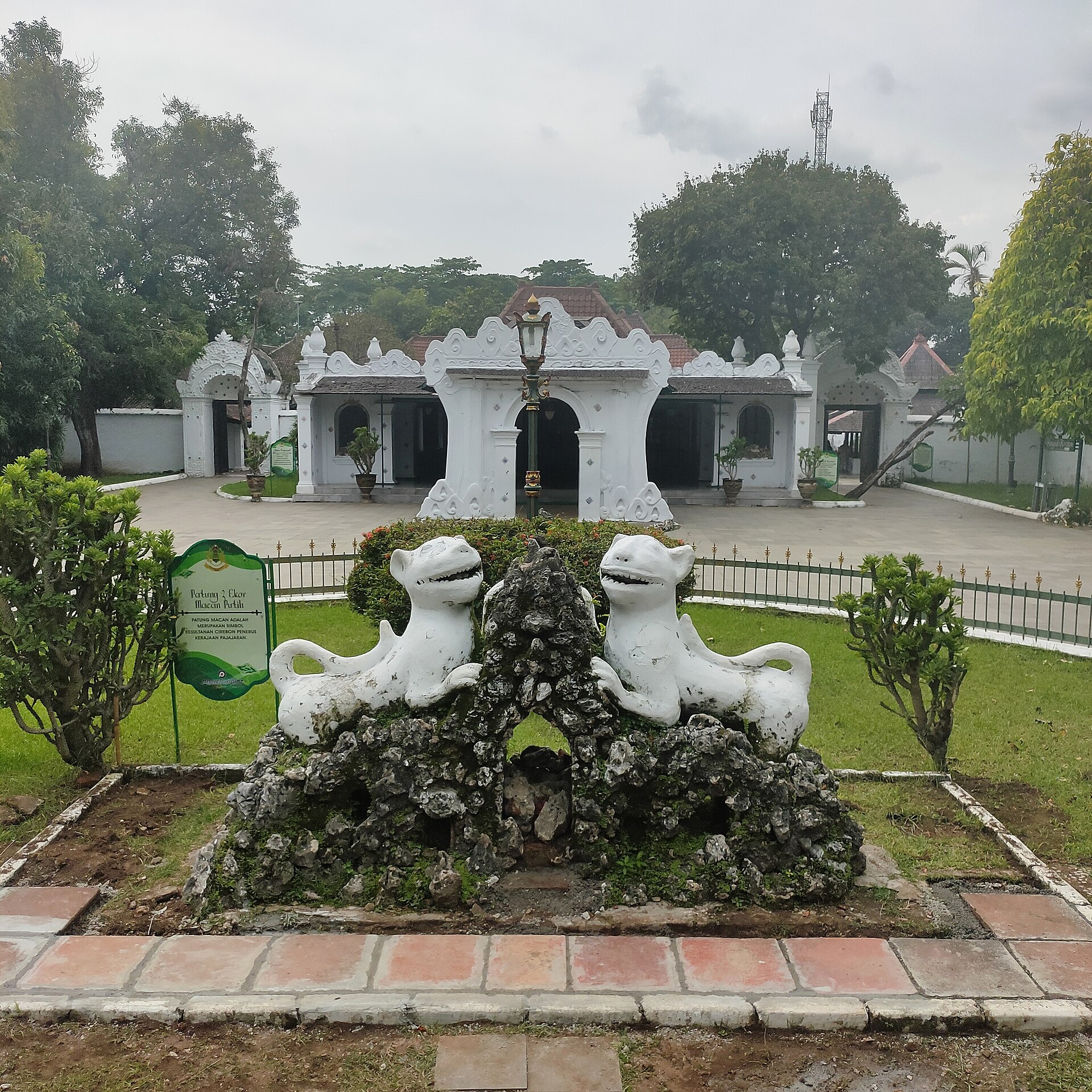
The palace is guarded by statues, including the famous white tigers that stand in its courts, symbols associated with the Sundanese royal house of Pajajaran from which the rulers of Cirebon claimed descent. These and other decorative elements express the blended heritage of the court.
The eclectic architecture of the Kraton Kasepuhan, combining the traditions of half of Asia, is the physical expression of the culture of Cirebon. Its porcelain walls, its statues, its blend of forms, make the palace a unique monument, a meeting of civilizations built in brick and tile on the coast of Java.
Look closely and you begin to notice how little of the palace insists on a single style. A brick gateway borrowed from an older Javanese vocabulary might stand a few steps from a pavilion whose proportions feel almost Chinese, and neither seems out of place. That refusal to choose is itself the statement. The builders were confident enough in their own tradition to absorb whatever arrived by sea, and the result is a compound that reads like a slow conversation between cultures rather than a monument to any one of them.
The Siti Hinggil
The approach to the palace passes through the Siti Hinggil, a raised ceremonial complex at the front of the compound where the sultan appeared before his people and where great ceremonies were held. Its name means, roughly, the high ground, referring to the raised platform on which it stands.
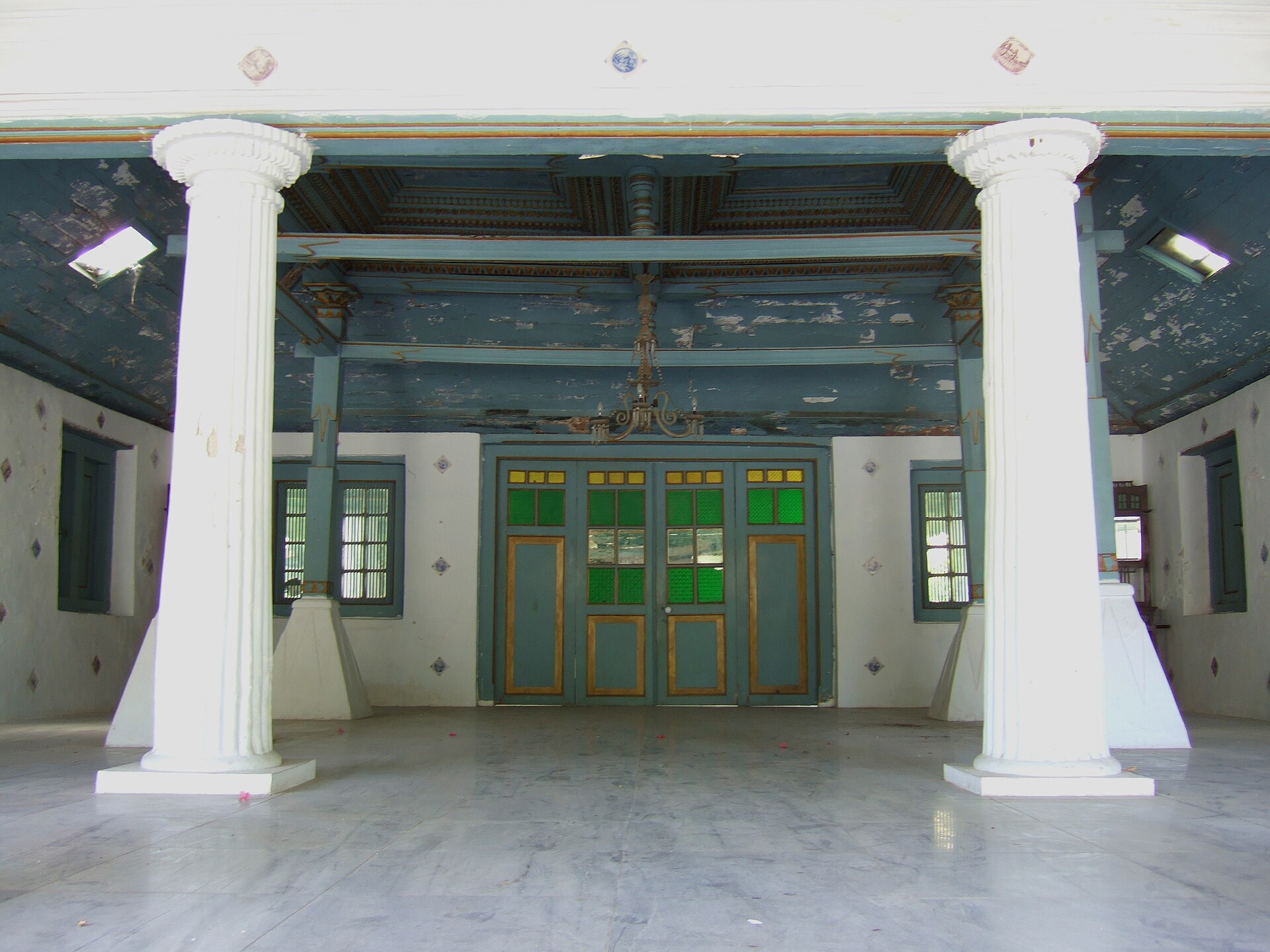
The Siti Hinggil is a group of pavilions on a raised terrace, built of red brick and decorated with the eclectic ornament of the court, including porcelain tiles. It was the public and ceremonial front of the palace, the place where the ruler met the world beyond the inner courts.
The pavilions of the Siti Hinggil served for the ceremonies in which the sultan appeared before his court and people, and for the assembly of officials on great occasions. Its raised position and its decoration expressed the majesty of the sultanate and marked the threshold of the royal precinct.
The red brick construction and the porcelain decoration of the Siti Hinggil are characteristic of the eclectic architecture of Cirebon, blending Javanese, Islamic, and imported elements. The complex is among the most distinctive features of the palace, a striking example of its unique style.
For the visitor, the Siti Hinggil provides the grand approach to the Kraton Kasepuhan, the ceremonial front of the palace. From here the compound unfolds inward through gates and courts to the inner buildings, in the manner of the Javanese court adapted to the culture of the coast.
Walls of Porcelain
One of the most distinctive features of the Kraton Kasepuhan is the porcelain that decorates its walls, blue and white tiles and plates set into the brick, some of Chinese origin and some European, including Dutch tiles. These porcelain decorations are a vivid emblem of the meeting of cultures in Cirebon.
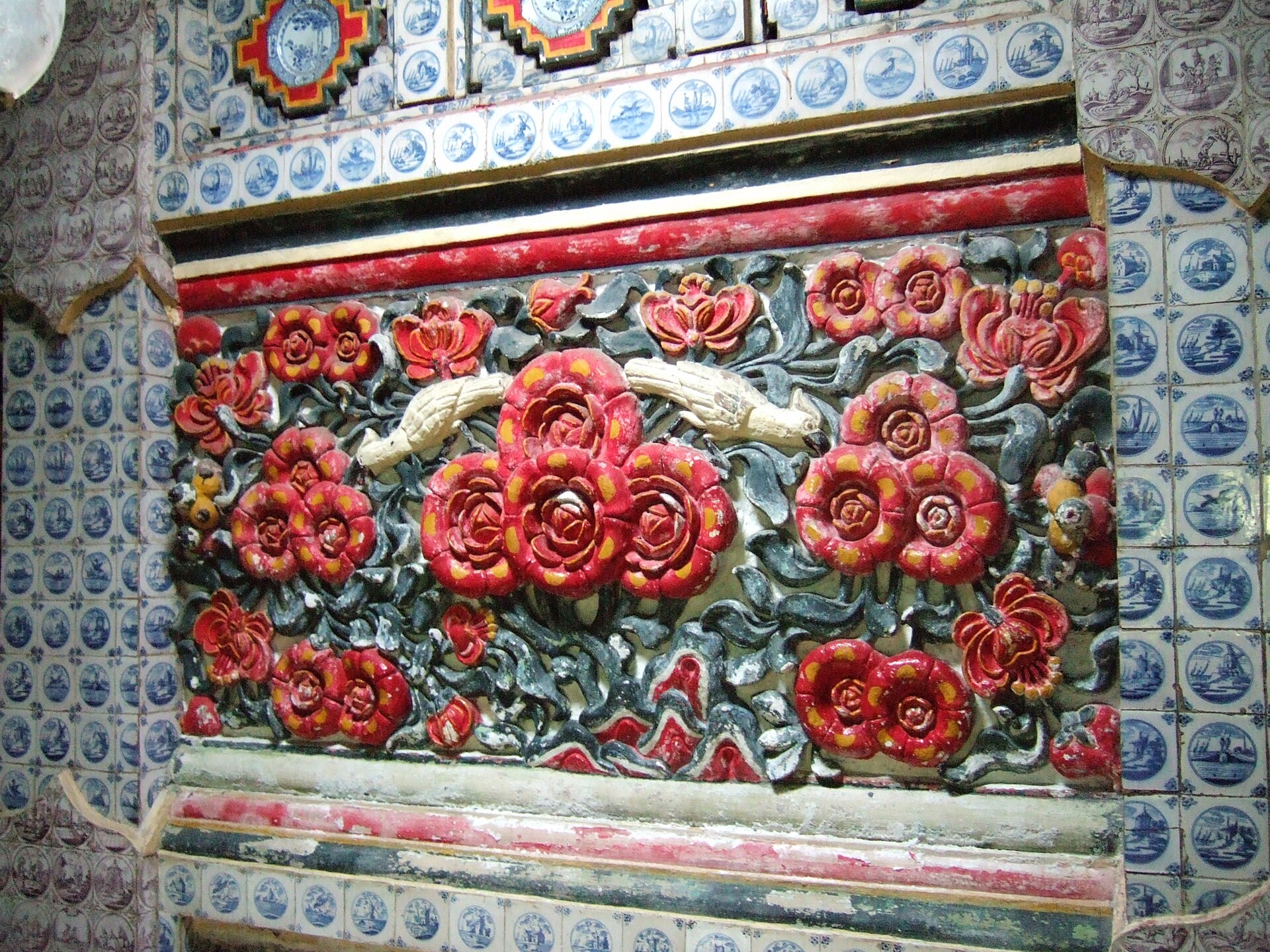
The tiles include Dutch delftware depicting biblical scenes and other subjects, set into the walls of the palace alongside Chinese porcelain, an extraordinary juxtaposition of European Christian imagery within an Islamic Javanese court. This blending reflects the cosmopolitan world of the trading port.
The porcelain came to Cirebon through trade, brought by the merchants who made the port a crossroads of the archipelago and the wider world. Its incorporation into the fabric of the palace was a way of displaying the wealth and the wide connections of the court, and of adorning the buildings with precious imported goods.
The blue and white porcelain, set against the red brick of the walls, creates a striking decorative effect, unique to the palaces of Cirebon. It is one of the most memorable features of the Kraton Kasepuhan, a visible record of the trade and the cultural exchange that shaped the court.
The porcelain walls of the Kraton Kasepuhan embody the eclectic culture of Cirebon, the meeting of China, Europe, Islam, and Java in a single decorative scheme. They are among the treasures of the palace, a vivid and beautiful expression of the confluence of cultures that gave the court its distinctive character.
The tiles reward patience. Stand in front of a wall long enough and you start to pick out individual scenes, each one a small window into a story that a seventeenth-century courtier would have recognised at a glance. Some carry biblical episodes, others show ships or animals, and together they turn a plain surface into something closer to an illustrated manuscript fixed to stone. For the sultans who commissioned them, the tiles were a quiet form of display, a way of signalling that Cirebon’s harbour reached far enough to bring the world’s imagery to its walls.
The Great Mosque of Sang Cipta Rasa
Near the palace stands one of the great mosques of Cirebon and of Java, the Masjid Sang Cipta Rasa, associated with the coming of Islam to the region and with Sunan Gunung Jati. One of the oldest mosques in Java, it is a monument to the religious significance of Cirebon.

The mosque is built in the traditional Javanese style, with a great tiered roof of the meru type rising in layers, quite different from the domed mosques of other Islamic lands. This distinctive Javanese mosque architecture reflects the way Islam was adapted to the culture of the island.
The mosque is associated with the Wali Songo and with the establishment of Islam in Cirebon, and its construction is connected in tradition to Sunan Gunung Jati and the saints who spread the faith. It remains an active place of worship and a monument to the Islamization of Java.
The tiered roof, the carved woodwork, and the traditional forms of the mosque express the Javanese adaptation of Islamic architecture, a style found across the island. The mosque is one of the finest examples of this tradition and a monument of great historical and religious importance.
For the visitor, the Great Mosque near the Kraton Kasepuhan is an essential part of the palace complex and its culture, a monument to the coming of Islam and to the sacred significance of Cirebon. Its distinctive Javanese form and its historical associations make it one of the treasures of the city.
The Singa Barong Carriage
Among the great treasures of the Kraton Kasepuhan is its famous royal carriage, the Singa Barong, a fantastical creation that embodies the blended culture of Cirebon in a single object. The carriage takes the form of a mythical beast combining features of several animals, a masterpiece of symbolic art.

The Singa Barong combines the features of three creatures, an elephant with its trunk, a dragon, and a mythical lion or bird, each drawn from a different cultural tradition. The elephant is associated with India, the dragon with China, and the mythical beast with the Middle East, so that the carriage unites the great civilizations that met in Cirebon.
The carriage was used for royal ceremonies and processions, drawing the sultan through the city on great occasions, and it was designed with ingenious features, including a movable trunk and wings. It is a work of both art and craft, embodying the wealth and the eclectic culture of the court.
The symbolism of the Singa Barong, uniting the animals and the cultures of India, China, and the Middle East, expresses the character of Cirebon as a meeting point of civilizations. The carriage is a statement in art of the cosmopolitan identity of the sultanate and its court.
The Singa Barong carriage, preserved in the palace, is one of the most remarkable treasures of the Kraton Kasepuhan and one of the most famous objects of Javanese royal culture. It embodies, in a single fantastical creation, the blended heritage of Cirebon, a meeting of the great cultures of Asia.
The chariot’s power comes from how many meanings it holds at once. Its trunk-like snout, its winged body, and its clawed feet each point to a different creature and a different tradition, and the whole thing was designed to be read as a deliberate fusion rather than a muddle. When it was paraded on ceremonial days it announced, without a word, that the ruler who owned it commanded a realm where Indian, Chinese, and local symbols could be gathered into a single triumphant form. Few objects in the palace carry that message so vividly.
The Batik of Cirebon
Cirebon is famous for its distinctive style of batik, the traditional wax-resist textile art of Java, and the court was a center of this craft. The batik of Cirebon has its own characteristic motifs and styles, reflecting the eclectic culture of the city and its court.
The most famous of the Cirebon batik motifs is the megamendung, the cloud pattern, a design of stylized clouds in graduated colors that is unique to the region and reflects Chinese influence. The megamendung is one of the most recognizable and beloved of all Javanese batik designs.
The batik of Cirebon, with its cloud motifs and its other distinctive patterns, reflects the blend of Javanese, Chinese, and other influences that characterizes the culture of the city. The court patronized the craft, and its designs are associated with the traditions of the palace.
Batik was both an art and a marker of status and identity in Javanese culture, and the distinctive batik of Cirebon expressed the particular identity of the city and its court. The craft flourished under the patronage of the sultans and remains a living tradition of the region.
For the visitor, the batik of Cirebon is one of the cultural treasures associated with the Kraton Kasepuhan, a living craft that expresses the eclectic heritage of the court. The megamendung cloud motif, born of the meeting of cultures in Cirebon, is among the great designs of Javanese art.
What sets the court’s textiles apart is the restraint behind their richness. The palette leans on deep indigos and warm browns pulled from natural dyes, and the motifs, however elaborate, follow rules that were understood as belonging to the keraton alone. Certain patterns were reserved, worn only by those close to the ruler, so a length of cloth could function almost like a badge of rank. That quiet code still lingers in Cirebon’s workshops, where weavers and dyers trace their craft back to the palace that first set its standards.
The Treasures of the Court
The Kraton Kasepuhan preserves its treasures and heirlooms in museums within the palace, displaying the regalia, weapons, art, and objects of the court and illuminating its history and culture. The collections include the famous Singa Barong carriage and many other treasures.
Among the treasures are the ceremonial weapons, including the sacred kris daggers, the royal regalia, the heirlooms of the sultanate, and objects reflecting the eclectic culture of the court. The collection is a rich record of the material heritage of Cirebon.
The museums also preserve the history of the sultanate and its rulers, through portraits, documents, and objects associated with the sultans of Cirebon. They tell the story of the court from its founding to the present day, and of its role in the history of Java.
The treasures reflect the wealth and the eclectic culture of the court, drawn from the many traditions that met in Cirebon. Each object carries the heritage of the sultanate, and together they make the palace a treasury of the culture of the coast.
For the visitor, the museums of the Kraton Kasepuhan provide a deeper understanding of the culture and history of Cirebon, their treasures illuminating the traditions of the court. Together with the buildings and the living culture of the palace, they make the Kraton a place to encounter the unique heritage of the city.
Spend time in the display rooms and the palace stops feeling like a stage set and starts feeling like a living archive. Weapons, carriages, gamelan instruments, and manuscripts sit alongside one another, and each object carries a caption that ties it to a particular reign or ceremony. The effect is cumulative. By the time you leave you have absorbed not a list of facts but a sense of how the court actually used these things, how a kris was more than a blade and a set of instruments more than music, and how carefully the family has worked to keep that knowledge intact.
The Kraton Kasepuhan Today
Today the Kraton Kasepuhan remains the seat of the sultans of Cirebon and a living center of the culture of the city. Though the sultanate lost its political power long ago, the court endures as the guardian of the unique heritage of Cirebon, its buildings, treasures, and traditions preserved and displayed.
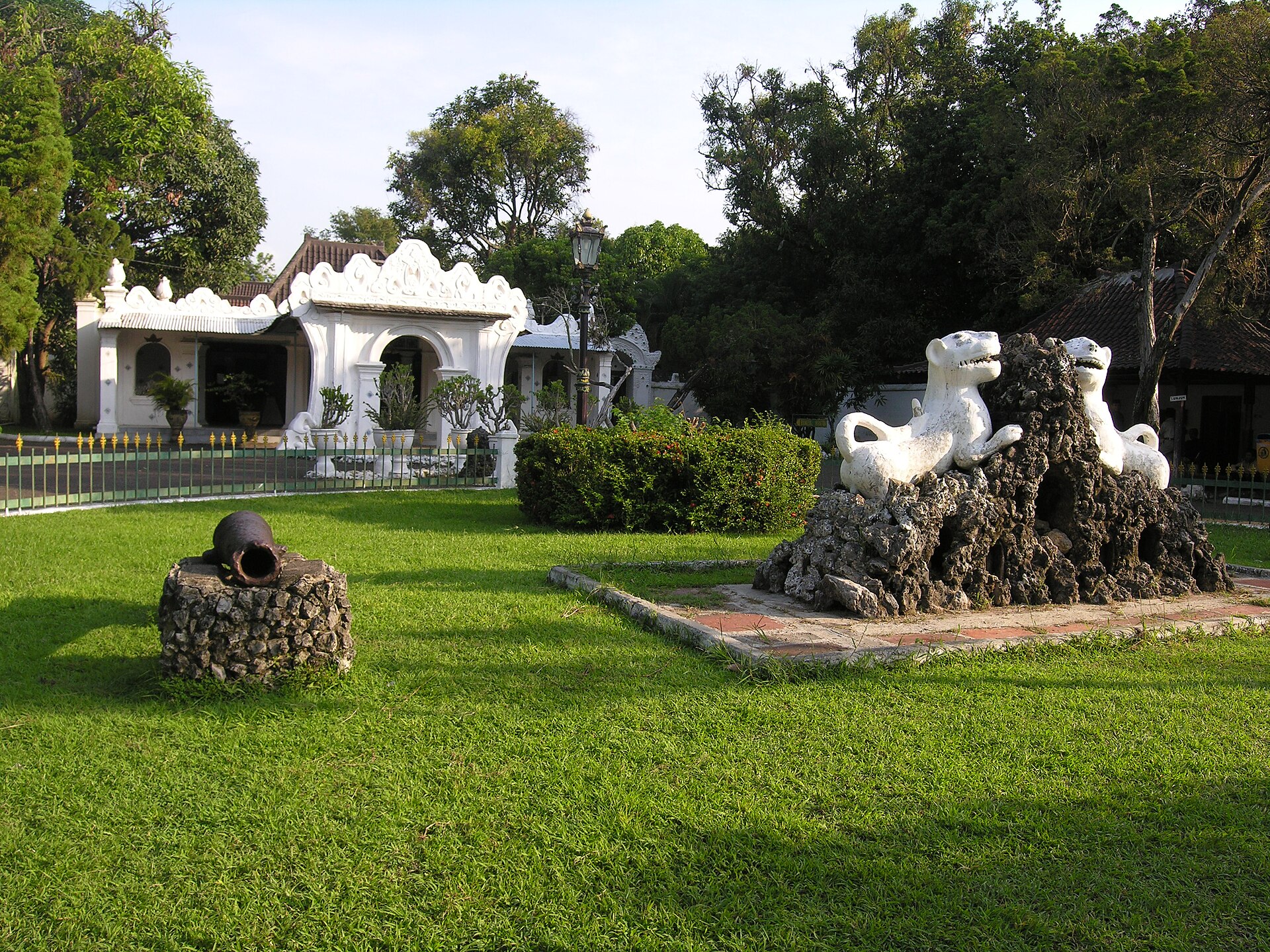
The palace is open to visitors, who come to see its eclectic architecture, its porcelain walls and white tigers, its famous carriage, and its treasures. It continues to observe the ceremonies and traditions of the court, and it remains a center of the culture and identity of Cirebon.
The Kraton Kasepuhan is one of several royal courts in Cirebon, for the sultanate divided over the centuries into separate houses, but it remains the oldest and most senior. Together the courts of Cirebon preserve the distinctive heritage of the city, a crossroads of the cultures of Asia.
For the people of Cirebon and of Java, the Kraton Kasepuhan is a cherished symbol of their heritage, the senior court of a great trading city and a center of the coming of Islam to Java. It stands as a monument to the meeting of civilizations on the coast of the island.
To enter the Kraton Kasepuhan, with its walls of porcelain and its statues of white tigers, to see the winged carriage and the great mosque, is to encounter the extraordinary blended culture of Cirebon. The sultanate is old and its power long gone, but its senior court endures, a meeting of the great cultures of Asia preserved on the coast of Java.
The survival of the Kraton Kasepuhan, and of the other courts of Cirebon, into the modern age is a quiet triumph of cultural persistence, for these palaces preserve a heritage found nowhere else. To wander the porcelain-studded courts, past the white tigers and the winged carriage, is to be reminded that the culture of Java was never a closed or isolated thing but a living tradition that absorbed and transformed the influences of half the world, and nowhere is that truth more vivid than here on the coast of Cirebon.
Palaces Nearby
If you are tracing the royal courts of Java, two more palaces make natural companions to Kasepuhan. Each holds its own version of the Mataram legacy, and together they map the island’s courtly world from the coast to the interior.
- Kraton Surakarta – the senior Mataram court in Central Java, with its blue tower and grand ceremonial pavilions.
- Pura Mangkunegaran – the elegant princely residence of Surakarta, famed for its vast pendopo and gamelan.
You May Like
Changgyeonggung: The Gentle Garden Palace of Seoul


2 thoughts on “Keraton Kasepuhan: The Oldest Royal Palace of Cirebon”